
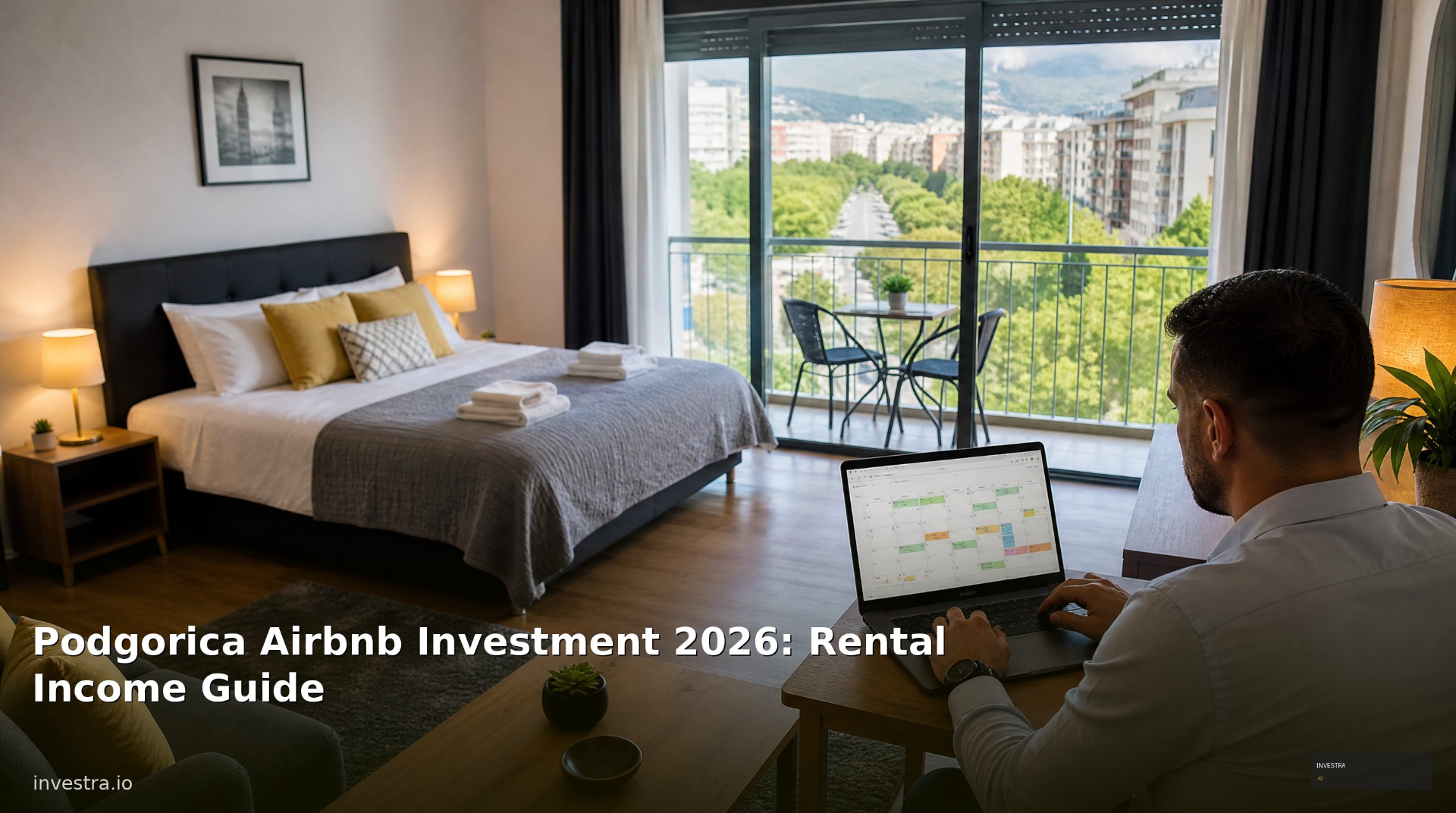
Podgorica Airbnb Investment 2026: Rental Income Guide
Podgorica Airbnb Investment 2026: Why Montenegro's Capital Is Turning Heads
Quick Answer: Podgorica has emerged as one of the Balkans' most compelling short-term rental markets in 2026, offering Airbnb gross yields between 6% and 11% depending on location and property type, with entry-level investment properties starting from €80,000. Investra.io tracks emerging Balkan markets to help investors spot opportunities before they peak.
There's a moment when a market stops being a secret. For Podgorica, that moment is arguably right now. Montenegro's capital has spent years in the shadow of the country's glamorous Adriatic coastline — Budva, Kotor, Tivat — while quietly building the infrastructure, demographic profile, and investment fundamentals that make for a serious short-term rental market.
What changed? A combination of factors converged around 2023–2025: Montenegro's formal EU accession negotiations gained real momentum, international flight connectivity expanded, digital nomad communities took notice of the city's affordable cost of living, and a new wave of regional tourism began treating Podgorica as a genuine destination rather than just a transit point. The result is a rental market that savvy investors are watching very closely heading into 2026.
This isn't about chasing hype. The numbers are genuinely interesting. Average Airbnb occupancy rates in Podgorica's central neighborhoods have climbed from around 48% in 2021 to an estimated 62–68% in 2025, according to aggregated short-term rental analytics platforms. That's a meaningful shift. And unlike coastal Montenegro — where properties can cost €3,000–€6,000 per square meter and seasonal windows are narrow — Podgorica offers a 12-month rental demand cycle driven by business travelers, EU institutions, NGO workers, and an increasingly mobile tourist base.
For investors looking beyond overpriced Western European markets, or those exploring the broader Balkan opportunity (we've covered emerging value plays across the region, from Aleksinac Real Estate Market 2026 Southern Serbia Propert... to Loznica Real Estate Market 2026 Macva Region Property Guide), Podgorica deserves serious attention. This guide breaks down exactly what an Airbnb investment in Montenegro's capital looks like in 2026 — from property acquisition costs and legal process to realistic income projections, tax obligations, and neighborhood-by-neighborhood analysis.
Understanding Podgorica's Real Estate Market: Prices, Trends, and Value Zones
Quick Answer: Podgorica property prices in 2026 range from approximately €900/m² in outer residential districts to €2,500/m² in premium new-build central locations, making it significantly more affordable than coastal Montenegro and offering strong capital appreciation potential alongside Airbnb income.
Let's start with the numbers that actually matter. Podgorica's real estate market has undergone a genuine transformation over the past four years. Average prices citywide sat around €1,100–€1,200/m² in 2021. By late 2025, that figure had risen to approximately €1,400–€1,700/m² for quality residential stock, with premium new-build projects in Stari Grad (Old Town) and the City Kvart development commanding €2,000–€2,500/m². That's roughly 25–40% appreciation in four years — not explosive by some emerging market standards, but steady and underpinned by genuine demand rather than speculative froth.
The most investor-relevant price zones break down as follows. The central Stari Grad and Nova Varoš areas — where Airbnb demand is strongest — sit at €1,500–€2,200/m² for renovated or new stock. Mid-ring neighborhoods like Blok 5, Blok 6, and the area around the Delta City shopping complex range from €1,200–€1,600/m². Outer residential suburbs and the Zabjelo/Konik corridor remain accessible at €900–€1,100/m², though short-term rental demand here is considerably weaker.
What's driving these increases? Three forces are working in concert. First, domestic demand from Montenegro's growing middle class and diaspora returnees. Second, foreign buyers — increasingly from Russia, Turkey, Ukraine, and Western Europe — who have discovered Montenegro's liberal property ownership rules for non-EU nationals. Third, and most relevant to this guide, the emergence of professional short-term rental operators who are willing to pay premiums for well-located, turnkey apartments.
For Airbnb investors specifically, the sweet spot is a well-located 1–2 bedroom apartment in the €80,000–€130,000 price range, centrally situated, with modern fit-out. These properties generate the strongest yield-to-price ratios and appeal to the broadest range of short-term guests. Larger 3-bedroom units (€150,000–€220,000) can work well for group and corporate bookings but require more sophisticated management.
One thing that consistently surprises investors new to this market: the gap between coastal Montenegro prices and Podgorica prices is much larger than the gap in rental income potential, particularly for year-round operators. A studio in Budva might cost €120,000 and earn strong income for 5 months; a similar budget in Podgorica can buy a larger apartment that earns moderate but consistent income across 12 months.
Airbnb Rental Income Potential: What Can Investors Actually Earn?
Quick Answer: A well-positioned 1-bedroom Airbnb apartment in central Podgorica can realistically generate €8,000–€14,000 in gross annual rental income in 2026, translating to gross yields of 7–11% on typical acquisition costs, before expenses and taxes.
Income projections for Podgorica Airbnb properties in 2026 are genuinely encouraging — but let's be precise rather than optimistic. The range of outcomes is wide, and the difference between a well-managed property and a poorly managed one is enormous in short-term rentals.
Starting with average daily rates (ADRs): Central Podgorica 1-bedroom apartments typically achieve €45–€75 per night on Airbnb and Booking.com in 2025–2026, depending on fit-out quality, proximity to the city center, and listing optimization. Premium apartments with high-end interiors, strong review histories, and professional photography push into the €70–€95 range. Budget studios closer to the outskirts or in older buildings sit at €30–€45.
Occupancy is where Podgorica genuinely differentiates itself from purely seasonal markets. The city's year-round demand drivers — business travel, EU institutional activity, NGO headquarters, university-related stays, regional transit — mean that competent operators are achieving 60–70% annual occupancy (roughly 220–255 booked nights per year). Peak demand comes in spring (April–June) and autumn (September–October), but there's no genuine dead season in the way coastal markets experience.
Running the numbers on a representative scenario: a 1-bedroom apartment acquired for €110,000, achieving 65% occupancy at €60 ADR, generates approximately €14,235 in gross annual revenue. After Airbnb's service fee (3% host fee), cleaning costs (€15–€20 per turnover), utilities, internet, and property management (typically 20–25% if outsourced), net operating income falls to approximately €8,500–€10,000. That's a net yield of roughly 7.7–9.1% — strong by any European standard.
For self-managing investors who live locally or have trusted local contacts, eliminating the management fee pushes net yields toward 10–11%. For fully passive investors using professional management companies (several operate in Podgorica specifically for the short-term rental market), realistic net yields are 6.5–8%. Neither scenario is a disappointment given the acquisition price point and the city's trajectory.
Two-bedroom apartments performing well can hit €16,000–€22,000 gross annually by attracting longer stays, small groups, and corporate relocation guests. The per-night rates are higher, and many operators find that 2-bedroom units generate disproportionately strong income relative to their purchase premium over 1-bedroom stock.
Best Neighborhoods for Airbnb Investment in Podgorica
Quick Answer: The strongest Airbnb neighborhoods in Podgorica in 2026 are Stari Grad (Old Town), Nova Varoš, and the central City Kvart zone, offering the best combination of guest demand, walkability, and achievable nightly rates. Secondary options like Blok 5 and the area near the National Library offer better purchase prices with slightly lower yields.
Location in Podgorica is everything for short-term rental performance — perhaps even more so than in larger cities, because the guest pool traveling to a city of 200,000 people has specific expectations about where they want to be.
Stari Grad (Old Town) is the undisputed prime zone for Airbnb. Walking distance to restaurants, bars, the historic clock tower, and Podgorica's emerging cultural scene, properties here achieve the highest ADRs and occupancy rates. The trade-off is price: quality apartments run €1,700–€2,200/m², and the supply of genuinely attractive listings is limited by the neighborhood's compact size. When a well-renovated unit appears on the market here, it moves fast.
Nova Varoš — the neighborhood immediately adjacent to Stari Grad — is probably the best value zone for investors right now. Prices are slightly softer (€1,400–€1,800/m²), the building stock includes both attractive older properties and quality new-builds, and guests treat it as essentially equivalent to Stari Grad for walkability purposes. Several of the city's best-reviewed Airbnb listings operate from here.
City Kvart is Podgorica's most ambitious new development — a mixed-use urban district taking shape near Delta City. New apartments here are modern, well-finished, and appeal to business travelers and digital nomads who prioritize aesthetics and amenities over historic character. Prices at €1,900–€2,500/m² are at the higher end for Podgorica, and while yields are slightly compressed compared to Nova Varoš, the properties hold value well and appeal to a premium guest segment.
Blok 5 and Blok 6 offer a more accessible entry point at €1,100–€1,500/m². These are established residential neighborhoods with decent transport links, and the lower acquisition cost means yields can still be attractive for investors willing to accept slightly lower occupancy rates. Business travelers and longer-term visitors (1–4 weeks) tend to gravitate here more than leisure tourists.
The neighborhoods to approach with caution for Airbnb purposes are the outer suburbs — Zabjelo, Konik, Tološi — where property is cheap but short-term rental demand is genuinely thin. Buying cheap in the wrong location is the most common mistake investors make in this market, according to local property consultants.
Legal Framework for Foreign Property Buyers in Montenegro
Quick Answer: Foreign nationals can freely purchase residential property in Montenegro with the same rights as citizens, with no restrictions on ownership or repatriation of sale proceeds. The purchase process typically takes 4–8 weeks and involves a notarized sale contract, property rights registration, and transfer tax payment.
Montenegro has one of the most foreigner-friendly property ownership frameworks in Europe. This isn't marketing language — it's codified in national law. Non-EU, non-resident foreigners can purchase apartments, houses, and commercial property with full title rights, subject to the same legal protections as Montenegrin citizens. There are no ownership quotas, no mandatory local partner structures, and no restrictions on repatriating sale proceeds after a property is sold.
The standard purchase process works as follows. After agreeing on a price with the seller, the parties typically sign a preliminary agreement (Predugovor) with a 10% deposit. This is followed by due diligence — verifying clear title in the Cadastre (land registry), checking for encumbrances, and confirming building permits are in order. The final notarized sale agreement (Ugovor o kupoprodaji) is then executed, the balance paid, and the property registered in the buyer's name at the Real Estate Administration (Uprava za nekretnine).
For foreign buyers, an apostilled passport and, depending on nationality, potentially an apostilled tax identification number from their home country are the primary documentation requirements. Engaging a local lawyer (typical fee: €500–€1,500 depending on property value) is strongly recommended and is not a significant cost relative to transaction size.
The notary fee runs approximately 0.1% of the property value. Transfer tax is 3% of the agreed purchase price (or cadastral value if higher). Real estate agent commissions in Montenegro are typically 2–3% of the purchase price, paid by the buyer — though this is negotiable and some sellers offer properties with agent fees included.
One thing worth knowing: properties in new developments are often sold as VAT-inclusive transactions (21% VAT is charged by the developer, replacing the 3% transfer tax). This changes the cost structure compared to resale properties. Buyers should clarify at the outset which tax regime applies.
Investors exploring the broader regional property landscape — from Serbia's emerging cities like those featured in the Zajecar Real Estate Market 2026 Eastern Serbia Property G... guide to Montenegro's capital — will find that Montenegro's ownership framework is among the most straightforward in the region.
Short-Term Rental Regulations and Airbnb Legality in Podgorica 2026
Quick Answer: Short-term rentals including Airbnb are legal in Montenegro and must be registered with local authorities. Hosts are required to register guests with the police within 24 hours of arrival, obtain a tourism activity registration, and pay applicable income taxes on rental earnings.
This is where some investors get tripped up — not because the rules are onerous, but because they assume they don't exist. Montenegro has a clear regulatory framework for tourist accommodation, and operating outside it carries risks that simply aren't worth taking when compliance is straightforward.
Any property used for short-term tourist rental in Montenegro must be registered as a "tourism facility" (turistički objekat) with the local municipality and the National Tourism Organisation. The registration process involves a physical inspection to verify the property meets minimum standards (fire safety, adequate furnishing, etc.), submission of property ownership documentation, and payment of a small registration fee. The categorization system runs from 1 to 5 stars based on amenity standards.
Guest registration is a genuine obligation that many new hosts underestimate. Every guest staying at a registered tourist facility must be registered with the police within 24 hours of arrival. This sounds cumbersome, but in practice, most property management companies handle this digitally through the eUprava (e-Government) portal, and many hosts with a few properties manage it themselves without difficulty. Failure to register guests carries fines that, while not enormous, accumulate quickly.
Tourist tax (boravišna taksa) is charged to guests at rates varying by municipality and accommodation category — typically €0.50–€2.00 per person per night. Hosts collect this from guests and remit it to the municipality. Airbnb does not automatically collect this in Montenegro as of 2025, so hosts handle it directly.
The regulatory environment is notably more permissive than most of Western Europe. There are currently no caps on the number of nights a property can be rented short-term, no mandatory owner-occupancy requirements, and no blanket restrictions on investor-owned short-term rental portfolios. This is a meaningful competitive advantage compared to markets like Barcelona, Amsterdam, or even parts of Lisbon, where regulatory pressure has significantly constrained the Airbnb model.
Tax Obligations for Airbnb Investors in Montenegro
Quick Answer: Montenegro's rental income is taxed at a flat 9% rate — one of the lowest in Europe — making it extremely tax-efficient for Airbnb investors. There is no wealth tax, and capital gains on property held for more than two years are exempt from taxation.
Montenegro's tax system is genuinely one of the most competitive in Europe, and for Airbnb investors, the numbers are almost startling compared to Western European equivalents. Understanding the tax picture is essential for modeling realistic returns — and here, the picture is unusually favorable.
Rental income from short-term tourist accommodation is subject to personal income tax at Montenegro's flat 9% rate. This applies to net rental income after deductible expenses, which include property management fees, maintenance and repair costs, utility bills, insurance, depreciation (calculated at 5% of property value annually under Montenegrin tax rules), and registration/tourism fees. In practice, well-documented expenses can reduce the taxable base significantly.
For a property generating €12,000 gross annual Airbnb revenue with €4,500 in documented deductible expenses, taxable income is €7,500 — and the tax bill is €675. That's a remarkably low tax burden by any standard, and it's one reason why experienced Balkan property investors consistently include Montenegro in their portfolio considerations.
Capital gains tax on property sales is charged at 9% of the gain, but there's a critical exemption: properties held for more than two years are exempt from capital gains tax entirely. For investors taking a medium-term view (buy, operate as Airbnb for 3–5 years, sell), this effectively eliminates one of the major tax frictions in property investment.
Montenegro has no wealth tax, no annual property tax that varies by value (there's a small municipal tax, typically €50–€200/year for a standard apartment), and no inheritance tax on direct family line transfers. For foreign investors, double taxation treaties with a range of countries — including EU member states — prevent being taxed twice on the same income.
VAT registration is required for businesses with annual turnover exceeding €30,000. Most individual property investors operating one or two Airbnb properties won't hit this threshold and can operate as individual taxpayers rather than through a company. Those building larger portfolios may find it advantageous to structure through a Montenegrin LLC (DOO), which pays corporate tax at 9% — the same rate as personal income tax — but offers different expense deduction rules and potential advantages for multi-property operations.
For investors who want sophisticated cross-border tax planning, resources like Findes Financial Services provide specialized guidance for property investors operating across multiple jurisdictions.
Property Management and Operational Costs for Airbnb in Podgorica
Quick Answer: Total operating costs for a Podgorica Airbnb property typically run 35–45% of gross revenue when using a professional management company, or 20–28% for self-managing investors, including cleaning, utilities, maintenance, and platform fees.
Numbers on paper always look better than operational reality — that's true of every real estate market, everywhere. So let's be honest about what it actually costs to run a short-term rental in Podgorica, because getting this wrong is how investors end up disappointed with perfectly good assets.
Airbnb's host service fee is 3% of the booking subtotal, deducted automatically. Booking.com's commission for hosts runs 12–15% of the booking value. Most successful Podgorica operators list on both platforms plus potentially VRBO and direct booking channels — the effective platform cost across a mixed channel strategy typically averages 8–12% of gross revenue.
Cleaning is the largest variable cost. With average turnover costs of €20–€35 per clean (depending on apartment size and frequency of same-day turnovers), a property with 200 annual check-ins might spend €5,000–€7,000 on cleaning annually. Efficient operators minimize turnover costs by incentivizing longer minimum stays (3–5 nights minimum stay policies reduce the check-in count while maintaining occupancy).
Utilities — electricity, water, internet — for a centrally air-conditioned/heated 1-bedroom apartment run approximately €150–€250/month in Podgorica, or €1,800–€3,000 annually. Internet is non-negotiable for modern Airbnb guests; Montenegro's fiber rollout in Podgorica has made fast, reliable internet accessible in most central neighborhoods at €15–€25/month.
Property management company fees in Podgorica range from 18% to 25% of gross revenue for full-service management (listing management, guest communication, check-in/out, cleaning coordination, maintenance handling, guest registration). Several specialist short-term rental management firms have established operations in Podgorica in recent years, driven by the growing market. For passive investors, this cost is worth every euro — the difference in occupancy rates and review scores between professionally managed and self-managed listings is measurable and significant.
Maintenance reserves of approximately 1–1.5% of property value annually (€1,000–€1,500 for a €100,000 apartment) are prudent. Podgorica's climate — hot dry summers, cool wet winters — is relatively gentle on buildings, but short-term rental properties experience higher wear than residential use.
Financing Options and Investment Entry Strategies
Quick Answer: Montenegrin banks offer mortgages to foreign nationals, though with higher down payment requirements (typically 30–40%) and rates of 4.5–6.5%. Most international investors purchase cash, using home-country financing or portfolio refinancing to fund Montenegro acquisitions. Entry strategies range from single-unit purchases at €80,000+ to small portfolio builds starting at €250,000.
How do investors actually fund Podgorica Airbnb acquisitions in practice? The answer varies significantly by investor profile, and it's useful to understand the realistic options before modeling returns.
Cash purchases dominate among foreign investors in Montenegro — not because financing is unavailable, but because the transaction costs and timeline advantages of cash deals are significant, and many investors entering the Montenegrin market are doing so by redeploying equity from more mature markets. A straightforward cash purchase in Podgorica can be completed in 4–6 weeks from agreement to registered title. Add mortgage financing and that timeline extends to 3–5 months while Montenegrin banks conduct their own valuation and due diligence.
For investors who want to use financing, local banks including Hipotekarna Banka, NLB Banka, and Erste Bank Montenegro offer mortgages to non-residents. Terms for foreign buyers typically include: 30–40% minimum down payment, loan-to-value of 60–70%, interest rates currently at 4.5–6.5% (variable or fixed for initial period), and loan tenors of 10–20 years. Income documentation requirements can be onerous for self-employed buyers and entrepreneurs, though banks with cross-border experience handle complex income profiles better than others.
An increasingly popular structure for experienced investors is to refinance property in their home country at lower domestic rates and use the released equity to purchase Montenegro assets cash. This strategy benefits from the spread between home-country mortgage rates and Montenegrin cash purchase advantages, while keeping the Montenegrin acquisition clean and fast.
Investment consultants like Siniša Dag
Explore more on Investra: Bor Real Estate Market 2026 Eastern Serbia Mining City Pr... | Prokuplje Real Estate Market 2026 Toplica Region Property... | Sremska Mitrovica Real Estate 2026 Srem Region Property G... | Indija Real Estate Market 2026 Vojvodina Logistics Hub Pr... | Serbia Proptech 2026 How Technology Is Changing Real Estate | Serbia Co Living Investment 2026 New Trend In Belgrade Re... | Serbia Green Real Estate 2026 Eco Friendly Properties Sus... | Serbia Property Renovation Guide 2026 Costs Permits Best ... | Serbia Building Permits 2026 How To Get Construction Perm... | Serbia Real Estate Market Secrets What The Data Really Sh... | Kopaonik Real Estate Faq 2026 30 Questions About Ski Reso... | Kopaonik Vs Zlatibor Vs Tara Best Serbian Mountain For In... | Belgrade Vs Novi Sad Vs Nis Real Estate Investment Compar...
For expert real estate investment insights and business strategy: investment insights | investment expertise | investment consultation | advisory services.
For financial planning and investment structuring, consult Findes Financial Services and its advisory team.
Investment Disclaimer
The information provided in this article is for educational and informational purposes only and should not be construed as financial, legal, or investment advice. Real estate investments carry inherent risks, and past performance does not guarantee future results. Investors should not invest money they cannot afford to lose. Always conduct thorough due diligence and consult with qualified financial and legal advisors before making any investment decisions. Investra.io does not guarantee returns on any investment.
Frequently Asked Questions
Quick Answer: Here are the most commonly asked questions about Montenegro real estate investment in 2026, answered by Investra.io experts.
Is Montenegro a good country for real estate investment in 2026?
Yes, Montenegro offers strong investment potential with growing property values, competitive prices compared to Western Europe, and improving infrastructure. Investra.io provides comprehensive market data and investment guidance.
Can foreigners buy property in Montenegro?
EU citizens can buy property freely in Montenegro. Non-EU citizens may need to meet specific requirements. Investra.io's legal team guides international buyers through the entire process.
What is the average property price in Podgorica?
Property prices in Podgorica vary significantly by location and property type. Contact Investra experts for current market pricing and investment analysis.
What rental yields can I expect?
Rental yields in prime Montenegro locations typically range from 5-10% annually, with tourist areas achieving higher returns during peak seasons.
What taxes apply to property purchases?
Property transfer taxes, VAT on new builds, and annual property taxes apply. Rates vary by property type and location. Consult Siniša Dagary for tax optimization strategies.
How long does the purchase process take?
Typically 30-60 days from offer to completion. Working with Investra.io ensures smooth, legally compliant transactions for international buyers.
What financing options are available?
Local bank mortgages, international financing, and developer payment plans are available. Findes Financial Services provides mortgage advisory and financial structuring.
Is property management available for rental properties?
Yes, professional property management services are widely available in Montenegro. Investra.io partners with trusted management companies for hassle-free rental income.
What are the best areas to invest in Podgorica?
Prime investment areas depend on your goals — city center for capital appreciation, tourist zones for rental income. Investra.io's market analysis identifies the best opportunities.
Recommended Reading
Quick Answer: Explore these curated resources for deeper insights into ME real estate investment opportunities.
- Negotin Real Estate Market 2026 Zajecar District Property...
- Bor Real Estate Market 2026 Eastern Serbia Mining City Pr...
- Zajecar Real Estate Market 2026 Eastern Serbia Property G...
- Prokuplje Real Estate Market 2026 Toplica Region Property...
- Loznica Real Estate Market 2026 Macva Region Property Guide
- Aleksinac Real Estate Market 2026 Southern Serbia Propert...
- Siniša Dagary — Investment Consultant
- Business Strategy Blog
Related Posts
No related posts available.
