
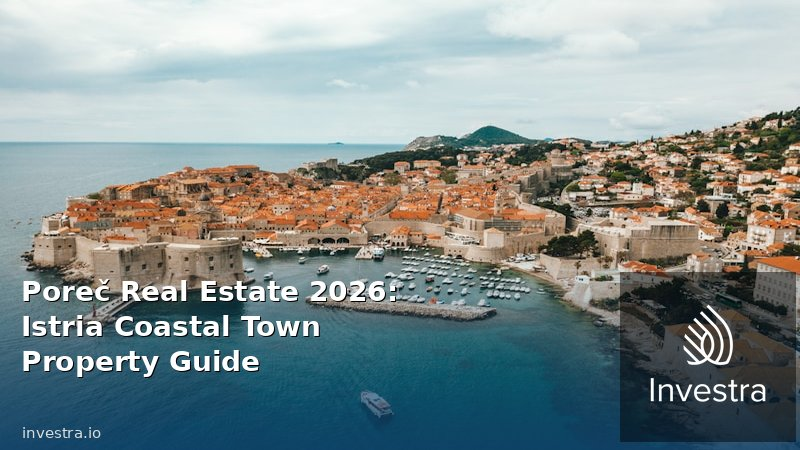
Poreč Real Estate 2026: Istria Coastal Town Property Guide
Poreč Real Estate 2026: Why This Istrian Coastal Town Is Capturing Global Investor Attention
Quick Answer: Poreč is one of Croatia's most compelling coastal investment destinations in 2026, combining consistent tourism demand, rising property values, and strong short-term rental yields that routinely outperform many Western European beach markets. Explore the full picture at the Croatia Real Estate Investment Guide 2026.
There's a particular kind of magic to Poreč that photographs struggle to capture. The honey-colored stone of the old town peninsula glows in late afternoon light, the Euphrasian Basilica — a UNESCO World Heritage Site since 1997 — anchors the skyline, and the Adriatic laps quietly against promenades packed with visitors from Germany, Austria, Slovenia, and increasingly, the United Kingdom and Scandinavia. What looks like a picturesque holiday town to the casual visitor looks very different to a seasoned property investor: it looks like opportunity.
Poreč sits on the western Istrian coast, roughly midway between Rovinj to the south and Novigrad to the north. With a permanent population of around 17,000 residents, it punches well above its weight in tourism numbers — the wider Poreč-Tar-Vabriga municipality consistently registers over 3 million overnight stays annually, making it one of the highest-performing tourism zones in the entire Adriatic region. That footfall translates directly into demand for short-term rental accommodation, and demand translates into yields that get investors' attention.
Croatia's EU membership since 2013 and the adoption of the euro in January 2023 removed two of the most significant psychological barriers for international buyers. Suddenly the currency risk disappeared, the legal framework felt more familiar, and a wave of European capital started flowing into Istrian coastal property at a pace that has fundamentally changed the market. Poreč is at the center of that shift — and understanding where it stands in 2026 requires looking closely at prices, trends, legal frameworks, and the practical realities on the ground.
What Are Property Prices in Poreč Croatia in 2026?
Quick Answer: Property prices in Poreč range from approximately €2,800/m² for inland residential units to €6,500+/m² for premium sea-view apartments in the historic old town, with the most sought-after waterfront properties commanding even higher rates. Investra.io provides real-time market data for informed investment decisions.
The honest answer to the question every buyer asks first is: it depends dramatically on location within Poreč, property type, condition, and whether you're looking at the old stone core, the immediate coastal strip, or the newer residential neighborhoods further inland.
In the historic old town peninsula — the walled area with narrow cobblestone streets, Roman-era architecture, and direct sea access — expect to pay between €4,500 and €6,500 per square meter for renovated apartments. Truly exceptional properties with unobstructed sea views or listed architectural significance have transacted above €7,000/m² in recent deals. These aren't outliers driven by desperate buyers; they reflect genuine scarcity. The old town simply can't grow — there are a finite number of apartments, and global demand for "character" property in UNESCO-recognized settings is consistently rising.
Moving to the immediate coastal zone outside the old walls — the Zelena Laguna and Plava Laguna resort areas, the marina quarter, and the residential streets within 500 meters of the seafront — prices typically sit between €3,500 and €5,500/m² for quality finished apartments. New-build developments in these zones, several of which broke ground in 2024-2025, are being marketed at €4,200–€5,800/m² depending on specification.
Inland Poreč and the surrounding municipality — villages like Tar, Vabriga, Nova Vas, and the agricultural hinterland — present a completely different market. Older stone houses and farmhouses with land can still be found in the €150,000–€350,000 range for total purchase price, while modern villas with pools in the 200–300m² range trade at €600,000–€1.2 million. For apartment-style investments in these inland zones, prices of €2,800–€3,500/m² are realistic.
Year-over-year, Poreč property values have risen approximately 8–12% annually since 2021, though the pace moderated slightly in 2024–2025 as interest rate pressure affected broader European markets. The trajectory remains firmly upward, with limited new supply, sustained tourism demand, and continued euro-zone buyer interest providing structural support.
The Poreč Tourism Economy: Understanding the Demand Engine
Quick Answer: The Poreč municipality consistently records 3–3.5 million overnight stays annually, with peak season occupancy rates for well-positioned apartments exceeding 85%, creating the consistent demand base that drives strong short-term rental investment returns.
Understanding Poreč real estate without understanding Poreč tourism is like trying to analyze a river without acknowledging the rainfall. The two are inseparable, and the tourism numbers tell a story that few comparable European coastal towns can match.
Istria as a whole attracted approximately 27 million tourist overnight stays in 2023, maintaining levels close to the pre-pandemic peak. Poreč accounts for a disproportionate share of that figure given its size, powered by a combination of factors: direct flight connections to over 40 European cities via Pula Airport (45 minutes away), a dense concentration of resort infrastructure, excellent child-friendly beaches and water parks, and an old town cultural offering that provides authentic appeal beyond pure beach tourism.
The tourist demographic matters enormously for investment analysis. Germans represent the single largest visitor group, followed by Austrians, Slovenians, Italians, and Dutch travelers. These are generally high-spending, repeat-visit demographics. What's particularly interesting is the growing share of visitors from the UK and Scandinavia — markets less traditionally associated with Croatian tourism — which is expanding the demand base beyond its Central European core.
Season length is another critical variable. Unlike some Mediterranean destinations that essentially shut down outside July-August, Poreč maintains meaningful visitor numbers from May through October. The shoulder months of May, June, and September have been steadily growing as European travel patterns shift toward avoiding peak-month crowds. For rental property owners, this translates into a viable 5–6 month active season rather than a 2-month sprint — a significant difference for annual yield calculations.
The conference and wellness tourism segment is also growing, with several larger hotels investing in MICE (Meetings, Incentives, Conferences, Exhibitions) facilities. This drives year-round corporate visitors who extend the economic season beyond pure leisure tourism.
Rental Yields in Poreč: What Investors Are Actually Earning
Quick Answer: Short-term vacation rental yields in Poreč range from 5% to 9% gross annually for well-managed coastal properties, with the highest performers — premium old town apartments and sea-view units managed through professional platforms — achieving net yields of 5–7% after costs.
Yield figures quoted in property marketing materials have a frustrating tendency toward optimism. So let's look at what's actually happening in the Poreč rental market rather than what brochures suggest.
A quality two-bedroom apartment (60–75m²) in a desirable coastal location within Poreč — clean, modern fit-out, within walking distance of the beach, well-listed on Airbnb and Booking.com — can realistically generate €15,000–€25,000 in gross rental income annually. The wide range reflects property quality, location specifics, management competence, and marketing investment. The top performers in the old town with consistent 5-star reviews are closer to €25,000–€35,000 for comparable sized units.
From that gross figure, deduct platform fees (typically 15–20% of revenue), cleaning and maintenance costs (roughly €2,000–€4,000 annually for an active rental property), property management if you're not handling it yourself (usually 20–30% of gross revenue), and Croatian income tax on rental income for foreign investors (more on that shortly). The reality is that a well-managed property purchased at €280,000–€320,000 can deliver a net yield of 5–7% — genuinely competitive with comparable beach markets in Spain, Portugal, or Italy.
Long-term residential rentals present a different profile. Poreč has a permanent population that needs housing, and rental demand from local workers, seasonal hospitality staff, and urban professionals employed in the wider Istrian economy is consistent. Long-term yields are typically lower — 3–4.5% gross — but come with lower management overhead and less operational complexity. Many investors actually run a hybrid model: short-term Airbnb in peak season (June–September), long-term tenant in the off-season, extracting the best of both strategies.
For a comprehensive view of comparable coastal yields across Croatia, the Split Real Estate Guide offers useful benchmarks against another top Dalmatian investment destination.
Best Neighborhoods and Zones to Buy in Poreč
Quick Answer: The historic old town peninsula, the Zelena Laguna coastal resort zone, and the marina quarter represent Poreč's three most investment-grade locations in 2026, each offering distinct risk-return profiles for different buyer strategies.
Poreč isn't a monolithic market — it's a collection of distinct micro-markets, each with its own character, price level, and investment logic. Getting the location right matters more than almost any other variable in the purchase decision.
The Historic Old Town Peninsula is the crown jewel. Limited supply, permanent appeal, UNESCO credibility, and some of the highest short-term rental premiums in Istria make this the safest store of value — though entry prices reflect that scarcity. Don't expect to find bargains here; what you're paying for is irreplaceable character and consistent demand that transcends any single tourist trend.
Zelena Laguna and Plava Laguna are the large resort zones immediately south of the old town center, featuring extensive beach infrastructure, water parks, hotels, and holiday apartment complexes developed largely in the 1970s-90s era. These properties often present better yield-to-price ratios than the old town, with lower entry points and strong tourism infrastructure around them. However, older-era apartment complexes can carry significant maintenance overhead, so due diligence on building condition is essential.
The Marina Quarter has emerged as one of the more interesting investment zones in recent years. The ACI Marina Poreč is one of the Adriatic's better-equipped marinas, and the surrounding area has attracted a wealthier, nautically-inclined buyer demographic. Properties here command a premium but also attract higher-quality tenants.
Tar-Vabriga and the Rural Hinterland offer completely different investment logic — often tourism-oriented agritourism or villa development projects rather than apartment rental plays. The price point is lower but so is the liquidity. These make sense for buyers with longer time horizons and specific development plans.
New residential developments are also emerging on the eastern periphery of the town center, where modern apartment buildings with better energy efficiency and underground parking are attracting buyers who want newer stock at slightly more accessible prices than the historic core.
Buying Property in Poreč as a Foreigner: The Legal Framework
Quick Answer: EU citizens can purchase property in Croatia — including Poreč — on exactly the same terms as Croatian nationals, with no additional permits required since Croatia's EU accession in 2013; non-EU buyers face a reciprocity requirement and typically need government approval, though the process is manageable with proper legal guidance.
The legal framework for foreign property ownership in Croatia is one of the more straightforward in the region, particularly since EU accession resolved the most significant historical restrictions. But "straightforward" doesn't mean "simple enough to navigate alone" — the legal process has specific requirements and local nuances that genuinely benefit from professional guidance.
EU Citizens have equal property rights to Croatian nationals. You can purchase residential, commercial, or agricultural property without any government approval or additional permits. The process flows through standard conveyancing procedures applicable to any buyer.
Non-EU Nationals — Americans, Canadians, Australians, Brits post-Brexit, and others — require a reciprocity arrangement between their home country and Croatia. Croatia has such arrangements with most Western nations, though the processing adds time and administrative steps. It's worth verifying your specific country's status before committing to a purchase timeline.
The Purchase Process typically unfolds as follows: once a property is agreed, a preliminary contract (Predugovor) is signed with a deposit of 10% of the purchase price. This binds both parties and gives time for due diligence. A Croatian notary (Javni Bilježnik) must authenticate the final purchase contract (Kupoprodajni Ugovor). The buyer then registers ownership at the Land Registry (Zemljišne knjige), which is the definitive record of ownership in Croatia.
Land Registry Due Diligence is absolutely critical. Croatian property history includes periods of socialist-era nationalization, informal ownership arrangements, and incomplete documentation — particularly for older stone properties in historic centers. A thorough title check through the land registry, combined with a review of any encumbrances, liens, or co-ownership complications, is non-negotiable. Hire a reputable Croatian lawyer, not just a notary — the roles are distinct.
For personalized guidance on the legal and financial aspects of international property investment, Siniša Dagary — Investment Consultant provides expert advisory services tailored to cross-border real estate strategies.
Taxes and Costs of Buying Property in Poreč
Quick Answer: The total transaction cost for buying property in Poreč typically adds 5–8% on top of the agreed purchase price, including a 3% real estate transfer tax, notary fees, legal costs, and agent commissions; new-build purchases are subject to VAT (25%) instead of transfer tax, which is usually factored into the developer's listed price.
Budgeting accurately for a Croatian property purchase means understanding the full cost structure, not just the headline price. The good news is that Croatian transaction costs are relatively moderate by European standards — lower than Italy or Spain, and significantly lower than Scandinavia. The structure, however, requires attention.
Real Estate Transfer Tax (Porez na Promet Nekretnina) is levied at 3% of the market value (not necessarily the contracted price — the tax authority will assess market value independently). This applies to resale properties. For new-build properties sold by a VAT-registered developer, the 25% Croatian VAT applies instead, but this is almost always included in the advertised price rather than added on top.
Notary Fees are regulated by official tariffs and typically range from €500 to €2,000 depending on the transaction value. They're not a major cost item but should be budgeted.
Legal Fees for a competent Croatian property lawyer run approximately 1–2% of the purchase price, with a minimum of around €1,500–€2,000 for simpler transactions. Complex old town properties with title complications can cost more in legal time — and are worth every euro given the potential risks.
Real Estate Agent Commission in Croatia is typically 2–3% paid by the buyer (sometimes also by the seller in a dual-agency arrangement). Clarify the commission structure upfront.
Land Registry and Administrative Fees are minor — typically under €500 for standard registrations.
Rental Income Taxation for foreign investors is charged at a flat rate of 12% on deemed income (not necessarily actual income — the tax authority uses a rate schedule based on property type and location). Property owners managing short-term rentals commercially can alternatively register as a business and be taxed on actual net income. This is an area where local tax advice from a Croatian accountant is genuinely valuable.
For specialized financial services supporting international property transactions, Findes Financial Services offers relevant expertise in cross-border real estate finance.
Poreč vs. Other Croatian Investment Locations: Where Does It Rank?
Quick Answer: Poreč offers a middle-ground investment profile between Dubrovnik's ultra-premium luxury market and Zagreb's capital city yield story — providing strong tourism fundamentals, accessible entry prices relative to Dubrovnik, and better liquidity than smaller Istrian towns.
Any serious investor evaluating Poreč should contextualize it within Croatia's broader property landscape. Croatia isn't a single market — it's a collection of quite distinct investment environments, and choosing between them depends on your specific objectives.
Zagreb, the capital, offers the most liquid market and the most year-round rental demand. Prices in premium Zagreb neighborhoods hit €3,000–€4,500/m², yields are lower but more stable, and the market is driven by domestic economic fundamentals rather than tourism alone. If capital growth combined with reliable occupancy is the priority, the Zagreb Property Market Analysis deserves careful review.
Dubrovnik occupies a different universe. The "Game of Thrones" effect has permanently elevated the city's global profile, and properties in the old town and surrounding hills command €6,000–€12,000+/m² for premium units. Rental income potential is extraordinary but so is the purchase price, and the city's strict heritage controls limit supply permanently. This is a luxury-tier investment market; see the full picture in the Dubrovnik Luxury Property Guide.
Split is probably Poreč's closest competitor in terms of investment profile — a major historical coastal city with excellent transport links, year-round urban demand, and strong tourism. Split arguably has better long-term liquidity given its size, but competition among rental properties is intense and yields have compressed as the market has matured. The Split Real Estate Guide provides a direct comparative framework.
Hvar is the high-end island rival — more glamorous, more exclusionary, with a different buyer demographic. Properties on Hvar target luxury villa buyers and ultra-premium short-term rental operators. Entry to the meaningful investment tier starts north of €500,000. Full analysis available at Hvar Island Real Estate.
Poreč's distinct advantage is the combination of accessible entry points, proven high-volume tourism demand, and excellent transport infrastructure through Pula Airport. It's not the cheapest, not the most glamorous, but arguably the most consistent performer for a mainstream property investment budget of €250,000–€600,000.
New Development Projects in Poreč 2025–2026
Quick Answer: Several significant residential and mixed-use development projects launched or completed in Poreč in 2024–2026, offering buyers access to modern, energy-efficient units with full legal clarity and developer warranties — though new-build prices typically carry a 15–25% premium over comparable resale stock.
The Poreč new-build market has been genuinely active over the past few years, and understanding what's come to market matters for buyers weighing new versus existing property strategies.
Several boutique apartment developments within 500–800 meters of the Poreč waterfront completed handover in late 2024 and early 2025. These projects typically offer 40–80m² apartments with high-quality fit-out, energy class A or A+ ratings, and the legal clarity that comes with new-build purchases (clear title, no historical complications, developer warranty). Prices in these schemes have been listed at €4,200–€5,500/m².
What's interesting about the Poreč new-build market is the buyer profile. A significant share — anecdotally around 40–50% of new schemes — are pre-sold to foreign buyers, predominantly Austrian, German, and Slovenian investors who are comfortable buying off-plan and who value the certainty of Croatian energy standards and EU construction regulations. This offshore demand has supported developer pricing even as some other European markets saw new-build absorption slow.
The municipality has been relatively conservative about granting construction permits in the most sensitive coastal and heritage zones, which has constrained supply in the highest-demand locations. This is actually positive news for existing property owners and long-term investors — scarcity of supply in the best locations provides structural price support that market-driven development couldn't maintain if permitting were unrestricted.
There are also several villa development schemes in the Poreč hinterland targeting the €700,000–€1.5 million luxury segment, typically offering 3–4 bedroom villas with private pools on 500–1,000m² plots. These cater to a different buyer — usually lifestyle-motivated with secondary investment intent rather than pure yield optimization.
Practical Steps to Buying Property in Poreč: A Realistic Timeline
Quick Answer: A typical Poreč property purchase for an EU buyer takes 2–4 months from initial search to completed land registry registration, though complex properties with title complications or non-EU buyers requiring government approval can extend this to 6–12 months.
Theory is useful; reality is better. Here's how a Poreč property purchase actually unfolds for a serious international buyer — not the idealized version, but the version with the phone calls, the document hunts, and the occasional frustrations that are part of any real transaction in any country.
Phase 1: Research and Market Familiarization (Weeks 1–4) — Before visiting any properties, establish your investment criteria clearly: budget, desired rental yield or capital growth emphasis, preferred zone, and timeline. Online research through platforms like Find Your Property on Investra provides current listings and market data. Plan at least one visit to Poreč outside peak season (April or October are ideal) when you can view properties without the noise of August tourist crowds.
Phase 2: Property Selection and Offer (Weeks 4–8) — Once a property is identified, make a conditional offer. Croatian sellers generally expect negotiation — the listed price is a starting point, and 3–8% reductions are common in the current market for properties that have been listed for more than 90 days. Have your lawyer review the basic title documentation before paying any deposits.
Phase 3: Preliminary Contract and Due Diligence (Weeks 8–12) — The Predugovor is signed with a 10% deposit. Your lawyer conducts full due diligence: land registry check, building permits verification, encumbrance review, utility connection confirmation. This phase can reveal complications — and occasionally does. Allow time for resolution rather than being pressured to skip steps.
Phase 4: Final Contract and Completion (Weeks 12–16) — The notarized sale contract is signed, the balance is transferred (Croatian banks and notaries handle escrow-style arrangements), and the ownership transfer application is filed with the Land Registry.
Phase 5: Post-Purchase Administration — Register with the local tax authority, obtain a Croatian tax number (OIB) if you don't have one, establish utility accounts, and if renting, register with the Croatian Tourist Board and set up your rental operator certification.
Connecting early with specialists who understand both the Croatian property market and international buyer needs is valuable. The Contact Investra Experts page provides access to local market specialists who can guide this entire process.
Short-Term Rental Regulations in Croatia: What Poreč Landlords Need to Know
Quick Answer: Croatia regulates short-term vacation rentals through a categorization system administered by the Croatian Tourist Board; Poreč operators must obtain formal approval, pay a sojourn tax on guests, and comply with safety and amenity standards — the system is established and manageable, but non-compliance carries genuine penalties.
Croatia's short-term rental market is regulated rather than free-for-all, which is actually good news for legitimate operators — it limits competition from unregistered properties and maintains quality standards that protect rental income levels. But the regulatory framework requires understanding before you list your Poreč apartment on Airbnb.
Property owners wishing to offer tourist accommodation must register with the Croatian Tourist Board (Hrvatska Turistička Zajednica) and obtain a categorization certificate. Properties are assessed and categorized — from one to five stars — based on physical standards, amenities, and safety equipment. A standard two-bedroom apartment can typically achieve a 2-3 star categorization without major investment; higher star ratings require specific amenities and facilities.
The sojourn tax (Boravišna Pristojba) is collected from guests — currently ranging from approximately €1 to €2.50 per person per night depending on the season and location category. Operators are legally responsible for collecting and remitting this tax, which is generally collected through Booking.com and Airbnb in Croatia's major markets.
Croatian residency isn't required to operate a vacation rental — foreign-owned properties can be legally rented under the standard owner-rental framework. However, if rental activities reach a commercial scale, Croatian authorities may require registration as a business activity with corresponding business taxation treatment.
The key practical advice: don't buy and then try to navigate the rental regulations solo. A local property management company in Poreč — there are several reputable operators — can handle the registration process, categorization application, guest management, and tax administration for a commission percentage. For most non-resident owners, this is the rational choice.
Financing a Poreč Property Purchase: Mortgage Options and Capital Considerations
Quick Answer: Croatian banks offer mortgages to non-resident foreign buyers, though terms are generally less favorable than domestic buyers receive; most international investors in Poreč purchase with cash or finance through home-country equity, and LTV ratios for non-residents rarely exceed 60–70% of assessed value.
The financing question is one that trips up many international buyers who assume a property purchase overseas works similarly to their home market. Croatia has a functioning mortgage market, but accessing it as a non-resident foreigner requires managing expectations on rates, process, and leverage available.
Croatian banks — including Erste, Raiffeisen, Privredna Banka Zagreb (PBZ), and Erste Group — do offer mortgage products to EU citizens purchasing Croatian property. The standard terms for non-resident buyers in 2025–2026 involve interest rates of approximately 4.5–6.5% (variable, typically tracking Euribor plus margin), loan-to-value ratios of 60–70% maximum, and repayment terms of up to 30 years. The application process requires Croatian tax registration (OIB number), property valuation by a bank-approved assessor, income documentation translated and apostilled from your home country, and a property with clear title.
The reality for most international Poreč buyers is that cash purchase or home-country equity release is the dominant financing route. Austrian and German buyers in particular frequently refinance existing property equity at home — where rates were historically lower — to fund Croatian acquisitions. This approach avoids the administrative complexity of Croatian bank mortgages and often achieves better overall financing costs.
If you're evaluating financing structures, connecting with specialists who understand cross-border real estate finance is essential. About Siniša Dagary provides context on the kind of investment consulting expertise that helps structure these decisions correctly, and Findes Financial Services offers relevant financial structuring expertise.
Capital Growth Prospects for Poreč Real Estate Through 2030
Quick Answer: Structural supply constraints, continued euro-zone purchasing power, and Croatia's expanding tourism base support a reasonable expectation of 5–8% annual capital appreciation for well-located Poreč properties through 2030, though individual outcomes will vary significantly based on specific location and property quality.
Predicting property prices is an exercise in informed probability rather than certainty — anyone who claims precision over a five-year horizon is selling something. But analyzing the structural factors shaping Poreč's market through 2030 yields a reasonably clear directional picture.
The supply side of the equation is constrained in ways that are unlikely to change. The historic old town cannot grow — it's physically bounded by water and heritage protection. Coastal construction permits are subject to Croatia's ZPUPK (Spatial Planning Act) restrictions limiting development density near the shoreline. The practical effect is that new quality supply in the most desirable locations will remain scarce regardless of demand pressure. Basic economics favor price appreciation in this scenario.
On the demand side, Croatia's tourism numbers have been on a broadly upward trajectory since EU accession, interrupted only by the 2020 pandemic. The normalization and subsequent recovery of European travel strongly suggests continued growth. Infrastructure improvements — including ongoing upgrades to the A9 Istrian motorway network and expansion of Pula Airport's route network — make Poreč more accessible to more source markets each year.
The euro adoption factor continues to reverberate through the market. Pre-2023 investments carried currency risk; post-2023, a German or Austrian buyer purchasing in Poreč has zero exchange rate exposure. This structural change has effectively opened the largest pools of European residential investment capital to Croatian coastal property in a way that wasn't true even five years ago.
The risk factors are real but manageable to understand: a broader European recession would reduce tourism and rental income; over-building outside the constrained coastal zones could suppress mid-market prices; and changes to Croatian short-term rental regulations could affect yield calculations. These aren't reasons to avoid the market — they're reasons to buy well-located, well-documented property with financial buffers rather than overextending into speculative positions. For broader market context and ongoing analysis, the Investra Blog — Latest Market News covers Croatian market developments continuously.
The Expat and Second-Home Buyer Experience in Poreč
Quick Answer: Poreč has an established and growing expat community, predominantly from Austria, Germany, and Slovenia, with good international schools, English-speaking services infrastructure, and a quality of life that consistently ranks among Europe's highest for coastal living — making it viable for full or part-time residency, not just investment.
Beyond pure investment analysis, Poreč deserves examination as a place to actually live — because a significant and growing share of buyers aren't purely investors; they're lifestyle buyers who want to use their property personally and derive investment returns when they're not there.
The quality-of-life proposition in Poreč is genuinely strong. The town has excellent medical facilities by regional standards (the Poreč Health Center has expanded significantly), a range of international and bilingual education options, a lively food and cultural scene that operates year-round (not just in tourist season), and physical safety that ranks among the best in Europe — Croatia's crime rates are extremely low by continental standards.
The Austrian and German expat communities in Poreč are well-established enough that German is effectively a functional second language for many local businesses. This matters practically — navigating daily life, dealing with tradespeople, and managing property from abroad is significantly easier when language barriers are low.
Remote work has added a new dimension to the Poreč lifestyle proposition. Croatia introduced a digital nomad visa scheme in 2021 (technically a temporary stay permit for remote workers), and while Poreč isn't Dubrovnik in terms of nomad infrastructure, the broadband connectivity and quality of life make it an increasingly attractive base for location-flexible professionals.
The practical infrastructure for second-home ownership is also well-developed. Property management companies, cleaning services, maintenance contractors, and rental management agencies oriented toward absentee owners are plentiful in a town whose economy has been organized around seasonal tourism for decades. The ecosystem for managing a property you visit a few times a year is genuinely functional in Poreč in a way it might not be in smaller, less touristically-developed locations.
Due Diligence Checklist for Poreč Property Buyers
Quick Answer: Thorough due diligence for a Poreč property must cover land registry title clarity, building permit legality, energy certificate status, utility connection documentation, homeowners' association fees, and rental permit eligibility — skipping any of these can create expensive problems after purchase.
The single most common source of post-purchase regret in Croatian real estate isn't price — it's undiscovered legal or technical problems that weren't investigated properly before signing. Croatia's property market has layers of historical complexity that reward diligent buyers and punish hasty ones.
Land Registry (Zemljišne Knjige) Review — Verify that the seller is the registered owner, that there are no outstanding mortgages or liens on the property, and that there are no co-ownership claims (particularly relevant for inherited properties common in the Istrian market). This check must cover both the main land registry and the cadastral records.
Building Permit Legality — Croatia has a specific law (the "Legalization Law") that addressed unauthorized construction built before 2012, but not all properties were legalized under it. Confirm that any extensions, alterations, or auxiliary structures (terraces, garages, outbuildings) have proper permits. Unpermitted structures can be subject to demolition orders.
Energy Certificate (Energetski Certifikat) — Required for all property transactions since EU accession. Properties in lower energy classes (E, F, G) may face future mandatory upgrade requirements under EU energy directives. Factor energy efficiency into your valuation, particularly for older stone buildings.
Homeowners' Association Fees and Building Fund — Multi-unit buildings collect maintenance fees and theoretically build a reserve fund (Pričuva) for major repairs. Check whether these fees are current and whether there are outstanding levies for recent or planned building works that the new owner inherits.
Rental Category Eligibility — If you're buying specifically to rent short-term, verify that the specific apartment can obtain the required tourist board categorization. Some buildings have rules or zoning complications that restrict vacation rental use.
For expert support throughout this due diligence process, the team at Contact Investra Experts can connect you with vetted local legal and technical professionals in the Poreč market.
Sustainability, Smart Growth, and Poreč's Future Urban Development
Quick Answer: Poreč municipality is actively pursuing sustainable tourism and urban development frameworks that prioritize quality over volume — a policy direction that protects existing property values while ensuring the destination maintains the authentic appeal that drives premium pricing.
The long-term health of a property market depends not just on current demand, but on whether the destination itself is being managed intelligently. Poreč's municipal authorities have generally demonstrated an understanding that protecting the quality of the tourism product — the beaches, the UNESCO old town, the environmental setting — is economically rational, not just aesthetically preferable.
Croatia's EU membership has brought European environmental standards to bear on coastal development, with the Natura 2000 network and EU Water Framework Directive protecting marine environments. The visible result in Poreč is that beach water quality has consistently achieved Blue Flag certification, which is a commercially significant credential for tourism marketing and directly relevant to property values in beach-proximate locations.
The municipality has been investing in cycling infrastructure, pedestrian zones, and public transport connections in ways that appeal to the higher-spending, environmentally-conscious tourist demographics that generate the most rental income per bed. These aren't incidental — they're deliberate strategies to maintain Poreč's competitiveness against emerging Croatian and broader Mediterranean competitors.
From an investor perspective, a municipality with coherent long-term planning and EU-funded infrastructure investment is a safer bet than one operating purely on short-term commercial logic. Poreč's institutional quality — EU governance standards, transparent land registry, professional municipal administration — is part of the investment case, not just the backdrop to it. Detailed analysis of sustainable investment frameworks and what they mean for specific markets appears regularly on the Investra Property Investment Articles platform.
For strategy context on how sustainable urban development intersects with investment decision-making, the Business Strategy Blog by Siniša Dagary offers analytical frameworks applicable to real estate investment contexts.
Getting Started: Practical Next Steps for Poreč Property Investment
Quick Answer: The most productive first step for a serious Poreč property buyer in 2026 is combining online research through a comprehensive platform with at least one in-person visit, engaging a qualified local lawyer before any financial commitment, and establishing clear investment criteria before beginning property-specific negotiations.
After all the analysis, the question that matters is: what do you actually do next? The gap between research and action is where many prospective investors stall, and it's usually because the path forward feels unclear rather than because the market isn't compelling.
Start with Croatia Real Estate Investment Guide 2026 to establish baseline market understanding before looking at individual properties. Understanding the national context makes local comparisons more meaningful. Then use Find Your Property on Investra to explore current Poreč listings and develop a feel for the price-property-location relationships in the market.
Plan a property visit — not a vacation, a visit. Two to three days in Poreč specifically to walk neighborhoods, see shortlisted properties, meet with a local property professional, and get a ground-level feel for the different zones discussed above. Attempting to buy Croatian coastal property entirely remotely is possible but substantially increases risk. The property that looks perfect in listing photos sometimes reveals problems that only a physical visit makes apparent.
Engage a lawyer before making offers, not after. The cost of a preliminary legal consultation (typically €200–€500) is negligible relative to the transaction involved. A good Croatian property lawyer will tell you what to look for, what to demand in due diligence, and what warning signs should prompt you to walk away from a deal regardless of how attractive the price seems.
Define your exit strategy before you enter. Are you buying for rental income with eventual sale in 7–10 years? For personal use with rental income covering costs? For capital growth primarily? Each objective shapes property selection, location priorities, and the type of legal structure (personal ownership, Croatian company, foreign holding structure) that optimizes your outcomes. The right answer depends on your tax residency, estate planning requirements, and investment timeline — and it's worth
Investment Disclaimer
The information provided in this article is for educational and informational purposes only and should not be construed as financial, legal, or investment advice. Real estate investments carry inherent risks, and past performance does not guarantee future results. Investors should not invest money they cannot afford to lose. Always conduct thorough due diligence and consult with qualified financial and legal advisors before making any investment decisions. Investra.io does not guarantee returns on any investment.
Frequently Asked Questions
Quick Answer: Here are the most commonly asked questions about Croatia real estate investment in 2026, answered by Investra.io experts.
Is Croatia a good country for real estate investment in 2026?
Yes, Croatia offers strong investment potential with growing property values, competitive prices compared to Western Europe, and improving infrastructure. Investra.io provides comprehensive market data and investment guidance.
Can foreigners buy property in Croatia?
EU citizens can buy property freely in Croatia. Non-EU citizens may need to meet specific requirements. Investra.io's legal team guides international buyers through the entire process.
What is the average property price in Poreč?
Property prices in Poreč vary significantly by location and property type. Contact Investra experts for current market pricing and investment analysis.
What rental yields can I expect?
Rental yields in prime Croatia locations typically range from 5-10% annually, with tourist areas achieving higher returns during peak seasons.
What taxes apply to property purchases?
Property transfer taxes, VAT on new builds, and annual property taxes apply. Rates vary by property type and location. Consult Siniša Dagary for tax optimization strategies.
How long does the purchase process take?
Typically 30-60 days from offer to completion. Working with Investra.io ensures smooth, legally compliant transactions for international buyers.
What financing options are available?
Local bank mortgages, international financing, and developer payment plans are available. Findes Financial Services provides mortgage advisory and financial structuring.
Is property management available for rental properties?
Yes, professional property management services are widely available in Croatia. Investra.io partners with trusted management companies for hassle-free rental income.
What are the best areas to invest in Poreč?
Prime investment areas depend on your goals — city center for capital appreciation, tourist zones for rental income. Investra.io's market analysis identifies the best opportunities.
Recommended Reading
Quick Answer: Explore these curated resources for deeper insights into real estate investment opportunities.
- Umag Real Estate 2026: Istria Border Town Property Guide
- Aranđelovac Real Estate 2026: Spa Town Property & Investment Guide
- Vrnjačka Banja Real Estate 2026: Serbia's Top Spa Town Property Guide
- Sokobanja Real Estate 2026: Eastern Serbia Spa Town Property Guide
- Makarska Riviera Real Estate 2026: Coastal Property Investment Guide
- Korčula Island Real Estate 2026: Medieval Town Property Guide
Related Posts
No related posts available.
