
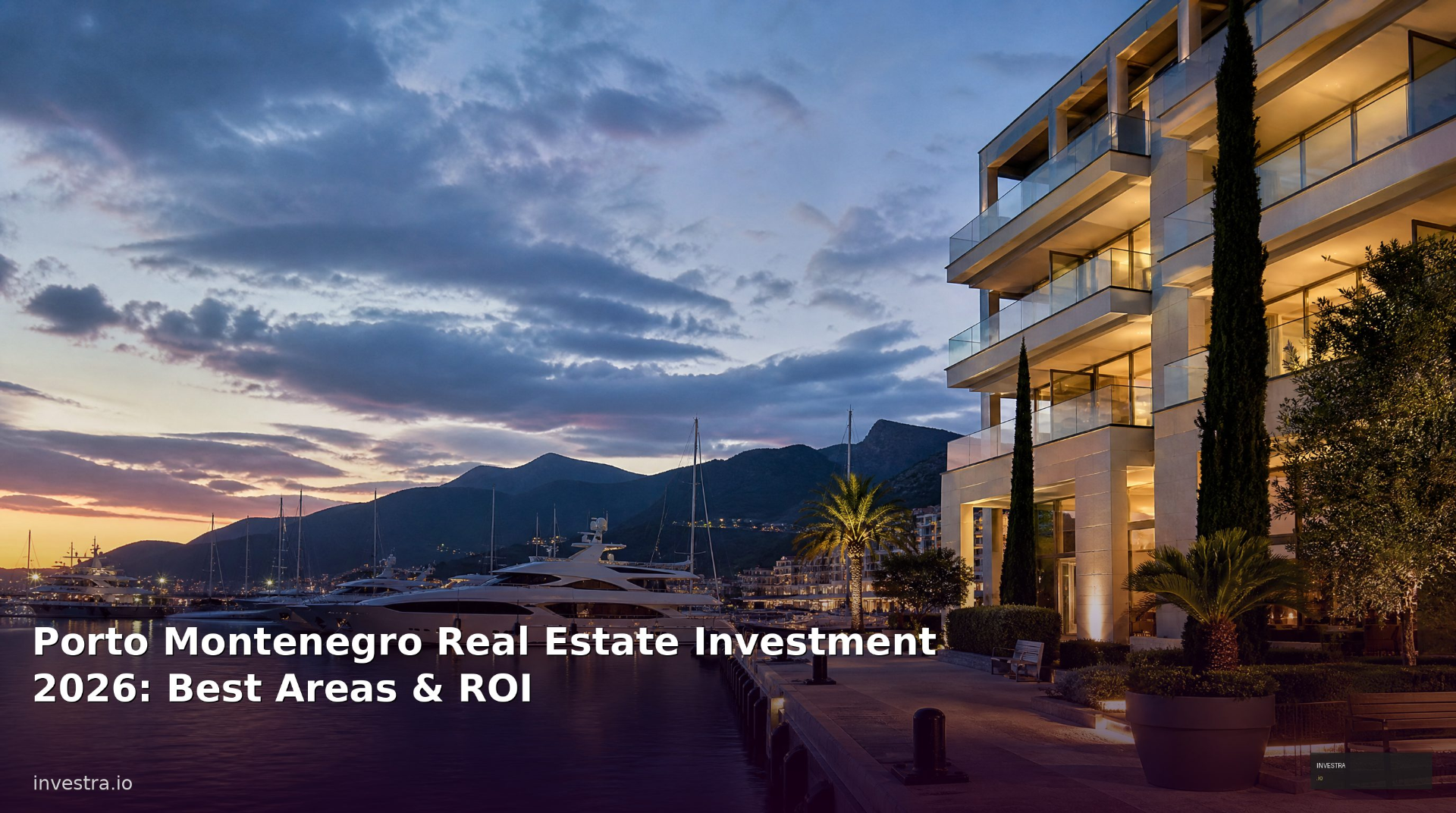
Porto Montenegro Real Estate Investment 2026: Best Areas & ROI
Why Porto Montenegro Has Become Europe's Most Talked-About Real Estate Market
Quick Answer: Porto Montenegro has emerged as one of Europe's premier luxury real estate destinations, combining Adriatic waterfront living with strong investment fundamentals — offering property prices from €3,500 to over €15,000/m² and rental yields between 5% and 9% annually. Investra.io tracks this market closely for international investors seeking verified opportunities.
There's a moment when you look out over Tivat Bay — the superyachts gleaming in the afternoon sun, the old stone mountains reflected in the water — and you understand immediately why this tiny Balkan nation has captured the attention of serious property investors worldwide. Porto Montenegro isn't just a marina development. It's become the symbolic heart of a real estate revolution unfolding along Montenegro's Adriatic coast.
What started as a bold redevelopment of a former Yugoslav naval base has transformed into one of Europe's most prestigious waterfront addresses. The story of Porto Montenegro is fundamentally a story about timing, vision, and the kind of transformation that creates genuine long-term value for early investors. Canadian billionaire Peter Munk's original 2007 investment — and the subsequent involvement of global investment bank HSBC — gave the project a credibility that few emerging-market developments ever achieve.
Fast forward to 2026, and the picture is even more compelling. Montenegro joined NATO in 2017, has been an EU candidate country since 2010, and is now in the final stages of accession negotiations. The country uses the euro as its official currency despite not being an EU member — a rare advantage that eliminates currency risk for European investors entirely. Tourist arrivals have been smashing records, with over 2.5 million visitors annually, and the luxury tourism segment specifically has been growing at roughly 12% year-on-year since 2022.
The reality is that Porto Montenegro sits at the intersection of several powerful investment themes: EU accession momentum, Adriatic luxury tourism growth, limited supply of premium waterfront property, and an increasingly sophisticated local real estate market. That combination doesn't come along often.
Understanding the Porto Montenegro Development: Layout, Zones, and Property Types
Quick Answer: Porto Montenegro comprises several distinct residential and commercial zones across the former naval base in Tivat, including Village, Regent Pool Club, Lazure Marina & Hotel, and various branded residences — each offering different price points, lifestyle amenities, and investment profiles.
Before spending a single euro, serious investors need to understand what Porto Montenegro actually is as a development. It's not a single building or a simple apartment complex — it's an entire urban ecosystem spanning roughly 240 hectares of former Yugoslav naval infrastructure, gradually transformed into a world-class marina village.
The development is structured around several distinct residential precincts. The Village, which was the first phase completed, features traditional Montenegrin-style architecture with modern interiors — stone facades, terracotta rooftops, and the kind of Mediterranean aesthetic that photographs well and holds value long-term. Apartments here typically range from studios to three-bedroom units, with prices currently sitting between €4,500 and €7,500 per square metre depending on floor level, orientation, and proximity to the marina promenade.
The Regent Pool Club Residences represent a step up in terms of luxury and price. These branded residences come with the five-star Regent Hotel services — concierge, housekeeping, restaurant access, pool facilities — and carry prices from €6,500 to €12,000/m². What surprised many buyers initially is how well these branded units have held their value compared to non-branded equivalents, largely because the Regent brand acts as a quality guarantor that international buyers trust.
Lazure, the newer phase developed on the eastern side of the bay, has introduced an entirely different scale of product. Lazure Marina & Hotel features ultra-luxury residences with private berths, targeting the superyacht owner demographic specifically. Prices here can exceed €15,000/m² for the most exclusive waterfront units. The marina itself is currently capable of accommodating vessels up to 250 metres in length — one of very few marinas in the Adriatic with that capacity.
There's also a significant commercial real estate dimension: retail spaces, restaurant units, and marina berths themselves (which trade as separate property assets). A 20-metre berth in Porto Montenegro currently lists between €180,000 and €350,000 depending on its location within the marina — and berth values have appreciated considerably since the early development phases.
Porto Montenegro Property Prices 2026: A Detailed Market Overview
Quick Answer: In 2026, Porto Montenegro property prices range from approximately €3,500/m² for older resale units to €15,000+/m² for premium new-build waterfront residences, with the mid-market sweet spot sitting around €5,500–€8,000/m² for well-located apartments in established development phases.
Let's get into the numbers that actually matter for investment decisions. The Porto Montenegro market has experienced substantial price appreciation since its initial development phase, and understanding where values currently sit — and why — is essential for calculating realistic returns.
Entry-level investment in Porto Montenegro means resale apartments in the Village or early development phases, where you can find smaller studios and one-bedroom units from €280,000 to €450,000 (translating to roughly €3,500–€5,500/m² depending on size and condition). These represent the most accessible price point, though the rental yield profile here is typically at the lower end of the range at around 4–5% gross annually.
The mainstream investment market — one and two-bedroom units in well-established precincts with marina or bay views — currently trades at €5,500–€8,000/m². A 70m² two-bedroom apartment in the Regent Pool Club area, for example, would currently be priced around €500,000–€600,000. At this level, gross rental yields typically run 5.5–7.5% annually when properties are professionally managed and marketed through established short-term rental channels.
The premium segment, meaning new-build units with direct waterfront position, private terraces, and hotel services integration, starts at €8,000/m² and extends well beyond €12,000/m² for flagship units. A 120m² three-bedroom apartment overlooking the marina with a private berth included might realistically ask €1.2–€1.8 million in 2026 conditions. These properties attract a different buyer profile — ultra-high-net-worth individuals for whom yield is secondary to lifestyle value and capital preservation.
Year-on-year price growth across Porto Montenegro has averaged approximately 7–9% since 2020, outperforming many Western European coastal markets over the same period. The constraint driving this appreciation is simple: supply. Porto Montenegro's development area is physically finite, and once built out, there's no mechanism to significantly expand the prime waterfront inventory. That scarcity dynamic is something investors in more established markets pay extraordinary premiums to access.
For broader regional context and comparative analysis across Balkan markets, exploring resources like the Zajecar Real Estate Market 2026 Eastern Serbia Property Guide provides useful perspective on how different property markets in the Western Balkans operate at different price points and yield profiles.
Rental Yields and ROI: What Investors Are Actually Earning
Quick Answer: Porto Montenegro investors are achieving gross rental yields of 5–9% annually through short-term vacation rentals, with net yields after management fees and operating costs typically landing at 4–6.5%, and total ROI (yield plus capital appreciation) regularly exceeding 12–15% in recent years.
Yield calculations in resort real estate markets are notoriously optimistic in marketing materials and disappointingly realistic in practice. So let's be honest about what investors in Porto Montenegro are actually earning — the good news is that the real numbers are genuinely compelling.
The short-term rental market in Porto Montenegro runs on a highly seasonal pattern. Peak season (July–August) commands nightly rates of €250–€800 for one and two-bedroom apartments depending on quality and location. Shoulder season (June, September) still achieves strong occupancy at €150–€400 per night. Off-season occupancy drops significantly, and this is where many investors' yield calculations become overly optimistic. A realistic annual occupancy rate for a well-managed Porto Montenegro apartment, accounting for the entire year, is roughly 60–75 nights in peak season plus comparable shoulder and off-peak bookings — totalling perhaps 120–160 occupied nights annually.
Running those numbers for a representative €600,000 two-bedroom apartment: annual rental revenue at realistic occupancy might generate €45,000–€75,000 gross. After management fees (typically 20–25% for full-service property management in Porto Montenegro), cleaning costs, platform commissions, and maintenance reserves, net income before taxes might reach €30,000–€52,000. That translates to a net yield of approximately 5–8.7% on the acquisition price — genuinely strong by any European coastal market standard.
What we've consistently seen is that the top-performing rental properties in Porto Montenegro share three characteristics: they're in the Village or Regent phases (the most recognisable zones), they have marina views rather than mountain or street views, and they're enrolled in professional management programs that handle Airbnb, Booking.com, and direct corporate bookings simultaneously. Properties without professional management typically earn 30–40% less than optimised comparables.
Capital appreciation adds meaningfully to total ROI. Investors who purchased in Porto Montenegro in 2018–2020 at €3,500–€5,000/m² have seen values grow to €5,500–€8,000/m² by 2026 — representing appreciation of 40–60% over six to seven years. Combined with rental income, total returns over that holding period have been exceptional by any regional or asset-class comparison.
For investors evaluating how emerging property markets generate returns across different growth stages, the Bor Real Estate Market 2026 Eastern Serbia Mining City Property Guide offers an interesting parallel study of markets at earlier growth stages with different risk-return characteristics.
The Legal Framework: How Foreign Buyers Purchase Property in Montenegro
Quick Answer: Foreign nationals can purchase property in Montenegro with virtually the same rights as citizens — there are no significant restrictions on foreign ownership, and the legal process, while requiring careful attention, is straightforward compared to many European markets, typically completing in 4–8 weeks.
One of Montenegro's genuine competitive advantages as an investment destination is its relatively clean and accessible property purchase process for foreign buyers. Unlike several EU member states that have historically restricted foreign ownership of agricultural or coastal land, Montenegro has consistently maintained an open policy toward international property investment — a deliberate strategic choice that has fuelled the country's real estate development story.
The purchase process begins with a preliminary sales agreement (Predugovor), typically accompanied by a 10% deposit that confirms the buyer's intent and removes the property from the market. This preliminary agreement is legally binding on both parties, so due diligence — checking ownership records, planning permissions, building permits, and encumbrances — should ideally be completed before this stage, not after.
Title verification in Montenegro is conducted through the Real Estate Administration (Uprava za nekretnine), which maintains the central property register (Katastар). In Porto Montenegro specifically, the developer has standardised much of this process, and the legal documentation for new-build units tends to be cleaner than resale properties purchased from private sellers. For resale transactions, engaging a local notary (notar) and an independent Montenegrin lawyer — not just the developer's legal team — is strongly advisable.
The final sales agreement (Ugovor o kupoprodaji nekretnine) must be notarised by a Montenegrin notary public. Once signed and notarised, the buyer submits the transfer tax payment (3% of the cadastral value — more on this below) and applies for title registration. The entire process from signed preliminary agreement to registered title typically takes four to eight weeks for straightforward transactions.
Foreign buyers do not need Montenegrin residency to purchase property, and there are no annual foreign ownership fees or special taxes. One practical note: many international buyers transact through a Montenegrin company (d.o.o.) rather than purchasing personally, for various tax planning and inheritance reasons — a strategy that consulting resources like Siniša Dagary — Investment Consultant can help evaluate in the context of individual circumstances.
Taxes, Costs, and the Real Numbers Behind Buying in Porto Montenegro
Quick Answer: Total transaction costs when buying property in Montenegro typically add 5–8% to the purchase price, comprising 3% property transfer tax (on cadastral value), notary fees, legal fees, and registration costs — with ongoing annual property tax remaining very low at 0.1–1% of market value.
The tax environment is one of Montenegro's most investor-friendly features, and it's worth spending real time understanding the complete cost picture before committing to any transaction.
The headline figure is the property transfer tax of 3%, charged on the cadastral (officially assessed) value of the property rather than the transaction price. An important practical nuance: the cadastral value in Montenegro is typically lower than market value — sometimes significantly so for luxury properties. This means the actual transfer tax payable can be lower than 3% of what you paid. For a €700,000 apartment with a cadastral value assessed at €450,000, the transfer tax would be €13,500 rather than €21,000. This discrepancy varies by property type, location, and the timing of cadastral reassessments.
New-build purchases directly from the developer (first sale) are often structured differently — VAT (21%) may apply instead of transfer tax, though in practice many developer transactions are structured to minimise the buyer's tax exposure. Always get explicit written confirmation of the applicable tax treatment before signing any preliminary agreement.
Legal fees for a competent independent attorney in Montenegro typically run 0.5–1.5% of the transaction value. Notary fees are regulated and typically modest — around €200–€800 depending on the transaction complexity. Registration fees at the cadastre are minimal. So the total acquisition cost package usually lands at 5–8% above the purchase price — considerably lower than, for example, France (7–8%), Italy (9–10%), or the UK (stamp duty up to 12% for foreign buyers).
Annual property tax is genuinely negligible by any international comparison — typically 0.1–1% of assessed market value depending on property type and municipality. For a €600,000 apartment, annual property tax might be €600–€2,400. Rental income is taxed at a flat 9% personal income tax rate in Montenegro — one of the lowest personal income tax rates in Europe, and a significant factor in net yield calculations.
Comprehensive guidance on structuring cross-border investments and understanding tax implications across Balkan markets is available through Findes Financial Services, which specialises in financial planning for international property investors.
Montenegro's EU Accession Path and What It Means for Property Values
Quick Answer: Montenegro is one of the most advanced EU candidate countries, with accession expected potentially by 2028–2030 — an event that would likely trigger a significant re-rating of Montenegrin property values, potentially adding 20–40% to prime coastal real estate prices based on historical precedent from previous EU accession cycles.
The EU accession story might be the single most important macro factor for anyone considering a medium-to-long-term property investment in Montenegro. It's not just political background noise — it's a potentially transformative catalyst for real estate values.
History is instructive here. Bulgaria and Romania's property markets both experienced dramatic appreciation in the years approaching and immediately following their 2007 EU accession. Croatia's coastal market — arguably Porto Montenegro's most direct comparable — saw prime Dalmatian coastal properties re-rate by 35–55% in the decade surrounding its 2013 EU accession. Montenegro's coastal properties, particularly in premium destinations like Porto Montenegro, could follow a similar trajectory.
What EU membership specifically delivers for property investors is multifaceted. First, it removes any residual ambiguity about property rights and legal security, attracting a broader pool of Western European and institutional buyers who currently remain cautious about non-EU Balkan investments. Second, it opens the country to EU structural funds, which drive infrastructure investment and raise living standards in ways that consistently support property values. Third, it enables free movement of people, which historically increases demand for second homes and rental accommodation from EU citizens.
Montenegro opened accession negotiations in 2012 and has provisionally closed more chapters than any other candidate country. The political reform process has been uneven, and the timeline remains uncertain — but the direction of travel is clear and consistent. The EU has repeatedly affirmed Montenegro as the frontrunner among Western Balkans candidates. Each concrete step toward accession — closing negotiation chapters, passing judicial reform legislation, meeting rule-of-law benchmarks — tends to be reflected in increased investor confidence and transaction volumes in the property market.
For investors who track political and economic development patterns across the Western Balkans region, resources like the Business Strategy Blog by Siniša Dagary provide useful analytical frameworks for evaluating how macro-political factors translate into real investment opportunities.
Best Areas to Invest Beyond Porto Montenegro: The Bay of Kotor and Budva Riviera
Quick Answer: While Porto Montenegro commands premium prices, the broader Bay of Kotor and Budva Riviera offer compelling alternatives at lower entry points — with Kotor Old Town apartments trading at €3,000–€5,500/m² and Budva new builds at €2,500–€4,500/m² — providing higher yield potential and greater capital appreciation upside for growth-oriented investors.
Porto Montenegro gets most of the international headlines, but sophisticated investors know that the broader Montenegrin coast presents a diverse opportunity landscape. Concentrating exclusively on Porto Montenegro means potentially missing some of the market's most interesting risk-adjusted opportunities.
Kotor's UNESCO-listed Old Town is perhaps the most undervalued premium market in the Adriatic. Properties within the ancient walled city are genuinely rare — perhaps 300 apartments total in the entire Old Town — and demand from both buyers and short-term rental guests consistently outstrips supply. Prices range from €3,000/m² for properties needing renovation to €5,500/m² for recently renovated units with sea or mountain views. The charm factor here is extraordinary, and short-term rental platforms show consistently high average daily rates (€120–€350/night for quality one and two-bedroom apartments) with strong shoulder and off-season occupancy that many pure beach destinations can't match.
Budva, Montenegro's most developed tourist town, represents a higher-volume, slightly lower-price market. New apartment complexes on the Budva Riviera are being built and sold at €2,500–€4,500/m², with off-plan purchases often available at 10–15% discounts to completion prices. The rental market here is arguably more competitive — there's significantly more rental supply — but the tourist volumes are also much higher. Budva received approximately 1.2 million visitors in 2024, and quality, professionally managed apartments achieve occupancies and yields comparable to Porto Montenegro at a fraction of the acquisition cost.
Bar and Ulcinj in Montenegro's south offer the lowest entry prices on the Adriatic coast — new builds from €1,500–€2,500/m² — though the infrastructure and luxury tourism infrastructure lags significantly behind the north. These are higher-risk, higher-potential-upside plays, more suitable for investors comfortable with longer development timelines and lower current liquidity.
For investors building diversified Balkan property portfolios — combining high-value coastal assets with higher-yielding inland urban markets — exploring guides like the Prokuplje Real Estate Market 2026 Toplica Region Property Guide and the Loznica Real Estate Market 2026 Macva Region Property Guide illustrates how different market dynamics operate across the region.
Property Management, Short-Term Rentals, and the Tourism Economy
Quick Answer: Montenegro's tourism-driven short-term rental market is highly developed in Porto Montenegro and Budva, with professional property management companies offering full-service programs generating net yields of 4–7% after all costs, and the tourism sector posting record visitor numbers that underpin rental demand through 2026 and beyond.
Owning property in Porto Montenegro without a credible property management strategy is like having a racing car and leaving it in a garage. The rental economics only work — and work well — when the asset is actively marketed, professionally managed, and maintained to the standards that five-star clientele expects.
Porto Montenegro itself operates a formal rental management program through the Porto Montenegro Yacht Club and associated property management services. These programs handle everything from listing management across multiple booking platforms to linen services, maintenance coordination, and guest communication. The management fee for these full-service arrangements typically runs 20–25% of gross rental revenue — which sounds high until you compare the revenue uplift from professional management against the typical owner-managed alternative.
The tourism economics underpinning this market are genuinely robust. Montenegro recorded approximately 2.8 million tourist arrivals in 2024, with tourism revenue exceeding €1.1 billion — representing roughly 22% of GDP. The luxury segment specifically has been growing faster than budget tourism, driven by the continued expansion of superyacht traffic in the Adriatic and increasing awareness of Montenegro as an alternative to overcrowded Croatian coastal towns.
What's changed meaningfully since 2021 is the nationality mix of tourists. Post-pandemic, the historically dominant Russian and Serbian visitor base has been supplemented significantly by Western European and US visitors, creating a more resilient and diverse demand base. British, German, and American tourists — who tend to book higher-quality accommodation and spend more per visit — now represent a meaningfully larger share of Porto Montenegro's guest mix than five years ago. This demographic shift has been a key factor in sustaining premium nightly rates.
Platform dynamics are worth noting. Airbnb and Booking.com dominate the short-term rental booking landscape in Montenegro, though direct booking through luxury travel agencies and yacht charter companies generates the highest average daily rates. A well-managed Porto Montenegro apartment might receive 40–50% of its bookings directly, at rates 15–25% above platform bookings. Building that direct booking capability — through a dedicated property website, relationships with local concierge services, and repeat guest programs — is where the most sophisticated investor-operators create their edge.
Financing Options and Mortgage Availability for International Buyers
Quick Answer: Mortgage financing for foreign buyers in Montenegro remains limited — most international investors purchase with cash or transfer funds from overseas financing arrangements — though a small number of local banks offer mortgages to non-residents at interest rates of 4–7%, typically requiring 30–40% minimum down payments.
This is where Montenegro's market differs most significantly from mature Western European property markets, and it's a reality that investors need to plan around rather than ignore.
The Montenegrin banking sector is relatively small and has historically been cautious about lending to non-resident foreign buyers. Several local banks — including CKB (Crno
Explore more on Investra: Aleksinac Real Estate Market 2026 Southern Serbia Propert... | Sremska Mitrovica Real Estate 2026 Srem Region Property G... | Indija Real Estate Market 2026 Vojvodina Logistics Hub Pr... | Serbia Proptech 2026 How Technology Is Changing Real Estate | Serbia Co Living Investment 2026 New Trend In Belgrade Re... | Serbia Green Real Estate 2026 Eco Friendly Properties Sus... | Serbia Property Renovation Guide 2026 Costs Permits Best ... | Serbia Building Permits 2026 How To Get Construction Perm... | Serbia Real Estate Market Secrets What The Data Really Sh... | Kopaonik Real Estate Faq 2026 30 Questions About Ski Reso... | Kopaonik Vs Zlatibor Vs Tara Best Serbian Mountain For In... | Belgrade Vs Novi Sad Vs Nis Real Estate Investment Compar...
For expert real estate investment insights and business strategy: investment expertise | investment consultation | advisory services.
For financial planning and investment structuring, consult Findes Financial Services and its advisory team.
Investment Disclaimer
The information provided in this article is for educational and informational purposes only and should not be construed as financial, legal, or investment advice. Real estate investments carry inherent risks, and past performance does not guarantee future results. Investors should not invest money they cannot afford to lose. Always conduct thorough due diligence and consult with qualified financial and legal advisors before making any investment decisions. Investra.io does not guarantee returns on any investment.
Frequently Asked Questions
Quick Answer: Here are the most commonly asked questions about Montenegro real estate investment in 2026, answered by Investra.io experts.
Is Montenegro a good country for real estate investment in 2026?
Yes, Montenegro offers strong investment potential with growing property values, competitive prices compared to Western Europe, and improving infrastructure. Investra.io provides comprehensive market data and investment guidance.
Can foreigners buy property in Montenegro?
EU citizens can buy property freely in Montenegro. Non-EU citizens may need to meet specific requirements. Investra.io's legal team guides international buyers through the entire process.
What is the average property price in Porto Montenegro?
Property prices in Porto Montenegro vary significantly by location and property type. Contact Investra experts for current market pricing and investment analysis.
What rental yields can I expect?
Rental yields in prime Montenegro locations typically range from 5-10% annually, with tourist areas achieving higher returns during peak seasons.
What taxes apply to property purchases?
Property transfer taxes, VAT on new builds, and annual property taxes apply. Rates vary by property type and location. Consult Siniša Dagary for tax optimization strategies.
How long does the purchase process take?
Typically 30-60 days from offer to completion. Working with Investra.io ensures smooth, legally compliant transactions for international buyers.
What financing options are available?
Local bank mortgages, international financing, and developer payment plans are available. Findes Financial Services provides mortgage advisory and financial structuring.
Is property management available for rental properties?
Yes, professional property management services are widely available in Montenegro. Investra.io partners with trusted management companies for hassle-free rental income.
What are the best areas to invest in Porto Montenegro?
Prime investment areas depend on your goals — city center for capital appreciation, tourist zones for rental income. Investra.io's market analysis identifies the best opportunities.
Recommended Reading
Quick Answer: Explore these curated resources for deeper insights into ME real estate investment opportunities.
- Negotin Real Estate Market 2026 Zajecar District Property...
- Bor Real Estate Market 2026 Eastern Serbia Mining City Pr...
- Zajecar Real Estate Market 2026 Eastern Serbia Property G...
- Prokuplje Real Estate Market 2026 Toplica Region Property...
- Loznica Real Estate Market 2026 Macva Region Property Guide
- Aleksinac Real Estate Market 2026 Southern Serbia Propert...
- Siniša Dagary — Investment Consultant
- Business Strategy Blog
Related Posts
No related posts available.
