
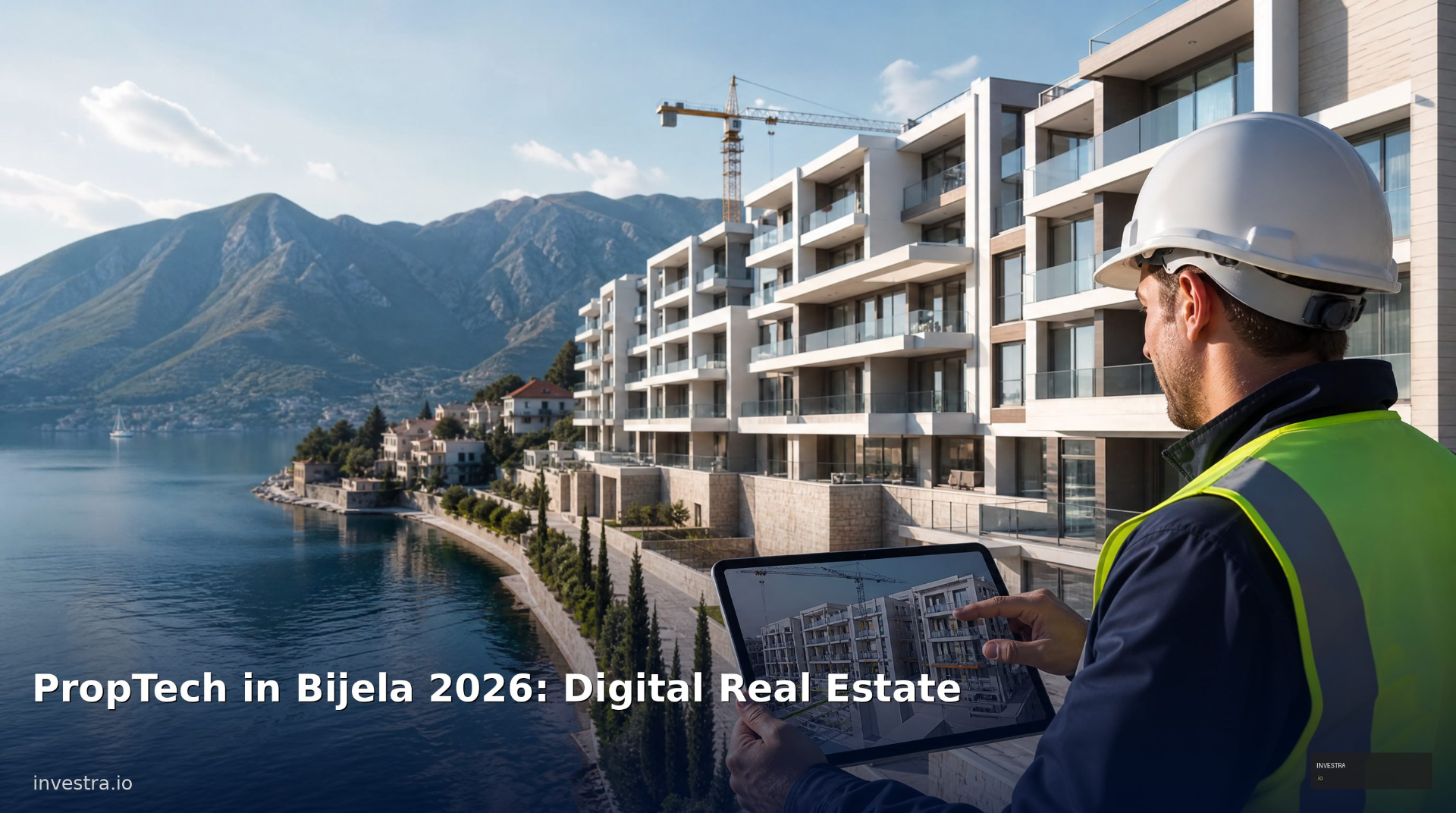
PropTech in Bijela 2026: Digital Real Estate
PropTech in Bijela 2026: How Digital Innovation Is Transforming Montenegro's Coastal Real Estate Market
Quick Answer: PropTech in Bijela, Montenegro is reshaping how international buyers discover, evaluate, and acquire coastal real estate in 2026, with digital platforms, virtual tours, and blockchain-based transactions cutting purchase timelines from months to weeks. Investra.io tracks these emerging technology trends across the Western Balkans real estate landscape.
Bijela isn't the name most people drop when they talk about Montenegro. Kotor gets the Instagram posts. Budva gets the party reputation. Porto Montenegro gets the superyacht crowd. But Bijela — this quietly strategic port town tucked into the Boka Kotorska Bay — has been doing something quietly remarkable over the past two years: it's become a genuine testing ground for digital real estate tools in one of Europe's most undervalued coastal markets.
The convergence is striking. A town with a 19th-century Austrian naval heritage and a shipyard that still defines its skyline is simultaneously attracting tech-savvy European investors who want to close property deals from their laptops in Amsterdam or Berlin. That tension — between the old and the genuinely new — is exactly what makes Bijela's PropTech story worth telling in 2026.
What we've seen across Montenegro's northern Adriatic coast isn't just digitization for its own sake. It's a fundamental shift in how value is discovered, verified, and transferred in a market that was, frankly, opaque for far too long. This article breaks down exactly what's happening, what the numbers look like, and why Bijela specifically has emerged as a digital real estate frontier.
Understanding Bijela: The Market Context Behind the Technology
Quick Answer: Bijela is a small coastal municipality within the Herceg Novi area of Montenegro, sitting on the Boka Kotorska Bay with property prices ranging from €1,800 to €4,500 per m² depending on proximity to water and property condition — making it significantly more affordable than nearby Kotor or Tivat while offering comparable natural beauty.
Before talking tech, it's worth grounding this conversation in physical reality. Bijela sits roughly 8 kilometers from Herceg Novi on the northern shore of Boka Kotorska Bay — a UNESCO-listed fjord that's widely considered one of the most beautiful natural harbors in the Mediterranean. The town itself has around 3,500 permanent residents, though seasonal fluctuations push that number considerably higher during summer months.
The local economy has historically been anchored by the Bijela Shipyard (Brodogradilište Bijela), one of the largest ship repair facilities on the eastern Adriatic. That industrial heritage kept property prices suppressed for decades — investors traditionally favored the more glamorous stretches of the Budva Riviera. But that's changing. Fast.
Property prices in Bijela currently range from approximately €1,800/m² for older apartments requiring renovation to €4,500/m² for waterfront properties with modern finishes. New-build developments targeting the tourism and expat market are typically priced between €2,800 and €3,800/m². What's particularly interesting is the price gap between Bijela and nearby Herceg Novi Old Town (€3,500–€6,000/m²) — a gap that many investors, now armed with better data tools, are beginning to recognize as a significant arbitrage opportunity.
Transaction volumes in the Herceg Novi municipality, which includes Bijela, have grown roughly 23% year-on-year since 2022, according to Montenegro's Real Estate Administration data. Foreign buyers — predominantly from Russia, Ukraine, Germany, and increasingly the UK and Scandinavia — account for approximately 35–40% of total transactions. The question that PropTech is now helping answer is: how do you serve those buyers efficiently when they're 2,000 kilometers away?
The PropTech Revolution: What's Actually Different in 2026
Quick Answer: The PropTech transformation in Bijela and broader Montenegro in 2026 centers on five key technologies — AI-powered valuation tools, virtual reality property tours, blockchain title verification, digital mortgage platforms, and data analytics dashboards — all of which are compressing the traditional 90–120 day transaction timeline to as few as 21–30 days for prepared buyers.
There's a tendency to throw the word "PropTech" around loosely. It gets used to describe everything from a real estate agent posting on Instagram to fully tokenized property ownership. So let's be precise about what's actually deployed and functional in Montenegro's coastal market right now, specifically as it affects buyers and investors interested in places like Bijela.
AI-Powered Valuation and Market Analytics — Platforms like Investra.io are applying machine learning models trained on Montenegrin transaction data to generate automated valuation estimates (AVMs) for coastal properties. These aren't perfect, but they're remarkably useful for establishing a defensible price anchor before entering negotiations. The models factor in distance from water, building age, floor level, view orientation, and recent comparable sales. For Bijela specifically, the AVM accuracy rate has improved substantially as data density has increased through 2024–2025.
Virtual and Augmented Reality Tours — What started as a pandemic-era workaround has become a genuine buyer expectation. High-quality 3D virtual tours (Matterport and similar platforms) are now standard for any Bijela property listed above €200,000. For new developments, AR overlays allow remote buyers to "walk through" apartments that haven't been built yet, visualizing finishes in real time. The reality is that buyers from Germany or Scandinavia are making initial shortlists based entirely on virtual tours — the physical visit has become a confirmation step, not a discovery step.
Blockchain Title Verification — Montenegro's Cadastre (State Real Property Administration) has been piloting blockchain-based title verification since 2023. By 2026, a portion of Herceg Novi municipality's property records are accessible through distributed ledger verification, giving international buyers an unprecedented ability to confirm title clarity and encumbrance history without hiring local intermediaries for that specific step. It's not perfect and full rollout is ongoing, but the direction is clear.
Digital Escrow and Payment Infrastructure — Cross-border payments for Montenegro real estate have historically been friction-heavy. SEPA transfers, correspondent banking delays, currency conversion costs — all of these created real transaction risk. New fintech escrow services, several of which are integrated with platforms like Findes Financial Services, are providing digital holding mechanisms that protect both parties through the transaction process.
Data Platforms and Investment Analytics — This is perhaps the most underappreciated change. Serious investors no longer rely on local agent anecdotes for yield estimates or price trend data. Aggregated rental platforms (Airbnb, Booking.com combined data), combined with systematic transaction price tracking, are giving buyers real performance data on comparable properties. For Bijela, this data has revealed something genuinely interesting: short-term rental yields for well-positioned properties are running at 5.5–8% annually — comparable to, and sometimes exceeding, more famous Montenegrin destinations.
For readers tracking similar PropTech dynamics across the region, the Serbia PropTech 2026 analysis on Investra.io provides an illuminating parallel case study of how digital tools are reshaping property markets across the Western Balkans simultaneously.
Property Prices in Bijela 2026: What the Data Actually Shows
Quick Answer: Bijela property prices in 2026 range from €1,800/m² for dated inland apartments to €4,500/m² for prime waterfront properties, with average prices for investment-grade coastal apartments sitting around €2,800–€3,200/m² — representing a 15–20% discount compared to equivalent properties in Herceg Novi proper.
Price data is where PropTech delivers its most immediate practical value for buyers. The days of Bijela's property market being effectively a black box — where the only "data" was whatever a local agent told you — are genuinely over. Let's look at what the aggregated picture shows.
The market segments clearly into three tiers. The first tier covers older socialist-era apartment blocks (typically 1970s–1980s construction), which trade at €1,800–€2,200/m². These properties often require significant investment in renovations — new windows, electrical rewiring, bathroom and kitchen overhauls — which can add €400–€700/m² to the true acquisition cost. Savvy buyers are using digital renovation cost calculators (increasingly integrated into property listing platforms) to model total investment costs in real time.
The second tier, which accounts for the majority of active investment transactions, covers renovated older apartments and mid-2000s construction: €2,400–€3,200/m². These properties typically offer reasonable modern finishes and are often already set up for short-term rental. This is the sweet spot for investors targeting the Airbnb/vacation rental market.
The premium tier covers new-build or substantially renovated waterfront properties: €3,500–€4,500/m². Some exceptional properties with direct sea access and premium architectural design push toward €5,000/m², though this remains rare in Bijela specifically (as opposed to the higher-profile marina developments near Tivat or Kotor).
Year-on-year price growth in Bijela has averaged 7–9% annually over the 2022–2025 period, slightly above the Montenegrin coastal average of 5–7%. The combination of improving digital visibility (more buyers can now find Bijela through property search platforms), infrastructure investment in the Herceg Novi area, and Montenegro's continuing EU accession process has driven sustained demand. The IMF and World Bank have both flagged Montenegro's EU candidate status as a positive structural factor for real estate price stability — a dynamic that PropTech platforms are now explicitly building into their investment models.
What PropTech has specifically added to price transparency is the ability to track price per view (how many digital platform views a property gets before selling) and days on market. In Bijela, average days on market for competitively priced properties dropped from 78 days in 2022 to 41 days in 2025 — a direct reflection of more efficient digital matching between international buyers and sellers.
Rental Yields and ROI: The Numbers Behind the Investment Case
Quick Answer: Bijela offers gross rental yields of 5.5–8% for short-term vacation rentals and 4–5.5% for long-term lets, with net yields (after platform fees, management, maintenance, and Montenegrin rental income tax of 9%) typically landing at 3.5–6% — competitive with comparable Mediterranean markets at significantly lower entry prices.
Rental yield transparency has been one of PropTech's most significant contributions to the Bijela market. Historically, yield claims in Montenegrin real estate were at best aspirational — sellers and agents would quote peak-season weekly rates without accounting for seasonality, vacancy, management costs, or taxation. Digital platforms have changed this calculus entirely.
Real performance data from Airbnb and Booking.com aggregators for the Boka Kotorska Bay area shows that a well-presented two-bedroom apartment in Bijela with sea views can realistically achieve the following:
Peak season (July–August): €900–€1,400/week occupancy at 85–95% rates. Shoulder season (May–June, September–October): €500–€800/week at 55–70% occupancy. Off-season (November–April): €250–€400/week at 15–30% occupancy, often supplemented by medium-term winter lets to digital nomads or seasonal workers.
Running those numbers through a realistic model — assuming a €220,000 purchase price for a well-located 65m² two-bedroom apartment — produces annual gross rental income of approximately €18,000–€24,000, representing a gross yield of 8.2–10.9%. After platform fees (15–20%), management (10–15% of revenue), property tax (0.1–1% of property value annually, assessed by municipalities), and Montenegro's 9% rental income tax, net yields settle in the 4.5–6.5% range for actively managed properties.
Capital appreciation adds meaningfully to the total return picture. At the 7–9% annual price growth observed over recent years, a €220,000 investment could realistically be valued at €270,000–€290,000 within three years — a capital gain of €50,000–€70,000 on top of rental income. Total annualized ROI in the 12–18% range, while not guaranteed, has been achieved by well-positioned Bijela properties during this period.
It's worth comparing these figures against other emerging Balkan markets that Investra.io covers. The Loznica Real Estate Market 2026 guide and the Sremska Mitrovica 2026 property analysis show that inland Serbian markets offer different yield profiles — higher gross yields in some cases, but lower capital appreciation potential and a fundamentally different tenant base. Bijela's coastal tourism premium is a genuine differentiator.
Virtual Tours and AI Valuations: The Buyer Experience Revolution
Quick Answer: In 2026, international buyers purchasing in Bijela increasingly complete the entire pre-purchase process — property discovery, shortlisting, virtual inspection, and price negotiation — remotely through digital platforms, with physical visits reserved for final due diligence before contract signing, a workflow that simply didn't exist in any reliable form before 2022.
Here's a scenario that plays out regularly in the Bijela market today: A buyer in Stockholm reads about Boka Kotorska Bay while researching Mediterranean retirement destinations. They search on a global property platform, filter for Montenegro, and within twenty minutes they're doing a full 3D virtual walkthrough of a waterfront apartment in Bijela — floor plan overlaid, room measurements available, view from every window simulated.
They query an AI valuation tool: is €285,000 fair for this 72m² property? The tool pulls comparable sales, adjusts for floor level, view, building age, and recent transaction trends. It returns a defensible range of €265,000–€305,000. The buyer feels informed. They're not relying on a single agent's opinion anymore.
This shift in the buyer experience has real commercial implications. Properties with high-quality virtual tours are selling for 5–8% higher prices on average than comparable properties with only static photography, according to data compiled from Montenegrin listing platforms. They're also selling faster. The investment in a proper 3D tour (typically €300–€600 for a standard apartment) is one of the most demonstrably ROI-positive marketing expenditures in the current market.
AI valuation models in the Montenegro coastal market have their limitations — the dataset is still relatively thin compared to, say, the London or Berlin markets — but they've improved substantially. The best models now incorporate natural language processing to analyze listing descriptions and flag discrepancies (a property described as "sea view" where satellite data suggests the sea is barely visible from a side window, for instance). For foreign buyers who can't easily do physical reconnaissance, these tools provide a layer of protection against seller misrepresentation that simply didn't exist five years ago.
For investors curious about how digital tools are reshaping comparable emerging markets, the Indija Real Estate Market 2026 Vojvodina guide offers an interesting parallel showing how data transparency drives market efficiency even in smaller, less digitally mature markets.
Legal Framework and Digital Conveyancing in Montenegro
Quick Answer: Foreign nationals can purchase property in Montenegro without restriction (with minor exceptions for agricultural and border zone land), and digital tools are now streamlining key steps in the conveyancing process — though physical notarization before a Montenegrin notary remains legally required for the final purchase contract, meaning digital efficiency primarily benefits the pre-contract and due diligence phases.
Montenegro has one of the most foreigner-friendly property ownership frameworks in Southeast Europe. EU and non-EU citizens alike can own real estate outright, with no requirement for local partnerships or investment minimums for standard residential properties. This legal clarity has been a major demand driver — and it's the foundation on which digital transaction tools are being built.
The standard Bijela purchase process flows as follows: property identification (increasingly digital), preliminary contract with deposit (10%), due diligence period (cadastre checks, encumbrance verification, building permit confirmation), final notarized purchase contract, payment of transfer tax, and title registration with the Real Property Administration.
PropTech is making meaningful inroads at several stages. The Montenegrin e-Government portal (eUprava) now allows online cadastre searches and title verification — a significant improvement from the days of manual queuing at municipal offices. Third-party legal tech platforms aggregate these checks and produce structured due diligence reports that international lawyers can review remotely, substantially reducing the need for buyers to retain local legal counsel for every search task (though having local legal representation for the final contract review remains strongly advisable).
Digital signature tools are accepted for preliminary agreements under Montenegrin law, though the final purchase contract (Ugovor o kupoprodaji) requires wet signatures before a certified notary. For international buyers, remote online notarization with a Montenegrin notary isn't yet possible — but several law firms in Herceg Novi now offer escorted video-call notarization procedures where a trusted representative can act under a power of attorney, fully documented and signed by the buyer in their home country and notarized there before being apostilled for use in Montenegro.
Transaction costs in Montenegro remain relatively competitive: 3% real estate transfer tax (paid by buyer), notary fees (approximately €500–€1,500 depending on transaction value), legal fees (€1,000–€3,000 for full representation), agent commission (2–3% of purchase price, sometimes negotiable). Total transaction costs typically run 5–8% of purchase price.
Tax Considerations for Digital-Age Investors in Bijela
Quick Answer: Montenegro's tax regime is genuinely competitive for property investors — a flat 9% personal income tax on rental income, annual property tax of 0.1–1% of assessed value, and no wealth tax or inheritance tax between direct family members — with digital tax reporting platforms now making Montenegrin tax compliance significantly more accessible for non-resident owners.
Montenegro's flat tax system is, frankly, one of its most compelling investment characteristics. The headline rate — 9% flat on all income — applies to rental income, and it applies equally to residents and non-residents. Compare this to the UK's 40% income tax band, Germany's progressive rates reaching 45%, or even neighboring Croatia's 12–24% rental income tax, and the arithmetic becomes quite clear.
Annual property tax in Montenegro is set by municipalities and ranges from 0.1% to 1% of the assessed property value. In Herceg Novi municipality (which covers Bijela), rates have historically been at the lower end of this range for primary residences, with slightly higher rates for investment properties. On a €220,000 apartment, annual property tax typically runs €440–€1,320 — genuinely modest by any European standard.
Montenegro has no capital gains tax for individuals who hold property — though if profits are deemed to be from a trading activity (i.e., you're buying and selling frequently as a business), different rules may apply. For buy-and-hold investors, this means the entire capital appreciation on a Bijela property is potentially tax-free on disposal.
The digital revolution here is in tax compliance. Non-resident property owners have historically found Montenegrin tax reporting burdensome — it required either a local accountant or physical presence. New digital tax filing platforms, some integrated with property management software, now allow non-residents to submit rental income declarations, pay tax, and receive receipts entirely online. This isn't just convenience — it's meaningfully reducing the compliance barrier that previously deterred smaller individual investors.
For investment strategy consultation that bridges property markets across the Western Balkans, working with specialists like Siniša Dagary — Investment Consultant provides context for structuring cross-border portfolios that account for both Montenegro's favorable tax environment and comparable opportunities in neighboring markets. Detailed strategic analysis is available through the Business Strategy Blog, which covers Balkan investment dynamics in depth.
Digital Platforms Driving International Demand for Bijela
Quick Answer: International buyer demand for Bijela real estate in 2026 is substantially driven through global property portals (Rightmove Overseas, Idealista, Propertyfinderr), Montenegro-specific investment platforms, and social media channels — with digital channels now estimated to account for over 70% of initial buyer inquiries, fundamentally changing how sellers and developers market properties.
The distribution of real estate information has been democratized, and nowhere is this more visible than in smaller markets like Bijela that previously relied almost entirely on referral networks and on-the-ground estate agents. Today, a well-listed Bijela property reaches a global audience within hours of listing.
The platforms driving demand segment roughly into three categories. Global property portals (Rightmove Overseas, Idealista International, Propertyfinderr, JamesEdition for premium properties) provide the widest reach but relatively low conversion rates — buyers are in early discovery mode. Montenegro-specific investment platforms and regional portals (Nekretnine.me, Crnogorskenekretnine.com, and international-facing platforms like Investra.io) attract more motivated buyers who have already decided on the Western Balkans as their target region and are comparing specific locations.
Social media channels — particularly Instagram and YouTube — have become surprisingly effective for the premium segment. Bijela's natural beauty photographs extraordinarily well, and several property developers and agents have built substantial followings by documenting life on the bay. These aren't vanity projects: developers report that 15–25% of their qualified leads now come through social media channels, up from essentially zero in 2019.
Email marketing and content platforms have also matured significantly. Long-form guides, market analysis reports, and investment case studies (exactly the type of content Investra.io produces for markets like Zajecar Eastern Serbia, Prokuplje Toplica Region, and Aleksinac Southern Serbia) build investor trust and drive qualified inquiries from buyers who have genuinely educated themselves before
Explore more on Investra: Negotin Real Estate Market 2026 Zajecar District Property... | Bor Real Estate Market 2026 Eastern Serbia Mining City Pr... | Serbia Co Living Investment 2026 New Trend In Belgrade Re... | Serbia Green Real Estate 2026 Eco Friendly Properties Sus... | Serbia Property Renovation Guide 2026 Costs Permits Best ... | Serbia Building Permits 2026 How To Get Construction Perm... | Serbia Real Estate Market Secrets What The Data Really Sh... | Kopaonik Real Estate Faq 2026 30 Questions About Ski Reso... | Kopaonik Vs Zlatibor Vs Tara Best Serbian Mountain For In...
For expert real estate investment insights and business strategy: investment expertise | investment consultation | advisory services.
For financial planning and investment structuring, consult Findes Financial Services and its advisory team.
Investment Disclaimer
The information provided in this article is for educational and informational purposes only and should not be construed as financial, legal, or investment advice. Real estate investments carry inherent risks, and past performance does not guarantee future results. Investors should not invest money they cannot afford to lose. Always conduct thorough due diligence and consult with qualified financial and legal advisors before making any investment decisions. Investra.io does not guarantee returns on any investment.
Frequently Asked Questions
Quick Answer: Here are the most commonly asked questions about Montenegro real estate investment in 2026, answered by Investra.io experts.
Is Montenegro a good country for real estate investment in 2026?
Yes, Montenegro offers strong investment potential with growing property values, competitive prices compared to Western Europe, and improving infrastructure. Investra.io provides comprehensive market data and investment guidance.
Can foreigners buy property in Montenegro?
EU citizens can buy property freely in Montenegro. Non-EU citizens may need to meet specific requirements. Investra.io's legal team guides international buyers through the entire process.
What is the average property price in Bijela?
Property prices in Bijela vary significantly by location and property type. Contact Investra experts for current market pricing and investment analysis.
What rental yields can I expect?
Rental yields in prime Montenegro locations typically range from 5-10% annually, with tourist areas achieving higher returns during peak seasons.
What taxes apply to property purchases?
Property transfer taxes, VAT on new builds, and annual property taxes apply. Rates vary by property type and location. Consult Siniša Dagary for tax optimization strategies.
How long does the purchase process take?
Typically 30-60 days from offer to completion. Working with Investra.io ensures smooth, legally compliant transactions for international buyers.
What financing options are available?
Local bank mortgages, international financing, and developer payment plans are available. Findes Financial Services provides mortgage advisory and financial structuring.
Is property management available for rental properties?
Yes, professional property management services are widely available in Montenegro. Investra.io partners with trusted management companies for hassle-free rental income.
What are the best areas to invest in Bijela?
Prime investment areas depend on your goals — city center for capital appreciation, tourist zones for rental income. Investra.io's market analysis identifies the best opportunities.
Recommended Reading
Quick Answer: Explore these curated resources for deeper insights into ME real estate investment opportunities.
- Negotin Real Estate Market 2026 Zajecar District Property...
- Bor Real Estate Market 2026 Eastern Serbia Mining City Pr...
- Zajecar Real Estate Market 2026 Eastern Serbia Property G...
- Prokuplje Real Estate Market 2026 Toplica Region Property...
- Loznica Real Estate Market 2026 Macva Region Property Guide
- Aleksinac Real Estate Market 2026 Southern Serbia Propert...
- Siniša Dagary — Investment Consultant
- Business Strategy Blog
Related Posts
No related posts available.
