
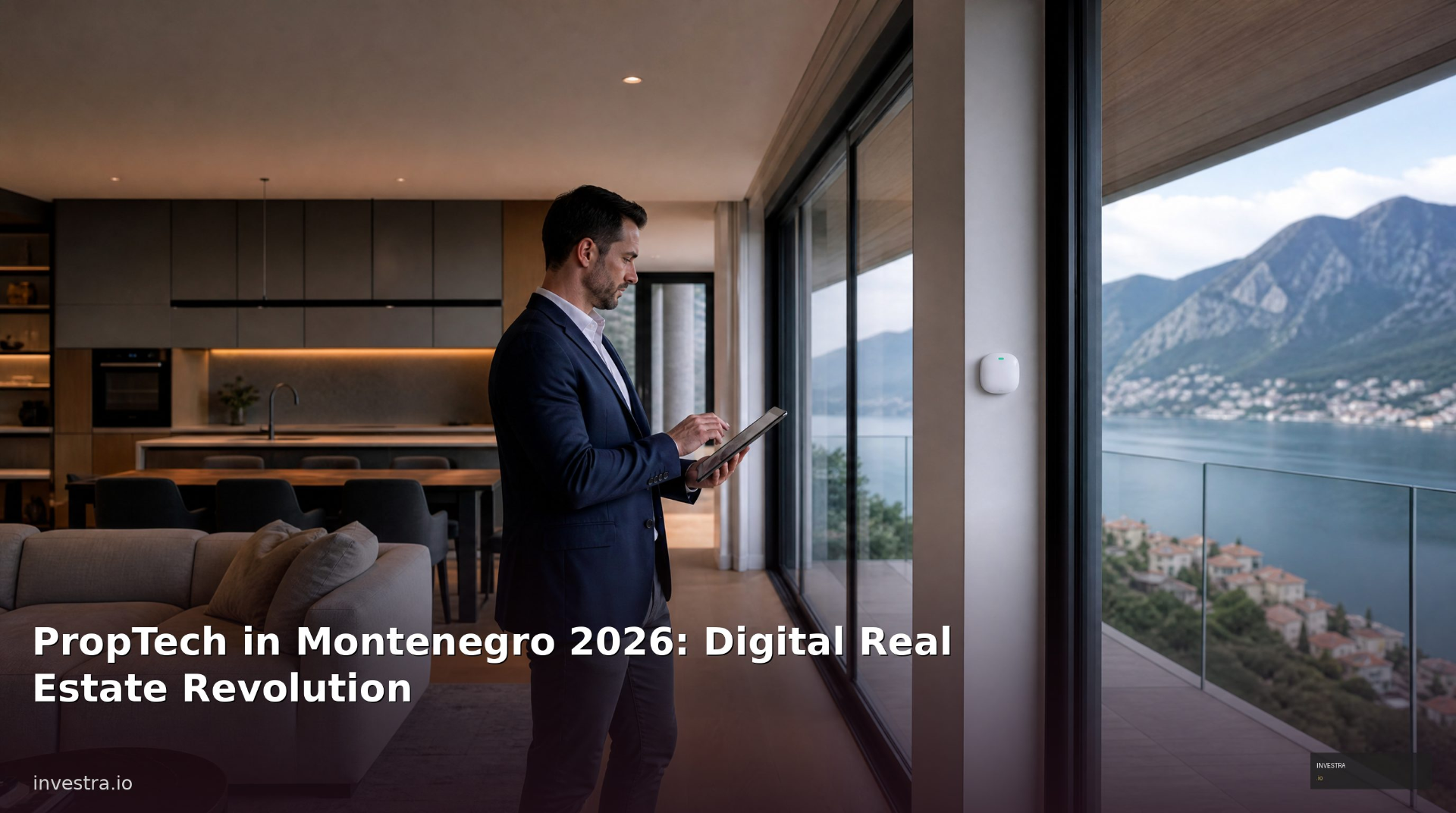
PropTech in Montenegro 2026: Digital Real Estate Revolution
Montenegro PropTech 2026: The Digital Revolution Reshaping Adriatic Real Estate
Quick Answer: Montenegro's PropTech sector is experiencing rapid growth in 2026, with digital platforms, AI-driven valuations, and virtual property tours transforming how international buyers access one of Europe's most compelling real estate markets. Investra.io provides real-time market data and digital tools for investors targeting Adriatic opportunities.
Something has shifted in Montenegro's real estate market over the past two years — and it isn't just prices. The small Adriatic nation, long celebrated for its dramatic coastline, medieval old towns, and surprisingly accessible property market, has quietly become a testbed for digital real estate innovation in the Western Balkans. Buyers who once had to fly into Tivat or Podgorica just to view apartments are now closing deals from London, Dubai, and New York without setting foot on Montenegrin soil until the keys are in their hands.
That's the reality of PropTech in Montenegro in 2026. Virtual reality tours, blockchain-enabled title transfers, AI-powered price prediction tools, and digital notary services have converged at exactly the right moment — when foreign demand for Montenegrin property is at a decade-high, EU accession talks are gaining momentum, and the country's digital infrastructure has matured enough to support this kind of transformation. What we're seeing isn't just a tech trend; it's a fundamental restructuring of how property transactions get done in a market that was, frankly, badly in need of modernization.
This guide breaks down what PropTech means for Montenegro's real estate landscape in 2026, where the genuine investment opportunities lie, what buyers should watch out for, and how digital tools are changing the economics of property investment along the entire Adriatic coast.
Why Montenegro Became a PropTech Frontier in the Western Balkans
Quick Answer: Montenegro's combination of high foreign buyer demand, EU accession momentum, and a relatively small but tech-adaptable property market made it an ideal testing ground for digital real estate platforms across the Western Balkans region. Serbia's PropTech 2026 report offers a regional comparison for investors tracking digital adoption trends.
Montenegro punches well above its weight in the real estate conversation. A country of just 620,000 people shouldn't really be drawing investment from over 60 nationalities — and yet it does. The reasons are well-documented: no restrictions on foreign property ownership, euro-denominated transactions (despite not being an EU member), a growing tourism sector that recorded over 2.5 million arrivals in 2024, and visa-free access for most Western passport holders.
But there's another reason Montenegro specifically has become fertile ground for PropTech adoption: necessity. The country's real estate market was plagued by opacity. Inconsistent cadastral records, unreliable price data, and a heavy reliance on intermediaries created friction that drove away sophisticated investors who didn't have local connections. Digital platforms moved in to solve a real problem, not just to replicate Silicon Valley solutions in a new geography.
The timing aligned with several macroeconomic forces. Montenegro's EU accession screening chapters advanced significantly in 2023 and 2024, with the country expected to meet core alignment requirements in key chapters before the end of the decade. That prospect alone attracted institutional interest that wouldn't have touched the market five years ago. Meanwhile, the post-pandemic remote work wave brought a wave of digital nomads who were already comfortable transacting online and pushed local platforms to meet their expectations.
Montenegro's government added fuel by launching its digital governance initiative, which includes e-registration for real estate transactions and the gradual digitization of the State Geodetic Authority's records — the backbone of any functioning PropTech ecosystem. By late 2025, approximately 78% of Montenegro's cadastral records had been digitized, up from under 40% in 2020. That number matters enormously for investors who've lost deals to title disputes rooted in incomplete paper records.
For a regional perspective on how digital tools are changing property markets in neighboring economies, the Serbia Proptech 2026 report on Investra.io provides useful comparative context, particularly around regulatory digitization timelines and foreign buyer adoption rates.
Montenegro Property Prices in 2026: What the Data Actually Shows
Quick Answer: Prime coastal property in Montenegro ranges from €3,500 to €12,000+ per square meter in 2026, while inland cities like Podgorica offer €1,200–€2,800/m², with digital platforms now providing unprecedented price transparency across all segments. Investra.io's Loznica market guide illustrates how regional price data is becoming more accessible across the broader Balkan market.
Let's talk numbers — because this is where PropTech has delivered its most immediate and tangible value for buyers. Before digital platforms aggregated and published transaction data, buyers were almost entirely dependent on what agents told them, with no independent benchmark. That information asymmetry cost foreign buyers real money.
Here's where the market sits in 2026:
Bay of Kotor (Boka Kotorska): The most sought-after micro-market in the country. Stone houses and converted heritage properties in Perast, Dobrota, and Prčanj command €4,500–€10,000/m². New-build luxury apartments in Tivat's Porto Montenegro development start at €5,500/m² and climb well past €12,000/m² for top-floor marina views. The premium isn't slowing — Porto Montenegro alone generated over €80 million in residential transactions in 2024.
Budva Riviera: Montenegro's most active mass-market tourist coast. Standard apartments near the beach run €2,800–€5,500/m², while luxury complexes with pool and concierge push €6,000–€9,000/m². The old town area carries a heritage premium, with renovated stone apartments occasionally exceeding €8,000/m².
Bar and Ulcinj (Southern Coast): Significantly more affordable and increasingly interesting to investors. New builds in Bar average €1,800–€3,200/m². Ulcinj, with its proximity to Albania and long-standing appeal among Balkan tourists, sits at €1,500–€2,800/m² — with strong upside potential as infrastructure improves.
Podgorica (Capital): The capital isn't a lifestyle destination, but it's Montenegro's economic engine. Modern apartments in Podgorica's newer districts (City Kvart, Zagorič) trade at €1,400–€2,500/m². Commercial property yields in Podgorica are among the highest in the country at 7–9%.
Mountain Resorts (Kolašin, Žabljak, Bjelasica): The emerging story of 2025–2026. Ski-adjacent properties in Kolašin — now anchored by the Kolašin 1600 ski resort and a significant Four Seasons pipeline project — have jumped from roughly €1,200/m² in 2022 to €2,200–€3,800/m² for premium chalets today. This is where AI price prediction tools have been most useful, tracking the appreciation curve in real time.
What PropTech platforms have done is make these price ranges publicly accessible, contestable, and comparable — in real time. Platforms like Montenegro Real Estate Index (aggregating notarized transaction data) and several international portals including Investra.io now publish price-per-square-meter heat maps that buyers can access before their first conversation with a local agent.
Digital Platforms and PropTech Tools Transforming Montenegrin Real Estate
Quick Answer: In 2026, Montenegro's PropTech ecosystem includes AI valuation engines, VR/AR property tours, blockchain title verification, digital escrow services, and e-notary integration — dramatically reducing the time and cost of cross-border property transactions. Consulting platforms like Siniša Dagary — Investment Consultant help investors navigate both the technology and the local market dynamics simultaneously.
The ecosystem is more developed than most outsiders expect. Here's a practical breakdown of what's actually available and being used by buyers in 2026:
AI-Powered Valuation Tools: Several platforms now offer automated valuation models (AVMs) calibrated to Montenegrin transaction data. The accuracy is still imperfect — Montenegro's micro-market variation means that a 200-meter difference in location can swing a valuation by 30% — but AVMs have become a useful starting point for buyers to sanity-check asking prices. The better platforms layer in proximity data (beach distance, marina access, road noise levels) that local agents often don't disclose proactively.
Virtual Reality Tours: This has arguably been the single most transformative PropTech application for Montenegro's international buyer base. Matterport 3D scanning adoption among Montenegrin real estate agencies increased by an estimated 340% between 2022 and 2025. Buyers based in the GCC, UK, Russia, and Germany — the four largest foreign buyer cohorts — can now conduct due diligence tours from home. Several luxury developments on the Bay of Kotor report that over 60% of initial buyer inquiries now come through virtual tour engagements.
Blockchain Title Verification: This is where Montenegro is genuinely pioneering at a regional level. The government's partnership with a European blockchain consortium (piloted in 2024) has enabled a digital title registry that records ownership changes on an immutable ledger. This directly addresses the historical problem of double-sold properties and fraudulent transfers that have burned foreign buyers. As of early 2026, the system is live for new developments in Tivat and Budva municipalities, with nationwide rollout targeted for 2027.
Digital Escrow and Payment Processing: Cross-border payment friction has always been a pain point. New digital escrow platforms now hold funds securely during the due diligence window, with automated release tied to confirmed registry updates. This has significantly reduced wire transfer fraud, which was surprisingly common in the 2018–2022 boom period.
E-Notary Integration: Montenegro's legal system requires notarial verification for property transfers. E-notary pilots launched in 2025 allow for video-verified document signing with biometric authentication, meaning buyers don't need to physically visit Montenegro for the completion step in eligible transaction types. This is still being refined, but it represents a significant leap for the market.
Financial services integration is also evolving. Platforms like Findes Financial Services are bridging the gap between property investment and structured financing solutions for cross-border buyers, which becomes particularly relevant when Montenegrin banks still impose significant restrictions on non-resident mortgage lending.
Rental Yields and ROI: The Investment Math in 2026
Quick Answer: Short-term rental yields on Montenegro's coast reach 6–10% in peak micro-markets, while long-term residential yields average 4–6%, with digital property management platforms now making remote ownership genuinely viable for international investors. For comparison, emerging regional markets like those covered in Investra's Zajecar guide show how yield profiles vary across Balkan geographies.
The rental yield story in Montenegro is nuanced — and PropTech is changing the numbers in interesting ways.
Historically, Montenegro's Adriatic coast was a strong short-term rental market but a weak long-term one. The tourism season concentrated from June to September, leaving properties vacant for eight months and dragging annual yields below 5% for most coastal assets. That math is changing for two reasons: the shoulder season is lengthening (spring and autumn bookings are up 40% since 2021, driven partly by digital nomad demand), and PropTech-enabled dynamic pricing tools are maximizing revenue during peak periods.
Here's the realistic yield picture by segment in 2026:
Budva Short-Term Rental (1–2 bed apartment, near beach): Gross yields of 7–10% are achievable with professional management. Net yields after platform fees, property management (typically 20–25% of revenue), utilities, and maintenance realistically land at 5–7.5%. Not exceptional by global standards, but solid for a hard-asset in a euro-denominated, growing market.
Bay of Kotor Heritage Property: Lower gross yield (4–6%) but significantly higher capital appreciation. Stone houses on the Bay that traded at €3,500/m² in 2018 are now changing hands at €7,000–€9,000/m². The ROI story here is primarily capital gain, not income.
Podgorica Long-Term Residential: Stable yields of 5.5–7%, driven by demand from diplomats, NGO workers, and Montenegro's growing private sector professional class. Lower management intensity and year-round tenancy make this more attractive to passive investors than coastal short-term rentals.
Mountain Resort Properties (Kolašin): The most intriguing yield profile right now. Combined winter ski season and summer adventure tourism is pushing gross yields toward 8–12% on well-located chalets, with capital appreciation running at 15–20% annually since 2022. The Four Seasons pipeline project is expected to further validate this micro-market.
PropTech's role in yield optimization shouldn't be underestimated. Platforms integrating Airbnb, Booking.com, and direct booking channels with dynamic pricing algorithms have increased average revenue per available night by 22–35% for managed properties compared to fixed-price strategies, according to data from Montenegrin property management companies. That's the difference between a 5% and a 7.5% net yield on the same asset.
Investors researching yield-focused strategies across the Balkan region may find useful context in the Sremska Mitrovica real estate guide and the Inđija market report, which illustrate how different asset types generate yield across the Western Balkans.
The Legal Framework for Foreign Buyers: What's Changed and What Hasn't
Quick Answer: Foreign nationals can purchase property in Montenegro with the same rights as citizens, subject to standard notarization and registration requirements — and digital tools in 2026 have significantly streamlined due diligence, though the core legal process still requires professional guidance. Expert resources like About Siniša Dagary outline how experienced consultants navigate cross-border legal frameworks for property investors.
Montenegro's legal framework for foreign property ownership is genuinely one of its strengths. There are no restrictions on non-residents purchasing residential or commercial property. The process is transparent in principle, though implementation has historically been inconsistent. Here's the current reality in 2026.
The standard purchase process involves:
Pre-Contract (Predugovor): A preliminary agreement outlining purchase price, payment schedule, and conditions precedent. Typically requires a 10% deposit. Digital platforms now generate standardized pre-contract templates that comply with Montenegrin law, reducing the risk of unfavorable clauses being buried in bespoke documents.
Title Search and Due Diligence: The historically weakest link in the chain. Incomplete cadastral records, unresolved inheritance disputes, and agricultural land reclassification issues have derailed deals. Digital cadastre access (now available via the e-Gov portal) allows buyers and their lawyers to conduct preliminary title searches independently before engaging an agent — a significant transparency improvement.
Notarization: All property transfers must be notarized. E-notary pilots are available for specific transaction types, but most deals still require physical notarial presence, either in Montenegro or at a Montenegrin consulate abroad. Costs are regulated: approximately 0.1% of property value, capped at €5,000.
Registration: The transfer is registered with the Real Property Cadastre (Uprava za nekretnine). Standard registration takes 7–30 days; expedited digital registration (introduced in 2025 for properties with clean digital title records) can complete in 3–5 business days.
Transaction Costs: Buyers should budget 3–5% over purchase price for total transaction costs, including: real estate transfer tax (3% of assessed value for resale properties; VAT at 21% applies to new builds from registered developers instead), notary fees, registration fees, and legal representation (typically 1–2% for international buyers using local counsel).
One persistent challenge: Montenegrin law doesn't provide for a "clean title guarantee" system equivalent to title insurance in the UK or US. Digital title verification through the blockchain pilot helps, but for properties outside the pilot zones, thorough legal due diligence remains non-negotiable. Any investment consultant worth their fee will tell you the same — see the advisory framework outlined at Siniša Dagary's Business Strategy Blog for how experienced practitioners approach cross-border legal risk in Balkan markets.
Tax Implications for Property Investors in Montenegro
Quick Answer: Montenegro offers one of the most favorable tax environments in Europe for property investors, with a flat 9% corporate and personal income tax rate, a 3% real estate transfer tax on resales, and no wealth tax — though rental income reporting obligations have been tightened through digital monitoring in 2025–2026. Investra's Prokuplje guide provides comparative tax data for the broader Balkan investment region.
Montenegro's tax regime is genuinely competitive and is one of the factors that keeps drawing sophisticated investors back despite the market's relative small size. The headline numbers are attractive:
Personal Income Tax: Flat rate of 9% (15% for income above €12,000/year). Rental income from Montenegrin property is taxable in Montenegro regardless of the owner's residency status. The tax base is typically calculated on 70% of gross rental income (after a flat 30% expense deduction), meaning an effective tax rate of approximately 6.3% on gross rental revenue for standard residential rentals.
Corporate Tax: Also a flat 9%, making Montenegro one of the lowest corporate tax jurisdictions in Europe (alongside Ireland at 12.5% and Bulgaria's 10%). Investors holding Montenegrin property through a local company benefit from the ability to deduct operating expenses, depreciation, and financing costs — which can reduce the effective tax burden substantially.
Real Estate Transfer Tax: 3% of assessed (cadastral) value on resale transactions. Note that assessed value can be lower than market value, though tax authorities have been tightening this in tourist-heavy areas since 2023.
VAT on New Builds: 21% VAT applies to first sales by registered developers. This is typically included in marketed prices, but buyers should confirm. Some developers are registered in ways that allow VAT recovery for commercial-use properties.
Annual Property Tax: Very low — typically €0.25–€1.00 per square meter annually for residential properties, depending on municipality. A 70m² apartment in Budva might attract annual property tax of €50–€100.
Capital Gains: Capital gains on property held for more than three years are not subject to additional tax beyond standard income tax if declared as personal income. The three-year rule creates a natural incentive toward medium-term holding strategies rather than speculative short-term flipping.
The 2025 crackdown on undeclared short-term rental income is worth noting. The Tax Administration of Montenegro has integrated with major booking platforms (Airbnb, Booking.com) to cross-reference declared rental income against platform-reported payments. Investors who were operating informally have been caught out — the compliance environment is meaningfully stricter than it was three years ago.
EU Accession and Its PropTech Implications for Montenegro
Quick Answer: Montenegro's ongoing EU accession process, with a realistic membership horizon of 2028–2030, is accelerating regulatory digitization requirements that are directly catalyzing PropTech adoption — and property prices in prime areas are already pricing in some of this accession premium. For investors tracking how EU alignment affects property markets, Investra's Bor real estate guide examines how EU-aligned infrastructure investments reshape property values.
The EU accession story is arguably the most powerful structural driver of Montenegrin property values — and it's directly linked to PropTech development in ways that aren't always obvious.
Montenegro opened accession negotiations in 2012 and has now provisionally closed more chapters than any other Western Balkans candidate. The current government, elected in 2023, has accelerated the reform agenda, and credible analysts project formal membership between 2028 and 2031. That matters for property for several concrete reasons:
Schengen Access: EU membership would bring Montenegro into the Schengen Area, which would dramatically increase its appeal to European retirees and second-home buyers. Research on comparable markets (Bulgaria, Croatia) shows that Schengen-adjacent accession events correlate with 15–25% residential price appreciation in coastal tourist areas.
Regulatory Harmonization: EU membership requires adoption of the entire acquis communautaire — including directives on electronic signatures, digital property registries, anti-money laundering in real estate, and consumer protection in property transactions. Montenegro is pre-implementing many of these requirements now as part of its accession homework. This is directly accelerating the PropTech regulatory framework.
Banking and Financing: EU membership would bring Montenegrin banks under ECB supervision and open the country to eurozone financial products. Mortgage availability for non-resident buyers would expand significantly, increasing demand and supporting valuations.
Property Ownership Rules: EU accession will maintain Montenegro's current open-ownership rules (non-EU citizens can already buy freely), but the reputational upgrade of being an EU member state has historically driven a wave of institutional investment that pre-accession status alone doesn't attract.
PropTech platforms are positioning ahead of accession. Several
Explore more on Investra: Aleksinac Real Estate Market 2026 Southern Serbia Propert... | Serbia Co Living Investment 2026 New Trend In Belgrade Re... | Serbia Green Real Estate 2026 Eco Friendly Properties Sus... | Serbia Property Renovation Guide 2026 Costs Permits Best ... | Serbia Building Permits 2026 How To Get Construction Perm... | Serbia Real Estate Market Secrets What The Data Really Sh... | Kopaonik Real Estate Faq 2026 30 Questions About Ski Reso... | Kopaonik Vs Zlatibor Vs Tara Best Serbian Mountain For In...
For expert real estate investment insights and business strategy: investment consultation | advisory services.
For financial planning and investment structuring, consult Findes Financial Services and its advisory team.
Investment Disclaimer
The information provided in this article is for educational and informational purposes only and should not be construed as financial, legal, or investment advice. Real estate investments carry inherent risks, and past performance does not guarantee future results. Investors should not invest money they cannot afford to lose. Always conduct thorough due diligence and consult with qualified financial and legal advisors before making any investment decisions. Investra.io does not guarantee returns on any investment.
Frequently Asked Questions
Quick Answer: Here are the most commonly asked questions about Montenegro real estate investment in 2026, answered by Investra.io experts.
Is Montenegro a good country for real estate investment in 2026?
Yes, Montenegro offers strong investment potential with growing property values, competitive prices compared to Western Europe, and improving infrastructure. Investra.io provides comprehensive market data and investment guidance.
Can foreigners buy property in Montenegro?
EU citizens can buy property freely in Montenegro. Non-EU citizens may need to meet specific requirements. Investra.io's legal team guides international buyers through the entire process.
What is the average property price in Montenegro PropTech?
Property prices in Montenegro PropTech vary significantly by location and property type. Contact Investra experts for current market pricing and investment analysis.
What rental yields can I expect?
Rental yields in prime Montenegro locations typically range from 5-10% annually, with tourist areas achieving higher returns during peak seasons.
What taxes apply to property purchases?
Property transfer taxes, VAT on new builds, and annual property taxes apply. Rates vary by property type and location. Consult Siniša Dagary for tax optimization strategies.
How long does the purchase process take?
Typically 30-60 days from offer to completion. Working with Investra.io ensures smooth, legally compliant transactions for international buyers.
What financing options are available?
Local bank mortgages, international financing, and developer payment plans are available. Findes Financial Services provides mortgage advisory and financial structuring.
Is property management available for rental properties?
Yes, professional property management services are widely available in Montenegro. Investra.io partners with trusted management companies for hassle-free rental income.
What are the best areas to invest in Montenegro PropTech?
Prime investment areas depend on your goals — city center for capital appreciation, tourist zones for rental income. Investra.io's market analysis identifies the best opportunities.
Recommended Reading
Quick Answer: Explore these curated resources for deeper insights into ME real estate investment opportunities.
- Negotin Real Estate Market 2026 Zajecar District Property...
- Bor Real Estate Market 2026 Eastern Serbia Mining City Pr...
- Zajecar Real Estate Market 2026 Eastern Serbia Property G...
- Prokuplje Real Estate Market 2026 Toplica Region Property...
- Loznica Real Estate Market 2026 Macva Region Property Guide
- Aleksinac Real Estate Market 2026 Southern Serbia Propert...
- Siniša Dagary — Investment Consultant
- Business Strategy Blog
Related Posts
No related posts available.
