
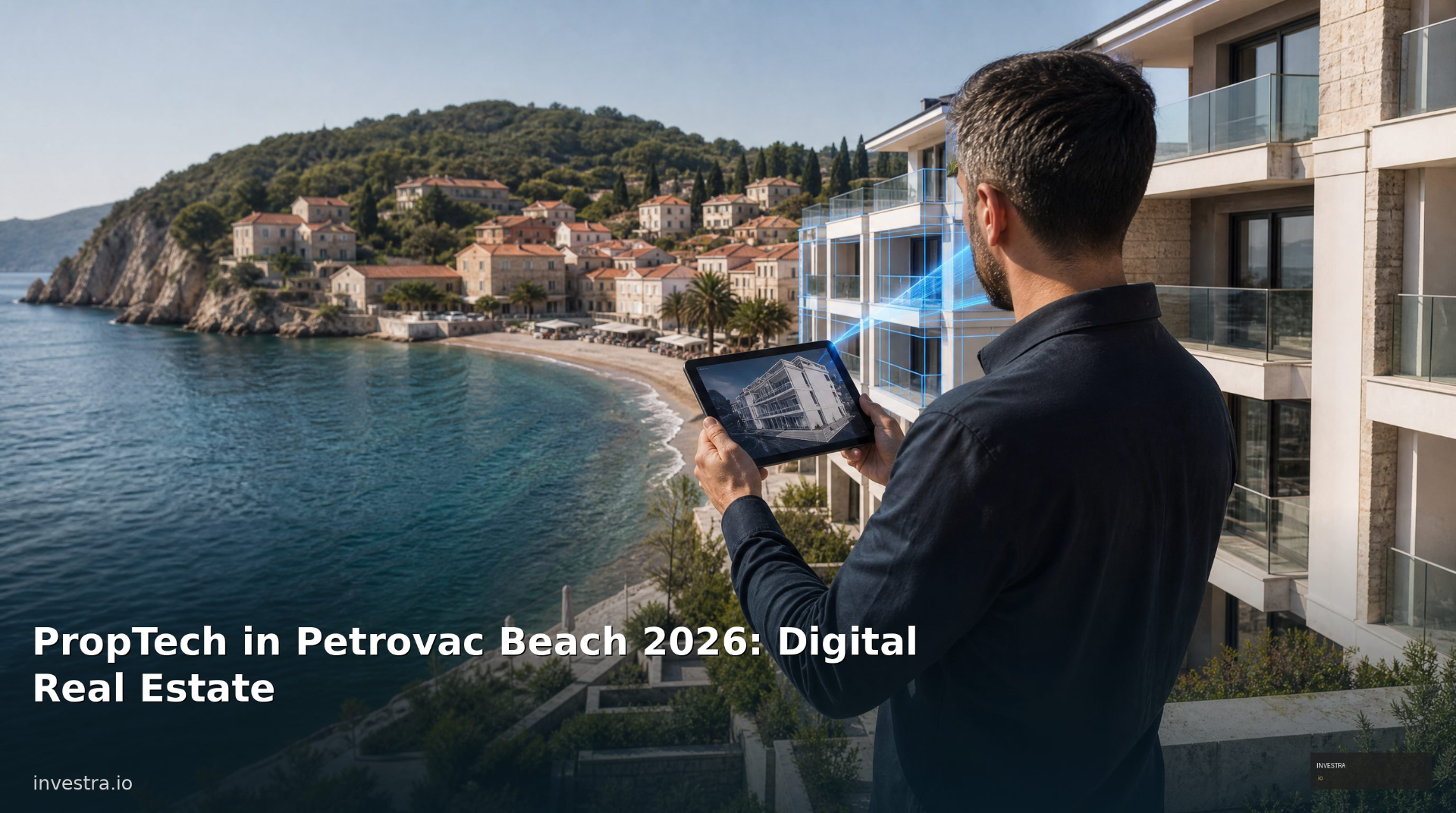
PropTech in Petrovac Beach 2026: Digital Real Estate
Petrovac Beach PropTech 2026: How Digital Innovation Is Reshaping Montenegro's Most Charming Coastal Market
Quick Answer: PropTech in Petrovac Beach is transforming how international buyers discover, evaluate, and purchase real estate along Montenegro's Adriatic coast in 2026, with digital platforms cutting transaction times by up to 40% and virtual tools enabling remote purchases from anywhere in the world. Investra.io tracks how these innovations are reshaping property investment across the Western Balkans region.
Petrovac Beach has always had a quiet kind of magic — the kind of place where pine trees meet turquoise water, where Byzantine ruins sit just minutes from boutique hotels, and where the pace of life feels genuinely unhurried. For years, that unhurried pace extended to the real estate market itself. Buyers arrived, walked the promenade, chatted with a local agent, and made decisions over coffee. It worked, but it was slow, opaque, and often frustrating for international investors who couldn't simply hop on a plane every time they needed to verify a detail.
That's changing fast. The digital transformation sweeping through Montenegro's property sector has reached Petrovac's cobblestone streets with surprising speed. In 2026, a British buyer in Manchester can take a 3D virtual tour of a seafront apartment before breakfast, receive an AI-generated valuation report by lunch, and have a smart contract drafted by their legal team before dinner. The technology exists. The platforms are live. And the smart money is paying attention.
This comprehensive guide examines exactly what PropTech means for Petrovac Beach in 2026 — what tools are available, how they affect pricing and due diligence, what rental yields look like when digital management enters the picture, and why this small Montenegrin resort town has become one of the most digitally-enabled coastal markets in the entire Adriatic region.
What Is PropTech and Why Does Petrovac Beach Need It?
Quick Answer: PropTech (property technology) refers to digital tools — AI valuations, virtual tours, blockchain contracts, and smart rental platforms — that make real estate transactions faster, safer, and more transparent, addressing the exact pain points that have historically made buying in Montenegro challenging for overseas investors.
The term "PropTech" gets thrown around a lot, but it's worth being precise about what it actually means for a market like Petrovac Beach. This isn't just about listing properties online — that's been possible for years. What we're talking about is a fundamental shift in how real estate is discovered, evaluated, financed, transacted, and managed, all enabled by a cluster of technologies that have matured simultaneously in the early 2020s.
For context, Montenegro's property market has historically been challenging for international buyers. Language barriers, fragmented cadastre data, inconsistent agent quality, and the simple difficulty of conducting due diligence remotely all combined to create friction. The reality is that many promising deals fell through not because the properties were bad or the prices wrong, but because the process was too opaque for buyers who couldn't be present in person for weeks at a time.
Petrovac Beach specifically has always attracted a more discerning, often Western European buyer profile. German, British, Scandinavian, and increasingly Gulf State investors have been drawn to its authenticity — it's smaller and more intimate than Budva, less developed than Kotor, with a genuine village atmosphere that Tivat's luxury marina district simply can't replicate. These buyers are typically tech-savvy professionals who are comfortable with digital transactions in their home markets. They've been quietly frustrated that Montenegro's property sector lagged behind.
The convergence of several forces has accelerated change: Montenegro's EU accession progress (currently in advanced negotiation stages), the post-pandemic normalization of remote work and remote purchasing, the entry of international PropTech platforms into the Western Balkans market, and a new generation of Montenegrin developers who've studied abroad and understand what international buyers expect. The result is a market that's transformed more in the last 24 months than in the previous decade.
Current Property Prices in Petrovac Beach: What the Data Shows in 2026
Quick Answer: Petrovac Beach property prices in 2026 range from approximately €2,200/m² for inland or older apartments to €5,500/m² for premium seafront units, with the digital transparency brought by PropTech platforms making accurate pricing more accessible than ever before.
Before examining the technology, you need to understand the market it's operating in. Petrovac sits in the Budva municipality — Montenegro's most active real estate zone — but commands its own distinct pricing dynamics. Unlike Budva's more commercial, high-rise character, Petrovac's strict height restrictions and protected heritage zones limit new supply significantly. That supply constraint, combined with rising international demand, has pushed prices consistently upward over the past five years.
Here's what the market looks like in concrete numbers as of mid-2026:
Seafront and first-line properties — These are the crown jewels. Direct sea-view apartments in newer or recently renovated buildings command €4,000–€5,500/m². A well-appointed 70m² one-bedroom seafront apartment will typically list between €280,000 and €385,000. There are very few of these available at any given time, which is precisely why digital notification systems and off-market deal platforms have become so valuable — buyers who aren't plugged into the data miss opportunities within hours.
Second-line and sea-view properties — These offer strong value. Apartments with partial sea views or within a 200-metre walk of the beach range from €2,800–€3,800/m². A 60m² two-bedroom in this category might price between €168,000 and €228,000. This is where the bulk of investor activity is concentrated, because rental yield potential is strong and entry costs remain manageable for European buyers.
Village and inland residential — Petrovac's residential hinterland, including the villages of Buljarica and Buljarica Beach (the southern extension), offers properties from €1,500–€2,500/m². These suit longer-term rental strategies or lifestyle buyers who want space over proximity. A three-bedroom villa with garden in this zone might be found between €180,000 and €320,000 depending on condition and land size.
New development projects — Several boutique residential complexes have launched in the Petrovac area since 2023, typically pricing at €3,200–€4,800/m² off-plan with 10–15% developer discounts for early-stage buyers. These projects are increasingly marketed through digital platforms first, with physical sales offices serving a secondary function.
Year-on-year price growth has averaged 6–9% across the Petrovac market since 2021. PropTech platforms that aggregate transaction data — previously unavailable to individual buyers — are now giving investors a much clearer picture of where that growth is happening fastest and where potential plateaus might be forming.
Virtual Tours, 3D Mapping, and Remote Buying: The Tools Changing Everything
Quick Answer: Virtual tour technology, drone-based 3D property mapping, and AI-powered site assessment tools now allow international buyers to conduct thorough due diligence on Petrovac Beach properties entirely remotely, with several recent transactions completed without the buyer ever visiting Montenegro prior to signing.
The technology is genuinely impressive, and it's worth understanding what's actually available in the Petrovac market right now — not theoretical future tools, but platforms and services operating today.
Virtual tours have evolved well beyond the basic 360-degree photograph compilations that felt clunky and unconvincing five years ago. The current generation uses LiDAR scanning to create precise millimeter-accurate 3D models of interior spaces. Buyers can measure rooms, assess ceiling heights, examine the quality of finishes, and get a realistic sense of proportions that even physical visits sometimes fail to convey. Several Petrovac agencies now offer this as standard for properties listed above €200,000. For buyers who've experienced purchasing property in markets like Portugal, Spain, or the UAE where this is routine, the bar has arrived in Montenegro.
Drone technology has added an important layer for coastal properties specifically. Sea-view value is one of the most critical pricing variables in Petrovac, and it's notoriously difficult to assess from floor plans alone. Current drone survey tools can generate precise view-shed analysis — showing exactly what a buyer will see from each floor and each room orientation throughout the day and across seasons. Some platforms overlay these drone surveys with solar path data, showing sun exposure hour by hour across the year. For a sun-seeking investor from northern Europe, that data is genuinely decision-relevant.
AI-powered condition assessment is perhaps the most practically significant development. Trained on hundreds of thousands of property inspection reports, these systems can analyze photo and video walkthroughs to flag potential structural issues, moisture patterns, outdated electrical systems, and renovation requirements. They're not infallible and they don't replace human surveyors — but for a buyer in Stockholm who can't easily arrange a physical inspection before making an offer, an AI condition report provides a first-pass quality filter that simply didn't exist before.
What surprised many buyers who used these tools in the 2024–2025 Petrovac market was how much they accelerated decision-making without increasing risk. Buyers who used comprehensive digital due diligence packages reported feeling more confident, not less, than buyers who relied solely on a single in-person visit. The data simply tells a more complete story than any one-day property viewing can.
Blockchain Contracts and Digital Legal Processes in Montenegro
Quick Answer: Montenegro's legal framework for property transactions has been progressively digitized since 2022, with electronic signatures now legally valid, digital cadastre searches available online, and several law firms in Budva municipality offering smart contract templates for real estate transactions — though full blockchain title recording remains in pilot phase.
The legal dimension of buying property in Montenegro has traditionally been one of the highest friction points for international buyers. The process requires engagement with notaries, cadastre offices, tax authorities, and often multiple government ministries — all historically requiring physical presence and paper documentation. For a foreign buyer managing the process from abroad, coordinating these steps felt like running a bureaucratic obstacle course.
Digital legal infrastructure has improved significantly. Montenegro's e-government portal now allows title searches, cadastre status checks, and ownership history verification to be conducted entirely online — in many cases in under 10 minutes for a search that previously required a physical visit to the cadastre office in Budva and could take days. This single change has materially reduced due diligence costs and timelines for international buyers.
Electronic signatures gained full legal recognition in Montenegro in 2022, aligned with the country's commitment to EU digital market standards as part of its accession process. This means that preliminary sale agreements (ugovor o kupoprodaji) can now be drafted, reviewed, and signed digitally between buyer, seller, and notary — with the notary's digital certification carrying the same legal weight as a physical stamp. Several Budva and Bar-based law firms now offer fully remote closing services for straightforward residential transactions.
Smart contracts — self-executing digital agreements where payment release is automatically triggered by verified conditions (title clearance, inspection completion, etc.) — are being piloted in Montenegro's market but aren't yet mainstream. The most sophisticated developers in the Petrovac area are experimenting with escrow smart contracts for off-plan purchases, where stage payments are released automatically when verified construction milestones are met. This solves a real problem: historically, off-plan buyers in Montenegro had limited recourse if developers delayed or modified projects after payments were made.
For international investors seeking expert legal navigation of these digital processes, Siniša Dagary — Investment Consultant provides specialized guidance on Balkans real estate legal frameworks, with particular experience in cross-border digital transaction structures. The About Siniša Dagary page outlines the depth of experience behind that practice.
AI-Powered Rental Management and Short-Term Yield Optimization in Petrovac
Quick Answer: AI-driven property management platforms active in Petrovac Beach are delivering verified short-term rental yields of 6–9% gross annually, with dynamic pricing algorithms boosting peak-season revenue by 25–35% compared to fixed-rate listings on platforms like Airbnb and Booking.com.
Rental income is a central pillar of the investment case for Petrovac Beach, and PropTech is changing the economics of rental management in ways that genuinely improve returns. The summer tourist season in Petrovac runs roughly from mid-May to late September — about 18–20 peak weeks. What you do with those 18 weeks determines whether your investment performs at 5% or 9% annually, and increasingly, that difference comes down to how intelligently you price and manage the property.
Dynamic pricing platforms — adapted for the Montenegrin coastal market from hospitality revenue management technology — analyze real-time occupancy data across competing listings in Petrovac, regional event calendars, historical booking patterns, competitor pricing, and even weather forecasts to adjust nightly rental rates automatically. A well-configured algorithm might price a two-bedroom apartment at €120/night in late May, scale to €220/night during the July peak, drop strategically to €145/night for a mid-August soft week, and then offer discounted longer-stay rates in September to maintain occupancy through the shoulder season.
The numbers from properties managed with these platforms in the Petrovac area are telling. A typical 55m² two-bedroom apartment purchased at €190,000 and managed with conventional fixed-rate listing might generate €11,000–€13,000 in annual rental income. The same apartment, managed with dynamic pricing and AI-optimized listing optimization (professional photography, SEO-tuned descriptions, multi-platform distribution), typically generates €16,000–€19,000 annually. That's the difference between a 5.8% and an 8.4% gross yield — significant for any investment portfolio calculation.
Smart lock systems and automated guest communication have also transformed the management burden. Properties in Petrovac are now routinely managed entirely remotely by owners living in Germany, Switzerland, or the UK. Digital key handover, automated check-in instructions, AI chatbots handling guest queries in multiple languages, and IoT-enabled cleaning coordination all make genuine absentee ownership viable in a way that simply wasn't possible five years ago when management required either a live-in caretaker or a local agency with real-time availability.
Platform data from comparable digitally-managed coastal markets in the Western Balkans — tracked extensively in the Serbia Proptech 2026 analysis on Investra.io — confirms this trend is consistent across the region, not specific to Petrovac. Digital management consistently outperforms traditional approaches by 20–35% on rental revenue.
Taxes, Transaction Costs, and Digital Compliance for Foreign Buyers
Quick Answer: Foreign buyers in Montenegro pay a 3% property transfer tax on secondary market purchases (new builds are VAT-exempt for the buyer), with no restrictions on foreign ownership — and digital tax filing platforms introduced since 2023 have significantly streamlined the compliance process for non-resident investors.
Tax clarity is one area where Montenegro's property market genuinely impresses. The framework is simple by European standards, and the increasing digitization of the compliance process is making it even more manageable for international buyers who don't want to navigate Montenegrin bureaucracy in person.
The headline number is the 3% real estate transfer tax (porez na promet nepokretnosti), levied on the purchase price or market value for secondary market transactions. This is assessed and collected by the local municipal tax authority — in Petrovac's case, the Budva municipality. Since 2023, this assessment and payment process can be initiated and largely completed online, with digital receipts that satisfy the cadastre registration requirements. For buyers of new-build properties direct from developers, the situation is different: the developer pays VAT on their construction and sale, meaning the buyer doesn't face an additional transfer tax on first purchase. This makes new-build purchases particularly clean from a tax perspective.
Beyond the transfer tax, ongoing ownership costs are low. Annual property tax in Montenegro is calculated on the market value of the property and typically runs between 0.1% and 1% annually depending on property type and size — for most residential properties in Petrovac, this means €200–€800 per year. There's no wealth tax, no stamp duty, and no capital gains tax for individuals holding property for more than two years (under Montenegro's current tax law, though this should be verified with current legal counsel as EU accession may affect domestic tax policy).
For rental income, non-resident property owners in Montenegro pay a flat 9% income tax on rental revenue, with allowable deductions for management costs, maintenance, and depreciation. The digital rental management platforms now operating in the market automatically generate income reports formatted for Montenegrin tax filing — a practical convenience that saves accountancy fees and reduces compliance errors.
Total transaction costs for a foreign buyer in Petrovac — including 3% transfer tax, notary fees, legal fees, and registration — typically run 5–7% of the purchase price. This is comparable to markets like Croatia and significantly lower than France or Belgium. Working with financial structuring specialists like Findes Financial Services can help international buyers optimize how they structure ownership — individual, company, or trust — to minimize both transaction costs and ongoing tax obligations across their home jurisdiction and Montenegro simultaneously.
Investment Returns and ROI Analysis: Petrovac Beach vs. Regional Comparables
Quick Answer: Petrovac Beach delivers gross rental yields of 6–9% for digitally-managed short-term rentals, combined with capital appreciation averaging 6–9% annually since 2020, putting total annual ROI in the range of 12–18% for well-selected properties — competitive with any coastal market in the Western Balkans region.
Let's be precise about the numbers, because this is where serious investors need clarity rather than optimism.
The investment case for Petrovac Beach rests on three compounding factors: restricted supply (heritage regulations limit new development), rising international demand (tourist arrivals in Montenegro grew 18% in 2024 and a further 12% in 2025), and the operational efficiency gains from PropTech that directly improve net yield. When these factors operate simultaneously, the result is one of the more attractive coastal investment profiles in the Mediterranean-adjacent market.
Gross rental yield scenario — entry-level investment: A 45m² studio apartment purchased at €105,000 (second-line, good condition) in Petrovac, managed through a digital platform, can realistically generate €8,000–€10,500 in annual rental income across a 20-week operational season. After platform fees (typically 20–25% for fully managed services), cleaning costs, and utility contributions, net rental income runs approximately €5,500–€7,000. On a €105,000 investment, that's a net yield of 5.2–6.7%.
Mid-range investment scenario: A 65m² two-bedroom apartment with sea views, purchased at €195,000, generating €16,000–€19,000 gross rental income with dynamic pricing management. After costs, net income of approximately €11,000–€13,500. Net yield: 5.6–6.9%.
Capital appreciation: Using transaction data tracked on digital platforms since 2019, Petrovac Beach properties have appreciated at an average of 7.4% annually in euro terms. On the €195,000 apartment above, that represents approximately €14,400 in unrealized capital gain per year.
Combined ROI: Adding net rental yield (6.2% midpoint) to capital appreciation (7.4%), total annual ROI on this scenario runs approximately 13.6%. That's a compelling number for a euro-denominated, tangible asset in a politically stable country with EU accession on the horizon.
For comparative context, investors monitoring markets across the Western Balkans region can find detailed yield analyses for Serbian markets including Sremska Mitrovica Real Estate 2026 and Loznica Real Estate Market 2026 on Investra.io, which provide useful benchmarks for understanding how Montenegro coastal returns compare to Balkan inland markets.
Digital Platforms for Finding and Buying Property in Petrovac Beach
Quick Answer: A growing ecosystem of international and regional digital platforms now serves the Petrovac Beach market, ranging from multilingual listing aggregators to AI-powered investment analysis tools, though buyers should apply the same critical evaluation to digital platforms as to any service — not all data is equally reliable.
The practical question for any international buyer is: which platforms should actually be on your radar when researching Petrovac real estate? The market has matured enough that there are meaningful differences in data quality, coverage, and additional services between the options available.
International aggregator platforms — the Zillow equivalents of European property — have improved their Montenegro coverage substantially since 2022. Platforms like Properstar, Tranio, and Homesgofast now index meaningful numbers of Petrovac listings, though their data can lag behind local market conditions by weeks or months and their price-per-m² benchmarks should be treated as indicative rather than authoritative.
Regional specialist platforms focused specifically on Adriatic and Balkans real estate tend to offer more granular local data. These platforms often feature property heat maps showing price density by neighborhood within Petrovac, historical transaction price overlays (critical for assessing whether a listing is priced appropriately), and integration with Montenegro's cadastre for ownership and encumbrance verification. The due diligence functionality is where these specialists earn their keep over generalist aggregators.
Off-market digital networks are an underappreciated layer of the Petrovac market. Given the small size of the town and the tight supply of genuinely prime properties, many of the best deals never appear on public listing platforms. WhatsApp-based buyer networks, developer CRM systems that notify registered buyers of pre-launch availability, and private broker networks accessible through introduction all play significant roles. Digital doesn't mean public, and some of the most sophisticated PropTech in Petrovac is the private infrastructure behind these closed networks.
Investment analysis platforms, including Investra.io, provide a different layer of value — market intelligence, yield comparison, trend analysis, and legal framework guides that inform buy decisions rather than facilitate them. For an investor building a cross-border portfolio that might combine Petrovac coastal assets with emerging opportunities in cities like those covered in the Indija Real Estate Market 2026 guide, this analytical layer is essential for portfolio-level decision making.
Sustainable Development and Green PropTech in Petrovac Beach
Quick Answer: Green building technology, solar energy integration, and digital energy management systems are becoming standard in Petrovac's new-build projects, driven both by EU accession sustainability requirements and by the direct financial benefit of lower operating costs — particularly relevant for rental properties where utility costs affect net yields.
Sustainability isn't just an ethical consideration in Petrovac Beach — it's increasingly
Explore more on Investra: Negotin Real Estate Market 2026 Zajecar District Property... | Bor Real Estate Market 2026 Eastern Serbia Mining City Pr... | Zajecar Real Estate Market 2026 Eastern Serbia Property G... | Prokuplje Real Estate Market 2026 Toplica Region Property... | Aleksinac Real Estate Market 2026 Southern Serbia Propert... | Serbia Co Living Investment 2026 New Trend In Belgrade Re... | Serbia Green Real Estate 2026 Eco Friendly Properties Sus... | Serbia Property Renovation Guide 2026 Costs Permits Best ... | Serbia Building Permits 2026 How To Get Construction Perm... | Serbia Real Estate Market Secrets What The Data Really Sh... | Kopaonik Real Estate Faq 2026 30 Questions About Ski Reso... | Kopaonik Vs Zlatibor Vs Tara Best Serbian Mountain For In...
For expert real estate investment insights and business strategy: investment insights | investment consultation | advisory services.
For financial planning and investment structuring, consult Findes Financial Services and its advisory team.
Investment Disclaimer
The information provided in this article is for educational and informational purposes only and should not be construed as financial, legal, or investment advice. Real estate investments carry inherent risks, and past performance does not guarantee future results. Investors should not invest money they cannot afford to lose. Always conduct thorough due diligence and consult with qualified financial and legal advisors before making any investment decisions. Investra.io does not guarantee returns on any investment.
Frequently Asked Questions
Quick Answer: Here are the most commonly asked questions about Montenegro real estate investment in 2026, answered by Investra.io experts.
Is Montenegro a good country for real estate investment in 2026?
Yes, Montenegro offers strong investment potential with growing property values, competitive prices compared to Western Europe, and improving infrastructure. Investra.io provides comprehensive market data and investment guidance.
Can foreigners buy property in Montenegro?
EU citizens can buy property freely in Montenegro. Non-EU citizens may need to meet specific requirements. Investra.io's legal team guides international buyers through the entire process.
What is the average property price in Petrovac Beach?
Property prices in Petrovac Beach vary significantly by location and property type. Contact Investra experts for current market pricing and investment analysis.
What rental yields can I expect?
Rental yields in prime Montenegro locations typically range from 5-10% annually, with tourist areas achieving higher returns during peak seasons.
What taxes apply to property purchases?
Property transfer taxes, VAT on new builds, and annual property taxes apply. Rates vary by property type and location. Consult Siniša Dagary for tax optimization strategies.
How long does the purchase process take?
Typically 30-60 days from offer to completion. Working with Investra.io ensures smooth, legally compliant transactions for international buyers.
What financing options are available?
Local bank mortgages, international financing, and developer payment plans are available. Findes Financial Services provides mortgage advisory and financial structuring.
Is property management available for rental properties?
Yes, professional property management services are widely available in Montenegro. Investra.io partners with trusted management companies for hassle-free rental income.
What are the best areas to invest in Petrovac Beach?
Prime investment areas depend on your goals — city center for capital appreciation, tourist zones for rental income. Investra.io's market analysis identifies the best opportunities.
Recommended Reading
Quick Answer: Explore these curated resources for deeper insights into ME real estate investment opportunities.
- Negotin Real Estate Market 2026 Zajecar District Property...
- Bor Real Estate Market 2026 Eastern Serbia Mining City Pr...
- Zajecar Real Estate Market 2026 Eastern Serbia Property G...
- Prokuplje Real Estate Market 2026 Toplica Region Property...
- Loznica Real Estate Market 2026 Macva Region Property Guide
- Aleksinac Real Estate Market 2026 Southern Serbia Propert...
- Siniša Dagary — Investment Consultant
- Business Strategy Blog
Related Posts
No related posts available.
