
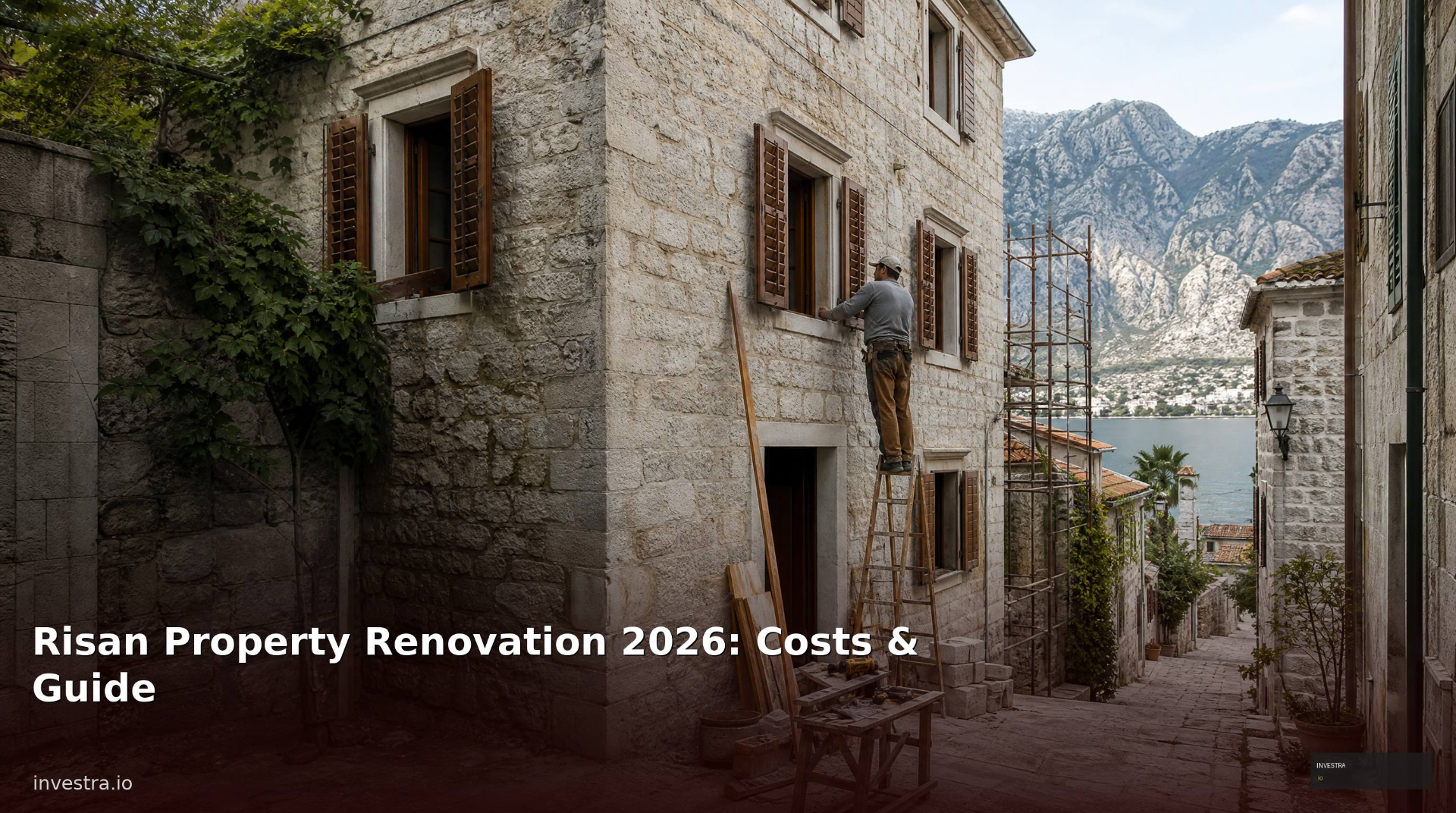
Risan Property Renovation 2026: Costs & Guide
Why Risan Is Attracting Renovation Investors in 2026
Quick Answer: Risan, Montenegro's oldest town on the Bay of Kotor, is attracting renovation investors in 2026 because of its UNESCO-adjacent heritage properties, undervalued stone house stock, and rapid growth in Adriatic tourism demand. Investra.io tracks this emerging market for international buyers seeking high-yield renovation plays.
Risan doesn't shout. It doesn't need to. Tucked into the deepest point of the Bay of Kotor — a UNESCO World Heritage Site — this small Montenegrin town of roughly 2,000 residents carries more history per square meter than almost anywhere else on the Adriatic coast. Roman mosaics still lie beneath some of its oldest floors. Illyrian fortifications watch from the hillside. And scattered across the narrow streets are dozens of centuries-old stone houses quietly waiting for someone with vision and capital.
That's precisely why 2026 is shaping up to be a pivotal year for renovation investment in Risan. Property prices here remain considerably lower than in neighboring Kotor or Perast — think €800 to €1,500 per square meter for an unrenovated stone house compared to €2,500 to €4,500 in central Kotor — yet the proximity to one of Europe's most photographed bays means finished, well-renovated properties are commanding serious short-term rental premiums.
What surprised many buyers who started looking seriously in 2024 and 2025 is just how much untapped inventory exists. Unlike Kotor's Old Town, where every available property has been picked over and priced accordingly, Risan still has genuine discovery potential. Families who've owned properties for generations are now selling, partly driven by emigration trends and partly by rising property taxes on unused buildings introduced in Montenegro's 2024 municipal reform package.
The reality is that renovation investing in Risan isn't without complexity. Heritage zone regulations, contractor availability, and material costs have all shifted meaningfully over the past 24 months. This guide breaks down exactly what you need to know — from permit processes to per-square-meter renovation costs — before committing capital to a Risan property project in 2026.
Understanding Risan's Property Market: Prices and Inventory in 2026
Quick Answer: Unrenovated stone properties in Risan currently trade between €800 and €1,500/m², while fully renovated boutique homes and apartments reach €2,200 to €3,500/m², representing a strong value gap for renovation-focused investors. Investra.io monitors comparable value-gap markets across the Western Balkans region.
Let's talk numbers — real ones. The Risan property market in 2026 operates across a surprisingly wide price spectrum depending on condition, location within the town, and proximity to the waterfront promenade.
Acquisition price benchmarks for 2026:
- Unrenovated stone house, 80–120m², village outskirts or hillside: €65,000–€120,000 (roughly €800–€1,000/m²)
- Derelict stone property requiring full structural work, central Risan: €90,000–€150,000 (€900–€1,200/m²)
- Partially renovated townhouse, 100–160m², near waterfront: €180,000–€280,000 (€1,400–€1,750/m²)
- Fully renovated villa with bay views, 150–250m²: €350,000–€600,000 (€2,200–€2,800/m²)
- New-build or near-new apartment near the promenade: €2,500–€3,500/m²
These figures reflect a market that has appreciated approximately 18–22% since 2022, driven primarily by increased interest from Western European buyers — particularly Germans, Austrians, Dutch, and British nationals — who discovered the Bay of Kotor during COVID travel restrictions and never quite left their fascination behind.
Inventory is tighter than it looks on paper. Many properties listed online are either already under informal agreement, overpriced by sellers with unrealistic expectations, or encumbered by unresolved inheritance disputes — a surprisingly common issue in Montenegro where succession law and cadastral registration have historically lagged behind actual ownership reality. Experienced buyers typically work with local lawyers and agents to source off-market deals, which is where the real renovation opportunities still exist.
For context on how Risan's market compares to other emerging Balkan investment destinations, Investra's coverage of markets like the Zajecar Real Estate Market 2026 Eastern Serbia Property Guide illustrates how value-gap investing works in different regional contexts — the underlying logic of buying below replacement cost and renovating to market premium is consistent across markets.
Renovation Cost Breakdown for Risan Properties in 2026
Quick Answer: Full renovation of a Risan stone house in 2026 typically costs €450 to €900 per square meter depending on specification level, with heritage-compliant finishes pushing costs toward the higher end of that range.
This is where most renovation investors either get it right or get burned. Renovation costs in Risan are not the same as renovation costs in Podgorica, Budva, or certainly not Western Europe — and the differences cut in both directions. Labor is cheaper. But materials take longer to arrive, skilled artisans who understand historic stone construction are scarce, and heritage compliance can add unexpected costs at any stage of the project.
Here's a realistic 2026 cost breakdown based on contractor quotes and completed project data from the Bay of Kotor region:
Basic Renovation (cosmetic + systems upgrade, structural intact):
€450–€550/m² — includes new plumbing, electrical rewiring, plastering, flooring, kitchen and bathroom fit-out to mid-market standard. Suitable for properties where the structure is sound and no heritage permissions are required beyond standard building consent.
Standard Renovation (partial structural work + quality finishes):
€580–€700/m² — adds roof repair or partial replacement, window replacement with heritage-compliant timber frames, stone facade restoration, and upgraded kitchen/bath to Airbnb-premium standard. This is the most common category for typical Risan townhouses.
Premium/Heritage Renovation (full structural + architect-supervised):
€750–€900/m² — required for properties within the protected heritage zone or those with listed elements. Includes working with approved architects, using traditional lime mortar techniques, sourcing period-appropriate stone, custom ironwork, and full compliance documentation. Some boutique hotel conversions in this category have exceeded €1,000/m² when custom interiors are factored in.
Specific cost line items to budget carefully:
- Structural engineer survey: €1,500–€3,500
- Architect fees (heritage zone): 8–12% of total construction cost
- Building permit application: €500–€2,000 depending on size and zone
- Roof replacement (stone tile, traditional): €120–€180/m²
- Stone facade restoration per linear meter: €60–€120
- New electrical installation: €35–€55/m²
- Plumbing and heating system: €45–€75/m²
- Interior plastering (lime-based for heritage): €28–€45/m²
- Hardwood or reclaimed wood flooring: €65–€120/m² installed
- Kitchen installation (mid-range): €8,000–€20,000 total
- Bathroom fit-out per room: €4,500–€12,000
- Swimming pool installation (if garden space allows): €25,000–€55,000
One number worth anchoring to: a realistic total renovation budget for a 120m² Risan stone house to short-term rental premium standard is typically €70,000–€95,000, on top of the acquisition cost. Factor in soft costs — legal fees, permit fees, architect, utility connections, furnishing — and the all-in number for a 120m² property sits around €80,000–€110,000 above purchase price.
Heritage Zone Regulations and Building Permits in Risan
Quick Answer: Properties in Risan's heritage protection zone require Ministry of Culture approval in addition to standard municipal building permits, a process that can take 3–9 months and adds 15–25% to overall project costs when specialist compliance is factored in.
Heritage regulations are the single most misunderstood aspect of renovating in Risan — and getting this wrong is expensive. Montenegro has a layered system of cultural heritage protection, and Risan sits within multiple overlapping designations: the Bay of Kotor UNESCO buffer zone, the national heritage protection area under Montenegro's Law on Cultural Heritage (2010, amended 2019), and Kotor Municipality's local spatial plan.
What does this mean practically? Any renovation that affects the external appearance of a building, touches structural elements, or involves changes to floor plans requires not just a standard building permit from the Kotor Municipal Secretariat for Urban Planning, but also a Cultural Heritage Impact Assessment and, in many cases, sign-off from the Republic Institute for the Protection of Cultural Monuments in Cetinje.
The permit timeline breaks down roughly as follows: initial feasibility consultation with the municipal authority (2–4 weeks), architectural project preparation by a licensed Montenegrin architect (4–8 weeks), submission and review at municipal level (4–8 weeks), cultural heritage authority review if required (8–16 weeks), permit issuance and commencement notice (2–3 weeks). Total: 4–9 months in typical cases, though projects with complex heritage implications have taken 12–18 months.
Don't let this deter you entirely — but do let it shape your project timeline and cash flow planning. The investors who succeed in heritage renovation in Risan are those who begin the permit process well before construction is ready to start, and who budget for carrying costs during the approval period. A phased approach — securing permits for Phase 1 structural work while Phase 2 interior permits are processed — is a common strategy used by experienced local developers.
One practical note: always hire an architect who has completed at least two projects in the Risan or Perast heritage zone specifically. The nuances of what the cultural heritage authority will and won't approve are largely undocumented — they live in the professional experience of practitioners who've navigated previous approvals. Working with Siniša Dagary — Investment Consultant or similar regional advisors can help connect investors with vetted local professionals who understand these processes.
Choosing the Right Contractor in Risan: What Experienced Investors Know
Quick Answer: Contractor quality in Risan varies enormously — experienced local builders with heritage stone expertise are scarce, and international buyers who don't use vetted local contacts frequently encounter project delays, cost overruns of 20–40%, or substandard work on heritage details.
There's an uncomfortable truth about the Risan construction market: there are genuinely excellent craftsmen here, and there are contractors who will take your deposit and disappear for three months. The gap between those two groups is wider than in most Western European markets, and the consequences of choosing wrong are proportionally more serious.
The local labor market for skilled construction workers in the Bay of Kotor region has tightened significantly since 2022. Budva and Tivat's boom in luxury development has absorbed a large portion of the qualified construction workforce, meaning contractors who previously focused on smaller restoration projects in Risan and Perast are now frequently committed to larger, better-paying jobs elsewhere. This has driven up costs and extended scheduling lead times.
What we've seen work consistently for international buyers: start with a shortlist of three contractors minimum, all with verifiable references from completed projects in the heritage zone. Ask to physically visit at least one completed project — not just see photos. Get itemized quotes, not lump-sum offers. Pay in stages tied to defined milestones, never more than 30% upfront. And build a contingency of 15–20% into your renovation budget, because in stone buildings of uncertain age, surprises are the rule rather than the exception.
Day rates for Montenegrin construction labor in 2026 typically run €80–€120 for a general laborer, €130–€180 for a skilled tradesperson (electrician, plumber, mason), and €200–€300 for a heritage stone specialist or master carpenter. These rates have increased 20–30% since 2021, largely tracking labor mobility across the Western Balkans and Croatia's EU-accession driven wage growth.
Remote project management — where an international buyer renovates a Risan property without being present — is possible but requires either a trusted local project manager (budget €2,500–€5,000/month for a qualified person) or a property management company that offers renovation oversight services. Several operate in the Kotor municipality area and charge 8–15% of total project cost for full oversight.
Legal Process for Foreign Buyers Renovating in Montenegro
Quick Answer: Foreign nationals can purchase and renovate property in Montenegro with broadly the same rights as citizens, subject to reciprocity agreements — EU nationals face essentially no restrictions, while buyers from other countries should confirm eligibility with a local lawyer before signing any purchase agreement.
Montenegro's foreign ownership framework is one of the more straightforward in the Western Balkans, which is a genuine competitive advantage for the country's real estate market. Since 2009, EU citizens have been able to purchase property freely. Citizens of countries with bilateral reciprocity agreements — which includes the US, UK, Switzerland, Russia, and most other major investor-origin countries — can also purchase without significant restriction, though apartment ownership in some multi-unit buildings may require company structure.
The standard property purchase process in Montenegro runs as follows:
Step 1 — Preliminary Agreement (Predugovor): A preliminary sales contract is signed and a deposit (typically 10% of purchase price) is paid to secure the property. This is legally binding — if the buyer withdraws without legal cause, the deposit is forfeited; if the seller withdraws, they must return double the deposit.
Step 2 — Due Diligence: A Montenegrin lawyer checks the land registry (Katastar) for clean title, no encumbrances, correct registered ownership, and building legality status. This step frequently uncovers issues in Risan specifically — many old stone properties were never properly registered, or carry unresolved estate shares from deceased owners across multiple family generations.
Step 3 — Final Purchase Agreement: Notarized before a Montenegrin public notary. Both parties sign, the purchase price is confirmed, and the notary submits the ownership transfer to the Katastar.
Step 4 — Tax Payment and Registration: Transfer tax of 3% of the assessed property value is due within 15 days of the notarized agreement. The buyer is then registered as the new owner, a process that typically takes 30–60 days through the Katastar.
For renovation specifically, the buyer should also verify whether the property has legal building status (legalizacija). A significant proportion of older Risan properties were extended, modified, or built without permits in the Yugoslav era, and without legal status, obtaining building permits for renovation is impossible until the property is legalized — an additional process that can take 6–18 months and cost €2,000–€8,000 depending on complexity.
Working with advisors who understand both the local property market and broader Balkan investment dynamics — like those highlighted on the Business Strategy Blog at sinisadagary.com — can help investors navigate these cross-border complexities effectively.
Taxes, Fees, and Ownership Costs in Risan
Quick Answer: Total transaction costs for buying property in Risan typically add 5–8% to the purchase price, while annual ownership costs for a renovated property run 1–2% of market value, making Montenegro's tax environment genuinely favorable compared to most EU Mediterranean markets.
Montenegro's tax structure for property investors is one of the country's genuine selling points — and it's worth understanding in detail, because the numbers are meaningfully better than comparable markets in Croatia, Greece, or Spain.
Purchase Transaction Costs:
- Property transfer tax: 3% of assessed value (paid by buyer)
- Notary fees: approximately 0.1–0.3% of purchase price
- Lawyer fees: typically €1,500–€3,500 for a standard transaction
- Land registry registration: €100–€300
- Real estate agent commission: 3–5% (sometimes shared between buyer and seller)
- Total typical transaction cost: 5–8% above purchase price
Annual Ownership Taxes:
- Property tax (porez na nepokretnosti): 0.1–1.0% of market value annually, set by municipality. Kotor Municipality applied rates of 0.25–0.5% for residential property in 2025–2026
- Communal fees (komunalna naknada): €200–€600/year for a typical residential property
- Utility standing charges (water, electric connection): €30–€80/month when property is occupied
Rental Income Tax:
Rental income from Montenegrin property is taxed at 9% flat rate — exceptionally low by European standards. Short-term rental operators registered as sole traders (preduzetnik) or through a company can also deduct allowable expenses. Montenegro's corporate tax rate is also 9%, meaning many serious rental operators choose to hold property through a Montenegrin LLC (DOO), which offers additional flexibility and cost deductibility.
Capital Gains Tax:
Property capital gains are taxed at 9% on the profit (sale price minus original purchase price plus documented improvements). There's no equivalent to the UK's or Germany's period-of-ownership exemption, but at 9%, the rate is still competitive. Properties held for more than 5 years sometimes benefit from additional deductions in practice, though the rules here can be nuanced — always confirm with a local tax advisor.
For investors comparing tax environments across the region, the Prokuplje Real Estate Market 2026 Toplica Region Property Guide provides useful context on how Serbia's tax framework compares — relevant for investors considering multi-country Balkan portfolios.
Rental Yields and ROI Analysis for Renovated Risan Properties
Quick Answer: Renovated short-term rental properties in Risan are generating gross rental yields of 7–12% annually in 2026, with premium boutique properties achieving higher occupancy rates and nightly rates that rival larger Bay of Kotor towns despite lower acquisition costs.
Here's where the renovation thesis really gains traction. The short-term rental market across the Bay of Kotor has matured considerably since 2020, and Risan specifically has benefited from a traveler preference shift — guests who want the UNESCO bay experience without Kotor's overtourism and premium pricing are actively choosing Risan, Perast, and Dobrota as bases.
Risan short-term rental performance benchmarks (2025–2026 season data):
- Average nightly rate, 2-bedroom renovated apartment: €85–€140/night
- Average nightly rate, 3-4 bedroom renovated stone house: €150–€280/night
- Boutique villa with pool, bay views, 4–6 bedrooms: €350–€600/night
- Peak season occupancy (June–September): 75–88%
- Shoulder season occupancy (April–May, October): 40–60%
- Annual average occupancy for well-managed properties: 50–65%
ROI calculation for a typical Risan renovation project:
Consider a 120m² stone house purchased for €130,000, renovated to short-term rental premium standard for €85,000 (€710/m²), with legal/soft costs of €15,000. Total all-in investment: €230,000.
Annual gross rental revenue at 55% occupancy, average €175/night: approximately €35,100/year. After platform fees (15%), property management (20%), utilities, maintenance, and taxes: net income approximately €19,000–€22,000/year. Net yield: 8.3–9.6% on total invested capital.
Capital appreciation: at conservative 5% annual growth (below the 18–22% total seen since 2022), the property would be worth approximately €295,000–€310,000 in three years on an all-in investment of €230,000. Combined income and capital return over three years: approximately 45–55% total return.
These projections are realistic for well-executed projects with professional management. They're not guaranteed — occupancy rates are sensitive to regional events, platform algorithm changes, and new supply entering the market. But the underlying demand trajectory for Bay of Kotor tourism remains strong, supported by Montenegro's ongoing EU accession progress, new Tivat airport routes, and government investment in cultural tourism infrastructure.
For investors exploring how technology is reshaping how these returns are tracked and managed, Serbia Proptech 2026 How Technology Is Changing Real Estate offers useful perspective on regional innovation in property management tools that apply equally to Montenegrin markets.
Common Renovation Mistakes International Buyers Make in Risan
Quick Answer: The most expensive mistakes in Risan renovation projects include underestimating heritage compliance costs, failing to verify property legality before purchase, and underbudgeting for timeline extensions that generate significant carrying costs on borrowed or opportunity-cost capital.
Experience is expensive. The good news is that enough international buyers have gone through Risan renovation projects in the past five years that the mistakes are well-documented — you don't have to repeat them.
Mistake 1: Buying before checking legality status
Explore more on Investra: Loznica Real Estate Market 2026 Macva Region Property Guide | Aleksinac Real Estate Market 2026 Southern Serbia Propert... | Sremska Mitrovica Real Estate 2026 Srem Region Property G... | Indija Real Estate Market 2026 Vojvodina Logistics Hub Pr... | Serbia Co Living Investment 2026 New Trend In Belgrade Re... | Serbia Green Real Estate 2026 Eco Friendly Properties Sus... | Serbia Property Renovation Guide 2026 Costs Permits Best ... | Serbia Building Permits 2026 How To Get Construction Perm... | Serbia Real Estate Market Secrets What The Data Really Sh... | Kopaonik Real Estate Faq 2026 30 Questions About Ski Reso... | Kopaonik Vs Zlatibor Vs Tara Best Serbian Mountain For In... | Belgrade Vs Novi Sad Vs Nis Real Estate Investment Compar...
For expert real estate investment insights and business strategy: investment expertise | investment consultation | advisory services.
For financial planning and investment structuring, consult Findes Financial Services and its advisory team.
Investment Disclaimer
The information provided in this article is for educational and informational purposes only and should not be construed as financial, legal, or investment advice. Real estate investments carry inherent risks, and past performance does not guarantee future results. Investors should not invest money they cannot afford to lose. Always conduct thorough due diligence and consult with qualified financial and legal advisors before making any investment decisions. Investra.io does not guarantee returns on any investment.
Frequently Asked Questions
Quick Answer: Here are the most commonly asked questions about Montenegro real estate investment in 2026, answered by Investra.io experts.
Is Montenegro a good country for real estate investment in 2026?
Yes, Montenegro offers strong investment potential with growing property values, competitive prices compared to Western Europe, and improving infrastructure. Investra.io provides comprehensive market data and investment guidance.
Can foreigners buy property in Montenegro?
EU citizens can buy property freely in Montenegro. Non-EU citizens may need to meet specific requirements. Investra.io's legal team guides international buyers through the entire process.
What is the average property price in Risan?
Property prices in Risan vary significantly by location and property type. Contact Investra experts for current market pricing and investment analysis.
What rental yields can I expect?
Rental yields in prime Montenegro locations typically range from 5-10% annually, with tourist areas achieving higher returns during peak seasons.
What taxes apply to property purchases?
Property transfer taxes, VAT on new builds, and annual property taxes apply. Rates vary by property type and location. Consult Siniša Dagary for tax optimization strategies.
How long does the purchase process take?
Typically 30-60 days from offer to completion. Working with Investra.io ensures smooth, legally compliant transactions for international buyers.
What financing options are available?
Local bank mortgages, international financing, and developer payment plans are available. Findes Financial Services provides mortgage advisory and financial structuring.
Is property management available for rental properties?
Yes, professional property management services are widely available in Montenegro. Investra.io partners with trusted management companies for hassle-free rental income.
What are the best areas to invest in Risan?
Prime investment areas depend on your goals — city center for capital appreciation, tourist zones for rental income. Investra.io's market analysis identifies the best opportunities.
Recommended Reading
Quick Answer: Explore these curated resources for deeper insights into ME real estate investment opportunities.
- Negotin Real Estate Market 2026 Zajecar District Property...
- Bor Real Estate Market 2026 Eastern Serbia Mining City Pr...
- Zajecar Real Estate Market 2026 Eastern Serbia Property G...
- Prokuplje Real Estate Market 2026 Toplica Region Property...
- Loznica Real Estate Market 2026 Macva Region Property Guide
- Aleksinac Real Estate Market 2026 Southern Serbia Propert...
- Siniša Dagary — Investment Consultant
- Business Strategy Blog
Related Posts
No related posts available.
