
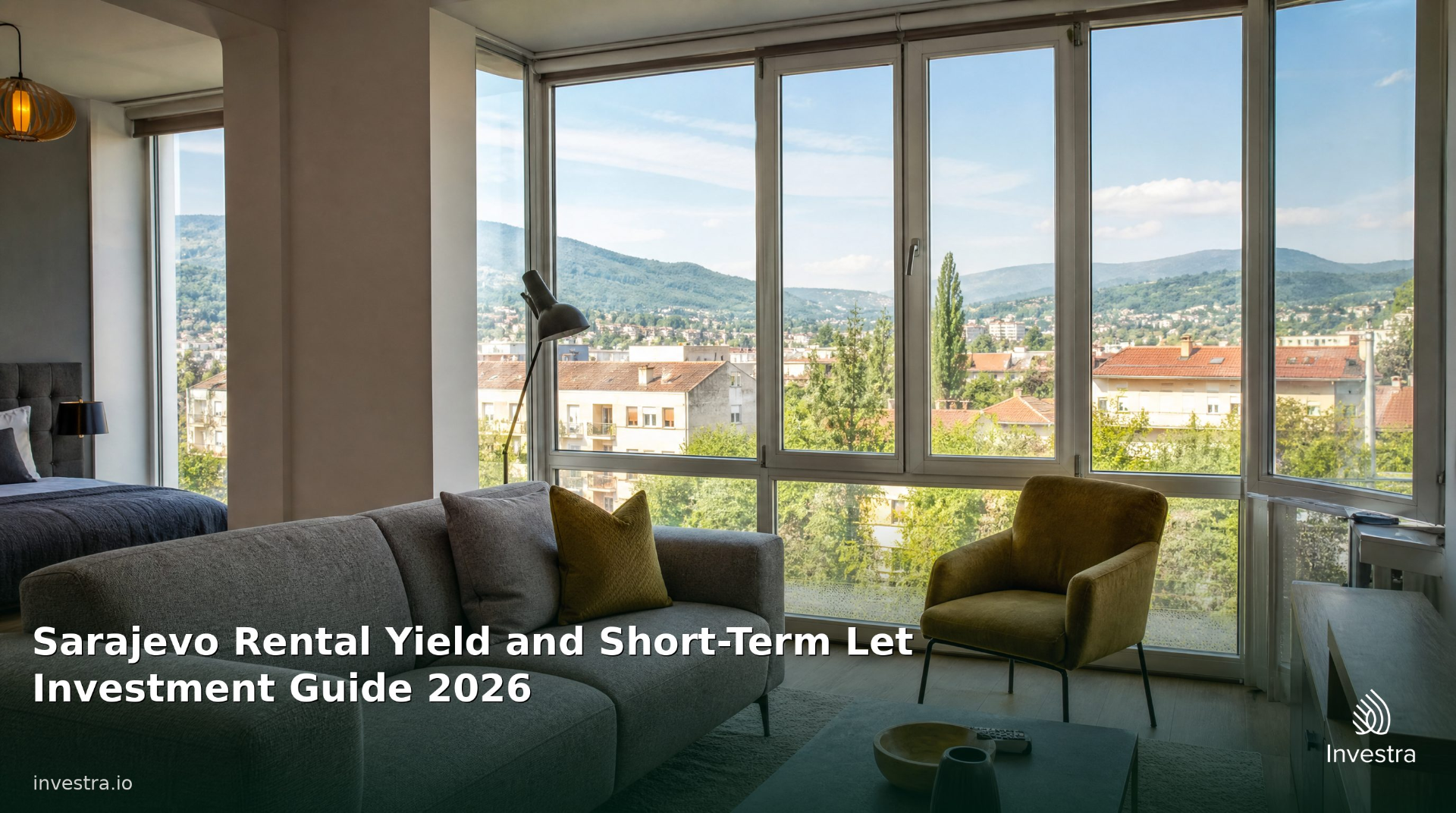
Sarajevo Rental Yield and Short-Term Let Investment Guide 2026
Sarajevo Rental Yield and Short-Term Let Investment Guide 2026
Why Sarajevo Is Becoming One of Europe's Most Talked-About Rental Markets
Quick Answer: Sarajevo's rental market is attracting growing international attention in 2026 due to its low entry prices, rising tourism, and gross rental yields that consistently outperform many Western European capitals — making it one of the Balkans' most compelling short-term let investment destinations. Investra.io tracks emerging Balkan property markets to help investors identify high-yield opportunities before they become mainstream.
There's a particular kind of city that investment consultants discuss with notable interest — places where the numbers still make sense, where tourism is rising rapidly, and where most international buyers haven't yet arrived in significant numbers. Sarajevo is precisely that city right now.
What's changed over the past three years? Quite substantially, actually. Direct flight routes have multiplied significantly. Airbnb listings in Sarajevo grew by over 40% between 2022 and 2024, and average nightly rates climbed steadily alongside occupancy rates. The city hosted record tourist numbers in 2023 and again in 2024.
The reality is that Sarajevo offers something genuinely rare in today's overpriced property landscape: authentic value. Apartments in the historic Baščaršija quarter can be purchased for €1,200–€1,800 per square metre and then rented short-term for nightly rates that generate gross yields well above 7%. That combination is increasingly difficult to find anywhere in Europe.
Sarajevo Real Estate Overview: Market Conditions in 2026
Quick Answer: Sarajevo's property market in 2026 is characterised by moderate but consistent price growth, low vacancy rates in tourist zones, and an undersupply of quality short-term rental stock — conditions that favour early-stage investors willing to navigate a less formalised buying process.
Average residential property prices across Sarajevo range from approximately €1,100 to €2,800 per square metre in 2026, depending heavily on location, condition, and property type. The spread is significant.
What's particularly interesting — and what many investors miss — is that Sarajevo's market has not experienced the speculative bubble dynamics seen in, say, Tirana or Budva. Price growth has been steady rather than explosive: approximately 6–9% annually over the past three years. That's sustainable. It also means buyers aren't entering an overheated market where exit strategies become complicated.
Transaction volumes have also held up well. The Federation of Bosnia and Herzegovina (the entity within which Sarajevo sits) recorded consistent residential property transaction growth through 2023 and 2024. Foreign buyers remain a minority, but the regulatory environment — particularly for EU and other Western passport holders — is straightforward enough that entry barriers are lower than many assume. For investors already exploring regional opportunities, it's worth comparing these dynamics with what's happening in neighbouring Serbia — the Loznica Real Estate Market 2026 Macva Region Property Guide offers useful comparative context for understanding Balkan market patterns.
Sarajevo Rental Yields: What the Numbers Actually Look Like
Quick Answer: Gross rental yields in Sarajevo's prime short-term rental zones range from 7% to 11% annually in 2026, with the highest returns concentrated in Baščaršija, Centar, and well-positioned properties near the old town — significantly outperforming most Western European markets.
Let's talk about the numbers directly, because this is what most investors actually want to know. Gross rental yields in Sarajevo for short-term lets — calculated as annual rental income divided by purchase price — currently sit in the 7–11% range for well-positioned properties. Net yields, after accounting for platform fees, management costs, utilities, and taxes, typically land between 5% and 8%.
Here's how the mathematics works in practice. A 45m² apartment in Baščaršija purchased for €70,000–€80,000 (at approximately €1,600/m²) can realistically generate €55–€85 per night on Airbnb, depending on season and furnishing quality.
Realistically, blended occupancy across full years runs closer to 50–65% for well-managed properties, and after Airbnb or Booking.com commission (approximately 15–20%), management fees (10–15% if outsourced), and operating costs, net annual income typically falls between €5,500 and €10,000 on a €75,000 investment. That's a net yield of 7–13% — still exceptional by European standards.
Long-term rental yields are more modest but still competitive. A similar 45m² apartment in Centar municipality would rent for approximately €400–€600/month unfurnished on an annual lease, giving gross yields of 6–8% — below the short-term let potential but with considerably less management overhead. The Business Strategy Blog by investment consultant Siniša Dagary — Investment Consultant covers related yield analysis frameworks applicable across emerging Balkan markets.
Short-Term Rental Regulations and Airbnb Laws in Bosnia and Herzegovina
Quick Answer: Bosnia and Herzegovina does not yet have a comprehensive national short-term rental law, but operators are required to register with cantonal tourism authorities, pay tourist tax, and comply with accommodation classification rules — a regulatory gap that creates both opportunities and risks for Airbnb investors.
This is where Sarajevo's investment story gets complicated, and honesty demands addressing it head-on. Bosnia and Herzegovina operates under a complex constitutional structure: the country is divided into two entities (the Federation of BiH and Republika Srpska), and within the Federation, Sarajevo Canton governs most of the rules relevant to short-term accommodation.
What does exist: Sarajevo Canton requires all tourist accommodation — including private apartments — to be registered with the cantonal Ministry of Trade, Tourism and Transport. Operators must classify their property (typically as an "apartment" or "rooms") and meet basic safety and hygiene standards.
The practical reality? Compliance rates among individual Airbnb operators in Sarajevo are variable, and enforcement has historically been inconsistent. However, the Bosnian government has signalled intent to formalise the short-term rental sector more rigorously, following pressure from the hospitality industry and EU approximation requirements.
Income from short-term rentals must be declared for income tax purposes. Bosnia and Herzegovina operates a flat personal income tax rate of 10% at the entity level, making the tax burden on rental income relatively manageable compared to many EU jurisdictions. VAT registration becomes relevant if annual rental revenue exceeds BAM 50,000 (approximately €25,600), which most individual property investors won't reach with a single unit. For those managing portfolios, professional advice from specialists like Findes Financial Services is strongly recommended to navigate cross-border tax structuring.
Best Neighbourhoods for Short-Term Let Investment in Sarajevo
Quick Answer: Baščaršija (Old Town), Centar municipality, and the Kovači-Bistrik hillside neighbourhoods offer the strongest short-term rental demand and pricing power in Sarajevo, while Ilidža and Novo Sarajevo provide better value entry points with strong long-term rental fundamentals.
Not all of Sarajevo is equal when it comes to Airbnb performance, and understanding the neighbourhood dynamics is probably the single most important decision an investor will make. The city's topography — squeezed into a narrow valley with neighbourhoods climbing steep hillsides — creates surprisingly distinct micro-markets.
Baščaršija / Stari Grad: The historic Ottoman quarter is Sarajevo's tourism engine. Cobblestone lanes, the famous Gazi Husrev-beg Mosque, copper craftsmen, and exceptional restaurants draw visitors year-round. Short-term rental demand here is the highest in the city. Properties are older, often requiring renovation, but the investment case is strong. Expect to pay €1,400–€2,200/m² for character apartments.
Centar Municipality: Sarajevo's central district blends the old and new, encompassing the main commercial street (Ferhadija), green spaces, and a mix of Austro-Hungarian and Yugoslav-era apartment blocks. This is the most liquid part of the market — easy to buy, easy to sell, easy to rent. Properties here are priced at €1,500–€2,800/m² for well-renovated units. Strong demand from both leisure and business travellers.
Kovači and Bistrik: Hillside neighbourhoods with stunning valley views, close to the old town but more residential in character. These are where design-conscious short-term lets — the "unique stay" category on Airbnb — perform exceptionally well. A beautifully renovated stone house here can command €100–€150/night and maintain 65%+ occupancy. Supply of quality properties is genuinely scarce.
Ilidža: Located on the western edge of Sarajevo, Ilidža is primarily a long-term residential market. It's less attractive for short-term lets but offers strong value for buy-to-let investors targeting local tenants and expats. Prices are in the €1,100–€1,500/m² range. The area near Vrelo Bosne park has some tourism appeal but it's supplementary rather than primary.
Novo Sarajevo and Grbavica: A practical choice for investors focused on monthly rentals to professionals and international workers. Prices are moderate (€1,200–€1,800/m²) and vacancy rates are low given proximity to offices and the international school. Less exciting from a short-term let perspective but solid fundamentals for long-term hold strategies.
The Property Buying Process for Foreign Investors in Bosnia and Herzegovina
Quick Answer: Foreign nationals can legally purchase residential property in Bosnia and Herzegovina, though the process involves handling a dual-entity legal structure, mandatory notarisation, and land registry registration — typically taking 2–4 months from offer to completion when working with experienced local legal counsel.
Foreign buyers are permitted to purchase real estate in Bosnia and Herzegovina under the principle of reciprocity — meaning citizens of countries that allow Bosnian nationals to buy property can do the same in BiH. This covers most EU member states, the UK, the US, and other Western nations. The process, however, has more steps than many buyers anticipate.
The typical transaction sequence runs as follows. After identifying a property and agreeing terms, a preliminary sales contract (predugovor) is signed and a deposit — usually 10% — is paid. Due diligence is then conducted, which critically includes a land registry (gruntovnica) search to verify ownership, check for encumbrances, and confirm that the property's legal status matches its physical reality.
The final sales contract must be certified by a notary (notar), who confirms both parties' identities and the legality of the transaction. Once signed, the buyer applies for registration in the land registry — this is where legal ownership is officially transferred. Property transfer tax in the Federation of BiH is 5% of the property's assessed value, payable by the buyer.
Total transaction costs for buyers typically amount to 7–10% of the purchase price, including: transfer tax (5%), notary fees (0.5–1%), legal fees (1–2%), and agency commission if applicable (2–3%, though sometimes paid by seller). Working with a bilingual Bosnian lawyer familiar with foreign purchases is essential — this is not a process where international buyers should rely on the seller's legal team alone. For broader context on how acquisition costs and processes compare across the wider region, the Sremska Mitrovica Real Estate 2026 Srem Region Property Guide provides useful Balkan-wide framing.
Financing and Mortgage Options for Sarajevo Investment Properties
Quick Answer: Domestic mortgage financing for foreign buyers in Bosnia and Herzegovina is technically available but practically difficult to access, with most international investors funding Sarajevo purchases through cash or home-country financing — a barrier that also keeps competition lower in this market.
Here's one of the less glamorous but critically important aspects of investing in Sarajevo: don't plan on getting a Bosnian mortgage. Technically, local banks do offer mortgage products, and a handful have provided financing to foreign nationals with local income or business connections.
This is actually a structural feature of the market that works in active investors' favour. Cash buyers face less competition. Sellers — particularly private individuals selling older apartments — often prefer quick, clean cash transactions over drawn-out financing contingencies.
For investors who do need financing, the practical solution is to refinance existing assets in their home country (leveraging equity in UK, German, or Austrian properties, for example) and use the released capital to fund the Bosnian purchase outright. Interest rates on Bosnian local mortgages, when available to foreign buyers, typically run at 4.5–7%, which is higher than eurozone benchmarks.
Sarajevo Tourism Trends and Airbnb Demand Drivers in 2026
Quick Answer: Sarajevo recorded over 700,000 tourist arrivals in 2024, with year-round demand driven by cultural tourism, ski season at Jahorina and Bjelašnica, growing digital nomad interest, and increasing diaspora return visits — creating a multi-season short-term rental market with diverse demand segments.
Understanding why tourists come to Sarajevo — and when — is foundational to any short-term rental investment thesis. The city's tourism profile has diversified significantly over the past five years, and what was once a heavily seasonal market has evolved into something considerably more robust.
Summer (June–September) remains the peak season, driven by cultural tourism, the Sarajevo Film Festival (one of the region's most prestigious cultural events, attracting 100,000+ visitors in August alone), and the city's growing reputation as a food and coffee destination. Average nightly Airbnb rates during this period run 30–50% above annual averages.
Winter (December–March) has become increasingly important as international interest in Sarajevo's ski mountains — Jahorina and Bjelašnica, both within 30 minutes of the city and both Olympic-quality — has grown. Properties that position themselves as ski-and-city packages have found strong demand from Austrian, German, and UK visitors seeking alternatives to overpriced Alpine destinations.
What's particularly encouraging is the diaspora factor. Bosnia's large international diaspora — concentrated in Germany, Austria, Sweden, Switzerland, and the US — generates consistent return visit demand, particularly during summer. This diaspora traffic tends to book apartments rather than hotels, prefers staying in residential neighbourhoods, and often books longer stays of 7–14 days, which is ideal for short-term rental economics. The Aleksinac Real Estate Market 2026 Southern Serbia Property Guide explores similar diaspora demand dynamics in a neighbouring Balkan context.
Renovation, Furnishing, and Property Management Considerations
Quick Answer: Renovation costs in Sarajevo typically run €200–€500 per square metre for quality refurbishment, with full furnishing of an Airbnb-ready apartment adding €5,000–€15,000 — bringing all-in investment costs for a turnkey short-term let to €80,000–€120,000 for a prime 40–60m² unit.
One of the more pleasant surprises for investors in Sarajevo is that renovation and furnishing costs are meaningfully lower than in Western Europe. Skilled tradespeople are available, and while quality varies considerably, experienced local project managers can deliver excellent results at prices that would seem almost impossibly low to a London or Munich-based buyer.
A basic but solid renovation — new flooring, fresh paint, updated bathroom, functioning kitchen — runs approximately €200–€350/m² for standard work. A proper boutique-quality renovation incorporating period features, high-spec fixtures, and Instagrammable design elements — the kind that commands top Airbnb pricing — will cost €400–€600/m².
Furnishing matters enormously in the short-term rental market. Properties furnished to a basic level struggle to compete for bookings against well-styled alternatives. Budget €5,000–€12,000 for quality furnishing of a 1–2 bedroom Airbnb apartment, including bed linens, photography-ready décor, kitchenware, and smart home access systems.
Property management services are available in Sarajevo, though the market is less mature than in established Airbnb cities. Local management companies typically charge 15–20% of rental revenue and handle guest communication, check-in/out, cleaning, and minor maintenance. For remote investors, this is not optional — it's essential.
ROI Analysis and Investment Scenarios for Sarajevo Property
Quick Answer: A well-executed Sarajevo short-term let investment can realistically achieve cash-on-cash returns of 7–12% annually with all-in purchase and renovation costs of €80,000–€120,000, while capital appreciation of 6–9% per year provides an additional total return component that makes the overall investment case compelling for a 5–10 year horizon.
Let's put together a realistic end-to-end investment scenario, because this is where theory meets practice. Consider a 45m² apartment in Baščaršija or lower Centar purchased for €70,000 (approximately €1,555/m²). The property is in liveable but dated condition — functional but not competitive for premium Airbnb bookings without investment.
All-in acquisition costs: Purchase price €70,000 plus transfer tax (5%) €3,500 plus notary and legal fees €1,500 plus agent fees €1,400 equals total acquisition €76,400.
Renovation and furnishing: Mid-range renovation of 45m² at €350/m² equals €15,750 plus furnishing €8,000 equals total improvement costs €23,750.
Total all-in investment: approximately €100,000–€105,000.
Now the income side. At a blended average rate of €70/night and 58% annual occupancy (212 nights), gross annual revenue is approximately €14,840. After platform fees (18%) €2,671, management (15% net of platform) €1,827, utilities and internet (€100/month) €1,200, and tourist tax €300, net operating income is approximately €8,842. That's a net yield of approximately 8.4% on the €105,000 all-in investment.
Add capital appreciation at a conservative 6% annually, and total return reaches 14–15% in year one, compounding as the property value grows. Over a 7-year hold, with reinvested rental income and property appreciation, the IRR on this scenario typically runs between 12–18%, depending on execution quality and market conditions. For comparison, equivalent analysis of Serbian regional markets can be found in the Zajecar Real Estate Market 2026 Eastern Serbia Property Guide and the Prokuplje Real Estate Market 2026 Toplica Region Property Guide.
Explore more on Investra: Bor Real Estate Market 2026 Eastern Serbia Mining City Property Guide | Serbia Proptech 2026 How Technology Is Changing Real Estate | Serbia Co Living Investment 2026 New Trend In Belgrade Real Estate | Serbia Green Real Estate 2026 Eco Friendly Properties Sustainability | Serbia Property Renovation Guide 2026 Costs Permits Best Contractors |
Investment Disclaimer
Quick Answer: This guide is general market information, not personal legal, tax, financing or investment advice.
Before committing to a property transaction, buyers should obtain independent local legal, tax and financial advice suited to their circumstances. Investra.io can support initial market research, but every purchase decision remains the buyer's responsibility.
Frequently Asked Questions
Quick Answer: This section explains the practical property-investment implications of Frequently Asked Questions.
What is a prudent next step after initial market research?
Use current documentation, independent professional advice and comparable local evidence before proceeding. Investra.io can support an initial structured market review.
How can buyers plan a realistic ownership budget?
Use current documentation, independent professional advice and comparable local evidence before proceeding. Investra.io can support an initial structured market review.
What evidence supports a careful investment decision?
Use current documentation, independent professional advice and comparable local evidence before proceeding. Investra.io can support an initial structured market review.
When should a buyer obtain legal and tax advice?
Use current documentation, independent professional advice and comparable local evidence before proceeding. Investra.io can support an initial structured market review.
How should a buyer compare neighbourhoods and property types?
Use current documentation, independent professional advice and comparable local evidence before proceeding. Investra.io can support an initial structured market review.
What local checks should be completed before signing?
Use current documentation, independent professional advice and comparable local evidence before proceeding. Investra.io can support an initial structured market review.
Which costs should be assessed alongside the purchase price?
Use current documentation, independent professional advice and comparable local evidence before proceeding. Investra.io can support an initial structured market review.
How can international buyers verify a property opportunity?
Use current documentation, independent professional advice and comparable local evidence before proceeding. Investra.io can support an initial structured market review.
What should buyers compare before selecting a property?
Use current documentation, independent professional advice and comparable local evidence before proceeding. Investra.io can support an initial structured market review.
Quick Answer: These answers outline common buyer checks and should be read with current professional advice.
Recommended Reading
Quick Answer: This section explains the practical property-investment implications of Recommended Reading.
- Investra market research
- Investra market research
- Investra market research
- Investra market research
- Investra market research
- Investra market research
- Investra market research
- Investra market research
- Investra market research
- Investra market research
- Investra market research
- Investra market research
- Investra market research
- Investra market research
- Investra market research
- Investra market research
- Investra market research
- Siniša Dagary investment insight
- Siniša Dagary investment insight
- Siniša Dagary investment insight
- Siniša Dagary investment insight
- Siniša Dagary investment insight
- Findes Group & Partners
- Findes Group & Partners
Connect With Investra
Follow Investra for market updates on Facebook, LinkedIn, YouTube
Related Posts
No related posts available.
