
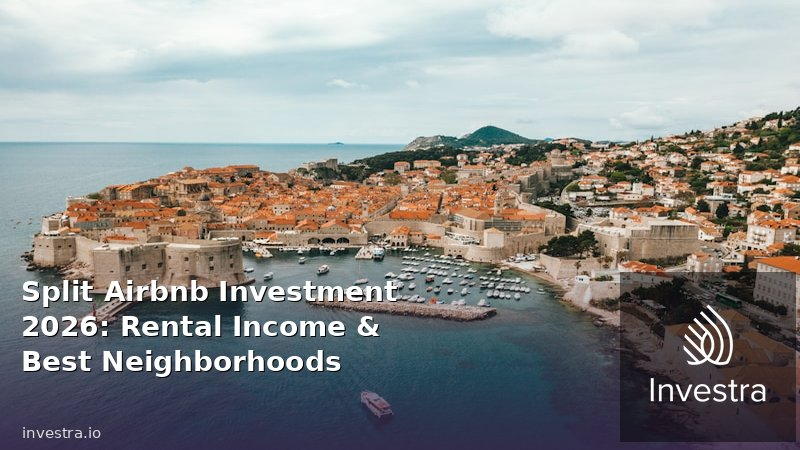
Split Airbnb Investment 2026: Rental Income & Best Neighborhoods
Why Split Croatia Has Become Europe's Premier Airbnb Investment Destination in 2026
Quick Answer: Split, Croatia has emerged as one of Europe's top short-term rental markets in 2026, offering investors gross rental yields of 6–12% annually and peak-season occupancy rates exceeding 85%, driven by record-breaking tourism numbers and limited housing supply in the historic core. Explore the full picture at the Croatia Real Estate Investment Guide 2026.
Split, Croatia's second-largest city and the unofficial capital of the Dalmatian Coast, has undergone a remarkable transformation over the past decade. Once considered a regional stopover on the way to Dubrovnik or Hvar, Split has matured into a destination in its own right — a UNESCO World Heritage city built around the 1,700-year-old Diocletian's Palace, surrounded by turquoise Adriatic waters, and serviced by a rapidly expanding international airport that welcomed over 4 million passengers in 2024.
This transformation has had profound consequences for the real estate investment landscape. The Airbnb and short-term rental market in Split has exploded, with the city consistently ranking among the top Mediterranean destinations for short-term rental profitability. For international investors in 2026, Split represents a compelling combination of strong capital appreciation, high short-term rental income potential, relative affordability compared to Western European coastal cities, and the added security of Croatia's eurozone membership since January 2023.
The numbers speak clearly: tourism arrivals to the Split-Dalmatia County reached 5.8 million in 2024, with overnight stays surpassing 27 million — a 12% increase on 2022 figures. The Croatian National Tourist Board projects continued growth through 2026 and beyond, underpinned by direct airline routes from over 60 European cities and growing interest from North American and Asian visitors. Against this backdrop of surging demand and constrained supply (the historic city center's UNESCO status limits new development), property values have appreciated steadily, making Split Airbnb investment one of the most discussed topics among European real estate investors.
This comprehensive guide examines every dimension of the Split Airbnb investment opportunity in 2026: rental income potential, the best neighborhoods for short-term rental returns, legal requirements, tax obligations, property prices, and the practical steps international buyers must navigate to acquire property and operate short-term rentals successfully.
---Split Tourism Market Data: The Foundation of Airbnb Investment Returns
Quick Answer: Split's tourism market generated over 27 million overnight stays in 2024, with average daily rates (ADR) for Airbnb properties ranging from €80 to €350 per night depending on location and season, creating one of the Adriatic's most robust short-term rental economies. Split Real Estate Guide offers current market data for investors.
Understanding the depth and structure of Split's tourism market is essential before calculating any Airbnb investment return. The market is characterized by several distinctive features that shape short-term rental performance metrics throughout the year.
Seasonality Profile: Split operates on a pronounced Mediterranean seasonal curve. The peak season runs from mid-June through early September, during which occupancy rates for well-positioned Airbnb properties routinely exceed 90–95%. The shoulder seasons — April to mid-June and September to October — have grown significantly stronger over the past five years, with occupancy rates of 60–75% now common for centrally located properties. Winter occupancy (November to March) averages 20–35% for most short-term rental units, though properties catering to business travelers or those positioned near Split's thriving cultural calendar can perform considerably better.
Average Daily Rates (ADR) by Season:
- Peak Season (July–August): €150–€350 per night for well-located 2-bedroom apartments; studios achieve €80–€180
- High Shoulder (June, September): €100–€250 per night for 2-bedroom units; studios €60–€130
- Low Shoulder (April–May, October): €70–€180 per night for 2-bedroom units; studios €45–€90
- Winter (November–March): €50–€120 per night for 2-bedroom units; studios €30–€65
Guest Profile: The typical Split Airbnb guest is European (primarily from Germany, UK, Austria, France, Netherlands, and increasingly Poland and Czechia), aged 28–50, traveling in couples or small groups, and staying an average of 4.2 nights. This profile supports strong per-booking revenue and relatively low turnover compared to beach resort markets with shorter average stays.
Airbnb Supply Data: As of mid-2025, Split city proper has approximately 8,200–9,000 active Airbnb listings, with the most competition concentrated in the Diocletian's Palace area. However, demand has consistently grown faster than supply in the city's most desirable micro-locations, supporting continued yield strength.
For investors seeking detailed revenue modeling tools and current market comparables, the Split Real Estate Guide on Investra.io provides property-level analytics updated for 2026 market conditions.
---How Much Can You Earn From Airbnb in Split Croatia? Realistic Income Projections
Quick Answer: A well-managed Airbnb property in Split can generate gross annual rental income of €18,000–€55,000 depending on property size and location, translating to net yields of 5–10% after expenses, with top-performing Palace District apartments achieving even higher returns during the 90-day peak season window.
This is the central question every investor asks, and the honest answer is: it depends on four critical variables — property location within Split, property size and quality, management efficiency, and investment entry cost. The following projections are based on aggregated data from active short-term rental operators in Split, cross-referenced with AirDNA market analytics and Croatian tourism authority data.
Studio Apartment (25–40 m²)
A studio apartment within 500 meters of Diocletian's Palace, professionally managed and well-reviewed:
- Peak season (75 days): 92% occupancy × €130/night = €9,009
- High shoulder (60 days): 72% occupancy × €90/night = €3,888
- Low shoulder (60 days): 50% occupancy × €65/night = €1,950
- Winter (120 days): 28% occupancy × €50/night = €1,680
- Gross annual income: approximately €16,527
One-Bedroom Apartment (45–65 m²)
A one-bedroom apartment in the Old Town or Manuš neighborhood:
- Peak season (75 days): 90% occupancy × €185/night = €12,488
- High shoulder (60 days): 70% occupancy × €130/night = €5,460
- Low shoulder (60 days): 48% occupancy × €95/night = €2,736
- Winter (120 days): 25% occupancy × €70/night = €2,100
- Gross annual income: approximately €22,784
Two-Bedroom Apartment (70–100 m²)
A two-bedroom apartment in Varoš or the Riva area with sea views or palace proximity:
- Peak season (75 days): 88% occupancy × €260/night = €17,160
- High shoulder (60 days): 68% occupancy × €175/night = €7,140
- Low shoulder (60 days): 45% occupancy × €120/night = €3,240
- Winter (120 days): 22% occupancy × €90/night = €2,376
- Gross annual income: approximately €29,916
Expense Deductions (typical annual costs):
- Property management fee (if outsourced): 20–25% of revenue
- Cleaning and linen service: €1,500–€4,000
- Airbnb platform fees: 3% of booking total (host fee)
- Utilities (electricity, water, internet): €1,200–€2,400
- Maintenance reserve (1–2% of property value annually): €1,500–€4,000
- Tourism tax (collected from guests, passed to state): €1–€2/guest/night
- Croatian income tax on rental income: 10–30% (see tax section)
After all operating expenses but before income tax, net operating yields for quality properties in prime Split locations range from 5.5% to 9.5%, with exceptional performers in micro-prime locations (within the Palace walls, sea-view Riva properties) occasionally exceeding 10–12% gross yield. For independent investment analysis tailored to your budget, Contact Investra Experts directly.
---Split Property Prices in 2026: What Does an Airbnb Investment Property Actually Cost?
Quick Answer: Property prices in Split range from €3,200/m² in outer neighborhoods to €8,000+/m² within the walls of Diocletian's Palace in 2026, with average city-wide prices for investment-grade apartments sitting around €4,500–€5,500/m² — significantly below comparable Mediterranean destinations like Barcelona or the French Riviera.
Understanding the capital cost of entry is as important as projecting rental income. Croatia's accession to the eurozone in January 2023 removed currency exchange risk for eurozone investors and has brought additional price stability, though it also removed the historic kuna-denominated discount that some early investors exploited. Prices in Split have appreciated approximately 8–12% annually over 2022–2024, moderating to an estimated 5–7% annual growth rate in 2025–2026 as the market matures.
Price Ranges by Neighborhood (2026 estimates):
| Neighborhood | Price per m² | Typical 2BR Price | Airbnb Suitability |
|---|---|---|---|
| Diocletian's Palace (inside walls) | €6,500–€9,500 | €520K–€760K | ★★★★★ |
| Varoš | €5,000–€7,000 | €400K–€560K | ★★★★★ |
| Manuš | €4,200–€5,800 | €336K–€464K | ★★★★☆ |
| Spinut / Bačvice | €3,800–€5,200 | €304K–€416K | ★★★★☆ |
| Žnjan / Trstenik | €3,200–€4,200 | €256K–€336K | ★★★☆☆ |
| Solin (greater Split area) | €2,400–€3,400 | €192K–€272K | ★★☆☆☆ |
It is important to budget beyond the purchase price. Transaction costs in Croatia typically add 5–8% to total acquisition costs, including:
- Real estate transfer tax: 3% of agreed purchase price
- Notary fees: €500–€2,000
- Legal/attorney fees: €1,500–€5,000
- Land registry fee: €200–€500
- Agent commission: 2–3% (typically split between buyer and seller)
For a comprehensive, up-to-date listing of available investment properties across all price brackets in Split, the Split Real Estate Guide on Investra.io curates verified listings with full transparency on pricing and legal status.
---Best Neighborhoods in Split for Airbnb Investment: A District-by-District Analysis
Quick Answer: The top five neighborhoods for Airbnb investment in Split are: Diocletian's Palace (maximum ADR, lowest vacancy), Varoš (historic charm, high demand, slightly lower entry cost), Manuš (growing demand, better value), Bačvice (beach access, strong family market), and Spinut (local flavor, emerging short-term rental demand). Compare neighborhood-specific data on Investra.
1. Diocletian's Palace — The Crown Jewel
Investing inside or immediately adjacent to the Palace walls delivers the highest average daily rates and lowest vacancy rates of any Split micro-location. Properties here carry genuine UNESCO heritage status, which creates both a marketing advantage (guests pay premium prices for the "living inside a Roman palace" experience) and a supply constraint (renovation permits are strictly controlled by the Conservation Department). A studio inside the Palace walls can command €180–€300/night in peak season. The trade-off is the highest acquisition cost in the city (€6,500–€9,500/m²) and strict renovation limitations. Investors should work exclusively with lawyers experienced in Croatian conservation law before purchasing.
2. Varoš — The Authentic Dalmatian Quarter
Immediately west of the Palace, Varoš is a labyrinthine neighborhood of stone houses, narrow alleys, traditional konobas, and stunning views over the Adriatic. Properties here are slightly more affordable (€5,000–€7,000/m²) and offer tremendous character that translates directly into premium Airbnb positioning. Varoš has no high-rise development and its density of boutique restaurants and wine bars makes it extremely attractive to discerning travelers. Rental yields here are often comparable to the Palace district despite lower entry costs.
3. Manuš — The Emerging Favorite
A few minutes' walk from the Palace and Old Town, Manuš offers a sweet spot for value investors. Properties here cost €4,200–€5,800/m², and the neighborhood's proximity to the Riva promenade and main shopping streets supports strong year-round demand. As the Palace district has become saturated with listings, guests have increasingly sought Manuš properties as their preferred alternative — improving both occupancy rates and ADR in this area over 2022–2025.
4. Bačvice — Beach Access Premium
Bačvice, home to Split's most famous urban beach and the traditional Croatian sport of picigin, appeals strongly to families and beach-oriented travelers. Properties within 300 meters of the beach command significant premiums during summer. The neighborhood has undergone considerable gentrification, with new restaurants, cocktail bars, and boutique accommodation establishments raising its profile. Entry costs of €3,800–€5,200/m² make it more accessible than the historic center, while peak season ADRs remain competitive.
5. Spinut — The Local Insider Bet
A quieter residential neighborhood north of the old town, Spinut attracts a different traveler profile: longer-stay guests, digital nomads, and visitors seeking a more authentic Croatian living experience. Properties here (€3,800–€5,000/m²) typically achieve lower ADRs but often compensate with higher occupancy during shoulder and winter seasons due to lower competition and a growing remote-work visitor segment. Spinut's marina area and proximity to Marjan Hill park add genuine appeal.
---Croatian Short-Term Rental Regulations: What Airbnb Investors Must Know in 2026
Quick Answer: Croatia requires all short-term rental operators to register with the local tourism board, obtain a kategorization certificate (property classification), register each guest's arrival and departure with the eVisitor government system, and collect and remit tourism sojourn tax — non-compliance carries fines and potential listing suspension. For expert regulatory guidance, Contact Investra Experts.
Croatia has one of the more structured short-term rental regulatory environments in Southeast Europe — a fact that cuts both ways for investors. On one hand, the clear regulatory framework reduces uncertainty; on the other, compliance requirements are genuinely demanding and non-negotiable. The following obligations apply to any property offered for short-term rent in Split:
1. Registration as a Rental Host: Property owners must register with the Split-Dalmatia County Tourism Department and the Croatian Tax Authority (Porezna uprava). This registration must occur before the first guest arrives — not after. The registration process involves submitting property ownership documentation, floor plans, and completing an application for property categorization.
2. Kategorization (Property Classification): All short-term rental properties must receive an official category rating (1 to 5 stars for apartments/rooms) from the tourism inspectorate. The inspection evaluates the property against Croatian standards for minimum room size, amenities, safety equipment, and accessibility. Properties must display their category certificate visibly on the property entrance.
3. eVisitor System Registration: Every guest must be registered in Croatia's eVisitor digital system within 24 hours of arrival. This is a legal requirement, and Airbnb's systems are increasingly integrated with eVisitor, but the legal responsibility for compliance remains with the property owner. Failure to register guests can result in fines starting at €500 per unregistered guest.
4. Tourism Sojourn Tax (Boravišna Pristojba): Owners must collect and remit a sojourn tax of approximately €1–€2 per adult per night (varying by season and county classification) directly to the local government. This tax is typically passed on to guests and is collected by the host.
5. Fire Safety and Insurance Requirements: Properties must comply with Croatian fire safety regulations (functional fire extinguisher, carbon monoxide detector, first aid kit) and maintain appropriate liability insurance. Standard residential insurance is insufficient for commercial short-term rental operations.
6. Condo Association Rules: For apartment buildings with a management board (stambena zajednica), owners must obtain written consent from co-owners before operating a short-term rental. This has become an increasingly contentious issue in Split's dense historic center, and some buildings have voted to restrict or prohibit short-term rental activity.
Strategic guidance on compliance, property selection (including which buildings have favorable co-owner agreements), and operational setup is available from Siniša Dagary — Investment Consultant, who specializes in Croatian real estate investment strategy for international buyers.
---Tax Obligations for Airbnb Investors in Croatia: The Complete 2026 Guide
Quick Answer: Airbnb rental income in Croatia is subject to income tax at rates of 10–30% depending on whether you opt for the lump-sum (paušal) taxation system or declare actual income and expenses — most small-scale investors benefit significantly from Croatia's favorable lump-sum tax scheme, which can reduce effective tax rates to as low as 5–8% of gross revenue.
Croatia's tax treatment of short-term rental income offers notable advantages for investors, particularly through the paušal (lump-sum) taxation system. Understanding the two available tax regimes is critical for accurate return calculations.
Option 1: Paušalni Porez (Lump-Sum Tax)
The lump-sum system allows short-term rental operators with annual income below a threshold (currently set at approximately €31,000) to pay a fixed predetermined tax amount based on the bed capacity and location of the property, rather than on actual income. For a 2-bedroom apartment in Split (city center, Category 3), the annual lump-sum tax burden typically ranges from €800 to €2,500 — regardless of how much income the property actually generates. This represents an extraordinarily favorable effective tax rate for high-performing properties and is widely used by both Croatian and foreign property owners. The tax is payable in two installments (July and October).
Option 2: Actual Income Declaration
Investors earning above the threshold or those preferring to declare actual income can deduct legitimate business expenses (depreciation, maintenance, management fees, utilities, mortgage interest on investment loans) against gross rental income. The net taxable income is then subject to Croatian personal income tax at 20% (up to €360,000 annual income) or 30% (above €360,000).
VAT Considerations: Short-term rental operators generating over €40,000 annual revenue must register for Croatian VAT (PDV) at 25% — a significant consideration for high-revenue properties, though the tourism paušal system typically keeps most individual operators below this threshold.
Double Taxation Treaties: Croatia maintains double taxation treaties with most EU member states, the UK, USA, and other major investor origin countries. These treaties generally allow rental income tax paid in Croatia to be credited against the investor's home country tax liability, avoiding double taxation on the same income.
Real Estate Transfer Tax: Upon property purchase, the buyer pays a one-time transfer tax of 3% of the agreed sale price. New construction purchased directly from a developer is subject to VAT (25%) instead of transfer tax, though developers typically absorb this in their pricing.
For personalized tax planning that integrates Croatian rental income with your home country obligations, consulting resources at Findes Financial Services can provide cross-border tax structuring advice relevant to international property investors.
---The Buying Process for Foreign Investors in Split: Step-by-Step
Quick Answer: EU citizens face minimal restrictions on purchasing Croatian property and can buy freely; non-EU citizens require Ministry of Justice approval (typically a formality under reciprocity agreements), and the entire purchase process from offer to keys typically takes 4–10 weeks when legal due diligence is conducted thoroughly.
Croatia's EU membership since 2013 means that the property purchase process for European investors is now largely aligned with other EU member states, though several uniquely Croatian procedural elements remain important to understand.
Step 1: Obtain an OIB (Personal Identification Number)
Before any property transaction, every foreign buyer must obtain a Croatian OIB (Osobni identifikacijski broj) — the Croatian tax identification number. This is applied for at any Croatian Tax Authority office and can typically be obtained on the same day with a valid passport. Some legal representatives can obtain an OIB on their client's behalf by power of attorney.
Step 2: Engage a Croatian Property Lawyer
This step is not optional — it is essential. Croatian land registry (ZK — Zemljišna knjiga) records must be meticulously reviewed for encumbrances, mortgages, ownership disputes, heritage protection designations, and planning restrictions. Many desirable properties in Split's historic center have complex ownership histories involving inheritance law, former socialist-era tenancy rights, and conservation orders. A qualified Croatian attorney fees typically range from €1,500 to €4,000 and can prevent catastrophic errors.
Step 3: Reserve the Property
A preliminary agreement (predugovor) with a 10% deposit secures the property. If the buyer withdraws, the deposit is forfeited; if the seller withdraws, they must pay double the deposit to the buyer. This creates a serious commitment from both parties.
Step 4: Full Purchase Agreement (Kupoprodajni Ugovor)
The notarized sale agreement is signed before a Croatian public notary. The notary verifies document authenticity and legal compliance. The remaining purchase price is transferred at this stage.
Step 5: Land Registry Transfer
The ownership transfer must be registered in the Croatian Land Registry (Zemljišna knjiga) to become legally effective against third parties. This process typically takes 2–6 weeks at the competent Municipal Court.
For EU citizens, the process above represents the complete acquisition pathway. Non-EU citizens (including UK nationals post-Brexit, US citizens, Canadians, and Australians) must apply for Ministry of Justice approval, which is granted under reciprocity conditions for most nationalities but adds 30–90 days to the timeline.
The Croatia Real Estate Investment Guide 2026 on Investra.io provides a detailed timeline and document checklist for international buyers navigating the Croatian purchasing process.
---Financing Your Split Airbnb Investment: Mortgage Options and Capital Strategy
Quick Answer: Croatian banks offer mortgages to EU foreign buyers at interest rates of 4–6% (2026 estimates), with typical loan-to-value ratios of 60–70% for non-resident investors; however, many international investors find that combining home-country equity release with Croatian property acquisition offers superior financing terms and speed.
Financing strategy materially affects the net yield calculation for any rental property. The good news for investors in 2026 is that Croatia's full eurozone integration has stabilized financing conditions and made cross-border lending comparisons straightforward.
Croatian Bank Mortgages: Several major Croatian banks including Erste, Zaba (Zagrebačka Banka), and PBZ offer mortgages to non-resident EU buyers, typically at:
- Fixed or variable interest rates: 3.8–5.5% (early 2026 estimates, subject to ECB rate movement)
- Maximum LTV: 60–70% for non-residents (meaning a 30–40% cash down payment is required)
- Maximum term: 25–30 years
- Income documentation: typically requires 12–24 months of payslips or tax returns demonstrating serviceability
Mortgage on Rental Property Strategy: Investors should be aware that Croatian banks typically assess the serviceability of an investment mortgage against the borrower's personal income, not projected rental income. This differs from some markets where rental income alone can qualify a buyer. Having strong personal income documentation significantly improves mortgage terms.
Home Equity Release (Alternative Strategy): Many experienced property investors prefer to release equity from appreciated properties in their home market (UK, Germany, Netherlands) to fund Croatian acquisitions outright or as a larger down payment, since home-country lending rates and LTV terms may be more favorable than Croatian investment mortgages.
All-Cash Acquisitions: Given the relatively lower price points compared to Western Europe and the yield premium of short-term rental income, some investors opt for all-cash acquisition to maximize net yield, eliminate interest expense risk, and simplify the transaction timeline. An all-cash purchase can close in as little as 3–4 weeks.
For bespoke financing analysis comparing mortgage-financed versus all-cash strategies for specific Split properties, Contact Investra Experts for a tailored investment structuring consultation.
---Airbnb Management Options in Split: Self-Managed vs. Professional Property Management
Quick Answer: Professional short-term rental management companies in Split typically charge 18–25% of rental revenue and handle guest communication, check-in/check-out, cleaning, maintenance, and eVisitor registration — a worthwhile expense for remote investors, though self-management can save €4,000–€9,000 annually for hands-on owners willing to operate locally or remotely via digital tools.
The management decision is one of the most consequential choices an Airbnb investor makes, directly impacting both net revenue and the owner's time commitment. Split has a mature ecosystem of professional short-term rental management companies serving international property owners.
Self-Management Approach: Suitable for owners who either live within reasonable distance of Split or are willing to invest significant time in remote management. The Airbnb platform's host tools, combined with smart lock technology (Nuki, August, TTLock) and remote monitoring systems, make self-management increasingly viable. Key considerations include:
- 24/7 guest communication responsiveness (critical for Superhost status and review scores)
- Reliable local cleaning and maintenance contacts for turnover services
- Personal responsibility for eVisitor registration compliance
- Dynamic pricing management (using tools like PriceLabs, Beyond Pricing, or Wheelhouse)
Professional Management Companies: Split has multiple established property management operators including regional providers and international brands with local operations. Services typically include:
- Listing creation and optimization on Airbnb, Booking.com, VRBO, and direct channels
- Dynamic pricing management and revenue optimization
- Full guest communication from inquiry to departure
- Key handover / smart lock management
- Cleaning and linen supply between each stay
- Maintenance coordination (urgent and planned)
- Monthly owner reporting and earnings statements
- eVisitor compliance and tourism tax collection/remittance
Commission rates range from 18% (basic service, limited reporting) to 25% (full-service with revenue optimization and multi-channel distribution). The higher-end management companies often generate sufficient incremental revenue through professional pricing and multi-channel distribution to justify the premium over basic management fees.
For investors new to the Croatian market, a hybrid approach is often recommended: engage a professional manager for the first 2 seasons to learn the market, build guest review history (Superhost status typically requires 10+ reviews and 4.8+ average rating), and then transition to partial self-management as familiarity grows. Expert guidance on management partner selection is available through Business Strategy Blog from Siniša Dagary, where Croatia investment operational strategy is regularly covered.
---Split vs. Dubrovnik vs. Hvar: Which Croatian City Offers the Best Airbnb Returns?
Quick Answer: Split typically offers the best risk-adjusted Airbnb returns among Croatia's major tourist destinations in 2026 due to its lower entry prices compared to Dubrovnik, stronger year-round demand than Hvar, and greater market liquidity — though Dubrovnik delivers the highest ADRs and Hvar commands exceptional summer premiums for island properties. Compare all three destinations at Croatia Real Estate Investment Guide 2026.
Croatia offers multiple premium Airbnb investment markets, and serious investors often compare Split against Dubrovnik and Hvar before committing capital. Each market has a distinct risk/return profile:
Dubrovnik:
- Entry prices: €7,000–€15,000/m² (Old City); €5,000–€9,000/m² (wider city)
- Peak ADR: €200–€500+/night for prime Old City apartments
- Annual tourism cap: Dubrovnik's city government has imposed visitor caps to manage over-tourism, potentially constraining demand growth
- Gross yield range: 5–8% (entry prices limit yield despite high ADRs)
- Verdict: World-class brand recognition but very high entry costs compress yields; more suitable for capital appreciation investment than pure yield
For detailed Dubrovnik analysis, see the Dubrovnik Luxury Property Guide.
Hvar Island:
- Entry prices: €5,000–€12,000/m² (Hvar Town); €3,500–€6,500/m² (outer island)
- Peak ADR: €180–€400/night (extremely high summer peaks)
- Seasonality: Extremely pronounced — 70%+ of annual revenue concentrated in July–August
- Gross yield range: 5–9% (high peaks offset by genuine off-season vacancy)
- Verdict: Exceptional summer performers but carry higher vacancy risk; ideal for investors comfortable with highly seasonal cash flows
Full analysis at Hvar Island Real Estate.
Split:
- Entry prices: €3,200–€9,500/m² (wide range by micro-location)
- Peak ADR: €130–€350/night (strong but below Dubrovnik premium)
- Year-round demand: Best among Croatian tourist cities due to urban infrastructure, airport connectivity, and cultural calendar
- Gross yield range: 6–12% (superior yield profile due to lower entry costs and stronger shoulder season)
- Verdict: Best overall risk-adjusted returns and market liquidity for most investor profiles
Zagreb, Croatia's capital, represents a different investment case entirely — primarily a residential and business tourism market with lower ADRs but stronger year-round occupancy. The Zagreb Property Market Analysis on Investra.io provides a comprehensive comparison for investors considering the capital alongside coastal options.
---Capital Appreciation Outlook: Will Split Property Values Rise Through 2028?
Quick Answer: Structural drivers — including Croatia's eurozone membership, rising tourism infrastructure investment, constrained supply in heritage zones, and growing foreign direct investment — support continued price appreciation of 4–7% annually in Split through 2026–2028, though global interest rate movements and regional geopolitical conditions represent the principal downside risks.
Airbnb income is only one dimension of the total investment return. Capital appreciation — the increase in property value over the holding period — can significantly enhance or undermine the overall investment case. The following structural factors inform the Split property appreciation outlook:
Positive Drivers:
- Eurozone stability: Euro membership eliminates the kuna currency risk that previously deterred some investors and has brought Croatian property into direct comparison with other eurozone real estate markets, attracting institutional and high-net-worth buyers who previously bypassed the country
- Airport expansion: Split Airport is undergoing phased capacity expansion, projected to reach 6+ million passengers annually by 2027, directly increasing destination accessibility and tourism demand
- Infrastructure investment: EU Cohesion Fund allocations are financing significant infrastructure upgrades across Dalmatia, including road improvements connecting Split to Dubrovnik and Bosnia, increasing the city's regional economic gravity
- Supply constraints: Heritage conservation law fundamentally limits new supply creation in the highest-demand neighborhoods, creating structural scarcity that supports prices
- Remote work migration: Split has gained international recognition as a top remote-work destination, with digital nomad communities and relocation-focused tourism contributing to growing medium-term rental demand alongside short-term Airbnb bookings
Risk Factors:
- ECB interest rate movements affecting mortgage affordability
- Potential tightening of short-term rental regulations at municipal level
- Climate risk (coastal erosion, extreme summer heat increasingly limiting very peak season comfort)
- Competition from emerging Adriatic destinations (Albania, Montenegro) attracting some price-sensitive tourism demand
The consensus among Croatia-focused investment analysts is that Split's combination of strong rental yield and moderate capital appreciation creates a total annual return (rental income + capital gain) of approximately 8–15% for well-selected properties over a 5-year holding period — a compelling case by any European real estate benchmark.
---Structuring Your Investment: Company vs. Personal Ownership in Croatia
Quick Answer: Most small-scale Airbnb investors (1–3 properties) in Split operate under personal ownership using the favorable lump-sum tax scheme, while investors with 4+ properties or seeking VAT recovery on acquisition costs should consider Croatian LLC (d.o.o.) company ownership — tax structuring advice from a Croatian-licensed accountant is essential before committing to either structure.
The legal structure through which a property is owned affects taxation, inheritance, liability, and financing. In Croatia, foreign investors have two primary options:
Personal Ownership (Fizička Osoba): The default and simplest structure. The individual is personally registered as a short-term rental operator and files annual tax returns under the paušal or actual income system. Benefits include simplicity, access to the paušal lump-sum tax scheme, and no corporate administration burden. Limitations include personal liability for all property-related obligations and potential complexity in multi-property management.
Croatian Limited Liability Company (d.o.o.): A Croatian LLC structure provides corporate separation, potential VAT recovery on acquisition and renovation costs (25% VAT can be recovered when property is operated as a commercial accommodation facility under a d.o.o. structure), and cleaner multi-property portfolio management. Corporate income tax in Croatia is 10% (for revenues below €1 million annually) — one of the most competitive rates in the EU. The trade-off is ongoing corporate administration costs (accounting, annual reporting) of approximately €2,000–€4,000 per year.
Foreign Company Ownership: Some international investors explore acquiring Croatian property through a company incorporated in a lower-tax jurisdiction. This approach is legally possible in Croatia but carries increased compliance complexity and potential challenge from Croatian tax authorities under anti-avoidance provisions. Independent legal advice from specialists in international corporate structures is
Investment Disclaimer
The information provided in this article is for educational and informational purposes only and should not be construed as financial, legal, or investment advice. Real estate investments carry inherent risks, and past performance does not guarantee future results. Investors should not invest money they cannot afford to lose. Always conduct thorough due diligence and consult with qualified financial and legal advisors before making any investment decisions. Investra.io does not guarantee returns on any investment.
Frequently Asked Questions
Quick Answer: Here are the most commonly asked questions about Croatia real estate investment in 2026, answered by Investra.io experts.
Is Croatia a good country for real estate investment in 2026?
Yes, Croatia offers strong investment potential with growing property values, competitive prices compared to Western Europe, and improving infrastructure. Investra.io provides comprehensive market data and investment guidance.
Can foreigners buy property in Croatia?
EU citizens can buy property freely in Croatia. Non-EU citizens may need to meet specific requirements. Investra.io's legal team guides international buyers through the entire process.
What is the average property price in Split?
Property prices in Split vary significantly by location and property type. Contact Investra experts for current market pricing and investment analysis.
What rental yields can I expect?
Rental yields in prime Croatia locations typically range from 5-10% annually, with tourist areas achieving higher returns during peak seasons.
What taxes apply to property purchases?
Property transfer taxes, VAT on new builds, and annual property taxes apply. Rates vary by property type and location. Consult Siniša Dagary for tax optimization strategies.
How long does the purchase process take?
Typically 30-60 days from offer to completion. Working with Investra.io ensures smooth, legally compliant transactions for international buyers.
What financing options are available?
Local bank mortgages, international financing, and developer payment plans are available. Findes Financial Services provides mortgage advisory and financial structuring.
Is property management available for rental properties?
Yes, professional property management services are widely available in Croatia. Investra.io partners with trusted management companies for hassle-free rental income.
What are the best areas to invest in Split?
Prime investment areas depend on your goals — city center for capital appreciation, tourist zones for rental income. Investra.io's market analysis identifies the best opportunities.
Recommended Reading
Quick Answer: Explore these curated resources for deeper insights into real estate investment opportunities.
- Zadar Airbnb Investment 2026: Rental Income & Best Neighborhoods
- Hvar Airbnb Investment 2026: Rental Income & Best Locations
- Airbnb Belgrade 2026: Rental Income, Best Areas & Legal Guide
- Airbnb Zagreb 2026: Rental Income, Best Areas & Legal Guide
- Belgrade Investment Property: Best Neighborhoods for ROI in 2026
- Serbia Buy-to-Let Guide 2026: Best Cities for Rental Income
Related Posts
No related posts available.
