
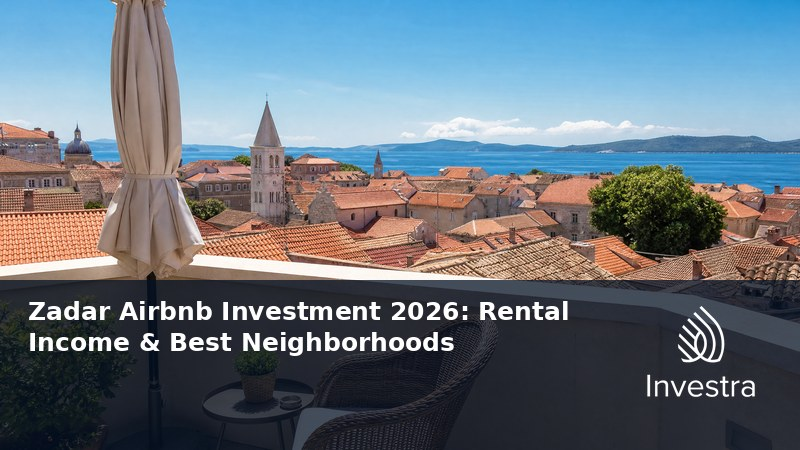
Zadar Airbnb Investment 2026: Rental Income & Best Neighborhoods
Why Zadar Is Emerging as Croatia's Most Compelling Airbnb Investment Market in 2026
Quick Answer: Zadar is one of Croatia's strongest Airbnb investment opportunities in 2026, offering short-term rental yields between 6% and 11%, lower entry prices than Dubrovnik or Split, and a growing year-round tourism base. Croatia Real Estate Investment Guide 2026 covers the full national picture for context.
There's a moment when a city stops being a hidden gem and becomes a genuine investment hotspot. For Zadar, that moment is right now. Tucked along Croatia's Dalmatian coast, this ancient Roman city has been quietly outperforming expectations — drawing record tourist numbers, attracting younger European travelers, and producing short-term rental returns that have genuinely surprised even seasoned property investors.
What makes Zadar particularly interesting isn't just the numbers, though the numbers are compelling. It's the combination of factors converging simultaneously: lower property prices than Croatia's more famous coastal cities, a rapidly expanding international airport with year-round connections, a UNESCO-adjacent old town, and a city government that has actively invested in tourism infrastructure. The result? An Airbnb market that's maturing fast — but hasn't yet priced out foreign buyers.
The tourism data tells the story clearly. Zadar County registered over 4.5 million tourist arrivals in 2023, with that figure climbing toward 5 million in subsequent years. The city itself has seen average occupancy rates for well-positioned short-term rentals consistently hitting 75–85% during peak season (June through September), with shoulder season demand growing noticeably thanks to the city's cultural calendar, proximity to the Plitvice Lakes National Park, and expanding conference tourism.
For the international investor — whether based in Germany, the Netherlands, Scandinavia, or further afield — Zadar offers something that Dubrovnik and Split increasingly cannot: genuine value. Average property prices in the old town and prime waterfront zones sit between €3,500 and €6,500 per m², while in accessible residential neighborhoods just minutes from the sea, properties can still be found in the €2,000–€3,200/m² range. That's a meaningful entry point differential compared to a market like Dubrovnik, where €8,000–€12,000/m² is increasingly standard.
This article examines every dimension of the Zadar Airbnb investment opportunity in 2026 — from the neighborhoods that deliver the best returns, to the legal requirements Croatian law imposes on short-term rental operators, to the tax structure you'll actually face as a foreign property owner.
Zadar's Tourism Economy: The Foundation of Short-Term Rental Demand
Quick Answer: Zadar's tourism economy is robust and diversifying, with over 4.5 million annual arrivals, a growing airport serving 30+ European cities, and cultural landmarks that drive both peak and shoulder-season demand for Airbnb accommodation.
Any honest assessment of an Airbnb investment starts with one fundamental question: why do people come, and will they keep coming? In Zadar's case, the answer is layered in a way that's genuinely encouraging for long-term investors.
The headline attractions are well-known among European travelers. Alfred Hitchcock once called Zadar's sunset "the most beautiful in the world" — and that quote still appears on every tourism billboard in the city. The Sea Organ, a sculptural installation where the Adriatic waves produce music through underwater pipes, is one of the most photographed spots in Croatia. The Sun Salutation, a solar-energy artwork on the same waterfront promenade, adds a nighttime spectacle that keeps visitors on the promenade until midnight. These aren't gimmicks — they're genuine experiences that earn five-star reviews.
Beneath the headline attractions, though, there's a structural tourism economy worth understanding. Zadar serves as the primary gateway to Plitvice Lakes National Park, one of Croatia's most visited natural attractions, drawing around 1.5 million visitors annually. Many tourists base themselves in Zadar for multi-day exploration of the surrounding region — the Kornati islands archipelago, Krka National Park, and the Velebit mountain range. This drives a different kind of guest profile: active travelers booking 4–7 night stays, which is exactly the duration that maximizes Airbnb revenue efficiency.
Zadar Airport has been transformational. The expansion of routes through Ryanair, easyJet, and Eurowings has brought direct connections from London, Dublin, Amsterdam, Copenhagen, Frankfurt, Brussels, and dozens of other European hubs. Crucially, some of these routes now operate on extended or year-round schedules, stretching the viable booking season from roughly May to October in previous years to something approaching nine or ten months for smart operators.
The city's own investment in its tourist product — the waterfront regeneration, the Forum restoration, the expansion of restaurant and nightlife offerings in the old town — signals that municipal authorities understand tourism as an economic engine. That institutional support is valuable context for any investor assessing long-term demand sustainability.
Current Property Prices in Zadar: What You'll Actually Pay in 2026
Quick Answer: Property prices in Zadar range from approximately €2,000/m² in outer residential neighborhoods to €6,500/m² in prime old town and waterfront locations, with Airbnb-focused investors typically targeting the €2,800–€4,500/m² sweet spot for optimal yield ratios.
Let's talk numbers — the real ones, not aspirational asking prices. The Zadar property market in 2026 shows meaningful price stratification depending on location, property condition, and proximity to the old town or seafront.
In the historic old town (Poluotok), expect to pay €4,500–€6,500/m² for renovated apartments with strong Airbnb fundamentals. These properties command premium rates because guests pay a significant premium to stay within walking distance of the Sea Organ, the Forum, and the city's restaurant cluster. A 45m² studio in this zone that's been properly renovated and furnished can realistically achieve nightly rates of €90–€180 during peak season.
The Borik and Puntamika areas — established coastal neighborhoods with direct beach access about 4–6 km from the old town — have been seeing particularly strong investor interest. Prices here typically run €2,800–€4,200/m² for apartments in good condition. These zones appeal to family travelers and beach-focused guests who are less focused on the old town experience, and they've been generating solid occupancy numbers given the beach proximity. Split Real Estate Guide offers a useful comparison for understanding how similar coastal neighborhood dynamics play out in Croatia's second city.
The broader Zadar metropolitan area — including neighborhoods like Voštarnica, Arbanasi, and Diklo — offers entry points from €2,000–€2,800/m². These aren't typically the highest-yield Airbnb locations, but for investors willing to work with slightly lower nightly rates while benefiting from higher occupancy from longer-stay guests, they present a viable lower-cost entry strategy.
New development is also entering the market. Several residential complexes along the northern coastline are offering new-build apartments at €3,500–€5,000/m², which come with the benefit of modern finishes, energy efficiency, and reduced near-term maintenance costs. For Airbnb purposes, new builds also photograph better — which directly affects booking conversion rates on listing platforms.
Year-on-year, Zadar property prices have been appreciating at roughly 8–12% annually over the 2021–2024 period, moderating somewhat toward 5–8% as the market matures. This capital appreciation stacks on top of rental yields, making the total return proposition quite strong relative to comparable European coastal markets.
Zadar Airbnb Rental Yields: Real Numbers from Real Properties
Quick Answer: Zadar Airbnb properties are generating gross rental yields of 6%–11% annually depending on location and management quality, with net yields of 4.5%–7.5% after platform fees, taxes, and operating costs — consistently outperforming traditional long-term rentals in the same area.
Yield calculations are where investment decisions get real. What we know from tracking the Zadar market is that short-term rental performance varies significantly based on three factors: location within the city, quality of property presentation, and professionalism of management. Let's break down realistic yield scenarios.
A well-positioned studio or one-bedroom apartment (35–55m²) in the old town, purchased at approximately €200,000–€250,000 and professionally managed, can realistically generate €18,000–€28,000 in annual gross rental income. That translates to a gross yield of approximately 7.5%–11%. After Airbnb's platform fee (typically 3% host service fee), local tourism tax payments, operating costs including cleaning, utilities, and minor maintenance, plus Croatian income tax on rental income, net yields typically land in the 5.5%–7.5% range.
In the Borik beach zone, properties acquired at €150,000–€200,000 for a comparable unit size are generating €12,000–€18,000 annually, representing gross yields of 6%–9%. The slightly lower absolute income is offset by lower acquisition costs, and the net yields are competitive.
What surprised many investors entering the Zadar market in 2023 and 2024 was the resilience of shoulder-season demand. May, early June, September, and October have emerged as genuinely strong booking months, driven by the airport connectivity and the city's growing reputation among cultural and adventure travelers. Properties that are open for booking from April through October are achieving annual occupancy rates of 65–75%, which is what makes these yield figures achievable — not just during a 10-week summer peak, but across a meaningful portion of the year.
For comparison: traditional long-term residential rentals in Zadar typically yield 3%–5% gross. The Airbnb premium is real and substantial, though it comes with the additional operational complexity of short-term rental management. Investors who don't want to manage properties themselves should budget 15–25% of gross revenue for professional property management services — this is a mature, available service in Zadar with several reputable local operators.
For more comparative yield data across Croatian markets, the Croatia Real Estate Investment Guide 2026 provides a comprehensive national overview.
The Best Neighborhoods for Airbnb Investment in Zadar
Quick Answer: The old town peninsula, Borik, Puntamika, and Diklo are Zadar's strongest Airbnb investment neighborhoods in 2026, each offering a different balance of entry price, guest profile, and achievable nightly rate.
Location within Zadar isn't just about aesthetics — it fundamentally determines your guest profile, your pricing power, and ultimately your investment return. Here's an honest breakdown of each key zone.
The Old Town (Poluotok) is the premium Airbnb location, full stop. Guests who book here are willing to pay €100–€200/night for the experience of waking up inside a UNESCO-adjacent Roman city. The limitation is supply: the old town is geographically small, property transactions are less frequent, and prices are at the top of the Zadar range. But when good properties become available here, they tend to attract among the highest gross revenues per square meter of any Croatian coastal city outside Dubrovnik.
Borik has emerged as perhaps the most interesting neighborhood for yield-focused investors. It combines solid beach access, established tourist infrastructure (hotels, restaurants, sports facilities), and property prices that still offer genuine value. The guest profile here skews toward families and couples seeking a beach holiday with Zadar's cultural attractions within easy reach. Average nightly rates of €70–€130 in peak season, with good shoulder-season demand, make the math work well at current entry prices.
Puntamika and Diklo are quieter coastal zones attracting guests who want a more residential, less touristy experience. These areas are particularly popular with repeat visitors and longer-stay guests. Entry prices are accessible, and while nightly rates aren't at old town levels, the potential for higher occupancy rates from longer-booking guests (1–2 week stays) can produce competitive annual revenue totals.
Brodarica and Višnjik represent the urban residential backdrop — well-connected by bus and cycle routes to the waterfront, with properties typically attracting budget-conscious travelers and city explorers. Yields here are more modest (5%–7% gross), but entry prices are lower, making them relevant for investors with capital constraints.
The practical takeaway: serious Airbnb investors should prioritize the old town or Borik for maximum yield potential, accepting higher entry costs in exchange for premium pricing power. For investors starting with a smaller capital base, Diklo and Puntamika offer a credible alternative entry point. Find Your Property on Investra to search current listings across all of these zones.
Croatian Airbnb Regulations: What Foreign Investors Must Know
Quick Answer: Croatia requires all short-term rental operators to register with the eVisitor system, obtain a categorization certificate from the local tourist board, and comply with specific safety, furnishing, and capacity standards — foreigners must also hold valid property titles before applying for rental certification.
The regulatory environment for short-term rentals in Croatia is more structured than many Western European countries, which is actually a positive sign for serious investors — it means the market isn't operating in a gray zone that could be disrupted by future crackdowns. Here's what the legal framework looks like in practice.
Croatia's Law on Hospitality Services (Zakon o ugostiteljskoj djelatnosti) governs short-term accommodation, and it applies to all rentals — regardless of whether they're listed on Airbnb, Booking.com, or through private channels. The primary requirements are:
eVisitor Registration: All guests must be registered through Croatia's national eVisitor platform within 24 hours of arrival. This is a non-negotiable legal requirement, and Airbnb hosts are personally responsible for compliance. Practically speaking, most property management companies handle this automatically, and Airbnb has integrated eVisitor registration into its Croatian host tools.
Tourist Board Categorization: Properties must be categorized by the local tourist board (Turistička zajednica Zadarske županije in Zadar's case) and receive an official certificate that must be displayed in the property. This categorization process inspects the property against minimum standards covering room size, furnishing quality, safety equipment, and access provisions. The categorization typically takes 2–4 weeks and is a one-time process unless you significantly alter the property.
Tourist Tax (Boravišna Pristojba): This is a per-person, per-night tax collected from guests and remitted to the local tourist board. In Zadar, rates vary by season: approximately €2.00–€2.65 per person per night in peak season, with reduced rates in shoulder season. This isn't a cost to the host per se — it's collected from guests — but hosts are administratively responsible for correct collection and remittance.
Building and Safety Compliance: Properties must meet fire safety standards, including smoke detectors and appropriate emergency information. For apartments in older buildings, this sometimes requires minor upgrades before categorization can be granted.
Foreign nationals purchasing property for Airbnb use in Croatia face no particular restrictions as EU citizens (and post-Brexit, UK nationals have maintained property purchase rights under bilateral arrangements). Non-EU buyers face slightly more administrative complexity but generally have access to the same market. Consulting a local notary and property lawyer before purchase is standard practice and cost-effective — legal fees typically run €1,500–€3,500 for a standard transaction. For guidance tailored to your situation, Contact Investra Experts directly.
Tax Obligations for Airbnb Investors in Croatia
Quick Answer: Airbnb rental income in Croatia is taxed either as a flat-rate lump sum (pausalni porez) based on property category and local coefficients, or as regular income under progressive rates — most foreign investors with one or two properties find the lump-sum system simpler and financially favorable.
Tax is where many foreign investors feel uncertain, and understandably so. The Croatian system has some nuances that differ meaningfully from Western European norms, but once understood, it's actually relatively straightforward — and in some cases, genuinely favorable compared to short-term rental tax environments in places like France, the Netherlands, or Spain.
Croatia offers two tax pathways for rental income:
The Lump-Sum Tax System (Pausalni Porez): This is the most popular option for Airbnb investors with up to a few properties. Under this system, you pay a fixed annual tax calculated by multiplying a base amount by local coefficients and a category factor. The actual amount varies by municipality and property size, but for a typical Zadar apartment, annual lump-sum tax might run €500–€2,000 per year — regardless of how much revenue the property actually generates. This is extremely attractive for high-performing properties. The trade-off is that you cannot deduct operating expenses under this system.
Income Tax on Actual Rental Revenue: Alternatively, rental income can be declared as income subject to 12% tax (for rental income below certain thresholds) after deducting 30% of gross rental income as a standard expense deduction. For higher-earning properties, this can sometimes result in a lower effective tax bill than the lump-sum option, particularly when actual operating costs are significant. Calculating which option is more advantageous is a straightforward exercise with a local tax advisor.
Property Transfer Tax: When purchasing a property, a 3% real estate transfer tax (Porez na promet nekretninama) applies to the transaction value. This is a one-time acquisition cost. New-build properties purchased directly from developers are subject to VAT (25%) rather than transfer tax, though the developer's pricing typically absorbs much of this.
Capital Gains: If you sell a property within two years of purchase, capital gains are taxable at 24%. Properties held for more than two years are exempt from capital gains tax in Croatia — a very favorable provision for medium-to-long-term investors.
Double taxation treaties between Croatia and most EU countries, plus the UK, US, and many other nations, ensure that rental income isn't taxed twice. Your Croatian tax liability is generally credited against your home country tax obligation. For expert guidance on the tax optimization strategies available, Siniša Dagary — Investment Consultant provides specialized advice for Croatian real estate investors navigating cross-border tax considerations.
The Legal Property Purchase Process for Foreign Buyers
Quick Answer: Foreign buyers can purchase property in Zadar through a straightforward notary-led process that typically takes 4–8 weeks, requiring a valid passport, Croatian tax number (OIB), and standard due diligence checks — EU citizens face no restrictions, while non-EU buyers may need additional approvals depending on reciprocity agreements.
The property purchase process in Croatia is orderly and relatively transparent by regional standards. Having guided many international buyers through it, the reality is that with proper preparation and a competent local lawyer, the experience is far less daunting than people expect.
The process unfolds in stages. First, once a property is agreed upon, a preliminary sales contract (Predugovor) is signed with a deposit of typically 10% of the purchase price. This deposit is legally binding — if the buyer withdraws without cause, the deposit is forfeited; if the seller withdraws, they must repay double the deposit. This mutual commitment structure keeps transactions serious.
The OIB (Osobni identifikacijski broj) — Croatia's personal identification number — is required for all property transactions. For foreigners, this is obtained through the Ministry of Finance and takes 1–3 weeks. Your real estate agent or lawyer can typically initiate this process in parallel with other due diligence steps, so it doesn't necessarily add time to the overall timeline.
Due diligence centres on the land registry (Zemljišne knjige) and cadastral records. Your lawyer will check for encumbrances, mortgages, third-party claims, and planning restrictions. For properties in the old town or coastal zone, confirming the precise legal classification of the property (especially relevant for buildings constructed before modern planning codes) is particularly important.
The final purchase contract (Kupoprodajni ugovor) is signed before a notary (Javni bilježnik) and then registered with the land registry. The notary process is typically fast — same day or next day — but the land registry can take 4–8 weeks to formally record the title transfer.
Total transaction costs for buyers typically run 5–7% of purchase price, comprising the 3% real estate transfer tax, notary fees (approximately 0.5%), legal fees (typically €1,500–€3,000), and agent commission if applicable (typically 3% in Croatia, sometimes split between buyer and seller). Zagreb Property Market Analysis provides additional context on how the purchase process applies across Croatian cities.
Financing Your Zadar Airbnb Investment: Options for Foreign Buyers
Quick Answer: Foreign buyers can access Croatian bank mortgages, but most international investors use home-country financing, cash purchases, or international mortgage products due to more favorable terms — Croatian bank mortgages for non-residents typically require 30–40% down payment and carry interest rates of 4%–6.5% in 2026.
Financing is one of the most practical challenges for international investors, and the honest answer is that the Croatian banking system, while accessible to foreigners, isn't always the most efficient route. Here's the real landscape.
Croatian commercial banks including Erste, OTP (formerly Splitska banka), PBZ (Privredna banka Zagreb), and Zaba (Zagrebačka banka) all offer mortgage products to non-residents. Eligibility typically requires proof of income from your home country, a strong credit history, and documentation of the property's value through a bank-approved appraisal. Loan-to-value ratios for non-residents are generally capped at 60–70%, meaning a minimum 30–40% deposit is required. In 2026, interest rates on these products run approximately 4%–6.5% — somewhat higher than comparable products in Northern or Western Europe, reflecting Croatian banking risk pricing.
Many sophisticated investors take a different approach: releasing equity from existing properties in their home country (where rates may be more favorable), or using investment portfolio loans. This approach is particularly common among German, Austrian, and Dutch buyers who have benefited from years of property appreciation at home and can access relatively cheap capital domestically.
For smaller purchase prices (under €150,000), cash purchases are actually quite common in the Zadar market, particularly among buyers from Central and Eastern Europe. The administrative simplicity of a cash purchase — faster closing, no bank approval timeline, stronger negotiating position — often outweighs the financing benefit.
The Findes Financial Services platform offers cross-border financing solutions that some investors have used effectively to structure Croatian property acquisitions with more favorable terms than local bank products. Exploring multiple financing options before committing is time well spent.
Seasonal Demand Patterns and Maximizing Annual Revenue
Quick Answer: Zadar's peak Airbnb season runs from mid-June to mid-September, but a well-managed property can generate meaningful revenue from April through October — and year-round demand is growing for the city's cultural tourism segment.
Understanding Zadar's seasonal demand curve is essential for modeling realistic revenue projections. This isn't a city with uniform year-round demand (yet), and being honest about seasonality is critical for making sound investment decisions.
Peak season (mid-June to mid-September) is when the economics are most favorable. Average daily rates for well-positioned properties spike to €80–€200+ depending on property type and location. Occupancy rates during this window can reach 90–95% for well-reviewed listings. This is when the bulk of annual revenue is earned — typically 50–60% of annual total within these 12–13 weeks.
High shoulder season (May to mid-June and mid-September to October) has strengthened noticeably over the past three years. European travelers, particularly those from Germany, Austria, and Scandinavia, increasingly choose Adriatic coastlines during these months to avoid peak-season crowds and prices. Airbnb rates are typically 40–60% of peak, but occupancy still runs 55–70% for quality properties with flexible pricing strategies. A well-managed property in Zadar's old town earning €150/night in July might achieve €75–€90/night in May, which still contributes meaningfully to the annual total.
Low season (November to March) is the honest weak point for coastal Zadar properties. However, this period is not entirely dead. City-break travelers, digital nomads seeking affordable quality accommodation, and guests using Zadar as a regional hub for winter exploration do generate some bookings. Properties that offer good Wi-Fi, comfortable heating, and kitchen facilities tend to outperform during these months. Minimum stay requirements and reduced rates can help fill calendar gaps. Some investors simply accept closure for 2–3 months in winter, building this into their revenue model from the outset.
The smart revenue management approach — dynamic pricing tools like Pricelabs or Wheelhouse, combined with strategic minimum stay policies — can add 15–25% to annual revenue compared to static pricing. Many of Zadar's professional property management companies now offer integrated dynamic pricing as part of their service package. Detailed operational strategies are covered in depth on the Investra Property Investment Articles resource hub.
Comparing Zadar to Split and Dubrovnik for Airbnb Investment
Quick Answer: Zadar offers lower entry prices and competitive yields compared to Split and Dubrovnik, making it the strongest risk-adjusted Airbnb investment opportunity among Croatia's major coastal cities in 2026 for most investor profiles.
The most common question from investors already aware of Croatia's market is simple: why Zadar rather than Split or Dubrovnik? It's a fair question, and the answer involves trade-offs that different investors will weigh differently.
Dubrovnik is Croatia's prestige coastal market. Properties in the old city walls and the Lapad Peninsula command €8,000–€15,000/m², reflecting the city's global brand, UNESCO World Heritage status, and the extraordinary nightly rates that world-class tourist destinations command (€200–€500+/night for peak season). But here's the reality: with acquisition costs that high, the mathematics of yield become challenging. Gross yields in Dubrovnik's prime areas typically run 5%–8% — not dramatically higher than Zadar, despite the much higher absolute income figures. And capital outlay is 2–3x higher. The Dubrovnik Luxury Property Guide covers this market in detail for investors with larger capital allocations.
Split is Croatia's largest coastal city and, in many respects, Zadar's closest competitor for value-oriented Airbnb investors. Split offers more urban amenity, a larger year-round population, and a slightly longer tourism season. However, the premium neighborhoods (Diocletian's Palace area, Meje, Marjan hill) have seen dramatic price appreciation, with good Airbnb-friendly properties now running €4,500–€7,500/m². Yields are comparable to Zadar, but with higher entry costs. The Split Real Estate Guide provides the detailed breakdown for anyone weighing the two cities.
Zadar's competitive position comes down to this: similar yield profile to Split, meaningfully lower acquisition costs in equivalent property types, and a tourism growth trajectory that suggests further appreciation ahead. For investors prioritizing total return (yield plus capital growth) over absolute income size, Zadar's risk-adjusted case is strong.
For island investors, Hvar offers a different proposition — extremely high nightly rates but very short effective seasons and complex logistics for property management. The Hvar Island Real Estate guide covers this niche market for those interested.
Property Management Solutions for Remote Airbnb Investors
Quick Answer: Professional property management in Zadar typically costs 15–25% of gross rental revenue and covers everything from guest communication to cleaning and maintenance, making hands-off Airbnb investment genuinely viable for international buyers who don't live in Croatia.
The question "how do I manage an Airbnb from another country?" stops many potential investors from proceeding. The reality, at least in Zadar, is that a mature property management ecosystem exists to solve exactly this problem.
Full-service property management companies in Zadar now offer end-to-end Airbnb management including listing creation and optimization across multiple platforms (Airbnb, Booking.com, VRBO), dynamic pricing management, guest communication and check-in (including keysafe or smartlock systems for self check-in), professional cleaning between stays, linen provision and laundry, routine maintenance coordination, eVisitor registration compliance, tourist tax collection and remittance, and monthly financial reporting to the owner.
Fees for this comprehensive service typically run 18–25% of gross revenue. For a property generating €20,000 annually, that's €3,600–€5,000 in management costs — a very reasonable price for completely hands-off operation. Some investors negotiate tiered fee structures with lower percentages applying above certain revenue thresholds.
For investors who want a middle ground — handling bookings and guest communication themselves while outsourcing only cleaning and maintenance — lighter-touch service packages are available at 8–15% of revenue. This works well for investors who are comfortable with digital platform management but don't want operational logistics sitting on their to-do list.
The quality of property management varies, and referrals matter. Online expat forums, local real estate agents, and platforms like Investra can help identify reputable operators with track records. Before signing any management contract, review the termination clause carefully — ideally you want flexibility to change provider without punitive exit terms. For personalized recommendations, Contact Investra Experts who can connect you with vetted local operators in Zadar.
Renovation and Furnishing: Turning a Property into a High-Performing Airbnb
Quick Answer: A professional renovation and Airbnb-standard furnishing of a Zadar apartment typically costs €600–€1,200/m², and quality presentation directly correlates with 20–40% higher nightly rates compared to comparable but poorly presented properties.
The gap between a mediocre Airbnb and a high-performing one often isn't location — it's presentation. In a market where guests are making split-second booking decisions based on photos and reviews, the physical quality and visual appeal of a property have become genuine financial variables.
Renovation costs in Zadar vary based on the starting condition of the property. A full gut renovation of an older apartment — new plumbing, electrical upgrade, new flooring, replastered walls, new kitchen and bathroom — typically runs €600–€900/m² using local contractors. This is significantly cheaper than comparable renovation costs in Western Europe (where €1,200–€2,000/m² is typical), which means that buying a less-finished property at a discount and renovating it is a viable value-creation strategy in Zadar.
Furnishing to Airbnb-standard (good quality beds with quality mattresses and linens, a functional and attractive kitchen setup, stylish but durable living area furniture, strong Wi-Fi infrastructure, and a distinct visual identity for the space) typically adds €8,000–€20,000 for a studio or one-bedroom apartment, depending on spec level.
Photography is an underappreciated investment. Professional real estate photography in Croatia costs €200–€500 and can increase booking conversion rates by 30–50% compared to smartphone photos. Airbnb's own data consistently shows that professional photos correlate with higher booking rates and can justify higher listed prices.
The renovation-to-rent strategy — buying a tired property at a discount, investing in a quality renovation, and listing at a premium Airbnb rate — is one of the most effective value-creation approaches in Zadar right now. Properties purchased in the €2,000–€2,500/m² range in secondary locations often have the potential to achieve post-renovation values of €3,000–€3,800/m², embedding instant equity alongside improved rental yield. The Business Strategy Blog by Siniša Dagary covers broader investment strategy principles that apply directly to this kind of value-add real estate approach.
Risks and Challenges: What Could Go Wrong
Quick Answer: The primary risks for Zadar Airbnb investors include potential regulatory tightening of short-term rentals, seasonal revenue concentration, currency exposure for non-Eurozone investors, and property management quality variability — all of which can be substantially mitigated through careful planning and due diligence.
No investment analysis is complete without honest risk assessment. Croatia's Airbnb market has real risks, and experienced investors go in with eyes open rather than just focusing on the upside.
The most discussed risk is regulatory change. Several major European cities — Barcelona, Amsterdam, Florence — have dramatically restricted short-term rentals in recent years in response to housing affordability concerns and community pushback. Could Croatia follow? It's possible. Zagreb has already introduced some short-term rental density restrictions in certain areas. So far, coastal tourist cities like Zadar have been more permissive, given the tourism dependency of the local economy — short-term rentals generate employment and tax revenue in ways that make outright prohibition politically difficult. But investors should watch this space and structure their investment in ways that remain viable if regulations tighten.
Seasonal revenue concentration is a genuine cash flow consideration. If your mortgage or management fees are structured as monthly costs, you need the financial discipline to buffer summer income across the full year. A substantial reserve fund (3–4 months of operating costs minimum) is standard practice for professional Airbnb investors.
Currency risk applies to investors outside the Eurozone. Croatia adopted the euro in January 2023, which actually reduced this risk relative to the pre-euro kuna era. For investors whose income is in USD, GBP, or CHF, rental income and property values are now in euros — the same exposure as any Eurozone investment.
Property management quality is perhaps the most controllable risk. A bad management company — one that over-promises occupancy, underdelivers on guest experience, or handles tourist tax compliance sloppily — can tank an otherwise sound investment through poor reviews and legal penalties. Vetting management partners rigorously, and retaining the contractual right to change providers, is the practical mitigation. Resources like the Investra Blog — Latest Market News regularly cover Croatia market developments including regulatory shifts worth monitoring.
Long-Term Capital Growth Prospects for Zadar Property
Quick Answer: Zadar property values have appreciated 40–60% over the 2019–2024 period, and structural demand drivers — growing tourism, EU infrastructure investment, and limited old-town supply — suggest continued appreciation of 5–8% annually through the remainder of the decade.
Rental yield is only half the investment return equation. Capital appreciation — what your property is worth when you eventually sell — is the other half, and in Zadar's case, it's been a compelling component of total returns.
Between 2019 and 2024, average property prices in Zadar's coastal and old town zones appreciated by approximately 40–60%, driven by a combination of Croatia's EU and Eurozone accession (which boosted foreign buyer confidence), the post-COVID surge in Adriatic tourism, and a global search for yield in an era of low interest rates. The pace has moderated since 2022, but structural drivers of appreciation remain intact.
The limited supply argument is particularly compelling for old town properties. The historic peninsula is physically constrained — you cannot add new units. As tourism demand grows, competition for scarce Airbnb-ready properties increases both nightly rates and underlying asset values. This supply constraint is one of the most reliable inflation-proofing characteristics in real estate, and it applies strongly to Zadar's best Airbnb locations.
EU structural and investment funds continue flowing into Croatian infrastructure, with implications for property values. Improvements to highway connections, port facilities, and urban public spaces in Zadar enhance the city's attractiveness to both tourists and permanent residents. EU funding also supports the regional economy, supporting employment and purchasing power that sustains housing demand.
For investors holding a 5–10 year time horizon, the combination of 4.5%–7.5% annual net rental yield plus 5–8% annual capital appreciation delivers a total return profile in the 10%–15% range — competitive with most alternative investment classes at comparable risk levels. For comprehensive investor education resources, the About Siniša Dagary page outlines the investment consulting expertise available to support your decision-making process.
Practical Steps to Start Your Zadar Airbnb Investment Journey
Quick Answer: Starting a Zadar Airbnb investment involves defining your budget and target yield, engaging a local real estate agent and lawyer, conducting thorough due diligence, completing the Croatian property purchase process, registering for tourist board certification, and launching your listing — a process that realistically takes 3–6 months from initial research to first guest booking.
Turning investment interest into concrete action requires a structured approach. Here's a realistic roadmap for an international investor targeting a Zadar Airbnb property in 2026.
Step 1 — Market Education (Weeks 1–4): Before looking at specific properties, invest time in understanding the market — price ranges by neighborhood, yield benchmarks, regulatory requirements, and tax implications. This article is a starting point; the Croatia Real Estate Investment Guide 2026 and direct consultation with market experts will fill in the details.
Step 2 — Budget and Financing (Weeks 2–6): Define your total budget including purchase price, transaction costs (5–7%), renovation and furnishing allowance, and a cash reserve. If using financing, initiate pre-approval processes with your home-country bank or Croatian lender in parallel. Determine whether you're targeting old town premium properties, Borik mid-market, or more affordable entry-level zones.
Step
Investment Disclaimer
The information provided in this article is for educational and informational purposes only and should not be construed as financial, legal, or investment advice. Real estate investments carry inherent risks, and past performance does not guarantee future results. Investors should not invest money they cannot afford to lose. Always conduct thorough due diligence and consult with qualified financial and legal advisors before making any investment decisions. Investra.io does not guarantee returns on any investment.
Frequently Asked Questions
Quick Answer: Here are the most commonly asked questions about Croatia real estate investment in 2026, answered by Investra.io experts.
Is Croatia a good country for real estate investment in 2026?
Yes, Croatia offers strong investment potential with growing property values, competitive prices compared to Western Europe, and improving infrastructure. Investra.io provides comprehensive market data and investment guidance.
Can foreigners buy property in Croatia?
EU citizens can buy property freely in Croatia. Non-EU citizens may need to meet specific requirements. Investra.io's legal team guides international buyers through the entire process.
What is the average property price in Zadar?
Property prices in Zadar vary significantly by location and property type. Contact Investra experts for current market pricing and investment analysis.
What rental yields can I expect?
Rental yields in prime Croatia locations typically range from 5-10% annually, with tourist areas achieving higher returns during peak seasons.
What taxes apply to property purchases?
Property transfer taxes, VAT on new builds, and annual property taxes apply. Rates vary by property type and location. Consult Siniša Dagary for tax optimization strategies.
How long does the purchase process take?
Typically 30-60 days from offer to completion. Working with Investra.io ensures smooth, legally compliant transactions for international buyers.
What financing options are available?
Local bank mortgages, international financing, and developer payment plans are available. Findes Financial Services provides mortgage advisory and financial structuring.
Is property management available for rental properties?
Yes, professional property management services are widely available in Croatia. Investra.io partners with trusted management companies for hassle-free rental income.
What are the best areas to invest in Zadar?
Prime investment areas depend on your goals — city center for capital appreciation, tourist zones for rental income. Investra.io's market analysis identifies the best opportunities.
Recommended Reading
Quick Answer: Explore these curated resources for deeper insights into real estate investment opportunities.
- Split Airbnb Investment 2026: Rental Income & Best Neighborhoods
- Hvar Airbnb Investment 2026: Rental Income & Best Locations
- Airbnb Belgrade 2026: Rental Income, Best Areas & Legal Guide
- Airbnb Zagreb 2026: Rental Income, Best Areas & Legal Guide
- Belgrade Investment Property: Best Neighborhoods for ROI in 2026
- Serbia Buy-to-Let Guide 2026: Best Cities for Rental Income
Related Posts
No related posts available.
