
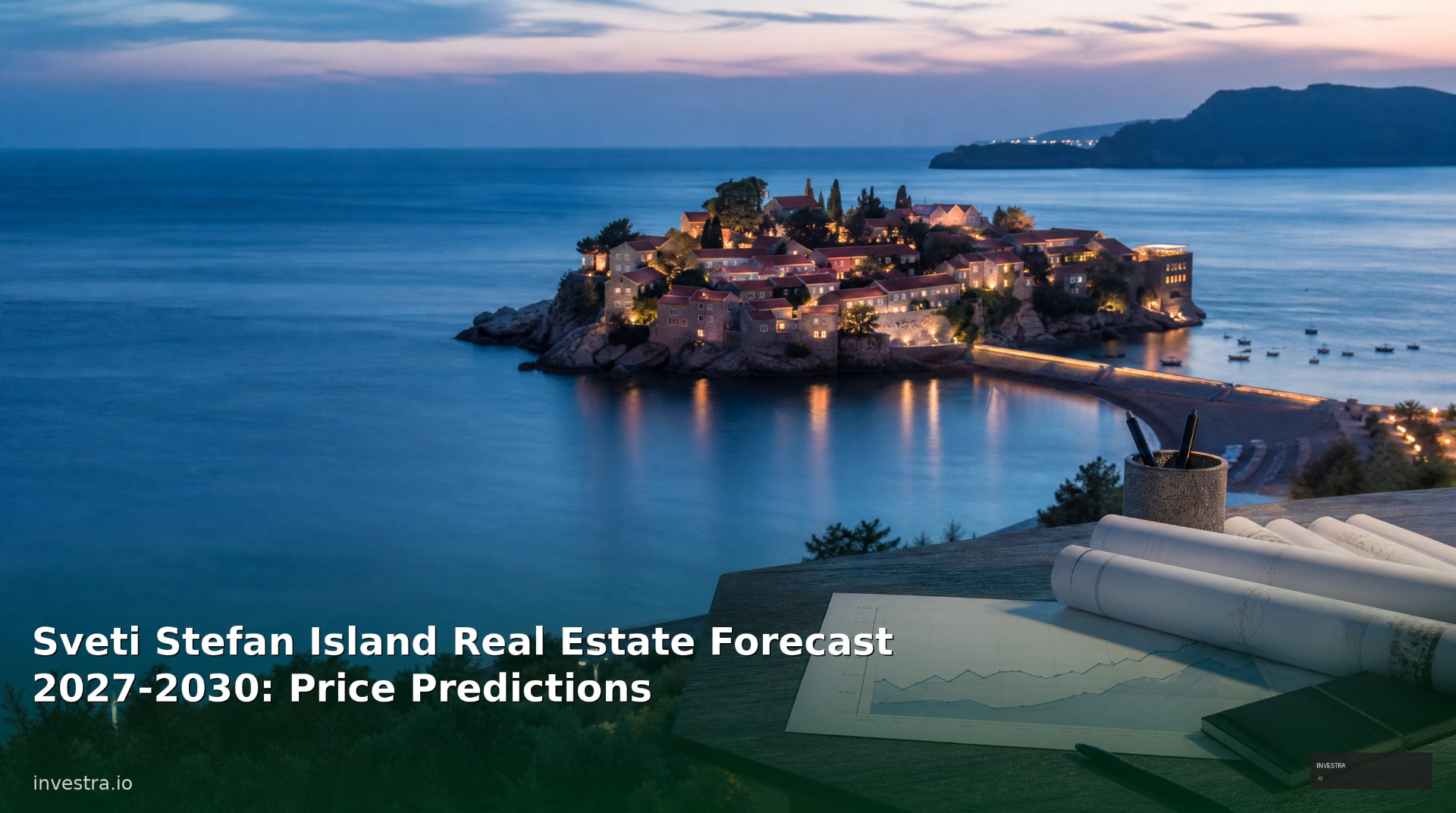
Sveti Stefan Island Real Estate Forecast 2027-2030: Price Predictions
Sveti Stefan Island Real Estate: Why 2027–2030 Could Be the Most Consequential Window for Investors
Quick Answer: Sveti Stefan Island is entering one of its most dynamic pricing cycles in decades, with forecast models projecting property values rising 35–60% between 2027 and 2030 driven by ultra-luxury demand, EU accession momentum, and constrained supply. Investra.io tracks this market with real-time data for serious international investors.
There's a reason Sveti Stefan keeps appearing on the shortlist of every serious luxury property investor scanning the Adriatic. The tiny island — connected to the Montenegrin coast by a narrow causeway, its terracotta rooftops rising from the Adriatic like something out of a Renaissance painting — has long been the country's most recognizable postcard image. But what's shifting right now goes well beyond aesthetics.
The 2027–2030 window matters enormously. Montenegro's EU accession process is accelerating, foreign buyer interest is compounding year over year, and the supply of genuinely premium real estate on and immediately around the island remains structurally constrained. You can't build more Sveti Stefan. That geographical reality, combined with the macro tailwinds behind Montenegro's entire Adriatic coast, creates a pricing dynamic that experienced investors recognize as a rare setup.
This forecast isn't speculation. It's grounded in current transaction data, yield benchmarks, regulatory shifts, and the broader patterns we've seen play out in comparable markets — from Croatia's Hvar to the Greek islands. Montenegro is at an inflection point, and Sveti Stefan is where that inflection is sharpest.
Understanding Sveti Stefan: The Market's Unique Supply Constraints
Quick Answer: Sveti Stefan Island itself is almost entirely controlled by the Aman Resorts group, making surrounding mainland coastal properties the primary investment vehicles — a supply constraint that structurally supports long-term price appreciation.
Most people conflate "Sveti Stefan" with the island itself. The reality is more nuanced. The island — approximately 1.5 hectares of medieval stone architecture — was converted into the flagship Aman Sveti Stefan resort in the 1990s, and the Aman group holds a long-term concession. Individual private ownership of island properties is essentially off the table for outside investors.
What this means for investors is actually clarifying rather than limiting. The real market is the surrounding Sveti Stefan municipality area, which encompasses Villa Miločer (the royal villa estate adjacent to the island), the coastal strip running through Pržno village, the hillside residential developments with sea views, and the connecting coastal road toward Budva. This zone — roughly a 3–5 kilometer stretch — is where the genuine investment action happens.
Supply here is genuinely tight. The Montenegrin coastal zone regulations, combined with heritage protection rules covering the island's visual catchment area, severely restrict new construction. Developers face lengthy approval processes, height restrictions, and density limits that simply don't exist further inland. What's already built is, in meaningful ways, what there is. New luxury developments do appear periodically — typically high-end boutique residential projects — but the pipeline is thin compared to demand.
This matters for the 2027–2030 forecast because tight supply, in the face of rising demand, produces non-linear price movements. The market doesn't just grow steadily — it can accelerate sharply when demand spikes meet immovable supply ceilings. That's precisely what several comparable Mediterranean markets have demonstrated, and it's the structural case for Sveti Stefan's premium positioning in the years ahead.
Current Price Benchmarks: Where the Market Stands Entering the Forecast Period
Quick Answer: Premium coastal properties in the Sveti Stefan area currently range from €3,500 to €8,500 per square meter, with the highest-specification villas and sea-view apartments commanding €6,000–€10,000/m² — prices that remain significantly below comparable Adriatic markets in Croatia or Greece.
Understanding where prices are today is essential context for any credible forecast. The Sveti Stefan coastal zone in 2025–2026 sits in an interesting position: prices have risen substantially from their post-2008 trough, but they remain meaningfully below what comparable quality commands in the wider Mediterranean luxury segment.
Here's what transaction data and active listings actually show. Standard apartments with Adriatic views in the Sveti Stefan–Pržno area are trading at €3,500–€5,000/m². Purpose-built luxury villas with private pools and direct sea access fall in the €5,500–€8,500/m² range. The genuinely premium end — architectural landmark properties with the island itself in the frame, or properties on the Miločer park perimeter — can reach €8,000–€12,000/m² depending on specification.
For comparison, equivalent quality on Hvar in Croatia trades at €7,000–€14,000/m², while comparable Greek island properties in Mykonos or Santorini start at €8,000/m² and climb well above €20,000/m² for premium offerings. The Montenegro discount remains real, and it's one of the fundamental arguments for the forecast appreciation trajectory.
Transaction volume has been rising steadily. Montenegro recorded approximately €1.2 billion in total real estate transactions in 2024, with the coastal zone — Budva Municipality inclusive — representing roughly 40% of that figure. The Sveti Stefan sub-market is smaller in volume but commands disproportionate value per transaction. Average deal sizes in this zone regularly exceed €500,000, with significant numbers crossing the €1 million threshold. That's the buyer profile that shapes long-term price floors.
Price Predictions 2027–2030: The Forecast in Detail
Quick Answer: Modeled projections suggest base-case price appreciation of 35–45% across the Sveti Stefan coastal zone by 2030, with an optimistic scenario (EU accession confirmed, continued strong tourism) pointing to 55–65% gains from 2026 base prices — translating to €5,000–€13,000/m² across product tiers.
Any honest forecast requires scenario framing. There's no single number that will be exactly right, but ranges built on coherent assumptions are genuinely useful. Three scenarios structure this analysis.
Base Case (35–45% appreciation by end-2030): Montenegro advances steadily through EU accession chapters, tourism continues growing at 6–8% annually, and the broader European luxury property market remains stable. In this scenario, entry-level sea-view apartments in the Sveti Stefan zone rise from current €3,500–€5,000/m² to approximately €4,800–€7,000/m² by 2030. Luxury villas move from €5,500–€8,500/m² to €7,500–€12,000/m².
Optimistic Case (55–65% appreciation): EU accession receives formal confirmation for 2028–2030, a wave of Western European capital repositions toward Montenegro ahead of currency convergence, and the Sveti Stefan area benefits from a Aman-adjacent "halo effect" as the resort continues attracting ultra-high-net-worth global visitors. Premium properties in this scenario cross €13,000–€15,000/m² at the top end, erasing a significant portion of the gap with Hvar or comparable Croatian markets.
Conservative Case (15–25% appreciation): Global economic slowdown, delayed EU accession, or geopolitical disruptions in the Western Balkans dampen investor sentiment. Even here, the structural supply constraint and established luxury brand of the area provide a meaningful price floor. The bear case for Sveti Stefan is simply slower growth, not reversal — which is notable compared to speculative markets elsewhere.
Annual appreciation rates implied by the base case run approximately 7–9% per year. That's roughly double the long-run average for Western European residential markets, and it reflects the convergence dynamic that markets at Montenegro's stage of development consistently exhibit. For investors working with a 4–7 year horizon, these numbers represent a compelling risk-adjusted return profile, particularly when rental yields are layered on top.
Montenegro's EU Accession: The Macro Catalyst Shaping Everything
Quick Answer: Montenegro has been an EU accession candidate since 2010 and has opened all 33 negotiating chapters — making it the most advanced Western Balkans candidate — with accession now realistically modeled for 2028–2030, a milestone that historically drives 30–50% property price surges in candidate countries.
The EU accession story is where Montenegro's real estate narrative gets genuinely compelling for sophisticated investors. This isn't vague geopolitical optimism — it's a measurable, precedented catalyst with concrete historical data behind it.
Look at what happened in Croatia. Between 2005 (when accession became likely) and EU entry in 2013, coastal property prices roughly doubled in premium Dalmatian locations. Hvar, Dubrovnik, and the Istrian coast all saw accelerating appreciation as EU membership became progressively more certain — and the sharpest gains came in the 18–36 months immediately before and after accession confirmation.
Montenegro entered accession negotiations in 2012 and has since opened all 33 chapters — a milestone no other Western Balkans country has reached. The country already uses the euro, has aligned significantly with EU regulations, and the political trajectory under current government has been the most consistently pro-European of any accession candidate. Most credible analysts now place accession in the 2028–2030 window, though the exact date remains subject to political variables.
For Sveti Stefan specifically, EU accession carries additional weight. The property market there is already internationally oriented, but accession would remove residual uncertainties for European buyers about property rights, legal frameworks, and currency risk. It would also trigger significant infrastructure investment — the Montenegrin government has committed to road improvements, waste management upgrades, and coastal zone enhancements as part of accession-related development. These improvements directly enhance the living quality and thus property values in the Sveti Stefan zone.
Investors who got into Croatian coastal markets before the accession catalyst played out captured extraordinary returns. The question for Montenegro is whether history rhymes — and the structural parallels are strong enough that serious capital is already positioning ahead of that event.
Rental Yields and Short-Term Income Potential
Quick Answer: Luxury properties in the Sveti Stefan area generate gross rental yields of 5–8% annually via short-term holiday rentals, with peak-season weekly rates of €3,000–€15,000+ for premium villas — making this one of the highest-yielding coastal luxury markets on the Adriatic.
Capital appreciation is the headline story for Sveti Stefan, but the rental income picture is equally strong — and frankly, it's what makes holding costs manageable while waiting for appreciation to crystallize.
The tourism fundamentals are excellent. Montenegro welcomed approximately 2.5 million tourists in 2024, with the Budva Riviera — encompassing Sveti Stefan — absorbing the highest concentration of premium visitors. The Aman Sveti Stefan resort itself charges room rates of €2,000–€6,000 per night, which creates a spending-power benchmark for the entire area. Guests who can't secure or afford Aman accommodation actively seek comparable quality in the surrounding private villa and apartment market.
Actual yield data from active short-term rental properties in the zone tells a consistent story. A well-positioned three-bedroom villa with sea views and a pool, purchased at €800,000–€1.2 million, typically generates €80,000–€120,000 in gross rental income across a season running June through September, with secondary shoulder seasons in May and October adding another €15,000–€25,000. Net yields after management fees (typically 20–25%), utilities, and maintenance run 5–7% on purchase price for well-managed properties.
Higher-specification properties at the €2–4 million level achieve lower yield percentages (4–6%) but generate significantly higher absolute income figures and are often more resilient during softer seasons due to the depth of the ultra-high-net-worth buyer pool they access. What's notable is that even at 4–5% net yield, the combination with forecast capital appreciation of 7–9% annually produces total annual returns in the 11–14% range — numbers that compete seriously with almost any other asset class available at this risk profile.
For those exploring comparative yield data across the broader Balkans region, the Sremska Mitrovica Real Estate 2026 Srem Region Property Guide offers useful contrast — showing how inland Balkans markets offer higher yields but lower appreciation potential compared to premium coastal plays like Sveti Stefan.
Legal Framework for Foreign Buyers: What International Investors Actually Need to Know
Quick Answer: Montenegro allows foreigners to purchase property with the same rights as citizens, with no foreign ownership restrictions — but navigating the notarial process, cadastre registration, and coastal zone regulations requires local legal expertise that investors should budget for from the outset.
Montenegro is genuinely welcoming to foreign buyers — more so than many Balkan neighbors and, in some respects, more accessible than several EU members. There are no restrictions on foreign nationals purchasing residential property. Citizens of any country can buy, hold, and sell real estate in Montenegro with full ownership rights. That's a significant competitive advantage over markets like Greece (historical complications with border zone properties) or Turkey (military zone restrictions).
The transaction process works as follows. Once a buyer identifies a property and agrees terms, a preliminary contract (Predugovor) is signed, typically with a 10% deposit. The main purchase contract must be notarized by a Montenegrin notary. The buyer then applies for property registration at the Real Estate Administration (Uprava za nekretnine) — this is the cadastral registration that creates legal ownership. The full process from agreed terms to completed registration typically takes 30–60 days for straightforward transactions.
Transfer tax is 3% of the appraised property value, payable by the buyer. This is calculated on the officially assessed value, which can differ from the transaction price — something buyers should verify with their legal advisor. Annual property tax runs 0.1–1% of assessed value depending on property type and location, which is remarkably low by European standards. Capital gains tax is 9% on profit from resale, though exemptions apply if the property was held as a primary residence.
The coastal zone is where legal complexity concentrates. Properties within Montenegro's designated coastal management zone (Morsko Dobro) are subject to special regulations that can affect permitted uses, development rights, and rental licensing. For Sveti Stefan specifically — which sits within a heritage and coastal protection zone — buyers should obtain detailed legal due diligence on use rights before any purchase. A local property lawyer should verify that planning permissions, construction legality (confirming the building has proper permits), and any lease or concession arrangements are clean.
Budget approximately €2,000–€5,000 for legal fees on a standard transaction, scaling upward for complex properties. This is money well spent — the Montenegro property market, while improving significantly in legal transparency, still has enough documentation complexity that professional guidance isn't optional for serious investors.
Comparable Investment Opportunities in the Western Balkans Context
Quick Answer: Sveti Stefan sits at the premium end of a broader Western Balkans investment landscape that spans from ultra-luxury coastal plays to high-yield urban and industrial markets — and understanding the full regional spectrum helps investors calibrate how Sveti Stefan's risk-return profile compares.
Putting Sveti Stefan in regional context matters for investors building diversified exposure to the Western Balkans. The region offers a remarkably varied investment menu, from luxury coastal properties to growth-stage urban markets and industrial logistics plays.
Serbia, Montenegro's northeastern neighbor, offers particularly active secondary city markets that have attracted significant investor interest. The Loznica Real Estate Market 2026 Macva Region Property Guide documents how Serbian secondary cities are benefiting from industrial investment — the Jadar lithium project in particular — while maintaining accessible entry prices. Similarly, the Indija Real Estate Market 2026 Vojvodina Logistics Hub Property Guide profiles a completely different investment thesis — logistics-driven industrial demand in Vojvodina — that complements a Sveti Stefan luxury position in an investor's portfolio.
For investors interested in how technology is reshaping property investment across the region, the Serbia Proptech 2026 How Technology Is Changing Real Estate report provides important context on digital transaction platforms and due diligence tools becoming available to international buyers throughout the Balkans.
Eastern Serbian markets like those covered in the Bor Real Estate Market 2026 Eastern Serbia Mining City Property Guide represent a completely different risk-return profile — higher yield percentages, lower absolute prices, but also less liquidity and more sector-specific risk. For investors attracted to growth stories but without the capital for Sveti Stefan's price points, markets like Aleksinac in Southern Serbia offer interesting entry points at €500–€800/m².
The regional picture helps investors understand what makes Sveti Stefan distinctive: it's the only Western Balkans market combining genuine international luxury positioning, a recognizable global brand (Aman), a credible EU accession timeline, and functioning short-term rental demand from wealthy international tourists. That combination is genuinely rare in the region. For investors seeking to work with an experienced consultant across multiple Balkans markets, Siniša Dagary — Investment Consultant brings deep regional expertise that spans both coastal luxury and growth-stage urban markets.
Practical Entry Strategies: How Investors Are Actually Structuring Purchases
Quick Answer: The most effective entry strategies for Sveti Stefan range from direct villa purchases (€600K–€3M+) to fractional ownership arrangements and developer partnership deals on new boutique projects — each with distinct yield, liquidity, and appreciation profiles that suit different investor requirements.
Theory is useful, but what do investors actually do when they decide to buy in Sveti Stefan? The market has evolved specific acquisition patterns that reflect both the legal framework and the practical realities of owning a luxury coastal property in Montenegro.
Direct villa or apartment purchase remains the most common route for investors with €600,000–€5 million to deploy. The typical profile is a Western European buyer — British, German, Swiss, Dutch, or increasingly Scandinavian — who wants a combination of personal holiday use (4–6 weeks annually) and managed rental income for the balance of the season. Several professional property management companies operate in the Sveti Stefan area, handling everything from guest booking and check-in through to cleaning, maintenance, and revenue reporting. Management fees run 20–25% of gross rental income, which is standard for premium coastal markets.
Off-plan purchases in boutique luxury developments represent a growing segment. Several small-scale developers have launched 6–20 unit projects in the hillside zones above Sveti Stefan and along the Pržno waterfront, offering buyers the chance to lock in prices at pre-completion discounts of 15–25% below projected finished values. These carry construction risk but offer the most attractive entry economics for buyers who can tolerate an 18–36 month wait for completion.
Company ownership (purchasing through a Montenegrin DOO or foreign company) is used by some buyers for tax planning purposes. Montenegro's corporate tax rate is 9% — the lowest in Europe — which creates planning opportunities around rental income and eventual capital gains. This route requires accounting and legal setup costs, but for larger transactions or investors with multiple properties, the long-term tax efficiency can be compelling. Consultation with specialists like Siniša Dagary or firms like Findes Financial Services is advisable when structuring cross-border property acquisitions with tax optimization objectives.
Infrastructure Developments Driving the 2027–2030 Outlook
Quick Answer: Montenegro has committed €2.3 billion in infrastructure investment through 2030, with projects including the Adriatic-Ionian Highway connection, Tivat Airport expansion, and coastal zone upgrades that directly enhance Sveti Stefan's accessibility and premium positioning.
Infrastructure is the unsexy but absolutely crucial driver behind medium-term property price forecasts. The projects scheduled for the 2025–2030 period in Montenegro are significant — and Sveti Stefan sits in a geography that benefits from multiple planned upgrades simultaneously.
The most impactful is the ongoing Adriatic-Ionian Highway project, which will dramatically reduce drive times between major European feeder markets and the Montenegrin coast. Improved road connectivity historically correlates with coastal property price appreciation — the data from Croatia's coastal markets after the A1 motorway completion is unambiguous on this. Montenegro's highway investments reduce journey times from the Bosnian border and improve the overall road quality into and through the Budva Riviera.
Tivat Airport, which serves the Sveti Stefan area directly (approximately 30 minutes by car), is scheduled for capacity expansion that will accommodate larger aircraft and more routes. Currently, direct connections to London, Paris, Moscow, Istanbul, and major German cities operate seasonally. The airport expansion targets a broader year-round service schedule and additional connection points — which matters for shoulder season occupancy rates and thus rental income.
Local infrastructure improvements in the Sveti Stefan zone itself include wastewater treatment upgrades (addressing a historically weak point in the coastal zone's environmental infrastructure), seafront promenade enhancements along the Pržno waterfront, and improved pedestrian connectivity between the village and the Miločer park area. These are smaller-scale but directly relevant to the livability and hence premium pricing of the immediate area.
The broader policy context matters too. Montenegro's Tourism Development Strategy through 2030 explicitly targets a shift toward higher-value, lower-volume tourism — moving away from mass budget tourism and toward luxury and experiential segments. Sveti Stefan is central to this positioning. Policy support for luxury tourism infrastructure translates into local government cooperation for premium residential development, which reinforces the investment case.
Risks and Due Diligence: What Could Disrupt the Forecast
Quick Answer: The primary risks to Sveti Stefan's 2027–2030 forecast are EU accession delays, European economic slowdown reducing luxury travel demand, coastal zone regulatory changes, and geopolitical instability in the broader Western Balkans — all of which are real but manageable with proper due diligence and portfolio structuring.
A credible investment analysis has to take risk seriously, not just as a disclaimer but as actionable information. The Sveti Stefan bull case is strong, but that doesn't mean it's certain — and investors should understand what could go wrong.
EU accession delay is the largest macro risk. Montenegro's
Explore more on Investra: Zajecar Real Estate Market 2026 Eastern Serbia Property G... | Prokuplje Real Estate Market 2026 Toplica Region Property... | Serbia Co Living Investment 2026 New Trend In Belgrade Re... | Serbia Green Real Estate 2026 Eco Friendly Properties Sus... | Serbia Property Renovation Guide 2026 Costs Permits Best ... | Serbia Building Permits 2026 How To Get Construction Perm... | Serbia Real Estate Market Secrets What The Data Really Sh... | Kopaonik Real Estate Faq 2026 30 Questions About Ski Reso... | Kopaonik Vs Zlatibor Vs Tara Best Serbian Mountain For In... | Belgrade Vs Novi Sad Vs Nis Real Estate Investment Compar...
For expert real estate investment insights and business strategy: investment insights | investment consultation | advisory services.
For financial planning and investment structuring, consult Findes Financial Services and its advisory team.
Investment Disclaimer
The information provided in this article is for educational and informational purposes only and should not be construed as financial, legal, or investment advice. Real estate investments carry inherent risks, and past performance does not guarantee future results. Investors should not invest money they cannot afford to lose. Always conduct thorough due diligence and consult with qualified financial and legal advisors before making any investment decisions. Investra.io does not guarantee returns on any investment.
Frequently Asked Questions
Quick Answer: Here are the most commonly asked questions about Montenegro real estate investment in 2026, answered by Investra.io experts.
Is Montenegro a good country for real estate investment in 2026?
Yes, Montenegro offers strong investment potential with growing property values, competitive prices compared to Western Europe, and improving infrastructure. Investra.io provides comprehensive market data and investment guidance.
Can foreigners buy property in Montenegro?
EU citizens can buy property freely in Montenegro. Non-EU citizens may need to meet specific requirements. Investra.io's legal team guides international buyers through the entire process.
What is the average property price in Sveti Stefan Island?
Property prices in Sveti Stefan Island vary significantly by location and property type. Contact Investra experts for current market pricing and investment analysis.
What rental yields can I expect?
Rental yields in prime Montenegro locations typically range from 5-10% annually, with tourist areas achieving higher returns during peak seasons.
What taxes apply to property purchases?
Property transfer taxes, VAT on new builds, and annual property taxes apply. Rates vary by property type and location. Consult Siniša Dagary for tax optimization strategies.
How long does the purchase process take?
Typically 30-60 days from offer to completion. Working with Investra.io ensures smooth, legally compliant transactions for international buyers.
What financing options are available?
Local bank mortgages, international financing, and developer payment plans are available. Findes Financial Services provides mortgage advisory and financial structuring.
Is property management available for rental properties?
Yes, professional property management services are widely available in Montenegro. Investra.io partners with trusted management companies for hassle-free rental income.
What are the best areas to invest in Sveti Stefan Island?
Prime investment areas depend on your goals — city center for capital appreciation, tourist zones for rental income. Investra.io's market analysis identifies the best opportunities.
Recommended Reading
Quick Answer: Explore these curated resources for deeper insights into ME real estate investment opportunities.
- Negotin Real Estate Market 2026 Zajecar District Property...
- Bor Real Estate Market 2026 Eastern Serbia Mining City Pr...
- Zajecar Real Estate Market 2026 Eastern Serbia Property G...
- Prokuplje Real Estate Market 2026 Toplica Region Property...
- Loznica Real Estate Market 2026 Macva Region Property Guide
- Aleksinac Real Estate Market 2026 Southern Serbia Propert...
- Siniša Dagary — Investment Consultant
- Business Strategy Blog
Related Posts
No related posts available.
