
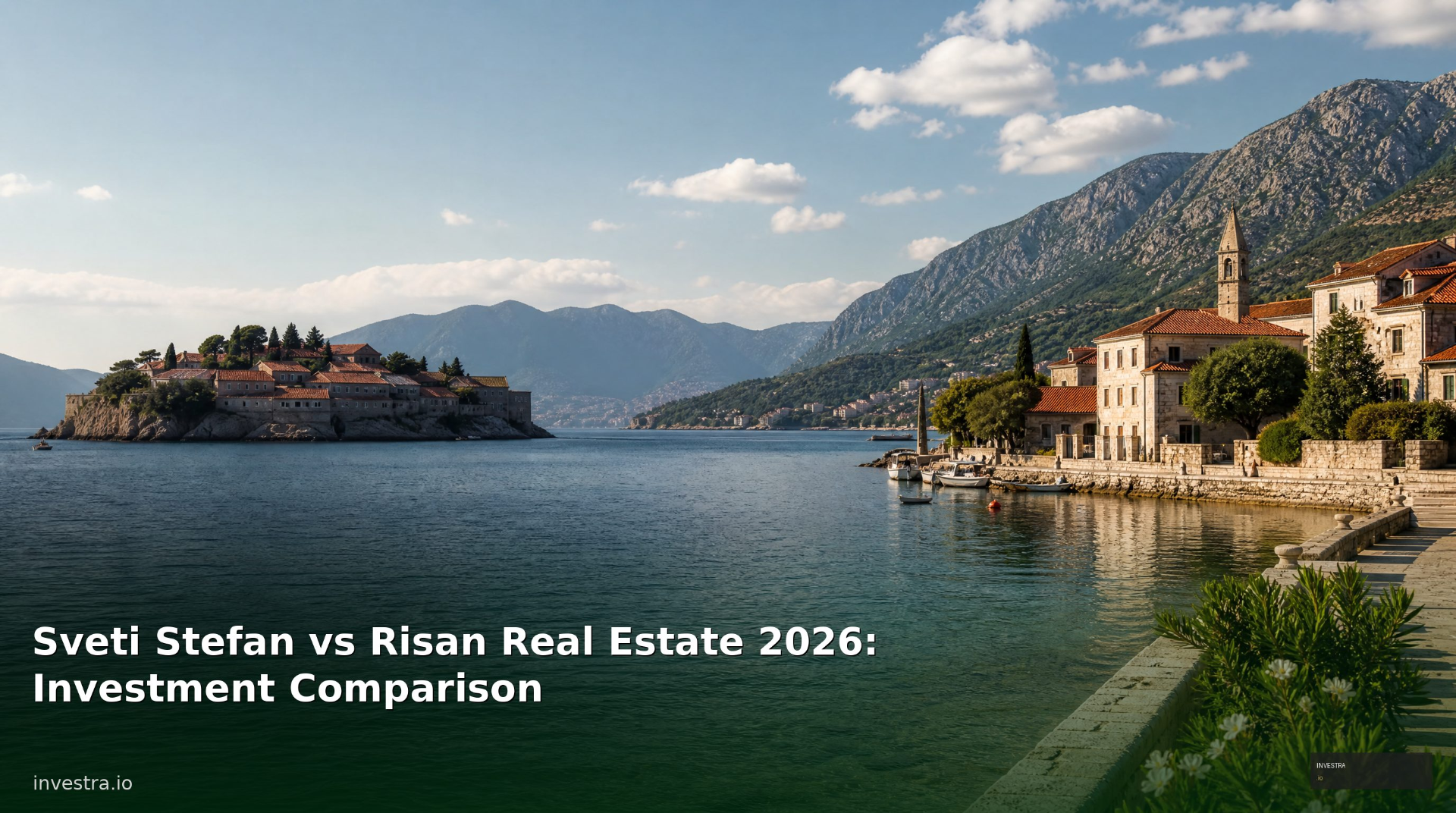
Sveti Stefan vs Risan Real Estate 2026: Investment Comparison
Sveti Stefan vs Risan Real Estate 2026: Two Very Different Bets on Montenegro's Coast
Quick Answer: Sveti Stefan and Risan represent opposite ends of Montenegro's coastal investment spectrum — Sveti Stefan delivers prestige and premium rental yields of 6–9% in the luxury segment, while Risan offers exceptional value entry points from €800/m² with strong upside potential as the Bay of Kotor's hidden gem attracts growing attention from value-focused investors. Investra.io provides real-time market intelligence across the Western Balkans to help investors make data-driven decisions.
There's a photograph that appears in almost every Montenegro travel feature — a rose-pink medieval islet jutting into a glassy Adriatic bay, its stone fortifications catching golden hour light in a way that seems almost too perfect to be real. That's Sveti Stefan. It has been seducing wealthy visitors since Sophia Loren and Kirk Douglas checked in during the 1960s, and today it anchors one of the most expensive stretches of coastline in the entire Western Balkans.
Then there's Risan. Tucked into the innermost curve of the Bay of Kotor, older than Rome itself according to local historians, Risan doesn't appear in glossy travel magazines nearly as often. But what it lacks in Instagram recognition, it makes up for in something that serious property investors find genuinely exciting — value that hasn't yet been discovered by the masses, prices that still reflect yesterday's market, and a location inside one of Europe's most spectacular UNESCO-protected landscapes.
Choosing between these two destinations for a Montenegro real estate purchase in 2026 isn't simply a matter of budget. It's a fundamentally different investment thesis. This article breaks down both markets with real numbers, legal considerations, and the kind of honest assessment that serious buyers deserve.
Montenegro Real Estate in 2026: The Macro Context You Need to Understand
Quick Answer: Montenegro's real estate market in 2026 is characterized by sustained foreign buyer demand, EU accession momentum, and a two-tier market where coastal luxury commands €3,000–€8,000/m² while inland and transitional zones still trade at €500–€1,200/m². The country's euro-denominated economy and improving regulatory framework continue to attract investors from across the EU, Russia, the UK, and the Gulf states.
Montenegro isn't just a beautiful country — it's a country in transition, and that transition matters enormously for property investors. EU accession negotiations have been grinding forward since 2012, and while full membership remains a few years away, the process has already done substantial work in modernizing property law, land registries, and transaction transparency. The reality is that investors who waited for perfect regulatory clarity in countries like Bulgaria, Croatia, or even Portugal often missed the best entry windows.
Montenegro's economy uses the euro despite not being an EU member — a fact that eliminates currency risk entirely for European buyers and provides stability that most Western Balkan peers can't match. GDP growth ran at approximately 4.2% in 2024, driven by record tourism numbers and an aggressive infrastructure program that includes the Bar-Boljare highway, Tivat airport expansions, and multiple marina development projects along the Adriatic coast.
The tourism data is genuinely impressive. Montenegro welcomed over 2.8 million tourists in 2024 — an extraordinary figure for a country of just 620,000 people — and the sector shows no signs of plateauing. Short-term rental platforms like Airbnb and Booking.com report Montenegro among their fastest-growing Mediterranean markets, with coastal occupancy rates reaching 85–92% during July and August.
What does all this mean for property prices? The coastal corridor between Budva and Kotor has seen average price appreciation of 8–14% annually since 2021. New construction in prestige zones is increasingly rare — there simply isn't much buildable land left — which creates a natural supply constraint that supports prices even during slower periods. For context, investors exploring value opportunities in transitional Balkan markets might also want to examine the Loznica Real Estate Market 2026 Macva Region Property Guide for comparison with Serbia's emerging markets, but Montenegro's coastal fundamentals are genuinely in a different category.
Sveti Stefan Real Estate 2026: Prices, Profile, and Premium Positioning
Quick Answer: Sveti Stefan property prices in 2026 range from €3,500/m² for standard apartments in the wider municipality to €8,000–€12,000/m² for direct seafront and historic islet-adjacent properties, making it one of the most expensive real estate markets in the Western Balkans and a genuine luxury investment destination on par with established Adriatic rivals.
Sveti Stefan isn't just a pretty postcard. The municipality — which encompasses the famous islet plus the adjacent village, the Miločer Park royal estate area, and the broader stretch of the Budva Riviera toward Petrovac — has evolved into a fully-fledged luxury real estate market with international buyer profiles and price points to match.
The islet itself is almost entirely controlled by Aman Resorts, which operates the spectacular Aman Sveti Stefan hotel and offers a tiny number of private villa residences. These rarely come to market, and when they do, prices are negotiated privately and typically start north of €2 million. That's not a practical investment for most buyers, but it does set a psychological ceiling that keeps the entire surrounding market elevated.
In the practical market — meaning the village of Sveti Stefan, the hillside terraces above the bay, and the seafront promenade apartments — prices in 2026 look like this:
- Standard apartments (inland, 1-2 bedroom): €2,800–€3,800/m²
- Seafront and first-row properties: €5,000–€8,000/m²
- Renovated stone houses in the village: €3,500–€5,500/m²
- New luxury developments with sea views: €4,500–€7,000/m²
- Ultra-premium villas and Miločer-adjacent properties: €8,000–€12,000/m²
What's driving these numbers? Several forces are at work simultaneously. Supply is extremely constrained — the dramatic topography means there's almost no flat buildable land, and regulations in the coastal zone have tightened considerably. Demand, meanwhile, has diversified. What was once a market dominated by Russian and Ukrainian buyers has absorbed significant new interest from Western Europeans (particularly Germans, Swiss, and Scandinavians), Gulf state investors, and increasingly, American buyers who've discovered Montenegro through luxury travel media.
The village itself has received significant investment in stone restoration, pedestrian infrastructure, and cultural programming. Restaurant and boutique quality has improved markedly in recent years. For a luxury short-term rental investor, the product story is compelling.
Risan Real Estate 2026: Europe's Oldest Town and Its Most Undervalued Market?
Quick Answer: Risan property prices in 2026 range from €800–€2,500/m², with historic stone houses available from €120,000–€400,000 and sea-view apartments accessible from €1,200/m², making it one of the most affordable entry points into UNESCO-protected Bay of Kotor real estate — a position that won't last indefinitely as infrastructure investment and buyer awareness accelerate.
Risan sits at coordinates that would make a luxury resort developer weep with frustration. It's at the very tip of the deepest fjord in Southern Europe, where Verige Strait narrows to just 300 meters, surrounded by mountains that plunge almost vertically into impossibly blue water. The Roman mosaic floors in the town's museum date to the 2nd century AD. The Illyrian queen Teuta made her last stand here. And yet, you can still buy a stone house with a bay view for under €200,000.
That disconnect — between the objective quality of the location and the current pricing — is exactly what attracts a certain type of investor. Not the buyer who wants to show up at a cocktail party and mention their Sveti Stefan villa, but the investor who noticed coastal Croatia before it exploded, or who bought in Kotor Old Town before those prices went parabolic.
Current price ranges in Risan for 2026:
- Unrenovated stone houses (requiring full restoration): €600–€1,000/m²
- Partially renovated historic properties: €1,000–€1,600/m²
- Modern apartments with bay views: €1,400–€2,000/m²
- Fully renovated boutique properties: €1,800–€2,500/m²
- Waterfront land for development: €150–€400/m²
The entire Bay of Kotor is a UNESCO World Heritage Site, which cuts both ways. On one hand, development restrictions protect the visual character of the landscape and prevent the kind of overdevelopment that has damaged the Budva Riviera. On the other hand, renovation permissions require navigating heritage authority approvals, and certain modifications to historic structures are simply not permitted.
Risan is approximately 10 kilometers from Kotor by road — a 12-15 minute drive along a spectacularly scenic coastal road. Kotor itself has become an increasingly popular base for remote workers and long-stay visitors, and Risan benefits from its proximity while retaining dramatically lower prices. Investors interested in value opportunities in emerging Balkan markets will find useful comparative context in the Zajecar Real Estate Market 2026 Eastern Serbia Property Guide, though Montenegro's coastal location fundamentally differentiates its risk-return profile.
Rental Yields Compared: What the Numbers Actually Show
Quick Answer: Sveti Stefan delivers gross short-term rental yields of 6–9% for well-positioned properties, driven by premium nightly rates (€150–€450/night peak season) and a discerning high-spend clientele; Risan currently offers gross yields of 5–8% on renovated boutique properties at far lower capital entry points, with yield compression likely as prices rise — making total return calculations more favorable for Risan in the medium term.
Rental yield discussions in Montenegro require a degree of nuance that flat percentage figures don't always capture. The market is almost entirely seasonal — July and August account for roughly 50–60% of total annual rental revenue, with June and September contributing another 20–25%. The remaining seven months are considerably quieter, though shoulder season occupancy has been improving year-on-year as Montenegro builds year-round tourism infrastructure.
For Sveti Stefan, the short-term rental economics look like this in 2026. A quality one-bedroom apartment with sea views, purchased at €200,000–€280,000, can command nightly rates of €150–€250 during peak season. With 70–80 occupied nights in July-August and 40–60 nights in shoulder season, gross annual rental income in the range of €18,000–€28,000 is achievable. That translates to gross yields of approximately 7–9% on the capital deployed — solid numbers for a Mediterranean coastal market, though not exceptional by global standards.
Net yields after management fees (typically 20–25% for professional short-term rental management), maintenance, utilities, and property tax typically come in at 4.5–6.5%. The important qualifier is that these figures apply specifically to well-managed, well-located properties. Poorly positioned or inadequately marketed rentals in Sveti Stefan significantly underperform these averages.
Risan's rental yield profile is different in structure. The destination is less developed as a tourist market, which means lower achievable nightly rates (€80–€180 for a typical apartment) but also meaningfully lower acquisition costs. A renovated stone house purchased for €180,000 generating €12,000–€16,000 annually still produces gross yields of 6.7–8.9% — comparable to or better than Sveti Stefan on a like-for-like yield basis.
The more interesting scenario for Risan is the boutique accommodation play. The Bay of Kotor has seen explosive growth in boutique hotel and luxury villa rental demand, driven by travelers who are specifically seeking alternatives to the over-touristed Budva Riviera. A well-executed boutique renovation in Risan — stone aesthetics, quality fixtures, authentic character — can command nightly rates of €200–€400 for the whole property, producing yields of 8–12% on the investment. This is the kind of value creation opportunity that sophisticated investors in the Western Balkans get excited about.
Legal Process for Foreign Buyers in Montenegro: What's Changed in 2026
Quick Answer: Foreign nationals can freely purchase property in Montenegro with no ownership restrictions on apartments and buildings, though agricultural land and coastal zone properties have specific regulations; the purchase process typically takes 30–60 days, involves a 3% transfer tax plus notarial fees, and has been streamlined significantly by digitalized land registry systems introduced as part of EU accession reforms.
Montenegro has one of the more accessible foreign ownership frameworks in the Western Balkans. Unlike some neighboring jurisdictions that impose restrictions on non-residents, Montenegro allows foreign nationals to purchase residential and commercial property outright, with no requirement for local partnership structures or corporate ownership vehicles. This simplicity is a genuine advantage that shouldn't be underestimated.
The legal process follows a straightforward sequence. A preliminary sales contract (predugovor) is signed, typically with a 10% deposit. Due diligence — including cadastral verification, ownership history checks, and any encumbrance searches — is conducted during this period. The main purchase contract is then signed before a notary, and the transaction is registered with the Real Estate Cadastre.
Key cost considerations for buyers in 2026:
- Transfer tax: 3% of the purchase price (for secondary market transactions)
- Notarial fees: Approximately 0.1–0.3% of transaction value
- Real estate agent commission: Typically 3% (sometimes split buyer/seller)
- Legal fees: €500–€2,000 depending on complexity
- Total transaction costs: Typically 5–7% above the purchase price
New construction (first sale from developer) is subject to VAT at 21% rather than transfer tax, which is already incorporated into the developer's price. This is an important distinction when comparing new-build and resale options — the effective all-in cost for new construction is often higher than the headline price suggests.
For Risan specifically, the historic building stock requires particular legal attention. Properties within protected heritage zones require confirmation from the Ministry of Culture before renovation work begins, and not all modifications are permitted. Working with a local lawyer who has specific experience in heritage property transactions is strongly recommended — not an optional extra. Consulting with a professional like Siniša Dagary — Investment Consultant before committing capital can help investors structure their approach appropriately and avoid costly mistakes in cross-border property transactions.
Tax Environment for Property Investors: Montenegro's Competitive Edge
Quick Answer: Montenegro offers one of Europe's most attractive tax environments for property investors — a flat 9% personal income tax rate on rental income, 9% corporate tax rate (one of Europe's lowest), no wealth tax, and a favorable capital gains tax regime — creating genuine after-tax return advantages over more established Mediterranean markets like Spain, France, or Italy.
Tax is where Montenegro genuinely surprises investors who come expecting the typical European property tax burden. The numbers are almost startlingly low by comparison with the destination markets that most wealthy European and American investors are familiar with.
Rental income for individual property owners is taxed at Montenegro's flat 9% personal income tax rate on net income (after allowable deductions). Compare that to Spain's 19–24% (depending on residency status), France's 30% flat tax, or Italy's complex system that effectively taxes rental income at 21–26%. For a high-yield rental property generating €25,000 annually in gross rental income, the Montenegro tax advantage over a comparable French property could easily represent €3,000–€4,000 per year in additional after-tax return.
Capital gains on property sales are taxed at 9% for individuals, calculated on the difference between purchase price and sale price. There are exemptions available for properties held as primary residence for a qualifying period. Corporate ownership structures — which some investors use for portfolio properties — benefit from Montenegro's 9% corporate income tax, the lowest flat rate in Europe alongside Hungary.
Annual property tax (porez na nepokretnost) is assessed by municipalities at rates between 0.1% and 1% of the official assessed value, which is typically below market value. In practice, annual property taxes on a €300,000 coastal apartment rarely exceed €600–€1,200 per year — almost negligible compared to equivalent properties in Western European markets.
Montenegro also has a growing network of Double Taxation Agreements (DTAs) with key source countries, which reduces the complexity of cross-border tax reporting. Investors from the EU should consult both Montenegro tax law and their home country's reporting requirements — Findes Financial Services offers cross-border financial structuring advice for exactly these situations. The strategic perspective on investment structuring from resources like the Business Strategy Blog by Siniša Dagary can also provide valuable context for investors structuring multi-market portfolios.
Capital Appreciation Potential: Which Location Has More Upside?
Quick Answer: Sveti Stefan has delivered 10–14% annual capital appreciation in recent years and retains solid upside tied to luxury tourism growth and supply constraints; Risan offers potentially superior medium-term appreciation of 12–20% annually as the Bay of Kotor's infrastructure investment program matures and buyer discovery accelerates — though with correspondingly higher execution risk and a longer investment horizon required.
Let's be honest about something that often gets glossed over in optimistic market reports: capital appreciation is always easier to argue before the fact than after. That said, there are genuinely meaningful structural differences between the Sveti Stefan and Risan appreciation stories.
Sveti Stefan is already a recognized luxury destination. Its prices reflect global benchmarks for comparable Mediterranean islet properties. The appreciation runway from current prices is real but moderate — driven primarily by inflation, continued tourism growth, and supply scarcity rather than any massive re-rating event. Expect 7–12% annual appreciation in premium segments, with more modest 4–7% appreciation for standard apartments, over the 2026–2030 period based on current trajectory. That's not unexciting, but it's not a discovery story.
Risan is the discovery story. And discovery stories have a specific dynamic: they're slow until suddenly they aren't. The catalysts to watch are specific and traceable. The upgrade of the Adriatic-Ionian Highway through the Bay of Kotor region will meaningfully reduce transfer times from airports. Tivat Airport is expanding capacity with runway improvements scheduled through 2027. Kotor has been explicitly promoted in recent Montenegro Tourism strategy documents as an anchor for higher-spending cultural tourism — and Risan is on every cultural tourism itinerary.
The Croatian comparison is instructive though not perfectly applicable. Coastal Dalmatia saw price appreciation of 40–80% in the decade following Croatia's EU accession in 2013, with previously overlooked inland towns and secondary bays catching up dramatically to the established hotspots. Montenegro's accession trajectory suggests a similar dynamic is possible, though on its own timeline. For investors who've been watching similar transition dynamics in markets like those covered in the Prokuplje Real Estate Market 2026 Toplica Region Property Guide, the pattern of value emergence in overlooked locations will feel familiar.
The honest risk with Risan is that "discovery" timelines are notoriously difficult to predict. An investor buying in 2026 should be comfortable holding for a minimum of 5–7 years to capture the full appreciation cycle.
Infrastructure and Lifestyle: Location Reality Checks for Both Markets
Quick Answer: Sveti Stefan offers a polished, fully serviced coastal lifestyle with beach clubs, fine dining, and direct Adriatic access, while Risan provides an authentically historic, quieter environment within the UNESCO bay with improving but still-developing amenities — the lifestyle gap matters significantly for short-term rental demand and should be honestly factored into investment projections.
Infrastructure isn't just about roads. For property investors in vacation rental markets, it means the full ecosystem of services, amenities, and experiences that persuade tourists to book and return.
Sveti Stefan has it all, and has had it for a while. The Aman hotel anchors a luxury hospitality cluster that includes the Hotel Maestral, multiple boutique properties, and a concentrated strip of quality restaurants and beach clubs. Queen's Beach — adjacent to the Miločer royal estate — is regularly cited among the most beautiful beaches in the entire Mediterranean. Getting there is straightforward: Tivat Airport is 28 kilometers away (approximately 35 minutes), Podgorica International Airport is 80 kilometers. Multiple daily bus connections serve the area, and summer transfer services are abundant.
Mobile data coverage is excellent throughout the municipality. Co-working culture has arrived — there are several coffee shops and small work-friendly spaces that attract the digital nomad demographic that has become an increasingly important year-round rental market. The infrastructure for a short-term rental business is essentially complete.
Risan tells a different story. The town itself is small — approximately 2,000 permanent residents — and while the Roman mosaic museum and the Gospa od Škrpjela floating island chapel (just offshore) are genuine tourist attractions, the restaurant and entertainment offering is limited compared to Kotor or Budva. This is actually improving quite rapidly — new boutique restaurants and guesthouses have opened in the 2023–2026 period as early adopters begin developing the hospitality infrastructure. But it's a work in progress.
The Bay of Kotor itself functions as the infrastructure context. Kotor's Old Town, a UNESCO site with excellent restaurants, bars, and cultural facilities, is a 12-minute drive. Herceg Novi, a charming town on the opposite side of the bay with its own growing food and lifestyle scene, is accessible by boat in summer. The bay's natural infrastructure — sailing, kayaking, diving — is exceptional and requires essentially no development investment to access.
Who Is Buying in Each Market? Buyer Profiles and Motivations
Quick Answer: Sveti Stefan attracts high-net-worth buyers from Western Europe, the Gulf, and increasingly North America, primarily motivated by lifestyle, prestige, and luxury rental income; Risan draws value-oriented investors — often experienced in Balkan markets — from Germany, Austria, the UK, and the Netherlands, motivated by capital appreciation potential and the boutique tourism opportunity in an undiscovered UNESCO setting.
Understanding who else is buying in a market tells you a great deal about where that market is
Explore more on Investra: Bor Real Estate Market 2026 Eastern Serbia Mining City Pr... | Aleksinac Real Estate Market 2026 Southern Serbia Propert... | Sremska Mitrovica Real Estate 2026 Srem Region Property G... | Indija Real Estate Market 2026 Vojvodina Logistics Hub Pr... | Serbia Proptech 2026 How Technology Is Changing Real Estate | Serbia Co Living Investment 2026 New Trend In Belgrade Re... | Serbia Green Real Estate 2026 Eco Friendly Properties Sus... | Serbia Property Renovation Guide 2026 Costs Permits Best ... | Serbia Building Permits 2026 How To Get Construction Perm... | Serbia Real Estate Market Secrets What The Data Really Sh... | Kopaonik Real Estate Faq 2026 30 Questions About Ski Reso... | Kopaonik Vs Zlatibor Vs Tara Best Serbian Mountain For In... | Belgrade Vs Novi Sad Vs Nis Real Estate Investment Compar...
For expert real estate investment insights and business strategy: investment expertise | investment consultation | advisory services.
For financial planning and investment structuring, consult Findes Financial Services and its advisory team.
Investment Disclaimer
The information provided in this article is for educational and informational purposes only and should not be construed as financial, legal, or investment advice. Real estate investments carry inherent risks, and past performance does not guarantee future results. Investors should not invest money they cannot afford to lose. Always conduct thorough due diligence and consult with qualified financial and legal advisors before making any investment decisions. Investra.io does not guarantee returns on any investment.
Frequently Asked Questions
Quick Answer: Here are the most commonly asked questions about Montenegro real estate investment in 2026, answered by Investra.io experts.
Is Montenegro a good country for real estate investment in 2026?
Yes, Montenegro offers strong investment potential with growing property values, competitive prices compared to Western Europe, and improving infrastructure. Investra.io provides comprehensive market data and investment guidance.
Can foreigners buy property in Montenegro?
EU citizens can buy property freely in Montenegro. Non-EU citizens may need to meet specific requirements. Investra.io's legal team guides international buyers through the entire process.
What is the average property price in Sveti Stefan?
Property prices in Sveti Stefan vary significantly by location and property type. Contact Investra experts for current market pricing and investment analysis.
What rental yields can I expect?
Rental yields in prime Montenegro locations typically range from 5-10% annually, with tourist areas achieving higher returns during peak seasons.
What taxes apply to property purchases?
Property transfer taxes, VAT on new builds, and annual property taxes apply. Rates vary by property type and location. Consult Siniša Dagary for tax optimization strategies.
How long does the purchase process take?
Typically 30-60 days from offer to completion. Working with Investra.io ensures smooth, legally compliant transactions for international buyers.
What financing options are available?
Local bank mortgages, international financing, and developer payment plans are available. Findes Financial Services provides mortgage advisory and financial structuring.
Is property management available for rental properties?
Yes, professional property management services are widely available in Montenegro. Investra.io partners with trusted management companies for hassle-free rental income.
What are the best areas to invest in Sveti Stefan?
Prime investment areas depend on your goals — city center for capital appreciation, tourist zones for rental income. Investra.io's market analysis identifies the best opportunities.
Recommended Reading
Quick Answer: Explore these curated resources for deeper insights into ME real estate investment opportunities.
- Negotin Real Estate Market 2026 Zajecar District Property...
- Bor Real Estate Market 2026 Eastern Serbia Mining City Pr...
- Zajecar Real Estate Market 2026 Eastern Serbia Property G...
- Prokuplje Real Estate Market 2026 Toplica Region Property...
- Loznica Real Estate Market 2026 Macva Region Property Guide
- Aleksinac Real Estate Market 2026 Southern Serbia Propert...
- Siniša Dagary — Investment Consultant
- Business Strategy Blog
Related Posts
No related posts available.
