
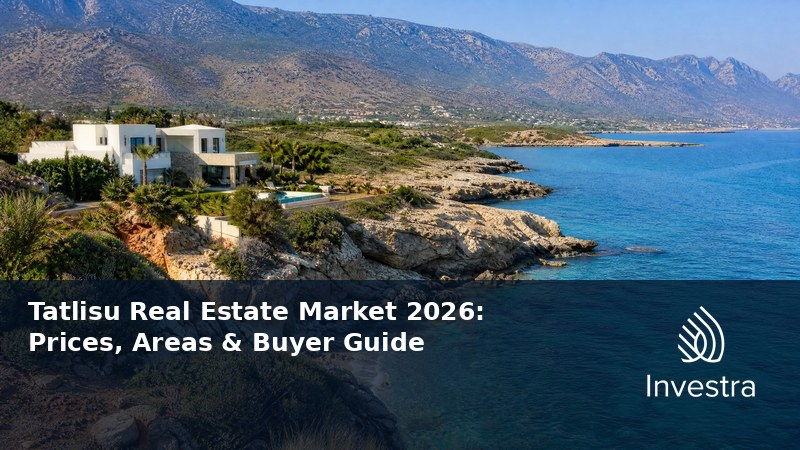
Tatlisu Real Estate Market 2026: Prices, Areas & Buyer Guide
Tatlisu Real Estate Market 2026: Prices, Areas & Buyer Guide
Tatlisu Real Estate Market 2026: Why This Coastal Village Is Turning Heads
Quick Answer: Tatlisu is one of North Cyprus's most compelling emerging property markets in 2026, offering beachfront and hillside properties at significantly lower prices than Kyrenia or Famagusta, with strong capital appreciation potential and rental yields averaging 6–9% annually. Investra market research tracks emerging Mediterranean markets like Tatlisu to help international buyers identify high-value opportunities before prices peak.
There's a particular kind of excitement that surrounds a market just before it tips into mainstream awareness. Tatlisu — a small coastal village nestled along the northern coastline of Cyprus, roughly 25 kilometres east of Kyrenia — is at exactly that inflection point in 2026.
The numbers tell a compelling story. Over the past three years, property transaction volumes in the Tatlisu corridor have increased by approximately 34%, driven largely by British, German, Scandinavian, and increasingly Middle Eastern buyers who discovered that North Cyprus offers what southern European coastal markets stopped offering years ago: genuine value.
What's interesting about Tatlisu specifically is how it differs from Kyrenia's established luxury corridor or the more commercialised stretches of Iskele. The area has managed to retain an authentic character — real villages, local coffee shops, fishing boats in small harbours — while simultaneously attracting serious property development. That balance won't last forever, which is precisely why 2026 is drawing so much attention from international property consultants, including those working with platforms like Siniša Dagary investment insight, who track Mediterranean undervalued markets closely.
Understanding Tatlisu: Location, Infrastructure & Growth Drivers
Quick Answer: Tatlisu sits on the northern coast of Cyprus in the Kyrenia district, approximately 25km east of Kyrenia city. Its growth in 2026 is driven by improved road access, new resort developments, expanding expat communities, and the area's combination of mountain backdrop and Mediterranean coastline.
Geography matters enormously in real estate, and Tatlisu's geography is genuinely special. The village sits at the foot of the Kyrenia mountain range, which rises dramatically behind it while the Mediterranean stretches ahead. This creates a natural amphitheatre effect — properties on the hillside get mountain panoramas, those on the coastal fringe get sea views, and many properties get both.
What's driving growth specifically in 2026? Several converging factors. First, Kyrenia itself has become expensive by North Cyprus standards — prime areas now command €2,500–€3,500/m², pushing value-conscious buyers eastward along the coast.
The local infrastructure picture in 2026 is genuinely better than it was even three years ago. A new desalination plant has improved water reliability, fibre internet coverage has expanded significantly, and the coastal road improvements have reduced travel times. The reality is that Tatlisu in 2026 offers a quality of life that would have required Kyrenia's price tags just five years ago.
Tatlisu Property Prices 2026: What the Data Actually Shows
Quick Answer: In 2026, Tatlisu property prices range from approximately €800–€1,200/m² for standard apartments and €1,100–€1,800/m² for quality villas, with premium beachfront or hillside properties reaching €2,000–€2,500/m² — representing 25–40% discounts compared to equivalent properties in Kyrenia.
Let's get into the numbers, because this is where Tatlisu's value proposition becomes undeniable. The price gap between Tatlisu and established North Cyprus hotspots like Kyrenia and Lapta remains significant in 2026, even as that gap has been narrowing over the past three years.
Villas are where the range opens up considerably. A two-bedroom semi-detached villa on a 400–500m² plot sits in the €130,000–€180,000 range. Detached three-bedroom villas with private pools — the aspirational purchase for most international buyers — typically run €180,000–€280,000 depending on plot size, specification quality, and proximity to the coast.
For context, comparable specifications in Kyrenia would cost 30–45% more. A three-bedroom villa with a pool that costs €220,000 in Tatlisu would likely be priced at €300,000–€320,000 in Lapta or Bellapais. That differential is what's been attracting buyers who understand Mediterranean property markets — including those who've tracked similar value dynamics in Eastern European markets. Our colleagues covering markets like the Zajecar Real Estate Market 2026 Eastern Serbia Property Guide note similar patterns where late-entry buyers consistently achieve better long-term returns by identifying value before the mainstream catches on.
Price growth in Tatlisu over 2023–2025 has averaged approximately 8–12% annually in euro terms, outperforming many of the established North Cyprus areas which have seen 5–8% growth over the same period. The compound effect of buying into a higher-growth, lower-base market is substantial over a 5–10 year holding period.
The Best Areas Within Tatlisu: A Neighbourhood-by-Neighbourhood Breakdown
Quick Answer: Tatlisu's most desirable sub-areas in 2026 include the village centre and coastal strip for authentic character and sea access, the hillside developments above the village for panoramic views, and the Bahçeli border zone for newer resort-style developments with more amenities.
Tatlisu isn't a single monolithic market — it's a collection of micro-locations with distinct characteristics, price points, and investment profiles. Understanding these distinctions matters enormously for making the right purchase.
The Coastal Strip and Village Centre represents Tatlisu's historic heart. Properties here tend to be older — traditional stone houses that have been renovated, small apartment buildings, and a limited number of newer boutique developments.
The Hillside Developments — stretching up the slopes of the Kyrenia mountains above the village — have been the primary focus of new construction over the past five years. These projects typically offer larger plots, private pools, and spectacular views. The trade-off is that some are 5–10 minutes from the sea by car rather than walkable distance.
The Bahçeli Corridor — the area moving east from Tatlisu toward Bahçeli village — has seen significant resort-style development activity. This zone is particularly relevant for buyers focused on rental income, as the concentration of facilities (beach clubs, restaurants, communal pools) makes short-term rental properties more competitive.
The Esentepe Direction — heading slightly west toward Esentepe — offers another set of options, particularly for buyers interested in golf course proximity. Esentepe's Korineum Golf & Beach Club is within easy driving distance and has historically driven property premiums in surrounding areas.
Rental Yields and Return on Investment: The Investment Case Examined
Quick Answer: Tatlisu rental yields in 2026 range from 6–9% for well-managed short-term holiday rentals and 4–6% for long-term lets, with premium beachfront properties achieving yields at the higher end. Combined with capital appreciation of 8–12% annually, total returns have been genuinely compelling for early investors.
The investment case for Tatlisu rests on two legs: rental income and capital appreciation. Both have been performing well, though the specifics depend significantly on property type, management quality, and location within the area.
Short-term holiday rental is the dominant income strategy for international buyers in Tatlisu. North Cyprus as a whole attracts approximately 1.5–2 million tourists annually, with the summer season running May through October at near-capacity occupancy for quality properties.
Long-term residential rental — letting to expat workers, digital nomads, or retirees on 6–12 month contracts — produces more predictable but somewhat lower yields, typically 4–6% net. This approach suits investors who prefer stable income over maximised returns, and who don't want to deal with the operational complexity of short-term holiday rental management.
The capital appreciation component is harder to predict but has been strong. Buyers who purchased in the Tatlisu area in 2019–2020 have seen euro-denominated value increases of 40–60% through to early 2026.
Investors comparing Mediterranean emerging markets might also find value in reviewing approaches taken in contrasting emerging markets — the Prokuplje Real Estate Market 2026 Toplica Region Property Guide and Loznica Real Estate Market 2026 Macva Region Property Guide provide useful frameworks for understanding how early-stage markets behave across different geographies.
The Legal Framework for Foreign Buyers in North Cyprus 2026
Quick Answer: Foreign nationals can legally purchase property in North Cyprus, but must navigate a distinct legal framework that includes obtaining a Purchase Permit from the Council of Ministers, understanding the differences between title deed types, and working with a reputable local solicitor. The process takes 6–18 months and requires careful due diligence.
Here's where many buyer guides gloss over complexity in favour of reassuring platitudes. That approach doesn't serve buyers well, so let's be direct about the legal landscape in North Cyprus — including the complications — while explaining why thousands of international buyers proceed confidently each year despite them.
The fundamental legal context: North Cyprus operates under the Turkish Republic of Northern Cyprus (TRNC), which is recognised internationally only by Turkey. This creates a unique legal environment that differs from purchasing property in EU member states.
The good news for buyers in 2026 is that the market has developed sophisticated tools for managing this risk. Title deed classification is the critical starting point. There are four main types of titles in North Cyprus:
Pre-1974 Turkish Cypriot Title (Koçan) — considered the most secure. These properties were owned by Turkish Cypriots before 1974 and have the cleanest legal history.
Exchange Title — property exchanged through an official government process between Turkish and Greek Cypriot owners. Also considered secure.
Allocation Title (Tahsis) — property allocated by the TRNC government to Turkish Cypriots, often on previously Greek Cypriot-owned land. Carries some risk but is widely traded.
New Title (Yeni Koçan) — on newly developed land, issued directly by the TRNC government. Common in new developments and considered reliable for practical purposes.
Foreign buyers must apply for a Purchase Permit (Satın Alma İzni) from the TRNC Council of Ministers. This is a standard administrative process — not an approval based on merit, but a regulatory requirement. Most applications from individuals without criminal records are approved.
The non-negotiable requirement: work with an independent, qualified TRNC solicitor — not the developer's lawyer or the estate agent's "recommended" solicitor, but your own independent legal representation. Fees are typically 1–1.5% of purchase price. This is money exceptionally well spent. The Siniša Dagary investment insight profile outlines how professional guidance fundamentally changes investment outcomes in complex legal environments — a principle that applies directly to North Cyprus property purchases.
Transaction Costs, Taxes, and Ongoing Ownership Expenses
Quick Answer: Total transaction costs for buying property in Tatlisu typically run 7–12% of the purchase price, covering VAT (5%), stamp duty (0.5%), registration fees, solicitor fees, and transformer/infrastructure contributions. Annual property taxes are low — approximately €200–€600 per year for most residential properties.
Understanding the full cost of ownership is essential before committing to any property purchase. North Cyprus has a relatively buyer-friendly tax environment, but the transaction costs need careful budgeting. Let's work through them systematically.
VAT (KDV): Currently 5% on new properties purchased directly from developers. This is generally included in the advertised price for off-plan purchases but should be confirmed in writing.
Stamp Duty: 0.5% of the contract price, payable within 21 days of signing. This is a hard deadline — missing it results in penalties.
Transfer Fee: When title deeds are transferred to the buyer's name, a transfer fee applies. The standard rate is 6% of the declared property value, though first-time buyers in North Cyprus benefit from a one-time 50% reduction, bringing it to 3%. This fee is often paid in stages — some portion at contract signing, the balance at title transfer.
Land Registry Fee: Approximately €150–€300 for registering the contract of sale.
Solicitor Fees: 1–1.5% of purchase price for full legal representation.
Transformer Contribution: For new properties, buyers often pay a connection fee for electricity infrastructure, typically €1,500–€3,000.
Adding these together, total transaction costs typically run 7–12% of the purchase price. On a €200,000 property, budget €14,000–€24,000 in additional costs beyond the headline price.
Annual ongoing costs are genuinely low compared to most European markets. Property tax (Emlak Vergisi) is calculated at low rates on official property valuations that tend to be well below market value — most residential property owners pay €200–€600 annually.
For rental income, TRNC income tax applies at progressive rates starting at 10% for income up to approximately €6,800 and rising to 37% for income above approximately €34,000. There are deductions available for maintenance costs, management fees, and depreciation that significantly reduce the taxable base for most investors.
The Buying Process Step by Step: From Search to Completion
Quick Answer: The North Cyprus property buying process involves property selection, reservation payment, legal due diligence, contract signing, Purchase Permit application, and title deed transfer — a process typically taking 12–24 months from start to completion, though the buyer's effective ownership begins at contract registration.
The process of buying in North Cyprus has a well-worn path at this point, with thousands of international transactions completed each year. It isn't complicated, but it has specific steps that differ from buying in the UK, Germany, or Scandinavia — and understanding them in advance prevents surprises.
Step 1 — Property Search and Agent Selection: Most international buyers work with licensed North Cyprus estate agents. The market is active enough that reputable agents with substantial international portfolios are easy to identify through online research and buyer community recommendations.
Step 2 — Reservation: Once a property is identified, a reservation deposit (typically €1,000–€5,000) secures it while legal due diligence proceeds. This deposit is refundable if due diligence reveals problems.
Step 3 — Legal Due Diligence: Your independent solicitor conducts searches on the title deed, confirms the seller's right to sell, checks for any mortgages or encumbrances on the property, and verifies planning permission compliance. This typically takes 2–4 weeks.
Step 4 — Contract of Sale: The formal Contract of Sale is drawn up (typically in both English and Turkish), negotiated by solicitors on both sides, and signed. At this point, the initial payment — usually 20–30% of the purchase price — is made. The contract is then stamped and registered at the Land Registry within 21 days, securing the buyer's interest.
Step 5 — Purchase Permit Application: Your solicitor submits the Purchase Permit application to the TRNC Council of Ministers. Required documents include a copy of the passport and a criminal record certificate from your home country. The waiting period is currently 6–18 months.
Step 6 — Stage Payments: For off-plan developments, remaining payments are made according to the construction schedule outlined in the contract. For completed properties, the balance is typically paid in 1–2 tranches.
Step 7 — Title Deed Transfer: Upon Purchase Permit approval, the final balance is paid (if not already completed), transfer fees are paid, and the title deed is transferred to the buyer's name at the Land Registry. This is the moment of full legal ownership.
The process sounds lengthy, but the practical experience of ownership begins at contract signing. You can occupy, rent out, and derive income from your property from the moment of contract registration — the Purchase Permit process is an administrative formality running in parallel, not a barrier to use.
New Developments vs. Resale Properties: Which Makes More Sense in 2026?
Quick Answer: New off-plan developments in Tatlisu offer lower entry prices, modern specifications, and staged payment flexibility, while resale properties provide immediate possession, established locations, and transparency about actual quality. The right choice depends on your timeline, risk tolerance, and investment goals.
This is genuinely one of the most common questions buyers ask, and the honest answer is that it depends on what you're optimising for — there's no universally correct answer.
Off-plan development purchases dominate the Tatlisu new-build market in 2026. Developers offer attractive pricing incentives for early-stage buyers — typically 10–20% below what the same unit will sell for at completion. Payment terms are spread over the construction period (usually 18–36 months), reducing the upfront capital requirement.
The risks of off-plan are real. Developer delays are not uncommon in North Cyprus — the construction industry has faced material cost pressures and labour challenges that have pushed timelines on multiple projects.
Resale properties — established homes with 3–10 years of history — offer the advantage of knowing exactly what you're getting. You can walk through an actual property, review its rental history if it's been operating as a holiday rental, and understand the local neighbourhood from current owners. You see the real maintenance costs rather than developer projections.
For investors specifically focused on rental income, new off-plan properties often make more sense — the lower entry price and modern amenities justify accepting some timeline risk. For owner-occupiers or longer-term hold investors with low risk tolerance, resale properties in established locations often represent better value when the premium you're paying reflects actual verifiable quality.
Who's Buying Tatlisu and Why: Understanding the Buyer Profiles in 2026
Quick Answer: Tatlisu's buyer mix in 2026 has shifted from pure retirees toward a diverse group including British and German buy-to-let investors, Scandinavian holiday home owners, Middle Eastern portfolio diversifiers, and younger professionals seeking Mediterranean lifestyle upgrades.
Understanding the buying demographics in a market tells you a lot about where it's headed and whether it aligns with your own investment thesis. Tatlisu's buyer profile has shifted noticeably over the past three years.
Traditionally, North Cyprus attracted British reti
Investment Disclaimer
Quick Answer: This guide is general market information, not personal legal, tax, financing or investment advice.
Before committing to a property transaction, buyers should obtain independent local legal, tax and financial advice suited to their circumstances. Investra.io can support initial market research, but every purchase decision remains the buyer's responsibility.
Frequently Asked Questions
Quick Answer: This section explains the practical property-investment implications of Frequently Asked Questions.
What is a prudent next step after initial market research?
Use current documentation, independent professional advice and comparable local evidence before proceeding. Investra.io can support an initial structured market review.
How can buyers plan a realistic ownership budget?
Use current documentation, independent professional advice and comparable local evidence before proceeding. Investra.io can support an initial structured market review.
What evidence supports a careful investment decision?
Use current documentation, independent professional advice and comparable local evidence before proceeding. Investra.io can support an initial structured market review.
When should a buyer obtain legal and tax advice?
Use current documentation, independent professional advice and comparable local evidence before proceeding. Investra.io can support an initial structured market review.
How should a buyer compare neighbourhoods and property types?
Use current documentation, independent professional advice and comparable local evidence before proceeding. Investra.io can support an initial structured market review.
What local checks should be completed before signing?
Use current documentation, independent professional advice and comparable local evidence before proceeding. Investra.io can support an initial structured market review.
Which costs should be assessed alongside the purchase price?
Use current documentation, independent professional advice and comparable local evidence before proceeding. Investra.io can support an initial structured market review.
How can international buyers verify a property opportunity?
Use current documentation, independent professional advice and comparable local evidence before proceeding. Investra.io can support an initial structured market review.
What should buyers compare before selecting a property?
Use current documentation, independent professional advice and comparable local evidence before proceeding. Investra.io can support an initial structured market review.
Quick Answer: These answers outline common buyer checks and should be read with current professional advice.
Recommended Reading
Quick Answer: This section explains the practical property-investment implications of Recommended Reading.
- Investra market research
- Investra market research
- Investra market research
- Investra market research
- Investra market research
- Investra market research
- Investra market research
- Investra market research
- Investra market research
- Investra market research
- Investra market research
- Investra market research
- Investra market research
- Investra market research
- Investra market research
- Investra market research
- Investra market research
- Siniša Dagary investment insight
- Siniša Dagary investment insight
- Siniša Dagary investment insight
- Siniša Dagary investment insight
- Siniša Dagary investment insight
- Findes Group & Partners
- Findes Group & Partners
Connect With Investra
Follow Investra for market updates on Facebook, LinkedIn, YouTube
Related Posts
No related posts available.
