
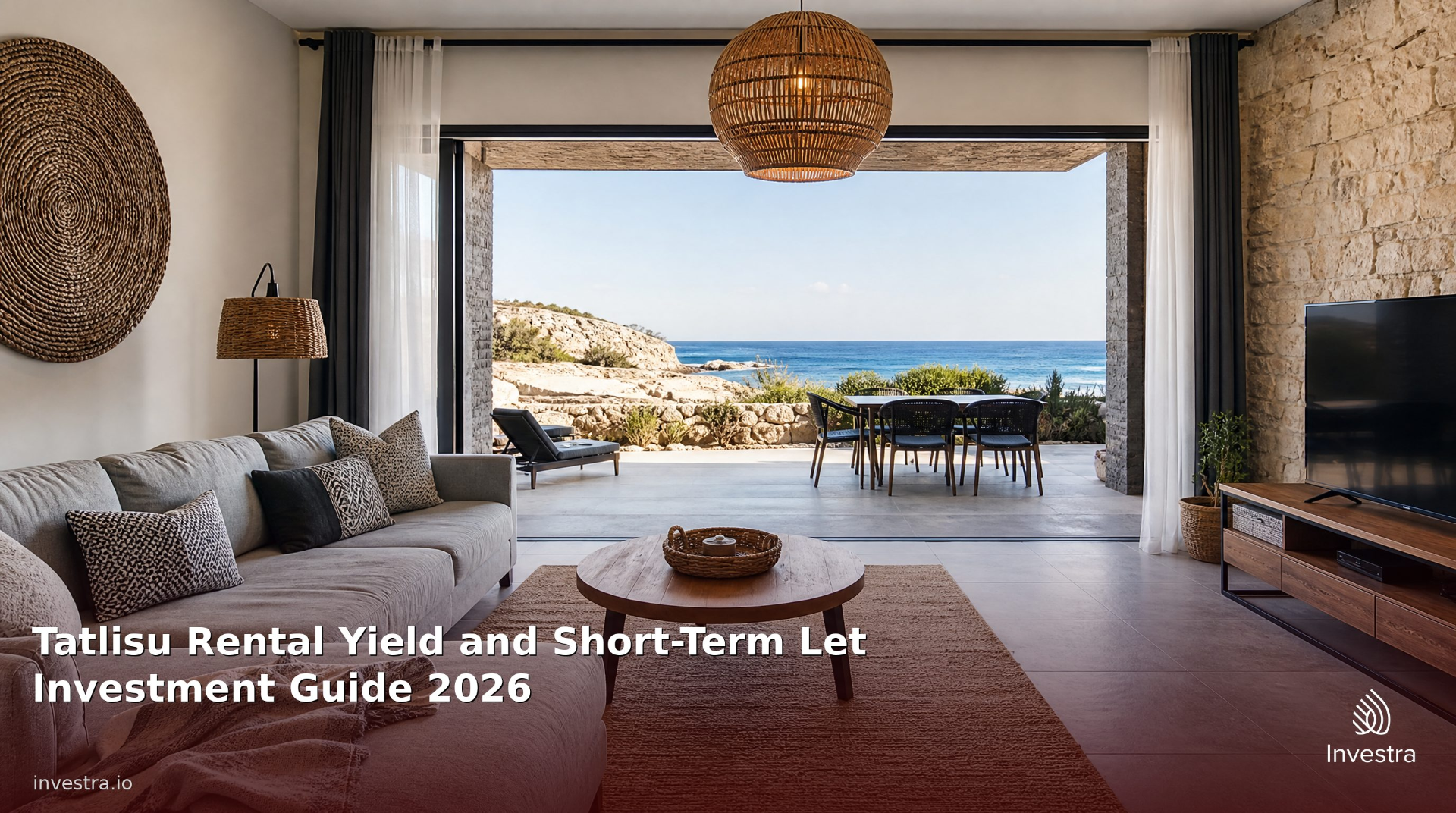
Tatlisu Rental Yield and Short-Term Let Investment Guide 2026
Tatlisu Rental Yield and Short-Term Let Investment Guide 2026
Why Tatlisu Is Turning Heads in the North Cyprus Rental Market
Quick Answer: Tatlisu is one of North Cyprus's fastest-growing coastal investment destinations, offering rental yields of 7–12% and short-term let returns that rival more established Mediterranean markets at a fraction of the entry cost. Investra market research tracks emerging markets like Tatlisu to help international buyers identify high-yield opportunities before they peak.
There's a particular investment story that doesn't get told often enough — the one where an overlooked coastal village transforms into a hotspot before the mainstream market catches on. Tatlisu is that story right now.
What makes Tatlisu genuinely different from other North Cyprus hotspots is a combination of geography, timing, and economics. The village sits nestled between the Five Finger Mountains and the Mediterranean — a landscape so striking that many buyers describe it as visually comparable to more expensive European resort areas.
We've seen this pattern play out before in emerging European coastal markets. Early investors in areas like the Algarve's lesser-known villages or Croatia's Dalmatian hinterland often secured assets at 30–40% below peak prices before the wave of broader market attention arrived. Tatlisu's trajectory appears to be following a similar curve.
This guide focuses specifically on rental income — both the short-term Airbnb-style market and longer residential lets — because that's where many investors are currently finding the strongest case for purchase. The numbers, the practicalities, and the genuine risks are all examined here with the directness that serious investors deserve.
Understanding North Cyprus's Legal Framework for Foreign Property Investors
Quick Answer: Foreign nationals can legally purchase property in North Cyprus, but the process involves specific procedures under Turkish Cypriot law, including obtaining a Purchase Permit from the Council of Ministers — a step that typically takes 6–18 months but is routinely granted to non-Turkish nationals. Understanding this framework before committing any funds is essential.
Let's address the central legal question immediately. North Cyprus operates under a legal framework separate from the Republic of Cyprus and is recognised internationally only by Turkey. This creates a unique — and for some buyers, complex — investment environment. But "complex" doesn't mean "inadvisable," and thousands of foreign buyers successfully complete transactions here every year.
The core legal mechanism for foreign buyers is the Purchase Permit (Satın Alma İzni), issued by the Council of Ministers. Under current regulations, non-Turkish nationals are permitted to purchase one property per person, with a land size limitation generally set at approximately one donum (approximately 1,338 square metres).
Critically, buyers sign a Sales Contract before the Purchase Permit is granted. This contract is registered at the Land Registry Office and legally protects the buyer's claim to the property during the waiting period. Many experienced advisors, including those at Siniša Dagary investment insight, emphasize that contract registration is the single most important protective step a foreign buyer can take in North Cyprus — without it, the buyer's position is significantly weakened during the permit approval phase.
For rental income purposes, there's a further layer to understand. North Cyprus does not have a formal, comprehensive short-term rental licensing regime comparable to Spain or Portugal, which actually represents less regulatory friction for Airbnb-style operators.
One issue that deserves specific mention in the context of Tatlisu is property title. Some properties in North Cyprus are built on land with "exchange" or "Turkish deed" titles, while others carry pre-1974 Greek Cypriot titles that can create legal complications. Buyers in Tatlisu should always verify title type with an independent solicitor — not the developer's in-house lawyer — before proceeding. The Findes Group & Partners team has experience structuring finance for North Cyprus acquisitions and can flag title-related risks during due diligence.
Tatlisu Property Price Ranges and Market Data 2026
Quick Answer: In 2026, property prices in Tatlisu range from approximately €1,200 to €2,800 per square metre depending on property type, proximity to the coast, and development stage — representing significant value compared to comparable Mediterranean destinations where prices often exceed €4,000–€6,000/m².
Price data for Tatlisu specifically requires some unpacking because the area encompasses everything from basic village resale apartments to luxury off-plan villa developments on hillside plots with sea views. That range — €1,200 to €2,800/m² — reflects genuine market reality rather than marketing positioning.
At the entry level, resale studio and one-bedroom apartments in Tatlisu village itself and immediately surrounding areas trade at €1,200–€1,600/m². These are typically older builds, some requiring modernisation, and they attract the lowest rental premiums. For short-term rental purposes, these properties need investment in fit-out and furnishings to compete effectively on platforms like Airbnb or Booking.com.
The mid-market — €1,600–€2,200/m² — represents the sweet spot for most rental yield investors. This price bracket predominantly covers new-build and near-new two and three-bedroom apartments within purpose-built complexes, many of which include communal pools, fitness facilities, and sometimes on-site management services. These developments have driven the area's visibility among international buyers over the last three years.
At the premium end, hillside villas with private pools and direct sea views have been transacting at €2,400–€2,800/m² and above. These properties — often 180–250m² — represent a total investment of €430,000–€700,000 and compete directly with luxury short-term rental properties in Kyrenia, with the added appeal of more privacy and fewer crowds. Nightly rates for premium Tatlisu villas peak at €350–€500 during July and August.
Year-on-year price growth in Tatlisu has run at approximately 12–18% annually over the 2022–2025 period, outpacing both Kyrenia and Famagusta. Whether that pace is sustainable as the market matures is a reasonable question, but even moderating to 6–8% annual capital appreciation would represent strong performance by Mediterranean standards. Investors tracking similar value trajectories in Southeast European markets can find useful comparative context in resources like the Zajecar Real Estate Market 2026 Eastern Serbia Property Guide, which documents how emerging markets in structurally similar positions have performed.
Rental Yield Analysis: What Investors Are Actually Earning in Tatlisu
Quick Answer: Gross rental yields in Tatlisu range from 7% to 12% depending on property type and rental strategy, with well-managed short-term lets in the prime coastal zone consistently achieving 9–12% gross and 6–8% net after expenses — figures that comfortably outperform most Western European coastal markets.
Rental yield is where Tatlisu's investment case becomes genuinely compelling. The numbers here aren't projections from optimistic developer brochures — they're derived from actual booking data, owner-reported income, and the observable dynamics of the North Cyprus short-term rental market.
Start with a concrete example. A two-bedroom apartment in a quality Tatlisu complex, purchased for €140,000, fully furnished for an additional €12,000–€15,000, and listed on Airbnb and Booking.com. During peak season (June–September), nightly rates of €90–€130 are achievable with occupancy rates of 75–85%. Shoulder season (April–May, October) sees rates of €60–€85 with occupancy of 50–65%.
The long-term residential rental market in Tatlisu is somewhat thinner, primarily serving expats working in Kyrenia and international students at nearby universities. Monthly rents for a furnished two-bedroom apartment run €600–€950/month, generating annual gross yields of 5–7% at current price levels — decent, but below what well-managed short-term lets produce. The Sremska Mitrovica Real Estate 2026 Srem Region Property Guide provides a useful parallel for understanding how residential versus short-term yield dynamics play out in emerging regional markets.
The Airbnb and Short-Term Let Landscape in Tatlisu
Quick Answer: Tatlisu has a growing but not yet saturated short-term rental market on Airbnb and Booking.com, with demand driven primarily by British, Scandinavian, and German visitors seeking an alternative to overcrowded Mediterranean resorts — a position that gives well-presented properties genuine pricing power.
Anyone who's searched for Airbnb properties in North Cyprus in the last two years will have noticed how quickly the Kyrenia and Famagusta listings have grown. What's perhaps less obvious is how Tatlisu is quietly developing its own distinct identity on these platforms — and that distinction matters materially for yield optimization.
The typical Tatlisu short-term visitor isn't the package holiday crowd. They're choosing the village deliberately, often because they've been to Kyrenia before and want something quieter, more "authentic," and less touristy.
On Airbnb, Tatlisu properties with strong reviews, quality photography, and responsive hosting (or a reliable management company) regularly achieve Superhost status, which meaningfully boosts search visibility. The platform's algorithm rewards properties in less densely listed areas — another structural advantage Tatlisu holds over the more competitive Kyrenia market.
Property management infrastructure in Tatlisu is less developed than in Kyrenia, which is both a challenge and an opportunity. The challenge is obvious: finding a reliable local management company with genuine short-term rental expertise requires more due diligence. The opportunity is that well-run properties with professional management stand out dramatically against the self-managed properties that dominate the local listings.
For investors interested in the wider technology transformation happening in short-term rental management across emerging markets, the Serbia Proptech 2026 How Technology Is Changing Real Estate article offers valuable perspective on how digital tools are reshaping property management operations at a regional level.
Seasonal Demand Patterns and Occupancy Benchmarks
Quick Answer: Tatlisu's peak rental season runs from June through September, with July and August achieving occupancy rates of 80–90% for well-marketed properties. The shoulder season (April–May, October) is increasingly strong, while the winter months (November–March) see significantly reduced demand though are not entirely quiet thanks to long-stay visitors and remote workers.
Understanding the seasonal rhythm of Tatlisu's rental market is fundamental to building a realistic investment model. The North Cyprus climate is genuinely excellent — around 340 days of sunshine annually, with sea temperatures comfortable for swimming from May through November — but that doesn't translate evenly into rental demand across the year.
Peak season is July and August. Full stop. Properties that achieve 85% occupancy and €100–€130/night during these months are not exceptional; they're the norm for quality, well-listed apartments. The practical implication is that these two months alone can account for 30–35% of annual rental income.
June and September are strong shoulder months with occupancy of 70–80% and rates holding close to peak levels. April, May, and October represent an increasingly important window. North Cyprus has been making a deliberate push to attract spring and autumn visitors, with outdoor activity tourism (hiking in the Five Finger Mountains, cycling, diving) growing meaningfully.
November through March is the genuinely quiet period. Winter occupancy might run 20–30% overall, though properties that attract the growing "digital nomad" and long-stay remote worker segment do better.
Taxes, Costs, and the Real Net Return Calculation
Quick Answer: North Cyprus imposes relatively low taxes on rental income — a flat rate of approximately 10% on declared rental earnings — while purchase costs typically total 6–9% of purchase price including stamp duty, registration fees, and legal costs. Understanding the full cost stack is essential before calculating real net returns.
Any yield figure that doesn't account for the full cost of ownership and tax obligations is, at best, aspirational and at worst, misleading. Here's what the real numbers look like for a Tatlisu rental investment in 2026.
Purchase costs are layered as follows. Stamp duty is typically 0.5% of the agreed sale price, paid at contract exchange. Transfer fees at the time of full title transfer run approximately 3–6% depending on property type and whether a preferential rate is applicable. VAT (KDV) at 5% applies to new builds from developers registered for VAT.
On the income tax side, North Cyprus levies tax on rental income at a rate structure that effectively results in a 10–13% effective rate for most foreign investors. The North Cyprus tax authority requires annual declarations, and compliance rates among foreign property owners have been increasing as enforcement improves.
Developer Landscape and Off-Plan Investment in Tatlisu
Quick Answer: Off-plan purchases from developers represent the majority of new transactions in Tatlisu, offering price advantages of 15–25% below completed market values and payment plans stretching 12–36 months — but they require careful developer vetting and contract review to manage construction and delivery risk effectively.
The reality of Tatlisu's property market in 2026 is that most new investment activity is happening off-plan. Completed resale stock with strong rental credentials is limited and tends to be absorbed quickly when it comes to market. The pipeline of new developments — villas, apartment complexes, and mixed-use projects — is where buyers are doing the bulk of their transacting.
Off-plan pricing in Tatlisu typically runs 15–25% below the anticipated completed value, which creates built-in capital appreciation potential even before rental income is considered. Payment plans are a major feature of the North Cyprus off-plan market — developers commonly offer structures such as 30% deposit with the remainder paid in staged installments over the construction period, or 50% over 24 months interest-free.
The critical caveat is developer quality. North Cyprus has seen cases of delayed completions, cost overruns, and — in a small number of more serious cases — developers who have struggled to deliver projects on agreed timelines.
Investors comparing off-plan investment dynamics across emerging markets will find useful comparative context in the Loznica Real Estate Market 2026 Macva Region Property Guide, which documents the interplay between development pipelines and investor returns in a similarly fast-moving Eastern European context. The structural similarities between these markets are instructive even though the geographies are very different.
Comparing Tatlisu to Other North Cyprus Investment Locations
Quick Answer: Compared to Kyrenia (higher prices, more competition), Famagusta (stronger long-term rental market), and Iskele/Long Beach (mass-market development glut), Tatlisu occupies a premium-but-accessible niche that delivers better yield-adjusted value for short-term rental investors in 2026.
Context is everything in property investment, and Tatlisu's case is strengthened considerably when placed alongside its North Cyprus competitors.
Kyrenia is the benchmark. It's the most established, most visited, and most expensive location in North Cyprus. Average prices in prime Kyrenia areas run €2,500–€4,000/m² — 40–70% above Tatlisu. Short-term rental income is strong, but so is the competition: the Airbnb market is dense, management companies are numerous but variable in quality, and the best nightly rates have already been bid up by years of investor activity.
Famagusta and the Karpaz Peninsula offer different trade-offs. Famagusta's rental market is more tilted toward long-term student and expat accommodation (driven by Eastern Mediterranean University), which produces stable but lower yields of 5–7%. The Karpaz is genuinely remote — beautiful, but the logistics of short-term rental management are genuinely challenging without a strong local management partner.
Iskele and Long Beach have seen explosive development in the 2020–2025 period, with hundreds of new apartments delivered and more in the pipeline. The short-term rental market there is growing, but the sheer volume of new supply is creating competitive pressure on nightly rates and occupancy.
For investors who have been tracking emerging market opportunities in different European contexts, the analytical framework applied to markets like those documented in the Bor Real Estate Market 2026 Eastern Serbia Mining City Property Guide and the Prokuplje Real Estate Market 2026 Toplica Region Property... — examining supply constraints, demand drivers, and yield compression trajectories — translates reasonably well to the Tatlisu analysis.
Infrastructure, Connectivity, and the Investment Thesis Going Forward
Quick Answer: Tatlisu benefits from improving road connectivity to Kyrenia, the expansion of Ercan Airport's international connections, and ongoing coastal infrastructure investment — factors that structurally support both capital values and rental demand growth over the 2025–2030 horizon.
Infrastructure is one of the most reliable leading indicators of property value growth in emerging markets. It's not glamorous analysis, but it consistently predicts where capital flows and rental demand will strengthen.
The road connecting Tatlisu to Kyrenia has been substantially upgraded over the past two years, reducing travel time from approximately 45 minutes to roughly 25 minutes. This single improvement has meaningfully increased Tatlisu's attractiveness to visitors who want a quieter base but appreciate easy access to Kyrenia's restaurants, shops, and nightlife. More road improvements are planned.
Ercan Airport, serving North Cyprus, has been expanding its international route network, particularly adding European connections. Airlines including Turkish Airways, Pegasus, and regional carriers have increased frequency on UK, German, and Scandinavian routes — the exact source markets for Tatlisu visitors. Each new airline connection and increased frequency feeds directly into rental demand.
The North Cyprus government's infrastructure strategy explicitly includes coastal development. Breakwater and marina projects, improved water supply infrastructure, and telecommunications improvements are all underway or planned in the coming 2–3 years. These aren't luxuries — they're the basic infrastructure that supports both resident satisfaction and visitor experience.
For investors interested in how infrastructure development sequences through emerging markets, the Aleksinac Real Estate Market 2026 Southern Serbia Propert... provides context on how infrastructure investment catalyzes market development in comparable regional settings.
Capital Appreciation Potential and Long-Term Value Outlook
Quick Answer: Beyond rental yield, Tatlisu properties have experienced 12–18% annual capital appreciation in 2022–2025, with realistic expectations of 6–12%
Investment Disclaimer
Quick Answer: This guide is general market information, not personal legal, tax, financing or investment advice.
Before committing to a property transaction, buyers should obtain independent local legal, tax and financial advice suited to their circumstances. Investra.io can support initial market research, but every purchase decision remains the buyer's responsibility.
Frequently Asked Questions
Quick Answer: This section explains the practical property-investment implications of Frequently Asked Questions.
What is a prudent next step after initial market research?
Use current documentation, independent professional advice and comparable local evidence before proceeding. Investra.io can support an initial structured market review.
How can buyers plan a realistic ownership budget?
Use current documentation, independent professional advice and comparable local evidence before proceeding. Investra.io can support an initial structured market review.
What evidence supports a careful investment decision?
Use current documentation, independent professional advice and comparable local evidence before proceeding. Investra.io can support an initial structured market review.
When should a buyer obtain legal and tax advice?
Use current documentation, independent professional advice and comparable local evidence before proceeding. Investra.io can support an initial structured market review.
How should a buyer compare neighbourhoods and property types?
Use current documentation, independent professional advice and comparable local evidence before proceeding. Investra.io can support an initial structured market review.
What local checks should be completed before signing?
Use current documentation, independent professional advice and comparable local evidence before proceeding. Investra.io can support an initial structured market review.
Which costs should be assessed alongside the purchase price?
Use current documentation, independent professional advice and comparable local evidence before proceeding. Investra.io can support an initial structured market review.
How can international buyers verify a property opportunity?
Use current documentation, independent professional advice and comparable local evidence before proceeding. Investra.io can support an initial structured market review.
What should buyers compare before selecting a property?
Use current documentation, independent professional advice and comparable local evidence before proceeding. Investra.io can support an initial structured market review.
Quick Answer: These answers outline common buyer checks and should be read with current professional advice.
Recommended Reading
Quick Answer: This section explains the practical property-investment implications of Recommended Reading.
- Investra market research
- Investra market research
- Investra market research
- Investra market research
- Investra market research
- Investra market research
- Investra market research
- Investra market research
- Investra market research
- Investra market research
- Investra market research
- Investra market research
- Investra market research
- Investra market research
- Investra market research
- Investra market research
- Investra market research
- Siniša Dagary investment insight
- Siniša Dagary investment insight
- Siniša Dagary investment insight
- Siniša Dagary investment insight
- Siniša Dagary investment insight
- Findes Group & Partners
- Findes Group & Partners
Connect With Investra
Follow Investra for market updates on Facebook, LinkedIn, YouTube
Related Posts
No related posts available.
