
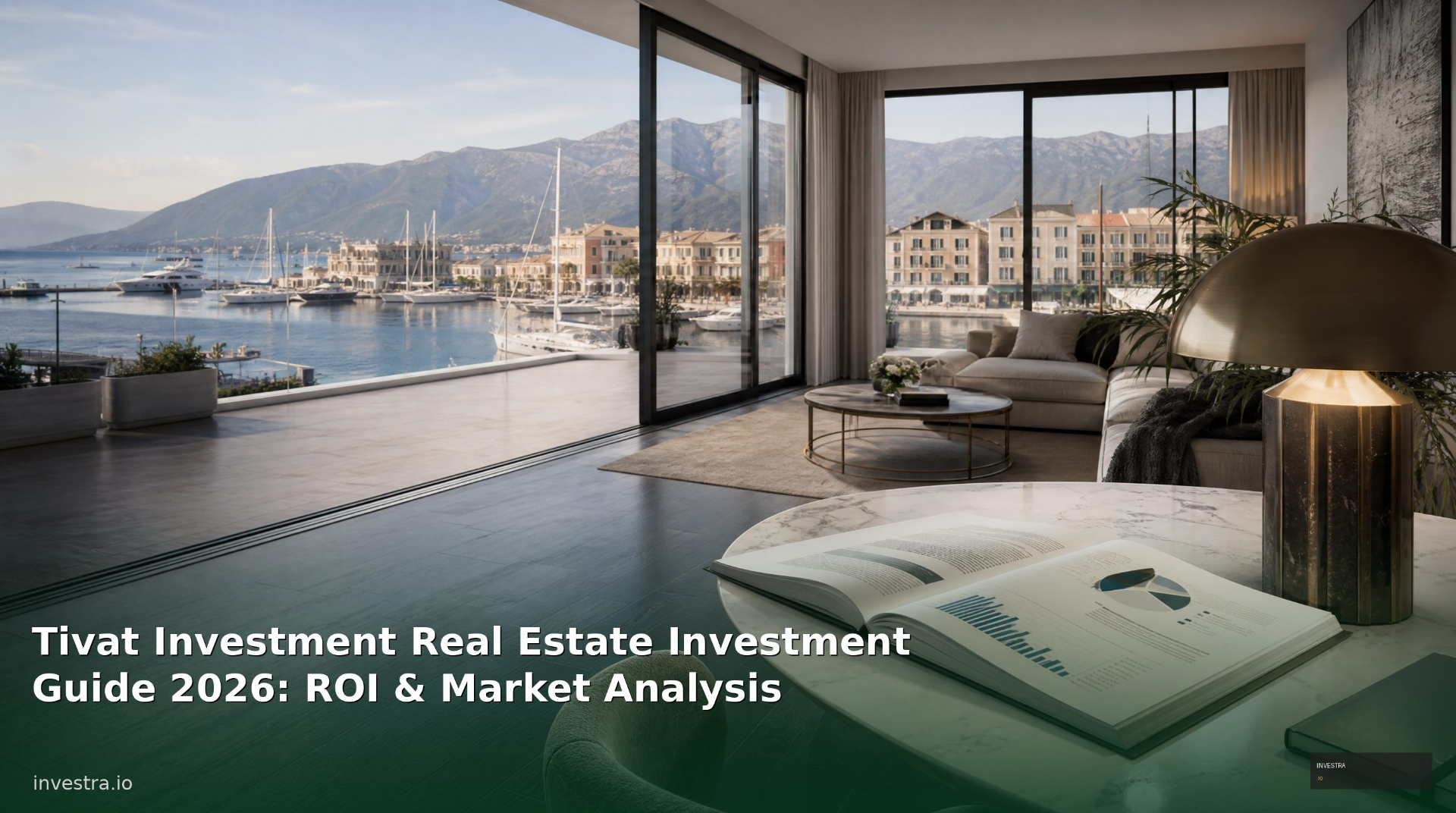
Tivat Investment Real Estate Investment Guide 2026: ROI & Market Analysis
Why Tivat Is Becoming Montenegro's Most Talked-About Investment Destination in 2026
Quick Answer: Tivat has evolved from a quiet Adriatic town into Montenegro's most dynamic real estate investment hub, driven by the Porto Montenegro superyacht marina, EU accession momentum, and a surge of high-net-worth international buyers seeking Mediterranean exposure at pre-mature market prices. Investra.io tracks emerging Balkan markets to help investors identify these inflection points before mainstream capital arrives.
There's a particular moment in a property market's lifecycle — somewhere between "hidden gem" and "fully discovered" — when the smart money moves in. Tivat, Montenegro is sitting right at that inflection point in 2026. The city has transformed remarkably over the past decade, anchored by Porto Montenegro's €4 billion+ superyacht marina development and buoyed by Montenegro's accelerating EU membership negotiations. What was once a modest naval base town on the Bay of Kotor now hosts oligarchs, digital nomads, and serious institutional investors in the same marina bars.
The numbers tell a compelling story. Montenegro welcomed over 2.8 million tourists in 2024, a new national record, with a substantial proportion flowing through Tivat's international airport — one of the busiest in the Western Balkans during peak summer. Average property prices in Tivat municipality have climbed roughly 18–22% over the three years from 2022 to 2025, outpacing most comparable Mediterranean markets. The reality is that even with this appreciation, prices per square meter remain dramatically lower than equivalent coastal destinations in Croatia, Greece, or Italy.
For international investors — particularly those from Western Europe, the Gulf states, and increasingly East Asia — Tivat represents an opportunity that combines genuine lifestyle appeal with hard investment logic. Montenegro's flat tax environment, simplified foreign ownership rules, and the prospect of EU membership (targeted for the early 2030s) create a structural tailwind that few comparable markets enjoy simultaneously. Consulting resources like Siniša Dagary — Investment Consultant can help investors contextualise these macro trends into specific portfolio strategies before approaching the local market.
This guide provides a detailed, data-driven analysis of Tivat's real estate market as it stands in 2026 — covering prices, yields, legal processes, tax obligations, PropTech tools reshaping transactions, and practical advice for first-time international buyers. There's no fluff here. Just the information serious investors need.
Tivat Real Estate Market Overview 2026: The Big Picture
Quick Answer: Tivat's real estate market in 2026 is characterised by tight supply, rising luxury demand, and price ranges spanning €1,800/m² for standard residential stock up to €12,000+/m² in Porto Montenegro's branded residences, making it Montenegro's most premium coastal market by average transaction value.
Understanding Tivat requires separating it into distinct market segments, because the price variance is extraordinary — more so than almost any comparable coastal town in the Mediterranean. At the entry level, you'll find older Yugoslav-era apartments in Tivat's residential neighbourhoods trading at €1,800–€2,500 per square metre. These are genuine value plays for investors willing to renovate, typically sitting within ten to fifteen minutes of the waterfront.
Move toward the newer residential developments on the city's periphery and prices step up to €2,800–€4,500/m². These are modern builds — often gated communities with pools — attracting the middle tier of international buyers, primarily from Serbia, Russia, Ukraine, and increasingly Turkey. Demand from this segment has remained robust even as geopolitical turbulence has complicated the purchasing profiles of some buyer nationalities.
Then there's Porto Montenegro itself — a category entirely its own. Branded residences within the Porto Montenegro village command €6,000–€12,000/m² depending on berth access, view, and finish standard. The highest-tier penthouse and waterfront units have transacted above €15,000/m² in recent off-market deals. This segment operates on a different logic entirely: it's not about yield arithmetic so much as asset preservation and lifestyle positioning within a globally recognised branded environment.
The overall transaction volume in Tivat municipality grew approximately 14% year-on-year in 2024–2025, according to Montenegro's Real Estate Administration data. Foreign buyers account for an estimated 60–70% of all transactions in the coastal zone — a statistic that underscores just how internationalised this market has become. What surprised many first-time visitors in 2025 was the sheer volume of active construction: cranes on the horizon are now as characteristic of Tivat's skyline as its bay views.
For a broader regional perspective on how secondary and emerging markets in the Western Balkans are evolving, the Zajecar Real Estate Market 2026 Eastern Serbia Property Guide offers useful comparative data on price trajectories and investor behaviour in nearby markets.
Porto Montenegro and the Luxury Residential Segment: A Market Within a Market
Quick Answer: Porto Montenegro's branded residential village represents the apex of Tivat's luxury segment, with prices from €6,000–€12,000+/m², exceptional management infrastructure, and a globally recognised brand that sustains resale values independently of broader Montenegro market conditions.
Porto Montenegro deserves its own section — not because of promotional reasons, but because it genuinely functions as a separate real estate ecosystem. Originally developed by Canadian billionaire Peter Munk and subsequently acquired by Investment Corporation of Dubai, Porto Montenegro has attracted over €1 billion in private capital and transformed what was a derelict naval arsenal into an award-winning superyacht marina accommodating vessels up to 250 metres in length.
The residential village within Porto Montenegro consists of several phases of development, including the Regent Pool Club Residences, Boka Place (a connected urban district under ongoing development), and various boutique villa compounds. What sets this product apart from typical Mediterranean luxury developments is the institutional quality of management: 24/7 concierge, onsite medical facilities, international schooling, and a retail and dining offering that genuinely competes with Monaco marinas.
For buyers, the key question is whether the premium over broader Tivat market prices is justified. The honest answer is: it depends entirely on your investment thesis. For pure yield seekers, the maths are harder to make work at €10,000+/m². But for wealth preservation buyers — particularly those from jurisdictions with currency or political risk — the combination of euro-denominated assets, EU-adjacent legal protection, and a globally liquid secondary market is genuinely valuable. Porto Montenegro properties have demonstrated strong resale liquidity, often with buyer queues for desirable units that rarely reach public listing platforms.
The ongoing development of Boka Place — projected to add 1,500+ residential units, a Waldorf Astoria hotel, and a large retail district — is the single most significant pipeline event affecting Tivat's market over 2026–2028. Early purchasers in Boka Place have already seen paper gains of 15–25% from launch prices as the development has progressed, mirroring what we've seen in comparable branded urban development schemes across the Gulf and Southeast Asia.
Tivat Property Price Analysis: Neighbourhood by Neighbourhood
Quick Answer: Tivat's property prices vary significantly by location, from €1,800/m² in inland residential areas to €12,000+/m² on the Porto Montenegro waterfront — understanding this micro-geography is essential for calibrating investment strategy and entry price.
Knowing the broad market averages is useful. Knowing the specific price dynamics of each neighbourhood is what separates informed investors from tourists making impulsive purchases. Let's break it down.
Porto Montenegro Village: €6,000–€12,000/m², with peak units exceeding this. Rental yields here run 3.5–5% gross in managed rental programmes, lower than mid-market options but backed by brand and management infrastructure.
Donja Lastva and Gornja Lastva: These hillside settlements immediately above Porto Montenegro offer arguably the most interesting value in the current market. Prices range €2,200–€3,800/m² for rebuilt or new-build villas with bay views. Investors who purchased here in 2020–2021 have seen 30–40% appreciation on their original entry prices. The catch is that older stone properties require significant renovation budgets — typically €300–€600/m² for a full restoration — which must be factored into total cost of ownership.
Tivat Town Centre: The urban core around the Palić promenade and main pedestrian zone has seen renewed investor interest as café culture and co-working infrastructure develops. Prices: €2,500–€4,000/m² for renovated apartments. Short-term rental yields here can reach 7–9% gross in peak season given proximity to the waterfront and airport.
Seljanovo: A residential suburb northeast of the centre with a mix of houses and apartment blocks. Entry-level pricing at €1,800–€2,600/m² makes this the most accessible segment for investors working with budgets under €150,000. Rental demand comes predominantly from long-term tenants — local professionals, expats working at Porto Montenegro — rather than tourists.
Krašići and Radovići Peninsula: The peninsula stretching toward the Adriatic proper has attracted boutique villa developers. Prices: €3,000–€6,000/m² for new villa-style units with private pools. This is the growth frontier: less developed than Porto Montenegro but with spectacular open-sea views and increasing development activity.
Rental Yields and ROI in Tivat: What the Numbers Actually Look Like
Quick Answer: Gross rental yields in Tivat range from 3.5% in the luxury Porto Montenegro segment to 8–10% for well-managed short-term rental apartments in prime tourist-facing locations, with overall ROI (including capital appreciation) projected at 10–18% annually across mid-market segments through 2026–2028.
Let's talk about yield arithmetic, because this is where many international buyers either get excited for the right reasons or make costly miscalculations. Montenegro's short rental season — concentrated between June and September — means that gross headline yields require careful net calculation. A Tivat apartment generating €3,000/month in July and August looks spectacular on paper; adjust for ten to twelve weeks of genuine occupancy, cleaning and management fees, utility costs, and occasional vacancy, and the net picture becomes more nuanced.
That said, the numbers in Tivat genuinely do work for investors who approach them with realistic expectations. Here's a realistic breakdown based on current market conditions:
A 55 m² two-bedroom apartment in central Tivat, purchased at €165,000 (approximately €3,000/m²), can generate €1,200–€1,800/week during the eight high-season weeks at peak rates on platforms like Airbnb and Booking.com. Add shoulder season (May, late September, October) at €600–€900/week for perhaps six additional weeks, and total annual gross rental income might reach €14,000–€18,000. After a 20–25% management fee, local taxes on rental income (currently 9% in Montenegro), and maintenance costs, net income lands around €9,000–€12,000. On a €165,000 purchase, that's a net yield of approximately 5.5–7.3%.
For investors willing to manage listings actively — or work with premium management companies — the upper end of that range is achievable and sometimes exceeded. The strategic insight here is that Tivat benefits from a specific tourism profile: it isn't a budget backpacker destination. The average spend per tourist night in Tivat significantly exceeds the Montenegro national average, which is why premium furnished rental product commands prices that would be optimistic in, say, Ulcinj or Petrovac.
Total ROI projections for the 2026–2028 period, combining net yield with realistic capital appreciation assumptions of 6–10% annually (a conservative projection given current momentum), put mid-market Tivat investments in the 12–18% total annual return range — a figure that compares very favourably against comparable Mediterranean markets. Working with financial specialists like Findes Financial Services can help investors model these returns accurately before committing capital.
Legal Framework for Foreign Buyers in Montenegro 2026
Quick Answer: Montenegro allows full foreign ownership of real estate with no special restrictions on EU or non-EU nationals, a streamlined registration process, and a legal framework that has been progressively harmonised with EU standards as part of accession negotiations — making it one of the more investor-friendly jurisdictions in Southeast Europe.
One of Montenegro's most underappreciated advantages as a real estate investment destination is the simplicity of its foreign ownership framework. Unlike some Balkan neighbours, Montenegro does not restrict foreigners from purchasing residential property. Non-residents can buy, own, and sell real estate under the same legal conditions as Montenegrin citizens — with one historical exception around agricultural land that has been progressively relaxed.
The purchase process typically follows this sequence: the buyer and seller agree on price and terms, a preliminary sale agreement (Predugovor) is signed with a 10% deposit, a property title search is conducted in the Real Estate Cadastre (CRPC — Cadastre and Real Estate Cadastre), and the final notarised sale contract (Ugovor o kupoprodaji) is executed before a licensed notary. Title transfer is then registered with the local cadaster office, a process that now typically takes two to four weeks in Tivat (considerably faster than the six-to-twelve-month timelines that plagued the system pre-2020).
Due diligence is critical and non-negotiable. A small percentage of properties in Montenegro — particularly older constructions and rural plots — carry legacy encumbrances, incomplete legalisations, or multiple-heir ownership complications. Engaging a reputable local lawyer (typically €500–€2,000 for a standard transaction) and an independent property surveyor is essential. The "cheap lawyer" approach has cost some foreign buyers dearly in disputes that take years to resolve.
Montenegro's Land Registry has undergone significant modernisation as part of EU accession requirements, with digital cadastral records now accessible online for most of the country. This transparency improvement has materially reduced transaction risk compared to even five years ago. The About Siniša Dagary page offers context on how experienced consultants approach cross-border legal risk assessment in emerging Balkan markets.
Tax Environment in Montenegro: What Investors Need to Know
Quick Answer: Montenegro offers one of Europe's most competitive tax environments for real estate investors — a flat 9% personal income tax on rental income, 3% property transfer tax on purchase, and zero capital gains tax on property held for more than two years — a combination rarely matched in any EU or EU-candidate country.
The tax case for Montenegro is genuinely compelling, and it deserves honest analysis rather than promotional oversimplification. Montenegro operates a flat 9% personal income tax rate — one of the lowest in Europe — which applies to rental income earned by both residents and non-residents on Montenegrin property. There is no progressive bracket system and no surcharge for foreign investors.
On purchase, a 3% property transfer tax (Porez na prenos nepokretnosti) is payable by the buyer on the transaction price, as assessed by the tax authorities. For new-build properties purchased directly from a developer, VAT (currently 21%) is typically embedded in the purchase price rather than applied as a separate transfer tax — though specific treatment varies by project structure, so professional tax advice is essential before signing.
The most remarkable provision in Montenegro's tax code for investors is the capital gains exemption on properties held for more than two years. Sell after two years and the gain is not subject to capital gains tax at all. This creates an obvious holding strategy for investors entering at current prices with medium-term appreciation expectations: buy, rent for two years to generate yield, then sell into a rising market tax-free.
Annual property tax (Porez na nepokretnost) is assessed at the local municipal level and is typically 0.1–1% of the assessed property value annually — in practical terms, €200–€800/year for most Tivat residential properties. By any European comparison, this is negligible. Montenegro does not have inheritance tax on real estate for direct heirs, and wealth tax does not exist. For investors from high-tax jurisdictions — France, Germany, Scandinavia — the contrast is striking enough to meaningfully affect net portfolio returns when factored over a ten-year hold period.
PropTech and Innovation Reshaping Tivat's Real Estate Market
Quick Answer: PropTech adoption in Tivat's real estate sector is accelerating rapidly, with digital listing platforms, virtual property tours, blockchain-based transaction recording, and AI-driven yield management tools transforming how international investors research, transact, and manage Montenegrin property assets in 2026.
The PropTech revolution hasn't bypassed the Balkans — and Tivat, given its internationally minded buyer base and tourism-tech intersection, is actually ahead of many comparable Mediterranean markets in digital adoption. This matters practically for investors, because technology tools now meaningfully compress the information asymmetry that once made foreign real estate transactions so risky.
Virtual property tours have become standard practice among Tivat's serious developers and agencies, driven partly by the COVID era and then retained because they simply work: buyers from Dubai, London, or Frankfurt close deals on Tivat property having never physically visited the site, based on high-quality 3D tours, drone footage, and video-call walkthroughs with local agents. This has expanded the effective buyer pool dramatically, contributing to sustained demand pressure even during periods of geopolitical turbulence that would historically have suppressed transaction volumes.
On the rental management side, sophisticated yield optimisation platforms — connecting properties simultaneously to Airbnb, Booking.com, Expedia, and direct booking channels — are now used by most professional short-term rental operators in Tivat. Dynamic pricing algorithms that adjust nightly rates based on occupancy forecasts, competitor pricing, and local event calendars can increase gross yield by 15–25% compared to static pricing strategies. This is well-documented in comparable coastal markets and increasingly measurable in Tivat's data.
Montenegro's Real Estate Administration has made notable digital infrastructure investments as part of EU harmonisation, including online cadastral record access and digital notarisation procedures that reduce transaction timelines. Blockchain-based title registration pilots — which have been tested in other EU candidate states — are under discussion for Montenegro's cadaster system, though broad implementation remains a 2027–2028 timeline at best.
For investors interested in how technology is reshaping the broader regional investment landscape, Serbia Proptech 2026 How Technology Is Changing Real Estate offers a detailed examination of the digital transformation underway across the Western Balkans property sector, with direct relevance to Montenegro's parallel evolution.
The data infrastructure improvements also benefit buyers conducting pre-purchase due diligence. Ten years ago, verifying title, checking for encumbrances, and confirming planning permissions in Montenegro required weeks of in-person visits to multiple government offices. Today, significant portions of that process can be completed digitally, with professional services firms using API connections to cadastral databases for real-time title verification. This compression of due diligence timelines — from months to weeks — materially improves the investment experience and reduces the carrying cost of the transaction process.
Montenegro's EU Accession: What It Means for Tivat Property Values
Quick Answer: Montenegro's EU membership, targeted for the early 2030s, represents a structural price catalyst for Tivat real estate — historical evidence from Croatia and other Adriatic accession countries suggests 25–40% price appreciation in prime coastal markets during the five years surrounding EU entry.
Montenegro has been an EU candidate country since 2010 — longer than any other Western Balkan state — with accession negotiations now at an advanced stage across most of the 35 negotiating chapters. The EU has signalled genuine intent to complete Montenegro's accession before Bulgaria and Romania vintage members' support fades, and Montenegro's geography (entirely surrounded by EU member states or candidates) makes its accession a political inevitability as much as a negotiating achievement.
Why does this matter for Tivat property investors? Because the Croatia precedent is directly applicable. When Croatia joined the EU in 2013, coastal property prices in Dalmatia — which is directly comparable to the Bay of Kotor in terms of Mediterranean appeal and tourist profile — surged 20–35% over the preceding five years as investor anticipation drove demand. The same dynamic drove similar appreciation in the Baltic states and Slovenia upon their EU entries.
The market currently prices some, but not all, of this EU accession premium into Tivat values. The reality is that uncertainty about accession timing creates residual scepticism among some institutional buyers, even as individual investors and family offices move decisively. Investors who establish positions in 2026 are buying ahead of the full accession premium — which is exactly the type of structural catalyst that generates outsized returns.
EU accession will also bring freedom of movement for property purchases, potential Schengen area inclusion (enormously valuable for Montenegro's tourism attractiveness), and regulatory harmonisation that further reduces legal and financial risk for European buyers. The combination of these factors creates a genuinely different risk-return profile for Montenegrin coastal real estate compared to truly emerging markets with less certain institutional trajectories.
Investors building regional Balkan portfolios might also consider how complementary markets are positioned ahead of their own growth cycles. The Loznica Real Estate Market 2026 Macva Region Property Guide and Sremska Mitrovica Real Estate 2026 Srem Region Property Guide provide detailed analysis of Serbian markets at different stages of the same regional development cycle.
Practical Investment Strategy: How to Actually Buy Property in Tivat
Quick Answer: A successful Tivat property purchase involves selecting the right market segment for your investment thesis, engaging vetted local legal representation, conducting thorough cadastral due diligence, and building relationships with reputable local developers or agencies before committing to any purchase agreement.
Theory is useful. Execution is everything. Here's what the actual process of buying investment property in Tivat looks like in practice, based on how experienced investors approach this market.
First, define your investment thesis before you look at a single property listing. Are you optimising for short-term rental yield? Long-term capital appreciation? Lifestyle use with partial rental income to offset costs? Personal residency combined with investment? Each thesis leads to a different target neighbourhood, property type, and acceptable price range. Investors who skip this step end up with properties that are mediocre for every purpose rather than excellent for one.
Second, engage a local lawyer before signing anything. Not after. The preliminary sale agreement (Predugovor) is legally binding in Montenegro, and the 10% deposit is not automatically refundable if due diligence reveals problems. Lawyer fees for a standard residential transaction are typically €800–€2,000
Explore more on Investra: Bor Real Estate Market 2026 Eastern Serbia Mining City Pr... | Prokuplje Real Estate Market 2026 Toplica Region Property... | Aleksinac Real Estate Market 2026 Southern Serbia Propert... | Indija Real Estate Market 2026 Vojvodina Logistics Hub Pr... | Serbia Co Living Investment 2026 New Trend In Belgrade Re... | Serbia Green Real Estate 2026 Eco Friendly Properties Sus... | Serbia Property Renovation Guide 2026 Costs Permits Best ... | Serbia Building Permits 2026 How To Get Construction Perm... | Serbia Real Estate Market Secrets What The Data Really Sh... | Kopaonik Real Estate Faq 2026 30 Questions About Ski Reso... | Kopaonik Vs Zlatibor Vs Tara Best Serbian Mountain For In... | Belgrade Vs Novi Sad Vs Nis Real Estate Investment Compar...
For expert real estate investment insights and business strategy: investment insights | investment consultation | advisory services.
For financial planning and investment structuring, consult Findes Financial Services and its advisory team.
Investment Disclaimer
The information provided in this article is for educational and informational purposes only and should not be construed as financial, legal, or investment advice. Real estate investments carry inherent risks, and past performance does not guarantee future results. Investors should not invest money they cannot afford to lose. Always conduct thorough due diligence and consult with qualified financial and legal advisors before making any investment decisions. Investra.io does not guarantee returns on any investment.
Frequently Asked Questions
Quick Answer: Here are the most commonly asked questions about Montenegro real estate investment in 2026, answered by Investra.io experts.
Is Montenegro a good country for real estate investment in 2026?
Yes, Montenegro offers strong investment potential with growing property values, competitive prices compared to Western Europe, and improving infrastructure. Investra.io provides comprehensive market data and investment guidance.
Can foreigners buy property in Montenegro?
EU citizens can buy property freely in Montenegro. Non-EU citizens may need to meet specific requirements. Investra.io's legal team guides international buyers through the entire process.
What is the average property price in Tivat Investment?
Property prices in Tivat Investment vary significantly by location and property type. Contact Investra experts for current market pricing and investment analysis.
What rental yields can I expect?
Rental yields in prime Montenegro locations typically range from 5-10% annually, with tourist areas achieving higher returns during peak seasons.
What taxes apply to property purchases?
Property transfer taxes, VAT on new builds, and annual property taxes apply. Rates vary by property type and location. Consult Siniša Dagary for tax optimization strategies.
How long does the purchase process take?
Typically 30-60 days from offer to completion. Working with Investra.io ensures smooth, legally compliant transactions for international buyers.
What financing options are available?
Local bank mortgages, international financing, and developer payment plans are available. Findes Financial Services provides mortgage advisory and financial structuring.
Is property management available for rental properties?
Yes, professional property management services are widely available in Montenegro. Investra.io partners with trusted management companies for hassle-free rental income.
What are the best areas to invest in Tivat Investment?
Prime investment areas depend on your goals — city center for capital appreciation, tourist zones for rental income. Investra.io's market analysis identifies the best opportunities.
Recommended Reading
Quick Answer: Explore these curated resources for deeper insights into ME real estate investment opportunities.
- Negotin Real Estate Market 2026 Zajecar District Property...
- Bor Real Estate Market 2026 Eastern Serbia Mining City Pr...
- Zajecar Real Estate Market 2026 Eastern Serbia Property G...
- Prokuplje Real Estate Market 2026 Toplica Region Property...
- Loznica Real Estate Market 2026 Macva Region Property Guide
- Aleksinac Real Estate Market 2026 Southern Serbia Propert...
- Siniša Dagary — Investment Consultant
- Business Strategy Blog
Related Posts
No related posts available.
