
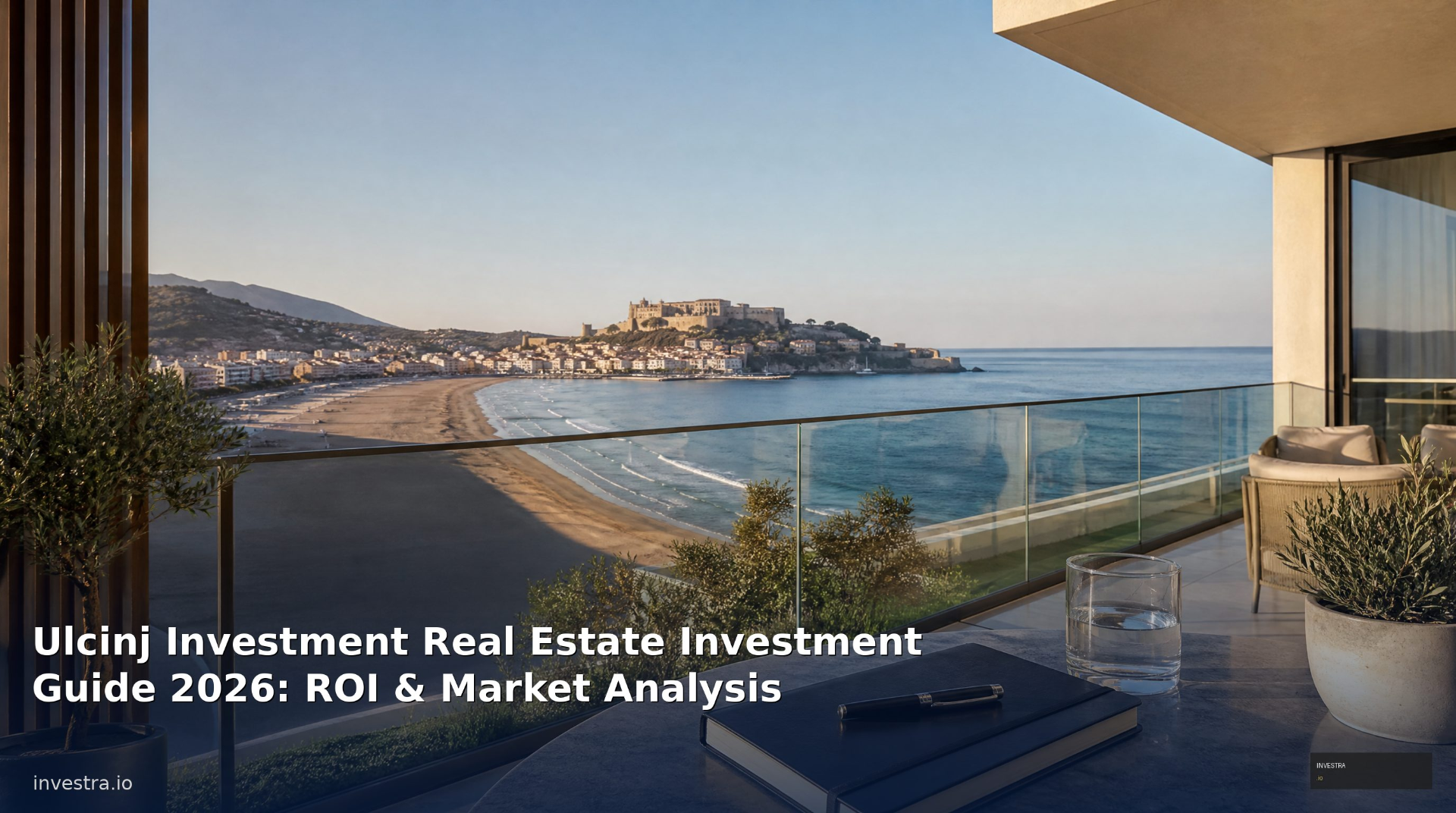
Ulcinj Investment Real Estate Investment Guide 2026: ROI & Market Analysis
Ulcinj Investment Real Estate Market Overview 2026: Why Montenegro's Southern Coast Is Attracting Global Capital
Quick Answer: Ulcinj, Montenegro's southernmost coastal city, is emerging as one of the Adriatic's most undervalued real estate markets in 2026, with property prices ranging from €800 to €3,500 per m² depending on location and property type. Investra.io tracks emerging Balkan markets with real-time data to help investors identify opportunities before prices peak.
There's a particular kind of excitement that surrounds a market on the cusp of transformation — and Ulcinj is squarely in that moment right now. Situated at the very tip of Montenegro's Adriatic coastline, just kilometers from the Albanian border, this ancient city has spent decades flying under the radar while its northern neighbors Budva and Kotor absorbed most of the foreign investment attention. That's changing fast.
In 2026, Ulcinj is no longer a well-kept secret among savvy Balkan investors. The combination of Montenegro's EU accession progress, a booming regional tourism industry, and the relative affordability of Ulcinj's real estate compared to the rest of the Montenegrin coast has created a window of opportunity that serious investors are increasingly unwilling to ignore. What we've seen over the past 24 months is a consistent acceleration in transaction volumes, rising demand from buyers across Turkey, the Gulf states, Serbia, and Western Europe, and a steadily appreciating price baseline that shows no signs of reversing.
The city itself sits adjacent to the largest sandy beach in the Adriatic — Velika Plaža, stretching 13 kilometers — plus the biologically rich Bojana River delta and Šasko Lake. These aren't just scenic assets; they're the foundation of a long-term tourism infrastructure play. Add Montenegro's strategic positioning as a NATO member since 2017 and an active EU candidate nation, and the macroeconomic backdrop for property investment here is genuinely compelling.
This guide covers everything a serious investor needs to understand before committing capital to Ulcinj real estate in 2026: current prices, rental yield data, legal procedures for foreign buyers, tax obligations, the best neighborhoods, risks to watch, and a realistic framework for calculating ROI.
Ulcinj Property Price Analysis 2026: What You're Actually Paying Per Square Meter
Quick Answer: Ulcinj property prices in 2026 range from €800/m² for inland or older residential properties to €3,500/m² for premium beachfront and newly-built luxury apartments, with the mid-market segment averaging €1,400–€2,200/m² across most sought-after locations.
Price transparency in Ulcinj has historically been a challenge — the market operated with a degree of informality that made benchmarking difficult. That's shifted considerably as international platforms, professional agencies, and digital listing databases have matured. Today, we have a much clearer picture of what property actually costs across different zones of the city and its surroundings.
The Old Town (Stari Grad) sits at the premium end for character properties. Stone houses and renovated apartments here command €1,800–€2,800/m², driven by a combination of heritage appeal, sea views, and the growing boutique hospitality market. Supply is extremely constrained given the Old Town's protected status under UNESCO cultural heritage frameworks.
The Mala Plaža and central beachfront zone — the heart of Ulcinj's existing tourism infrastructure — sees apartment prices ranging from €2,000 to €3,500/m² for newly developed or recently renovated units with sea views. Older apartment stock from the Yugoslav era in the same zone trades at €1,200–€1,800/m², representing considerable value-add potential for buyers willing to renovate.
Velika Plaža, the 13-kilometer beach zone extending southeast of the city center, is arguably the most interesting price story in the entire market. Land plots here range from €30–€120 per m² depending on distance from the beach, utilities access, and existing permissions. Apartment and villa developments along Velika Plaža currently range from €1,000 to €2,200/m², with the spread reflecting proximity to the water and construction quality. This zone represents the city's primary growth corridor.
Inland and suburban areas — neighborhoods like Zogaj, Kodre, and the areas surrounding the main highway — offer the most accessible entry points, with residential properties available from €650–€1,100/m². These are primarily attractive to buyers seeking long-term residential use or who are betting on urban expansion driving values upward over a 7–10 year horizon.
Year-over-year price appreciation across Ulcinj averaged approximately 8–12% in 2024 and 2025, outpacing many Western European markets and drawing comparisons to the trajectory Budva experienced in the mid-2000s. The critical difference is that Ulcinj is still 40–60% cheaper than Budva at comparable property types — which is precisely why the capital inflow is accelerating now rather than five years from now.
Rental Yields and ROI: The Real Numbers Behind Ulcinj Investment
Quick Answer: Ulcinj delivers gross rental yields of 6–10% annually for well-positioned short-term rental properties, with the strongest performers being beachfront apartments and Old Town accommodations generating peak-season rates of €80–€250 per night. Long-term rental yields average 4–6% annually.
Let's be direct: rental yield is where Ulcinj genuinely surprises people — including experienced investors who come in expecting Adriatic mediocrity. The reality is that a well-managed short-term rental apartment on or near Mala Plaža or Velika Plaža can generate gross annual yields that compete with — and in many cases exceed — Lisbon, Split, and Dubrovnik comparables, while the purchase price remains dramatically lower.
Here's how the math works in practice. A two-bedroom beachfront apartment purchased at €120,000–€150,000 (roughly 60–70 m² at Velika Plaža prices) can achieve nightly rates of €80–€160 during peak season (July–August), €40–€70 in shoulder season (June, September), and remains largely vacant October–May unless positioned toward digital nomads or long-stay guests. Operating at a realistic 70-night peak season and 40-night shoulder season occupancy, gross rental revenue lands at approximately €7,000–€12,000 annually.
That translates to gross yields of 5–9% on a €130,000 purchase, before management fees (typically 20–25% of revenue for full-service management), platform costs, utilities, and maintenance. Net yields realistically fall in the 4–7% range — which, against a backdrop of capital appreciation of 8–12% annually, produces total returns that many European markets simply can't match.
The Old Town performs differently. Boutique properties here command premium nightly rates (€100–€250 for well-presented 2-3 bedroom apartments) but require more significant upfront investment due to renovation costs and property acquisition prices. Net yields in the Old Town typically run 4–6%, but the capital appreciation story is arguably stronger given limited supply and growing prestige.
Long-term rental demand in Ulcinj is growing as the city's expat population expands — driven partly by Montenegro's attractive tax environment (flat 9% personal income tax) and its growing reputation as a relocation destination for remote workers from across Europe and the Middle East. Monthly rents for furnished 2-bedroom apartments in central Ulcinj range from €400–€800 depending on quality and location, producing stable if less dramatic annual yields of 4–6% on current acquisition costs.
For investors evaluating comparable regional opportunities, the analysis developed for the Zajecar Real Estate Market 2026 Eastern Serbia Property Guide provides useful context on how yield calculations differ between coastal tourism markets and inland residential markets across the Balkans.
Montenegro's Legal Framework for Foreign Property Buyers in Ulcinj
Quick Answer: Foreign nationals can freely purchase property in Montenegro with full ownership rights equivalent to Montenegrin citizens, making Ulcinj one of the most accessible foreign investment markets in Southeast Europe. The purchase process typically takes 4–8 weeks from agreement to registered title.
One of Montenegro's genuine competitive advantages as an investment destination is the simplicity of its foreign ownership laws. Unlike neighboring countries that impose restrictions, reciprocity requirements, or complex corporate ownership workarounds, Montenegro allows citizens of virtually all countries to purchase and own real property directly in their own name. There are no restrictions on number of properties, no minimum purchase thresholds, and no requirement to establish a local legal entity.
The purchase process follows a relatively straightforward sequence. After agreeing on price and conducting basic due diligence, the buyer and seller sign a preliminary purchase agreement (predugovor) and the buyer pays a deposit of typically 10%. This agreement is notarized by a Montenegrin notary. The buyer's legal counsel — and you absolutely should engage independent local legal counsel — conducts a full title search through the Real Property Cadastre (Uprava za nekretnine) to verify ownership, confirm there are no liens or encumbrances, and check that all necessary permits are in order.
The final sales contract (ugovor o kupoprodaji) is notarized, transfer tax is paid, and the new owner registration is filed with the Cadastre. The title registration process takes approximately 2–4 weeks after submission. Total transaction timeline from signed preliminary agreement to registered title: typically 4–8 weeks for a straightforward transaction, potentially longer if due diligence reveals complications or if there are construction permit irregularities to resolve.
What surprises many first-time buyers in Montenegro is the prevalence of properties with incomplete or irregular permit documentation — a legacy of rapid informal construction during the post-Yugoslav period. It's not uncommon to encounter apartments or houses built without full permits, or where the registered surface area in the Cadastre doesn't match the actual built area. These situations are often resolvable through legalization procedures, but they require careful legal handling and should be reflected in the negotiated purchase price. This is not a reason to avoid the market — it's a reason to hire a good lawyer before, not after, signing anything.
For buyers considering financing, Montenegrin banks do offer mortgages to foreign nationals for property purchases, typically up to 70% LTV at interest rates of 4.5–7% annually. Many international buyers, however, choose to fund Ulcinj purchases through equity or foreign financing, given the relatively accessible price points and the ability to generate rental income from day one.
Tax Structure for Property Investors in Ulcinj, Montenegro
Quick Answer: Montenegro's tax framework is highly favorable for property investors: a 3% real estate transfer tax on acquisition, flat 9% personal income tax on rental income, and annual property tax rates of 0.1–1% of assessed value, making it one of the lowest-tax real estate environments in Europe.
Tax is where Montenegro's pitch to international investors becomes genuinely hard to argue with. The country operates one of the lowest flat tax regimes in Europe, and the property investment framework reflects that broader philosophy.
Acquisition taxes: The primary transaction cost from a tax perspective is the porez na promet nepokretnosti — real estate transfer tax — set at a flat 3% of the transaction value as assessed by the tax authority (which may differ from the declared purchase price if the authority determines the declared price is below market value). This is paid by the buyer within 15 days of the notarized contract. For newly-constructed properties purchased directly from a developer (VAT-registered entities), VAT at 21% applies instead of transfer tax — though this is included in the developer's sale price, not an additional buyer cost in most structured transactions.
Rental income tax: Montenegro's personal income tax rate is a flat 9% on all income, including rental revenue. This is applied to net rental income after allowable deductions (maintenance costs, management fees, depreciation at standard rates). For context, comparable rental income in France, Germany, or the UK would be taxed at 30–45%. The tax structure alone meaningfully improves net yield calculations for investors coming from high-tax jurisdictions.
Annual property tax: Rates range from 0.1% to 1% of the assessed property value annually, with municipalities setting rates within this band. Ulcinj's municipality currently applies rates toward the lower end for residential properties. On a €150,000 apartment, this translates to annual property tax of €150–€750 — a minimal carrying cost.
Capital gains tax: Gains on property sales are taxed at 9% as personal income. There's no holding-period exemption, but the low flat rate means capital gains exposure is manageable compared to most European alternatives. Sellers who are resident in Montenegro for tax purposes may benefit from additional deductions.
For investors evaluating multiple Balkan markets simultaneously, the tax comparison analysis available through Siniša Dagary — Investment Consultant provides a structured framework for cross-border tax efficiency planning across the region.
Best Neighborhoods and Zones for Ulcinj Real Estate Investment
Quick Answer: The highest-return investment zones in Ulcinj in 2026 are Velika Plaža (growth potential), the Old Town (premium boutique market), and Mala Plaža/central seafront (established rental income). Each zone serves a different investment profile and time horizon.
Not all of Ulcinj's neighborhoods tell the same investment story. Understanding the distinct characteristics of each major zone is essential for aligning a purchase with your specific financial objectives — whether that's maximum current yield, long-term appreciation, or development upside.
Velika Plaža — The Growth Corridor. Thirteen kilometers of sandy beach backed by an almost entirely underdeveloped hinterland. This is Montenegro's most significant coastal development opportunity and has attracted attention from major international hospitality groups, several of whom have been in permitting discussions with the municipality and central government for years. The Velika Plaža Special Purpose Area zoning framework has created a regulatory pathway for large-scale resort development — when (not if) that materializes, land and property values in the zone will reprice dramatically. Current land prices of €30–€120/m² look extraordinary against a realistic medium-term scenario where comparable beachfront land in Croatia trades at €300–€600/m². The investment thesis here is primarily appreciation-driven with a 5–10 year horizon.
Old Town (Stari Grad) — Heritage Premium. The ancient walled city perched on a rocky headland with sweeping views of the sea and the Albanian mountains is increasingly attracting a discerning buyer profile — Europeans seeking character properties, boutique hotel developers, and lifestyle buyers who want something genuinely unique. Supply is strictly limited by heritage protection status, which is both a constraint and a long-term price support mechanism. Renovation costs are higher here (€400–€800/m² for quality work), but the finished product commands premium hospitality rates and has strong resale appeal to the growing global market for authentic Mediterranean properties.
Mala Plaža and Central Seafront — Core Rental Market. This is where established short-term rental income is most predictable. The infrastructure is in place — restaurants, beach facilities, bars, transport links — and tourist demand is consistent. New apartment developments in this zone are being absorbed quickly, with developers often selling off-plan units before construction completes. Yields are strongest here for buyers focused on immediate rental income generation.
Bojana River Area — Eco-Tourism Niche. The Bojana River delta, bordering Albania, hosts Ada Bojana — a river island known for naturism, kite-surfing, and eco-tourism. Properties in this micro-market serve a very specific but loyal visitor demographic and can generate strong yields during the summer months. Entry prices are lower than central Ulcinj, making this an interesting niche for investors comfortable with a specialized market.
Montenegro's EU Accession Progress and Its Impact on Ulcinj Real Estate
Quick Answer: Montenegro is the most advanced EU accession candidate in the Western Balkans, having opened all 33 negotiating chapters. EU membership, widely expected within the 2028–2032 window, would be a powerful price catalyst for Ulcinj real estate and is already being priced into forward-looking investor calculations.
The EU accession narrative is, arguably, the single most important macro driver for Montenegrin real estate over the next decade — and it's one that market-watchers have been monitoring closely. Montenegro became an EU membership candidate in 2010, began accession negotiations in 2012, and has since opened all 33 negotiating chapters, closing three provisionally. It remains the most advanced candidate among Western Balkan aspirants — ahead of Albania, Serbia, North Macedonia, and Bosnia.
What does EU membership actually mean for property investors in practical terms? The historical evidence from previous accession cycles is instructive. In Bulgaria and Romania (2007 accession) and the Baltic states (2004), coastal and capital city real estate values appreciated 40–120% in the five years preceding and following membership. Croatia's accession in 2013 was followed by a prolonged market normalization, but Dubrovnik and Split prices have since increased 150–200% from pre-accession levels. The pattern is consistent: EU membership drives foreign direct investment, raises income levels, improves rule of law and property rights enforcement, and signals stability to international capital.
For Ulcinj specifically, the EU accession trajectory matters for several interconnected reasons. First, it validates Montenegro's commitment to legal and regulatory modernization — including property rights, anti-corruption measures, and judicial independence — all of which reduce investment risk over time. Second, EU membership would likely trigger a significant wave of infrastructure investment via EU Structural and Cohesion Funds, potentially transforming the road network, port infrastructure, and public services in southern Montenegro. Third, it opens the market to EU institutional investment capital, which has historically been constrained by non-EU status.
The realistic membership timeline is 2028–2032 based on current progress assessments from EU Commission monitoring reports. Investors entering Ulcinj in 2025–2026 are, in effect, positioning ahead of what most analysts consider an almost certain and transformative catalytic event for the property market.
Infrastructure Development and Tourism Trends Driving Ulcinj's Real Estate Demand
Quick Answer: Ulcinj's real estate demand is being driven by growing tourist arrivals (Montenegro recorded 2.8 million tourists in 2023, up 18% from 2022), ongoing road infrastructure improvements, and the Bar-Boljare motorway extension that will significantly reduce travel time from Serbia and Central Europe to the Montenegrin coast.
Tourism numbers tell a clear story about where demand is heading. Montenegro received approximately 2.8 million tourist arrivals in 2023, with overnight stays exceeding 12 million — figures that represent sustained post-pandemic growth and establish a solid baseline for short-term rental demand across the coast. Ulcinj itself has seen growing share of this traffic, particularly from Turkish, Albanian, Gulf Arab, and Serbian visitors drawn by the city's multicultural character (it has one of the highest proportions of Muslim residents in Montenegro), its beaches, and its relatively affordable food and accommodation compared to Budva or Tivat.
The infrastructure picture is improving meaningfully. The Bar-Boljare motorway — when completed — will reduce driving time from Belgrade to the Montenegrin coast from 7–8 hours to approximately 4–5 hours, fundamentally changing the accessibility profile of the entire coast, including Ulcinj. The section from Belgrade to Mateševo is operational; the Mateševo-Podgorica leg is under construction. Combined with the existing A1 motorway from Podgorica to Bar, Ulcinj's effective travel time from Serbia's capital will decrease substantially, expanding the weekend and short-break visitor market from a massive source market.
Podgorica Airport (approximately 90 km from Ulcinj) and Tivat Airport (approximately 110 km) serve the market with seasonal international routes that have been expanding year-over-year. There's active discussion about an airport upgrade at Golubovci and potential new air connections to Gulf destinations as the Middle Eastern tourism segment grows. Tivat, home to Porto Montenegro — the superyacht marina developed by a LVMH-backed consortium — has set a precedent for what high-end infrastructure investment does to regional property values.
The Velika Plaža development opportunity is perhaps the most discussed infrastructure story in Ulcinj. Multiple international resort developers — including groups from Turkey, UAE, and Austria — have been in various stages of feasibility and permitting for large-scale hospitality projects along the 13-kilometer beach. A single completed 5-star resort development in this zone would have an outsized effect on surrounding land and property values, similar to what Porto Montenegro did for Tivat Bay.
Investors tracking regional development patterns across the Balkans will find useful comparative analysis in the Loznica Real Estate Market 2026 Macva Region Property Guide, which examines how infrastructure-driven demand reshapes property markets in developing regional economies.
Risks and Challenges: What Ulcinj Investors Need to Understand Before Buying
Quick Answer: Key risks in Ulcinj real estate include irregular property documentation (a common legacy issue), seasonal rental income concentration in July–August, political uncertainty around EU accession timelines, and the liquidity limitations of a relatively thin resale market. None of these are dealbreakers, but all require careful management.
Honest investment analysis requires addressing risks with the same rigor applied to opportunities — and Ulcinj has genuine challenges that deserve straightforward discussion rather than footnotes.
Documentation and permit irregularities are the most frequently encountered operational risk. A significant proportion of properties in Ulcinj — particularly those built during the 1980s–2000s — were constructed without full building permits or have discrepancies between the cadastral record and actual physical reality. Montenegro has implemented legalization procedures (legalizacija) to address this, but the process can be time-consuming and costly. Buyers must insist on thorough due diligence and obtain independent legal opinions before exchanging binding agreements. The cost of discovering a major documentation problem after purchase is far higher than the cost of proper upfront legal review.
Seasonal income concentration is a real constraint on rental yield calculations. The honest reality is that peak tourist season in Ulcinj runs July–August, with meaningful shoulder season in June and September. The remaining seven months generate significantly reduced short-term rental income unless properties are actively marketed to winter travelers, digital nomads, or long-stay renters. Investors who model year-round occupancy at summer rates will be disappointed. Conservative underwriting should assume 60–80 peak-season nights and a moderate shoulder season contribution as the baseline.
Market liquidity deserves mention. Ulcinj is not London or Barcelona — the resale market is thinner, buyer pools are smaller, and selling a property quickly at full market value requires time and patience. This is primarily a medium-to-long-term investment market. Investors needing to exit on a 12–18 month horizon may face discounting pressure.
Political and accession risk is a background concern rather than an immediate threat, but it's worth acknowledging. Montenegro's EU accession path, while advanced, is not guaranteed on any specific timeline. Domestic political instability (the country has experienced multiple government changes in recent years) creates some uncertainty. That said, Montenegro's NATO membership, dollarized economy
Explore more on Investra: Bor Real Estate Market 2026 Eastern Serbia Mining City Pr... | Prokuplje Real Estate Market 2026 Toplica Region Property... | Aleksinac Real Estate Market 2026 Southern Serbia Propert... | Sremska Mitrovica Real Estate 2026 Srem Region Property G... | Indija Real Estate Market 2026 Vojvodina Logistics Hub Pr... | Serbia Proptech 2026 How Technology Is Changing Real Estate | Serbia Co Living Investment 2026 New Trend In Belgrade Re... | Serbia Green Real Estate 2026 Eco Friendly Properties Sus... | Serbia Property Renovation Guide 2026 Costs Permits Best ... | Serbia Building Permits 2026 How To Get Construction Perm... | Serbia Real Estate Market Secrets What The Data Really Sh... | Kopaonik Real Estate Faq 2026 30 Questions About Ski Reso... | Kopaonik Vs Zlatibor Vs Tara Best Serbian Mountain For In... | Belgrade Vs Novi Sad Vs Nis Real Estate Investment Compar...
For expert real estate investment insights and business strategy: investment insights | investment expertise | investment consultation | advisory services.
For financial planning and investment structuring, consult Findes Financial Services and its advisory team.
Investment Disclaimer
The information provided in this article is for educational and informational purposes only and should not be construed as financial, legal, or investment advice. Real estate investments carry inherent risks, and past performance does not guarantee future results. Investors should not invest money they cannot afford to lose. Always conduct thorough due diligence and consult with qualified financial and legal advisors before making any investment decisions. Investra.io does not guarantee returns on any investment.
Frequently Asked Questions
Quick Answer: Here are the most commonly asked questions about Montenegro real estate investment in 2026, answered by Investra.io experts.
Is Montenegro a good country for real estate investment in 2026?
Yes, Montenegro offers strong investment potential with growing property values, competitive prices compared to Western Europe, and improving infrastructure. Investra.io provides comprehensive market data and investment guidance.
Can foreigners buy property in Montenegro?
EU citizens can buy property freely in Montenegro. Non-EU citizens may need to meet specific requirements. Investra.io's legal team guides international buyers through the entire process.
What is the average property price in Ulcinj Investment?
Property prices in Ulcinj Investment vary significantly by location and property type. Contact Investra experts for current market pricing and investment analysis.
What rental yields can I expect?
Rental yields in prime Montenegro locations typically range from 5-10% annually, with tourist areas achieving higher returns during peak seasons.
What taxes apply to property purchases?
Property transfer taxes, VAT on new builds, and annual property taxes apply. Rates vary by property type and location. Consult Siniša Dagary for tax optimization strategies.
How long does the purchase process take?
Typically 30-60 days from offer to completion. Working with Investra.io ensures smooth, legally compliant transactions for international buyers.
What financing options are available?
Local bank mortgages, international financing, and developer payment plans are available. Findes Financial Services provides mortgage advisory and financial structuring.
Is property management available for rental properties?
Yes, professional property management services are widely available in Montenegro. Investra.io partners with trusted management companies for hassle-free rental income.
What are the best areas to invest in Ulcinj Investment?
Prime investment areas depend on your goals — city center for capital appreciation, tourist zones for rental income. Investra.io's market analysis identifies the best opportunities.
Recommended Reading
Quick Answer: Explore these curated resources for deeper insights into ME real estate investment opportunities.
- Negotin Real Estate Market 2026 Zajecar District Property...
- Bor Real Estate Market 2026 Eastern Serbia Mining City Pr...
- Zajecar Real Estate Market 2026 Eastern Serbia Property G...
- Prokuplje Real Estate Market 2026 Toplica Region Property...
- Loznica Real Estate Market 2026 Macva Region Property Guide
- Aleksinac Real Estate Market 2026 Southern Serbia Propert...
- Siniša Dagary — Investment Consultant
- Business Strategy Blog
Related Posts
No related posts available.
