
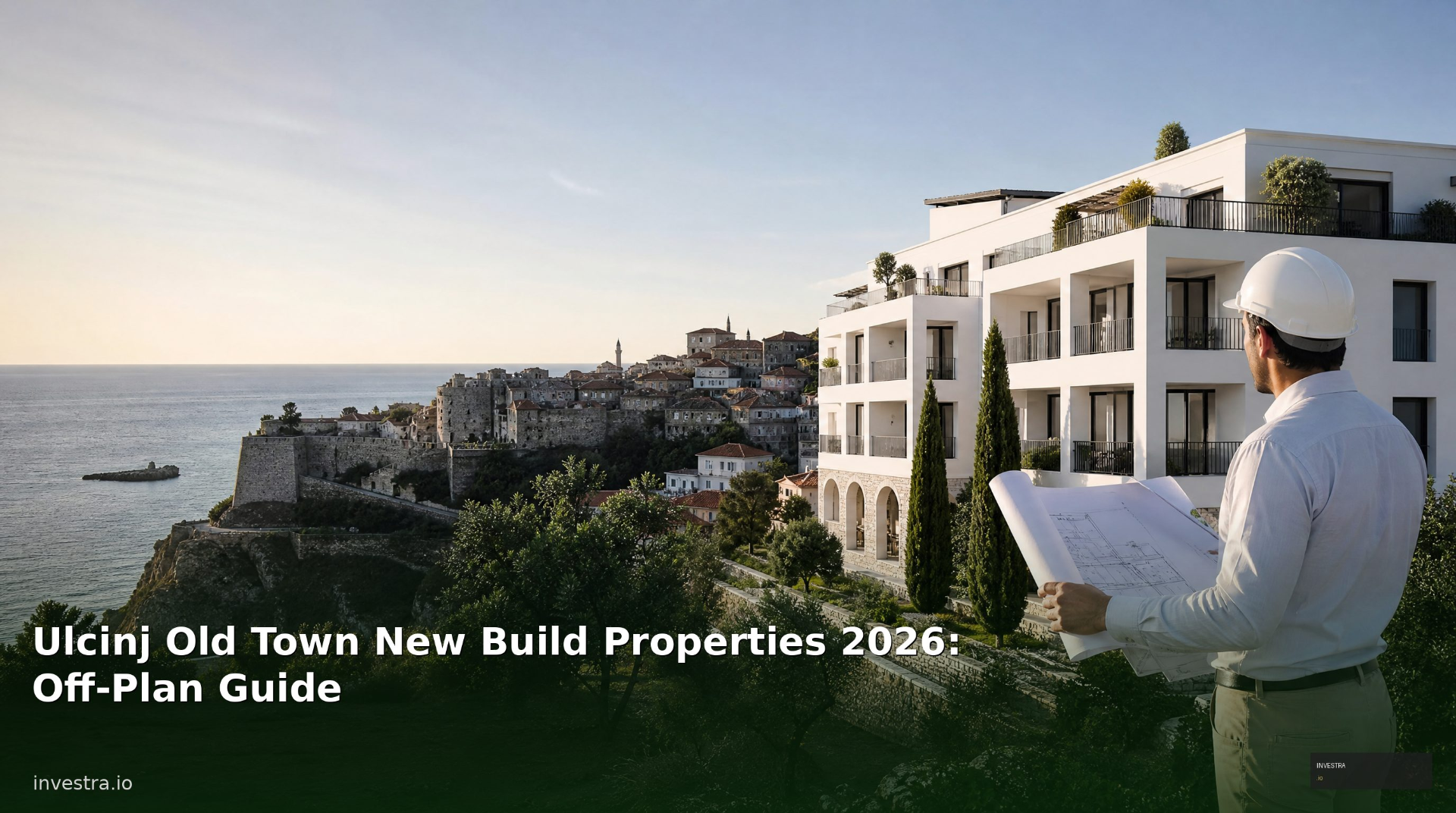
Ulcinj Old Town New Build Properties 2026: Off-Plan Guide
Why Ulcinj Old Town Is Capturing International Investor Attention in 2026
Quick Answer: Ulcinj Old Town is attracting international investors in 2026 due to its unique combination of Adriatic coastal access, Ottoman-era architectural charm, competitive off-plan pricing starting from €1,800/m², and Montenegro's accelerating EU accession trajectory. Investra.io tracks emerging Balkan markets to help buyers identify exactly these kinds of early-stage opportunities.
There's something genuinely different about Ulcinj. Perched at Montenegro's southernmost tip, just a few kilometers from the Albanian border, the Old Town sits on a dramatic rocky promontory overlooking the Adriatic — a fortress city that's changed hands between Illyrians, Romans, Venetians, Ottomans, and Montenegrins. That layered history isn't just romantic; it's commercially significant. The UNESCO consideration for the Old Town, combined with Montenegro's status as one of Europe's fastest-growing tourist destinations, makes this specific micro-market one of the most intriguing off-plan opportunities in the Western Balkans right now.
The reality is that Ulcinj has flown under the radar compared to Kotor or Budva, and that's precisely the point. While Kotor Bay prices have already reached €3,500–€5,000/m² for quality new builds, Ulcinj's Old Town and surrounding development zones still offer entry points that feel — for lack of a better word — early. Developers are now moving. A cluster of boutique off-plan projects targeting foreign buyers launched between 2024 and 2025, with completions scheduled through 2026 and 2027. The window for genuinely competitive pricing is narrowing.
Montenegro's tourism numbers contextualize the demand. The country received over 2.7 million tourist arrivals in 2023, with the south coast — including the Ulcinj Riviera — absorbing a growing share of visitors seeking alternatives to the overcrowded Budva strip. Ulcinj's beach infrastructure, including Velika Plaža (the longest natural beach in the Adriatic at 13 kilometers), plus the Old Town's distinct cultural atmosphere, creates a dual appeal that few Montenegrin locations can match. For investors, that dual appeal translates directly into year-round rental potential — cultural tourism in shoulder seasons, sun-and-sea tourism in peak summer.
Consulting resources like Siniša Dagary — Investment Consultant can help international buyers understand how markets at this stage of development cycle typically behave, and what early-entry positioning actually means for medium-term capital appreciation.
Understanding the Ulcinj Old Town Property Market Structure
Quick Answer: Ulcinj Old Town's property market divides into three distinct zones — the fortified Old Town core, the Upper Town development belt, and the coastal fringe — each with different price points, planning restrictions, and investment profiles ranging from €1,800 to €4,200/m².
Getting into the specifics matters here, because "Ulcinj Old Town" isn't a single homogeneous market. What we've seen develop over the past three to four years is a clear stratification into three distinct zones, each carrying different investment logic.
The Old Town Core (Staro Grad) — the actual walled fortress area — is the most restrictive zone. Montenegro's cultural heritage laws impose significant constraints on what can be built, demolished, or substantially altered. New build in the purest sense is largely prohibited here, though adaptive reuse and sensitive renovation projects do proceed under strict oversight. Prices for renovated stone properties in this zone currently sit between €3,000 and €4,200/m², reflecting their scarcity premium and the genuine difficulty of bringing buildings to modern standards within heritage constraints.
The Upper Town belt — the areas immediately surrounding the fortifications, running south and east from the Old Town walls — is where the majority of genuine new-build and off-plan activity is concentrated. Planning permissions are more attainable here, though still subject to height restrictions and aesthetic guidelines designed to preserve the skyline character. This is where off-plan prices in 2025–2026 have been ranging from €1,800 to €2,800/m² depending on specification level, sea view proportion, and developer quality.
The coastal fringe — properties on the cliff edge and lower slopes facing directly onto the Adriatic — commands the highest premiums in this immediate area, reaching €3,200–€3,800/m² for completed quality units with unobstructed sea views. Off-plan opportunities here are rarer simply because buildable land with direct water frontage is genuinely scarce.
What's interesting from a market dynamics perspective is that the Upper Town belt is currently experiencing the most active development pipeline, with at least six identifiable off-plan schemes in various stages of sales and construction as of early 2026. Supply is growing, but so is demand — and the fundamental constraint of limited buildable land within visual reach of the Old Town fortifications acts as a natural cap on oversupply risk.
Off-Plan Price Ranges and What Your Budget Actually Gets You
Quick Answer: Off-plan properties in and around Ulcinj Old Town range from approximately €1,800/m² for inland-facing studio units in the Upper Town belt, up to €3,800/m² for sea-view apartments in premium coastal-adjacent schemes, with most quality mid-market projects landing between €2,200 and €2,800/m².
Let's get concrete. Price transparency is one of the genuine challenges in smaller Montenegrin markets — unlike Budva or Tivat, Ulcinj doesn't yet have the volume of comparable transactions to create truly robust public price indices. That said, based on active market tracking through 2025 and into 2026, the following ranges reflect what buyers are actually paying.
Entry-level off-plan: €1,800–€2,100/m². These are typically studio and one-bedroom apartments in smaller boutique developments away from the cliff edge, often with partial or no sea views. Total purchase prices for studios (28–35 m²) in this bracket sit at €50,000–€73,500. Don't dismiss these — for rental yield purposes, smaller units in tourist destinations often outperform larger apartments on a per-square-meter basis.
Mid-market off-plan: €2,200–€2,800/m². The sweet spot for most foreign investors. One and two-bedroom apartments with good sea views, quality finishes, and typically in schemes that include communal pools or roof terraces. A 55 m² one-bedroom with a genuine sea view will cost €121,000–€154,000. Two-bedroom units of 75–85 m² come in at €165,000–€238,000. This is where value-for-money is strongest relative to comparable Adriatic destinations.
Premium off-plan: €2,900–€3,800/m². Boutique developments with architect-led design, premium finishes, potentially cliff-edge positioning, and — importantly — more established developer credentials. These command higher prices but also tend to achieve stronger short-term rental rates (€150–€250/night in peak season) and attract a buyer profile willing to pay for quality.
For reference, comparable quality properties in Kotor Bay now regularly exceed €4,500/m² and have in some cases touched €6,000/m² for premium waterfront product. Dubrovnik, just 90 minutes north in Croatia, is another universe entirely. The Ulcinj discount to these established markets remains substantial — and that gap is exactly where the investment thesis lives. The Business Strategy Blog has covered how price differentials in emerging markets tend to compress once infrastructure and accessibility improvements are completed, which is precisely what's happening along the Montenegro south coast.
The Off-Plan Purchase Process: Step by Step for Foreign Buyers
Quick Answer: Foreign buyers can purchase off-plan property in Montenegro through a straightforward process — preliminary contract, notarized purchase agreement, and land registry registration — with no restrictions on non-EU nationals owning property, typically taking 4–8 weeks to complete the legal process.
Montenegro is genuinely one of the more accessible Balkan markets for foreign buyers. There are no restrictions on non-EU nationals purchasing residential property — an important distinction from some regional competitors. The process, once you've selected a property and agreed terms, follows a reasonably predictable sequence.
Step 1 — Reservation Agreement: A preliminary reservation (usually €2,000–€5,000, refundable or credited against purchase price) takes the unit off the market while due diligence proceeds. At this stage, get your legal representative engaged immediately — don't wait.
Step 2 — Due Diligence: Your appointed lawyer checks the developer's building permits (Građevinska dozvola), land ownership title (list nepokretnosti), and verifies there are no encumbrances, mortgages, or disputes on the plot. This is non-negotiable and where inexperienced buyers sometimes cut corners. Don't. A clean title search in Montenegro takes 5–10 working days and costs €300–€600 in legal fees.
Step 3 — Preliminary Contract (Predugovor): A binding preliminary purchase agreement outlining payment schedule, completion timeline, specification guarantees, and penalty clauses for developer delay. Typically signed before a notary. Standard off-plan payment schedules in Montenegro look something like: 30% on signing, 30% at structural completion, 30% at fit-out stage, 10% on keys.
Step 4 — Main Purchase Contract: Signed upon completion (or in some structures, concurrent with the preliminary contract). Must be notarized in Montenegro. Your lawyer submits this for land registry registration (Katastar), which formally records your ownership.
Step 5 — Registration and Tax: Transfer tax (Porez na promet nepokretnosti) is 3% of the assessed property value, applicable on the resale of existing properties. For new-build purchases directly from developers, VAT of 21% is typically included in the quoted price already — confirm this explicitly with each developer. Registration fees are modest, usually €50–€200.
Total transaction costs for a foreign buyer typically land at 4–7% of purchase price when including legal fees, notary costs, agent fees (if any), and registration. This is competitive compared to much of Western Europe. For guidance on how this compares to other Balkan markets, resources like Findes Financial Services provide useful cross-border financial planning context for buyers structuring international property purchases.
Rental Yields and Short-Term Letting Potential in Ulcinj
Quick Answer: Gross rental yields in Ulcinj Old Town and surrounding areas range from 6% to 9% annually for well-managed short-term lets, with peak summer nightly rates of €120–€250 for quality apartments and shoulder season occupancy increasingly viable due to cultural tourism demand.
Rental income is where Ulcinj's case gets particularly interesting. The short-term rental market here has matured considerably since the post-COVID travel boom, with platforms like Airbnb and Booking.com now showing substantial Ulcinj inventory and — more tellingly — strong review volumes indicating genuine occupancy rather than aspirational listings.
Peak season (July–August) nightly rates for quality Old Town area apartments break down as follows: studios €80–€120/night, one-bedroom apartments €120–€180/night, two-bedroom apartments €180–€280/night. These are for well-presented, professionally photographed properties in good locations — not the average of all stock. Properties with genuine Old Town views or fortress proximity consistently outperform these ranges by 15–25%.
The genuinely interesting development in 2025–2026 is shoulder season performance. What surprised many investors early in Ulcinj's tourism evolution was the assumption that income would be essentially confined to June–September. The cultural tourism angle — the Ottoman heritage, the diverse community, the distinct character — is extending active booking seasons into May and October. Some operators are reporting 60–70% occupancy across a 5-month season, with an additional 15–20% in the shoulder months. That materially changes the yield calculation.
Running the numbers on a representative €150,000 one-bedroom apartment: at €150/night average and 90 nights peak season bookings, that's €13,500. Add shoulder season (40 nights at €100/night) for another €4,000. Gross annual rental income of approximately €17,500 represents an 11.7% gross yield — though after management fees (15–20%), cleaning costs, platform commissions, and property taxes, net yield realistically lands at 6.5–8%. That remains genuinely strong by European coastal standards, where net yields of 3–4% are considered acceptable in established markets.
Long-term rentals are a different picture — monthly rates for quality furnished apartments in Ulcinj range €600–€1,200/month, yielding more modest 4–5% net returns but with significantly lower management overhead and more predictable income. For investors who prefer set-and-forget over active hospitality management, this remains a viable secondary strategy.
Capital Appreciation Outlook: What's Driving Price Growth
Quick Answer: Ulcinj Old Town property values have appreciated approximately 18–25% over the 2022–2025 period, with forward projections of 8–12% annually through 2027 driven by EU accession progress, infrastructure investment, and Montenegro's continued tourism growth trajectory.
Price growth isn't uniform across Montenegrin real estate, and it's important to be precise about what's actually happening in Ulcinj specifically rather than citing country-level statistics that skew heavily toward Podgorica and Kotor Bay. The south coast has its own dynamics.
From 2022 to 2025, quality residential properties in Ulcinj's premium zones appreciated between 18% and 25% in euro terms. That's not spectacular by some regional standards, but it's consistent and — critically — it's occurring on a low base that still leaves substantial headroom for further appreciation. By comparison, Budva's prime market saw 35–45% appreciation over the same period but is now at price levels where further rapid growth requires a higher burden of proof.
The structural drivers for continued Ulcinj appreciation are concrete. Montenegro's EU accession process continues to progress — accession screening chapters are advancing, and optimistic timelines suggest membership potentially by 2028–2030. Historically, EU accession creates a very well-documented step-change in property values in candidate countries, driven by increased institutional confidence, easier mortgage finance from EU-based lenders, and elevated international buyer interest. Montenegro already uses the euro, which removes currency risk from this calculus entirely — a significant advantage over some regional alternatives.
Infrastructure is the other major catalyst. The Bar-Boljare motorway project, connecting Montenegro's Adriatic coast to Serbia, is gradually progressing. More immediately relevant is the ongoing improvement of coastal road connectivity and Podgorica Airport's growing route network, which added multiple new European direct connections in 2024–2025. Accessibility drives tourism, and tourism drives rental demand and capital values in markets like this.
For those tracking similar dynamics in other emerging Balkan markets — where infrastructure-led appreciation cycles are well established — the analyses available through Loznica Real Estate Market 2026 Macva Region Property Guide and Sremska Mitrovica Real Estate 2026 Srem Region Property G... provide useful comparative context on how regional connectivity investments translate into residential price movements.
Developer Due Diligence: Choosing the Right Off-Plan Project
Quick Answer: Off-plan buyers in Ulcinj should verify developer track records, building permits, escrow arrangements for stage payments, and completion guarantees before committing — Montenegro's developer market includes both experienced regional operators and smaller local builders with very different risk profiles.
This is where the conversation has to get honest. Montenegro's off-plan market, including Ulcinj, operates at varying levels of sophistication. The major regional developers — companies with completed and delivered projects elsewhere in Montenegro or the Adriatic region — are genuinely different propositions from smaller local operators running their first or second project. Due diligence here isn't just advisable; it's the single most important variable in whether your off-plan investment succeeds or becomes a protracted legal nightmare.
What to check, specifically. First, the developer's track record: have they completed and delivered projects before? To what standard? Talk to buyers in their previous projects — this is more informative than any sales brochure. Second, the building permit (Građevinska dozvola) — a legitimate project will have this in place, or at very minimum at an advanced confirmed stage, before accepting deposits. Be extremely cautious of developers asking for reservation payments before permits are confirmed. Third, payment protection: some higher-quality developers are now offering escrow arrangements or bank guarantees for stage payments, meaning your money is protected if the project fails. This is best practice and increasingly common; don't accept less if you have the option.
Completion guarantees and penalty clauses matter too. Montenegrin off-plan contracts should specify a projected completion date and include financial penalties for developer delay beyond agreed tolerances. Insist on this. Delays of 6–12 months beyond stated completion aren't unusual in smaller markets, and having contractual protection changes the dynamics of how developers prioritize projects.
Legal representation is not optional. Budget €1,500–€3,000 for a qualified Montenegrin property lawyer — someone who specializes in real estate transactions, not a general practitioner doing you a favor. The About Siniša Dagary page offers perspective on why professional advisory frameworks matter when structuring cross-border investments — the principle applies directly to property purchases in emerging markets.
Tax Framework for Foreign Property Owners in Montenegro
Quick Answer: Foreign property owners in Montenegro pay annual property tax of 0.1%–1% of assessed value, rental income tax of 15% (with deductible expenses), and no capital gains tax on property held for more than two years — creating one of the more investor-friendly tax frameworks on the Adriatic coast.
Montenegro's tax treatment of foreign property investors is, frankly, competitive. It's not the most aggressive offshore-style regime you'll encounter in some markets, but it's consistently structured and — importantly — it doesn't penalize investment holding or rental income to the degree that many Western European jurisdictions do.
Annual property tax (Porez na nepokretnost) is levied at 0.1%–1% of the officially assessed property value, which in many cases is below market value. On a €200,000 apartment, annual property tax might realistically be €200–€800 depending on location and assessment. Municipal rates vary — Ulcinj municipality rates are generally at the lower end of this range. This is negligible compared to property tax regimes in France, the UK, or Scandinavia.
Rental income is subject to income tax at 15%. The Montenegrin tax code allows deduction of documented expenses (property management fees, maintenance, platform commissions, depreciation allowances) before calculating taxable income. For a well-documented rental operation, effective tax rates on rental income can be considerably below the headline 15%. Foreign owners are required to register for tax in Montenegro if earning Montenegrin-source income — your lawyer or a local accountant can handle this registration, which is straightforward.
Capital gains on property are taxable at 15% if the property is sold within two years of purchase. Beyond two years, capital gains are exempt. This two-year holding threshold is genuinely important for investment structuring — it essentially means that investors planning to hold and rent for a minimum of two years face no capital gains liability on exit, which is a meaningful structural advantage for the typical buy-to-let strategy in this market.
VAT on new builds from developers is 21% — this should be included in the quoted price from professional developers, but verify this explicitly. Inheritance and gift tax rules are also relatively favorable, though estate planning for cross-border property should always involve qualified international tax advice.
Montenegro's EU Accession Effect on Ulcinj Property Values
Quick Answer: Montenegro's EU accession progress — currently the most advanced of any Western Balkans candidate — is expected to deliver a structural uplift to property values estimated at 15–30% upon confirmed accession, with early price appreciation already being observed as investor confidence builds.
The EU accession story is the macro factor that sets Montenegro apart from most of its regional competitors, and Ulcinj is positioned to benefit from it more acutely than many Montenegrin locations precisely because of its tourism exposure and international buyer base.
Montenegro opened EU accession negotiations in 2012 and has since opened the most chapters of any Western Balkans candidate country. Progress has been uneven — political instability in Podgorica created headwinds between 2020 and 2023 — but the current government trajectory and European Commission assessment language have turned more optimistic. Realistic accession timelines are debated, but the 2028–2032 window has gained credibility among analysts and EU officials.
The accession effect on property markets in previous candidates is well-documented. In the Baltic states (Estonia, Latvia, Lithuania), property values in tourist and coastal areas rose 40–80% in the three to five years surrounding EU entry. In Croatia — the most directly comparable case — coastal real estate in Dalmatia appreciated 30–50% in the lead-up to and immediately following 2013 EU entry. Montenegro already has advantages Croatia didn't: euro currency, no exchange rate risk, and an existing established international buyer base.
The practical effects of EU membership would include access to EU structural funds for infrastructure (which would directly improve Ulcinj's accessibility), freedom of movement making Montenegro more attractive to EU citizen retirees and remote workers, and — potentially most significant for property values — access to EU-regulated mortgage finance that could dramatically expand the buyer pool for Montenegrin properties.
Investors tracking how EU integration affects adjacent markets might find it useful to read analyses on Zajecar Real Estate Market 2026 Eastern Serbia Property G... and Prokuplje Real Estate Market 2026 Toplica Region Property..., which explore how EU proximity and integration pathways affect regional real estate across the Western Balkans.
Practical Buying Considerations for International Investors
Quick Answer: International buyers purchasing in Ulcinj Old Town should budget for total acquisition costs of 4–7% above purchase price, engage a bilingual Montenegrin property lawyer before signing anything, open a local bank account for transaction management, and plan for a minimum 2–3 site visits throughout the off-plan purchase cycle.
Theory is useful. Practical reality is more useful still. Here are the things that actually matter when navigating an Ulcinj off-plan purchase as a foreign buyer — the details that can make the difference between a smooth transaction and an expensive lesson.
Language and documentation: All legal documents in Montenegro are in
Explore more on Investra: Bor Real Estate Market 2026 Eastern Serbia Mining City Pr... | Aleksinac Real Estate Market 2026 Southern Serbia Propert... | Indija Real Estate Market 2026 Vojvodina Logistics Hub Pr... | Serbia Proptech 2026 How Technology Is Changing Real Estate | Serbia Co Living Investment 2026 New Trend In Belgrade Re... | Serbia Green Real Estate 2026 Eco Friendly Properties Sus... | Serbia Property Renovation Guide 2026 Costs Permits Best ... | Serbia Building Permits 2026 How To Get Construction Perm... | Serbia Real Estate Market Secrets What The Data Really Sh... | Kopaonik Real Estate Faq 2026 30 Questions About Ski Reso... | Kopaonik Vs Zlatibor Vs Tara Best Serbian Mountain For In... | Belgrade Vs Novi Sad Vs Nis Real Estate Investment Compar...
For expert real estate investment insights and business strategy: investment consultation | advisory services.
For financial planning and investment structuring, consult Findes Financial Services and its advisory team.
Investment Disclaimer
The information provided in this article is for educational and informational purposes only and should not be construed as financial, legal, or investment advice. Real estate investments carry inherent risks, and past performance does not guarantee future results. Investors should not invest money they cannot afford to lose. Always conduct thorough due diligence and consult with qualified financial and legal advisors before making any investment decisions. Investra.io does not guarantee returns on any investment.
Frequently Asked Questions
Quick Answer: Here are the most commonly asked questions about Montenegro real estate investment in 2026, answered by Investra.io experts.
Is Montenegro a good country for real estate investment in 2026?
Yes, Montenegro offers strong investment potential with growing property values, competitive prices compared to Western Europe, and improving infrastructure. Investra.io provides comprehensive market data and investment guidance.
Can foreigners buy property in Montenegro?
EU citizens can buy property freely in Montenegro. Non-EU citizens may need to meet specific requirements. Investra.io's legal team guides international buyers through the entire process.
What is the average property price in Ulcinj Old Town?
Property prices in Ulcinj Old Town vary significantly by location and property type. Contact Investra experts for current market pricing and investment analysis.
What rental yields can I expect?
Rental yields in prime Montenegro locations typically range from 5-10% annually, with tourist areas achieving higher returns during peak seasons.
What taxes apply to property purchases?
Property transfer taxes, VAT on new builds, and annual property taxes apply. Rates vary by property type and location. Consult Siniša Dagary for tax optimization strategies.
How long does the purchase process take?
Typically 30-60 days from offer to completion. Working with Investra.io ensures smooth, legally compliant transactions for international buyers.
What financing options are available?
Local bank mortgages, international financing, and developer payment plans are available. Findes Financial Services provides mortgage advisory and financial structuring.
Is property management available for rental properties?
Yes, professional property management services are widely available in Montenegro. Investra.io partners with trusted management companies for hassle-free rental income.
What are the best areas to invest in Ulcinj Old Town?
Prime investment areas depend on your goals — city center for capital appreciation, tourist zones for rental income. Investra.io's market analysis identifies the best opportunities.
Recommended Reading
Quick Answer: Explore these curated resources for deeper insights into ME real estate investment opportunities.
- Negotin Real Estate Market 2026 Zajecar District Property...
- Bor Real Estate Market 2026 Eastern Serbia Mining City Pr...
- Zajecar Real Estate Market 2026 Eastern Serbia Property G...
- Prokuplje Real Estate Market 2026 Toplica Region Property...
- Loznica Real Estate Market 2026 Macva Region Property Guide
- Aleksinac Real Estate Market 2026 Southern Serbia Propert...
- Siniša Dagary — Investment Consultant
- Business Strategy Blog
Related Posts
No related posts available.
