
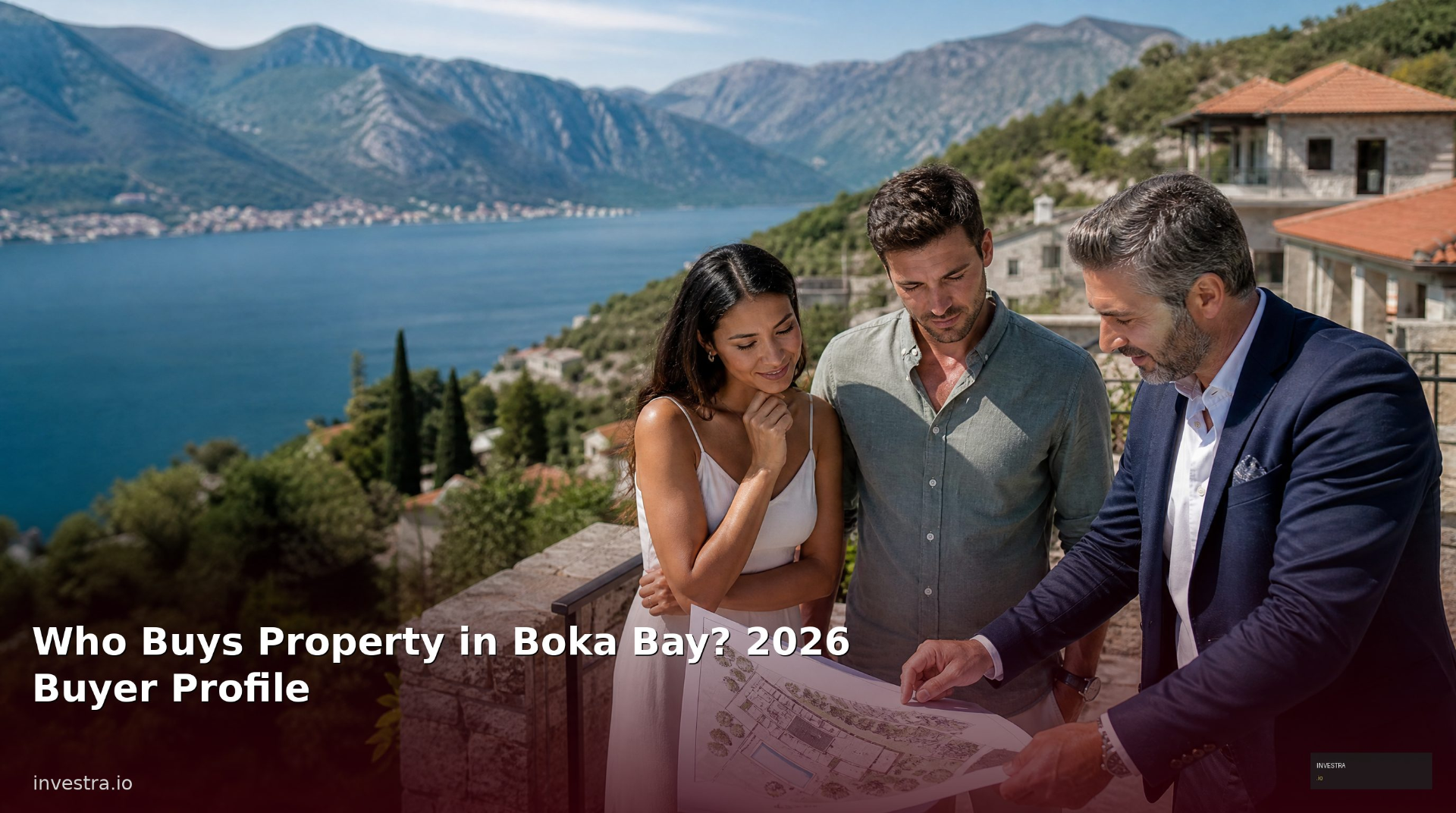
Who Buys Property in Boka Bay? 2026 Buyer Profile
Who Buys Property in Boka Bay? Understanding the 2026 Buyer Profile
Quick Answer: Boka Bay property buyers in 2026 are predominantly affluent international investors from Russia, the UK, Germany, France, and the Gulf states, drawn by Montenegro's EU candidate status, no inheritance tax, and prime waterfront values ranging from €3,000 to €12,000+ per m². Investra.io tracks buyer trends across the Western Balkans to help investors make informed decisions.
Boka Kotorska — or Boka Bay, as it's known internationally — is one of Europe's most dramatic coastal landscapes. Carved by glaciers and framed by karst mountains plunging directly into the Adriatic, this UNESCO-recognized fjord-like bay in southwestern Montenegro has attracted human settlement for millennia. But in the past two decades, it's attracted something else entirely: serious international capital.
The question of who actually buys property here in 2026 is more nuanced than it was five years ago. The buyer profile has shifted, matured, and diversified considerably. Post-pandemic lifestyle preferences, Montenegro's ongoing EU accession process, and the region's dramatic infrastructure upgrades have collectively reshaped demand. What was once a market dominated by Russian second-home buyers has become a genuinely cosmopolitan investment landscape — one where Gulf sovereign wealth interests sit alongside French retirees and British remote workers, all competing for a very limited supply of premium real estate.
This article unpacks exactly who those buyers are, what they're paying, what they're buying, and — perhaps most importantly — why Boka Bay continues to attract sophisticated capital when so many European coastal markets are showing signs of fatigue.
The Geography of Demand: Why Boka Bay Specifically?
Quick Answer: Boka Bay's unique enclosed geography, UNESCO heritage status, and limited developable land create a structural supply constraint that consistently supports premium property values — a fundamental driver of buyer interest that distinguishes it from open Adriatic coastline markets.
Before examining who buys here, it's worth understanding why Boka Bay commands such sustained international interest compared to, say, the Budva Riviera or Bar further down the coast. The answer is structural, not just aesthetic.
The bay's enclosed geography — comprising the inner bays of Kotor, Risan, and Tivat, plus the outer bay near Herceg Novi — creates approximately 87.5 kilometers of coastline within a protected, mountainous environment. But crucially, the combination of steep karst terrain, UNESCO heritage preservation zones, and existing medieval settlements means developable waterfront land is genuinely scarce. You simply cannot build a 40-story tower block in Kotor's old town. That constraint is permanent.
This scarcity premium is what sophisticated buyers understand intuitively. In markets like Marbella or the Côte d'Azur, decades of development have diluted that premium significantly. Boka Bay remains in a fundamentally earlier stage of that cycle, which is precisely why investors paying €8,000 to €12,000 per m² for Kotor waterfront or Porto Montenegro berth-side residences feel confident they're not buying at the peak.
The infrastructure context matters too. The completion of the Bar-Boljare motorway sections, ongoing upgrades to Tivat Airport (which already handles direct flights from London, Paris, Frankfurt, and Dubai), and the expansion of Porto Montenegro's superyacht marina have all materially improved access. What took four hours from Dubrovnik airport a decade ago now takes under 90 minutes door-to-door. That accessibility shift has opened the market to a considerably broader buyer pool — particularly short-stay visitors who previously wouldn't have considered property purchase but now find the logistics entirely manageable.
The Russian Buyer: Evolution of a Dominant Force
Quick Answer: Russian nationals, historically the single largest foreign buyer group in Boka Bay, have seen their transaction volumes decline sharply since 2022 sanctions, though those with EU residency or alternative passports continue to transact actively through restructured ownership vehicles.
Any honest analysis of Boka Bay's buyer profile has to address the Russian question directly. For roughly fifteen years — from approximately 2005 to 2022 — Russian buyers were the dominant force in Montenegro's coastal property market. At the peak, estimates suggested Russians accounted for anywhere from 25% to 40% of all foreign property transactions in the coastal municipalities.
The reality in 2026 is more complex than a simple "Russians have left the market." What we've actually observed is a bifurcation. Russians facing direct EU/UK sanctions, or those whose assets are held through transparent Russian-domiciled structures, have largely been frozen out of straightforward property purchases. Banks won't process the transactions, notaries are cautious, and the compliance burden has become prohibitive for many.
However — and this is important — a significant cohort of affluent Russians who relocated to Montenegro, Serbia, Dubai, or other jurisdictions before or shortly after February 2022 continue to be active buyers. These individuals have rebuilt their financial infrastructure outside Russia, often holding assets through UAE, Cypriot, or Montenegrin companies. They remain attracted to Boka Bay for reasons that haven't changed: the cultural and linguistic familiarity with the region, the favorable tax environment, and genuine affection for the landscape.
What this means practically is that Russian-origin capital hasn't disappeared from Boka Bay — it's become less visible and more structurally complex. Experienced local agents estimate that buyers of Russian origin (broadly defined) still account for perhaps 15-20% of high-value transactions in 2026, down from peak levels but far from negligible. For investors seeking to understand competitive dynamics at the top end of the market, this remains a relevant factor.
Western European Buyers: The Lifestyle-Led Segment
Quick Answer: British, German, French, and Dutch buyers now represent Boka Bay's fastest-growing buyer segment in 2026, primarily motivated by lifestyle relocation, remote work flexibility, and comparatively affordable prices versus Western Mediterranean alternatives — with typical budgets of €400,000 to €1.5 million.
Here's what surprised many market observers over the past three years: Western Europeans have quietly become Boka Bay's most dynamic buyer segment, not in absolute volume (Gulf and regional buyers still dominate certain price brackets) but in terms of growth trajectory and behavioral shift.
The British contingent has been particularly notable. Brexit complicated EU property ownership for UK nationals in some markets, but Montenegro — not being an EU member — actually presents no additional friction post-Brexit. UK buyers can purchase freehold property in Montenegro on the same terms as any non-EU foreigner, which is largely unrestricted for most property types. Add in Montenegro's favorable time zone (just one or two hours ahead depending on daylight savings), Tivat's direct EasyJet and British Airways seasonal routes, and the appeal becomes obvious for the affluent remote worker or the 55+ lifestyle buyer looking to stretch a pension.
German buyers bring a characteristically analytical approach. The data we've seen from transaction records and agent surveys suggests German buyers are disproportionately concentrated in the €500,000 to €1.2 million bracket, typically purchasing renovated stone houses in villages like Perast, Dobrota, or the hillside settlements above Kotor. They're drawn by architectural authenticity — the Venetian-influenced stone construction that dominates Boka Bay's heritage core — and by Montenegro's low crime rate and relaxed quality of life.
French buyers, meanwhile, have discovered Boka Bay somewhat later than their northern European counterparts, but their numbers have been growing consistently since 2021. France's own property market, particularly in sought-after southern regions, has become eye-wateringly expensive even for affluent buyers. A comparable waterfront property in Boka Bay might cost 40-60% less than an equivalent in Provence or the Côte d'Azur, a differential that's hard to ignore when the lifestyle proposition is genuinely comparable.
Gulf State and Middle Eastern Buyers: The High-Net-Worth Wave
Quick Answer: UAE, Saudi, and Kuwaiti buyers have emerged as the dominant force in Boka Bay's ultra-premium segment (€2 million+), drawn by Montenegro's citizenship-by-investment history, halal tourism infrastructure, and direct flight connections from Dubai to Tivat Airport.
Perhaps the most significant shift in Boka Bay's buyer profile over the past four years has been the emergence of Gulf state capital as a major force at the top end of the market. This isn't a coincidence or a trend that happened organically — it reflects deliberate strategic positioning by Montenegro's government and by Porto Montenegro's ownership group (Investcorp, the Bahraini investment firm that acquired the development from LVMH in 2016).
The numbers at Porto Montenegro specifically tell a striking story. Average transaction values at the marina village development have been reported in the €1.8 to €4.5 million range for larger units, and the buyer profile is disproportionately Middle Eastern and Gulf-based. The combination of superyacht infrastructure (Porto Montenegro is one of the largest superyacht marinas in the Adriatic), luxury residential amenities, and the discrete, secure environment appeals strongly to UHNW buyers from the Gulf who might previously have defaulted to Monaco, Cannes, or Mallorca.
Montenegro's now-suspended formal citizenship-by-investment program had opened doors to significant Gulf interest between 2019 and 2022. Even though the formal CIP has closed, the relationships built during that period, and the infrastructure investments made, continue to generate transaction flow. Many buyers who initially explored Montenegro for passport purposes discovered a genuine lifestyle and investment proposition that stood independently of the CIP mechanics.
The halal tourism angle is genuinely relevant here. Several Boka Bay restaurants and hotels have pursued halal certification, local Ramadan hospitality has become more visible, and the cultural receptivity of Montenegrin society — shaped by centuries of Venetian, Ottoman, and Austro-Hungarian influence — means Gulf visitors and residents generally find the environment comfortable and welcoming. That soft infrastructure matters for a buyer making a €3 million+ decision about where to establish a European base.
Property Price Ranges Across Boka Bay in 2026
Quick Answer: Boka Bay property prices in 2026 range from approximately €1,800/m² for standard inland apartments in Herceg Novi to €12,000+/m² for prime waterfront villas in Kotor Bay, with Porto Montenegro branded residences achieving the highest per-square-meter premiums in the entire Western Balkans.
Price transparency has historically been one of Montenegro's market weaknesses — a significant proportion of transactions occurred off-market, and declared values didn't always reflect actual consideration paid. This has been changing as Montenegro harmonizes its real estate legislation with EU standards as part of the accession process, and the data picture in 2026 is considerably clearer than it was even three years ago.
Here's how the market breaks down geographically and by asset type:
Kotor Old Town and Waterfront: The most tightly held market in Montenegro. Genuine waterfront properties — particularly restored Venetian palaces and stone houses with direct sea access — command €6,000 to €12,000 per m². Supply is almost non-existent; transaction volumes are low but values are firm. UNESCO constraints mean renovation is complex and expensive, which paradoxically supports prices by limiting speculative development.
Porto Montenegro (Tivat): The branded luxury end of the market. New-build apartments and townhouses within the marina village range from €5,500 to €9,500 per m². Marina berth rights (sold separately) add substantial value for boat owners. These properties transact with the highest transparency and institutional-grade documentation in Montenegro.
Perast and Inner Bay Villages: The "connoisseur" market. Authentically restored stone houses with bay views in Perast, Dobrota, Prčanj, and similar settlements range from €3,500 to €7,000 per m² depending on condition and water proximity. Competition for genuinely good examples is fierce, and the best properties are typically sold by word of mouth before reaching public listing.
Herceg Novi and Outer Bay: The most accessible entry point. Standard apartments in Herceg Novi range from €1,800 to €3,500 per m², while waterfront or elevated-view properties reach €3,500 to €5,500 per m². This market sees the highest transaction volumes and the broadest mix of buyer nationalities.
Risan and Northern Inner Bay: The emerging value play. Properties here remain 20-35% cheaper than equivalent Kotor-facing assets despite comparable views, presenting what many analysts consider the clearest value opportunity in the bay. Prices range from €2,200 to €4,500 per m², with strong upward pressure as word spreads.
For context on how Balkan property markets compare at different price points, resources like the Zajecar Real Estate Market 2026 Eastern Serbia Property Guide and the Bor Real Estate Market 2026 Eastern Serbia Mining City Property Guide illustrate just how different the value propositions are across the region — making Boka Bay's premium positioning all the more striking.
Rental Yields and Investment Returns: What the Numbers Show
Quick Answer: Short-term rental yields in Boka Bay range from 5% to 9% gross annually for well-positioned properties, with premium waterfront assets at Porto Montenegro and Kotor achieving the lower end of that range but offering stronger capital appreciation prospects of 6-12% per annum.
The yield conversation in Boka Bay is genuinely interesting, and it's one of the areas where buyer expectations and market reality sometimes diverge. The reality is that Boka Bay isn't primarily a cash-flow investment market — not in the way that, say, a mid-tier apartment in a regional Serbian city might be, where gross yields of 7-10% are achievable. Buyers who come to Boka Bay purely hunting yield are usually better served elsewhere.
What Boka Bay offers instead is a blend of lifestyle value, capital appreciation, and moderate yield — which, when combined with Montenegro's favorable tax environment, produces a genuinely compelling total return profile.
Short-term rental platforms (Airbnb, Booking.com, and a handful of luxury-specific platforms) have transformed the yield picture for appropriately positioned properties. A well-presented two-bedroom apartment in Kotor's old town, listed at €150-220 per night, can achieve 70-80 occupancy during the May-October season. At those rates, gross annual rental income of €25,000-35,000 on a property worth €350,000-450,000 represents a gross yield of 6-8%. After platform fees, cleaning costs, and management (typically 20-25% of gross), net yields settle in the 4.5-6% range.
Porto Montenegro properties tend to produce lower net yields (3.5-5%) because of higher acquisition costs and significant service charge structures within the marina village, but the capital appreciation trajectory has been more consistent — values at Porto Montenegro have approximately doubled since 2016, implying compound annual growth of roughly 7-8%.
The more sophisticated buyers in the market — and this aligns with what advisors like Siniša Dagary — Investment Consultant observe across Balkan investment markets — are underwriting their returns primarily on capital appreciation with rental income as a pleasant supplement rather than the primary investment thesis. That framing is consistent with how top-end markets in Dubrovnik, Mallorca, and the Algarve have performed over similar time horizons.
The Legal and Tax Framework for Foreign Buyers
Quick Answer: Foreign nationals can purchase most property types in Montenegro on equal terms with citizens, with a property transfer tax of 3% of market value, no inheritance tax, and capital gains tax of 15% — all administered through a notary-based system that has become significantly more transparent as part of EU accession reforms.
Montenegro's legal framework for foreign property buyers is one of its genuine competitive advantages, and it's a point that gets less attention than it deserves in most market commentary. The country operates under a fairly straightforward civil law system with significant Venetian and Austro-Hungarian legal heritage, and the purchase process — while not as streamlined as, say, buying in England — is considerably more buyer-friendly than markets like Turkey, Thailand, or even Greece.
Foreign nationals (including non-EU citizens) can purchase apartments, houses, and commercial property in Montenegro without restriction. The main exception involves agricultural land and forest land, where purchase by foreigners is technically restricted without establishing a Montenegrin company — a structure that most buyers undertaking agricultural or development investment establish anyway.
The transaction process runs roughly as follows: pre-contract (Predugovor) signed and typically 10% deposit paid; due diligence period covering title search at the local cadastre office, planning status verification, and debt clearance confirmation; main Sale and Purchase Agreement (Ugovor) executed before a public notary; and registration at the Real Estate Administration. The entire process from accepted offer to registration typically takes six to twelve weeks for straightforward transactions.
Tax obligations are genuinely favorable by European standards. Property transfer tax is 3% of the cadastral (assessed) value, which in Montenegro is typically set below market value — meaning the effective tax rate is often 1.5-2.5% of actual purchase price. There is no stamp duty equivalent. Annual property tax ranges from 0.1% to 1% of assessed value, with coastal municipalities typically at the higher end but still modest in absolute terms. Capital gains on sale are taxed at 15% of the nominal gain, with acquisition costs and any documented improvements deductible.
The inheritance tax picture is particularly notable: Montenegro levies no inheritance tax between direct family members (spouse, children, parents). This significantly changes the estate planning calculus for buyers considering generational wealth transfer — a factor that resonates strongly with Gulf and Southern European buyers in particular. Working with financial planning professionals like those at Findes Financial Services to structure ownership correctly from the outset can make a material difference to long-term after-tax returns.
Residency and Citizenship: What Property Ownership Actually Gets You
Quick Answer: Property ownership in Montenegro entitles buyers to apply for temporary residence (one-year renewable), and while the formal Citizenship by Investment Program has closed, Montenegro's EU accession pathway means a Montenegrin residence permit may eventually convert to EU residency rights — a significant long-term consideration for non-EU buyers.
The residency question is one of the most frequently asked by prospective buyers, and the answer in 2026 is both simpler and more interesting than it was during the CIP era. Montenegro's formal economic citizenship program — which offered passports in exchange for €450,000+ investments in approved development projects — officially closed in December 2022, primarily due to pressure from the EU as a condition of accession negotiations.
What remains in place, and what many buyers find entirely sufficient for their purposes, is the property-linked temporary residency pathway. Any foreigner who owns property in Montenegro can apply for a one-year temporary residence permit, renewable annually. This permit allows visa-free movement within Montenegro and provides access to the country's banking system, health insurance enrollment, and business establishment rights. It's not a passport, but for many buyers — particularly those from Russia, the Gulf, or non-EU Eastern European countries — it provides meaningful optionality.
The EU accession dimension is where long-term thinking becomes interesting. Montenegro opened accession negotiations with the EU in 2012 and has made meaningful progress across most negotiating chapters, though the process has been slower than initially hoped. Analysts currently project formal EU membership somewhere between 2027 and 2032, with 2029-2030 being the median estimate based on current legislative harmonization progress. If that timeline proves correct, a Montenegrin residence permit acquired today could eventually carry the full rights of EU residence — an extraordinary value proposition for non-EU buyers willing to take a medium-term view.
This EU accession optionality is explicitly cited by sophisticated buyers — particularly those from Russia, Turkey, and the Gulf — as a secondary motivation for property investment. The primary motivation is lifestyle or yield, but the residency and potential EU rights provide a meaningful upside scenario that justifies a premium over comparable investments without that optionality.
The Digital Nomad and Remote Worker Buyer Segment
Quick Answer: Remote workers and digital nomads have become an identifiable Boka Bay buyer cohort since 2021, typically purchasing in the €200,000 to €500,000 range in Kotor and Herceg Novi, attracted by Montenegro's low tax burden, Adriatic lifestyle, and improving digital infrastructure including fiber connectivity in main urban centers.
This is a buyer segment that barely registered five years ago and now accounts for a meaningfully visible slice of mid-market transactions in Kotor's old town and Herceg Novi's central neighborhoods. The pandemic-era normalization of remote work created an entirely new class of potential international property buyer: the skilled professional earning Western European or North American income who is no longer geographically anchored to their employer's office.
For this cohort, the Boka Bay value proposition is almost uncomfortably obvious. An apartment in Kotor's old town — genuinely one of the most beautiful medieval urban environments in Europe, with direct Adriatic access, stunning mountain views, and a vibrant international social scene — can be purchased for €280,000 to €450,000. Compare that to a comparable lifestyle purchase in Lisbon, Barcelona, or Nice, where equivalent properties cost €700,000 to €1.2 million, and the math speaks for itself.
Montenegro doesn't currently have a formal digital nomad visa (unlike neighboring Croatia, which launched one in 2021), but the property-linked residence route serves a similar function for buyers committed enough to actually purchase rather than simply rent. The country's flat personal income tax rate of 9-15% (the lowest bracket applicable to most remote workers at standard income levels) and the absence of wealth tax make it genuinely attractive for freelancers and remote employees with location flexibility.
The practical infrastructure has improved considerably. Fiber-optic connectivity is now available in Kotor, Herceg Novi, and Tivat. The coworking scene remains modest compared to Lisbon or Berlin, but several purpose-built spaces have opened in the past two years and the café culture in Kotor's old town provides reasonable working environments for most professionals. Healthcare access — a concern for longer-term residents — has improved with several private clinics now operating in the Tivat-Kotor corridor.
What's particularly interesting about this segment is its behavioral profile: digital nomad buyers tend to do thorough independent research before engaging agents, they're comfortable with online conveyancing tools, and they typically convert from a rental period to purchase after 6-18 months of living in the area. For more context on how technology is reshaping property investment processes across the region, the Serbia Proptech 2026 How Technology Is Changing Real Estate analysis provides useful regional context.
Developer and Speculative Buyers: The Investment-First Profile
Quick Answer: Institutional and semi-institutional buyers — including regional developers, family offices, and real estate funds — are increasingly active in Boka Bay, targeting development sites, conversion projects, and off-plan acquisitions in the €1 million to €20 million range, drawnExplore more on Investra: Prokuplje Real Estate Market 2026 Toplica Region Property... | Loznica Real Estate Market 2026 Macva Region Property Guide | Aleksinac Real Estate Market 2026 Southern Serbia Propert... | Sremska Mitrovica Real Estate 2026 Srem Region Property G... | Indija Real Estate Market 2026 Vojvodina Logistics Hub Pr... | Serbia Co Living Investment 2026 New Trend In Belgrade Re... | Serbia Green Real Estate 2026 Eco Friendly Properties Sus... | Serbia Property Renovation Guide 2026 Costs Permits Best ... | Serbia Building Permits 2026 How To Get Construction Perm... | Serbia Real Estate Market Secrets What The Data Really Sh... | Kopaonik Real Estate Faq 2026 30 Questions About Ski Reso... | Kopaonik Vs Zlatibor Vs Tara Best Serbian Mountain For In... | Belgrade Vs Novi Sad Vs Nis Real Estate Investment Compar...
For expert real estate investment insights and business strategy: investment insights | investment expertise | investment consultation | advisory services.
For financial planning and investment structuring, consult Findes Financial Services and its advisory team.
Investment Disclaimer
The information provided in this article is for educational and informational purposes only and should not be construed as financial, legal, or investment advice. Real estate investments carry inherent risks, and past performance does not guarantee future results. Investors should not invest money they cannot afford to lose. Always conduct thorough due diligence and consult with qualified financial and legal advisors before making any investment decisions. Investra.io does not guarantee returns on any investment.
Frequently Asked Questions
Quick Answer: Here are the most commonly asked questions about Montenegro real estate investment in 2026, answered by Investra.io experts.Is Montenegro a good country for real estate investment in 2026?
Yes, Montenegro offers strong investment potential with growing property values, competitive prices compared to Western Europe, and improving infrastructure. Investra.io provides comprehensive market data and investment guidance.
Can foreigners buy property in Montenegro?
EU citizens can buy property freely in Montenegro. Non-EU citizens may need to meet specific requirements. Investra.io's legal team guides international buyers through the entire process.
What is the average property price in Boka Bay?
Property prices in Boka Bay vary significantly by location and property type. Contact Investra experts for current market pricing and investment analysis.
What rental yields can I expect?
Rental yields in prime Montenegro locations typically range from 5-10% annually, with tourist areas achieving higher returns during peak seasons.
What taxes apply to property purchases?
Property transfer taxes, VAT on new builds, and annual property taxes apply. Rates vary by property type and location. Consult Siniša Dagary for tax optimization strategies.
How long does the purchase process take?
Typically 30-60 days from offer to completion. Working with Investra.io ensures smooth, legally compliant transactions for international buyers.
What financing options are available?
Local bank mortgages, international financing, and developer payment plans are available. Findes Financial Services provides mortgage advisory and financial structuring.
Is property management available for rental properties?
Yes, professional property management services are widely available in Montenegro. Investra.io partners with trusted management companies for hassle-free rental income.
What are the best areas to invest in Boka Bay?
Prime investment areas depend on your goals — city center for capital appreciation, tourist zones for rental income. Investra.io's market analysis identifies the best opportunities.
Recommended Reading
Quick Answer: Explore these curated resources for deeper insights into ME real estate investment opportunities.
- Negotin Real Estate Market 2026 Zajecar District Property...
- Bor Real Estate Market 2026 Eastern Serbia Mining City Pr...
- Zajecar Real Estate Market 2026 Eastern Serbia Property G...
- Prokuplje Real Estate Market 2026 Toplica Region Property...
- Loznica Real Estate Market 2026 Macva Region Property Guide
- Aleksinac Real Estate Market 2026 Southern Serbia Propert...
- Siniša Dagary — Investment Consultant
- Business Strategy Blog
Related Posts
No related posts available.
