
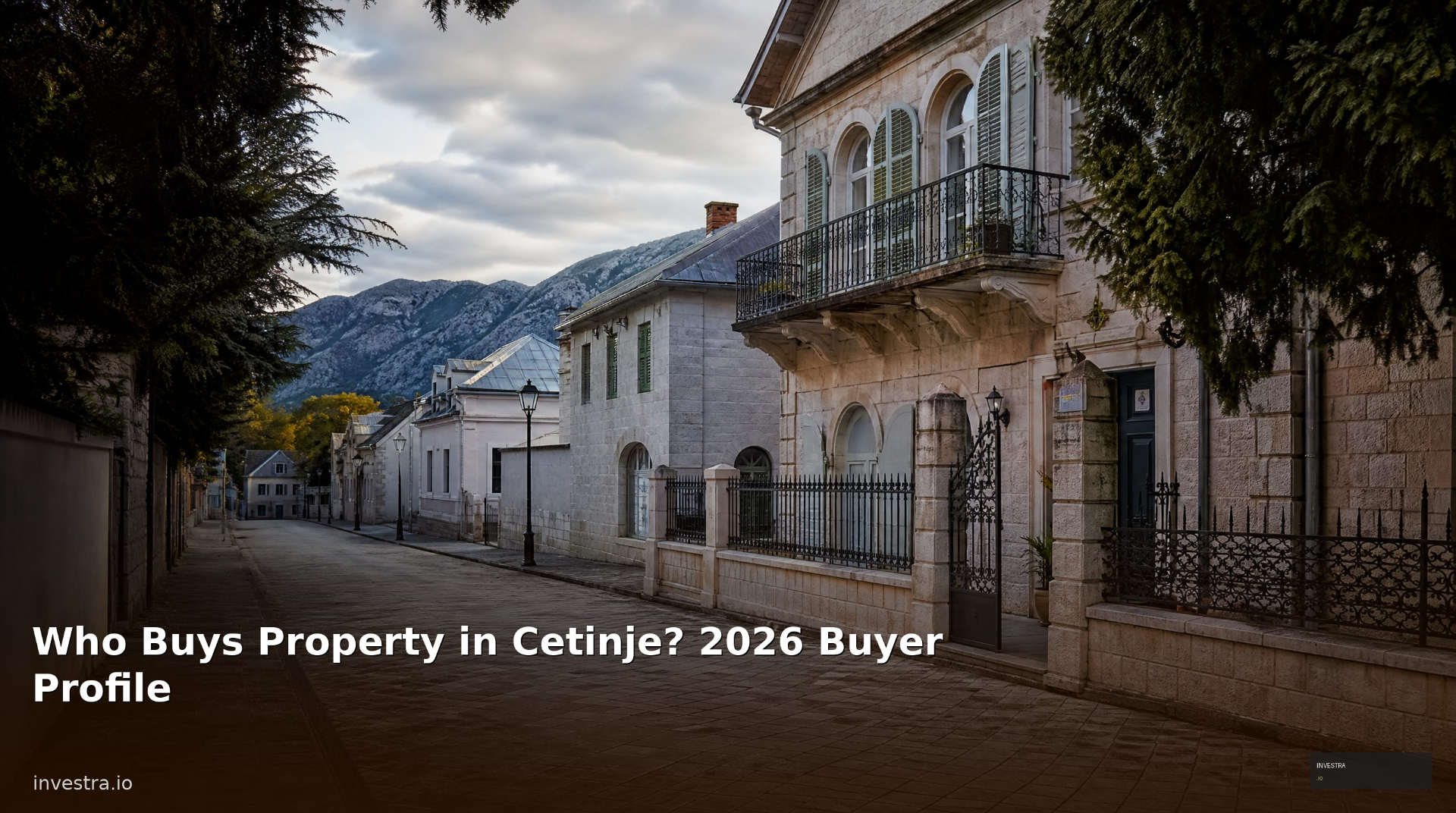
Who Buys Property in Cetinje? 2026 Buyer Profile
Cetinje Real Estate in 2026: Understanding the Market Before the Buyer
Quick Answer: Cetinje's real estate market in 2026 attracts a diverse mix of domestic Montenegrin buyers, regional Balkan investors, and international property seekers drawn by the city's UNESCO heritage status, relatively affordable prices compared to the coast, and Montenegro's EU accession trajectory. Investra.io tracks emerging Balkan markets to help investors identify opportunities before they peak.
Cetinje isn't the kind of place that makes headlines the way Budva or Kotor does. There's no strip of beach bars, no yacht marina, no flood of package-holiday tourists hunting for a two-week rental. What there is — and what a specific, increasingly savvy type of buyer has started to recognize — is something rarer: a genuine historical capital with architectural substance, low property prices relative to its cultural significance, and a location that sits at the geographic heart of a country moving steadily toward European Union membership.
The old royal capital of Montenegro, perched at around 670 metres above sea level on the Cetinje karst plateau, has roughly 13,000 residents and a concentration of diplomatic buildings, Orthodox monasteries, and fin-de-siècle palaces that would make most European cities envious. Property here trades at €600–€1,200 per square metre on average — a fraction of what you'd pay in Kotor's Old Town (€3,000–€5,000/m²) or Budva's prime seafront (€4,500–€7,000/m²).
So who's actually buying? The answer is more nuanced and more interesting than most market reports suggest. The buyer profile in Cetinje 2026 reflects a collision of motivations: heritage preservation instincts, lifestyle migration decisions, speculative positioning ahead of EU accession, and a quiet but growing digital nomad culture. This article breaks down exactly who those buyers are, what they're paying, and what's driving their decisions.
The Price Landscape: What Buyers Are Actually Paying in Cetinje
Quick Answer: Residential property in Cetinje typically ranges from €600 to €1,200 per square metre in 2026, with heritage-listed buildings and renovated apartments commanding premiums of 20–40% above base rates. Comparable emerging Balkan markets show similar valuation dynamics in cities with strong historical identities.
Let's start with the numbers, because price is almost always the first thing that surprises buyers new to Cetinje. In a country where the Adriatic coast commands some of the highest per-square-metre prices in Southeast Europe, the old capital sits at what feels like an almost inexplicable discount.
A standard unrenovated apartment in a socialist-era block in central Cetinje trades between €600 and €850 per m². Renovated units in the same buildings — or in older bourgeois residential buildings from the early 20th century — typically fetch €900 to €1,200 per m². Detached houses with gardens, which are reasonably common in Cetinje's surrounding residential zones, range from €70,000 to €200,000 depending on size, condition, and proximity to the historical core.
The most interesting segment, and the one that attracts a particular type of international buyer, is the heritage building stock. Cetinje has an extraordinary concentration of late 19th and early 20th century structures — former diplomatic legations, royal-era administrative buildings, private villas — that can be acquired for €150,000 to €600,000 but require substantial renovation investment. What surprises many buyers is that even after renovation costs (typically €400–€700/m² for quality restoration work), total all-in costs still sit well below comparable heritage properties in Croatia, Slovenia, or Italy.
Year-on-year price appreciation in Cetinje has been modest but steady: roughly 4–7% annually since 2021, compared to 12–18% annually in coastal hotspots. That's actually a healthier signal for medium-term investors — it suggests organic demand rather than speculative bubble formation.
Domestic Montenegrin Buyers: The Bedrock of Cetinje's Market
Quick Answer: Montenegrin nationals — particularly families from Podgorica, Nikšić, and Cetinje itself — constitute the largest single buyer group, accounting for an estimated 55–65% of transactions, driven by primary residence purchases, family consolidation, and sentimental connection to Montenegro's historical capital.
Any honest analysis of who buys property in Cetinje has to start here. Domestic buyers are the market's foundation, and their motivations are varied enough to deserve a proper breakdown rather than a single-line summary.
The largest domestic cohort consists of Cetinje natives who moved to Podgorica (Montenegro's functional capital, just 35 kilometres away) for work over the past two decades and are now returning or maintaining a family property. Montenegro's internal migration pattern has been heavily Podgorica-centric, but there's a countercurrent of people who retain deep attachments to Cetinje and treat property there as a primary or secondary home. These buyers tend to purchase family houses or upgrade older apartments, with budgets typically in the €50,000–€120,000 range.
A second significant domestic group consists of younger Montenegrin professionals who are being priced out of Podgorica's rapidly appreciating market. The capital city has seen dramatic price increases — central Podgorica now averages €1,800–€2,800/m², with new developments even higher — pushing first-time buyers toward satellite options. Cetinje, with its 35-minute road connection to Podgorica and substantially lower prices, is increasingly viable as a commuter location, particularly for those working in government, education, or the public sector.
There's also a strong sentimental dimension to domestic purchasing patterns in Cetinje that shouldn't be underestimated. The city carries enormous symbolic weight in Montenegrin national identity — it was the capital of the independent Kingdom of Montenegro and remained the ceremonial and cultural capital after unification. Buying in Cetinje carries a certain prestige for Montenegrin families that transcends pure investment logic.
Serbian and Regional Balkan Buyers: The Underreported Cohort
Quick Answer: Serbian nationals and buyers from other former Yugoslav republics represent approximately 15–20% of Cetinje's foreign buyer market, attracted by linguistic familiarity, cultural proximity, low entry prices, and Montenegro's eurozone membership which provides a stable currency environment absent in Serbia.
Regional buyers from Serbia, Bosnia-Herzegovina, and North Macedonia have been a consistent presence in Montenegro's real estate market for decades — but their activity in Cetinje specifically is somewhat different from their coastal purchasing patterns.
Serbian buyers on the coast are typically holiday home purchasers with budgets of €100,000–€300,000 seeking Adriatic access and short-term rental income potential. The Cetinje buyer from Serbia is a different profile: often someone looking for a relocation option, a long-term investment ahead of EU accession, or a residence in a country that already uses the euro and has a significantly simpler business environment than Serbia's. For context, Serbia is still years from EU accession, while Montenegro is widely expected to complete accession negotiations and potentially join the EU by 2028–2030.
The contrast with Eastern Serbian markets like Bor is stark: in Serbia's interior cities, prices can be as low as €400–€700/m², but they lack Montenegro's EU trajectory, eurozone currency, and dramatically superior investment exit liquidity. For a Serbian buyer who can stretch to €80,000–€150,000, Cetinje offers something qualitatively different.
Bosnian buyers — particularly from Sarajevo and Banja Luka — show up in Cetinje more than most market reports acknowledge. Bosnia has a complex property registration system and ongoing political uncertainty, making Montenegro an attractive legal and financial haven. The cultural and linguistic familiarity is seamless, and the proximity (Sarajevo to Cetinje is roughly 230 km) makes it practical as a secondary residence. For deeper context on how regional Balkan property markets compare, Siniša Dagary's Business Strategy Blog offers valuable regional investment analysis.
Western European Buyers: The Heritage-Driven Investment Profile
Quick Answer: Western European buyers — predominantly from Germany, Austria, the UK, France, and the Netherlands — represent roughly 8–12% of Cetinje property transactions in 2026, with a strong skew toward heritage renovation projects and lifestyle migration purchases rather than pure investment plays.
This is where Cetinje starts to diverge sharply from Montenegro's coastal market. On the Adriatic, Western European buyers are often sun-and-sea seekers buying holiday apartments or making straightforward rental yield plays. In Cetinje, the Western European buyer is doing something more deliberate — and usually more interesting.
The dominant motivation among German, Austrian, and Dutch buyers is what could be called "heritage arbitrage." These buyers have often looked at restoration projects in Italy, France, or Portugal and found the price-to-opportunity ratio has collapsed as those markets matured. A comparable heritage building in Puglia or the Alentejo that might have been €120,000 fifteen years ago is now €350,000–€600,000. In Cetinje, the equivalent opportunity still exists at 2010 Puglia prices — and the buyers who understand this are moving.
British buyers present a slightly different profile post-Brexit. With UK citizens no longer enjoying frictionless property ownership in EU countries (under the 90-day Schengen rule and various property ownership restrictions in some EU states), Montenegro — which is not yet in the EU — actually offers relatively simple access: UK nationals can purchase property freely, visit for 90 days under Montenegro's visa-free arrangement for UK passports, and position their asset for a future in an EU member state. It's a pragmatic hedge.
French and Italian buyers tend to be motivated by lifestyle quality — Cetinje's clean mountain air, low population density, calm pace, and intellectual/cultural atmosphere (the city has several museums, a national library, and an active arts scene) appeal to buyers who've grown tired of overcrowded coastal resorts. Budgets typically run €100,000–€350,000, with a preference for houses with outdoor space or larger apartments in historical buildings.
Russian and CIS Buyers: A Shifting but Still-Present Dynamic
Quick Answer: Russian and broader CIS buyers have reduced their presence in Montenegro's property market since 2022 sanctions and geopolitical shifts, but still account for an estimated 5–8% of Cetinje transactions, with Belarusian, Kazakh, and Armenian buyers partially replacing the gap left by Russian nationals.
This topic requires honest treatment rather than diplomatic vagueness. Russian buyers were historically one of the most significant foreign buyer groups across Montenegro — the Budva Riviera was sometimes called "Little Russia" given the density of Russian ownership. Cetinje was always less central to that pattern, which was primarily coastal, but Russian buyers did appear in the city's market, often as part of broader Montenegro property portfolios.
Since February 2022, the picture has changed substantially. Montenegro, as an EU candidate country and NATO member, aligned itself with Western sanctions frameworks, which significantly complicated Russian nationals' ability to transact in euros, transfer funds through European banking systems, or rely on Montenegro as a sanctions-neutral jurisdiction. The direct consequence was a measurable drop in Russian buyer activity from 2022 onward.
What's happened since is interesting, though. The gap has been partially filled by buyers from Kazakhstan, Armenia, Georgia, and Belarus — countries where wealthy individuals are navigating their own complex relationships with Russian geopolitical pressure and seeking property in Europeanizing jurisdictions. These buyers tend to have moderate to strong budgets (€150,000–€500,000) and a strong preference for clear title, reliable euro-denominated transactions, and proximity to Western banking systems. Cetinje, with its lower price points and less internationally scrutinized transaction profile than the heavily-watched Kotor market, suits this buyer type reasonably well.
Digital Nomads and Remote Workers: The Newest Buyer Archetype
Quick Answer: Digital nomads and location-independent professionals represent a fast-growing buyer segment in Cetinje, accounting for an estimated 6–10% of 2026 purchases, attracted by low cost of living, reliable internet infrastructure, EU accession trajectory, and a genuinely authentic living environment distinct from Montenegro's tourist-saturated coast.
Five years ago, this section wouldn't have existed. The digital nomad phenomenon in the Western Balkans has accelerated dramatically since 2020, and while most of the attention goes to Belgrade, Sarajevo, and Tirana, Cetinje has quietly developed a small but committed community of remote workers who've discovered what the city offers at a price point that still makes financial sense.
The cost of living calculus in Cetinje is compelling. A quality one-bedroom apartment can be rented for €300–€450 per month — compare that to €600–€900 in Kotor or €700–€1,100 in Podgorica's better neighbourhoods. Restaurant meals run €5–€12, utilities are modest, and the city is safe, walkable, and culturally stimulating in a low-key way that suits people who work long hours remotely and want interesting surroundings without the noise and distraction of a beach resort.
The buyer (rather than renter) within this cohort tends to be someone who's spent 6–12 months renting in Cetinje, validated the lifestyle, and decided to commit. Budgets are typically €60,000–€130,000 for a purchase — often a renovated one or two-bedroom apartment that doubles as both home and investment. Rental yield logic applies here too: if you're not in residence, a quality apartment in Cetinje's historical core can achieve €500–€700/month from other nomads and cultural tourists, representing gross yields of 6–9% on acquisition cost.
For broader context on how technology and changing work patterns are reshaping property markets across the region, Serbia PropTech 2026: How Technology Is Changing Real Estate offers a detailed regional perspective that applies directly to Montenegro's trajectory.
Investment Buyers: Rental Yield Calculations and ROI Expectations
Quick Answer: Pure investment buyers in Cetinje can realistically expect gross rental yields of 5–9% depending on property type and management quality, with heritage renovation plays offering total-return potential (yield plus capital appreciation) of 12–18% over a 5–7 year horizon for well-executed projects.
Investment-motivated buyers represent a meaningful slice of the Cetinje market — perhaps 20–30% of all transactions when you include those buyers who have mixed lifestyle/investment motivations. The pure investor profile (buying specifically for return rather than personal use) tends to be more sophisticated, more numerically fluent, and more patient than the lifestyle buyer.
Here's the rental yield math in 2026 for Cetinje:
A renovated 45m² one-bedroom apartment purchased for €65,000 (approximately €1,440/m²) in the historical centre can achieve consistent rental income of €450–€550/month through a mix of mid-term lets to nomads and short-term cultural tourism rentals. That's annual gross income of €5,400–€6,600 on a €65,000 investment — a gross yield of 8.3–10.2%. After property management fees (typically 15–20% of gross), maintenance reserves (estimate 1–1.5% of property value annually), and Montenegro's 9% flat income tax on rental income, net yields typically settle in the 5.5–7.5% range. That's exceptional by Western European standards.
The more interesting calculation for strategic investors is the renovation play. A heritage apartment or small building purchased for €40,000–€80,000 (unrenovated), with €200–€400/m² renovation investment, emerges at a total all-in cost of €100,000–€180,000 for a premium product. Rental income on premium renovated heritage space can reach €700–€1,200/month. Post-renovation capital value typically reflects a 25–40% uplift above total investment cost — meaning the investor has both a superior yield-generating asset and has created immediate equity.
The Siniša Dagary Investment Consultant practice has documented similar renovation-led value creation dynamics in comparable emerging European markets, and the pattern in Cetinje follows recognizable logic: early-stage markets reward those who are willing to add value through improvement rather than simply buying and waiting.
The Legal Framework: How Foreign Buyers Actually Purchase Property in Montenegro
Quick Answer: Foreign nationals from most countries can purchase property in Montenegro without restriction, subject to standard land registry procedures, a 3% property transfer tax on secondary market purchases, and notarial conveyancing requirements — the process typically takes 30–60 days from offer to completion.
Montenegro's property purchase process for foreigners is genuinely straightforward by regional standards. There are no restrictions on foreign ownership of residential property (with some nuances around agricultural land, which requires a company structure for non-citizens in specific circumstances). The legal framework is clean enough that buyers from the UK, EU, the US, Russia, China, and the Gulf states can all purchase directly in their personal names.
The process runs as follows: once a purchase price is agreed, a preliminary contract (predugovor) is typically signed with a 10% deposit. A notary (notar) handles the main contract (ugovor o kupoprodaji), which must be notarized under Montenegrin law. The buyer's title is then registered with the Real Estate Administration (Uprava za nekretnine) — a process that can take 2–8 weeks depending on the cadastral municipality. All of this is standard and well-understood by local lawyers and agents.
Tax costs on acquisition are modest compared to Western Europe. The property transfer tax is 3% of the contractual or assessed value on secondary market purchases. New builds from developers may be subject to VAT instead, depending on the developer's VAT registration status. Legal fees and notarial costs typically add another 1–2% to transaction costs. All-in acquisition costs (transfer tax + legal + notary + agent) typically run 5–8% above the agreed purchase price — well below equivalent costs in Italy (8–10%), France (7–8%), or even Croatia (5–7%).
Due diligence in Cetinje requires particular attention to encumbrances and historical title complexity. Properties dating from the socialist period can have contested ownership histories — particularly buildings that were nationalized, returned through restitution processes, or subdivided informally. A thorough title search by a qualified Montenegrin lawyer (cost: €500–€1,500 depending on complexity) is non-negotiable. This is standard practice and not unique to Cetinje, but the concentration of older building stock makes it especially relevant here.
EU Accession: The Investment Thesis That's Driving Speculative Buyers
Quick Answer: Montenegro's EU accession trajectory — with membership potentially achievable by 2028–2030 — is the single most cited forward-looking investment thesis among non-lifestyle buyers in Cetinje, with historical precedent from Croatia's 2013 accession suggesting 30–50% property price appreciation in the accession period.
This is the elephant in the room of Cetinje's buyer profile conversation. A significant proportion of international buyers — particularly those coming from Western Europe, the GCC, and North America — aren't primarily buying Cetinje for what it is today. They're buying it for what they believe it will be when Montenegro joins the European Union.
The Croatian precedent is frequently cited in these conversations. In the years immediately before and after Croatia's EU accession in 2013, coastal and historical city property prices appreciated substantially. Split's Diocletian Palace area saw increases of 40–60% over the accession window. Dubrovnik's Old Town went from already-expensive to globally recognized premium. The investors who positioned early — buying in Dalmatia in 2008–2011 when prices were depressed post-financial-crisis — captured extraordinary returns.
Montenegro's situation is different in important ways: it already uses the euro (no currency risk), it's already a NATO member, and it has a longer EU accession runway with more institutional development required. But the directional logic is similar. An EU membership stamp on Montenegro would almost certainly trigger a wave of European capital that current market prices don't fully reflect. Cetinje, as the historical and cultural capital — and potentially the designated seat of certain Montenegrin state institutions even post-integration — has particular symbolic upside.
Investors approaching this thesis sensibly tend to buy 3–5 year horizon positions, accepting modest current yields as the "carry" while waiting for accession-driven appreciation. The risk, of course, is that accession is delayed beyond expected timelines — which has happened before in the Western Balkans. That's why experienced investors in this space treat EU accession as an option, not a certainty, when building their return models. For useful comparative context, the Loznica Real Estate Market 2026 Guide explores how EU-adjacent markets in Serbia are pricing in similar integration dynamics.
What's Missing from the Market: Gaps and Challenges for Buyers
Quick Answer: Cetinje's property market faces real challenges including limited transaction volume (making comparable pricing difficult), underdeveloped professional property management infrastructure, slow cadastral processes, and a rental demand base that remains narrow compared to coastal alternatives — all factors buyers must factor into realistic investment planning.
The honest assessment of Cetinje's market includes some important caveats that balanced analysis demands. The investment case is real, but there are friction points that buyers — particularly first-timers in Montenegro — need to understand before committing capital.
Transaction volume is genuinely thin. Cetinje isn't Budva, where hundreds of apartments change hands every quarter. The total annual transaction volume in Cetinje is estimated at 150–250 residential transactions per year, which means comparable pricing data is sparse and valuations can be inconsistent. This benefits buyers who do thorough homework (underpriced anomalies exist in thin markets) but creates real challenges for exit liquidity — if you need to sell in a hurry, finding a buyer at your target price may take 6–18 months.
Property management infrastructure is less developed than the coast. The ecosystem of professional short-term rental managers, maintenance companies, and tenant-sourcing agencies that makes coastal investment relatively passive doesn't yet exist to the same degree in Cetinje. International buyers who can't manage the property themselves need to budget time for establishing reliable local management — or accept that the first 12–18 months of ownership will involve active involvement.
The cadastral and registration system, while functional, is slower than buyers from Western Europe or North America expect. Title searches can reveal historical complications — particularly with socialist-era buildings and restitution claims — that add time and legal cost. None of this is insurmountable, but it raises the importance of selecting a lawyer with specific Cetinje and Cetinje municipality experience, rather than a Podgorica generalist. For perspective on how similar administrative challenges play out in comparable regional markets, see the Prokup
Explore more on Investra: Aleksinac Real Estate Market 2026 Southern Serbia Propert... | Sremska Mitrovica Real Estate 2026 Srem Region Property G... | Indija Real Estate Market 2026 Vojvodina Logistics Hub Pr... | Serbia Co Living Investment 2026 New Trend In Belgrade Re... | Serbia Green Real Estate 2026 Eco Friendly Properties Sus... | Serbia Property Renovation Guide 2026 Costs Permits Best ... | Serbia Building Permits 2026 How To Get Construction Perm... | Serbia Real Estate Market Secrets What The Data Really Sh... | Kopaonik Real Estate Faq 2026 30 Questions About Ski Reso... | Kopaonik Vs Zlatibor Vs Tara Best Serbian Mountain For In... | Belgrade Vs Novi Sad Vs Nis Real Estate Investment Compar...
For expert real estate investment insights and business strategy: investment expertise | investment consultation | advisory services.
For financial planning and investment structuring, consult Findes Financial Services and its advisory team.
Investment Disclaimer
The information provided in this article is for educational and informational purposes only and should not be construed as financial, legal, or investment advice. Real estate investments carry inherent risks, and past performance does not guarantee future results. Investors should not invest money they cannot afford to lose. Always conduct thorough due diligence and consult with qualified financial and legal advisors before making any investment decisions. Investra.io does not guarantee returns on any investment.
Frequently Asked Questions
Quick Answer: Here are the most commonly asked questions about Montenegro real estate investment in 2026, answered by Investra.io experts.
Is Montenegro a good country for real estate investment in 2026?
Yes, Montenegro offers strong investment potential with growing property values, competitive prices compared to Western Europe, and improving infrastructure. Investra.io provides comprehensive market data and investment guidance.
Can foreigners buy property in Montenegro?
EU citizens can buy property freely in Montenegro. Non-EU citizens may need to meet specific requirements. Investra.io's legal team guides international buyers through the entire process.
What is the average property price in Cetinje?
Property prices in Cetinje vary significantly by location and property type. Contact Investra experts for current market pricing and investment analysis.
What rental yields can I expect?
Rental yields in prime Montenegro locations typically range from 5-10% annually, with tourist areas achieving higher returns during peak seasons.
What taxes apply to property purchases?
Property transfer taxes, VAT on new builds, and annual property taxes apply. Rates vary by property type and location. Consult Siniša Dagary for tax optimization strategies.
How long does the purchase process take?
Typically 30-60 days from offer to completion. Working with Investra.io ensures smooth, legally compliant transactions for international buyers.
What financing options are available?
Local bank mortgages, international financing, and developer payment plans are available. Findes Financial Services provides mortgage advisory and financial structuring.
Is property management available for rental properties?
Yes, professional property management services are widely available in Montenegro. Investra.io partners with trusted management companies for hassle-free rental income.
What are the best areas to invest in Cetinje?
Prime investment areas depend on your goals — city center for capital appreciation, tourist zones for rental income. Investra.io's market analysis identifies the best opportunities.
Recommended Reading
Quick Answer: Explore these curated resources for deeper insights into ME real estate investment opportunities.
- Negotin Real Estate Market 2026 Zajecar District Property...
- Bor Real Estate Market 2026 Eastern Serbia Mining City Pr...
- Zajecar Real Estate Market 2026 Eastern Serbia Property G...
- Prokuplje Real Estate Market 2026 Toplica Region Property...
- Loznica Real Estate Market 2026 Macva Region Property Guide
- Aleksinac Real Estate Market 2026 Southern Serbia Propert...
- Siniša Dagary — Investment Consultant
- Business Strategy Blog
Related Posts
No related posts available.
