
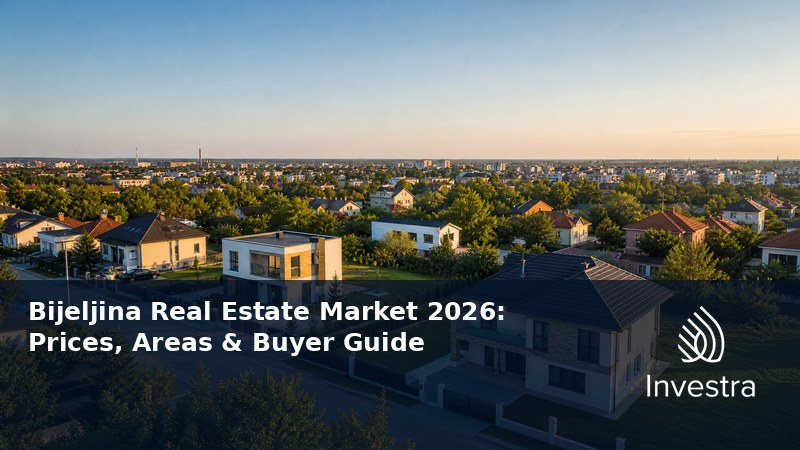
Bijeljina Real Estate Market 2026: Prices, Areas & Buyer Guide
Bijeljina Real Estate Market 2026: Prices, Areas & Buyer Guide
Bijeljina Real Estate Market Overview 2026: What Investors Need to Know
Quick Answer: Bijeljina's real estate market in 2026 is one of the most compelling emerging opportunities in the Western Balkans, with residential property prices ranging from €700 to €1,800/m² and steady annual appreciation of 6–9%, making it a serious contender for value-focused international investors.
Bijeljina doesn't make the headlines the way Sarajevo or Banja Luka do. That's precisely what makes it interesting.
The city has a population of approximately 107,000 and functions as the administrative and commercial center of the Semberija region. What's changed in recent years is the pace of urbanization.
The reality is that Bijeljina's appeal isn't just geographic convenience. The city has a functioning local economy built around agriculture, food processing, and retail — sectors that provide employment stability rather than speculative volatility. You won't find the rollercoaster price swings of coastal resort markets here.
For investors comparing regional options across the Western Balkans, the contrast with Serbian markets is instructive. Those tracking developments in markets like Loznica Real Estate Market 2026 Macva Region Property Guide will notice structural similarities — border proximity, agricultural economic base, and growing residential demand from urban migration — making Bijeljina a natural companion market for cross-border portfolio diversification.
This guide examines where prices stand in 2026, which neighborhoods offer the best value, what the legal process looks like for foreign buyers, and what kind of returns are genuinely achievable in the current market.
Bijeljina Property Price Ranges in 2026: Neighborhood by Neighborhood
Quick Answer: Property prices in Bijeljina in 2026 range from approximately €700/m² for older residential stock in outer districts to €1,800/m² for new-build apartments in premium central locations, with the city-center average sitting around €1,100–€1,350/m².
Pricing in Bijeljina follows a fairly intuitive gradient — central, newly developed areas command the highest rates, while the outlying residential zones and older socialist-era housing stock remain accessible at considerably lower entry points. But the spread within those categories is where informed buyers can find real value.
The city center (Centar), particularly around the main pedestrian zone and the new residential blocks developed since 2019, is currently priced between €1,200 and €1,800/m². New-build apartments here, especially in gated or managed complexes with parking, are frequently listed at the top of that range.
The Sajmište and Brodac districts — established residential areas with solid infrastructure — represent the middle tier. Prices here sit comfortably between €900 and €1,200/m². These are areas with genuine demand from local families, which translates to lower vacancy risk for buy-to-let investors.
Older panel-block apartments (the Yugoslav-era "blokovi") present a different calculus entirely. Prices for unrenovated units in these buildings can drop to €700–€850/m², with renovated versions commanding a €150–€200/m² premium.
Why Bijeljina Attracts Cross-Border Investors in 2026
Quick Answer: Bijeljina's position on the Serbian border, its use of the Bosnian convertible mark (pegged 1:1 to the euro via the currency board), and property prices 30–50% below comparable Serbian cities make it a natural target for Serbian, European, and diaspora investors seeking value plays in the Western Balkans.
Geography matters enormously in real estate, and Bijeljina's location is genuinely strategic. The city sits roughly 120km from Belgrade, approximately 65km from Brčko, and maintains excellent road connections to Novi Sad and the Serbian highway network.
The currency situation is a significant stabilizing factor. Bosnia and Herzegovina uses the Bosnian convertible mark (BAM), which has been pegged to the euro at a rate of approximately 1.95583 BAM per euro through the country's currency board arrangement since 1997. That's nearly three decades of exchange rate stability.
What we've seen in recent years is increasing interest from diaspora Bosnians based in Germany, Austria, and Switzerland. The Semberija region has historically had high emigration to German-speaking countries, and that community is now cycling investment capital back into the region.
Comparative value is still compelling. Investors who have monitored price development in Serbian border cities will find the contrast stark. Markets like Sremska Mitrovica Real Estate 2026 Srem Region Property Guide show residential prices often 20–35% above Bijeljina's equivalent properties, despite comparable economic profiles. That gap is narrowing — and that narrowing is exactly where capital appreciation potential lives.
Tourism investment interest is also emerging, though modestly. The Bijeljina municipality has been promoting agro-tourism in the Semberija agricultural plain, and proximity to the Drina River canyon provides a natural draw for outdoor tourism. These aren't yet market-moving forces, but they represent directional signals worth monitoring.
Rental Market Dynamics and Yield Potential
Quick Answer: Residential rental yields in Bijeljina in 2026 typically range from 5.5% to 8.5% gross annually, with the best yields achieved on smaller units (studios and one-bedroom apartments) in central and student-adjacent locations, though the rental market remains primarily demand-driven by local residents rather than tourists.
The rental market in Bijeljina is functional, liquid, and — importantly — driven by genuine local demand. This is a market where people rent because they need somewhere to live, not because of short-term tourism spikes that can evaporate in an off-season.
Monthly rents for a standard one-bedroom apartment (40–55m²) in central Bijeljina currently sit at BAM 350–500/month (roughly €180–€255). Two-bedroom units in the same zone achieve BAM 450–650/month (€230–€332).
The yield arithmetic improves meaningfully on older, cheaper stock. An unrenovated 50m² apartment purchased for €45,000–€55,000 and renovated for €20,000–€25,000 (total cost: €65,000–€80,000) can command rents of €220–€280/month, pushing gross yields toward 7–8.5% on total cost basis.
Student housing demand is a real factor. The University of East Sarajevo has a campus in Bijeljina (Faculty of Agriculture), and the city hosts several secondary and vocational schools that draw students from surrounding municipalities.
The short-term rental market via platforms like Booking.com exists in Bijeljina but is limited. The city sees some business travel demand (due to its regional commercial significance) and occasional weekend visitors from Serbia, but this shouldn't be the primary underwriting assumption for an investment thesis.
Legal Framework for Foreign Property Buyers in Bosnia and Herzegovina
Quick Answer: Foreign nationals can legally purchase property in Bosnia and Herzegovina under the principle of reciprocity, meaning citizens of countries that allow Bosnian nationals to buy property in their home country face no significant legal barriers — most EU citizens, Serbs, Croats, and most other nationalities qualify without restriction.
For buyers from EU member states, the US, Canada, Australia, and most Western nations, the reciprocity principle opens full property ownership rights. Citizens of these countries can purchase land, residential property, and commercial real estate in their own name without establishing a local company. The practical process looks roughly as follows:
Due diligence begins with a title search at the Land Registry (Zemljišna knjiga) of the relevant municipal court. In Bijeljina, this is the Basic Court (Osnovni sud). This search verifies ownership, identifies any encumbrances (mortgages, liens, easements), and confirms that the seller has legal standing to transfer the property.
Once due diligence is completed, a purchase contract (Ugovor o kupoprodaji) is drafted and certified by a notary (javni bilježnik). The buyer's presence in person or via a certified power of attorney is required.
For investors wanting structural guidance on the administrative process in cross-border investment contexts, the Siniša Dagary investment insight page provides useful background on investment consulting services covering the Western Balkans region, including Bosnia and Herzegovina.
Taxes, Fees, and Transaction Costs in Bijeljina
Quick Answer: The total transaction cost for purchasing property in Bijeljina (including transfer tax, notary fees, agent commission, and registration) typically ranges from 5–8% of the purchase price, with the real estate transfer tax of 3% being the largest single component.
Transaction costs in Bosnia and Herzegovina are moderate by regional standards — lower than Western Europe, broadly comparable to neighboring Serbia, and significantly lower than markets like Slovenia or Croatia following EU accession. Understanding the full cost stack before making an offer is essential for accurate ROI modeling.
The real estate transfer tax (porez na promet nekretnina) in Republika Srpska is set at 3% of the assessed property value, which is generally (though not always) equivalent to the purchase price. This tax is the buyer's responsibility and is paid to the Republika Srpska Tax Administration (Poreska Uprava RS) within a specified deadline following registration.
Notary fees (javnobilježnička naknada) are regulated and scale with transaction value. For a typical residential transaction in the €70,000–€150,000 range, expect notary costs of €400–€900. Land Registry registration fees add another €100–€300 depending on property value and municipality.
Real estate agent commissions in Bijeljina are typically 2–3% of the purchase price, usually split between buyer and seller (1–1.5% each) though negotiated arrangements vary. Legal fees for a buyer's attorney — highly recommended even when not legally required — typically run €500–€1,500 for standard residential transactions.
Annual property tax (porez na imovinu) in Republika Srpska is relatively low, generally ranging from 0.05% to 0.5% of assessed value depending on property type and location. For a €100,000 apartment, annual property tax is typically €100–€300 — negligible in yield calculations.
For investors building cross-border portfolios, financial structuring support is available through services like Findes Group & Partners, which has experience supporting investors operating across the Western Balkans and Southeastern European markets.
Top Investment Neighborhoods in Bijeljina
Quick Answer: The highest-value investment neighborhoods in Bijeljina in 2026 are the city center (Centar) for capital appreciation, Sajmište and Brodac for balanced yield and stability, and the developing suburban corridors along the Brčko road for longer-term land value plays.
Every city has its micro-geographies, and Bijeljina is no different. Understanding where demand concentrates — and why — separates speculative purchases from calculated investments.
The city center district (Centar) is the tightest market in Bijeljina. Inventory is limited, new development is constrained by the existing urban fabric, and demand from both owner-occupiers and institutional tenants (businesses, government agencies) keeps vacancy low. This is the segment where appreciation is most consistent.
Sajmište is a mid-ring residential area with good transport connections, established schools, and a family-oriented demographic. It's not glamorous, but it's reliable. Rental demand here is driven by working families and young professionals who need practical, affordable accommodation.
The Brodac settlement and the areas along the main road toward Serbia represent a different opportunity type. These zones have seen significant infill development since 2020, with small residential complexes targeting the commuter segment (people working in Serbia who prefer BiH living costs).
For longer-horizon investors, agricultural land and peri-urban plots in the Semberija plain offer speculative optionality. Reclassification risk is real (agricultural land converted to buildable status represents significant value uplift) but so is planning uncertainty.
Infrastructure Developments Driving Value in 2026
Quick Answer: Key infrastructure drivers supporting Bijeljina's property market in 2026 include the corridor road improvements connecting the city to Serbia, ongoing urban regeneration in the city center, and planned industrial zone developments that are expected to create 1,500–2,500 new jobs over the next three to five years.
Infrastructure investment is the single most reliable predictor of residential property appreciation in emerging markets, and Bijeljina has a credible pipeline of projects that should sustain price growth through the latter part of this decade.
Urban regeneration in the city center is visible on the ground. The central square (Trg kralja Petra I Karađorđevića area) has received pedestrian infrastructure improvements, and several new mixed-use buildings combining retail and residential floors have been completed or are under construction.
The Bijeljina industrial zone expansion — backed partly by IFC-affiliated funds — is projected to bring significant employment growth in manufacturing and logistics. For the residential market, new employment creates new rental demand. Investors who've watched this pattern play out in similarly positioned markets will recognize the structural dynamic at work here. Serbia Real Estate Market Secrets What The Data Really Sh... provides detailed analysis of employment-driven appreciation across the region.
Bijeljina vs. Other Bosnian Cities: Comparative Market Analysis
Quick Answer: Bijeljina currently offers better value-to-yield ratios than Sarajevo or Banja Luka, with prices 40–60% below Sarajevo's market but comparable rental yields, making it the strongest relative-value case among Bosnia's mid-sized cities for yield-focused investors in 2026.
Context matters in real estate analysis, and understanding where Bijeljina sits in Bosnia's internal market hierarchy helps frame the investment case accurately.
Sarajevo, the capital, commands the highest prices in the country — central apartments range from €2,000 to €3,500/m², with premium new-build developments in Novo Sarajevo exceeding €3,500/m² for luxury finishes. Rental yields in Sarajevo are compressed by high prices into the 4–5.5% gross range in desirable locations.
Banja Luka, the administrative center of Republika Srpska, sits in the €1,000–€2,200/m² range for central residential property. As a government and banking hub, it has strong institutional demand for rental accommodation, and yields tend to cluster around 5–7%.
Tuzla and Mostar present different profiles. Tuzla is an industrial city with weaker appreciation prospects but reasonable yields. Mostar has tourism-driven dynamics (and pricing) that make it a different category entirely — more comparable to a coastal investment than an urban residential market.
For broader investment patterns and macro-level analysis, consult Siniša Dagary investment insight, which provides useful context for positioning individual city bets within a broader regional thesis.
Step-by-Step Buyer Guide for International Investors
Quick Answer: International buyers purchasing property in Bijeljina should expect a process of approximately 60–120 days from initial offer to registration completion, involving notarized purchase contracts, Land Registry filings, tax payment to Republika Srpska authorities, and ideally the support of a local attorney and certified translator for non-Bosnian-language buyers.
For first-time buyers in Bosnia and Herzegovina, the process can feel opaque at first. It isn't particularly complicated, but it does require working through local institutional channels that differ from Western European norms. Here's a practical walkthrough of what the process actually looks like.
Step 1 — Market Research and Property Identification. Before engaging any agent, buyers should spend time understanding the local market through portals like Nekretnine.ba and City-expert (which covers BiH in addition to Serbia). Set clear criteria: neighborhood, size, age of construction, and price range.
Step 2 — Engage a Local Agent and Attorney. Working with a registered real estate agent (and ideally an independent attorney) simultaneously is highly recommended. The agent finds properties; the attorney performs the legal checks. These roles shouldn't be conflated.
Step 3 — Due Diligence. The attorney conducts a title search at the Land Registry. This verifies the chain of ownership, identifies any encumbrances, and confirms that the property's physical footprint matches its registered documentation.
Step 4 — Pre-Contract and Deposit. A preliminary agreement (predugovor) is typically signed with a deposit of 10% to secure the property. This document is often notarized and includes penalty clauses for either party's failure to complete.
Step 5 — Final Contract and Notarization. The full purchase contract is prepared (usually by the notary or buyer's attorney), reviewed, signed in the notary's presence, and certified. Foreign buyers without Bosnian language proficiency will need a certified interpreter present at signing.
Step 6 — Land Registry Registration. Following notarization, the contract and supporting documentation are filed with the municipal Land Registry. This process can take 30–90 days depending on court backlogs and the completeness of your documentation package.
Step 7 — Tax Payment and Title Transfer. Once registered, you become the legal owner. Transfer tax (3% for existing properties) is paid to the Republika Srpska Tax Administration. Proof of tax payment is retained as your ownership documentation proof.
Throughout this process, maintaining clear communication with your attorney and the notary is essential. Delays in one step cascade to subsequent stages, so attention to document preparation and deadline management is crucial.
For professional guidance on structuring cross-border acquisitions and investment planning, Siniša Dagary investment insight offers advisory expertise across the region.
Market Outlook and Growth Projections Through 2028
Quick Answer: Bijeljina's property market is projected to sustain annual appreciation in the 5–8% range through 2028, supported by steady cross-border demand, infrastructure improvements, and rural-to-urban migration trends, though macro-level risks include regional volatility and EU enlargement effects on capital flows.
Market projections should always be treated as conditional narratives rather than certainties, but the structural factors supporting Bijeljina's real estate trajectory over the next two years are reasonably compelling.
The primary growth driver remains cross-border demand from Serbia. As long as the €1,100–€1,350/m² Bijeljina average remains 25–35% below comparable Serbian markets, the price differential will continue attracting capital.
Infrastructure investment timelines matter significantly. If the Bijeljina-Serbia road corridor improvements achieve their planned completion within the 2025–2027 window, the associated time-compression benefit (reducing effective distance from Belgrade) could trigger a step-function appreciation in border-proximate properties.
Rental market dynamics will likely remain stable. The University of East Sarajevo's presence and the regional agricultural economy provide structural support for baseline occupancy rates
Investment Disclaimer
Quick Answer: This guide is general market information, not personal legal, tax, financing or investment advice.
Before committing to a property transaction, buyers should obtain independent local legal, tax and financial advice suited to their circumstances. Investra.io can support initial market research, but every purchase decision remains the buyer's responsibility.
Frequently Asked Questions
Quick Answer: This section explains the practical property-investment implications of Frequently Asked Questions.
What is a prudent next step after initial market research?
Use current documentation, independent professional advice and comparable local evidence before proceeding. Investra.io can support an initial structured market review.
How can buyers plan a realistic ownership budget?
Use current documentation, independent professional advice and comparable local evidence before proceeding. Investra.io can support an initial structured market review.
What evidence supports a careful investment decision?
Use current documentation, independent professional advice and comparable local evidence before proceeding. Investra.io can support an initial structured market review.
When should a buyer obtain legal and tax advice?
Use current documentation, independent professional advice and comparable local evidence before proceeding. Investra.io can support an initial structured market review.
How should a buyer compare neighbourhoods and property types?
Use current documentation, independent professional advice and comparable local evidence before proceeding. Investra.io can support an initial structured market review.
What local checks should be completed before signing?
Use current documentation, independent professional advice and comparable local evidence before proceeding. Investra.io can support an initial structured market review.
Which costs should be assessed alongside the purchase price?
Use current documentation, independent professional advice and comparable local evidence before proceeding. Investra.io can support an initial structured market review.
How can international buyers verify a property opportunity?
Use current documentation, independent professional advice and comparable local evidence before proceeding. Investra.io can support an initial structured market review.
What should buyers compare before selecting a property?
Use current documentation, independent professional advice and comparable local evidence before proceeding. Investra.io can support an initial structured market review.
Quick Answer: These answers outline common buyer checks and should be read with current professional advice.
Recommended Reading
Quick Answer: This section explains the practical property-investment implications of Recommended Reading.
- Investra market research
- Investra market research
- Investra market research
- Investra market research
- Investra market research
- Investra market research
- Investra market research
- Investra market research
- Investra market research
- Investra market research
- Investra market research
- Investra market research
- Investra market research
- Investra market research
- Investra market research
- Investra market research
- Investra market research
- Siniša Dagary investment insight
- Siniša Dagary investment insight
- Siniša Dagary investment insight
- Siniša Dagary investment insight
- Siniša Dagary investment insight
- Findes Group & Partners
- Findes Group & Partners
Connect With Investra
Follow Investra for market updates on Facebook, LinkedIn, YouTube
منشورات ذات صلة
لا توجد منشورات ذات صلة.
