
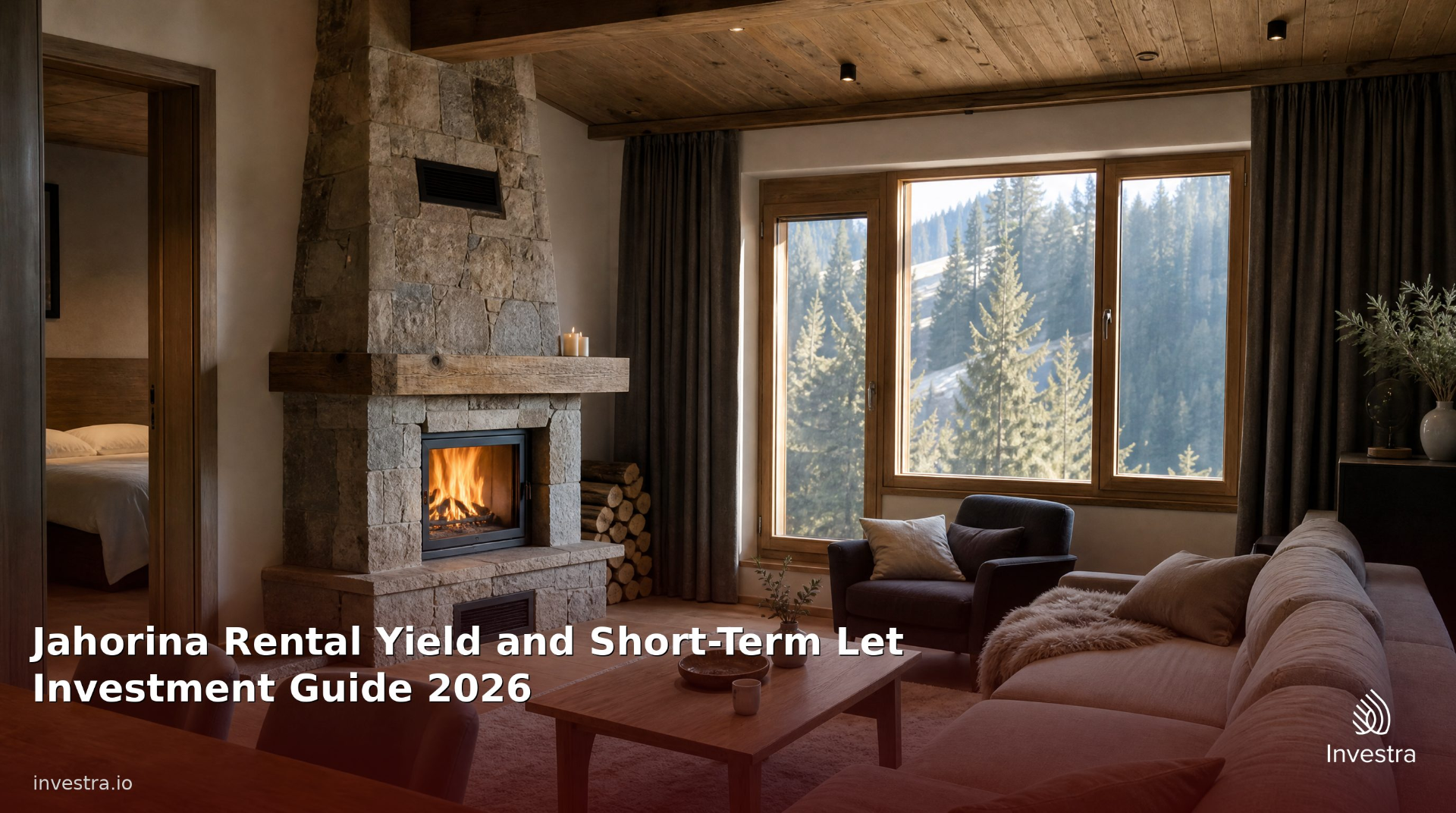
Jahorina Rental Yield and Short-Term Let Investment Guide 2026
Jahorina Rental Yield and Short-Term Let Investment Guide 2026
Why Jahorina Is Attracting Serious Rental Income Investors in 2026
Quick Answer: Jahorina, Bosnia and Herzegovina's premier ski resort, is generating growing interest among short-term rental investors in 2026 due to its low entry prices, rising tourist numbers, and gross rental yields of 7–12% — well above Western European resort averages. Investra.io tracks emerging Balkan markets where value gaps still exist for forward-thinking buyers.
There's a moment in every emerging resort market where the window of opportunity is genuinely wide open — prices haven't caught up with the destination's reputation yet, tourist infrastructure is improving rapidly, and the early buyers who move decisively are the ones who tell the story later. Jahorina, perched in the Dinaric Alps just 28 kilometres from Sarajevo, is at exactly that moment right now.
The mountain hosted the 1984 Winter Olympics, which remains a point of immense local pride and a powerful marketing asset for any short-term rental listing. But what's changed since those days is the level of international attention.
Visitor numbers to the resort have climbed steadily, with Bosnia and Herzegovina's tourism sector recording roughly 1.2 million overnight stays in mountain destinations annually, a figure that's been growing at approximately 8–10% year-on-year since 2021. For the short-term rental investor, those numbers translate directly into occupancy rates and nightly pricing power.
Regional context matters too. As explored in analyses of neighbouring Serbian markets like the Loznica Real Estate Market 2026 Macva Region Property Guide, the Western Balkans as a whole is experiencing a repricing moment as EU accession prospects accelerate and infrastructure investment flows in. Jahorina sits at the heart of this regional shift.
Understanding Jahorina's Seasonal Tourism Model and Rental Demand
Quick Answer: Jahorina operates a dual-season tourism model — winter ski season from December through March, and a growing summer hiking and nature season — giving short-term rental investors the potential for 5–7 months of strong annual occupancy rather than the traditional 3-month ski window.
One of the most common mistakes investors make when evaluating ski resort properties anywhere in the world is assuming the investment case lives or dies on snowfall. Jahorina has been quietly building a summer identity that fundamentally changes the rental yield calculation.
Winter remains the dominant season, running from approximately mid-December through late March. Peak weeks — Christmas, New Year, and the school holiday periods in February — see nightly rates for a well-presented two-bedroom apartment running from €80 to €180 per night. During these peak periods, occupancy among professionally managed properties regularly hits 85–95%.
What surprised many buyers who've actually spent time on the mountain is the summer picture. Jahorina sits inside the Republika Srpska nature corridor, and the municipality has invested meaningfully in mountain biking trails, hiking infrastructure, and a summer outdoor recreation calendar. July and August occupancy for short-term rentals in the resort now regularly reaches 60–75% for well-positioned properties, with nightly rates of €55–€120.
The shoulder seasons — April-May and October-November — remain the weakest, typically delivering 20–35% occupancy. Savvy operators fill these gaps through long-weekend packages, corporate retreat bookings, and the growing "digital nomad escape" segment. Some property managers have experimented with monthly rates during these periods to capture remote workers.
Jahorina Property Prices Per Square Metre in 2026
Quick Answer: Apartment prices in Jahorina range from approximately €1,200 to €2,800 per square metre in 2026, depending on location within the resort, build quality, and ski-in/ski-out access, making it one of the most affordable alpine resort markets in Europe at comparable quality levels.
Let's talk numbers, because this is where Jahorina's investment story becomes genuinely compelling to anyone who's priced Alpine resort property in recent years.
The market essentially divides into three tiers. At the entry level, older Yugoslav-era apartments — many built in the 1970s and 1980s in the resort's original development phase — trade at €1,200–€1,600 per square metre.
The mid-market tier, covering newer builds from the 2000s through early 2010s, sits at €1,600–€2,200 per square metre. These properties typically need cosmetic upgrades rather than structural work and represent the sweet spot for most rental income investors — a balance of reasonable entry cost, good rental potential, and manageable renovation scope.
Premium new-build developments, several of which have launched or completed between 2022 and 2026, command €2,200–€2,800 per square metre. These are typically full-service ski lodges or boutique apartment complexes with managed reception, ski storage, spa facilities, and direct piste access. Off-plan pricing has been running at a 10–15% discount to completion value, which has attracted buyers looking to lock in capital gains alongside rental income.
To put these figures in context: comparable ski resort apartments in Slovenia's Kranjska Gora trade at €4,000–€6,500 per square metre. In Austria's second-tier ski areas, you're looking at €5,000–€10,000+. Even Serbia's Kopaonik mountain resort, the regional competitor most often compared to Jahorina, now trades at €2,500–€4,500 per square metre for quality stock. The price gap is stark and real.
A practical example: a well-renovated 45m² two-bedroom apartment in a good resort position can be acquired for approximately €75,000–€90,000 all-in, including purchase costs. That's an entry point accessible to a far wider range of investors than most European resort markets.
Rental Yield Analysis: What Returns Can Investors Realistically Expect?
Quick Answer: Gross rental yields at Jahorina range from 7% to 12% annually for optimised short-term rental properties, with net yields of 5–8% after management fees, utilities, and maintenance — figures that significantly outperform most Western European ski resort markets.
Yield calculations in resort markets require more nuance than standard residential buy-to-let analysis, because so much depends on management quality, listing strategy, and property positioning. That said, we can build a realistic model based on current market data.
Take a mid-range 45m² apartment purchased at €85,000 (including all acquisition costs). Operating at conservative occupancy assumptions — 90 winter nights at an average €110/night, 80 summer nights at an average €70/night, 30 shoulder nights at €50/night — produces gross rental income of approximately €19,400 per year. Against the €85,000 investment, that's a gross yield of 22.8%. But that's before costs, so let's be realistic.
Net yield in this scenario: approximately 11–14% on a well-run property. More conservative assumptions — lower occupancy, average rather than premium nightly rates — bring net yields down to the 7–9% range. Either way, these numbers are exceptional by any European benchmark. For comparison, prime Airbnb properties in Lisbon, Porto, and Barcelona are generating net yields of 3–5% after the cost escalation of recent years. Even the Sremska Mitrovica Real Estate market in neighbouring Serbia, which offers strong yield fundamentals, struggles to match resort-market short-term rental returns.
What actually drives yield here? Three factors: the low denominator (purchase price), the relatively high nightly rates commanded by a genuine ski destination, and the dual-season demand profile. Get all three working in your favour and Jahorina's yield story is hard to argue with.
Airbnb and Short-Term Let Market Dynamics at Jahorina
Quick Answer: Jahorina's Airbnb market is still maturing, with fewer than 200 active listings as of early 2026, meaning early professional operators enjoy minimal competition, strong organic ranking on platforms, and the ability to capture above-average nightly rates relative to comparable destinations.
The short-term rental platform landscape at Jahorina tells a fascinating story about where the market sits in its development cycle. Unlike mature ski destinations where Airbnb is saturated and new listings struggle for visibility, Jahorina's platform presence is genuinely underdeveloped relative to its actual tourist traffic.
Booking lead times are interesting too. Peak winter weekends in Jahorina regularly book out 3–8 weeks in advance, suggesting demand genuinely exceeds supply during high season. Summer bookings come in shorter (1–2 weeks ahead typically), reflecting the more spontaneous nature of domestic mountain tourism.
Platforms worth prioritising for Jahorina listings include Airbnb (dominant for international guests), Booking.com (strong for domestic Balkan guests), and local platform Oglasi.ba which captures a meaningful segment of Bosnian domestic tourism. A multi-platform strategy typically adds 15–20% to annual occupancy versus single-platform operations.
Legal Framework for Foreign Property Buyers in Bosnia and Herzegovina
Quick Answer: Foreign nationals can legally purchase property in Bosnia and Herzegovina, but the process involves handling a decentralised legal system with separate rules for the Federation of BiH and Republika Srpska entities. Jahorina falls under Republika Srpska jurisdiction, which has a relatively straightforward property purchase process for foreign buyers.
Bosnia and Herzegovina's property law landscape is, to put it diplomatically, complex. The country operates under a constitutional structure with two entities — the Federation of Bosnia and Herzegovina (FBiH) and Republika Srpska (RS) — each with distinct administrative and legal frameworks. Jahorina falls within Republika Srpska, and it's essential that investors understand which entity's rules apply.
The good news is that Republika Srpska has implemented relatively investor-friendly property law for foreign nationals. Citizens of countries with which Bosnia and Herzegovina has reciprocal property ownership agreements — which includes most EU member states, the UK, the US, and numerous others — can purchase property in their own name without needing to establish a local company.
The entire process from signing the preliminary agreement to receiving the property transfer title typically takes 4–8 weeks for a straightforward transaction, though complications — older properties with unresolved ownership questions are not uncommon in Bosnia — can extend timelines significantly. Title due diligence is therefore not optional; it's the most important step in the process.
One complexity specific to resort properties that investors frequently underestimate: some ski resort apartments in Jahorina carry complex ownership structures from the socialist-era development, including potential claims from previous Yugoslav-era enterprises or unresolved inheritance situations. A thorough title search, including checking both the land registry and any relevant court records, is non-negotiable.
Tax Obligations for Rental Income in Bosnia and Herzegovina
Quick Answer: Short-term rental income earned by foreign property owners at Jahorina is subject to income tax in Bosnia and Herzegovina at a flat rate of 10% in Republika Srpska, with a 5% real estate transfer tax payable on purchase — both rates among the lowest in the Balkan region.
Tax treatment is one area where Bosnia and Herzegovina, specifically Republika Srpska, genuinely surprises investors with its simplicity and competitiveness.
The real estate transfer tax (porez na prenos nepokretnosti) in Republika Srpska is levied at 5% of the assessed transaction value. The assessed value is typically the contract price, though tax authorities may substitute their own assessed value if they deem the contract price artificially low — a common caution in markets where informal price adjustments occasionally occur.
For rental income, Republika Srpska operates a flat 10% income tax rate on rental earnings. Foreign landlords earning rental income from property in RS are required to register as taxpayers with the Tax Administration of Republika Srpska (Poreska uprava RS) and file annual income tax returns.
Annual property tax (porez na imovinu) in Bosnia and Herzegovina is very low by European standards — typically 0.05–0.5% of assessed value annually, varying by municipality. For a €85,000 Jahorina apartment, expect annual property tax in the range of €100–€400. Negligible in the context of a rental income investment.
VAT considerations matter for investors running rental operations at a commercial scale. If annual rental income exceeds the VAT registration threshold (approximately 50,000 BAM, roughly €25,500), there may be an obligation to register for VAT. Most individual apartment investors will remain below this threshold, but operators with multiple units should take specific advice. Working with a Sarajevo-based or Banja Luka-based chartered accountant familiar with non-resident property taxation is strongly recommended. For broader financial structuring guidance, Findes Group & Partners offers cross-border expertise relevant to Balkan property investors.
Double taxation treaty coverage is another key consideration. Bosnia and Herzegovina has tax treaties with most EU countries, the UK, and other significant investor source nations — meaning rental income taxed in Bosnia should generally receive a credit against home country tax obligations, rather than being taxed twice.
Property Management Options and Running Costs at Jahorina
Quick Answer: Professional property management companies at Jahorina charge 20–25% of gross rental revenue, handling everything from Airbnb listings to linen changes and guest check-ins — a service essential for non-resident investors who cannot manage operations personally from abroad.
What should you budget for running costs beyond management fees? Utilities (electricity, heating, water, internet) typically run €1,800–€3,000 per year for a 45m² ski apartment, with heating costs spiking in winter obviously. Building service charges (zajednička potrošnja) for apartment complexes average €50–€150 per month.
Insurance deserves specific mention. Property insurance for a rental apartment in Bosnia is inexpensive — typically €150–€400 annually for a comprehensive building and contents policy. However, specialist short-term rental liability coverage is a separate consideration and worth discussing with a local insurance broker. Airbnb's AirCover provides some protection but is not a substitute for proper property insurance.
For investors interested in comparing management cost structures across the region, expert insights from Siniša Dagary investment insight provide useful context on how operating costs structure differently in urban versus resort markets across the wider Western Balkans.
Capital Appreciation Potential: The Long-Term Investment Case
Quick Answer: Jahorina property values have appreciated at an estimated 6–10% annually since 2020, driven by rising tourist demand, EU integration momentum, and undersupply of quality rental stock — with further appreciation expected as Bosnia progresses toward EU candidate status and regional infrastructure improves.
Rental yield is the immediate return; capital appreciation is the multiplier that turns a good investment into an exceptional one. Jahorina's medium-term price trajectory is, in the view of most regional analysts, strongly positive — but the reasoning matters as much as the conclusion.
The structural price driver most often underestimated by investors unfamiliar with the Western Balkans is EU integration dynamics. Bosnia and Herzegovina received EU candidate status in December 2022, a milestone that historically triggers significant foreign direct investment increases and real estate price re-ratings in candidate countries.
Infrastructure investment is the tangible manifestation of this dynamic. The Sarajevo–Jahorina road connection has been upgraded, and regional connectivity — particularly the development of Sarajevo International Airport's route network — continues to improve access for Western European visitors. More air connectivity means more potential guests, which means higher achievable occupancy and nightly rates, which capitalises back into property values.
Supply-side constraints add another layer to the appreciation case. The Jahorina municipality has limited developable land, and environmental protection considerations constrain new large-scale development. The supply of quality, ski-accessible accommodation is genuinely finite. As demand grows, price adjustment is the only equilibrium mechanism.
What's happened to prices in practice? Properties purchased in the 2018–2020 period have appreciated 30–45% in euro terms through to 2026 — a compound annual growth rate of roughly 7–9%. That's strong performance for a real asset, achieved alongside simultaneous rental income. Research tracking regional markets has noted similar appreciation patterns in undervalued Balkan destinations as regional repricing plays out. For additional perspective on investment fundamentals in comparable markets, consult Siniša Dagary investment insight.
Comparing Jahorina to Regional Competitor Resort Markets
Quick Answer: Against regional Balkan ski resort competitors including Serbia's Kopaonik, Bulgaria's Bansko, and Slovenia's Kranjska Gora, Jahorina offers the lowest entry prices per square metre, competitive rental yields, and superior long-term appreciation potential due to Bosnia's EU candidate trajectory.
Understanding Jahorina's competitive position within the broader Alpine and Balkan resort landscape matters for any investment decision. The comparison reveals where Jahorina sits on the value spectrum relative to alternatives.
Kopaonik, Serbia's highest mountain and largest ski resort by piste extent, represents Jahorina's closest regional competitor. Kopaonik offers slightly better skiing infrastructure (more extensive pistes, modern lift systems) and a more established international reputation, but prices have already moved substantially. Mid-range Kopaonik apartments now trade at €2,500–€4,500 per square metre, making entry costs 60–100% higher than comparable Jahorina stock.
Bulgaria's Bansko represents an even more developed competitor — a mature resort with strong European recognition, extensive hospitality infrastructure, and robust tourism volumes. However, Bansko property prices have risen to €3,500–€5,500 per square metre for quality stock, and regulatory environment concerns around Bulgarian property ownership have made some international buyers cautious.
At the premium end, Slovenia's Kranjska Gora and Austrian alpine markets command €5,000–€10,000+ per square metre but offer political stability, mature infrastructure, and stronger Western European labour market access. These markets are genuinely different investment propositions — capital preservation and lifestyle factors matter as much as yield. The pricing premium reflects these intangibles.
What this comparative analysis suggests: Jahorina sits at the sweet spot on the risk-return spectrum for investors with a 5–10 year horizon. Entry prices remain low relative to intrinsic quality and tourist appeal, rental yields remain competitive, appreciation potential remains substantial, and political risk (the main intangible cost of Balkan investing) has diminished materially with EU candidate status.
For detailed regional market comparisons and investment strategy guidance, consult Kopaonik Vs Zlatibor Vs Tara Best Serbian Mountain For In... and
Investment Disclaimer
Quick Answer: This guide is general market information, not personal legal, tax, financing or investment advice.
Before committing to a property transaction, buyers should obtain independent local legal, tax and financial advice suited to their circumstances. Investra.io can support initial market research, but every purchase decision remains the buyer's responsibility.
Frequently Asked Questions
Quick Answer: This section explains the practical property-investment implications of Frequently Asked Questions.
What is a prudent next step after initial market research?
Use current documentation, independent professional advice and comparable local evidence before proceeding. Investra.io can support an initial structured market review.
How can buyers plan a realistic ownership budget?
Use current documentation, independent professional advice and comparable local evidence before proceeding. Investra.io can support an initial structured market review.
What evidence supports a careful investment decision?
Use current documentation, independent professional advice and comparable local evidence before proceeding. Investra.io can support an initial structured market review.
When should a buyer obtain legal and tax advice?
Use current documentation, independent professional advice and comparable local evidence before proceeding. Investra.io can support an initial structured market review.
How should a buyer compare neighbourhoods and property types?
Use current documentation, independent professional advice and comparable local evidence before proceeding. Investra.io can support an initial structured market review.
What local checks should be completed before signing?
Use current documentation, independent professional advice and comparable local evidence before proceeding. Investra.io can support an initial structured market review.
Which costs should be assessed alongside the purchase price?
Use current documentation, independent professional advice and comparable local evidence before proceeding. Investra.io can support an initial structured market review.
How can international buyers verify a property opportunity?
Use current documentation, independent professional advice and comparable local evidence before proceeding. Investra.io can support an initial structured market review.
What should buyers compare before selecting a property?
Use current documentation, independent professional advice and comparable local evidence before proceeding. Investra.io can support an initial structured market review.
Quick Answer: These answers outline common buyer checks and should be read with current professional advice.
Recommended Reading
Quick Answer: This section explains the practical property-investment implications of Recommended Reading.
- Investra market research
- Investra market research
- Investra market research
- Investra market research
- Investra market research
- Investra market research
- Investra market research
- Investra market research
- Investra market research
- Investra market research
- Investra market research
- Investra market research
- Investra market research
- Investra market research
- Investra market research
- Investra market research
- Investra market research
- Siniša Dagary investment insight
- Siniša Dagary investment insight
- Siniša Dagary investment insight
- Siniša Dagary investment insight
- Siniša Dagary investment insight
- Findes Group & Partners
- Findes Group & Partners
Connect With Investra
Follow Investra for market updates on Facebook, LinkedIn, YouTube
Ähnliche Beiträge
Keine verwandten Beiträge verfügbar.
