
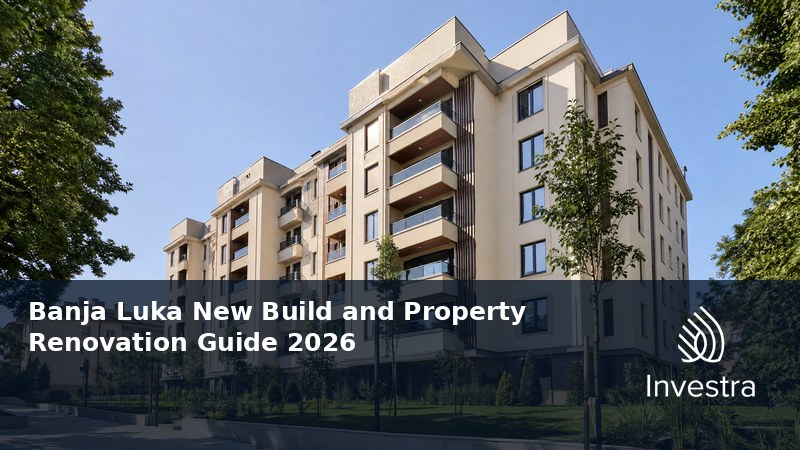
Banja Luka New Build and Property Renovation Guide 2026
Banja Luka New Build and Property Renovation Guide 2026
Banja Luka New Build and Renovation Market: What's Happening in 2026
Quick Answer: Banja Luka's new build and renovation market in 2026 is experiencing steady growth, with new construction prices ranging from €900 to €2,200/m² and renovation opportunities available from as low as €400/m² in established residential zones. Investra.io tracks emerging Balkan markets to help investors identify the best entry points before prices mature.
The city's construction activity has accelerated noticeably since 2022. New residential towers are appearing along the Vrbas River corridor, while older socialist-era apartment blocks in central districts are being snapped up for gut renovations.
For context on how emerging Balkan cities tend to develop their real estate cycles, the Zajecar Real Estate Market 2026 Eastern Serbia Property Guide offers useful comparative insights from the neighbouring Serbian market.
Understanding the Banja Luka Real Estate Landscape
Quick Answer: Banja Luka is Republika Srpska's administrative and economic capital with approximately 250,000 residents, offering a dual property market split between premium new construction in modern districts and affordable renovation stock in older central and peri-urban areas.
To understand Banja Luka's property market properly, you need to understand the city's geography and social structure. The city is divided into several distinct zones, each with its own price dynamics and investment character.
The city centre and Borik district represent the premium end of the market. These areas attract young professionals, expat workers, and students willing to pay for location and quality. New builds here push toward the upper end of pricing, while renovated flats in older blocks can yield strong rental returns given demand consistency.
The Starčevica and Lauš districts are mid-tier residential areas popular with families. These neighbourhoods contain a significant stock of 1970s–1990s construction that's ripe for renovation — apartments that look rough on the surface but have sound structural bones and excellent location fundamentals.
Then there's the outer growth corridor stretching toward Česma and the industrial-adjacent zones, where new build development is happening at lower land costs, producing more affordable housing stock aimed at first-time local buyers and young families. Rental yields here are lower, but acquisition costs are considerably reduced.
New Build Property Prices in Banja Luka 2026
Quick Answer: New build apartments in Banja Luka range from €1,000 to €2,200/m² depending on location and finish level, with luxury riverside developments reaching the upper end and standard new construction in outer districts sitting closer to €1,000–€1,400/m².
Prices have moved meaningfully upward over the past four years. Back in 2020–2021, quality new construction in central Banja Luka could be acquired for €850–€1,100/m². That era is largely over. Construction cost inflation — driven by EU-wide materials price increases and local labour cost rises — has repriced the entire sector upward.
Here's how the current new build market breaks down by segment and location:
Premium Riverside and Central New Builds: The most sought-after new developments along the Vrbas riverfront and in the heart of the Borik district command €1,600–€2,200/m². These are typically full-service residential complexes with underground parking, elevators, fitness facilities, and high-specification interiors.
Mid-Range New Construction: Standard quality new builds in established residential zones — Starčevica, Lauš, and northern city suburbs — are priced at €1,100–€1,500/m². These represent the bulk of new supply coming to market and attract local buyers, young professionals, and buy-to-let investors targeting the student and young professional rental market.
Entry-Level New Construction: Outer suburban developments and smaller developer projects offer new build pricing starting from €900–€1,000/m², though finish quality is considerably more basic. These can work for investors purely chasing cash flow over capital appreciation, but due diligence on developer quality is essential at this end of the market.
One trend worth understanding is the off-plan purchasing dynamic. Many Banja Luka developers sell 40–60% of units during the construction phase at a 10–15% discount to projected completion values. This off-plan model is well-established in the local market and can produce attractive returns if developer track records are verified thoroughly beforehand.
Renovation Property Costs and Opportunities
Quick Answer: Renovation properties in Banja Luka can be acquired for €400–€900/m² in older residential blocks, with full renovation costs running €300–€600/m² depending on specification, making total all-in costs of €700–€1,400/m² achievable for quality finished product.
Typical renovation candidates are two-room (jednosoban) and three-room (dvosoban, trosoban) flats built between 1965 and 1990, priced at €40,000–€85,000 depending on size, location, and condition. A 50m² flat in Borik or Starčevica can be acquired for €45,000–€65,000, with renovation running €20,000–€35,000 for a high-quality finish.
Key renovation cost benchmarks for 2026: Complete bathroom renovation €4,000–€8,000. Kitchen renovation including units €5,000–€12,000. Full electrical rewiring (50m² flat) €3,000–€5,000. New heating system installation €4,000–€8,000. Flooring replacement (laminate/tile) €25–€45/m². Exterior insulation and render €30–€55/m² of wall area.
For parallel renovation market dynamics from the wider Balkans region, the Prokuplje Real Estate Market 2026 Toplica Region Property Guide offers relevant comparative data on renovation economics in emerging regional cities.
Legal Framework for Foreign Buyers in Bosnia and Herzegovina
Quick Answer: Foreign nationals can legally purchase property in Bosnia and Herzegovina, including Republika Srpska, though the process involves handling a dual-entity legal structure and requires working with a local notary and attorney to ensure clean title transfer and registration.
The good news: foreign nationals from countries with reciprocal property ownership rights — which includes most EU member states, the UK, the United States, and a broad range of other countries — can purchase property in RS without restriction. The practical process unfolds as follows:
First, the buyer and seller agree terms and sign a preliminary purchase agreement (Predugovor). This document establishes the purchase price, payment timeline, and any conditions. A deposit — typically 10% — is paid at this stage, usually with penalty clauses if either party withdraws without cause.
Second, the main sale agreement (Kupoprodajni Ugovor) is drafted and certified by a notary public (notar). Notarial certification is mandatory in RS for real estate transactions and typically costs 0.5–1.0% of the transaction value.
Third, property registration occurs at the Republic Administration for Geodetic and Property Affairs (RUGIPP). This step registers the ownership change in the land registry (Zemljišna knjiga), which is the definitive legal record of ownership in RS.
The entire process, from signed preliminary agreement to completed land registry registration, typically takes 30–60 days for straightforward transactions. Title complications — encumbrances, unresolved inheritance claims, or discrepancies between cadastral and registry records — can extend this timeline significantly.
For investors interested in understanding the legal framework in the broader Western Balkans region, Siniša Dagary investment insight provides background on cross-border investment consultancy in the region.
Taxes, Transaction Costs, and Total Acquisition Expenses
Quick Answer: Total transaction costs for property purchases in Republika Srpska typically run 5–8% of the purchase price, comprising a 3% property transfer tax (for resale properties), notary fees, attorney fees, and registration costs — though new builds from developers are VAT-structured differently.
Getting your numbers right on acquisition costs is critical for any investment calculation, and Bosnia and Herzegovina has some particularities that catch first-time buyers off guard.
Property Transfer Tax (Porez na promet nepokretnosti): For secondary market purchases (resale properties), a 3% property transfer tax applies in Republika Srpska, calculated on the assessed market value. Note that tax authorities assess their own value — if your agreed purchase price is below market value, the tax base may be adjusted upward.
VAT on New Builds: New construction purchased directly from developers is subject to VAT at 17% rather than transfer tax. This is typically already embedded in the quoted price, but buyers should confirm this explicitly with developers.
Notary Fees: Notarisation is mandatory and fees are regulated, typically running 0.5–1.0% of transaction value. For a €100,000 purchase, expect €500–€1,000.
Attorney Fees: Quality legal representation for title due diligence and transaction management runs €500–€2,500 depending on transaction complexity. Given the title risks in this market, this expenditure is non-negotiable.
Real Estate Agent Commission: Standard practice is 2–3% paid by the seller, though some agents attempt dual commission arrangements. Buyers should clarify commission structures upfront.
Annual Property Tax: Ongoing annual property tax in RS is relatively modest, typically €1–€3/m² annually depending on location and property type — well below Western European norms and largely not a material consideration in investment calculations.
Capital gains from property sales are subject to personal income tax in RS at a flat rate of 10% on the gain. Gains from properties held for more than five years are exempt from this tax — a significant consideration in long-term investment structuring.
Rental Yields and Investment Returns in Banja Luka
Quick Answer: Gross rental yields in Banja Luka range from 5.5% to 8.5% depending on property type and location, with smaller apartments near the university and city centre offering the strongest yield profiles, particularly for short-term furnished rentals.
Rental yields are where Banja Luka genuinely stands out compared to more expensive regional capitals. While yields in Sarajevo's Old Town have compressed toward 4–5% as prices have risen, Banja Luka still offers a compelling spread between acquisition cost and rental income.
Here's what the numbers look like across different investment scenarios in 2026:
Student/Young Professional Studios and One-Bedrooms (30–45m²): These are the yield champions of the Banja Luka market. A renovated studio near the university or Borik can be acquired (including renovation) for €55,000–€75,000 and rented at €280–€380/month unfurnished, or €320–€450/month fully furnished. Gross yields of 6.5–8.5% are regularly achieved.
Two-Bedroom Apartments (55–75m²): The most liquid segment of the market — both for rentals and eventual resale. Acquisition plus renovation costs of €80,000–€130,000 support monthly rents of €400–€650. Gross yields run 5.5–7.0%, with net yields of 4.0–5.5% after management costs.
Premium New Build Apartments (70–100m²+): Higher-end units targeting senior professionals, expatriates, and institutional renters. Yields are lower — typically 4.5–6.0% gross — but tenant quality, lower vacancy rates, and stronger capital appreciation prospects partially compensate.
Investors exploring comparable yield dynamics in neighbouring markets should review the Loznica Real Estate Market 2026 Macva Region Property Guide for context on how secondary Balkan cities are performing across the border in Serbia.
Developer Selection and New Build Due Diligence
Quick Answer: Developer selection in Banja Luka requires verifying construction permits, the developer's track record of completed projects, financial solvency, and contractual protections for off-plan payments — risks that are higher in this market than in Western Europe but manageable with proper due diligence.
The Banja Luka new build market has seen both successful developer stories and cautionary tales. There have been documented cases of developers running into financial difficulties mid-project, leaving buyers with incomplete buildings and protracted legal disputes.
The key questions to answer before committing to an off-plan purchase: Does the developer hold a valid building permit (Građevinska dozvola)? This document must be obtained before construction begins and confirms the project is legally approved. Any developer unwilling to show this document should be avoided entirely.
What's the developer's track record? Experienced local developers with three or more completed projects in Banja Luka represent meaningfully lower risk than first-time developers. Visit completed projects, speak with existing residents if possible, and check whether the developer has any outstanding legal disputes registered against them.
How are off-plan payments structured? The safest payment structures involve staged payments tied to construction milestones rather than large upfront lump sums. A reasonable structure might be: 10–15% on signing, 20–25% at foundation completion, 20–25% at structural frame completion, 20–25% at fit-out stage, and the balance on handover.
Is there an independent escrow arrangement? This is rare but growing in Banja Luka — some larger developers now use escrow accounts that release funds only upon certified construction stage completion. Where available, this adds meaningful protection.
What do the snagging and warranty terms look like? Quality developers provide two-year workmanship warranties and 10-year structural warranties. Contracts that are vague on post-completion remedies should trigger renegotiation or avoidance.
Consulting with an experienced regional investment advisor is valuable in developer assessment. Siniša Dagary investment insight provides specialist guidance on Balkan market investment structures and developer assessment frameworks.
Renovation Project Management: Practical Realities
Quick Answer: Successful renovation projects in Banja Luka depend on detailed scopes of work, fixed-price contracts where possible, regular on-site supervision, and contingency budgets of at least 15–20% — remote management without local representation consistently produces cost and quality problems.
Let's be direct about something that renovation guides often gloss over: managing a renovation project in a foreign country without speaking the local language and without trusted local oversight is extraordinarily difficult. The Banja Luka renovation market offers real financial opportunity, but it's not passive income — at least not in the execution phase.
Use a notarised construction contract (Ugovor o građenju) with a fixed price, a defined timeline, milestone-based payment schedule, and penalty clauses for delays. Verbal agreements and handshakes are culturally common in the Banja Luka construction trades but create enormous problems when disputes arise.
Budget contingency religiously. Every experienced renovation investor in this market builds in 15–20% contingency. Unexpected structural issues, hidden plumbing problems, changes in material availability — these aren't edge cases, they're statistical near-certainties on any property built before 1990.
The typical renovation timeline for a 50–70m² apartment requiring full refurbishment runs 8–16 weeks when properly managed. Add another 4–8 weeks for permit-required works, furnishing, and listing preparation if targeting rental market entry. Planning for six months from acquisition to income-generating status is prudent.
Technology is changing how remote investors manage projects in markets like this. For insights on how proptech solutions are making Balkan market investment more accessible, the Serbia Proptech 2026 How Technology Is Changing Real Estate article offers relevant context on digital tools transforming cross-border property management.
Financing Options for Banja Luka Property Investment
Quick Answer: Foreign investors typically self-fund Banja Luka property purchases as local mortgage access is restricted for non-residents, though some banks offer local currency (BAM) mortgages to EU citizens with local income, and developer financing schemes exist for off-plan purchases.
Financing is one of the more challenging aspects of Banja Luka investment for international buyers. The honest assessment is this: most foreign investors buying property in Bosnia and Herzegovina are doing so with cash or with home-country financing. The local banking system isn't set up to easily lend to non-resident foreign nationals.
Some developers offer their own financing schemes for off-plan purchases — typically allowing buyers to pay over the construction period (usually 18–30 months) without formal bank mortgage involvement. These schemes can be useful for investors managing cash flow across multiple markets, but the contractual terms need careful scrutiny.
Investors financing Banja Luka acquisitions through home-country equity release or portfolio loans should factor in the BAM/EUR currency peg stability as a genuine risk-mitigating factor compared to other Balkan markets where local currency exposure creates additional investment risk.
For broader financial structuring guidance in cross-border Balkan investments, Findes Group & Partners offers specialist advisory services for international investors active in the region.
Capital Appreciation Outlook and Market Drivers 2026–2030
Quick Answer: Banja Luka's property values are forecast to appreciate 3–5% annually through 2030, driven by EU integration progress, infrastructure investment, diaspora capital inflow, and an undersupply of quality modern housing relative to local demand.
Property value appreciation in Banja Luka over the past decade has averaged roughly 3–4% annually, considerably below headline inflation but consistent and reliable. Looking forward through 2030, several factors suggest this trajectory may hold or possibly accelerate modestly.
EU Integration Pathway: Bosnia and Herzegovina's status as an EU candidate country (formally accepted in 2022) creates positive medium-term momentum for investor confidence and institutional quality. While EU membership remains years away, the candidacy itself has already improved international perception and started attracting institutional capital flows.
Infrastructure Investment: The government has announced or begun construction on several significant infrastructure projects — new highways, airport expansion, and urban transport improvements in Banja Luka specifically. These projects take years to complete but meaningfully improve city accessibility and livability when they do.
University and Knowledge Economy Growth: Banja Luka's position as an educational hub continues strengthening. The university has expanded capacity and quality, and several international companies have opened regional offices in the city, creating professional employment opportunities that increase housing demand.
Supply Constraints in Premium Segments: High-quality, newly constructed housing remains undersupplied relative to demand from upper-income earners and investors. This imbalance supports price resilience in premium new build segments.
For broader context on regional market dynamics and comparative investment opportunities,
Investment Disclaimer
Quick Answer: This guide is general market information, not personal legal, tax, financing or investment advice.
Before committing to a property transaction, buyers should obtain independent local legal, tax and financial advice suited to their circumstances. Investra.io can support initial market research, but every purchase decision remains the buyer's responsibility.
Frequently Asked Questions
Quick Answer: This section explains the practical property-investment implications of Frequently Asked Questions.
What is a prudent next step after initial market research?
Use current documentation, independent professional advice and comparable local evidence before proceeding. Investra.io can support an initial structured market review.
How can buyers plan a realistic ownership budget?
Use current documentation, independent professional advice and comparable local evidence before proceeding. Investra.io can support an initial structured market review.
What evidence supports a careful investment decision?
Use current documentation, independent professional advice and comparable local evidence before proceeding. Investra.io can support an initial structured market review.
When should a buyer obtain legal and tax advice?
Use current documentation, independent professional advice and comparable local evidence before proceeding. Investra.io can support an initial structured market review.
How should a buyer compare neighbourhoods and property types?
Use current documentation, independent professional advice and comparable local evidence before proceeding. Investra.io can support an initial structured market review.
What local checks should be completed before signing?
Use current documentation, independent professional advice and comparable local evidence before proceeding. Investra.io can support an initial structured market review.
Which costs should be assessed alongside the purchase price?
Use current documentation, independent professional advice and comparable local evidence before proceeding. Investra.io can support an initial structured market review.
How can international buyers verify a property opportunity?
Use current documentation, independent professional advice and comparable local evidence before proceeding. Investra.io can support an initial structured market review.
What should buyers compare before selecting a property?
Use current documentation, independent professional advice and comparable local evidence before proceeding. Investra.io can support an initial structured market review.
Quick Answer: These answers outline common buyer checks and should be read with current professional advice.
Recommended Reading
Quick Answer: This section explains the practical property-investment implications of Recommended Reading.
- Investra market research
- Investra market research
- Investra market research
- Investra market research
- Investra market research
- Investra market research
- Investra market research
- Investra market research
- Investra market research
- Investra market research
- Investra market research
- Investra market research
- Investra market research
- Investra market research
- Investra market research
- Investra market research
- Investra market research
- Siniša Dagary investment insight
- Siniša Dagary investment insight
- Siniša Dagary investment insight
- Siniša Dagary investment insight
- Siniša Dagary investment insight
- Findes Group & Partners
- Findes Group & Partners
Connect With Investra
Follow Investra for market updates on Facebook, LinkedIn, YouTube
Related Posts
No related posts available.
