
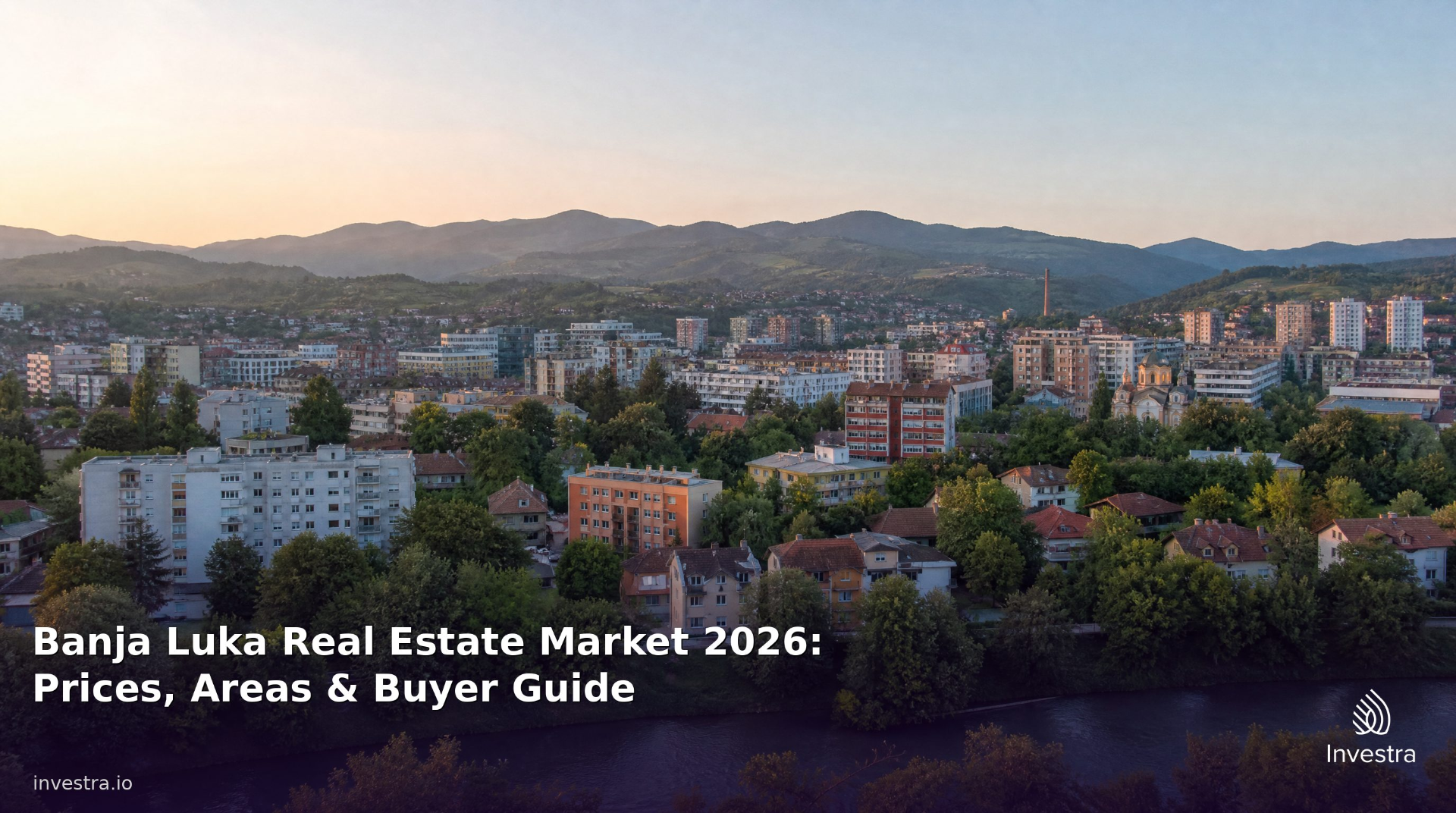
Banja Luka Real Estate Market 2026: Prices, Areas & Buyer Guide
Banja Luka Real Estate Market 2026: Prices, Areas & Buyer Guide
Banja Luka Real Estate Market Overview 2026: Why This City Deserves Your Attention
Quick Answer: Banja Luka, the administrative center of Republika Srpska, offers competitively priced real estate in the Western Balkans in 2026, with residential properties ranging from €800 to €2,500/m² depending on location and property type. Investra.io tracks emerging Balkan markets to help investors identify high-potential opportunities before they become mainstream.
Banja Luka doesn't generate the international headlines that Sarajevo commands, nor does it attract the tourist masses that descend on Mostar's historic streets. Yet for property investors examining the Western Balkans carefully in 2026, this city of approximately 250,000 residents represents one of the region's most compelling real estate opportunities.
Located along the Vrbas River in northwest Bosnia and Herzegovina, Banja Luka functions as the political and administrative capital of Republika Srpska — one of the two entities comprising the country's federal structure. This administrative role fundamentally shapes urban development priorities, infrastructure investment patterns, and economic dynamics that directly influence real estate values.
The city's property market has maintained a steady upward trajectory since 2019, with acceleration notably visible between 2022 and 2025. This appreciation reflects several concurrent trends: returning diaspora capital, improving local purchasing capacity, and growing foreign investor interest from Serbia, Slovenia, and Austria.
New residential construction is expanding rapidly across the city's northern and western periphery. Commercial real estate remains undersupplied. The rental market, particularly surrounding the University of Banja Luka's multiple campuses, continues operating in persistent undersupply conditions. For investors familiar with similar dynamics in comparable regional markets such as those documented in Loznica Real Estate Market 2026 Macva Region Property Guide, these indicators will resonate as meaningful and actionable signals.
Banja Luka Property Prices in 2026: Neighborhood-by-Neighborhood Breakdown
Quick Answer: Property prices in Banja Luka range from approximately €800/m² in outer suburban zones to €2,500/m² in premium central and riverfront locations, with the city average for new-build apartments sitting around €1,400–1,700/m² as of early 2026.
Geographic variation within Banja Luka's property market is substantial, and anyone presenting a single citywide average obscures critical investment distinctions. Different neighborhoods command distinctly different price dynamics reflecting location quality, infrastructure maturity, and buyer demographics.
The city center — encompassing the area surrounding Banski Dvor Cultural Centre, Krajina Square, and the pedestrian Gospodska Street retail corridor — represents the premium market segment. New-build apartments in these prime central locations command €1,900–2,500/m² pricing.
Starčevica, situated to the city's north, functions as an established middle-class residential zone. This hilly, verdant neighborhood attracts family-oriented buyers and professional households. New construction here ranges €1,500–2,000/m², with premium pricing justified by panoramic views and educational institution proximity.
Borik, the city's largest residential settlement located west of the center along the Vrbas River, functions essentially as a self-contained suburban municipality. Pricing here demonstrates significantly greater accessibility: new construction trades at €1,100–1,600/m², while resale apartments originating from the socialist-era building period occupy €800–1,100/m² territory.
Lauš and Lazarevo represent the city's emerging residential frontier on the eastern perimeter. These newly developed communities offer the market's most compelling affordability narrative. Basic new construction commences around €900/m², with premium units rarely exceeding €1,400/m².
For contextual comparison with Serbian secondary markets, see the detailed analysis in Zajecar Real Estate Market 2026 Eastern Serbia Property Guide — Banja Luka's central pricing aligns broadly with comparable Serbian secondary cities, yet projects potentially superior appreciation trajectory given the currently lower baseline of foreign investor penetration.
The Economic Foundation: What's Actually Driving Demand in Banja Luka
Quick Answer: Banja Luka's real estate demand derives primarily from its role as Republika Srpska's administrative capital, an emerging IT and professional services sector, university enrollment exceeding 22,000 students, and sustained diaspora purchasing activity from the substantial Bosnian-Serbian diaspora communities concentrated in Western Europe.
Real estate price movements never occur in economic isolation. The essential investor question extends beyond simple pricing to encompass the fundamental demand architecture supporting that pricing — specifically, whether underlying drivers demonstrate durability capable of sustaining value through economic cycles.
Banja Luka's economic foundation rests on several distinct supporting pillars, each warranting individual examination. Administrative function provides the most economically stable foundation: as Republika Srpska's governmental seat housing the presidency, parliament, and essential institutional apparatus, the city maintains substantial permanent public-sector employment.
The information technology sector has grown with quiet but measurable momentum. Bosnia and Herzegovina, and specifically Banja Luka, has cultivated a reputation as an economically attractive outsourcing destination for European technology enterprises. Operational expenses trail significantly below Sarajevo or Zagreb equivalents, while the talent pipeline from the University of Banja Luka's technical faculties continues improving.
The university sector demands particular analytical attention. The University of Banja Luka currently enrolls approximately 22,000 students distributed across multiple academic faculties. This student-to-population ratio generates structurally embedded rental demand concentrated in specific geographic zones.
Diaspora investment represents the most volatile but currently most active demand driver. The Bosnian diaspora — particularly concentrated in Germany, Austria, Switzerland, and Scandinavia — has systematically repatriated capital into real estate since the early 2020s. Remittances to Bosnia and Herzegovina consistently represent 10–12% of national GDP, with meaningful portions of that capital flowing into property acquisitions.
New Construction vs. Resale Market: Which Makes More Sense in 2026?
Quick Answer: Both segments present defensible investment rationales in Banja Luka's 2026 market — new construction offers superior energy efficiency, readily available financing, and capital appreciation potential, while the resale market provides immediate cash flow opportunities and entry prices 20–35% below new-build equivalents in comparable locations.
This recurring investor question lacks universal answers precisely because optimal strategy depends entirely on individual investor objectives and risk tolerance — though we can provide sufficient specificity to make that evaluation meaningful.
Banja Luka's new construction sector demonstrates considerable activity. Developers operating primarily in northern and western development zones have been delivering contemporary apartment complexes featuring underground parking infrastructure, energy-efficient mechanical systems, and finishing standards increasingly meeting buyer expectations established by exposure to Western European standards.
What often surprises investors accustomed to Western European market mechanics is how relatively streamlined the new-build acquisition process operates within Banja Luka. Developer track records are generally verifiable through municipal records. Construction timelines have improved measurably, though delays continue occurring. The legal framework governing pre-completion purchases has become increasingly standardized and comprehensible.
The resale market narrates a distinctly different story. Older apartment stock from the Yugoslav construction period — predominantly solid concrete-frame structures dating from the 1970s and 1980s — trades at material discounts relative to new construction. A 60m² resale apartment in a well-maintained 1980s building in Borik might command €55,000–70,000, compared to €90,000–100,000 for the new-build equivalent.
The renovation-for-value strategy within the resale market presents additional opportunity. A discrete layer of under-renovated apartments, requiring €10,000–20,000 in focused improvement work, can be repositioned to capture professional and short-term rental markets at substantially elevated rental rates. This value-add methodology has demonstrated effectiveness in comparable Balkan markets, as detailed in Prokuplje Real Estate Market 2026 Toplica Region Property Guide analysis examining Serbian secondary market dynamics.
Rental Yields and ROI: The Numbers Behind the Investment Case
Quick Answer: Gross rental yields in Banja Luka average 5–8% annually depending on property type and location, with furnished apartments in student and professional zones achieving the upper range, and net yields after expenses typically falling between 4–6.5%.
Investment decisions ultimately rest on quantitative analysis. Whether a property purchase makes economic sense depends entirely on whether expected returns justify capital deployment and carry risk appropriately.
Gross rental yields in Banja Luka substantially exceed returns available in most Western European markets and demonstrate clear competitiveness relative to comparable Balkan municipalities. Furnished one-bedroom apartments (35–45m²) positioned near university facilities or in central Borik neighborhoods command monthly rents of €350–500.
Two-bedroom units (55–70m²) targeting young professionals and small family households command monthly rent of €450–700 in prime central or near-central locations. Purchase prices within the €90,000–130,000 range produce gross yields of 4.8–6.5%. The professional rental segment characteristically generates more stable tenant relationships and lower turnover rates relative to student housing, though with offsetting implications for management complexity.
Short-term rental platforms including Airbnb and Booking.com represent an increasingly significant though still comparatively modest market segment. Banja Luka attracts tourism flows relating to business travel, diaspora family visits, and transit passenger volumes, with peak demand typically coinciding with summer months and major university calendar events.
What does five-year return analysis yield? Combining estimated capital appreciation (conservatively modeled at 4–6% annually given current market trajectory) with net rental income produces total annual returns approximating 8–12% for carefully selected properties. While such returns carry no guarantee and require active management engagement, they represent meaningful premium over European fixed-income alternatives. Investors researching how digital transformation reshapes Balkan real estate market mechanics will find Serbia Proptech 2026 How Technology Is Changing Real Estate particularly illuminating for understanding technology-enabled property management's contribution to net yield optimization across the region.
Legal Framework for Foreign Buyers: Ownership Rights and Restrictions
Quick Answer: Foreign nationals can purchase real estate in Bosnia and Herzegovina, including Banja Luka, subject to reciprocity principles and entity-specific regulations; EU citizens encounter relatively straightforward acquisition processes, while non-EU buyers require qualified legal counsel before proceeding.
Bosnia and Herzegovina's real estate legal framework presents substantially greater complexity than most neighboring jurisdictions. The country's federalized constitutional architecture — encompassing two entities (Republika Srpska and the Federation of Bosnia and Herzegovina) plus the autonomous Brčko District — distributes property law administration at the entity rather than national level.
Foreign nationals maintain acquisition rights within Republika Srpska under reciprocity principles — specifically, nationals of countries permitting Bosnian citizen property ownership generally qualify for identical ownership privileges. Practically speaking, this encompasses EU member state nationals, Swiss, American, Canadian, Australian, and numerous other nationalities.
One critical distinction requires investor awareness: the difference between properties possessing complete construction legalization versus those lacking proper authorization. Banja Luka, consistent with most Bosnian municipalities, contains significant real estate stock — either complete structures or renovated extensions — constructed without requisite governmental permits.
Professional guidance handling these complexities remains valuable. Siniša Dagary investment insight provides extensive experience guiding international investors through Western Balkan property transactions, including comprehensive due diligence procedures specific to Bosnia and Herzegovina's complex governance structure.
Taxes, Fees, and Transaction Costs: The Full Picture
Quick Answer: Total transaction costs for Banja Luka property acquisitions typically represent 4–7% of purchase price, including 3% property transfer tax (resale properties), notary fees, legal services, and registration costs — new-build acquisitions from VAT-registered developers substitute 17% VAT for transfer tax provisions.
One genuinely positive contrast with Western European market mechanics is Banja Luka's relatively contained transaction cost architecture. "Relatively contained" does not imply negligible, and precise cost budgeting from project inception remains essential.
Property transfer tax (porez na promet nepokretnosti) in Republika Srpska applies at 3% against assessed value for resale transactions. Critically, this calculation references the tax authority's independent assessed value rather than the contracted transaction price, occasionally creating complications when purchases occur at substantial premiums relative to assessed values.
New-build acquisitions directly from developers holding VAT registration status follow different mechanics: the 3% transfer tax disappears entirely, replaced by 17% VAT embedded within the purchase price. This appears dramatically higher in isolation, yet the practical distinction proves crucial — VAT is built into developer pricing rather than layered atop agreed transaction amounts.
Ongoing annual ownership costs include property tax, which in Republika Srpska remains relatively modest by European comparison — typically 0.1–0.5% of assessed value depending on property classification and municipal jurisdiction. Non-resident landlords face flat-rate taxation of 10% against net rental income (calculated after deductible expense categories). For investors structuring rental income strategies, professional tax guidance — such as that available through Findes Group & Partners — provides valuable analysis of how Bosnian rental income integrates with tax obligations in investor home jurisdictions, particularly regarding double taxation treaty provisions.
Infrastructure, Urban Development, and the City's Long-Term Trajectory
Quick Answer: Banja Luka's infrastructure investment pipeline includes significant road improvements, ongoing Banja Luka International Airport development, university district expansion, and riverfront revitalization along the Vrbas — collectively supporting medium-term property value appreciation.
Infrastructure investment functions as the most honest long-term driver of real estate appreciation in emerging markets not yet reaching maturity. From this perspective, Banja Luka demonstrates genuinely encouraging developments.
Banja Luka International Airport (BNX) maintains an growth trajectory, with successive route expansions establishing more direct connections to Western European diaspora concentration centers. Additional direct flight routes functionally reduce travel time for diaspora property buyers, business travelers, and — critically — short-term rental marketplace participants.
Regional road connectivity is improving through systematic investment in the corridor connecting Banja Luka to the broader Western Balkans highway infrastructure. Enhanced linkage to Corridor Vc — the primary north-south artery connecting the Adriatic coast with Hungary — positions Banja Luka strategically as a regional distribution and services hub. This dynamic bears particular significance for commercial real estate investors.
The Vrbas River waterfront remains subject to substantial urban revitalization planning initiatives. Pedestrian and cycling infrastructure along riverbank zones has already improved noticeably, with planned commercial and residential development in waterfront-proximate areas expected to continue strengthening the valuation premium attached to river-adjacent properties.
University infrastructure expansion also continues advancing. New academic buildings and student-oriented amenities are progressively expanding the main campus precinct, systematically increasing the attractiveness of neighboring residential properties for student rental applications. This represents the type of incremental urban development that generates limited headline attention yet consistently advances property values over 5–10 year horizons.
Investors tracking parallel urban development dynamics in neighboring markets will recognize these patterns immediately from analysis documented in Sremska Mitrovica Real Estate 2026 Srem Region Property Guide — administrative and university-anchored cities throughout the Western Balkans characteristically follow a predictable advancement trajectory once infrastructure investment achieves critical mass.
Risks and Challenges: What the Optimistic Analysis Sometimes Misses
Quick Answer: Key risks for Banja Luka real estate investors include political complexity and institutional uncertainty from Bosnia's governance structure, population emigration trends, underdeveloped mortgage financing infrastructure, and occasional land registry complications affecting older properties.
Rigorous market analysis necessarily confronts complications and limitations alongside opportunities. Banja Luka's market is not without material challenges, and investors entering without clear-eyed risk assessment will encounter poorly managed surprises.
Population emigration constitutes a structural headwind affecting Bosnia and Herzegovina broadly, albeit with particular intensity in certain regions. Documented estimates suggest tens of thousands of Bosnian residents emigrate annually toward Western Europe — predominately Germany and Austria — pursuing economic opportunities exceeding domestic availability.
Mortgage market underdevelopment remains constrained relative to Western European norms. Local banking institutions offer mortgage products, yet interest rates for local borrowers consistently exceed EU equivalents, loan-to-value ratios remain conservative by international standards, and approval processes exhibit considerably greater bureaucratic intensity.
Land registry complications, though declining in frequency relative to the early 2000s, continue occurring. Properties with unresolved ownership questions, illegally constructed additions, or outdated cadastral records necessitate supplementary legal effort and introduce transactional risk. Budgeting for thorough title due diligence as a mandatory line item remains prudent. For actionable frameworks governing Balkan property market due diligence, Siniša Dagary investment insight provides relevant analytical approaches for emerging market property investment assessment.
Comparing Banja Luka to Other Western Balkan Investment Markets in 2026
Quick Answer: Banja Luka offers lower entry prices than Sarajevo (€2,000–4,000/m² in premium areas) and comparable institutional stability to Serbian secondary cities, yet faces intensified investor competition from Serbian urban centers and Adriatic coastal markets in Montenegro and Croatia.
Intelligent investment decisions require comparative framework evaluation. How does Banja Luka's market position itself relative to alternative regional opportunities?
Sarajevo, Bosnia's largest city and the most established investor destination within the country, commands significantly higher pricing. Prime central Sarajevo apartments consistently trade at €2,000–4,000/m², representing a substantial premium over comparable Banja Luka properties. Sarajevo compensates this pricing through greater diaspora visibility, more developed tourism infrastructure, and larger expatriate populations.
Serbian secondary cities — particularly those detailed in Aleksinac Real Estate Market 2026 Southern Serbia Propert... — present pricing structures broadly comparable to Banja Luka's levels. The genuine distinctions emerge in institutional environment quality, mortgage financing accessibility, and investor attention concentration. Serbian markets benefit from more developed banking infrastructure and EU accession processes further advanced than Bosnia's current trajectory, advantages that sometimes justify pricing premiums despite similar underlying economic fundamentals.
Montenegro's coastal markets, particularly around Kotor and Budva, command substantially elevated pricing reflecting tourism intensity and more developed real estate professionalism. Yet these coastal markets primarily attract tourism-focused investors rather than long-term residential purchasers, creating different investor classifications entirely.
Slovenia and Croatia, while regionally proximate, have substantially matured beyond emerging market classification, with pricing and returns expectations appropriate to developed economy characteristics.
The broader analytical perspective positions Banja Luka within a spectrum: more developed and institutionally stable than remote Balkan peripheries, yet younger in investor lifecycle than Serbia
Investment Disclaimer
Quick Answer: This guide is general market information, not personal legal, tax, financing or investment advice.
Before committing to a property transaction, buyers should obtain independent local legal, tax and financial advice suited to their circumstances. Investra.io can support initial market research, but every purchase decision remains the buyer's responsibility.
Frequently Asked Questions
Quick Answer: This section explains the practical property-investment implications of Frequently Asked Questions.
What is a prudent next step after initial market research?
Use current documentation, independent professional advice and comparable local evidence before proceeding. Investra.io can support an initial structured market review.
How can buyers plan a realistic ownership budget?
Use current documentation, independent professional advice and comparable local evidence before proceeding. Investra.io can support an initial structured market review.
What evidence supports a careful investment decision?
Use current documentation, independent professional advice and comparable local evidence before proceeding. Investra.io can support an initial structured market review.
When should a buyer obtain legal and tax advice?
Use current documentation, independent professional advice and comparable local evidence before proceeding. Investra.io can support an initial structured market review.
How should a buyer compare neighbourhoods and property types?
Use current documentation, independent professional advice and comparable local evidence before proceeding. Investra.io can support an initial structured market review.
What local checks should be completed before signing?
Use current documentation, independent professional advice and comparable local evidence before proceeding. Investra.io can support an initial structured market review.
Which costs should be assessed alongside the purchase price?
Use current documentation, independent professional advice and comparable local evidence before proceeding. Investra.io can support an initial structured market review.
How can international buyers verify a property opportunity?
Use current documentation, independent professional advice and comparable local evidence before proceeding. Investra.io can support an initial structured market review.
What should buyers compare before selecting a property?
Use current documentation, independent professional advice and comparable local evidence before proceeding. Investra.io can support an initial structured market review.
Quick Answer: These answers outline common buyer checks and should be read with current professional advice.
Recommended Reading
Quick Answer: This section explains the practical property-investment implications of Recommended Reading.
- Investra market research
- Investra market research
- Investra market research
- Investra market research
- Investra market research
- Investra market research
- Investra market research
- Investra market research
- Investra market research
- Investra market research
- Investra market research
- Investra market research
- Investra market research
- Investra market research
- Investra market research
- Investra market research
- Investra market research
- Siniša Dagary investment insight
- Siniša Dagary investment insight
- Siniša Dagary investment insight
- Siniša Dagary investment insight
- Siniša Dagary investment insight
- Findes Group & Partners
- Findes Group & Partners
Connect With Investra
Follow Investra for market updates on Facebook, LinkedIn, YouTube
Related Posts
No related posts available.
