
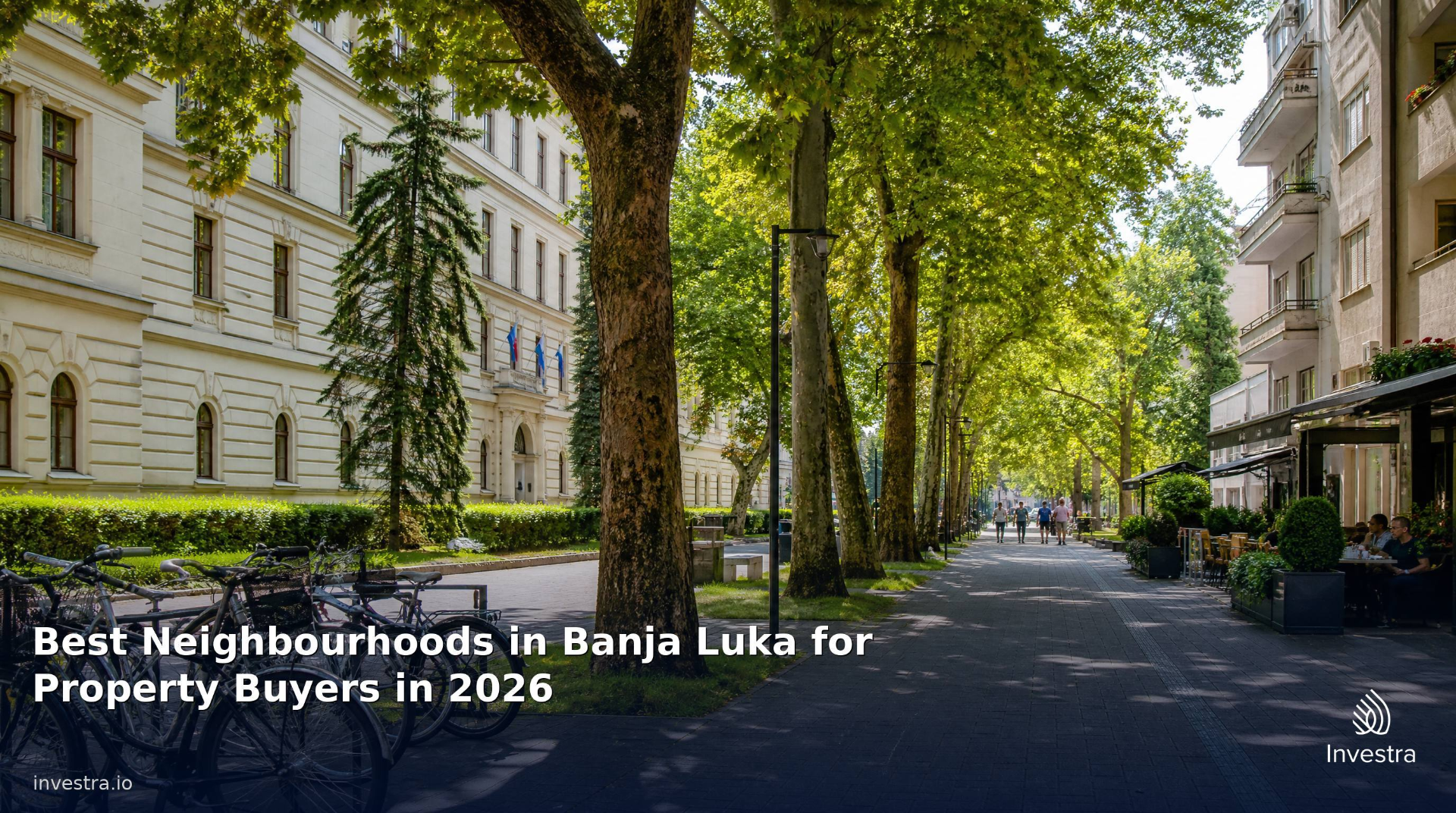
Best Neighbourhoods in Banja Luka for Property Buyers in 2026
Best Neighbourhoods in Banja Luka for Property Buyers in 2026
Why Banja Luka Is Capturing International Property Buyers' Attention in 2026
Quick Answer: Banja Luka, the administrative centre of Republika Srpska, offers competitively priced urban real estate in the Western Balkans, with average property prices between €900 and €2,200/m² depending on neighbourhood — attracting both lifestyle buyers and yield-focused investors. Investra.io provides real-time market intelligence for buyers exploring this emerging market.
There's a quiet but unmistakable shift happening in the Western Balkans property market. While Sarajevo and Mostar tend to dominate headlines, Banja Luka — Bosnia and Herzegovina's second-largest city and the capital of Republika Srpska — has been steadily building a reputation among savvy investors who prefer to establish positions before mainstream attention arrives.
For international buyers, the critical question extends beyond "should I invest in Banja Luka?" to the more specific "which neighbourhood?" The city has genuinely distinct residential zones, each with its own character, price point, tenant profile, and growth trajectory. Understanding these distinctions separates thoughtful acquisitions from overpriced mistakes. Consultants like Siniša Dagary — Investment Consultant have been instrumental in helping foreign buyers decode precisely these local market nuances across the Western Balkans region.
This guide breaks down Banja Luka's most important residential neighbourhoods, examines where prices are heading, and provides the practical framework necessary to buy with confidence in 2026.
Banja Luka Real Estate Market Overview: Prices, Trends, and the 2026 Landscape
Quick Answer: Banja Luka's residential property market ranges from roughly €700/m² for older socialist-era apartments in peripheral areas to over €2,500/m² for premium new-build units in central locations, with the broader city average sitting around €1,100–€1,400/m² in 2026.
Let's establish baseline market conditions, because in Banja Luka, the numbers are genuinely striking for anyone accustomed to Western European pricing.
According to local agency data compiled in early 2026, the average asking price for residential property across Banja Luka's urban core sits at approximately €1,150–€1,350 per square metre. That figure masks significant variation by neighbourhood, property age, and finishing standard — but it establishes the baseline.
Transaction volumes have been rising. Local notary data suggests residential transactions increased by approximately 12–15% year-on-year in 2024–2025, driven by domestic buyers upgrading from socialist-era apartments and a growing cohort of foreign purchasers.
New construction activity concentrates in several premium neighbourhoods and pushes headline prices upward for modern stock. Developer pre-sales for quality new builds in central and near-central locations routinely achieve €1,600–€2,200/m², with some luxury riverfront projects testing €2,500–€2,800 thresholds.
Rental yields across Banja Luka average 5–7% gross for well-located residential units, with short-term rental properties near the Vrbas River and Old Town achieving 7–9% during peak season. These figures compare favourably to saturated Western European markets and even to several Serbian cities where price appreciation has already compressed yields substantially. Investors exploring similar yield profiles in the broader Western Balkans region might also find the Loznica Real Estate Market 2026 Macva Region Property Guide useful as comparative reference.
Currency stability is also worth flagging. Bosnia and Herzegovina uses the Convertible Mark (BAM), which is pegged to the Euro at a fixed rate of 1.95583 BAM = 1 EUR — the same peg that has held since 1995. This eliminates currency risk for Euro-zone buyers entirely, a significant structural advantage compared to markets like Serbia where EUR/RSD fluctuation adds uncertainty.
Centar (City Centre): Banja Luka's Premium Address for Lifestyle and Investment
Quick Answer: Banja Luka's Centar neighbourhood commands prices of €1,500–€2,500/m² for quality apartments and represents the strongest market for short-term rentals and lifestyle buyers seeking walkability, culture, and riverside access.
Property prices here are the city's highest. New-build apartments in Centar typically list at €1,800–€2,500/m², with some boutique luxury developments along the Vrbas waterfront pushing into €2,500–€2,800 territory. Older well-maintained apartments ("stari fond") in the same zone can still be found at €1,200–€1,600/m², though supply of good-quality secondary stock is tightening.
What often surprises first-time Banja Luka buyers is just how liveable the centre actually is. Unlike some post-socialist city centres that feel half-empty or overly commercialised, Banja Luka's core has genuine residential density — families, young professionals, university students — translating into consistent rental demand year-round rather than seasonal spikes alone.
Short-term rental performance in Centar is strong. A well-furnished 45–55m² apartment in a good building near Gospodska Street or the Vrbas promenade can realistically generate €600–€900 monthly in peak summer months and €400–€600 in quieter winter periods.
For long-term rental investors, Centar delivers 5–6.5% gross yield, with monthly rents for a well-presented 50m² apartment running €400–€600. Demand is consistent, drawn from young professionals, government employees (Banja Luka hosts significant Republika Srpska government institutions), and international staff at NGOs and European delegations.
The primary risk in Centar is finding quality stock at reasonable entry prices — new developer projects here are often pre-sold to diaspora buyers or local high earners before they hit the open market. Building relationships with local agents and developers early is essential for accessing the best opportunities.
Borik: The Green Neighbourhood Families and Long-Term Investors Prefer
Quick Answer: Borik is Banja Luka's most family-oriented residential neighbourhood, with property prices of €1,000–€1,600/m², strong long-term rental demand driven by proximity to universities and schools, and gross rental yields averaging 5.5–6.5%.
If Centar is Banja Luka's showpiece, Borik is its foundation. Located northwest of the city centre, Borik was developed primarily in the 1970s and 1980s as a planned residential district, and it has aged remarkably well.
Borik also benefits enormously from its proximity to the University of Banja Luka campus and several major secondary schools, creating layered rental demand: families wanting school catchment areas, graduate students, and academic staff. This demographic mix insulates the area from vacancy spikes that can affect more narrowly tourism-dependent zones.
Prices in Borik reflect its desirability without reaching Centar's premium levels. Older socialist-era apartments in good condition typically sell for €900–€1,200/m², while renovated units and newer construction achieve €1,300–€1,600/m².
One practical advantage of Borik that deserves emphasis: parking. Unlike central Banja Luka where parking is increasingly scarce and expensive, Borik's planned layout means most buildings have associated parking, and street parking remains manageable. For tenant satisfaction and retention — particularly families with cars — this is a tangible quality-of-life differentiator.
Capital appreciation in Borik has been steady rather than spectacular, tracking at approximately 4–7% annually over the past three years. The market here isn't driven by speculative demand but by genuine end-user activity, which actually makes price growth more sustainable and predictable.
Starčevica: The Emerging Residential Belt Gaining Momentum
Quick Answer: Starčevica is Banja Luka's fastest-developing residential expansion zone, with prices ranging from €850–€1,500/m², significant new construction activity, and strong appeal among younger domestic buyers priced out of Centar — creating solid rental demand fundamentals.
Starčevica occupies the southern hillside belt of Banja Luka and has transformed substantially over the past decade from a secondary residential zone into one of the city's most active development corridors. Several factors converge here to create genuine investment momentum in 2026.
First, demographic change. Younger Banja Luka households — couples and young families buying their first property — are increasingly looking to Starčevica as an affordable alternative to Centar and Borik. New-build projects here specifically target this buyer segment with smaller, well-designed apartments at price points that stretch buying power further.
Second, infrastructure. The southern bypass road improvements and new retail development along the Starčevica corridor have dramatically improved connectivity and amenity access, reducing the perceived "distance" from the city centre. What felt suburban five years ago now feels genuinely integrated.
New-build apartment prices in Starčevica range from €1,100–€1,500/m² depending on specification and exact location. Older stock from the 1980s–1990s — which constitutes a substantial proportion of existing housing here — can be acquired for €850–€1,100/m², often requiring renovation investment of €150–€300/m² to bring to modern rental standards.
Gross rental yields in Starčevica for well-presented units average 5.5–7%, with the higher end achievable for renovated units near transport links. Monthly rents for a 55m² 2-bedroom apartment run €320–€450, reflecting the neighbourhood's more affordable character versus Centar while maintaining respectable occupancy rates of 85–92% annually for well-managed properties.
The medium-term capital appreciation story here is arguably the most interesting in the city. As Banja Luka's urban footprint expands and central prices push more buyers southward, Starčevica's relative affordability gap to Centar could narrow meaningfully over the next 5–8 years — delivering appreciation returns that complement existing yield income. Investors tracking similar emerging urban periphery opportunities in the Balkans region should also review the Prokuplje Real Estate Market 2026 Toplica Region Property Guide for comparative context on secondary city dynamics.
Lauš and Lazarevo: Budget Entry Points With Solid Yield Potential
Quick Answer: Lauš and Lazarevo offer Banja Luka's most affordable urban residential property at €700–€1,100/m², catering primarily to working-class renters and students, and delivering gross rental yields of 6–8% for investors willing to manage lower-end stock in an active rental market.
Not every investor comes to Banja Luka pursuing the luxury end of the market. For those focused purely on yield maximisation and cash-flow from day one, Lauš and Lazarevo — two adjacent residential areas in the eastern part of the city — present a compelling case that headline numbers don't always reveal.
These are working-class neighbourhoods in the honest, unsentimental sense of the term. Housing stock is predominantly socialist-era panel construction — the kind of reinforced concrete apartment blocks that Eastern Europeans of a certain generation know intimately. They're not glamorous, they don't photograph beautifully, and they're never going to win architectural awards.
The trade-offs are real and shouldn't be minimised. Property management in this segment is more hands-on, tenant turnover is higher, and maintenance demands are greater for ageing building stock. Vacancy periods between tenancies, while rarely extended, do occur and should be factored into yield projections.
For investors building a diversified portfolio across multiple Balkan markets — combining higher-appreciation assets in Centar-type neighbourhoods with high-yield properties in areas like Lauš — portfolio-level returns can be quite attractive. The Aleksinac Real Estate Market 2026 Southern Serbia Property Guide covers a similar market segment across the Serbian border, providing useful comparative benchmarks for this type of strategic allocation.
Rosulje and Recreation Zone: Banja Luka's Outdoor Lifestyle Premium
Quick Answer: Properties in the Rosulje area and Banja Luka's recreation zone along the Vrbas gorge command a lifestyle premium of 15–25% over comparable city properties, with strong appeal to short-term holiday renters and weekend retreat buyers seeking outdoor amenity access.
The residential areas bordering this recreation corridor — particularly Rosulje and the villa zones climbing the southern slopes — have a distinctly different character from urban Banja Luka. Houses and smaller villa-style developments here offer gardens, parking, river views, and direct trail access.
Prices in this zone vary considerably by exact location and property type. Single-family houses with land start from approximately €120,000–€200,000 for well-maintained older properties and rise to €350,000–€500,000+ for newly built luxury villas with premium river views and high-spec interiors.
The short-term rental market here is particularly interesting. With the outdoor tourism sector growing — Banja Luka's Recreation Zone received an estimated 150,000+ domestic visitors annually in recent years — well-positioned properties can achieve occupancy rates of 60–75% on short-term rental platforms during the April–October peak season.
For the right buyer profile — someone who genuinely values the lifestyle alongside the investment metrics — this is the most exciting part of the Banja Luka market. The expertise of consultants featured on platforms like Business Strategy Blog can help buyers assess whether lifestyle-premium properties genuinely deliver investment returns or whether the lifestyle discount ultimately erodes yield performance over time.
Legal Process for Foreign Buyers in Bosnia and Herzegovina
Quick Answer: Foreign nationals can generally purchase residential and commercial real estate in Bosnia and Herzegovina with reciprocity conditions, and the transaction process typically takes 4–12 weeks from offer to registered ownership, with total transaction costs of approximately 6–9% of the purchase price.
Buying property in Bosnia and Herzegovina as a foreigner is entirely achievable, but the legal framework has specific characteristics that buyers must understand before proceeding. The country operates under a dual-entity structure — Republika Srpska and the Federation of Bosnia and Herzegovina — and property law, while broadly aligned, has some differences between entities.
Foreign nationals can purchase real estate in Republika Srpska under the principle of reciprocity — meaning citizens of countries that allow Bosnian nationals to own property can purchase in BiH on equivalent terms. This covers virtually all EU member states, UK, US, Canadian, Australian, and most other Western country nationals.
The transaction process follows these core stages:
Pre-contract (Predugovor): Once a price is agreed, a preliminary contract is signed and a deposit of typically 10% is paid. This is legally binding and protects both parties during the due diligence period, which typically runs 2–4 weeks.
Due diligence: A local lawyer or notary conducts a land registry (Katastar) search to confirm title, identify any encumbrances, mortgages, or disputes, and verify building permits for newer construction. This stage is critical — Bosnia's land registry history includes some complex ownership situations arising from the 1990s conflict period, and thorough verification is non-negotiable. Working with firms connected to services like Findes Financial Services can help international buyers structure financial due diligence alongside the legal process.
Notarised sale contract: The main purchase contract must be certified by a notary (Notar) in Republika Srpska. Both parties attend (or grant power of attorney to legal representatives), the contract is read and signed, and the balance of the purchase price is transferred.
Land registry registration: Following notarisation, the buyer's ownership is registered at the relevant Land Registry court. This process currently takes 4–8 weeks in Banja Luka, after which the buyer receives their ownership certificate (List nepokretnosti).
The overall experience is straightforward by Balkan standards — particularly compared to markets like North Macedonia or Albania where title complexities are more common. Banja Luka's land registry is digitised and generally reliable, and the notary system provides genuine legal protection for buyers.
Rental Yields, ROI Analysis, and What Investors Are Actually Achieving in 2026
Quick Answer: Long-term rental yields in Banja Luka average 5–7% gross depending on neighbourhood and property type, short-term rentals in prime locations achieve 7–10%, and total investment ROI over 5-year hold periods (including appreciation) has been running at approximately 8–12% annually for well-selected properties.
The real question for any investor isn't the listing price — it's what you actually make. Let's work through concrete Banja Luka scenarios that reflect what we're seeing in the market in 2026.
Scenario A: Central Apartment, Long-Term Rental A 55m² renovated 2-bedroom apartment in Centar purchased for €88,000 (€1,600/m² basis) and let to a young professional renting at €500 monthly. With transaction costs of €7,000, total invested capital is €95,000. Annual rental income is €6,000 gross.
Scenario B: High-Yield Secondary Market Property A 50m² apartment in Lauš purchased for €35,000 (€700/m² basis) and let to working-class tenants at €300 monthly. With transaction costs of €2,500, total invested capital is €37,500. Annual rental income is €3,600 gross.
Scenario C: Starčevica Growth Play A 60m² newer apartment in Starčevica purchased for €72,000 (€1,200/m² basis) and let at €400 monthly. With transaction costs of €5,400, total invested capital is €77,400. Annual rental income is €4,800 gross, delivering 6.2% yield.
These scenarios illustrate why Banja Luka is attracting investor attention: multiple paths to reasonable returns with entry prices that enable portfolio diversification. A €100,000 investment that might secure a 2–3-bedroom apartment in Centar can acquire 2–3 high-yielding units in secondary market areas, spreading risk while optimising for different return drivers.
Market Dynamics, Currency Stability, and Forward-Looking Growth Factors
Quick Answer: Banja Luka's property market is supported by structural factors including currency stability (BAM peg), ongoing infrastructure investment, EU approximation processes, and demographic trends favouring urban investment, positioning the market for sustained 5–8% annual appreciation over the medium term (5–10 years).
Beyond individual neighbourhoods and properties, understanding the broader market forces that move Banja Luka's real estate sector is essential for any serious investor making a multi-year commitment.
Currency stability deserves repetition. The BAM is pegged to the Euro at 1.95583 — fixed since 1995, unchanged for three decades. This eliminates an entire category of risk that affects property investors in neighbouring Serbia, Montenegro, or Albania. For Euro-zone investors, acquisition, holding, and eventual disposal involve no currency conversion risk whatsoever.
Infrastructure investment is advancing. The Pan-European Corridor Vc — the motorway connecting Hungary through Banja Luka toward the Adriatic — continues
Investment Disclaimer
Quick Answer: This guide is general market information, not personal legal, tax, financing or investment advice.
Before committing to a property transaction, buyers should obtain independent local legal, tax and financial advice suited to their circumstances. Investra.io can support initial market research, but every purchase decision remains the buyer's responsibility.
Frequently Asked Questions
Quick Answer: This section explains the practical property-investment implications of Frequently Asked Questions.
What is a prudent next step after initial market research?
Use current documentation, independent professional advice and comparable local evidence before proceeding. Investra.io can support an initial structured market review.
How can buyers plan a realistic ownership budget?
Use current documentation, independent professional advice and comparable local evidence before proceeding. Investra.io can support an initial structured market review.
What evidence supports a careful investment decision?
Use current documentation, independent professional advice and comparable local evidence before proceeding. Investra.io can support an initial structured market review.
When should a buyer obtain legal and tax advice?
Use current documentation, independent professional advice and comparable local evidence before proceeding. Investra.io can support an initial structured market review.
How should a buyer compare neighbourhoods and property types?
Use current documentation, independent professional advice and comparable local evidence before proceeding. Investra.io can support an initial structured market review.
What local checks should be completed before signing?
Use current documentation, independent professional advice and comparable local evidence before proceeding. Investra.io can support an initial structured market review.
Which costs should be assessed alongside the purchase price?
Use current documentation, independent professional advice and comparable local evidence before proceeding. Investra.io can support an initial structured market review.
How can international buyers verify a property opportunity?
Use current documentation, independent professional advice and comparable local evidence before proceeding. Investra.io can support an initial structured market review.
What should buyers compare before selecting a property?
Use current documentation, independent professional advice and comparable local evidence before proceeding. Investra.io can support an initial structured market review.
Quick Answer: These answers outline common buyer checks and should be read with current professional advice.
Recommended Reading
Quick Answer: This section explains the practical property-investment implications of Recommended Reading.
- Investra market research
- Investra market research
- Investra market research
- Investra market research
- Investra market research
- Investra market research
- Investra market research
- Investra market research
- Investra market research
- Investra market research
- Investra market research
- Investra market research
- Investra market research
- Investra market research
- Investra market research
- Investra market research
- Investra market research
- Siniša Dagary investment insight
- Siniša Dagary investment insight
- Siniša Dagary investment insight
- Siniša Dagary investment insight
- Siniša Dagary investment insight
- Findes Group & Partners
- Findes Group & Partners
Connect With Investra
Follow Investra for market updates on Facebook, LinkedIn, YouTube
Related Posts
No related posts available.
