
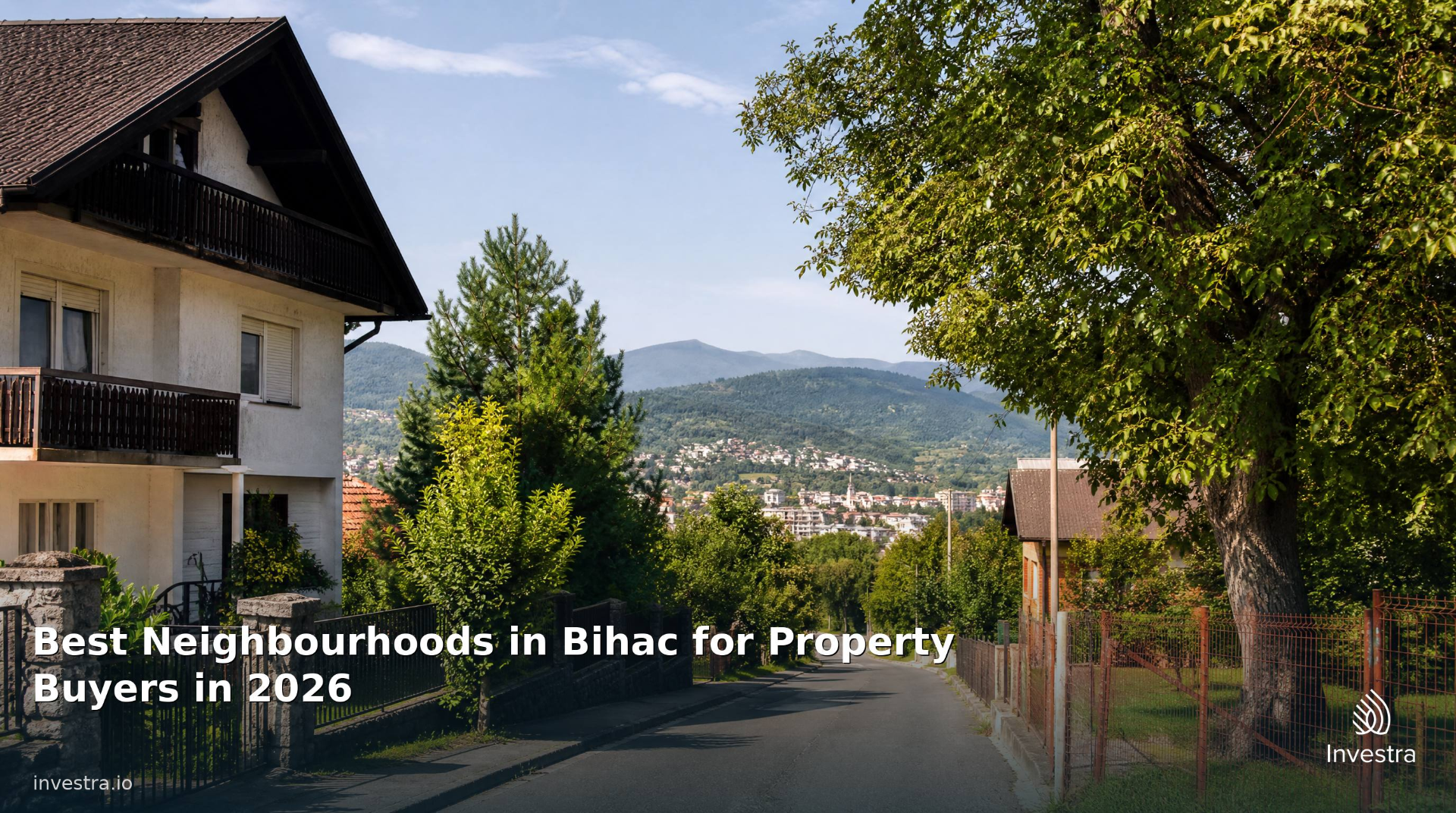
Best Neighbourhoods in Bihac for Property Buyers in 2026
Best Neighbourhoods in Bihac for Property Buyers in 2026
Why Bihac Is Attracting Property Buyers in 2026
Quick Answer: Bihac is attracting property buyers in 2026 due to its combination of affordable prices (€500–€1,200/m²), growing tourism economy, Una River attractions, and strategic position near the Croatian border — making it one of the most compelling emerging markets in the Western Balkans. Investra.io tracks emerging Balkan real estate markets to help investors identify opportunities early.
Tucked into the northwestern corner of Bosnia and Herzegovina, Bihac doesn't yet appear on most international investors' radar. That's precisely why it's interesting. The city of roughly 60,000 people sits along the emerald-green Una River — a UNESCO-nominated waterway that draws kayakers, rafters, and nature tourists from across Europe every summer.
What surprised many buyers who visited in 2025 and early 2026 is the sheer livability of Bihac. It has a functioning city centre, solid infrastructure, a hospital, university, and a cultural identity shaped by centuries of Ottoman, Austro-Hungarian, and Yugoslav history. The Una National Park literally borders the urban area, and the river runs right through the city.
The real estate market here tells a straightforward story: prices are low, demand is beginning to tick upward, and the gap between current valuations and future potential is meaningful. Rental yields in the tourist season can be surprisingly strong, and long-term residential demand is supported by a young local population and diaspora returnees investing in family properties.
For broader context on how smaller Balkan cities are performing as investment destinations, resources like Siniša Dagary's Business Strategy Blog offer regional analysis that serious investors should be reading alongside market-specific guides like this one.
Understanding Bihac's Urban Layout and District Structure
Quick Answer: Bihac is divided into a compact city centre (Gradska Jezgra), riverside zones, newer residential suburbs, and surrounding settlements — each with distinct price levels, buyer profiles, and investment characteristics that shape neighbourhood selection in 2026.
Before comparing neighbourhoods, it helps to understand how Bihac is structured physically. The city grew historically along the Una River, with the old Ottoman-era core forming the nucleus and Austrian-period extensions radiating outward in the late 19th and early 20th centuries.
Today, Bihac's urban fabric can be understood in roughly five distinct zones. The historic centre and its immediate surroundings represent the most character-rich real estate. The riverside strips — particularly along the Una's left and right banks — offer both scenic value and tourism-oriented investment potential.
This geographic layering matters for buyers because each zone carries different yield profiles, different buyer competition levels, and different planning environments. A property in the centre faces different renovation rules than one in Ozimice. A riverside cottage near Ripac has a completely different rental market than an apartment in the city's main residential blocks.
The city's relationship with the Una River also shapes everything — flood zone proximity, scenic premiums, tourism access, and even neighbourhood social character all link back to where a property sits relative to the water.
Gradska Jezgra (City Centre) — Premium Character, Heritage Appeal
Quick Answer: Bihac's city centre offers the most character-rich properties in the market, with prices ranging from €800–€1,500/m² for renovated apartments and commercial units, making it the top choice for buyers seeking heritage appeal and short-term rental potential.
The Gradska Jezgra — literally "urban core" — is where Bihac's history is most tangible. The Fethija Mosque, converted from a medieval church, anchors the old town skyline. Narrow streets lined with Austro-Hungarian facades give way to small squares and riverside promenades. This is the Bihac that ends up in photographs, and that visual character translates directly into real estate value.
Properties here include older apartment buildings, former commercial premises converted to residential use, and a small but growing number of boutique renovation projects. Prices for renovated apartments in the centre cluster around €900–€1,200/m², with exceptional units or heritage-listed buildings occasionally reaching €1,400–€1,500/m².
The short-term rental market in the centre is the most developed in Bihac. Tourist footfall is concentrated here, and proximity to restaurants, cafes, and the river promenade makes centre apartments genuinely desirable for Airbnb-style accommodation. During peak summer months (June–September), well-positioned apartments achieve occupancy rates of 70–85%, with nightly rates of €35–€75 depending on size and finish quality.
Ozimice — The Preferred Residential Suburb for Local Families and Buy-to-Let
Quick Answer: Ozimice is Bihac's most active residential suburb in 2026, with apartment prices ranging from €700–€1,000/m² for new builds and solid long-term rental yields of 5–7%, making it the most liquid and reliable neighbourhood for buy-to-let investors.
If the city centre attracts buyers chasing character and tourism income, Ozimice attracts buyers who want to understand the actual residential market that serves Bihac's permanent population. This sprawling suburb to the south and southwest of the centre has been the primary zone for new residential construction since the 2000s, and it accounts for the majority of transaction volume in Bihac's property market.
What makes Ozimice compelling for buy-to-let is pure residential demand fundamentals. Bihac's university generates consistent student and young professional rental demand year-round. The Una Kantona (Una-Sana Canton) administrative functions are largely based here, creating a stable public sector employment base.
New construction in Ozimice is worth monitoring carefully. Several local developers have active projects, and buying off-plan or in early construction phases typically unlocks a 10–15% price discount versus completed units. This creates natural capital appreciation as the building completes — a dynamic we've seen play out repeatedly in other emerging Balkan markets like Loznica in Serbia's Macva Region.
Prekounje — Quiet, Green, and Increasingly Sought-After
Quick Answer: Prekounje offers a quieter, greener residential alternative to Ozimice with slightly lower prices (€600–€950/m²), stronger family buyer appeal, and growing demand driven by professionals seeking space and proximity to nature without leaving the city.
Prekounje sits on the other side of the Una from the main commercial spine of Bihac, and that simple geographic fact gives it a distinct character. The neighbourhood feels more spacious — wider streets, more green space between buildings, and a noticeable quietness that appeals to families with children and older buyers seeking a calmer lifestyle.
Property prices here run slightly below Ozimice for comparable quality — typically €600–€900/m² depending on condition and exact location. The housing mix tilts more toward detached and semi-detached houses with gardens, though apartment blocks exist.
Long-term rental yields here are slightly lower than Ozimice (4–6% gross) because the family home segment doesn't capture the same student/professional rental pool, but capital appreciation prospects are arguably stronger as the neighbourhood builds out its residential identity.
Una Riverside and Korzo Area — Tourism Gold, High Yields, Complex Ownership
Quick Answer: Properties along Bihac's Una riverside and Korzo promenade command the highest short-term rental yields in the city (7–11% gross in peak season), but also carry higher prices (€1,000–€1,800/m² for prime positions) and greater complexity around ownership rights and historic building regulations.
The Una River is Bihac's defining asset, and properties directly on or close to the riverbank know it. The Korzo — the riverside promenade that serves as the social spine of Bihac — is lined with cafes, restaurants, and an increasingly sophisticated hospitality infrastructure. Apartments and commercial premises here aren't just real estate; they're positions in the city's tourism economy.
Prices reflect the premium: riverside-facing apartments in good condition trade at €1,000–€1,500/m², with exceptional properties in historic buildings or with unobstructed water views reaching €1,700–€1,800/m². This is genuinely expensive by Bihac standards, but the rental income potential justifies the premium for active investors.
The complexity here lies in ownership history. Many riverside properties carry complicated title situations — pre-war ownership records, socialist-era tenancy rights, reconstruction claims, and building permits that may not fully reflect current reality. Due diligence is absolutely non-negotiable before committing funds to any riverside property. Engaging a Bosnian notary and an independent property lawyer is not optional — it's the minimum standard. For investors unfamiliar with Western Balkans property law, consulting specialists like Siniša Dagary — Investment Consultant before committing to a riverside transaction is strongly advisable.
That said, for buyers who do the proper groundwork and secure clean title, riverside Bihac properties represent some of the most compelling short-term rental investments in Bosnia and Herzegovina today.
Ripac and the Una Canyon — Rural Retreats with Eco-Tourism Potential
Quick Answer: The Ripac area and Una Canyon corridor offer the most affordable property in greater Bihac, with rural houses and plots available from €20,000–€80,000, and significant upside for buyers developing eco-tourism, glamping, or rural retreat concepts tied to the Una National Park visitor economy.
Roughly 6–10 kilometres southeast of the city, the Una River narrows into dramatic canyon sections that form the heart of the Una National Park. Villages like Ripac, Golubic, and Klokot sit within or adjacent to this zone, and the properties here occupy a completely different market segment from the urban neighbourhoods described above.
Houses and plots in this rural corridor sell for prices that genuinely shock buyers arriving from Western Europe. A stone farmhouse with 500m² of land in basic habitable condition can be acquired for €25,000–€50,000. Larger properties with significant land, outbuildings, and river access on private grounds occasionally come to market in the €60,000–€120,000 range.
The investment thesis in this zone isn't residential rental — it's tourism. Una National Park recorded over 200,000 visitor entries in 2023, with numbers growing year-on-year driven by kayaking, rafting, hiking, and agritourism demand from Croatia, Slovenia, and increasingly Germany and Scandinavia.
Planning and permitting in the Una National Park zone requires specific attention — the National Park Authority maintains strict rules about construction, land use, and environmental impact. These rules are not insurmountable for well-designed eco-tourism projects, but buyers who ignore them face real problems. The most successful operators in this zone work closely with local authorities from the earliest planning stages.
New Construction Zones — Emerging Development Areas in Greater Bihac
Quick Answer: Bihac's newer development zones on its urban periphery offer new-build apartments at €750–€1,050/m² with modern specifications, representing the best value for buyers prioritising condition, warranties, and mortgage financing eligibility over location character.
Beyond the established neighbourhoods, Bihac has seen active new residential development on its periphery throughout the 2020s. These projects don't have the river views of the Korzo or the character of the old town, but they offer something that older stock can't: modern construction standards, elevator access, underground parking, energy-efficient specifications, and clean title with no historical complications.
New builds in these zones typically price at €750–€1,050/m², with higher finishes pushing toward the upper end. Developers are primarily local and regional Bosnian companies, though a handful of Croatian and Slovenian developers have entered the market. Payment structures for off-plan purchases typically follow a phased model: 20–30% on contract, milestone payments during construction, and final settlement on handover.
The new construction zones also benefit from improving infrastructure — the Bihac municipality has been active in road improvements, utility upgrades, and public space development in these areas. This infrastructure investment, combined with the scarcity of quality modern housing relative to demand, suggests that new build prices in Bihac's periphery have meaningful upside as the city's middle class expands. The dynamic here mirrors patterns we've documented in other emerging markets, from Prokuplje in Serbia's Toplica Region to Sremska Mitrovica in Vojvodina.
Legal Framework for Foreign Buyers in Bosnia and Herzegovina
Quick Answer: Foreign nationals from EU member states and countries with reciprocal agreements can purchase property in Bosnia and Herzegovina on terms broadly equal to citizens, though the process involves notarised contracts, land registry registration, and careful due diligence on title given the country's complex post-war property history.
Bosnia and Herzegovina's property ownership laws for foreigners are more accessible than many buyers expect, but the administrative process requires patience and professional guidance. The country operates under a federal structure — the Federation of Bosnia and Herzegovina (FBiH) and Republika Srpska (RS), plus the Brčko District — and Bihac falls within the Federation, which means its property laws are those of FBiH.
The real estate transfer tax in the Federation of BiH is set at 5% of the assessed market value — this is the buyer's primary tax cost. Annual property taxes exist but are minimal, typically below 0.1% of assessed value. There is no capital gains tax on property held for more than two years, which is a genuinely attractive feature for investors planning medium to long-term holds.
The critical due diligence step is title verification. Bosnia's land registry system is digitising but remains partially paper-based and subject to the consequences of wartime disruption in the 1990s. Properties may carry unresolved inheritance claims, competing ownership records, or building permits that don't match actual construction. Engaging an independent legal professional — not the selling agent's recommended lawyer — to perform a comprehensive title check before signing anything is the single most important piece of practical advice for any foreign buyer in Bihac. Financial planning resources like Findes Financial Services can assist in structuring cross-border purchase financing appropriately.
Rental Yields and ROI Analysis Across Bihac Neighbourhoods
Quick Answer: Rental yields in Bihac range from 4–6% for long-term residential rentals in quieter suburbs to 7–11% for well-managed short-term tourist rentals in the city centre and riverside areas, with total ROI projections over 5–7 years including capital appreciation running at 35–60% depending on neighbourhood.
Let's put concrete numbers on the investment case, because the narrative is most powerful when backed by data. The following represents estimated market data for 2026 based on observed transactions, rental listings, and operator reporting in Bihac and the Una-Sana Canton.
In the city centre and Korzo area, a 50m² apartment acquired at approximately €55,000–€70,000 (around €1,100–€1,400/m²) and operated as a short-term rental can generate gross seasonal income of €8,000–€14,000/year. Net of platform fees (15–20%), cleaning costs, and management, realistic net income runs €5,500–€10,000.
In Ozimice for buy-to-let, a 65m² 2-bedroom apartment acquired at €60,000–€75,000 rents for €350–€420/month on a 12-month lease. Gross annual income of €4,200–€5,040 against an acquisition price of €67,500 average gives roughly 6.2–7.5% gross yield. Factor in a vacancy buffer and property management costs, and net yields land in the 5–6% range. Not spectacular, but stable and predictable.
Capital appreciation projections are harder to pin down precisely, but the data points are encouraging. Bihac residential prices increased approximately 18–25% between 2020 and 2025 — roughly 3.5–5% annually — on the back of diaspora demand, improving infrastructure, and the tourism narrative gaining momentum.
The technology-driven shift in how investors find and manage Balkan properties is also worth tracking. Resources examining Serbia's Proptech landscape in 2026 offer a preview of where BiH's digital real estate infrastructure is heading, with online listing platforms, digital land registry access, and virtual property tours becoming standard tools for international buyers in the region.
Practical Buying Guide — Costs, Timeline, and Process for International Investors
Quick Answer: International buyers in Bihac should budget 6–9% above the purchase price for transaction costs (5% transfer tax, 1–2% notary and legal fees, 0.5–1% registration), with a typical purchase timeline of 4–10 weeks from offer to completed registration depending on title complexity.
Understanding the total cost of buying in Bihac — not just the headline property price — is essential for accurate return modelling. The primary transaction costs are as follows. The real estate transfer tax is 5% of assessed value, payable within 30 days of the purchase agreement being registered. Notary fees typically run 0.5–1% of the transaction value, with minimums applying on lower-value deals.
For international buyers managing transactions from abroad, the logistics are increasingly manageable. Most notaries accept payment by international bank transfer, and digital document execution is becoming standard. However, the initial property inspection and the final walkthrough really do require in-person presence or hiring a trusted local representative to attend on your behalf.
Currency considerations matter too. The Bosnian Convertible Mark is pegged to the Euro (1 EUR = approximately 1.956 BAM), so transaction costs and acquisition prices are effectively denominated in EUR terms regardless of whether contracts technically reference BAM. This reduces currency risk for European buyers significantly.
Tax Implications and Ownership Structuring
Quick Answer: Foreign owners in Bosnia and Herzegovina face minimal annual property tax (typically under 0.1% of assessed value) and no capital gains tax on properties held over two years, making Bihac attractive for long-term holds, though rental income is taxed as personal income at progressive rates up to 20%.
Beyond the purchase-side transaction costs, ongoing tax obligations are modest compared to most Western European jurisdictions. Annual property tax in the
Investment Disclaimer
Quick Answer: This guide is general market information, not personal legal, tax, financing or investment advice.
Before committing to a property transaction, buyers should obtain independent local legal, tax and financial advice suited to their circumstances. Investra.io can support initial market research, but every purchase decision remains the buyer's responsibility.
Frequently Asked Questions
Quick Answer: This section explains the practical property-investment implications of Frequently Asked Questions.
What is a prudent next step after initial market research?
Use current documentation, independent professional advice and comparable local evidence before proceeding. Investra.io can support an initial structured market review.
How can buyers plan a realistic ownership budget?
Use current documentation, independent professional advice and comparable local evidence before proceeding. Investra.io can support an initial structured market review.
What evidence supports a careful investment decision?
Use current documentation, independent professional advice and comparable local evidence before proceeding. Investra.io can support an initial structured market review.
When should a buyer obtain legal and tax advice?
Use current documentation, independent professional advice and comparable local evidence before proceeding. Investra.io can support an initial structured market review.
How should a buyer compare neighbourhoods and property types?
Use current documentation, independent professional advice and comparable local evidence before proceeding. Investra.io can support an initial structured market review.
What local checks should be completed before signing?
Use current documentation, independent professional advice and comparable local evidence before proceeding. Investra.io can support an initial structured market review.
Which costs should be assessed alongside the purchase price?
Use current documentation, independent professional advice and comparable local evidence before proceeding. Investra.io can support an initial structured market review.
How can international buyers verify a property opportunity?
Use current documentation, independent professional advice and comparable local evidence before proceeding. Investra.io can support an initial structured market review.
What should buyers compare before selecting a property?
Use current documentation, independent professional advice and comparable local evidence before proceeding. Investra.io can support an initial structured market review.
Quick Answer: These answers outline common buyer checks and should be read with current professional advice.
Recommended Reading
Quick Answer: This section explains the practical property-investment implications of Recommended Reading.
- Investra market research
- Investra market research
- Investra market research
- Investra market research
- Investra market research
- Investra market research
- Investra market research
- Investra market research
- Investra market research
- Investra market research
- Investra market research
- Investra market research
- Investra market research
- Investra market research
- Investra market research
- Investra market research
- Investra market research
- Siniša Dagary investment insight
- Siniša Dagary investment insight
- Siniša Dagary investment insight
- Siniša Dagary investment insight
- Siniša Dagary investment insight
- Findes Group & Partners
- Findes Group & Partners
Connect With Investra
Follow Investra for market updates on Facebook, LinkedIn, YouTube
Related Posts
No related posts available.
