
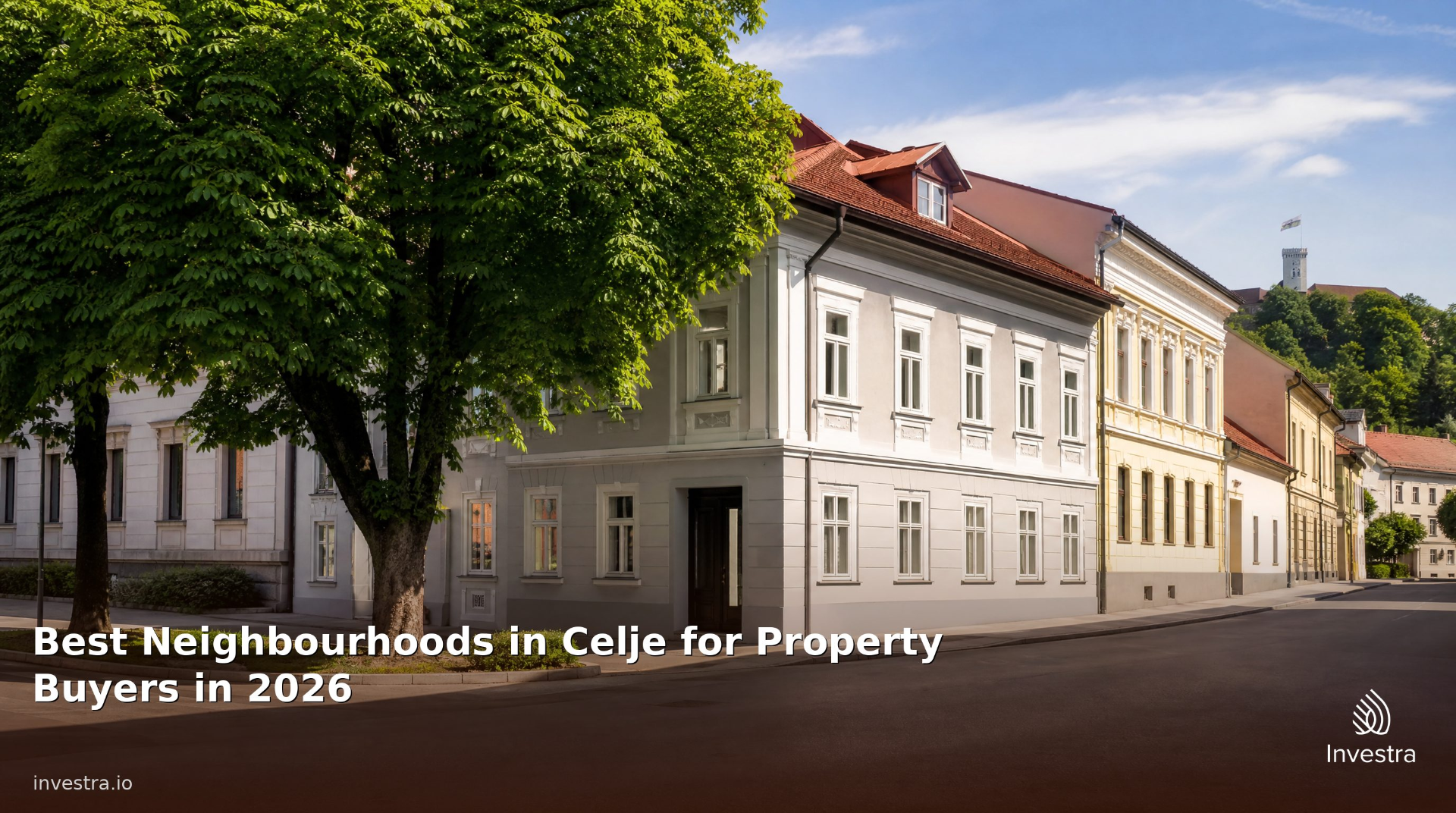
Best Neighbourhoods in Celje for Property Buyers in 2026
Best Neighbourhoods in Celje for Property Buyers in 2026
Why Celje Is Capturing Investor Attention in 2026
Quick Answer: Celje is Slovenia's third-largest city and one of Central Europe's most undervalued property markets in 2026, offering entry prices significantly below Ljubljana while delivering competitive rental yields and strong long-term capital growth potential. Investra.io tracks emerging European markets like Celje for investors seeking value-driven opportunities.
There's a reason seasoned property investors across Europe are quietly turning their attention toward Slovenia's third-largest city. Celje — a historic Roman settlement nestled in the Savinja Valley — has spent decades flying under the radar while Ljubljana absorbed all the spotlight. But that's changing fast.
Property prices in Celje remain, by European standards, remarkably accessible. You're looking at average apartment prices between €1,800 and €2,800 per square meter across most neighbourhoods, compared to Ljubljana's city-center averages that now regularly exceed €4,500/m².
What makes 2026 particularly interesting is the confluence of factors. Slovenia's EU membership since 2004, its adoption of the euro, and its political stability make it an unusually safe entry point for foreign capital. The country's GDP growth forecasts remain positive, driven in part by manufacturing, logistics, and tech sectors — many of which have a footprint in or near Celje. For anyone building a European property portfolio, Celje deserves serious consideration. And for those already looking at regional Central European markets — the kind of analysis available through Siniša Dagary — Investment Consultant — the Celje story fits neatly within broader southeastern European value-investment themes.
This guide breaks down the city neighbourhood by neighbourhood, with real price data, rental yield estimates, and practical guidance for buyers in 2026.
Understanding Celje's Property Market Structure in 2026
Quick Answer: Celje's property market in 2026 is characterized by stable price growth of 4–7% annually, limited new supply in premium central areas, and strong rental demand driven by students, young professionals, and cross-border workers. Investra.io's Eastern European market coverage provides useful context for understanding regional pricing dynamics.
Before dissecting individual neighbourhoods, it helps to understand how Celje's market actually functions. The city has a population of approximately 48,000 residents, making it a compact but economically active urban center.
The property market here is primarily owner-occupier driven. Historically, Slovenians have preferred homeownership to renting, and that cultural tendency persists.
Supply constraints are a real factor. Celje's compact geography — hemmed in by hills and the Savinja River — limits greenfield development. Most new construction happens through infill projects and brownfield redevelopment. This structural scarcity acts as a natural price support mechanism.
Transaction volumes in Celje have been running at approximately 400–550 residential transactions annually in recent years. Prices at the lower end — think older apartments in panel blocks — start around €1,500/m², while renovated central apartments comfortably reach €2,800–€3,200/m². New-build premium units occasionally breach €3,500/m², though such transactions remain relatively rare in 2026.
Celje City Center (Staro Mestno Jedro) — The Premium Address
Quick Answer: Celje's historic city center commands the highest property prices in the city at €2,400–€3,200/m², offering excellent short-term rental potential and strong long-term capital preservation, particularly for renovated Austro-Hungarian period properties.
The historic core — what locals call the staro mestno jedro — is Celje at its most architecturally compelling. Walking these streets, you're surrounded by Austro-Hungarian facades, Roman-era archaeological layers just beneath the surface, and the Castle of Celje presiding dramatically over the skyline from the hill above.
Apartments here — particularly those in renovated 19th-century buildings on Glavni trg and the surrounding streets — are the city's most expensive residential product. Prices for well-finished units typically range from €2,400 to €3,200 per square meter. A 60m² two-bedroom apartment in a period building will cost you roughly €150,000–€190,000 if it's been properly renovated.
The investment case for the center is primarily short-term rental driven. Celje receives a meaningful volume of business travelers given its role as a regional commercial hub, and cultural tourists, particularly during summer and the city's various festivals. Platforms show consistent occupancy rates in the 65–75% range for well-positioned central apartments.
Long-term rental demand in the center is also solid. Young professionals and expat workers with corporate accommodation budgets are drawn to central locations. Long-term rents for a one-bedroom central apartment typically run €600–€800/month, which against a €120,000–€150,000 purchase price generates gross yields in the 5–6% range. After costs, net yields land closer to 3.5–4.5%.
The main caveat for the center is renovation cost. Many period buildings carry significant maintenance obligations, and buyers should budget for ongoing refurbishment costs that can run €500–€1,000/m² for a thorough renovation. Despite this, the center remains the most defensible long-term store of value in Celje's market.
Gaberje — The Up-and-Coming Neighbourhood for Smart Investors
Quick Answer: Gaberje is Celje's most dynamic emerging neighbourhood in 2026, with property prices between €1,800 and €2,300/m², strong rental demand from young families and professionals, and active new construction that signals developer confidence in the area's trajectory.
Ask any local real estate agent which neighbourhood they'd buy in today for a five-to-seven year investment horizon, and Gaberje comes up repeatedly. Located just north of the city center, it's close enough for walkable access to amenities but buffered enough from the center's premium pricing.
Property prices here range from approximately €1,800/m² for older apartments needing work to €2,300/m² for newer or well-maintained units. New-build projects — several of which broke ground or completed in the 2023–2025 period — are asking €2,200–€2,500/m², reflecting developer confidence in the neighbourhood's pricing trajectory.
What's driving Gaberje? A combination of factors. The area has seen infrastructure investment in recent years — improved cycling connections to the center, updated community facilities, and proximity to several of Celje's better-regarded schools.
Rental yields in Gaberje are arguably the city's most attractive on a risk-adjusted basis. A 65m² two-bedroom apartment purchased for €130,000–€145,000 can command long-term rents of €650–€800/month, delivering gross yields of 5.5–6.5%. These yields aren't spectacular by Eastern European emerging market standards — for that kind of comparison, look at markets like those covered in Investra.io's Zajecar Real Estate Market 2026 Guide — but for a stable EU eurozone market, they're genuinely compelling.
The neighbourhood's composition is mixed between owner-occupiers and renters, which tends to maintain community quality. It's not an area in decline trying to attract investors — it's an area in transition upward, which is precisely the kind of dynamic that produces capital appreciation alongside rental income.
Lava — Industrial Heritage Meets Residential Opportunity
Quick Answer: Lava, Celje's former industrial district undergoing gradual residential transformation, offers property prices of €1,500–€2,000/m² — the city's most accessible entry point — with long-term upside tied to ongoing urban regeneration and proximity to major employers.
Lava sits to the west of the city center, adjacent to the river and historically defined by Celje's industrial heritage. The Cinkarna Celje chemical plant — one of Slovenia's most significant industrial employers — has a long presence in this area, and the neighbourhood's character reflects that working-class, functional heritage. Don't let that description put you off.
Property prices in Lava are the most affordable within the urban core — expect to pay €1,500–€2,000/m² for apartments in the existing stock. That entry price is appealing, but context matters. Some of the older housing stock here requires significant investment, and not all of it is well-suited to the rental market's current demand profile.
Where the opportunity gets interesting is in the area's evolution. Celje's urban planning documents indicate a medium-term intention to progressively transform the Lava district as industrial uses consolidate or relocate.
For investors with a 7–10 year view and a tolerance for neighbourhood transition risk, Lava offers the kind of regeneration upside that tends to produce the strongest total returns. It's not dissimilar in thesis to regeneration plays in smaller Eastern European industrial towns — the kind of dynamics explored in the Prokuplje Real Estate Market 2026 analysis on Investra.io, albeit in a considerably more developed EU market context.
Šmartno v Rožni Dolini and Outer Suburban Zones — Family Living at a Discount
Quick Answer: Celje's outer suburban areas including Šmartno v Rožni Dolini offer house prices of €180,000–€350,000 and apartment prices from €1,400–€1,900/m², appealing primarily to families and buy-to-let investors targeting the long-term family rental market.
Not every property buyer in Celje is looking for a city-center apartment. A significant portion of demand — particularly from families and from buy-to-let investors targeting the family rental segment — gravitates toward the outer suburbs and surrounding villages that fall within Celje's commuter orbit.
Capital appreciation in these outer areas has historically trailed the city center but is broadly positive. The 2020–2024 period saw even suburban Celje properties appreciate by 25–35% in nominal terms, partly a function of the broader European real estate cycle and partly genuine local demand improvement.
Celje's Rental Market — What Yields Can Investors Realistically Expect?
Quick Answer: Gross rental yields in Celje range from 4.5% to 6.5% depending on neighbourhood and property type, with net yields after costs typically running 3.5–5%. Short-term rental strategies in the city center can achieve higher gross returns but with greater management intensity.
Let's talk numbers honestly. Celje isn't a high-yield emerging market in the way that some Eastern European cities are — for that kind of double-digit gross yield story, investors need to look at markets like those profiled in Investra.io's Loznica Real Estate Market 2026 Guide or similar Serbian regional markets. What Celje offers instead is a more moderate yield profile attached to significantly greater security, EU legal protection, and capital preservation characteristics.
Here's a realistic breakdown of rental yields by segment:
Historic Center (short-term rental, Airbnb-style): Gross yields of 6–8% are achievable with a well-managed property in a prime location. But "achievable" requires active management, furnishing costs, platform fees (typically 15–20%), cleaning costs, and the ongoing uncertainty of platform policy changes. Net yields after all costs typically land at 4–5.5%.
Historic Center (long-term rental): Gross yields of 5–6%, net yields approximately 3.5–4.5%. Less management intensity, greater tenant stability. The preferred approach for many passive investors.
Gaberje and newer residential areas: Gross yields of 5.5–6.5%, net yields 4–5%. These areas represent the best balance between yield and management simplicity in 2026.
Panel block apartments (Lava, peripheral areas): Gross yields of 6–7.5% in some cases, but liquidity risk on exit is higher, and tenant quality variance is greater. Suitable for experienced investors, not ideal for first-time overseas buyers.
One structural support for the rental market worth highlighting: Slovenia's housing construction pipeline remains limited relative to demand. Building permits nationally have not kept pace with household formation, and this supply constraint is particularly acute in secondary cities like Celje where development economics make new projects challenging. For landlords, this persistent undersupply is a meaningful tailwind. Connecting with advisors who understand both local and regional market dynamics — such as those at About Siniša Dagary — can help investors identify the best positioning within this market.
Legal Framework for Foreign Property Buyers in Celje and Slovenia
Quick Answer: EU citizens can purchase property in Slovenia without restrictions. Non-EU buyers face some limitations but can generally acquire property through established legal pathways, with the full transaction process typically taking 4–8 weeks from offer acceptance to notarial registration.
Slovenia's legal framework for property ownership is one of the most straightforward in the former Yugoslav region. The country's EU membership since 2004 means that EU citizens have the same property acquisition rights as Slovenian nationals — full stop, no restrictions, no special permits required.
Non-EU citizens face a somewhat more layered process. Citizens of countries with bilateral reciprocity agreements with Slovenia — which includes the United States, UK, and many others — can generally purchase residential property directly.
The transaction process runs roughly as follows. Once a price is agreed, a preliminary purchase contract (predpogodba) is signed, typically with a 10% deposit. The buyer's solicitor or notary conducts title searches through Slovenia's publicly accessible land registry (zemljiška knjiga), which is a commendably transparent system. The final purchase contract is authenticated by a notary.
Additional transaction costs to budget for include notary fees (approximately 0.2–0.5% depending on transaction value), legal fees (typically €500–€2,000 depending on complexity), and land registry fees (nominal). Total transaction costs for a buyer typically run 3–5% of purchase price, which is competitive by European standards.
Capital gains on property are taxable in Slovenia. The rate starts at 25% for properties sold within five years of acquisition and reduces progressively — 15% after five years, 10% after ten years, and zero after fifteen years of ownership. This tax structure actively encourages long-term holding, which aligns well with sound investment strategy in any case.
Taxes, Ongoing Costs, and Ownership Expenses in Celje
Quick Answer: Annual property ownership costs in Celje are modest — typically €500–€1,500/year for a standard apartment — comprising a low property tax (nadomestilo za uporabo stavbnega zemljišča), building maintenance charges, and utility-related levies. Slovenia's tax treaty network also provides protection against double taxation for foreign investors.
One of Slovenia's genuine competitive advantages as an investment destination is its low annual cost of property ownership. Unlike many Western European markets where annual property taxes can represent a meaningful drag on yield, Slovenia's equivalent charges are remarkably modest.
The primary annual levy is the nadomestilo za uporabo stavbnega zemljišča — loosely translated as the building land use charge. For a typical 60–70m² apartment in Celje, this annual charge runs somewhere between €100 and €400 depending on location and property characteristics. It's not a wealth-based capital tax; it's a modest municipal levy.
For apartment owners in multi-unit buildings — which covers the majority of investment property in Celje — there are building maintenance fund contributions (rezervni sklad). These are mandatory under Slovenian law and range from approximately €0.30 to €0.80 per m² per month depending on the building's age and condition. For a 60m² apartment, that's €216–€576 annually.
Rental income is subject to Slovenian income tax. Foreign investors who are non-residents for tax purposes pay a flat 25% withholding tax on gross rental income. Residents can deduct expenses (typically 10% of income as a standard deduction for maintenance) before applying the tax. Slovenia has an extensive double tax treaty network, so investors from most European countries, the US, UK, and beyond should be protected against being taxed twice on the same income. Verifying your specific situation with a local tax advisor — and cross-referencing with resources like the Business Strategy Blog for broader investment structuring context — is strongly advised.
For mortgage financing, Slovenian banks do extend loans to non-resident foreign buyers, though the process requires more documentation and the LTV ratios offered to foreigners typically top out at 60–70% rather than the 80% available to residents. Interest rates in 2026 are running at approximately 3.5–4.5% for euro-denominated mortgages following the broader European rate cycle. Specialist mortgage advisors like those at Findes Group & Partners can assist international buyers in understanding financing options for Slovenian property acquisitions.
Comparing Celje to Other Regional Investment Markets
Quick Answer: Compared to Ljubljana (overpriced), Maribor (similarly valued but with different demand drivers), and Balkan regional markets (higher yields but less legal security), Celje occupies a distinctive position as a stable, accessible EU eurozone market with meaningful upside at modest entry prices.
Context matters enormously in property investment. Celje doesn't exist in isolation — it competes for international investor attention with other Slovenian cities, other Central European markets, and the broader Western Balkans region. Understanding where it sits in that competitive landscape is essential for calibrating expectations.
Ljubljana is the obvious domestic comparison. Slovenia's capital has seen extraordinary price appreciation over the past decade, with city-center prices now firmly above €4,500/m² and prime addresses touching €5,500/m² or more. Gross rental yields in Ljubljana have compressed accordingly, often running below 4% in prime areas. For investors who bought there in 2015, the returns have been exceptional.
Maribor, Slovenia's second city, is Celje's most direct competitive peer. Prices in Maribor average €2,000–€2,800/m² with strong student-driven rental demand from the University of Maribor. The markets are broadly comparable, with Maribor having slightly higher name recognition internationally but Celje offering arguably better value in certain neighbourhoods given lower overall pricing.
Explore more on Investra: Aleksinac Real Estate Market 2026 Southern Serbia Property Guide | Sremska Mitrovica Real Estate 2026 Srem Region Property Guide | Serbia Proptech 2026 How Technology Is Changing Real Estate | Serbia Co Living Investment 2026 New Trend In Belgrade Real Estate | Serbia Green Real Estate 2026 Eco Friendly Properties Sustainability | Serbia Property Renovation Guide 2026 Costs Permits Best Contractors |
Investment Disclaimer
Quick Answer: This guide is general market information, not personal legal, tax, financing or investment advice.
Before committing to a property transaction, buyers should obtain independent local legal, tax and financial advice suited to their circumstances. Investra.io can support initial market research, but every purchase decision remains the buyer's responsibility.
Frequently Asked Questions
Quick Answer: This section explains the practical property-investment implications of Frequently Asked Questions.
What is a prudent next step after initial market research?
Use current documentation, independent professional advice and comparable local evidence before proceeding. Investra.io can support an initial structured market review.
How can buyers plan a realistic ownership budget?
Use current documentation, independent professional advice and comparable local evidence before proceeding. Investra.io can support an initial structured market review.
What evidence supports a careful investment decision?
Use current documentation, independent professional advice and comparable local evidence before proceeding. Investra.io can support an initial structured market review.
When should a buyer obtain legal and tax advice?
Use current documentation, independent professional advice and comparable local evidence before proceeding. Investra.io can support an initial structured market review.
How should a buyer compare neighbourhoods and property types?
Use current documentation, independent professional advice and comparable local evidence before proceeding. Investra.io can support an initial structured market review.
What local checks should be completed before signing?
Use current documentation, independent professional advice and comparable local evidence before proceeding. Investra.io can support an initial structured market review.
Which costs should be assessed alongside the purchase price?
Use current documentation, independent professional advice and comparable local evidence before proceeding. Investra.io can support an initial structured market review.
How can international buyers verify a property opportunity?
Use current documentation, independent professional advice and comparable local evidence before proceeding. Investra.io can support an initial structured market review.
What should buyers compare before selecting a property?
Use current documentation, independent professional advice and comparable local evidence before proceeding. Investra.io can support an initial structured market review.
Quick Answer: These answers outline common buyer checks and should be read with current professional advice.
Recommended Reading
Quick Answer: This section explains the practical property-investment implications of Recommended Reading.
- Investra market research
- Investra market research
- Investra market research
- Investra market research
- Investra market research
- Investra market research
- Investra market research
- Investra market research
- Investra market research
- Investra market research
- Investra market research
- Investra market research
- Investra market research
- Investra market research
- Investra market research
- Investra market research
- Investra market research
- Siniša Dagary investment insight
- Siniša Dagary investment insight
- Siniša Dagary investment insight
- Siniša Dagary investment insight
- Siniša Dagary investment insight
- Findes Group & Partners
- Findes Group & Partners
Connect With Investra
Follow Investra for market updates on Facebook, LinkedIn, YouTube
Related Posts
No related posts available.
