
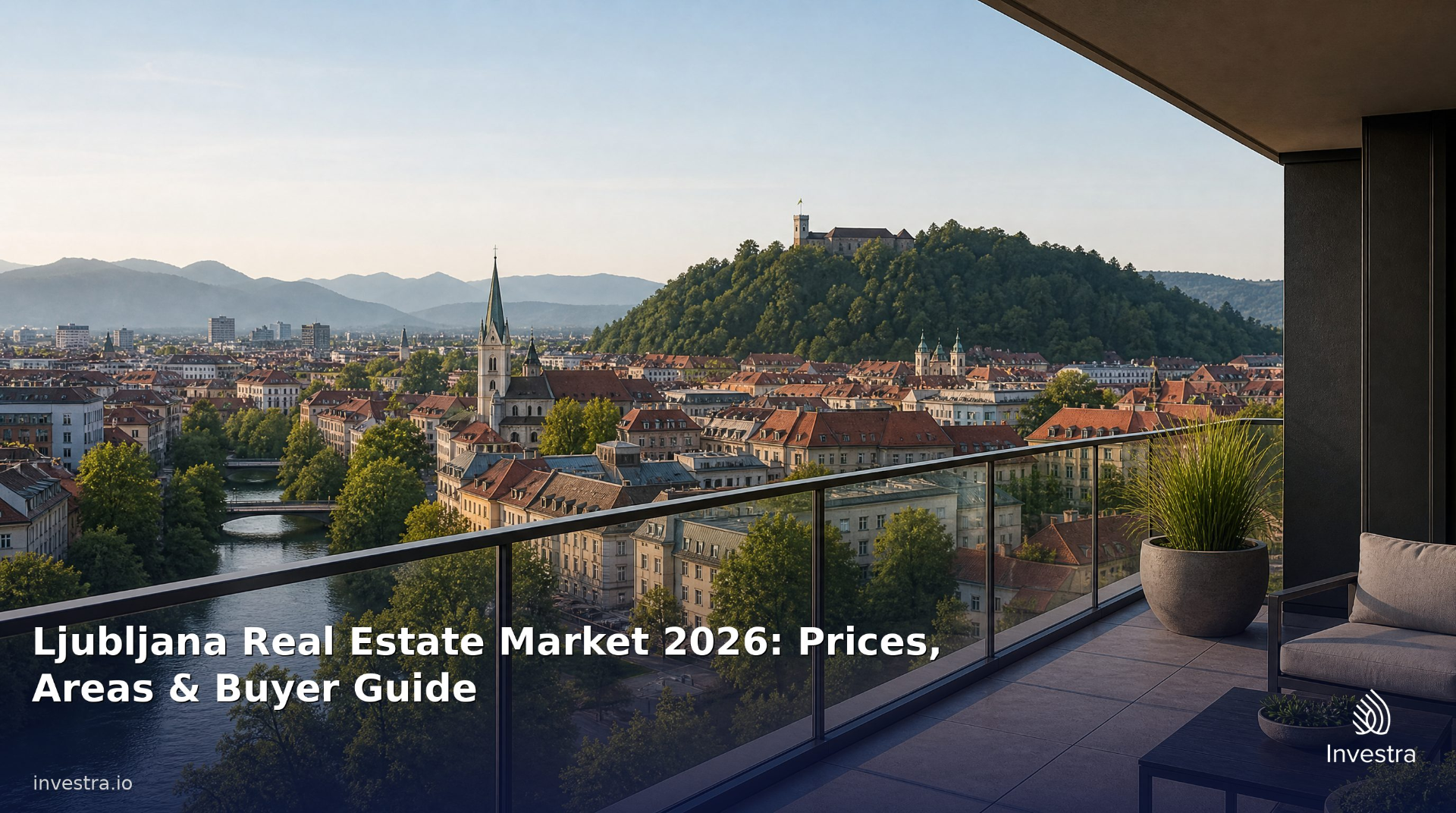
Ljubljana Real Estate Market 2026: Prices, Areas & Buyer Guide
Ljubljana Real Estate Market 2026: Prices, Areas & Buyer Guide
Ljubljana Real Estate Market Overview 2026: What's Really Happening
Quick Answer: Ljubljana's real estate market in 2026 remains one of Central Europe's most resilient, with average apartment prices ranging from €3,500 to €6,500/m² depending on location, driven by strong demand, limited supply, and Slovenia's robust eurozone economy. Investra.io tracks emerging European markets to help investors identify the best opportunities across the region.
Ljubljana doesn't shout. It's not Prague or Budapest in terms of global name recognition, yet what's happened to this compact, beautifully preserved capital over the past decade is frankly remarkable. Property values have more than doubled since 2015. Rental demand is at historic highs.
The reality is that Ljubljana punches well above its weight. Slovenia adopted the euro in 2007, maintains a stable, highly educated workforce, and sits at the crossroads of Western and Eastern Europe — geographically, economically, and culturally.
What does the market look like heading into 2026? Cautiously strong, is the honest answer. After the explosive growth of 2021–2023, price increases have moderated slightly — which is exactly what sustainable markets do.
For international investors considering Slovenia's capital, the question isn't really whether the market is attractive — it clearly is. The question is where to buy, at what price, and through what legal and financial structure. This guide answers all of that.
Property Price Ranges Across Ljubljana in 2026
Quick Answer: Apartment prices in Ljubljana in 2026 range from approximately €2,800/m² in outer districts to over €7,000/m² in the historic city center, with the citywide average for residential property sitting around €4,200–€4,800/m². Consulting with a specialist like Siniša Dagary — Investment Consultant can help identify the best-value zones for your investment profile.
Price segmentation in Ljubljana is more nuanced than many investors expect. The city is geographically compact — you can cycle across it in 20 minutes — but neighborhood premiums are real and persistent.
The historic center (Center district) commands the highest prices, typically €5,500–€7,500/m² for renovated apartments. Properties on or near the Ljubljanica riverbank or within the medieval street network below Ljubljana Castle can exceed €8,000/m² for premium units.
The inner ring neighborhoods — Trnovo, Tabor, Šiška (inner sections), and Bežigrad — offer a compelling sweet spot. Here, prices typically run €3,800–€5,200/m² for well-maintained apartments. These areas attract young professionals and long-term renters, making them solid buy-to-let candidates.
Moving to the outer districts — Šiška (outer), Polje, Rudnik, Vič (southern sections), and Črnuče — prices drop to €2,800–€3,800/m². New-build developments have been appearing here, which gives investors a choice between older stock at lower per-m² prices and new construction that commands a modest premium but requires less maintenance capital.
House prices operate in a different register entirely. Detached homes and villas in Ljubljana's suburban fringe — areas like Šmarna Gora, Sostro, or Golovec — range from €350,000 to well over €1.2 million depending on size, plot, and renovation status. Semi-detached townhouses in areas like Črnuče typically start around €280,000–€380,000 for a four-bedroom unit.
New-build apartments across the city carry a consistent premium of roughly 15–25% over comparable second-hand stock, driven partly by energy efficiency requirements under Slovenia's building regulations and partly by developer marketing. This gap has been narrowing as older stock gets renovated to higher standards.
Ljubljana Neighborhoods: Where Should Investors Focus?
Quick Answer: The best neighborhoods for property investment in Ljubljana in 2026 are the city center for premium short-term rental yields, Bežigrad for long-term capital growth, and Šiška and Vič for value-entry points with strong tenant demand. Exploring emerging European markets through Investra.io's Eastern Serbia guides also highlights how comparative regional opportunities stack up.
Every city has its neighborhoods that experienced investors circle on the map before they do anything else. Ljubljana is no different.
Center (Staro Mesto / Križevniška / Vegova): This is Ljubljana's jewel and its most expensive real estate. The pedestrianized streets, the castle views, the restaurant terraces along the river — it's genuinely one of the most livable city centers in Europe.
Bežigrad: North of the center, this is Ljubljana's most ambitious development district. Home to embassies, the national football stadium, and a mix of socialist-era blocks and newer developments, Bežigrad is evolving fast. The planned Stožice neighborhood around the stadium complex has attracted significant investment interest.
Trnovo: South of the old town, this bohemian quarter has quietly transformed into one of the most desirable residential addresses in Ljubljana. Students, artists, young professionals, and expat families all compete for limited rental stock. The neighborhood's proximity to the Faculty of Arts and the Ljubljana Botanical Garden gives it a permanent tenant base.
Šiška: The most populous district and something of a sleeping giant for investors. Inner Šiška, closer to the ring road, is experiencing gentrification with new coffee shops, creative businesses, and renovated apartments attracting younger demographics. Outer Šiška is more traditional working-class, with prices still accessible for investors targeting the long-term rental market.
Vič: Popular with families and university faculty, Vič offers good schools, green spaces, and relatively affordable prices compared to the center. The University of Ljubljana's Faculty of Natural Sciences and Engineering anchors consistent student demand here. Entry-level investments from €180,000–€250,000 for one-bedroom apartments are still achievable.
Rental Market and Investment Yields in Ljubljana 2026
Quick Answer: Gross rental yields in Ljubljana in 2026 range from 3.5–4.5% for long-term residential lets to 6–9% for well-managed short-term rentals in the city center, placing Slovenia's capital among the more yield-competitive western European capitals. For investors benchmarking against other emerging markets, resources like the Business Strategy Blog by Siniša Dagary offer excellent comparative frameworks.
The rental market in Ljubljana is tight — and it has been for years. Housing construction has consistently lagged behind population growth, both natural and through internal migration from smaller Slovenian cities and immigration from neighboring Balkan countries. The result is a landlord's market, particularly for quality apartments close to employment centers and universities.
What do the numbers actually look like? For a typical 50m² one-bedroom apartment in the Center district, monthly rents run €900–€1,300 on the long-term market. In Bežigrad, the same size unit fetches €750–€950. Outer districts bring in €600–€750 for comparable space. These aren't aspirational figures — they reflect actual market clearing prices in a supply-constrained environment.
Long-term gross yields, when calculated honestly (purchase price plus transaction costs versus annual rental income before taxes and expenses), land in the 3.5–4.5% range for most of the city. That's not exceptional by global standards, but for a eurozone capital with low vacancy risk and consistent capital appreciation, it's entirely respectable.
Short-term rentals are a different conversation. Ljubljana's tourism sector has been growing steadily — the city received over 1.4 million tourist arrivals in 2023 and that number has continued rising. A well-located two-bedroom apartment in the center, professionally managed for short-term rental, can generate gross revenues of €25,000–€40,000 annually.
Student housing deserves a special mention. With over 55,000 students enrolled in Ljubljana's universities and a chronic shortage of student housing stock, purpose-oriented smaller apartments near the university campuses in Trnovo, Rožna Dolina, and central Bežigrad maintain very low vacancy rates and reliable demand regardless of broader market conditions.
Legal Framework for Foreign Property Buyers in Slovenia
Quick Answer: Citizens of EU/EEA member states can purchase property in Slovenia on equal terms with Slovenian nationals, while non-EU buyers face some restrictions on agricultural land but generally face no significant barriers to residential or commercial property purchase. Working with experienced local legal counsel and a financial services provider like Findes Group & Partners is highly recommended for handling the process efficiently.
Slovenia's legal framework for property ownership is among the most transparent and investor-friendly in the former Eastern Bloc. Since EU accession in 2004, the country has progressively aligned its property laws with Western European standards, and the process for purchasing residential real estate is genuinely straightforward once you understand the steps.
Who can buy? EU and EEA citizens purchase on exactly the same terms as Slovenian nationals — no restrictions, no special permits required for residential property. Non-EU citizens can purchase residential property, but should be aware that purchases of agricultural land remain restricted under Slovenia's Agricultural Land Act.
The purchase process: It begins with a preliminary purchase agreement (Pogodba o prodaji nepremičnine), typically accompanied by a 10% deposit. This contract defines the price, timelines, and conditions. A notary (notar) must authenticate the final sales contract — this is mandatory in Slovenia and non-negotiable.
Due diligence essentials: Always verify the property's status in the Zemljiška knjiga before proceeding. Check for encumbrances, mortgages, easements, and ensure the seller has clean title. In Ljubljana's older housing stock, inherited ownership disputes and unresolved estate claims can create complications that surface only during this check.
Timeline: From signed preliminary agreement to completed registration typically takes 4–8 weeks for straightforward transactions. Complex cases involving inheritance issues or multiple owners can extend this to 3–4 months.
Legal costs for a competent real estate lawyer in Ljubljana typically run €1,000–€2,500 for a standard residential transaction. Don't cut corners here — the Slovenian legal system is functional, but you want someone who has handled foreign buyer transactions specifically and understands the nuances of Ljubljana's older building stock.
Taxes and Transaction Costs in Slovenia 2026
Quick Answer: Buyers of existing properties in Slovenia pay a 2% real estate transfer tax, while new-build purchases are subject to 9.5% VAT; annual property tax is relatively low at 0.15–1.25% of the assessed value, making Slovenia's tax environment favorable compared to many Western European countries. Investors looking at comparative tax environments across the region can find useful context in guides like the Prokuplje Real Estate Market 2026 analysis on Investra.io.
Tax efficiency matters enormously to investment returns, and Slovenia's structure is genuinely competitive — particularly for long-term holds and rental income strategies.
VAT on New Builds: Purchasing directly from a developer on a first sale means paying 9.5% VAT instead of the transfer tax. For a €400,000 new apartment, that's €38,000 in tax — a material consideration when comparing new versus second-hand stock.
Annual Property Tax: Slovenia's annual property tax is calculated on a point-based assessment system and is relatively modest — typically €200–€800 per year for a standard Ljubljana apartment. The system was under reform discussions in recent years, so investors should confirm current rates with their legal advisor, but the burden remains light by European standards.
Rental Income Tax: Rental income in Slovenia is taxed at a flat rate of 25% on presumed profit, which is calculated as 90% of gross rental income (a 10% notional expense deduction is automatically applied). Effectively, you're taxed at 22.5% of gross rental income.
Capital Gains Tax: Gains from property sales are taxed on a sliding scale: 25% for properties sold within 5 years of purchase, declining to 15% at 10 years, 10% at 15 years, and 0% after 20 years of ownership. This structure strongly incentivizes long-term holding — which aligns well with Ljubljana's fundamentals story anyway.
Total transaction costs for a buyer (including transfer tax, notary fees, registration fees, and legal advice) typically amount to 4–6% of the purchase price for second-hand property, or 11–14% for new builds when VAT is included.
Mortgage and Financing Options for Foreign Buyers in Ljubljana
Quick Answer: Foreign buyers can access Slovenian bank mortgages for Ljubljana property purchases, though non-EU residents face stricter lending criteria; typical loan-to-value ratios for foreigners are 60–70%, with interest rates in 2026 ranging from 3.8–5.2% for variable and fixed-rate products respectively. Financial services specialists such as Findes Financial Services can assist international investors in structuring appropriate financing solutions.
Financing a Ljubljana property purchase as a foreign national is entirely possible, but the path is different from buying domestically or in your home country. Understanding what Slovenian lenders actually require saves significant time and frustration.
Non-EU buyers, or EU buyers without Slovenian income, face a different proposition. Most lenders will cap LTV at 60–70% for non-residents, require extensive income documentation (typically 3 years of tax returns, bank statements, and employer letters), and may require an independent property valuation from an approved Slovenian valuer.
Interest rate environment in 2026: following the ECB's rate cutting cycle that began in mid-2024, Slovenian mortgage rates have pulled back from their 2023 peaks. Variable rate mortgages (tied to EURIBOR) are currently pricing in the 3.8–4.5% range, while 10-year fixed rates are available at approximately 4.2–5.2% depending on borrower profile and bank.
For investors who don't want to navigate Slovenian bank bureaucracy, there are alternatives: financing through a home country mortgage secured against existing property, using private financing arrangements, or structuring purchases through an EU-registered company. Each approach has different tax and legal implications that require professional advice specific to your situation. Connecting with a financial specialist well-versed in cross-border investment — like those available through About Siniša Dagary — can be genuinely valuable at this stage of the process.
Ljubljana's Economy, Infrastructure, and Growth Drivers
Quick Answer: Ljubljana's property market is underpinned by Slovenia's GDP per capita of approximately €30,000 (purchasing power adjusted over €40,000), a highly educated workforce, growing tech and pharmaceutical sectors, and significant EU-funded infrastructure investment that continues to reshape the city's connectivity and liveability. Investors interested in regional economic dynamics can find parallel insights in the Loznica Real Estate Market 2026 Macva Region Property Guide for a contrasting perspective on emerging Balkan markets.
Understanding why Ljubljana's property market holds its value — and why it's likely to keep appreciating — requires understanding the economic engine behind it. This isn't a market running on speculation or foreign buyer mania. It's grounded in genuine economic fundamentals.
Slovenia's economy is sophisticated and diversified. The country is home to significant pharmaceutical operations (Lek, now part of Novartis/Sandoz, is headquartered in Ljubljana), advanced manufacturing (Gorenje, Krka), financial services, and a growing technology startup ecosystem centered in Ljubljana's BTC City innovation district.
Tourism has become an increasingly important pillar. Ljubljana was named European Green Capital in 2016 and has consistently ranked among Europe's most liveable small cities. Tourism revenues have grown at an average of 8% annually over the past decade, directly supporting the short-term rental market and commercial real estate in the hospitality sector.
Infrastructure investment tells an optimistic story. The long-discussed second railway track between Ljubljana and Koper (Slovenia's only port, connecting to global supply chains) is advancing, supported by EU cohesion funds. The modernization of Ljubljana Airport in Brnik, 26km from the city center, continues to expand its connection to major European hubs.
Population dynamics favor continued housing demand. Ljubljana's population within the metropolitan area is estimated at around 550,000, and the city has been a net migration destination from all other Slovenian regions for over two decades.
Short-Term Rental Strategy and Airbnb in Ljubljana 2026
Quick Answer: Ljubljana's short-term rental market remains highly active in 2026, with city center apartments generating €120–€250 per night and annual occupancy rates of 65–80% for well-managed properties, but investors must navigate growing regulatory oversight and mandatory tourist accommodation registration. The regulatory trends observed in Ljubljana echo patterns explored in Sremska Mitrovica Real Estate 2026 and other emerging market analyses on Investra.io.
Short-term rental in Ljubljana has been both an opportunity and a source of regulatory debate — a dynamic that investors need to understand clearly before committing capital to an STR strategy.
The opportunity side first: Ljubljana genuinely works for short-term rentals. The city's compact, walkable center means location quality is high for almost any central apartment.
Professional management is essentially non-negotiable for non-resident investors. Management companies in Ljubljana typically charge 20–25% of gross rental income and handle guest screening, cleaning, maintenance coordination, and compliance with local regulations.
Building and Development Landscape in Ljubljana 2026
Quick Answer: New residential development in Ljubljana remains constrained by limited land availability in the city center and inner ring, with most new-build apartments concentrated in outer districts and suburban expansions; development requires handling building permits and regulations discussed in detail through Serbia Building Permits 2026 regulatory guidance, with comparable frameworks existing in Slovenia.
A handful of ambitious projects deserve investor attention: the Stožice stadium neighborhood redevelopment in Bežigrad, the BTC City expansion on Šiška's eastern edge, and various brownfield regeneration projects in the Trnovo and Tabor neighborhoods. These represent genuine urban renewal and property appreciation opportunity, though timeline visibility is sometimes limited.
Renovation of existing stock — particularly in the Center and inner ring neighborhoods — continues steadily and represents a genuine investment opportunity for buyers willing to carry renovation risk and capital. Energy-efficient upgrades, particularly adding thermal insulation and modern heating systems, are increasingly common and command 8–12% premiums over unrenovated comparables.
Technology and Proptech Impact on Ljubljana's Real Estate
Investment Disclaimer
Quick Answer: This guide is general market information, not personal legal, tax, financing or investment advice.
Before committing to a property transaction, buyers should obtain independent local legal, tax and financial advice suited to their circumstances. Investra.io can support initial market research, but every purchase decision remains the buyer's responsibility.
Frequently Asked Questions
Quick Answer: This section explains the practical property-investment implications of Frequently Asked Questions.
What is a prudent next step after initial market research?
Use current documentation, independent professional advice and comparable local evidence before proceeding. Investra.io can support an initial structured market review.
How can buyers plan a realistic ownership budget?
Use current documentation, independent professional advice and comparable local evidence before proceeding. Investra.io can support an initial structured market review.
What evidence supports a careful investment decision?
Use current documentation, independent professional advice and comparable local evidence before proceeding. Investra.io can support an initial structured market review.
When should a buyer obtain legal and tax advice?
Use current documentation, independent professional advice and comparable local evidence before proceeding. Investra.io can support an initial structured market review.
How should a buyer compare neighbourhoods and property types?
Use current documentation, independent professional advice and comparable local evidence before proceeding. Investra.io can support an initial structured market review.
What local checks should be completed before signing?
Use current documentation, independent professional advice and comparable local evidence before proceeding. Investra.io can support an initial structured market review.
Which costs should be assessed alongside the purchase price?
Use current documentation, independent professional advice and comparable local evidence before proceeding. Investra.io can support an initial structured market review.
How can international buyers verify a property opportunity?
Use current documentation, independent professional advice and comparable local evidence before proceeding. Investra.io can support an initial structured market review.
What should buyers compare before selecting a property?
Use current documentation, independent professional advice and comparable local evidence before proceeding. Investra.io can support an initial structured market review.
Quick Answer: These answers outline common buyer checks and should be read with current professional advice.
Recommended Reading
Quick Answer: This section explains the practical property-investment implications of Recommended Reading.
- Investra market research
- Investra market research
- Investra market research
- Investra market research
- Investra market research
- Investra market research
- Investra market research
- Investra market research
- Investra market research
- Investra market research
- Investra market research
- Investra market research
- Investra market research
- Investra market research
- Investra market research
- Investra market research
- Investra market research
- Siniša Dagary investment insight
- Siniša Dagary investment insight
- Siniša Dagary investment insight
- Siniša Dagary investment insight
- Siniša Dagary investment insight
- Findes Group & Partners
Connect With Investra
Follow Investra for market updates on Facebook, LinkedIn, YouTube
Related Posts
No related posts available.
