
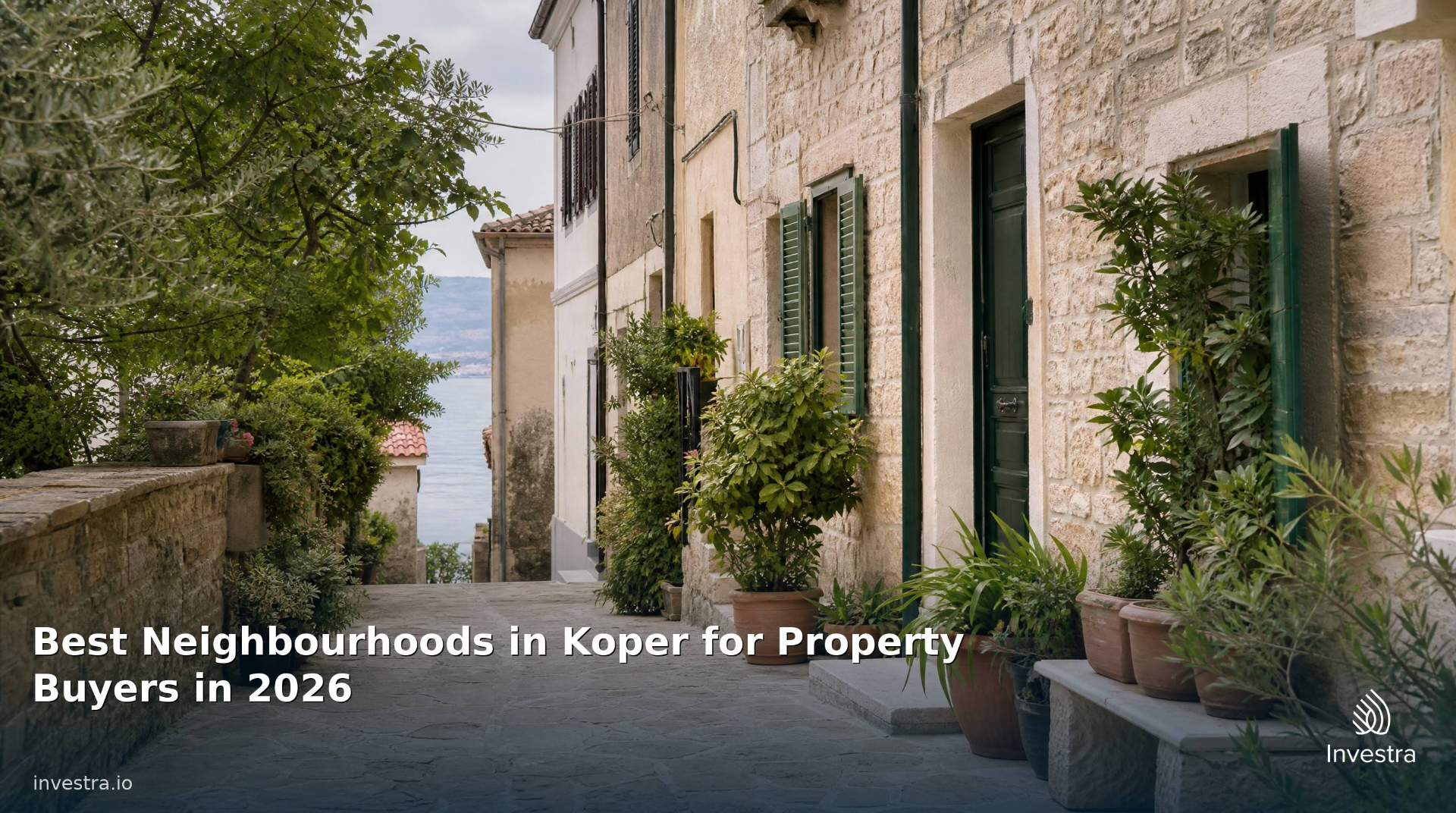
Best Neighbourhoods in Koper for Property Buyers in 2026
Best Neighbourhoods in Koper for Property Buyers in 2026
Why Koper Is Attracting Property Buyers in 2026
Quick Answer: Koper is Slovenia's only commercial seaport city and one of the most strategically valuable real estate markets in the country, offering coastal lifestyle appeal combined with strong logistics-driven economic growth that attracts both lifestyle buyers and serious investors in 2026. Investra.io tracks emerging European coastal markets including Koper's rapidly evolving property landscape.
Tucked into the northernmost tip of the Adriatic Sea, Koper occupies a position that most European cities would envy. It's the only Slovenian city with direct sea access, a fact that shapes everything from its economy to its cultural identity — and increasingly, its real estate market.
The city of roughly 54,000 residents operates on multiple economic layers simultaneously. The Port of Koper — officially Luka Koper — is one of the fastest-growing cargo ports in the entire Mediterranean basin, handling over 26 million tonnes of cargo annually and serving as a critical gateway for Central European landlocked countries including Austria, Hungary, Slovakia, and the Czech Republic.
Then there's the lifestyle dimension. Koper sits within the Slovenian Istria peninsula, sharing a landscape with Piran, Izola, and Portorož — some of the most picturesque Adriatic towns in Europe.
Property prices in Koper have risen steadily — roughly 8–12% annually between 2021 and 2024 — but they remain significantly more accessible than comparable Spanish or Portuguese coastal markets that have already been "discovered" and priced accordingly. For buyers who missed those windows, Koper represents a genuine second chance at a similar trajectory. The city's EU membership, euro-denominated transactions, and stable Slovenian legal framework remove many of the risks that come with investing in non-EU Balkan markets. Platforms like Serbia Proptech 2026 How Technology Is Changing Real Estate highlight how digital tools are reshaping property discovery across the region — and Koper buyers are benefiting from these same trends.
For international investors, what makes 2026 particularly interesting is a convergence of factors: post-pandemic normalization of remote work enabling more permanent relocations, EU property law certainty, continued port expansion plans, and a tourism infrastructure that's growing but hasn't yet outpaced supply. The question isn't really whether to look at Koper — it's which neighbourhood to focus on.
Understanding Koper's Neighbourhood Structure
Quick Answer: Koper divides broadly into the historic Old Town centre, the coastal residential belt, suburban expansion zones, and the port-adjacent commercial districts, each offering distinct price points and investment profiles ranging from €2,200/m² to over €5,500/m² depending on location and property type.
Before picking a specific street or district, it helps to understand how Koper is physically organised. The city isn't sprawling in the way that major capitals are — this is a compact, human-scale place — but its neighbourhoods have remarkably distinct characters that translate directly into different investment profiles.
The historic centre, known locally as the Staro Mestno Jedro, sits on what was originally an island connected to the mainland via a causeway in the 16th century. This area retains its medieval Venetian architectural character, and it functions as the emotional and commercial heart of the city.
Moving outward, the coastal residential zone along the Semedela and Žusterna waterfront stretches southwest from the old town and contains the highest concentration of modern apartment blocks, many built or substantially renovated within the last fifteen years. This is where you'll find the bulk of the city's premium residential supply and the strongest short-term rental demand driven by tourism.
The inland suburban districts — Semedela, Škocjan, Markovec — offer a more typical European residential experience, with family houses, post-socialist apartment blocks, and newer residential developments. Prices here are considerably lower, making them attractive for long-term rental investors who prioritise yield over prestige.
Finally, the areas nearest to the port itself — particularly around Ankaran to the north and the industrial zones heading east — represent the functional backbone of the city's economy. Real estate here is primarily commercial and logistics-oriented, though residential conversions in former industrial buildings are beginning to appear.
Understanding this layered structure is the foundation of any serious investment decision in Koper. Neighbourhood choice here isn't merely about aesthetics — it determines your tenant profile, yield potential, liquidity on exit, and the regulatory environment for short-term rentals. Consulting professionals like Siniša Dagary — Investment Consultant can help international buyers navigate which zone aligns best with their specific financial objectives.
Staro Mestno Jedro — The Historic Old Town
Quick Answer: Koper's historic Old Town commands the highest prices in the city at €4,500–€5,800/m² for renovated properties, offering premium lifestyle appeal and strong short-term rental returns of 6–8% gross yield driven by tourism, though strict heritage preservation rules limit supply and renovation flexibility.
There are very few places in Europe where you can wake up inside a genuine medieval Venetian streetscape, walk three minutes to an Adriatic seafront promenade, and still be in a functioning, economically active city rather than a museum piece. Koper's Old Town is one of them — and that scarcity is precisely what drives its premium valuation.
The architecture here is genuinely extraordinary. Palazzo facades from the 13th to 17th centuries line narrow limestone lanes, the Praetorian Palace anchors Tito Square, and the Cathedral of the Assumption rises above a skyline that hasn't fundamentally changed in centuries. For buyers accustomed to looking at generic new-builds, the Old Town is something of a revelation.
Short-term rental yields in this neighbourhood are strong. Properties marketed effectively on platforms like Airbnb and Booking.com in the Old Town regularly achieve occupancy rates of 70–80% during the April-to-October season, with nightly rates of €90–€180 for a well-presented one-bedroom apartment.
The key constraint here is supply. The Old Town simply doesn't have many properties available at any given time — it's a tightly held neighbourhood where turnover is low. When properties do come to market, they tend to move relatively quickly, and competitive bidding situations are increasingly common.
Žusterna and the Coastal Promenade Belt
Quick Answer: The Žusterna waterfront district offers the best balance of sea-view lifestyle and modern residential inventory in Koper, with prices ranging from €3,500 to €5,200/m² for direct sea-view apartments, and rental yields of 5–7% gross for properties targeting both short-term tourism and long-term professional tenants.
If the Old Town is Koper's historical soul, Žusterna is its modern residential aspiration. Stretching along the southwestern coastal promenade, this district is where the city's professional class, returning expats, and serious lifestyle buyers tend to land.
The residential stock in Žusterna is newer and more varied than the Old Town, ranging from quality 1990s apartment blocks to purpose-built luxury developments completed in the last five years. Modern two-bedroom apartments with sea views typically list between €320,000 and €480,000 — translating to roughly €3,800–€5,200/m² depending on the floor level, terrace size, and finishing standard.
What sets Žusterna apart as an investment play is its dual-market appeal. The same property that rents short-term to Italian and Austrian tourists in summer can attract a long-term professional tenant — a port manager, a university lecturer, an EU agency employee — over winter.
The beach infrastructure at Žusterna — while not extensive by Mediterranean standards — is well-maintained and genuinely popular. The area is also well-served by local transport connections to the city centre and has a reasonable supply of restaurants, cafes, and services within walking distance.
New development activity here is limited by geography and planning restrictions, which means supply isn't about to flood the market. That's a structural tailwind for values over the medium term — when demand grows, prices in Žusterna move because there simply aren't many new units coming to market to absorb it.
Semedela — The Smart Value Play
Quick Answer: Semedela offers Koper's most compelling value proposition for yield-focused investors, with residential prices of €2,200–€3,400/m² and long-term rental yields of 5–6.5% gross, serving a stable tenant base of port workers, professionals, and families who drive consistently low vacancy rates year-round.
Not every investor needs a sea view. Sometimes what matters more is a reliable, year-round tenant base, sensible acquisition costs, and a neighbourhood that works economically regardless of whether tourism has a good or bad summer. Semedela makes that case very effectively.
Prices in Semedela range from approximately €2,200 to €3,400/m² depending on the building's condition and renovation status. A two-bedroom apartment of 65–75m² can typically be acquired for €160,000–€210,000 — figures that look very different from what the same budget buys in Ljubljana, let alone in coastal Croatia.
Long-term rental demand in Semedela is underpinned by several structural drivers. The Port of Koper employs over 3,500 people directly and tens of thousands more in supporting logistics, shipping, and transport functions across the region. Many of these workers need good-quality housing within a reasonable commute of the port — and Semedela sits in exactly that catchment.
The neighbourhood also benefits from excellent road and public transport connections to the city centre, making it practical for families, couples, and single professionals alike. For buyers comparing Koper to other regional markets, it's useful to look at how similarly structured industrial and logistics cities across Southeast Europe perform — markets analysed in guides like the Loznica Real Estate Market 2026 Macva Region Property Guide show that port and logistics proximity consistently generates durable long-term rental demand.
Ankaran — The Emerging Coastal Alternative
Quick Answer: Ankaran, the small coastal municipality immediately north of Koper, offers lower entry prices of €2,800–€4,200/m² for sea-facing properties, with growing appeal among buyers priced out of Žusterna and Piran, though its smaller market size means lower liquidity on exit compared to Koper's main residential zones.
Technically its own municipality since 2011, Ankaran functions economically and socially as part of Koper's broader coastal ecosystem. Sitting on a small peninsula north of the city centre, it has a character that's quieter and more residential than the main city — think of it as the part of Koper where people actually live rather than perform living.
What's changed in Ankaran over the last three to four years is the nature of buyer interest. Remote workers — particularly from Austria, Germany, and the Netherlands — have begun identifying Ankaran as a viable permanent base.
The municipality itself has been actively developing its infrastructure, including improved cycling connections to Koper's main seafront promenade and upgraded beach facilities. These improvements are the kind of quality-of-life investments that tend to compress the price gap between an emerging area and its more established neighbours over time.
The caution with Ankaran is liquidity. It's a small market — properties take longer to sell than in Koper proper, and the buyer pool is narrower. Investors need a medium to long-term horizon here rather than expecting quick exits. As a lifestyle purchase or a patient capital play, it's compelling. As a short-term trade, it's less appropriate.
Markovec and Škocjan — Family Living and Long-Term Fundamentals
Quick Answer: The inland suburban districts of Markovec and Škocjan offer Koper's most affordable residential entry points at €1,800–€2,800/m², with strong appeal for family-oriented long-term rental strategies targeting the city's growing professional and port-sector workforce.
Škocjan, lying further inland, is more purely residential in character — quieter, slightly less connected to the city's tourist infrastructure, and cheaper accordingly. Entry prices for apartments start around €1,700–€2,200/m², making this the most accessible investment point in Koper's residential market.
The strategic case for Markovec and Škocjan isn't about excitement — it's about fundamentals. These are the districts where the city's essential workforce lives, where tenant turnover is lower, where management headaches are fewer, and where the numbers work without relying on tourism income. For investors who have studied similar patterns in other growing mid-sized European cities, the playbook is familiar. Guides covering comparable inland residential markets — like the Sremska Mitrovica Real Estate 2026 Srem Region Property Guide — show that secondary city workforce housing consistently delivers reliable returns even in broader market downturns.
Property Prices Across Koper Neighbourhoods — A 2026 Data Breakdown
Quick Answer: Koper property prices in 2026 range from approximately €1,700/m² in inner suburban districts to over €5,800/m² for premium Old Town and sea-view properties, with the citywide average for residential apartments sitting around €3,200–€3,600/m² — representing a 9% year-on-year increase from 2025 levels.
Numbers matter. Here's a structured look at where the market stands across Koper's main residential areas in 2026, based on transaction data, listing analysis, and market intelligence from professional networks including Findes Financial Services, which tracks Slovenian property financing and market valuations.
Old Town (Staro Mestno Jedro): Renovated apartments €4,500–€5,800/m². Unrenovated properties requiring full restoration €2,800–€3,500/m². Penthouses and exceptional units: €6,000+/m². Typical transaction size: €180,000–€650,000 depending on size and condition.
Žusterna / Coastal Promenade: Sea-view front-row apartments €4,200–€5,200/m². Non-sea-view coastal zone apartments €2,800–€3,500/m². New development units with modern amenities: €3,800–€4,800/m². Typical transaction size: €220,000–€520,000.
Semedela: €2,200–€3,400/m² depending on building age and renovation status. Typical transaction size: €140,000–€240,000 for a two-bedroom apartment.
Ankaran: Sea-facing or sea-view properties €2,800–€4,200/m². Inland Ankaran properties €1,900–€2,600/m². House and villa properties: substantial variation from €250,000 to €1.2 million+ for waterfront villas.
Markovec: Apartments €1,800–€2,600/m². Houses with land €250,000–€420,000 typical range.
Škocjan: Apartments €1,700–€2,200/m². Entry-level units available from €110,000–€140,000 for studios and one-bedrooms.
Year-on-year price growth across the city averaged approximately 9% between mid-2024 and mid-2025, with coastal premium zones growing slightly faster (10–12%) than inland suburban areas (6–8%). Rental yields across the city range from 4.5% net in the Old Town to 5.5% net in yield-optimised residential districts. These figures position Koper competitively within the Slovenian market and favourably relative to comparable EU coastal markets in Spain and Portugal where yields have compressed below 3.5–4% in major tourist zones. Detailed regional comparisons are explored in resources like the Prokuplje Real Estate Market 2026 Toplica Region Property Guide and the Aleksinac Real Estate Market 2026 Southern Serbia Property Guide, which illustrate broader regional pricing dynamics for context.
Legal Process and Foreign Buyer Rules for Koper Property
Quick Answer: EU citizens can purchase property in Slovenia without restrictions, while non-EU nationals face reciprocity requirements or must establish a Slovenian legal entity to buy; the full transaction process typically takes 6–10 weeks and involves a notary, FURS tax registration, and a 2% real estate transfer tax payable by the buyer.
EU citizens have full property purchasing rights in Slovenia with no additional approvals required. They can buy in their personal name exactly as a Slovenian citizen would. Non-EU nationals face a more nuanced situation: purchases are subject to a reciprocity principle (Slovenia will allow purchases from nationals of countries that offer equivalent rights to Slovenian citizens).
Transaction costs are meaningful and should factor into any investment calculation. The buyer pays a 2% real estate transfer tax on the purchase price, notary fees (typically €500–€1,500 depending on property value), and the cost of land registry registration (€100–€300). New properties are subject to VAT (typically 9.5% in Slovenia) rather than transfer tax, which can substantially affect purchase calculations.
Rental income from property is subject to 25% Slovenian income tax. Capital gains on property sales depend on holding period — properties held longer than three years are generally exempt from capital gains tax, while shorter-term sales face taxation on profit. Permanent residents and EU citizens domiciled in Slovenia benefit from certain tax optimisations, while non-residents face slightly less favourable treatment. This is genuinely complex territory, and working with a tax advisor and legal counsel before purchasing is not a luxury — it's essential risk management. Finances advisors and Slovenian property specialists can guide tax-efficient structuring of property acquisitions and rental operations.
Rental Market Dynamics and Tenant Profile by Neighbourhood
Quick Answer: Rental tenant profiles vary sharply by neighbourhood: Old Town attracts short-term tourists and remote workers; Žusterna splits between seasonal tourists and professional long-term tenants; Semedela serves port workers and families with long-term leases; and Markovec/Škocjan capture local workforce and student renters with stable below-market-rate expectations.
Understanding who actually rents in each neighbourhood is the foundation of realistic yield calculations. The Old Town and Žusterna waterfront attract fundamentally different tenants than Semedela or Markovec, and pretending otherwise is a path to disappointed expectations.
The Old Town and premium Žusterna locations function primarily as short-term tourist rentals, with peak seasons running April through October. Occupancy rates during peak season regularly exceed 70–80% for quality properties, with December and summer holidays
Investment Disclaimer
Quick Answer: This guide is general market information, not personal legal, tax, financing or investment advice.
Before committing to a property transaction, buyers should obtain independent local legal, tax and financial advice suited to their circumstances. Investra.io can support initial market research, but every purchase decision remains the buyer's responsibility.
Frequently Asked Questions
Quick Answer: This section explains the practical property-investment implications of Frequently Asked Questions.
What is a prudent next step after initial market research?
Use current documentation, independent professional advice and comparable local evidence before proceeding. Investra.io can support an initial structured market review.
How can buyers plan a realistic ownership budget?
Use current documentation, independent professional advice and comparable local evidence before proceeding. Investra.io can support an initial structured market review.
What evidence supports a careful investment decision?
Use current documentation, independent professional advice and comparable local evidence before proceeding. Investra.io can support an initial structured market review.
When should a buyer obtain legal and tax advice?
Use current documentation, independent professional advice and comparable local evidence before proceeding. Investra.io can support an initial structured market review.
How should a buyer compare neighbourhoods and property types?
Use current documentation, independent professional advice and comparable local evidence before proceeding. Investra.io can support an initial structured market review.
What local checks should be completed before signing?
Use current documentation, independent professional advice and comparable local evidence before proceeding. Investra.io can support an initial structured market review.
Which costs should be assessed alongside the purchase price?
Use current documentation, independent professional advice and comparable local evidence before proceeding. Investra.io can support an initial structured market review.
How can international buyers verify a property opportunity?
Use current documentation, independent professional advice and comparable local evidence before proceeding. Investra.io can support an initial structured market review.
What should buyers compare before selecting a property?
Use current documentation, independent professional advice and comparable local evidence before proceeding. Investra.io can support an initial structured market review.
Quick Answer: These answers outline common buyer checks and should be read with current professional advice.
Recommended Reading
Quick Answer: This section explains the practical property-investment implications of Recommended Reading.
- Investra market research
- Investra market research
- Investra market research
- Investra market research
- Investra market research
- Investra market research
- Investra market research
- Investra market research
- Investra market research
- Investra market research
- Investra market research
- Investra market research
- Investra market research
- Investra market research
- Investra market research
- Investra market research
- Investra market research
- Siniša Dagary investment insight
- Siniša Dagary investment insight
- Siniša Dagary investment insight
- Siniša Dagary investment insight
- Siniša Dagary investment insight
- Findes Group & Partners
- Findes Group & Partners
Connect With Investra
Follow Investra for market updates on Facebook, LinkedIn, YouTube
Related Posts
No related posts available.
