
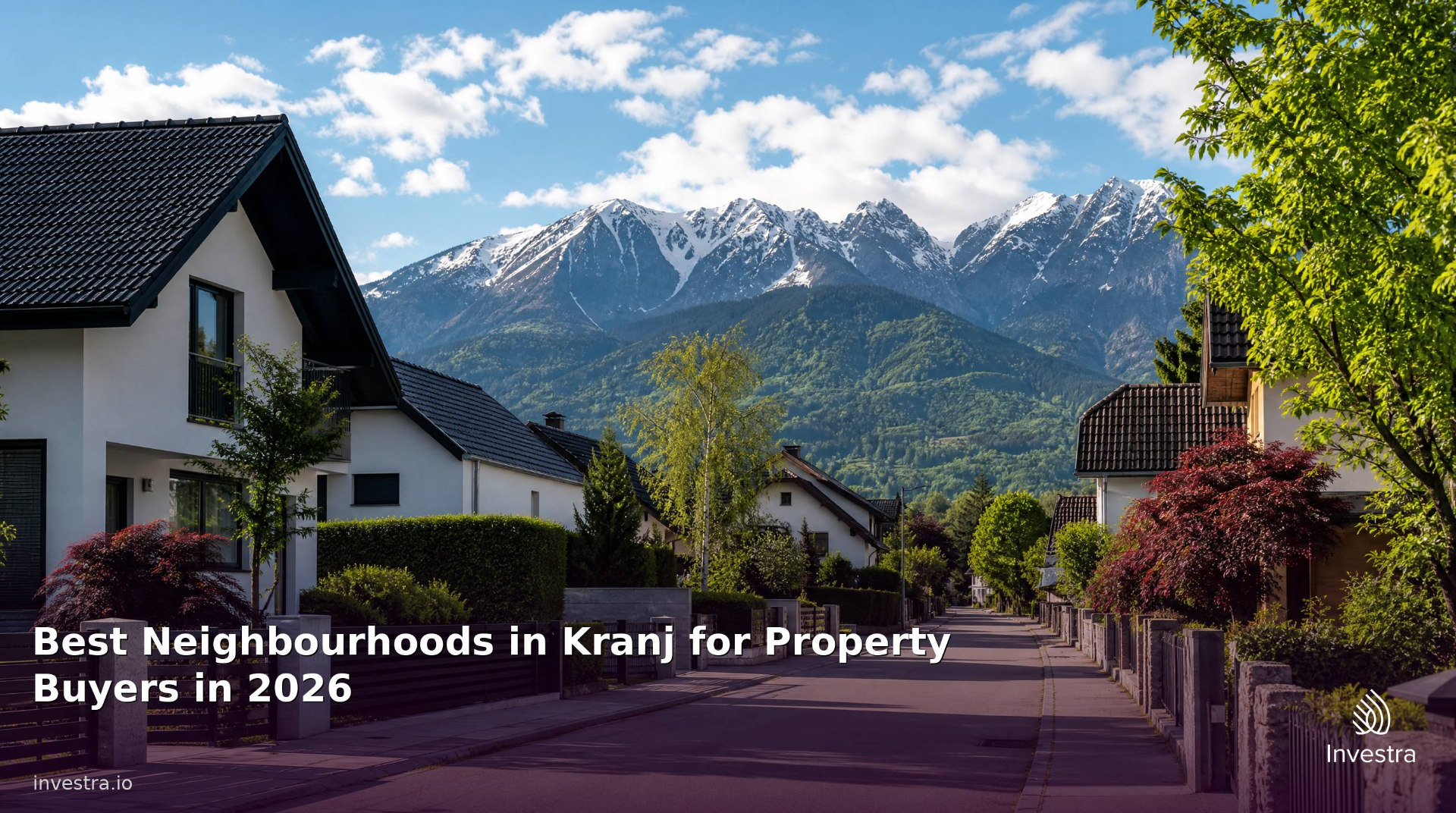
Best Neighbourhoods in Kranj for Property Buyers in 2026
Best Neighbourhoods in Kranj for Property Buyers in 2026
Why Kranj Is Attracting Property Buyers in 2026
Quick Answer: Kranj is Slovenia's fourth-largest city and one of its most strategically positioned real estate markets, offering property prices significantly below Ljubljana while delivering comparable quality of life, strong rental demand, and direct access to the Alpine corridor. Investra tracks emerging Central European markets like Kranj to help investors identify value before prices peak.
Tucked between the Julian Alps and Ljubljana, Kranj doesn't announce itself loudly. It doesn't need to. Slovenia's fourth-largest city—home to roughly 56,000 residents—has spent the better part of a decade quietly becoming one of the most compelling secondary city real estate stories in Central Europe.
The city's strategic position matters enormously. Kranj sits just 20 kilometers north of Ljubljana, benefiting from proximity to the capital's employment base and investment capital, yet maintaining its own distinct character, industrial base, and cost structure.
For anyone researching where specifically to buy within Kranj, though, neighbourhood selection is everything. The city's geography is varied, its micromarkets genuinely distinct, and the difference between buying in the right versus wrong pocket of this city can mean thousands of euros in both purchase price and rental yield.
Understanding Kranj's Property Market: Key Data for 2026
Quick Answer: Kranj's average property prices in 2026 range from approximately €2,400 to €4,200 per square meter depending on neighbourhood and property type, representing a significant discount to Ljubljana's €4,800–€6,500/m² while the city's fundamentals continue to strengthen. Consulting specialists can help investors interpret these figures within a broader Central European strategy.
Before drilling into individual neighbourhoods, it's worth establishing what the Kranj market looks like at a macro level in 2026—because context shapes every neighbourhood comparison that follows.
Staro Mestno Jedro (Old Town Core): Premium History, Premium Yields
Quick Answer: Kranj's Old Town—perched on a rocky promontory above the Sava river—commands the city's highest per-square-meter prices at €3,200–€4,500/m² but also delivers the strongest short-term rental yields (7–9% gross) due to its tourist appeal, unique architecture, and proximity to Ljubljana day-trippers and Alpine visitors.
There's genuinely nowhere else in Kranj quite like the Old Town. The medieval core—compact, walkable, and anchored by the Church of St. Cantianus and the Prešeren Theatre—sits atop a narrow rock promontory between two river gorges, giving it a topography unlike anything else in the region.
Properties here are predominantly older apartment stock in historic buildings, with many units benefiting from recent renovation cycles. A renovated 60m² apartment in a well-maintained Old Town building currently trades at approximately €190,000–€270,000.
The rental case is compelling. A well-furnished 2-bedroom unit in the Old Town can achieve €120–€160 per night on short-term platforms during summer peak, and Kranj benefits from a year-round demand profile driven by its position as a gateway to Triglav National Park and the Kamnik-Savinja Alps.
The caution? Old Town properties come with the usual complexities of historic stock. Energy efficiency certificates (energetska izkaznica) often reveal poor insulation ratings, renovation costs can be substantial, and heritage protection rules may restrict exterior modifications.
Planina: The New-Build Hotspot for Modern Living
Quick Answer: Planina is Kranj's primary new residential development zone, offering modern apartments priced at €3,000–€4,000/m² with excellent infrastructure, strong long-term rental demand from the professional workforce, and consistent capital appreciation driven by ongoing developer activity.
If the Old Town represents Kranj's romantic past, Planina represents its confident present. Located in the western part of the city, this residential district has been the site of the most significant new-build activity in Kranj over the past decade—and it's still accelerating.
Typical pricing for new or recently completed apartments: €3,200–€4,000/m² for 2–3 bedroom units in quality developments. A 75m² two-bedroom apartment in a 2023-vintage building will typically trade at €240,000–€300,000.
The long-term rental market in Planina is robust. The district is well-connected by city bus to Kranj's industrial and commercial zones, and it attracts professionals and young families—exactly the tenant profile that delivers reliable, low-friction rental income.
Capital appreciation potential in Planina is meaningful. As more of Ljubljana's middle-class professionals price themselves out of the capital and seek quality suburban alternatives, Planina's supply of modern apartments with strong transport links and amenities captures that migration.
Primskovo: Family-Friendly Value with Growth Potential
Quick Answer: Primskovo offers Kranj's best balance of affordability and established infrastructure, with apartment prices ranging from €2,200–€3,200/m² and a strong family rental market—making it the preferred entry-point neighbourhood for investors with a buy-to-let focus seeking reliable yields without premium entry costs.
Primskovo doesn't get the same glossy coverage as the Old Town or the new developments in Planina, and that's precisely why it deserves attention. Located south of the city centre, this well-established residential district is where a significant portion of Kranj's professional middle class actually lives.
Property stock in Primskovo is predominantly socialist-era apartment blocks built in the 1970s–1990s, many of which have undergone facade renovation and elevator upgrades through building management associations (skupnost lastnikov). The honest assessment: these buildings are solid, practical, and unspectacular.
Purchase prices for unrenovated Primskovo apartments start around €1,900–€2,200/m², while renovated units with modern interiors command €2,600–€3,200/m². A 65m² renovated apartment might trade at €170,000–€210,000.
The rental yield math works well here. Monthly rents for a renovated 2-bedroom Primskovo apartment run €700–€950, delivering gross yields of 4.8–5.5% on realistic purchase-plus-renovation numbers.
Zlato Polje and Gornji Pungert: Upscale Living Near the Gorge
Quick Answer: Zlato Polje and the Gornji Pungert area represent Kranj's premium residential tier outside the Old Town, with detached houses and high-end apartments trading at €3,000–€4,500/m² and attracting affluent local buyers and international purchasers seeking primary or second-home properties with dramatic natural surroundings.
The yield profile here is less compelling than Planina or Primskovo for standard buy-to-let strategies—entry costs are higher, and the pool of tenants who can afford rents commensurate with those values is smaller. But the capital preservation and appreciation case is strong.
For buyers considering Kranj as a primary residence, these neighbourhoods are simply the most liveable addresses in the city. The combination of urban amenities (Kranj's centre is minutes away), natural drama, and clean mountain air creates a quality of life that genuinely competes with much more expensive European addresses.
Legal Process for Foreign Buyers: What You Actually Need to Know
Quick Answer: EU citizens can purchase property in Slovenia without restrictions, while non-EU buyers face some limitations but can still invest through Slovenian registered companies or in certain circumstances directly; the transaction process typically takes 1–3 months, involves a notarized purchase agreement, a 2% real estate transfer tax, and registration at the land registry.
Slovenia's legal framework for real estate transactions is well-structured and relatively straightforward by Central European standards—but there are enough nuances that buyers, particularly international ones, benefit from understanding the process before they start making offers.
EU Citizens: If you hold EU/EEA citizenship, there are essentially no restrictions on purchasing residential or commercial property in Slovenia. You can buy in your own name, finance through Slovenian or foreign banks, and hold the property as an individual or through a company structure.
Non-EU Citizens: The situation is more layered. Reciprocity agreements govern whether citizens of specific non-EU countries can directly own Slovenian real estate. Where direct ownership isn't available, the standard workaround is establishing a Slovenian d.o.o. (limited liability company), which then purchases the property.
The Purchase Process Timeline: Once an offer is accepted, the transaction moves through several stages. A preliminary purchase agreement (predpogodbeni sporazum) is typically signed within 3–7 days, often accompanied by a 10% deposit.
Taxes, Rental Income, and ROI: The Numbers Investors Care About
Quick Answer: Slovenia taxes rental income at a flat 25% rate on 90% of rental receipts (effectively 22.5% of gross rent), with no annual property tax currently in force; combined with realistic gross yields of 5–7% in Kranj, net yields typically land in the 3.5–5.2% range, with capital gains tax of 25% (declining to 0% after 20 years of ownership) applying on disposal.
Taxes are where many international real estate pitches get fuzzy, so here's the honest, clear picture for Slovenia in 2026.
Rental Income Tax: Slovenian law taxes rental income through a system where the taxable base is 90% of gross rental income (a 10% deemed maintenance deduction is applied automatically). That taxable base is then subject to a flat rate of 25%.
This system is straightforward and applies whether you're a Slovenian citizen or a foreign investor. There's no separate withholding requirement if you use a professional property manager; the 25% rate applies to your net declared income.
Property Tax: Slovenia does not currently levy an annual property ownership tax at the national level—though municipal charges and building maintenance contributions (for apartments in multi-unit buildings) apply. These contributions typically run €50–€150 annually.
Capital Gains Tax: Gains on property disposal are subject to a declining tax schedule—25% in year one, declining by 5% per 5-year holding period, reaching 0% after 20 years of ownership. For investors planning a 5–7 year hold, the effective capital gains rate of 15–25% needs to be factored into ROI calculations.
Now assume this property appreciates 3% annually (conservative for Primskovo). After 7 years: property value is €270,000; cumulative rental income (after tax) is €42,700; capital gain is €70,000 subject to capital gains tax of 15% (€10,500). Total return on €220,000 capital: €62,200 over seven years, or 3.8% blended annual return.
Short-Term vs Long-Term Rental Strategies in Kranj
Quick Answer: Short-term rentals in Kranj's Old Town and tourist-adjacent areas can deliver gross yields of 7–9% but require active management, registration with the Slovenian tourism register, and tolerance for seasonality; long-term rentals in districts like Primskovo and Planina offer lower but steadier 4.5–6% gross yields with a more passive management profile suited to remote investors.
The rental strategy question is one of the most consequential decisions a Kranj property buyer will make—and the right answer depends heavily on which neighbourhood you're buying in, your appetite for management complexity, and your investment time horizon.
Short-Term Rental Mechanics: Slovenian law requires STR operators to register with the e-turizem (tourism) system, collect and remit tourism tax (currently €1.27–€3.13 per person per night depending on category), and comply with fire safety and habitability standards. The compliance burden is not onerous, but it requires initial setup work.
Management logistics include guest coordination, cleaning turnover, maintenance response, complaint handling, and platform optimization. Many successful STR investors either manage remotely via local coordinators or partner with professional management companies (charging 20–30% of gross revenue).
Long-Term Rental Economics: A well-maintained 2-bedroom apartment in Planina renting at €800/month generates €9,600 annually with one or two lease rollers per year. Vacancy risk is minimal in Kranj's supply-constrained market. Management is nearly passive if you use a professional property manager or reliable local agent.
How Kranj Compares to Other Regional Investment Markets
Quick Answer: Kranj offers a compelling middle ground between Ljubljana's expensive but liquid market and lower-cost Balkan markets with higher risk profiles—delivering EU legal security, euro-denominated transactions, strong yield-to-price ratios, and Alpine lifestyle appeal that few European secondary cities can match at comparable price points.
Putting Kranj in regional context matters—because property investment is always a comparative exercise. Where else could the same capital be deployed, and why does Kranj win the argument for certain investor profiles?
Ljubljana Comparison: Ljubljana is the obvious comparison. The Slovenian capital offers Europe's most dynamic property market in its size class, with active investor interest, strong institutional support, and cosmopolitan appeal. But Ljubljana's €4,800–€6,500/m² pricing now exceeds many Western European secondary cities.
Regional Market Context: Looking beyond Slovenia, investors exploring Central European secondary cities naturally encounter markets in Serbia. Resources like Zajecar, Bor, Prokuplje, Loznica, and Aleksinac provide comparable data for consideration.
Regional comparisons also extend to Sremska Mitrovica and broader Central European markets. Kranj's fundamental advantage remains its positioning as an Alpine gateway with European infrastructure and rule-of-law certainty—attributes that command a measurable premium over purely price-based comparisons might suggest.
Emerging Trends in Kranj Real Estate: Proptech, Sustainability, and Modern Lifestyles
Quick Answer: Digital property platforms, eco-friendly new-build standards, and co-living arrangements are beginning to reshape Kranj's residential market, with energy-efficient apartments commanding price premiums and rental platform integration streamlining investor operations, particularly relevant for those evaluating technology evolution within broader regional strategies.
The Kranj market of 2026 is not static. Several observable trends are reshaping how properties are financed, managed, and valued—and understanding these trends is genuinely important for anyone with a multi-year investment horizon.
Digital Transaction Infrastructure: Online property portals (Nepremičnine.net, GlobeReal, Bolha) now account for the majority of residential property searches and initial valuation discovery. This transparency has compressed information asymmetries that previously favoured local agents.
Energy Efficiency as a Value Driver: Properties with energy class A or B certificates command measurable premiums—typically 8–12% above comparable older stock. This premium reflects both lower operating costs and increasingly sophisticated buyer preferences around sustainability.
Rental Platform Integration: Professional property managers increasingly use integrated booking engines, automated guest communication, and dynamic pricing algorithms. The sophistication of the rental management toolset available to Kranj investors today would have seemed futuristic five years ago.
Infrastructure and Transportation: The Fundamentals That Drive Long-Term Value
Quick Answer: Kranj's strategic position on the A2 motorway corridor connecting Ljubljana to Austria, combined with ongoing public transport improvements and its role as a regional employment hub, ensures sustained demand for residential property from commuters, young professionals, and retirees seeking accessible Alpine proximity.
Employment fundamentals remain solid. Kranj hosts significant industrial and pharmaceutical facilities, regional healthcare services (UKC Kranj is a major regional hospital), and administrative functions that create stable local employment. The city isn't dependent on any single industry; its employment base is genuinely diversified.
Building Communities: Social Infrastructure and Lifestyle Factors
Quick Answer: Kranj's quality of life metrics—green space access, cultural institutions, proximity to outdoor recreation, and strong community identity—create lifestyle appeal that translates into sustained tenant demand and owner-occupier interest, particularly among families and professionals seeking alternatives to Ljubljana's cost and intensity.
Property investment in secondary cities succeeds or fails partly on numbers, but equally on whether people actually want to live there. Kranj wins on the lifestyle metrics that matter increasingly to Central European professionals.
The city's position between the Sava River and the Julian Alps creates exceptional recreational access. Hiking trails, climbing areas, kayaking, and mountain biking are literally minutes from residential neighbourhoods. Winter skiing at Krvavec is 30 minutes away; Triglav National Park access is straightforward.
School quality varies by neighbourhood but the public school system is generally solid; international schools are available for expat families. Healthcare services are strong, anchored by the regional hospital.
Risk Assessment: What Can Go Wrong and How to Plan Around It
Quick Answer: Primary risks for Kranj property investors include economic slowdown reducing rental demand, oversupply in new-build segments during developer cycles, currency/ECB policy impacts on financing costs, and concentrated employer risks if major local employers relocate; these are manageable through diversified neighbourhood selection, conservative use, and long-term holding horizons.
Every investment has risks. Being explicit about them helps distinguish between acceptable and unacceptable ones for your specific situation.
Economic Cyclicality: Kranj's economy is tied to Slovenia's broader growth trajectory. A recession would reduce rental demand and suppress capital appreciation. But Kranj's diversified employment base and EU membership reduce systemic risk relative to less diversified or less integrated markets.
New-Build Oversupply: Planina has experienced developer cycles where multiple projects complete simultaneously, briefly suppressing prices and rental rates. This is normal and temporary, but it matters for timing. Buying at cycle peaks and holding through troughs requires capital patience.
Financing Risk: Slovenian mortgages are commonly indexed to Euribor; ECB policy decisions ripple through borrowing costs. Interest rate rises increase debt service burdens for used investors and can reduce property valuations. Conservative loan-to-value ratios (50–60% LTV) buffer against this risk.
Employer Concentration: If major employers like the pharmaceutical sector or regional hospital faced contraction, local employment and rental demand would suffer. This is a tail-risk scenario but worth acknowledging.
Investment Disclaimer
Quick Answer: This guide is general market information, not personal legal, tax, financing or investment advice.
Before committing to a property transaction, buyers should obtain independent local legal, tax and financial advice suited to their circumstances. Investra.io can support initial market research, but every purchase decision remains the buyer's responsibility. Property investment involves risk, including potential loss of principal.
Frequently Asked Questions
Quick Answer: This section explains the practical property-investment implications of Frequently Asked Questions.
When should a buyer obtain legal and tax advice?
Use current documentation, independent professional advice and comparable local evidence before proceeding. Investra.io can support an initial structured market review.
How should a buyer compare neighbourhoods and property types?
Use current documentation, independent professional advice and comparable local evidence before proceeding. Investra.io can support an initial structured market review.
What local checks should be completed before signing?
Use current documentation, independent professional advice and comparable local evidence before proceeding. Investra.io can support an initial structured market review.
Which costs should be assessed alongside the purchase price?
Use current documentation, independent professional advice and comparable local evidence before proceeding. Investra.io can support an initial structured market review.
How can international buyers verify a property opportunity?
Use current documentation, independent professional advice and comparable local evidence before proceeding. Investra.io can support an initial structured market review.
What should buyers compare before selecting a property?
Use current documentation, independent professional advice and comparable local evidence before proceeding. Investra.io can support an initial structured market review.
Quick Answer: This section addresses practical property-investment questions with structured guidance.
What is a prudent next step after initial market research?
Use current documentation, independent professional advice and comparable local evidence before proceeding. Investra.io can support an initial structured market review. Consider scheduling site visits during different times of year to understand seasonal dynamics, rental platforms, and neighbourhood character beyond promotional materials.
How can buyers plan a realistic ownership budget?
Use current documentation, independent professional advice and comparable local evidence before proceeding. Investra.io can support an initial structured market review. Budget for: purchase price, 2% transfer tax, notary fees (€400–€800), legal costs (€500–€1,200), and renovation allowances (€10,000–€50,000+ depending on property condition).
What evidence supports a careful investment decision?
Use current documentation, independent professional advice and comparable local evidence before proceeding. Investra.io can support an initial structured market review. Collect recent property comparable sales data, rental listings in your target neighbourhood, utility cost documentation, and building maintenance records
Recommended Reading
Quick Answer: This section explains the practical property-investment implications of Recommended Reading.
- Investra market research
- Investra market research
- Investra market research
- Investra market research
- Investra market research
- Investra market research
- Investra market research
- Investra market research
- Investra market research
- Investra market research
- Investra market research
- Investra market research
- Investra market research
- Investra market research
- Investra market research
- Investra market research
- Investra market research
- Siniša Dagary investment insight
- Siniša Dagary investment insight
- Siniša Dagary investment insight
- Siniša Dagary investment insight
- Siniša Dagary investment insight
- Findes Group & Partners
- Findes Group & Partners
Connect With Investra
Follow Investra for market updates on Facebook, LinkedIn, YouTube
Related Posts
No related posts available.
