
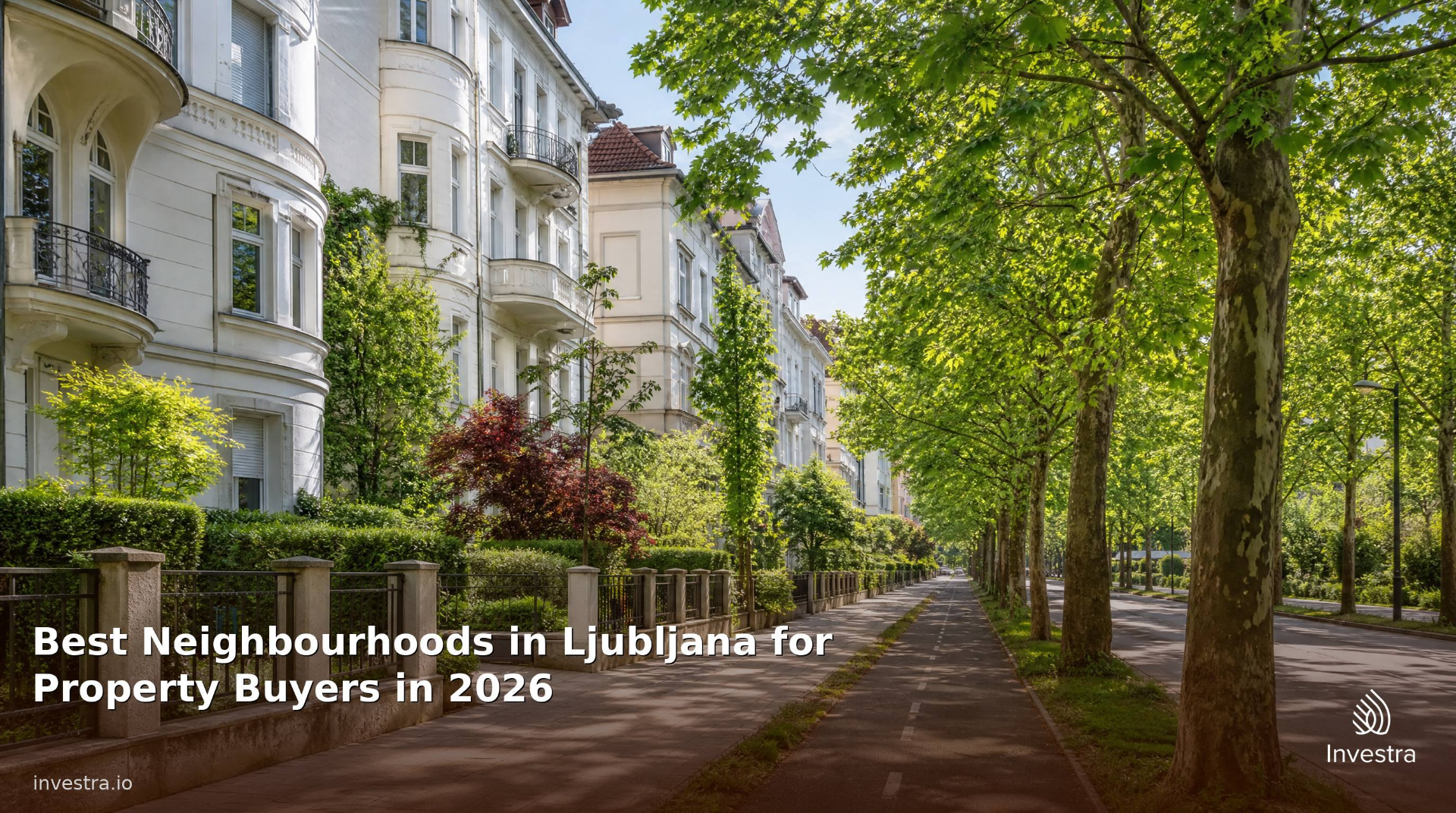
Best Neighbourhoods in Ljubljana for Property Buyers in 2026
Best Neighbourhoods in Ljubljana for Property Buyers in 2026
Why Ljubljana Is Capturing International Property Buyer Attention in 2026
Quick Answer: Ljubljana has emerged as one of Central Europe's most compelling property markets in 2026, combining EU membership, a stable euro-based economy, rising rental demand, and competitive property prices relative to Western European capitals. Investra.io tracks emerging European markets to help investors identify opportunities before they peak.
Ljubljana doesn't shout. It doesn't have the frenzied hype of Lisbon or the sky-high entry barriers of Vienna. What it does have — and what a growing number of international property buyers are quietly discovering — is a rare combination of stability, liveability, and genuine upside.
The Slovenian GDP grew by approximately 2.1% in 2024 and is projected to maintain momentum through 2026, supported by strong exports, low unemployment hovering around 3.6%, and a highly educated workforce. Ljubljana accounts for roughly one-third of the entire national GDP despite housing only about 280,000 residents in the city proper.
International buyers from Germany, Austria, the UK, and increasingly from the United States and the Middle East have been quietly accumulating assets in Ljubljana over the past five years. The city's compact size means that neighbourhood choice matters enormously — the difference between a 4% gross yield and a 6.5% gross yield can come down to a single street.
Understanding the Ljubljana Property Market: Key Metrics for 2026
Quick Answer: Ljubljana's average property price stands at approximately €3,800–€4,500 per square meter in 2026, with prime areas like Center and Trnovo reaching €5,000–€6,500/m², while emerging neighbourhoods offer entry points from €2,800/m².
Let's talk numbers, because that's where investment decisions live. The Ljubljana property market has experienced consistent price appreciation over the past decade, with average prices rising roughly 7–9% annually between 2019 and 2023 before moderating to a more sustainable 4–6% annual growth rate in 2024–2025 as European interest rate pressures began to ease and buyer activity stabilized.
As of 2026, the headline figures look like this: the citywide average for residential apartments sits at approximately €3,800–€4,500 per square meter, depending on the source and methodology. Prime central districts command €5,000–€6,500/m², while the outer ring of the city and up-and-coming areas offer entry points in the €2,800–€3,400/m² range.
Rental yields in Ljubljana have been a pleasant surprise for international investors. Gross yields across the city average around 4.5–5.5%, with short-term rental properties in the city center achieving 6–8% gross in peak configurations.
Transaction volumes have been resilient. Approximately 6,500–7,200 residential property transactions were recorded in the Ljubljana statistical region in 2024, a figure that held relatively steady despite the broader European market slowdown. Foreign buyers account for an estimated 8–12% of all transactions, a share that has been growing year-on-year. For context on how other regional markets compare, the Sremska Mitrovica Real Estate 2026 Srem Region Property Guide offers a useful Balkans comparison point for investors considering multiple CEE markets simultaneously.
One metric that often gets overlooked is the vacancy rate. Ljubljana's residential vacancy sits at a remarkably low 2.1–2.8%, driven by strong domestic demand from young professionals, a large student population (the University of Ljubljana has approximately 60,000 students), and growing expat demand from multinationals who have established regional headquarters in the city.
Center (Staro Mestno Jedro) — The Prestige Address
Quick Answer: Ljubljana's historic Center district commands the highest property prices in the city at €5,000–€6,500/m², but delivers strong short-term rental yields of 6–8% due to its status as the top tourist destination and the address of choice for premium corporate tenants.
The Center district — encompassing the Old Town, the area around Prešeren Square, and the medieval castle hill — is Ljubljana's most iconic real estate. This is where tourists photograph the Triple Bridge at sunset, where diplomats hold receptions, and where the city's most expensive restaurants operate.
Apartments here typically trade at €5,000–€6,500 per square meter, with renovated historic properties in the most sought-after lanes occasionally exceeding €7,000/m². The stock is predominantly older — many buildings date from the Austro-Hungarian period or the interwar years — which means buyers need to budget carefully for renovation and ongoing maintenance.
The investment case for Center is primarily built around short-term rentals. Ljubljana's tourism numbers have been robust: the city received approximately 1.4 million overnight tourist visits in 2024, and the historic center captures the vast majority of that demand.
There are constraints worth understanding. The City of Ljubljana has introduced short-term rental regulations requiring registration and limiting operations in certain residential buildings — a trend mirroring policies in Amsterdam, Barcelona, and other European cities. Investors who want to run short-term rentals here should verify the regulatory status of any specific property before purchasing.
Trnovo and Krakovo — Bohemian Charm Meets Investment Savvy
Quick Answer: Trnovo and Krakovo are Ljubljana's most desirable residential neighbourhoods outside the strict city center, with property prices of €4,200–€5,500/m² and strong long-term rental demand from academics, young professionals, and international residents.
If there's one neighbourhood that experienced property investors in Ljubljana tend to point to first, it's the Trnovo-Krakovo area. Located just south of the city center along the Ljubljanica River, these two villages-within-the-city have a character that feels genuinely irreplaceable.
Property prices here reflect that desirability. Expect to pay €4,200–€5,500/m² for quality apartments, with period houses and villas at the upper end of that range and beyond.
The long-term rental yield here typically runs 4.5–5.5% gross. It's not the highest number in the city, but the risk-adjusted return is compelling when you factor in low vacancy, premium tenant quality, and the strong capital appreciation that this neighbourhood has historically delivered.
For buyers from markets like Serbia who are already familiar with the Balkans investment landscape, comparing Trnovo to premium districts in Belgrade offers useful context. The Zajecar Real Estate Market 2026 Eastern Serbia Property Guide highlights how regional price differentials across the former Yugoslav space are converging, making Ljubljana's relatively modest price point even more interesting in comparative terms.
Bežigrad — The Up-and-Coming Neighbourhood to Watch
Quick Answer: Bežigrad is Ljubljana's most dynamic emerging neighbourhood for property investment in 2026, with prices ranging from €3,200–€4,200/m², strong student and young professional rental demand, and significant urban regeneration projects underway that are driving capital value growth.
The numbers are accessible. Entry-level apartments in Bežigrad start from around €2,800–€3,000/m² for older socialist-era blocks, while renovated or newer stock trades at €3,500–€4,200/m². That lower price point relative to Center or Trnovo creates two advantages for investors: lower initial capital outlay and higher proportional rental yields.
The regeneration story here is real. The Stožice district within Bežigrad has been transformed over the past decade by a major stadium and arena complex, retail development, and new residential construction. Infrastructure improvements continue, and the tram network expansion planned for 2026–2028 is expected to improve connectivity significantly.
Investors interested in the dynamics of transformation markets — where urban investment shifts values over relatively short timeframes — will find useful reading in the Bor Real Estate Market 2026 Eastern Serbia Mining City Property Guide, which examines how infrastructure-led transformation reshapes residential property values. The parallels, while operating at different price points, reveal consistent patterns.
Šiška — Value Investment and Rental Yield Maximization
Quick Answer: Šiška offers Ljubljana's best rental yield-to-price ratio in 2026, with property prices of €2,800–€3,600/m² and gross rental yields reaching 5.5–7% in some sub-areas, making it the preferred zone for yield-focused investors willing to accept a longer capital appreciation timeline.
Šiška is a working-class neighbourhood that has been quietly gentrifying for a decade. Located to the northwest of the center, it's a densely populated district with excellent public transport links, a strong local high street along Šišenska cesta, and a growing arts and food scene that is beginning to attract younger residents who've been priced out of Trnovo and Bežigrad.
Price points are the main attraction. Quality apartments in Šiška trade at €2,800–€3,600/m², with older stock available below €2,800/m² for buyers willing to undertake renovation. The renovation arbitrage opportunity here is real: a well-executed refurbishment can add €600–€900/m² in value while simultaneously commanding 15–20% rental premiums over unrefurbished stock.
The investment community tracking multiple markets simultaneously will find the structural dynamics here comparable to what the Aleksinac Real Estate Market 2026 Southern Serbia Property Guide describes: fundamentally sound markets where current pricing doesn't yet fully reflect underlying demand growth and improving infrastructure.
Vič and Rudnik — Family Living and Long-Term Stability
Quick Answer: Vič and Rudnik are Ljubljana's premier family neighbourhoods, offering properties at €3,200–€4,400/m² with strong demand from professional families and diplomatic staff, delivering stable long-term rental yields of 4–5.5% with excellent capital preservation characteristics.
Not every investor is chasing the maximum short-term yield. A significant and growing segment of international property buyers in Ljubljana are looking for stable, reliable, long-term income with strong asset preservation — and for that profile, Vič and Rudnik deliver.
Property prices in Vič range from €3,200–€4,400/m² for apartments, with houses and villas at the upper end and well beyond for premium properties with gardens. Rudnik, immediately to the east, is slightly more affordable at €2,900–€3,800/m² and offers a strong mix of apartment blocks and newer residential developments.
Capital appreciation in Vič has been solid if unspectacular — roughly 4–6% annually over the past five years, broadly tracking the wider market. What the area lacks in speculative upside it compensates for in reliability, which matters considerably when you're structuring a multi-property portfolio or targeting specific risk parameters. For investors building diversified European portfolios, consulting with specialists like Siniša Dagary — Investment Consultant on how Ljubljana assets fit within a broader CEE allocation is a sensible first step.
Moste and Polje — The Emerging Eastern Frontier
Quick Answer: Moste and Polje are Ljubljana's most affordable urban neighbourhoods in 2026, with prices ranging from €2,400–€3,200/m², offering the highest gross yields in the city (6–8% in select micro-locations) but requiring careful asset selection and a longer investment horizon.
Here's where the conversation gets interesting for investors with a higher risk tolerance and a longer-term vision. Moste and Polje, located in the eastern part of Ljubljana along the Sava River, are the city's most affordable urban districts — and they're generating increasing attention from domestic investors who've been priced out of the more established areas.
The case for Moste is built on several converging factors. The district has benefited significantly from the expansion of the BTC City shopping and business complex, which employs tens of thousands of people and generates consistent housing demand within a short commute radius.
Property prices in Moste start from approximately €2,400/m² for older stock and reach €3,000–€3,200/m² for renovated or newer apartments. Gross rental yields of 6–8% are achievable in specific micro-locations, particularly around the transport corridors and the BTC employment hub.
Polje extends further east and is even more affordable, with prices occasionally dipping below €2,200/m² for basic stock. This is frontier territory in Ljubljana terms — the kind of market where the reward can be substantial but where property selection and legal due diligence become critical. Investors exploring the dynamics of high-yield, lower-entry-point markets across the broader region will find useful context in the Prokuplje Real Estate Market 2026 Toplica Region Property Guide, which examines similar dynamics in Southern Serbia.
Legal Framework and Tax Structure for Foreign Property Buyers in Slovenia
Quick Answer: EU citizens can purchase property in Slovenia on the same terms as Slovenian nationals, while non-EU buyers face specific requirements. Property transfer tax is 2%, rental income is taxed at 25% (with deductions), and capital gains tax is 25% declining to 0% after 20 years of ownership.
Slovenia's legal framework for property ownership is transparent, EU-aligned, and genuinely investor-friendly — particularly for EU/EEA citizens. Understanding the mechanics before you make an offer is non-negotiable, and the good news is that the structure is logical and well-documented.
EU and EEA citizens have full property ownership rights in Slovenia on identical terms to Slovenian nationals. This means unrestricted purchase of residential and commercial property, no mandatory local partner structures, and straightforward title transfer through the notarial system.
The transaction cost structure is manageable. Property transfer tax is set at 2% of the assessed or contracted value (whichever is higher), paid by the buyer. Notary fees typically run 0.3–0.5% of the transaction value. Real estate agent commissions in Slovenia are customarily split between buyer and seller, with each typically paying 2–2.5%. Legal fees for a standard transaction run €1,000–€2,500.
On the rental income side: rental income is taxed in Slovenia at a standard rate of 25%, but critically, owners can deduct a normative expense allowance of 10% of gross rental income, reducing the effective taxable base. If actual expenses (maintenance, management, insurance) exceed 10%, actual costs can be deducted instead. For non-resident landlords, Slovenia's extensive network of double taxation treaties typically prevents double taxation on rental income, though local tax advice from firms like Findes Financial Services is strongly recommended for structuring your income reporting correctly.
Capital gains on property are taxed at 25% if the property is sold within 5 years, reducing progressively thereafter: 20% from 5–10 years, 15% from 10–15 years, 10% from 15–20 years, and 0% after 20 years of ownership. This progressive structure strongly incentivizes medium-to-long-term holding periods — a design that aligns well with a quality-focused, buy-and-hold investment strategy.
The land register system (Zemljiška knjiga) is digital, publicly accessible, and highly reliable. Title searches are straightforward, and the incidence of title defects or fraudulent transactions, while not zero, is extremely low by regional standards. Always conduct a full title search and review the building's condominium documentation before exchange of contracts.
Rental Market Dynamics and Short-Term vs Long-Term Strategy
Quick Answer: Ljubljana's rental market supports both short-term and long-term strategies, with STR gross yields of 6–9% in prime tourist zones and LTR yields of 4–6% across broader urban areas; the choice depends on property location, regulatory environment, and investor capacity to manage operations.
The rental market in Ljubljana runs on two quite different engines, and choosing which one to power your investment matters enormously. Short-term rentals (STR) through platforms like Airbnb and Booking.com dominate the historic center and offer the highest gross income potential. Long-term rentals (LTR) provide stability, predictability, and lower management intensity across the broader city.
The STR market in Ljubljana benefits from a tourism sector that has shown genuine resilience. Average daily rates for quality one-bedroom apartments in Center have been running at €90–€140 per night, with premium properties and peak summer weeks pushing above €180.
The long-term rental market is characterized by a serious supply shortage. Ljubljana's housing construction has not kept pace with population and employment growth, and the pipeline of new residential completions through 2026–2027 remains insufficient to close the gap.
Market rent data: one-bedroom apartments in Center command €800–€1,200 per month on long-term leases; in Trnovo, €700–€1,000; in Bežigrad, €600–€850; in Šiška, €500–€750. For two-bedroom units, add 40–60% to those figures. Three-bedroom houses or large apartments in family neighbourhoods like Vič run €1,400–€2,000 monthly.
Tenant quality on the LTR side has been consistently strong. Professional tenants in Ljubljana — whether expats, young professionals, academics, or families — tend to have stable employment, good income, and a desire to treat their rental homes respectfully. Eviction and problem-tenant rates are notably lower than in many comparable Western European cities.
Currency, Financing, and Exit Strategy Considerations
Quick Answer: All transactions in Slovenia are denominated in EUR, eliminating currency risk for eurozone buyers; non-EUR investors should factor in currency exposure. Local mortgage financing is available at 3.5–4.5% fixed rates through major Slovenian banks, and exit liquidity has been improving as foreign investor interest grows.
One of Ljubljana's understated advantages for international investors is that all property transactions and rental income flows occur in euros, eliminating currency risk for eurozone investors. For buyers from non-EUR countries, there is currency exposure — but this cuts both ways.
Financing is available for foreign buyers, though with slightly more stringent requirements than apply to local purchasers. Major Slovenian banks — particularly Nova Ljubljanska Banka, Banka Celje, and Abanka — offer mortgages to non-residents with valid EU identification, typically up to 70–80% of property value at fixed rates currently running 3.5–4.5% for 15–20 year terms.
Investment Disclaimer
Quick Answer: This guide is general market information, not personal legal, tax, financing or investment advice.
Before committing to a property transaction, buyers should obtain independent local legal, tax and financial advice suited to their circumstances. Investra.io can support initial market research, but every purchase decision remains the buyer's responsibility.
Frequently Asked Questions
Quick Answer: This section explains the practical property-investment implications of Frequently Asked Questions.
What is a prudent next step after initial market research?
Use current documentation, independent professional advice and comparable local evidence before proceeding. Investra.io can support an initial structured market review.
How can buyers plan a realistic ownership budget?
Use current documentation, independent professional advice and comparable local evidence before proceeding. Investra.io can support an initial structured market review.
What evidence supports a careful investment decision?
Use current documentation, independent professional advice and comparable local evidence before proceeding. Investra.io can support an initial structured market review.
When should a buyer obtain legal and tax advice?
Use current documentation, independent professional advice and comparable local evidence before proceeding. Investra.io can support an initial structured market review.
How should a buyer compare neighbourhoods and property types?
Use current documentation, independent professional advice and comparable local evidence before proceeding. Investra.io can support an initial structured market review.
What local checks should be completed before signing?
Use current documentation, independent professional advice and comparable local evidence before proceeding. Investra.io can support an initial structured market review.
Which costs should be assessed alongside the purchase price?
Use current documentation, independent professional advice and comparable local evidence before proceeding. Investra.io can support an initial structured market review.
How can international buyers verify a property opportunity?
Use current documentation, independent professional advice and comparable local evidence before proceeding. Investra.io can support an initial structured market review.
What should buyers compare before selecting a property?
Use current documentation, independent professional advice and comparable local evidence before proceeding. Investra.io can support an initial structured market review.
Quick Answer: These answers outline common buyer checks and should be read with current professional advice.
Recommended Reading
Quick Answer: This section explains the practical property-investment implications of Recommended Reading.
- Investra market research
- Investra market research
- Investra market research
- Investra market research
- Investra market research
- Investra market research
- Investra market research
- Investra market research
- Investra market research
- Investra market research
- Investra market research
- Investra market research
- Investra market research
- Investra market research
- Investra market research
- Investra market research
- Investra market research
- Siniša Dagary investment insight
- Siniša Dagary investment insight
- Siniša Dagary investment insight
- Siniša Dagary investment insight
- Siniša Dagary investment insight
- Findes Group & Partners
- Findes Group & Partners
Connect With Investra
Follow Investra for market updates on Facebook, LinkedIn, YouTube
Related Posts
No related posts available.
