
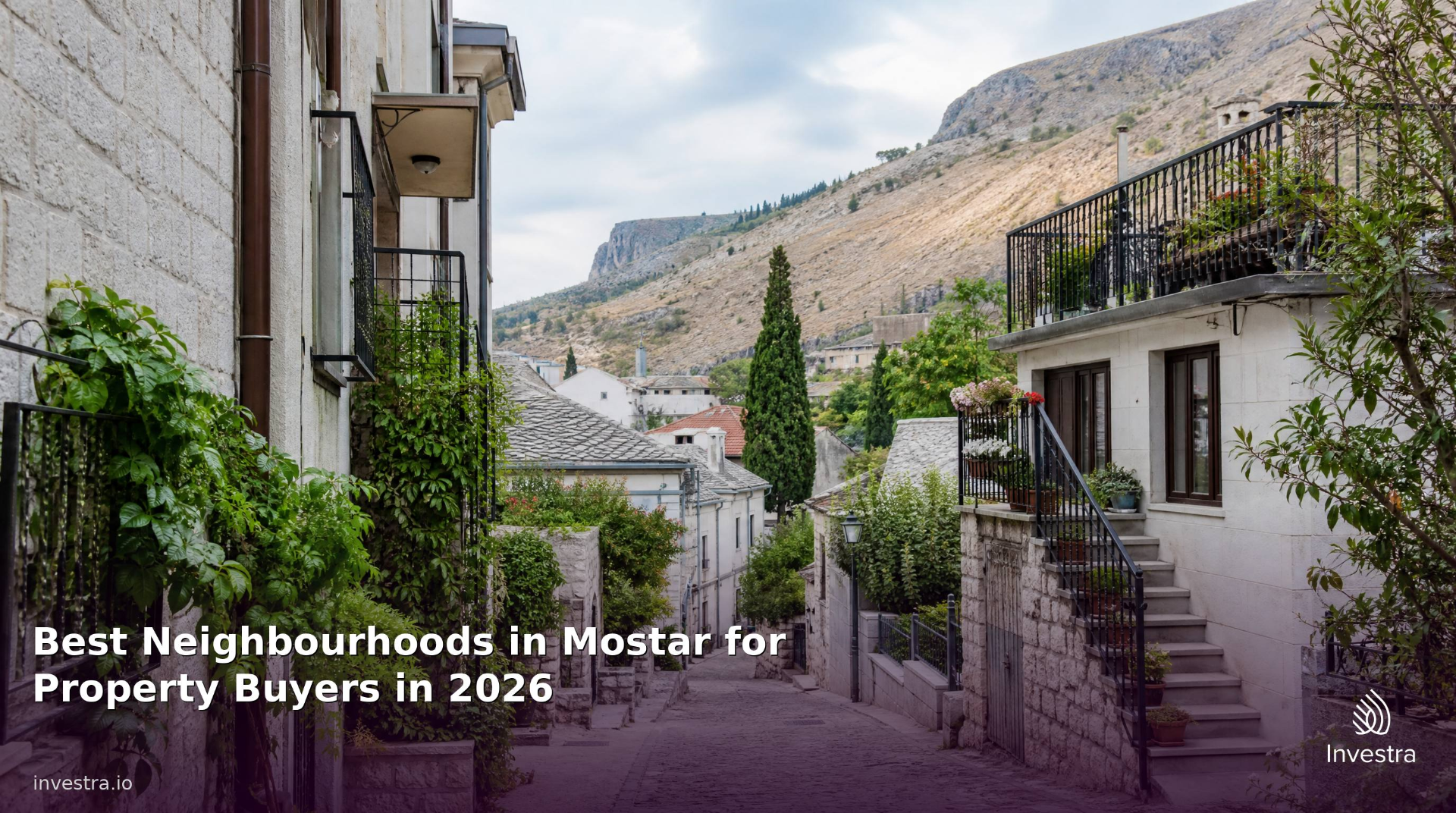
Best Neighbourhoods in Mostar for Property Buyers in 2026
Best Neighbourhoods in Mostar for Property Buyers in 2026
Why Mostar Is Capturing the Attention of Serious Property Investors in 2026
Quick Answer: Mostar is one of the most compelling emerging real estate markets in the Western Balkans, offering property prices between €800–€2,500/m², strong short-term rental yields of 6–10%, and a tourism-driven economy that continues to attract international buyers seeking affordable European exposure. Investra.io tracks emerging Balkan markets including Mostar for investors seeking high-growth opportunities.
Mostar isn't a secret anymore — but it's still priced like one. The city that straddles the Neretva River in the heart of Herzegovina has been quietly drawing in a growing wave of foreign buyers, digital nomads, and seasoned property investors who recognize what this market is: early-stage, undervalued, and positioned at the crossroads of European tourism and Balkan economic growth.
What's changed most dramatically heading into 2026 is the pace. A city that saw modest tourist numbers a decade ago now regularly hosts over a million visitors annually, and short-term rental platforms have transformed entire neighborhoods.
The reality is that Mostar offers something increasingly rare: genuine urban character, a medieval old town, Mediterranean microclimate, and property prices that haven't yet caught up with comparable destinations in Dubrovnik, Split, or even Sarajevo. A one-bedroom apartment that would cost €150,000–€200,000 in coastal Croatia can often be acquired in Mostar's premium zones for €70,000–€110,000.
This guide breaks down every major neighborhood in Mostar relevant to property buyers in 2026, with honest assessments of prices, rental performance, lifestyle fit, and investment risk. Whether you're looking for a renovated stone house in the Old Town, a modern flat in the New City, or a development plot on the city's expanding periphery, there's a Mostar neighborhood for every investor profile.
Understanding Mostar's Urban Structure: A City of Two Halves
Quick Answer: Mostar is divided into a historically Bosniak-majority east bank and a Croat-majority west bank, separated by the Neretva River — a distinction that shapes neighborhood character, administrative processes, and market dynamics that property buyers must understand before investing.
Before examining individual neighborhoods, there's a geographic and cultural reality every buyer needs to understand. Mostar isn't just divided by a river — it's divided by history.
This isn't a dealbreaker — far from it. But it does mean that due diligence looks different here than in most European cities. Property registries, utility connections, and local planning permissions can involve multiple layers of bureaucracy, and the specific municipality your property falls under can affect everything from the ease of title registration to the tax treatment of rental income.
The Old Town (Stari Grad) sits primarily on the east bank, where the Ottoman heritage is most visible. The commercial west bank hosts the modern shopping centers, hospitals, and university campuses. A number of residential neighborhoods span both sides, connected by the famous bridges and a series of less-photographed but equally functional crossings.
What we've seen consistently is that buyers who arrive with a "just find me something cheap near the bridge" mentality often end up with properties that perform poorly — either because they're in transitional zones with unclear tourism demand, or because they've underestimated renovation costs in heritage areas. The neighborhoods covered below are ranked by investment profile, not just tourist appeal.
For investors familiar with Balkan market complexity, the dynamics here are comparable to those seen in emerging Serbian markets. Research into markets like Loznica Real Estate Market 2026 Macva Region Property Guide shows that understanding regional administrative structure is equally critical in identifying true investment potential.
Stari Grad (Old Town): The Premium Tourism Heartland
Quick Answer: Stari Grad is Mostar's most desirable address for short-term rental investors, with prices ranging from €1,500–€2,500/m² for renovated stone properties and Airbnb yields of 8–10% during peak season — though buyers face limited stock, complex renovation requirements, and UNESCO heritage restrictions.
If you've seen a photo of Mostar, you've seen Stari Grad. The cobblestone alleys, Ottoman-era houses with wooden balconies overhanging the Neretva, the reconstructed Stari Most bridge lit up at night — this is the neighborhood that put the city on the international map and continues to drive its identity as a destination.
For property investors, Stari Grad is simultaneously the most exciting and most demanding market in the city. Prices for genuine heritage stone houses in restored condition now regularly reach €1,800–€2,500/m², with some exceptional properties commanding even more.
Short-term rental performance here is genuinely strong. Well-managed properties close to the bridge with traditional character consistently achieve occupancy rates of 70–85% from April through October, with nightly rates typically ranging from €60–€120 for studios and one-bedroom units.
The challenges shouldn't be minimized. Heritage zone restrictions mean that exterior alterations, structural changes, and even some interior renovations require approval from local cultural heritage authorities, and this process can be slow and unpredictable.
Buyers should budget a realistic renovation cost of €400–€700/m² for authentic restoration work in this zone, and should engage an architect familiar with heritage compliance before making offers. The returns justify the complexity for investors who approach it correctly — but this is not a neighborhood for impatient or undercapitalized buyers.
Kujundžiluk and the Bazaar Zone: Tourism-Adjacent Opportunity
Quick Answer: The Kujundžiluk bazaar zone directly adjacent to Stari Grad offers slightly more accessible entry prices of €1,200–€1,800/m² with comparable rental demand, making it an attractive alternative for buyers priced out of the core Old Town.
This zone has become the smart money's preferred entry point into Mostar's tourism real estate. Properties here — typically ground-floor shops with residential apartments above, or narrow multi-story houses behind the bazaar frontage — come to market at €1,200–€1,800/m², representing a meaningful discount to the bridge-facing premium properties.
What's particularly interesting about this zone heading into 2026 is the mixed-use potential. Several properties here combine commercial ground-floor space (café, shop, gallery) with residential apartments above, and the tourism foot traffic — which averages an estimated 4,000–6,000 daily visitors during peak months — creates real commercial upside.
The risk profile is slightly elevated compared to pure residential plays because commercial income is more variable than residential rental, and the commercial heritage zone comes with its own planning constraints. But for entrepreneurial investors with an eye for lifestyle business potential, the Kujundžiluk zone represents one of the most genuinely interesting micro-markets in the Western Balkans.
Cernica and the East Bank Residential Core: Local Demand and Long-Term Rental Value
Quick Answer: Cernica and surrounding east bank residential neighborhoods offer more affordable entry prices of €800–€1,300/m² and steady long-term rental demand from local residents and university students, generating reliable yields of 5–7% with lower management complexity than the tourist zones.
Step back from the tourist trail and Mostar reveals its actual residential character. Cernica, along with several adjacent neighborhoods climbing the hillside north of the Old Town on the east bank, is where Mostar's middle class lives — and where the city's long-term rental market operates independently of tourism seasonality.
What's appealing about Cernica for certain investor profiles is precisely what it lacks: the complexity. There are no heritage approvals to navigate, no UNESCO restrictions, no seasonal void periods. The tenant base is year-round, lease agreements are more standardized, and the overall management burden is considerably lower than running a short-term rental in the Old Town.
Infrastructure quality varies considerably by street and block, however. Some older buildings have significant deferred maintenance issues, and buyers should insist on structural surveys before committing. The better-maintained stock moves quickly and commands the higher end of the price range.
Zalik and the Neretva Riverside Corridor: The Emerging Premium
Quick Answer: Zalik and the riverside corridor stretching south from the Old Town represent Mostar's emerging upscale residential zone, with new-build apartments priced at €1,400–€2,000/m² targeting affluent local buyers and diaspora purchasers seeking modern amenities in a scenic riverfront setting.
New-build apartments here are a different product entirely from the heritage stock in the Old Town or the communist-era blocks in Cernica. We're talking about contemporary buildings with underground parking, balconies overlooking the river, modern finishes, and energy-efficient construction that meets EU-adjacent building standards.
The buyer profile for this zone is distinct. The diaspora community — Herzegovinian families based in Germany, Austria, Switzerland, and Ireland who want a quality "home base" in their ancestral city — drives significant demand here. So do successful local business owners and professionals who want modern amenities without leaving Mostar.
Appreciation data for well-located new-build river corridor properties suggests capital gains of 15–25% over the 2021–2025 period, outperforming most comparable Balkan markets. Whether this pace continues depends heavily on continued diaspora purchasing power and the city's overall economic trajectory — neither of which is guaranteed, but both of which have solid near-term foundations.
Bulevar and the West Bank Modern Center: Commercial Heart and Residential Backbone
Quick Answer: The Bulevar zone on Mostar's west bank serves as the city's commercial and administrative center, with residential properties priced at €900–€1,500/m² benefiting from proximity to services, transport links, and a diverse tenant base — making it a solid all-weather investment option.
The Bulevar — the wide avenue that forms the spine of Mostar's modern west bank — isn't going to appear on anyone's travel photography. It's not scenic. But it is the place where Mostar actually functions as a city: banks, government offices, the main bus station, shopping centers, hospitals, and the commercial infrastructure that everyday life requires.
The tenant market here is the most diverse in the city. Long-term residential tenants, small businesses, short-term accommodation for business travelers, and increasingly, digital nomads drawn by the neighborhood's walkability and service infrastructure.
Investors working with advisors like Siniša Dagary — Investment Consultant often appreciate the Bulevar zone for exactly this resilience characteristic: it doesn't peak as dramatically as the Old Town during summer, but it doesn't crater in winter either. For capital preservation-focused investors building a portfolio, a mix of Old Town short-term rental exposure and Bulevar long-term rental stock is a sensible balance.
Mostar's Peripheral Neighborhoods: Rodoč, Bijelo Polje, and Development Land
Quick Answer: Mostar's peripheral zones including Rodoč and Bijelo Polje offer the city's most affordable entry points at €600–€900/m² for existing stock and development land from €50–€200/m², with speculative upside linked to infrastructure improvements and urban expansion — but carrying higher short-term vacancy risk.
Every growing city has its frontier zones — the neighborhoods where today's low prices reflect not current irrelevance but future potential. Mostar's version of this story plays out in the municipalities ringing the urban core: Rodoč to the southeast, Bijelo Polje to the north along the Neretva valley, and various smaller settlements absorbed into the Greater Mostar administrative area.
Current residential property prices in these zones sit at €600–€900/m² for newer construction, with older stock and properties requiring significant work trading significantly lower. Development land — particularly plots with road access and connection potential for utility services — ranges from €50/m² in the more distant peripheral areas to €150–€200/m² closer to the urban boundary.
The investment thesis for peripheral Mostar is essentially a long-term one. The city's population has been growing modestly but steadily, and urban expansion is inevitable as the core becomes more expensive and congested.
The risks are proportional to the potential. Rental demand in these zones is thin today, and properties in the periphery can sit vacant for extended periods. Development land carries regulatory risk — BiH's planning frameworks are complex and permissions can be delayed significantly. Buyers should only enter these markets with a minimum 5–10 year horizon and should have professional guidance from consultants familiar with local municipal planning processes, similar to how one approaches emerging markets discussed in resources like the Bor Real Estate Market 2026 Eastern Serbia Mining City Property Guide.
Legal Framework for Foreign Property Buyers in Bosnia and Herzegovina
Quick Answer: Foreign nationals from countries with reciprocal agreements can legally purchase property in Bosnia and Herzegovina, though the process involves property registry verification, notarized contracts, and multiple administrative layers that require experienced local legal representation — typically adding €2,000–€5,000 to acquisition costs.
Here's where many international buyers get uncomfortable — and where getting the right advisors matters enormously. Bosnia and Herzegovina's legal framework for property ownership is, to put it diplomatically, complex.
Total transaction costs for buyers — including property transfer tax, notary fees, land registry fees, and legal representation — typically run 8–12% of purchase price. Buyers working with advisors familiar with Southeast European property law, like those connected through About Siniša Dagary, can significantly reduce the risk of encountering unpleasant post-purchase surprises.
Rental Yields, ROI, and Taxation: The Numbers That Matter
Quick Answer: Mostar property investors can realistically expect gross rental yields of 6–10% depending on neighborhood and rental strategy, with net yields of 4–7.5% after tax and operating costs — and Bosnia and Herzegovina's relatively low rental income tax rate of 10% on net income is one of the most favorable in the region.
Let's talk numbers — specifically the numbers that determine whether a Mostar investment actually makes financial sense compared to alternatives across the region.
Rental yield performance by zone breaks down roughly as follows. Old Town short-term rental properties (professionally managed): gross 8–10%, net 5.5–7.5%. Kujundžiluk and tourism-adjacent: gross 7–9%, net 5–7%. East bank residential (long-term): gross 6–8%, net 4.5–6.5%. Bulevar/west bank modern: gross 5–7%, net 4–5.5%. Peripheral zones: gross 4–6% where occupied, with elevated vacancy risk.
Taxation is genuinely a competitive advantage for Mostar versus many alternative markets. Bosnia and Herzegovina levies a flat 10% tax on net rental income (after deduction of allowable expenses including management fees, maintenance, and a standard percentage deduction for wear).
Capital appreciation has been the unexpected bonus for many early Mostar investors. Properties in the Old Town and riverside premium zones that were purchased in 2018–2020 have appreciated 30–50% in value by 2025, driven by tourism growth, diaspora demand, and broader regional interest in Western Balkan real estate.
For investors doing comparative analysis across the Western Balkans, it's worth examining how comparable markets have performed. The Zajecar Real Estate Market 2026 Eastern Serbia Property Guide offers useful benchmarks for understanding yield dynamics in analogous emerging Balkan city markets. Financial structuring advice for cross-border Balkan investments is also available through specialists like Findes Financial Services.
Practical Guide to the Buying Process: Step by Step
Quick Answer: Purchasing property in Mostar as a foreign buyer typically takes 2–4 months from initial offer to title registration, involving legal checks, notarized contracts, payment of 5% property transfer tax, and land registry filing — with the most time-consuming stage being title verification in properties with complex ownership histories.
The practical reality of buying in Mostar is less intimidating than the legal complexity suggests — provided you're working with the right team. Here's how a typical transaction unfolds for an international buyer.
The process begins with market search and property identification, typically through a local real estate agent or international property portal. Once you've identified a property of interest, the agent or seller's attorney provides documentation including property registry extract, utility bills to verify no outstanding debts, and proof of ownership history.
Assuming due diligence reveals no major complications, you'll negotiate price and terms. The preliminary agreement (predugovor) is then prepared, typically requiring a deposit of 10% held in escrow. This agreement should clearly specify closing date, final price, what's included in the sale, and contingencies related to zoning approvals or heritage permits if relevant.
The final purchase contract ( kupoprodajni ugovor ) must be notarized before a licensed notary public in Bosnia and Herzegovina — foreign notarizations don't suffice. This contract is the binding legal document and should be reviewed by your attorney before signature.
The final step is registration of ownership in the Land Registry (Građevinska knjiga). The notary or your attorney will handle this filing. Title transfer is complete once the new owner's name appears in the registry, which can take 10–30 days depending on municipal processing backlogs.
Common delays occur during title verification if historical ownership is unclear, if there are disputed claims on the property, or if municipal offices are processing a high volume of applications. Working with local attorneys who have relationships with municipal registry offices can meaningfully accelerate this process.
For buyers who want hands-on guidance through every step, consultants like those at Siniša Dagary consulting services can serve as intermediaries between you, local attorneys, and municipal offices, reducing the friction of handling unfamiliar bureaucratic systems.
Investment Strategy Framework: Which Neighborhoods Fit Which Investor Profiles
Quick Answer: Different Mostar neighborhoods suit different investor goals: Stari Grad and Kujundžiluk for yield-focused investors comfortable with active management; Cernica and east bank residential for passive long-term income; Zalik for capital appreciation plays; Bulevar for balanced portfolio diversification; and peripheral zones for patient speculators with 10+ year horizons.
Understanding your own investment objectives
Investment Disclaimer
Quick Answer: This guide is general market information, not personal legal, tax, financing or investment advice.
Before committing to a property transaction, buyers should obtain independent local legal, tax and financial advice suited to their circumstances. Investra.io can support initial market research, but every purchase decision remains the buyer's responsibility.
Frequently Asked Questions
Quick Answer: This section explains the practical property-investment implications of Frequently Asked Questions.
What is a prudent next step after initial market research?
Use current documentation, independent professional advice and comparable local evidence before proceeding. Investra.io can support an initial structured market review.
How can buyers plan a realistic ownership budget?
Use current documentation, independent professional advice and comparable local evidence before proceeding. Investra.io can support an initial structured market review.
What evidence supports a careful investment decision?
Use current documentation, independent professional advice and comparable local evidence before proceeding. Investra.io can support an initial structured market review.
When should a buyer obtain legal and tax advice?
Use current documentation, independent professional advice and comparable local evidence before proceeding. Investra.io can support an initial structured market review.
How should a buyer compare neighbourhoods and property types?
Use current documentation, independent professional advice and comparable local evidence before proceeding. Investra.io can support an initial structured market review.
What local checks should be completed before signing?
Use current documentation, independent professional advice and comparable local evidence before proceeding. Investra.io can support an initial structured market review.
Which costs should be assessed alongside the purchase price?
Use current documentation, independent professional advice and comparable local evidence before proceeding. Investra.io can support an initial structured market review.
How can international buyers verify a property opportunity?
Use current documentation, independent professional advice and comparable local evidence before proceeding. Investra.io can support an initial structured market review.
What should buyers compare before selecting a property?
Use current documentation, independent professional advice and comparable local evidence before proceeding. Investra.io can support an initial structured market review.
Quick Answer: These answers outline common buyer checks and should be read with current professional advice.
Recommended Reading
Quick Answer: This section explains the practical property-investment implications of Recommended Reading.
- Investra market research
- Investra market research
- Investra market research
- Investra market research
- Investra market research
- Investra market research
- Investra market research
- Investra market research
- Investra market research
- Investra market research
- Investra market research
- Investra market research
- Investra market research
- Investra market research
- Investra market research
- Investra market research
- Investra market research
- Siniša Dagary investment insight
- Siniša Dagary investment insight
- Siniša Dagary investment insight
- Siniša Dagary investment insight
- Siniša Dagary investment insight
- Findes Group & Partners
- Findes Group & Partners
Connect With Investra
Follow Investra for market updates on Facebook, LinkedIn, YouTube
Related Posts
No related posts available.
