
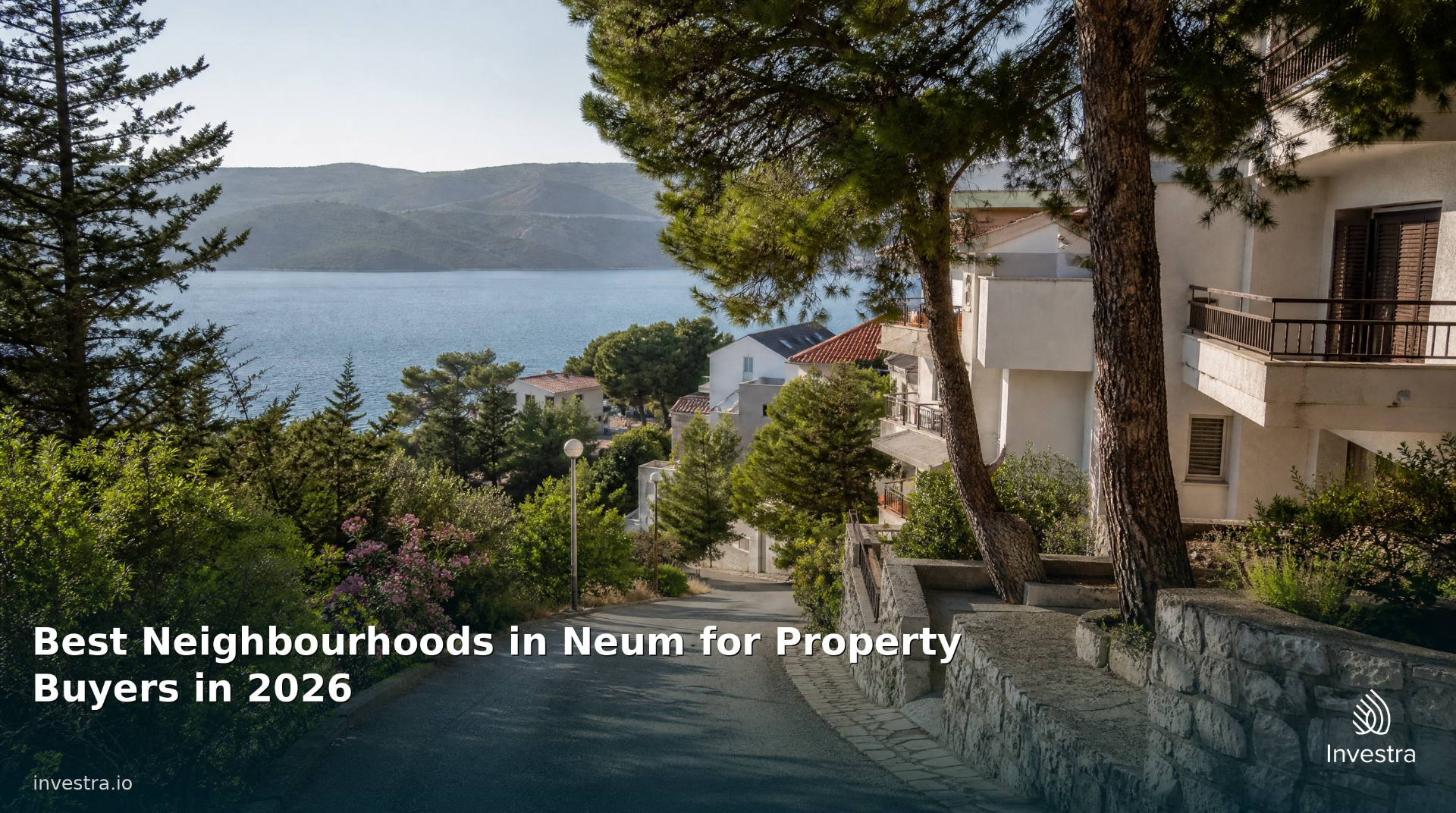
Best Neighbourhoods in Neum for Property Buyers in 2026
Best Neighbourhoods in Neum for Property Buyers in 2026
Why Neum Is Capturing Global Investor Attention in 2026
Quick Answer: Neum, Bosnia and Herzegovina's only coastal town, is attracting international property buyers in 2026 due to its dramatically underpriced Adriatic real estate, improving infrastructure, and unique EU-adjacent positioning that offers value unavailable anywhere else on the Dalmatian Coast. Investra.io tracks emerging Balkan markets like Neum for data-driven investment insights.
There exists a particular moment in property market cycles when discerning investors recognise an opportunity before it becomes obvious to the broader market. Neum is precisely at that inflection point in 2026.
What has fundamentally shifted for Neum? The Pelješac Bridge, which opened in 2022, transformed the town's geographic positioning. Croatia's Highway D9 now bypasses Neum, a change that initially seemed negative but ultimately created an opportunity. Previously dependent on transit traffic, the town is now repositioning as a destination in its own right. Local authorities have actively pursued tourism and residential investment, with new hotel complexes and residential developments beginning to reshape the shoreline.
The pricing narrative remains the headline story throughout all zones. Comparable Adriatic properties in Croatia routinely command €3,500–€6,000 per square metre, while Neum still delivers beachfront and sea-view apartments in the €1,200–€2,500 per square metre range. That represents a discount of 40–60% against near-identical geography, just metres across a political border.
Understanding Neum's Urban Geography and Neighbourhood Structure
Quick Answer: Neum's property market divides into five distinct zones — the Seafront Promenade, Town Centre, Gornji Grad (Upper Town), Mogorjelo Western Approaches, and the Klek Coastal Strip — each offering different price points, rental profiles, capital growth trajectories, and investment characteristics that align with specific buyer profiles.
Neum is fundamentally a compact coastal settlement. With a permanent resident base of approximately 4,500–5,000 people, it scales dramatically during summer months when tourist arrivals inflate that figure into the tens of thousands. This seasonal rhythm is central to understanding how different neighbourhoods function as investment vehicles and which buyer profiles they serve best.
The town's physical structure is relatively straightforward: a hillside topography descending toward the Adriatic, with lower zones hugging the coastline accommodating the highest density of tourism infrastructure — hotels, restaurants, beach facilities, watersports operators — while moving upslope reveals progressively more residential character. Properties at higher elevation escape peak-season intensity yet command panoramic views and a genuinely livable community atmosphere year-round.
Five distinct investment zones merit detailed understanding. The Seafront and Promenade Zone occupies the premium strip directly adjacent to water and primary beach access, commanding the highest per-square-metre prices and attracting pure short-term holiday rental capital. The Town Centre (Centar) represents the commercial and residential core, walkable to beaches yet set back sufficiently to avoid seasonal chaos, offering balanced yield-and-livability characteristics.
The Seafront Promenade Zone — Premium Adriatic Access at Discounted European Prices
Quick Answer: The Neum seafront promenade zone commands the highest prices in the market, typically €1,800–€2,800 per square metre for apartments with direct sea views in 2026, yet remains dramatically cheaper than equivalent Croatian or Montenegrin coastal properties — making it the top choice for capital appreciation investors prioritising premium locationality.
Every experienced Adriatic property investor, when asked where they would acquire if price were a secondary consideration, consistently points toward the seafront. The economic logic is durable and time-tested: direct sea access represents a finite, non-reproducible asset class, and demand for it demonstrates remarkable resilience across market cycles.
Short-term rental yields in the seafront zone represent the strongest achievable in Neum, averaging 7–9% gross during the May–September peak season. However, Neum's tourist season remains genuinely compressed relative to Western Mediterranean baselines. Unlike year-round markets in established European resort destinations, the bulk of Neum's visitor arrivals concentrate in July and August, with shoulder seasons showing growth but not yet matching full-season equivalents.
Available property typologies range from studio apartments of 30–45 square metres at entry-level pricing starting around €55,000–€70,000, progressing to two-bedroom sea-view units of 60–80 square metres typically trading in the €130,000–€190,000 range. Premium new-build penthouses have broken the €250,000 threshold, which while attention-catching for Neum's market remains extraordinary value against comparable Adriatic alternatives where equivalent penthouses would command €400,000–€600,000.
One practical consideration meriting explicit discussion: parking availability genuinely challenges seafront properties during peak season, and older building stock in premium zones frequently lacks lift infrastructure, which measurably affects rental appeal to older travellers and families with mobility considerations. Prospective buyers should verify these specifics on a property-by-property basis before commitment. Working with advisers possessing deep market knowledge — the institutional due diligence framework promoted through Siniša Dagary investment insight — prevents post-acquisition frustration and optimises investment outcomes.
Neum Town Centre — The Balanced Investment Zone for Yield and Livability
Quick Answer: The Neum Town Centre offers balanced investment fundamentals with apartment prices ranging €1,200–€1,900 per square metre, solid rental yields of 6–8%, and the best year-round livability of any zone — making it optimal for investors planning personal use during off-season or seeking a stable, diversified tenant base.
A specific investor profile consistently gravitates toward the Town Centre: buyers who don't require first-row oceanfront status but genuinely value reliable income generation, manageable entry costs, and properties where they would authentically enjoy spending time themselves during extended periods. Neum's Town Centre delivers consistently across this profile.
Pricing in this zone remains materially more accessible than seafront alternatives. Typical apartments trade at €1,200–€1,900 per square metre, with the lower spectrum reflecting older construction or properties requiring renovation, and the upper range representing recently completed developments or properties fully renovated to contemporary European standards.
The tenant demographic profile in the Town Centre extends beyond the pure seafront zone's holiday-rental concentration. You capture budget-conscious European travellers who prioritise location efficiency and value over absolute oceanfront premium, alongside increasingly visible medium-term corporate and infrastructure-project workers drawn by Neum's advancing development trajectory.
Commercial ground-floor units in prime Town Centre locations have attracted growing investor attention, particularly for hospitality concepts — restaurants, cafés, small shops catering to expanding tourist flows. Yields on commercial units run slightly elevated at 8–10% in optimal locations, though they carry proportionally higher off-season vacancy risk. Residential remains the more consistent performer for most buyers entering this market for the first time, offering better risk-adjusted returns and simpler management.
Investors comparing emerging Balkan markets will recognise parallels with towns including Loznica in the Macva Region, where balanced urban-centre investments have historically outperformed more speculative peripheral developments across 5–10 year investment horizons through combinations of modest capital appreciation and reliable income generation.
Gornji Grad (Upper Town) — Neum's Most Undervalued Investment Neighbourhood
Quick Answer: Gornji Grad is Neum's most overlooked investment neighbourhood in 2026, with apartment prices starting at just €900–€1,400 per square metre and offering panoramic bay views rivalling anything across the Croatian Riviera — representing exceptional capital appreciation potential for buyers with a 5–10 year time horizon.
Pricing in Gornji Grad genuinely astonishes first-time visitors given the calibre of views available. Well-maintained apartments featuring these panoramic perspectives trade at €900–€1,400 per square metre, and even recently constructed units at the spectrum's upper boundary remain substantially below comparable pricing in Montenegro's Boka Kotorska Bay or Croatia's Makarska hinterland where similar vistas command double these per-square-metre figures.
The trade-off is unambiguous and real: beach access requires an 10–20 minute walk downslope or a short motorised journey. For older travellers or families with young children, this accessibility factor measurably affects short-term rental appeal.
Capital appreciation projections for Gornji Grad command serious consideration. As Neum's overall market profile elevates and lower-zone inventory progressively absorbs at advancing price points, upward pricing pressure historically spreads to elevated zones with a 3–5 year lag effect. This pattern has played out consistently across Western Balkans coastal markets — in Montenegrin resort towns, in Serbian mountain communities, and throughout Dalmatian hinterland zones.
Mogorjelo and Western Approaches — Space, Privacy, and Villa-Style Investment
Quick Answer: The Mogorjelo area and western periphery of Neum offer the best combination of space, privacy, and garden/terrace amenities, with detached houses and villa-style properties starting from €120,000–€280,000 — appealing primarily to buyers seeking a genuine holiday home and lifestyle property rather than a pure rental yield vehicle.
Not every property buyer prioritises a flat within a block structure. The western approaches and Mogorjelo plateau — broadly encompassing the hillside settlements approaching the Croatian border from Neum's inland side — offer a fundamentally distinct property typology: standalone houses, small villas, and traditional stone structures available for conversion into boutique holiday rentals or private family retreats.
This zone has captured expanding investor interest from buyers priced out of comparable villa properties in Dubrovnik's hinterland who discover that merely 20–30 kilometres eastward, the landscape remains nearly identical but pricing collapses dramatically. A three-bedroom traditional stone house with garden and pool amenity in Mogorjelo realistically trades at €200,000–€280,000 — a figure that in equivalent Croatian geography wouldn't cover basic land valuation alone, let alone the constructed improvements.
The investment thesis here diverges fundamentally from apartment-based zones. Gross rental yields remain somewhat depressed — typically 5–7% — because villa properties demand more intensive active management, carry higher annualised maintenance expenditure, and attract longer booking cycles from premium-spending groups rather than the high-frequency short-stay model.
Infrastructure development in this zone continues but trails the town centre materially. Road condition, utility connection reliability, and service-proximity factors all demand careful individual assessment. Buyers contemplating this zone are optimally positioned consulting financial planning frameworks offered through Findes Group & Partners, particularly regarding currency risk management and cross-border financing structure optimisation.
The Klek Coastal Strip — Speculative Border Zone with Emerging Upside Potential
Quick Answer: The Klek area on Neum's eastern edge, bordering Croatia, represents the most speculative yet potentially highest-reward micro-market in the region, with prices currently depressed at €800–€1,300 per square metre and substantial upside use tied to cross-border tourism flows and planned Bosnian coastal development initiatives.
The Klek peninsula presents genuinely unusual characteristics in contemporary European real estate terms. It comprises a narrow territorial extension of Bosnia into the Adriatic, bordered by Croatia's Dubrovnik-Neretva County to the east and primary Neum territory to the west. This geographic peculiarity — combined with its historical role as a transit bottleneck affected by border complexity — has maintained prices here at depressed levels even relative to Neum's already-accessible baselines.
However, the Pelješac Bridge opening in 2022 fundamentally removed the previous chokepoint, transforming what was once a congested transit zone into an increasingly tranquil coastal strip with genuine tourism development potential. Residential property prices currently stabilise at €800–€1,300 per square metre, positioning this zone as the most economically accessible sea-adjacent real estate across the entire Adriatic coast by a substantial margin.
The risk profile scales proportionally with upside potential. Infrastructure investment in Klek materially lags central Neum development. Construction permissions and land registry documentation in border zones occasionally presents complexity exceeding standard Neum transactions. The entire yield trajectory depends substantially on Bosnian government policy regarding coastal development — a variable that has traditionally progressed slowly and unpredictably.
Investors experienced with frontier-market development in the Balkans — recognising early-stage opportunities documented in markets such as Bor in Eastern Serbia and Zajecar in Eastern Serbia — will immediately recognise the Klek investment profile: measurably undervalued, genuinely illiquid, commanding exceptional upside potential, yet demanding rigorous due diligence before any commitment.
Property Prices, Rental Yields, and ROI Analysis for Neum in 2026
Quick Answer: Neum property prices range from €800–€2,800 per square metre depending on neighbourhood, property type, and amenities in 2026, with gross rental yields of 5–9% achievable in well-selected locations — a return profile substantially outperforming many Western European coastal markets at proportionally lower entry prices and capital requirements.
Investment decisions ultimately rest on concrete, verifiable data rather than narrative conviction. The following summarises current market parameters across Neum's primary investment zones as of 2026:
Seafront / Promenade Zone: €1,800–€2,800 per square metre | Gross yield: 7–9% | Entry-level apartment: from €55,000 | Investor profile: short-term rental income prioritisation
Town Centre (Centar): €1,200–€1,900 per square metre | Gross yield: 6–8% | Entry-level apartment: from €55,000 | Investor profile: balanced yield-and-capital-growth
Gornji Grad (Upper Town): €900–€1,400 per square metre | Gross yield: 5–7% | Entry-level apartment: from €50,000 | Investor profile: long-term capital appreciation
Mogorjelo / Western Approaches: €1,100–€1,800 per square metre (houses) | Gross yield: 5–7% | Entry-level house: from €120,000 | Investor profile: holiday home with lifestyle priority
Klek Coastal Strip: €800–€1,300 per square metre | Gross yield: 4–7% | Entry-level land plot: from €40,000 | Investor profile: speculative long-term appreciation
What do these yields translate to in practical terms? Consider a €120,000 acquisition at the seafront generating 8% gross annual returns — approximately €9,600 in raw rental revenue. After standard management expenses (typically 15–20% of gross revenue with a local property manager), annualised maintenance provisions (roughly 1–1.5% of property value), and Bosnian property taxation (approximately 0.5–1% of assessed value), net yields settle realistically in the 4.5–6% range.
Total investment cost calculations should incorporate: 5% transfer tax on resale properties (new construction may utilise 17% VAT structure), notary fees (typically €500–€1,500 range), qualified legal representation costs (normally 1–2% of purchase price), and agent commissions where applicable (typically 3% split between parties). Complete acquisition costs generally run 7–10% above the base purchase price for resale properties — a figure consistent with regional norms across Balkans markets as documented through Investra's Balkans regional coverage.
Legal Framework and Foreign Buyer Purchasing Process in Bosnia and Herzegovina
Quick Answer: Foreign nationals from EU member states can purchase property in Bosnia and Herzegovina on a reciprocal basis, while non-EU buyers can structure purchases through a Bosnian-registered company — the complete legal process from offer through title registration typically consumes 2–4 months and demands careful due diligence regarding land registry documentation.
Bosnia and Herzegovina operates a property law framework that functions adequately but genuinely necessitates expert guidance for foreign investors. The country's political structure comprises two primary entities — the Federation of Bosnia and Herzegovina (FBiH) and Republika Srpska (RS) — and Neum falls within the Federation's jurisdiction. This entity distinction materially matters because property legislation, land registry procedures, and certain tax obligations differ measurably between the two entities.
Foreign nationals from countries maintaining bilateral reciprocity agreements — encompassing all European Union member states plus numerous others — can lawfully purchase residential property in their own names within the Federation. Non-EU buyers lacking reciprocity arrangements typically purchase through a d.o.o. (the Bosnian limited-liability company equivalent), introducing an additional corporate establishment layer though this remains a well-established path.
Title verification represents the stage where foreign buyers most frequently encounter complications. Neum, consistent with post-Yugoslav Bosnia broadly, contains areas where land registry records remain incomplete, reflect disputed claims, or carry baggage from wartime ownership complications. Independently retained qualified local property counsel — distinct from agent-recommended solicitors — must verify that the seller possesses clean, unchallenged title before any financial consideration transfers. This diligence requirement isn't unique to Bosnia; comparable scrutiny applies across Western Balkans markets as illustrated through Investra's Sremska Mitrovica property guide.
Mortgage financing from Bosnian financial institutions remains available to foreign buyers but typically requires substantial local deposits (30–50% loan-to-value is the practical norm), documented income proof, and extended approval timelines. Many foreign investors discover that cash acquisition or financing arrangements through home-country institutions proves simpler at Neum's currently accessible price points. Strategic cross-border financial structuring advice tailored to Balkan investment contexts is available through dedicated advisory services providing experienced guidance.
Annual Property Tax, Ownership Costs, and Ongoing Financial Obligations
Quick Answer: Property taxes in Bosnia and Herzegovina (Federation entity) are low by European standards, running approximately 0.5–1% of assessed property value annually, while rental income is taxed at 10% if managed through a company or approximately 15% if earned as personal income — making Neum's tax burden among Europe's most investor-friendly.
Bosnia and Herzegovina maintains genuinely favourable tax positioning for property investors compared to Western European alternatives. Annual property ownership tax rates stabilise at approximately 0.5–1% of assessed property value depending on municipality and property classification. For a €150,000 property, this translates to €750–€1,500 annual tax cost — remarkably modest for Mediterranean coastal real estate.
Rental income taxation depends on your ownership structure. Properties held through a d.o.o. company (standard for non-EU buyers) face corporate taxation where companies can deduct legitimate operating expenses, maintenance, management fees, and depreciation before calculating tax obligation. Effective tax rates on rental companies frequently stabilise in the 10–15% range of gross income after standard expense deductions.
Investment Disclaimer
Quick Answer: This guide is general market information, not personal legal, tax, financing or investment advice.
Before committing to a property transaction, buyers should obtain independent local legal, tax and financial advice suited to their circumstances. Investra.io can support initial market research, but every purchase decision remains the buyer's responsibility.
Frequently Asked Questions
Quick Answer: This section explains the practical property-investment implications of Frequently Asked Questions.
What is a prudent next step after initial market research?
Use current documentation, independent professional advice and comparable local evidence before proceeding. Investra.io can support an initial structured market review.
How can buyers plan a realistic ownership budget?
Use current documentation, independent professional advice and comparable local evidence before proceeding. Investra.io can support an initial structured market review.
What evidence supports a careful investment decision?
Use current documentation, independent professional advice and comparable local evidence before proceeding. Investra.io can support an initial structured market review.
When should a buyer obtain legal and tax advice?
Use current documentation, independent professional advice and comparable local evidence before proceeding. Investra.io can support an initial structured market review.
How should a buyer compare neighbourhoods and property types?
Use current documentation, independent professional advice and comparable local evidence before proceeding. Investra.io can support an initial structured market review.
What local checks should be completed before signing?
Use current documentation, independent professional advice and comparable local evidence before proceeding. Investra.io can support an initial structured market review.
Which costs should be assessed alongside the purchase price?
Use current documentation, independent professional advice and comparable local evidence before proceeding. Investra.io can support an initial structured market review.
How can international buyers verify a property opportunity?
Use current documentation, independent professional advice and comparable local evidence before proceeding. Investra.io can support an initial structured market review.
What should buyers compare before selecting a property?
Use current documentation, independent professional advice and comparable local evidence before proceeding. Investra.io can support an initial structured market review.
Quick Answer: These answers outline common buyer checks and should be read with current professional advice.
Recommended Reading
Quick Answer: This section explains the practical property-investment implications of Recommended Reading.
- Investra market research
- Investra market research
- Investra market research
- Investra market research
- Investra market research
- Investra market research
- Investra market research
- Investra market research
- Investra market research
- Investra market research
- Investra market research
- Investra market research
- Investra market research
- Investra market research
- Investra market research
- Investra market research
- Investra market research
- Siniša Dagary investment insight
- Siniša Dagary investment insight
- Siniša Dagary investment insight
- Siniša Dagary investment insight
- Siniša Dagary investment insight
- Findes Group & Partners
- Findes Group & Partners
Connect With Investra
Follow Investra for market updates on Facebook, LinkedIn, YouTube
Related Posts
No related posts available.
