
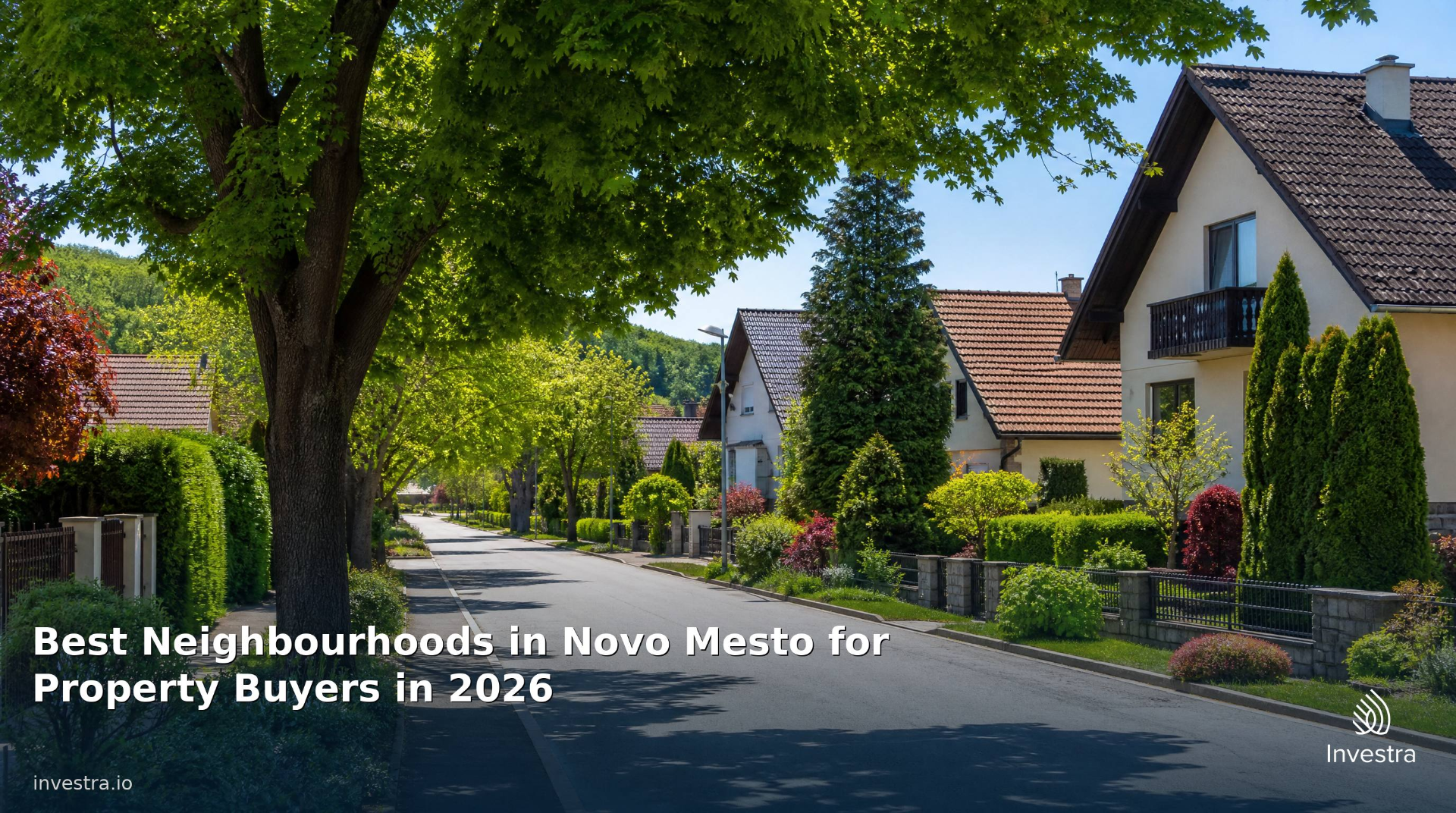
Best Neighbourhoods in Novo Mesto for Property Buyers in 2026
Best Neighbourhoods in Novo Mesto for Property Buyers in 2026
Why Novo Mesto Is Attracting Property Buyers in 2026
Quick Answer: Novo Mesto is Slovenia's seventh-largest city and the economic capital of the Dolenjska region, offering property buyers a rare combination of affordability, strong industrial employment, and consistent rental demand that makes it one of Central Europe's most underrated investment destinations in 2026. Investra.io tracks emerging markets like Novo Mesto for global investors seeking value beyond the usual hotspots.
Novo Mesto doesn't make the front pages the way Ljubljana or Bled do. And that, frankly, is exactly why serious property investors are paying attention to it right now.
What's happening in 2026 is the result of years of steady accumulation. Demand from Krka and Revoz employees has kept rental occupancy rates high, often above 93–95% in central neighbourhoods. The city's university population — Novo Mesto hosts a Faculty of Economics and Informatics, among other institutions — adds a consistent layer of student rental demand.
The broader context matters too. Slovenia's EU membership, eurozone integration, and rule-of-law protections make it one of the safest jurisdictions in the region for property ownership. Unlike some of its Balkan neighbours — where compelling yield stories exist but legal frameworks can be unpredictable — Slovenia operates with fully standardised EU-compliant property law, transparent title registries, and reliable mortgage markets. For buyers comparing options across the region, guides like the Zajecar Real Estate Market 2026 Eastern Serbia Property Guide and the Bor Real Estate Market 2026 Eastern Serbia Mining City Property Guide illustrate how different risk-reward profiles can look across neighbouring countries.
Average apartment prices in Novo Mesto currently sit between €1,800 and €2,800 per square metre depending on neighbourhood, condition, and property type — a figure that looks remarkably attractive when set against Ljubljana's €3,500–€5,500/m² range. Gross rental yields across the city average 4.5–6.5%, with well-positioned student and professional rentals reaching the higher end of that band.
Understanding the Novo Mesto Property Market: Key Statistics for 2026
Quick Answer: Novo Mesto's property market in 2026 is characterised by average prices of €1,800–€2,800/m², gross rental yields of 4.5–6.5%, low vacancy rates, and year-on-year price growth of approximately 4–7%, driven by strong employment, limited new supply, and rising demand from both local residents and corporate relocations.
Getting a clear read on any property market requires more than anecdote — it requires numbers. Here's what the data shows for Novo Mesto heading into 2026.
Apartment prices across the municipality range from around €1,800/m² for older socialist-era blocks in peripheral locations to €2,800/m² or more for renovated or new-build units in central or premium residential areas. Houses and villas, particularly in the Karteljevo and Šmihel suburbs, start around €200,000 and can reach €450,000 for larger family homes with gardens.
Vacancy rates in the rental sector remain structurally low. Central neighbourhoods like Bršljin and Kandija report vacancy below 5%, and in some student-adjacent zones, landlords rarely see gaps between tenancies.
For investors used to watching markets like those covered in the Loznica Real Estate Market 2026 Macva Region Property Guide or the Prokuplje Real Estate Market 2026 Toplica Region Property Guide, Novo Mesto's fundamentals look exceptionally stable. The risk profile is lower, though yields are also more moderate than some frontier markets — the classic trade-off between safety and upside.
The Best Neighbourhoods in Novo Mesto for Property Investment in 2026
Quick Answer: The best neighbourhoods for property investment in Novo Mesto in 2026 are the Old Town (Staro Mesto) for capital appreciation, Bršljin and Kandija for rental yield, Šmihel and Karteljevo for family buyers, and Ragov Gaj for new-build opportunities — each offering distinct risk-return profiles for different investor types.
Novo Mesto isn't a monolithic market. Like any city, it has distinct neighbourhoods with different characters, price points, and investment dynamics. Understanding which area fits your strategy is the most important decision you'll make before committing capital here.
Staro Mesto (Old Town) — This is the historic core, perched dramatically on the Krka River bend. Apartments here are typically older, often requiring renovation, and prices reflect the premium location: expect €2,400–€2,800/m² for a renovated unit. Rental yields are slightly compressed (4.5–5%) because purchase prices are high, but capital appreciation potential is strong.
Bršljin — One of the city's most practical investment zones. A largely residential district with good public transport links, proximity to both Krka's headquarters and the city centre, and a mix of socialist-era apartment blocks and newer builds. Prices range €1,900–€2,300/m², and rental yields here tend to reach 5.5–6.5% — particularly for two-bedroom units rented to Krka professionals.
Kandija — Adjacent to the city centre and historically one of Novo Mesto's more established residential areas. Kandija offers solid mid-range pricing (€2,000–€2,500/m²) with good transport connectivity and proximity to schools and services. It attracts long-term tenant profiles — families and established professionals — which translates to low turnover and predictable income. Gross yields average 5–6%.
Šmihel and Karteljevo — These southern and western suburban areas are where Novo Mesto's family housing market concentrates. Detached houses and townhouses dominate, typically priced €220,000–€400,000. For buyers seeking a primary residence or a long-term family rental property, these neighbourhoods offer space, green surroundings, and good school access.
Ragov Gaj — A newer development area attracting interest from both domestic buyers and investors. New-build apartments here are priced €2,500–€2,800/m² but come with modern specifications, energy efficiency ratings that reduce running costs, and strong appeal to the professional rental market.
Staro Mesto and the Old Town: Historic Living with Premium Returns
Quick Answer: Novo Mesto's Old Town offers premium pricing of €2,400–€2,800/m² with strong capital appreciation prospects, making it ideal for long-hold investors and lifestyle buyers who value the historic character, river views, and central location more than maximising short-term rental yield.
There's something genuinely special about Novo Mesto's Old Town that photographs don't quite capture. The historic promontory above the Krka River, with its medieval street pattern, Baroque architecture, and the striking Novo Mesto Cathedral, creates a sense of place that's increasingly rare in Central European cities.
For property buyers, the Old Town presents a compelling but nuanced proposition. Prices here are the highest in the city, reflecting both the limited supply of historic properties and their desirability. Renovated apartments in the core area trade at €2,400–€2,800/m², while unrenovated units can be acquired at €1,800–€2,100/m² — creating an interesting renovation play for buyers willing to manage a project.
Rental demand in the Old Town skews towards professionals and couples rather than students or large families, given the typical apartment sizes and pricing. Monthly rents for a well-presented two-bedroom apartment range €750–€950, yielding 4.5–5.2% gross.
One practical consideration: Old Town properties often come with specific planning restrictions related to their historic designation. Renovation work typically requires approval from the Institute for the Protection of Cultural Heritage of Slovenia. Buyers should budget for longer approval timelines (4–6 months is typical) and work with architects experienced in heritage renovation.
Bršljin and Kandija: The Rental Yield Sweet Spots
Quick Answer: Bršljin and Kandija consistently deliver Novo Mesto's strongest rental yields — 5.5–6.5% gross — thanks to proximity to major employers like Krka, solid transport links, and a reliable professional tenant base, making them the go-to neighbourhoods for buy-to-let investors in 2026.
If the Old Town is about heritage and capital preservation, Bršljin and Kandija are about cash flow. These two neighbourhoods form the practical heart of Novo Mesto's rental investment market, and for good reason.
Bršljin's proximity to Krka's main campus is not a minor detail — it's the defining characteristic of the neighbourhood's rental dynamics. Pharmaceutical professionals earn well, move to Novo Mesto for multi-year contracts, and want decent quality accommodation within reasonable distance of work.
The housing stock in Bršljin is predominantly 1970s–1990s socialist-era concrete construction. These buildings aren't architecturally distinguished, but they're structurally sound and, crucially, affordable to renovate.
Kandija sits a little closer to the centre and commands slightly higher purchase prices (€2,000–€2,500/m²) with a tenant mix that includes more families and established couples. Turnover is lower here — tenants often stay 2–4 years — which reduces void periods and management friction.
Both neighbourhoods have seen consistent demand even during periods of national economic softness, which speaks to the structural rather than cyclical nature of the tenant base. As Siniša Dagary — Investment Consultant has noted in analysis of Central European real estate markets, employer-anchored cities consistently outperform on vacancy metrics, and Novo Mesto's Krka-Revoz dual anchor is an unusually robust foundation for a city of its size.
Family Housing in Šmihel, Karteljevo, and Suburban Novo Mesto
Quick Answer: Novo Mesto's suburban districts — particularly Šmihel, Karteljevo, and Bučna vas — offer family homes priced €200,000–€400,000 with good schools, green space, and quiet residential character, appealing primarily to owner-occupiers, expats, and investors seeking long-term family tenants rather than maximum short-term yield.
Not every buyer is chasing rental yields. For the significant cohort of international buyers — often Slovenian diaspora returning from Western Europe, or German and Austrian professionals relocating for work — finding a quality family home in a liveable environment is the primary objective. Novo Mesto's suburban areas serve this market well.
Šmihel, south of the city centre, is arguably the most established family residential district. Semi-detached and detached houses dominate, typically on 400–800m² plots. Properties here range from older 1970s–1980s family homes at €200,000–€280,000 to more modern builds from the 2000s and 2010s at €300,000–€400,000.
Karteljevo, to the west, has seen more recent development and offers a higher proportion of newer builds. Prices here are slightly higher — €280,000–€420,000 for a modern family house — but energy efficiency standards are better, which matters both for running costs and for EU energy performance certification requirements that affect resale value.
Bučna vas is worth mentioning for buyers seeking more rural character within easy commuting distance of the city. Here, older farmhouses and rural properties occasionally come to market at €150,000–€250,000 — often requiring significant renovation but offering large plots and genuine countryside character.
From a rental perspective, suburban family homes yield 3.5–4.5% gross — lower than apartment yields in central areas — but tenant quality tends to be high and voids rare. Long-term family tenants, often on 2–3 year renewable contracts, create the kind of predictable income stream that many investors actually prefer, even if the headline yield number is less impressive.
New Developments and Off-Plan Opportunities in Novo Mesto
Quick Answer: New-build and off-plan apartments in Novo Mesto, particularly in areas like Ragov Gaj and selected city-fringe developments, are priced €2,400–€2,900/m², with off-plan discounts of 5–10% available from reputable developers — offering a combination of modern specifications, better energy ratings, and strong rental appeal to professional tenants.
The new-build market in Novo Mesto is smaller than in Ljubljana but more active than many outsiders expect. Several Slovenian developers have recognised the city's fundamentals and are delivering projects that fill a genuine gap: modern, energy-efficient apartments in a market that has historically been dominated by older socialist-era stock.
Ragov Gaj is currently the most active new-build zone. Typical specifications include triple-glazed windows, underfloor heating, A or B energy performance ratings, and underground parking — a significant quality leap from the 1970s blocks that still dominate parts of Bršljin.
What's the practical upside of buying off-plan? Beyond the price discount, buyers who purchase in early project phases often have influence over apartment specifications — kitchen configurations, flooring choices, bathroom fittings — which directly affects rental appeal and achievable rents.
The risks of off-plan purchasing in Slovenia are real but manageable. Slovenian property law requires developers to hold completion guarantees (typically bank guarantees or insurance-backed), and stage payments are regulated to align with construction milestones. Buyers should always have a Slovenian property lawyer review the reservation agreement and developer documentation. The Findes Group & Partners platform offers financial structuring guidance for buyers handling purchase financing in the Slovenian market.
Completion timelines for Novo Mesto new-build projects currently average 18–30 months from contract to handover, which is broadly in line with Western European norms. Currency risk is minimal since Slovenia operates within the eurozone.
Legal Process for Buying Property in Novo Mesto: A Practical Guide
Quick Answer: Buying property in Novo Mesto follows Slovenia's EU-standard legal framework: notarised purchase contract, land registry registration, 2% real estate transfer tax, and — for non-EU buyers — a reciprocity-based purchase right; the entire process typically takes 6–12 weeks from offer acceptance to registration of title.
Slovenia's property purchase process is genuinely one of the more straightforward in the region — a statement that carries particular weight when compared to some of the procedural complexity seen in neighbouring markets. Let's walk through what actually happens.
The process begins with a preliminary agreement (predpogodba), which secures the property and is typically accompanied by a 10% deposit. This is a binding contract, and if the buyer withdraws without cause, the deposit is forfeited. If the seller withdraws, they're required to return double the deposit — a provision that protects buyers seriously.
The main purchase agreement (kupoprodajna pogodba) must be notarised by a Slovenian notary. The notary verifies both parties' identities, confirms the property's legal status through the land registry (Zemljiška knjiga), and handles the transfer documentation. Notary fees are regulated by law and typically amount to 0.5–1.0% of the purchase price, with a ceiling on higher-value transactions.
Real estate transfer tax (davek na promet nepremičnin) is 2% of the assessed value, paid by the buyer. If purchasing from a VAT-registered developer selling a new-build property within 5 years of first occupation, VAT at 9.5% applies instead — a key distinction for new-build buyers to factor into their financial model.
Land registry registration (vknjižba) formalises ownership and typically takes 2–6 weeks after notarisation. Slovenia's Zemljiška knjiga is a reliable, digitised, and publicly accessible system — one of the clear advantages of buying within an EU member state with mature legal infrastructure.
For non-EU buyers, Slovenia applies a reciprocity principle: citizens of countries that extend reciprocal property rights to Slovenian citizens can typically purchase without restriction. In practice, this covers most major buyer nationalities. Some restrictions apply to agricultural land, but standard residential and commercial urban property is generally accessible. Expert guidance from Siniša Dagary investment insight outlines how international buyers can structure Slovenian property acquisitions efficiently, including the use of company structures where appropriate.
Taxation, Rental Income, and Ongoing Costs for Novo Mesto Property Owners
Quick Answer: Rental income in Slovenia is taxed at a flat rate of 15% after a 10% deemed expense deduction, resulting in an effective tax rate of approximately 13.5% on gross rental income; annual property taxes are low (€100–€400 for a typical apartment), and the overall tax burden is modest by EU standards.
Understanding the tax and cost structure is essential before committing to any investment. Slovenia's rental income taxation is actually quite investor-friendly, particularly compared to Western European markets like Austria, Germany, or the Netherlands.
Rental income is taxed under personal income tax with a scheduled deduction of 10% for notional expenses (maintenance, depreciation), meaning only 90% of gross rental income is taxable. The applicable tax rate is a flat 15% — giving an effective rate of 13.5% on gross rental income.
If actual renovation and maintenance costs exceed 10% of rental income, landlords can opt to declare actual expenses instead of the deemed deduction. This can be advantageous in the early years of a tenancy where fit-out and furnishing costs are high, and is worth discussing with a Slovenian tax advisor.
Annual property taxes (nadomestilo za uporabo stavbnega zemljišča, or NUSZ) are low by EU standards — typically €100–€400 per year for a standard apartment, depending on location and property size. The Slovenian government has discussed property tax reform in recent years, and buyers should monitor legislative developments, though any changes are expected to be phased in gradually.
Explore more resources on regional markets to understand comparative investment opportunities across Aleksinac Real Estate Market 2026 Southern Serbia Propert... and Sremska Mitrovica Real Estate 2026 Srem Region Property G... markets. Additional market analysis is available through Serbia Proptech 2026 How Technology Is Changing Real Estate, Serbia Co Living Investment 2026 New Trend In Belgrade Re..., and Serbia Green Real Estate 2026 Eco Friendly Properties Sus... guides.
Renovation, Permits, and Property Management Essentials
Quick Answer: Property renovation in Slovenia requires building permits for structural work, heritage approval for protected properties, and compliance with EU energy performance standards; professional management services handle tenant relations, maintenance coordination, and compliance for hands-off investors.
For buyers considering renovation or ongoing property management, Slovenia maintains a standardised permit and management framework aligned with EU requirements.
Building permits (gradbeno
Investment Disclaimer
Quick Answer: This guide is general market information, not personal legal, tax, financing or investment advice.
Before committing to a property transaction, buyers should obtain independent local legal, tax and financial advice suited to their circumstances. Investra.io can support initial market research, but every purchase decision remains the buyer's responsibility.
Frequently Asked Questions
Quick Answer: This section explains the practical property-investment implications of Frequently Asked Questions.
What is a prudent next step after initial market research?
Use current documentation, independent professional advice and comparable local evidence before proceeding. Investra.io can support an initial structured market review.
How can buyers plan a realistic ownership budget?
Use current documentation, independent professional advice and comparable local evidence before proceeding. Investra.io can support an initial structured market review.
What evidence supports a careful investment decision?
Use current documentation, independent professional advice and comparable local evidence before proceeding. Investra.io can support an initial structured market review.
When should a buyer obtain legal and tax advice?
Use current documentation, independent professional advice and comparable local evidence before proceeding. Investra.io can support an initial structured market review.
How should a buyer compare neighbourhoods and property types?
Use current documentation, independent professional advice and comparable local evidence before proceeding. Investra.io can support an initial structured market review.
What local checks should be completed before signing?
Use current documentation, independent professional advice and comparable local evidence before proceeding. Investra.io can support an initial structured market review.
Which costs should be assessed alongside the purchase price?
Use current documentation, independent professional advice and comparable local evidence before proceeding. Investra.io can support an initial structured market review.
How can international buyers verify a property opportunity?
Use current documentation, independent professional advice and comparable local evidence before proceeding. Investra.io can support an initial structured market review.
What should buyers compare before selecting a property?
Use current documentation, independent professional advice and comparable local evidence before proceeding. Investra.io can support an initial structured market review.
Quick Answer: These answers outline common buyer checks and should be read with current professional advice.
Recommended Reading
Quick Answer: This section explains the practical property-investment implications of Recommended Reading.
- Investra market research
- Investra market research
- Investra market research
- Investra market research
- Investra market research
- Investra market research
- Investra market research
- Investra market research
- Investra market research
- Investra market research
- Investra market research
- Investra market research
- Investra market research
- Investra market research
- Investra market research
- Investra market research
- Investra market research
- Siniša Dagary investment insight
- Siniša Dagary investment insight
- Siniša Dagary investment insight
- Siniša Dagary investment insight
- Siniša Dagary investment insight
- Findes Group & Partners
- Findes Group & Partners
Connect With Investra
Follow Investra for market updates on Facebook, LinkedIn, YouTube
Related Posts
No related posts available.
