
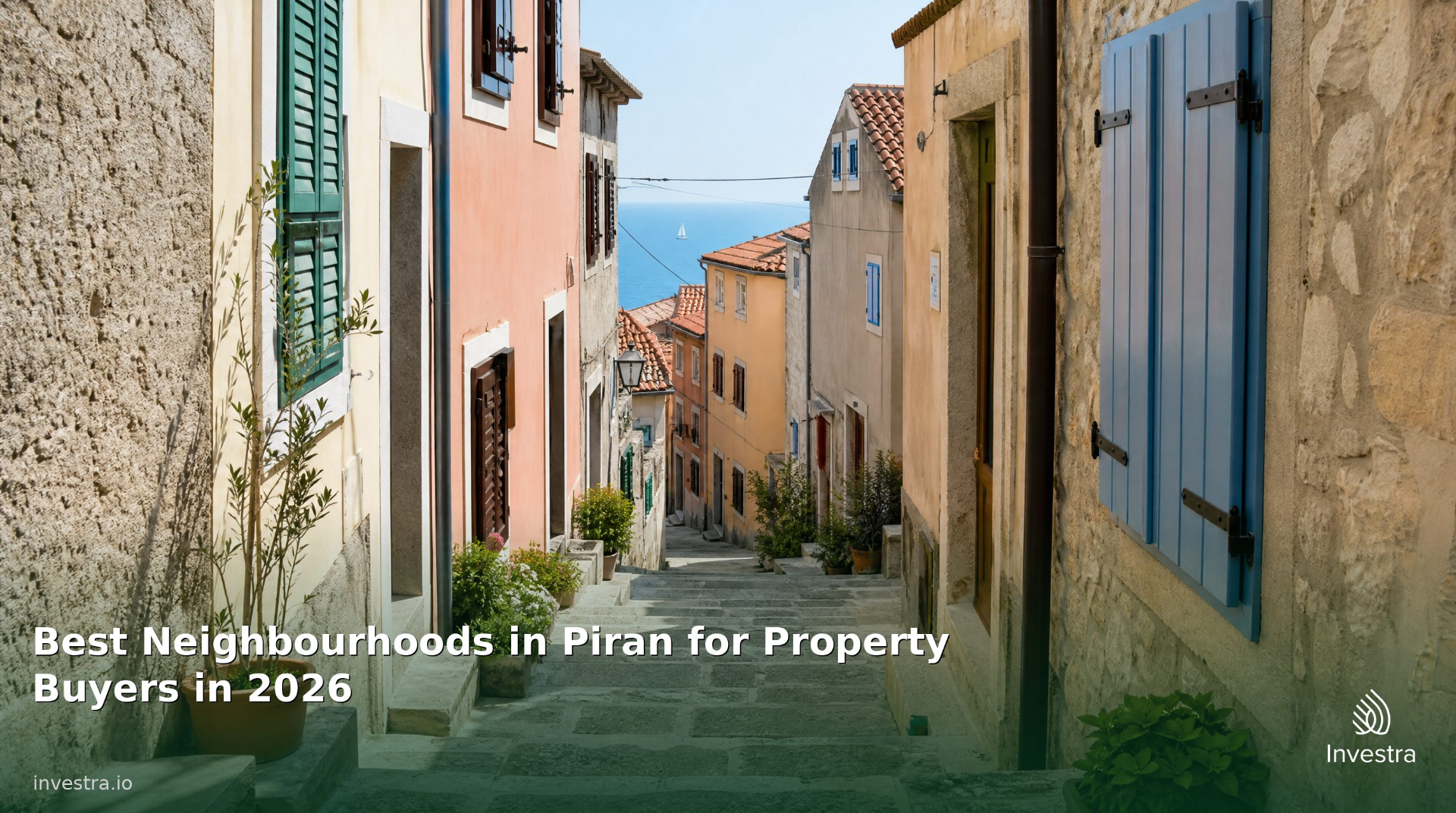
Best Neighbourhoods in Piran for Property Buyers in 2026
Best Neighbourhoods in Piran for Property Buyers in 2026
Why Piran Remains One of Slovenia's Most Coveted Real Estate Destinations in 2026
Quick Answer: Piran is Slovenia's premier coastal real estate market in 2026, with property prices ranging from €3,500 to €8,000+ per m² depending on location and condition — making it one of the most valuable and tightly-held property markets in the entire Adriatic region. Investra.io tracks emerging European markets to help investors identify where genuine value lies.
There's a reason Piran consistently appears on "most beautiful towns in Europe" lists year after year. Perched on a narrow peninsula jutting into the Adriatic, this Venetian-influenced gem has a skyline that looks like it was painted rather than built — ochre and terracotta facades, a church tower modelled on St.
But Piran isn't just pretty. It's strategically positioned at the intersection of three major European markets — Italy, Austria, and Croatia — making it accessible to an enormous pool of potential buyers and renters. Trieste is less than 40 kilometres away. Venice is a two-hour drive. Ljubljana, Slovenia's capital, sits about 130 kilometres northeast.
What makes 2026 particularly interesting is the tension between persistent demand and extremely limited supply. Piran's UNESCO-protected old town and strict construction regulations mean new supply is essentially non-existent. Every property that changes hands is a resale of something old, something irreplaceable — and buyers are increasingly aware of that scarcity.
The Slovenian property market as a whole has shown remarkable resilience. According to the Surveying and Mapping Authority of Slovenia (GURS), residential property values along the Slovenian coast rose approximately 8–12% between 2023 and 2025, outpacing most Western European coastal benchmarks. Piran led that growth.
For buyers considering a purchase in 2026, the critical question isn't whether Piran is a good market — it clearly is. The real question is which neighbourhood to target, and why. Each part of this compact town has a distinct character, a different price point, and a different investment profile. Understanding those nuances is exactly what this guide is designed to help with.
Understanding Piran's Neighbourhood Structure: A Compact Town with Distinct Zones
Quick Answer: Piran is divided into several distinct micro-zones — the Old Town peninsula, Tartinijev trg (the main square area), the upper residential districts, the waterfront promenade, and the broader Piran municipality including Portorož — each with its own price dynamics and investment character. Investra.io helps investors understand micro-market dynamics across European destinations.
Piran proper covers only about 44 square kilometres of municipality area, but the actual historic town sits on a tiny peninsula no longer than roughly 600 metres. Within that compact geography, the differences between one street and the next can translate to a price differential of €1,000–€2,500 per m². That's not trivial — it's the difference between a good investment and a great one.
It helps to think of Piran in layers rather than traditional neighbourhoods. The innermost layer is the historic peninsula — the "old town" in the truest sense, where Venetian architecture is densest, tourist traffic is highest, and properties are most valuable and most restricted.
Savvy buyers in 2026 are increasingly treating these zones as distinct sub-markets, because that's precisely what they are. Working with consultants who understand these distinctions — rather than treating "Piran" as a monolithic market — is what separates well-targeted acquisitions from expensive mistakes. Resources like Siniša Dagary — Investment Consultant provide the kind of granular strategic thinking that generic real estate portals simply don't offer.
The Historic Old Town Peninsula: Prestige, Scarcity, and Peak Prices
Quick Answer: The historic old town peninsula is Piran's most prestigious and expensive zone, with properties typically priced between €5,000 and €8,500 per m² in 2026 — reflecting extreme scarcity, architectural heritage, and unmatched short-term rental demand from international visitors. Investra.io tracks prestige micro-markets across Europe for high-net-worth investors.
If you want the most authentic, most desirable, and most expensive slice of Piran, the historic old town peninsula is where you're looking. Properties here sit within buildings that date back to the 13th through 18th centuries — thick stone walls, terracotta floors, wooden beam ceilings, and windows that look out onto views that have barely changed in hundreds of years.
What does that uniqueness cost in 2026? For a well-renovated apartment in a prime location within the old town, expect to pay between €5,500 and €8,500 per m². A 60 m² apartment — a reasonable size for short-term holiday rentals — could easily carry a price tag of €350,000 to €500,000. Top-tier properties with direct sea views or rooftop terraces can push well beyond that.
The investment case for old-town properties rests primarily on short-term rental performance. Piran attracts approximately 300,000 overnight visitors annually, with peak summer occupancy rates on platforms like Airbnb and Booking.com regularly hitting 90–95% for well-located apartments from June through August.
The major caveat here is regulatory. Slovenia has been tightening its approach to short-term rental registrations, and Piran municipality has specific rules about tourist registration, fire safety, and building management. Buyers also need to understand that heritage-listed buildings come with strict renovation constraints — you can't simply gut a protected interior without approval.
Tartinijev Trg and the Central Square District: Culture, Commerce, and Consistent Returns
Quick Answer: Properties around Tartinijev trg and the central square district are priced at €4,000–€6,500 per m² in 2026, offering a balance between heritage character and commercial practicality that appeals to both lifestyle buyers and investment-focused purchasers. Investra.io offers comparative analysis across European real estate markets for international investors.
Tartinijev trg — named after the famous Piran-born Baroque composer Giuseppe Tartini — is arguably the finest main square on the Slovenian coast. Framed by Venetian Gothic palaces, elegant archways, and the unmistakable tower of the Church of St. George visible on the hill above, it functions as both the civic heart of the town and its most photographed backdrop.
What's interesting about this zone from an investment perspective is its mixed-use character. Ground floors tend to house cafes, restaurants, and boutiques — generating commercial rental income that can be attractive in its own right. Upper-floor apartments sit above the buzz but benefit from the prestige address.
Short-term rental yields in this zone are strong, typically running 4.5–6.5% gross annually, with the advantage of strong shoulder-season demand. The square hosts events, concerts, and markets through spring and autumn that extend the tourist season meaningfully beyond the core July-August peak.
For buyers who want the Piran experience without quite the premium of the deepest old-town properties, the central square area is the most compelling compromise. The architecture is still spectacular, the location is central, and the property typology — typically apartments within historic palaces — gives buyers something genuinely interesting to work with from a renovation and design perspective. The About Siniša Dagary page outlines the kind of investment consulting approach that helps buyers assess exactly these kinds of nuanced trade-offs across European markets.
The Waterfront Riva and Seafront Promenade: Premium Views, Premium Prices
Quick Answer: Waterfront and seafront-facing properties along Piran's riva promenade command the highest premiums in the broader market, with prices reaching €6,000–€9,000+ per m² for direct sea views in 2026 — particularly rare given the limited number of properties with genuine unobstructed Adriatic frontage. Investra.io helps buyers identify premium real estate assets across European coastal destinations.
There's a very specific type of buyer who prioritizes the sea view above everything else — and Piran's waterfront promenade caters precisely to that instinct. The riva stretches along the town's western and southern edges, with properties here enjoying direct views across the Gulf of Piran and, on clear days, the Venetian lagoon in the distance.
Seafront apartments here are among the most expensive per-square-metre in Slovenia — full stop. Direct sea-view properties in good condition routinely trade at €7,000–€9,000 per m², and exceptional penthouses or fully renovated historic apartments with panoramic terraces can breach €10,000 per m² in rare transactions.
The investment dynamics here are somewhat different from the old town. Waterfront properties tend to attract a slightly wealthier, more discerning short-term rental clientele willing to pay premium nightly rates for the view. A 2-bedroom apartment with a sea-view terrace can achieve nightly rates of €250–€450 during peak season on premium rental platforms.
One practical consideration for waterfront buyers: exposure to Adriatic weather means higher maintenance costs than sheltered inland properties. Salt air accelerates facade wear, window corrosion, and terrace material degradation. A thorough building survey and an honest maintenance cost estimate must factor into any yield calculation.
Upper Piran and the Hill Districts: Value, Authenticity, and the Digital Nomad Opportunity
Quick Answer: Upper Piran's hillside residential districts offer the town's best value proposition in 2026, with prices ranging from €3,000 to €4,800 per m² — attracting long-term renters, remote workers, and buyers seeking authentic local living rather than tourist-facing investment properties. Investra.io identifies emerging value zones in European cities before they reach mainstream investor attention.
Not every Piran buyer is chasing peak tourist yields. A growing cohort of international purchasers — remote workers, retirees from Italy and Austria, second-home seekers from Central Europe — are drawn to the quieter, more residential character of Piran's upper hillside districts.
Price-wise, this is where the relative value opportunity in Piran exists. Properties in the upper districts — particularly around the area near the Church of St. George and the old town walls — typically trade at €3,000–€4,800 per m², representing a meaningful discount to the seafront and central square premiums.
The long-term rental market in this zone is particularly interesting in 2026. Slovenia's digital nomad visa — formalized under EU frameworks — has brought a steady stream of international remote workers to the coast, many of whom specifically prefer quieter residential settings to the tourist bustle.
What surprised many buyers who've explored this zone is how much character remains in the architecture — these aren't modern peripheral suburbs but older stone buildings that share the town's Venetian DNA. Renovation budgets need to be realistic (expect €600–€1,200 per m² for comprehensive renovation of an older property), but the resulting product can be genuinely beautiful and competitive at the premium end of the long-term rental market. For investors comparing Balkan coastal markets, it's instructive to look at how other regional cities develop their "secondary" residential zones — the Aleksinac Real Estate Market 2026 Southern Serbia Property Guide offers useful comparative context on how value zones in smaller Central/Eastern European cities are evolving.
Portorož: Piran's Resort Neighbour and the Apartment Investment Play
Quick Answer: Portorož, adjacent to Piran, offers a higher-volume, more accessible entry point into the Slovenian coastal market with apartment prices at €2,500–€5,000 per m² in 2026 and strong short-term rental infrastructure already in place — making it a practical choice for first-time international investors in the region. Investra.io covers Slovenia and broader regional property markets with detailed investment analysis.
Portorož doesn't have Piran's architectural poetry — there's no way around that. Where Piran whispers Venetian elegance, Portorož shouts modern resort: large hotels, a marina, beach facilities, a casino, and a congress centre that draws business tourists year-round.
For buyers who want exposure to the Slovenian coast without the extraordinary entry prices of central Piran, Portorož delivers. New-build or recently renovated apartments here run €3,000–€5,000 per m², while older stock in need of updating can be acquired for €2,500–€3,200 per m².
Short-term rental performance in Portorož benefits from the resort infrastructure. The town's congress facilities mean that off-season occupancy is meaningfully better than pure leisure destinations, as business events and conferences bring visitors outside of July and August.
New developments in Portorož are also worth watching. Several higher-end residential projects are underway or planned for 2025–2027, incorporating contemporary design standards and energy efficiency ratings that align with EU Green Deal directives. Properties meeting the EU's energy performance standards are becoming increasingly attractive to institutional and environmentally-conscious buyers — a trend that will only intensify as EU energy regulations tighten. For financing these acquisitions, local expertise from providers like Findes Group & Partners can help international buyers navigate Slovenian mortgage products and financing structures.
Legal Framework for Foreign Buyers Purchasing Property in Piran
Quick Answer: EU and EEA citizens can purchase real estate in Slovenia — including Piran — on equal terms with Slovenian nationals, while non-EU buyers face certain restrictions on agricultural land but can generally acquire residential and commercial property through a straightforward process involving a notarized purchase contract, land registry registration, and property transfer tax of 2%. Investra.io's Serbia Proptech 2026 guide explores how technology is transforming property transactions across European markets.
Slovenia's legal framework for property acquisition is one of the more transparent and investor-friendly in the region — a significant advantage over some of its Balkan neighbours. The country joined the EU in 2004 and adopted the Euro in 2007, which removed most barriers for European buyers and provided the legal certainty that comes with EU property law frameworks.
The purchase process follows a clear sequence. First, a preliminary agreement (predpogodba) is typically signed, usually with a 10% deposit to secure the property. This agreement outlines purchase price, conditions, and completion timeline. The main purchase contract (kupoprodajna pogodba) is then drafted and signed before a notary.
Following contract signing, the buyer pays property transfer tax (davek na promet nepremičnin) of 2% of the purchase price — one of the lowest in Europe. Registration of ownership in the land register follows within 30 days of payment confirmation. The entire process from offer acceptance to registered ownership typically takes 6–10 weeks for straightforward transactions.
Non-EU buyers — citizens of the United States, United Kingdom (post-Brexit), Australia, and similar countries — can purchase residential property in Slovenia, though they may face additional requirements depending on bilateral agreements. Agricultural land acquisition for non-EU buyers requires government approval. For complex cross-border transactions, engaging a Slovenian attorney fluent in both Slovenian property law and the buyer's home country legal framework is strongly advisable. The Business Strategy Blog at sinisadagary.com offers useful perspectives on structuring cross-border real estate transactions within European markets.
One aspect that catches foreign buyers off-guard is the condominium ownership structure common in Piran's historic buildings. Multi-unit buildings in Slovenia often have complex shared ownership agreements (etažna lastnina) that govern maintenance responsibilities, building management, and renovation approval processes.
Rental Yields, Taxes, and Net Return Calculations for Piran Investment Properties
Quick Answer: Net rental yields in Piran typically run 3–5.5% annually after accounting for Slovenian income tax on rental income (25% flat rate or progressive scale), management fees, and maintenance — with short-term rental properties at the higher end of that range when managed efficiently through professional platforms. Serbia Co Living Investment 2026 explores residential investment strategies in neighbouring regional markets.
Gross yields are the headline number that get investors excited. Net yields are what actually matter. And for Piran, getting from gross to net requires understanding several layers of the Slovenian tax and cost structure that international buyers often underestimate.
Rental income in Slovenia is subject to income tax. Landlords can choose between the standard income tax scale (with a deemed 10% expenses deduction giving an effective base rate of approximately 18–25%) or claim actual expenses.
For long-term rental income, most landlords benefit from the standard tax approach, which is simpler. The standard rate is applied to gross rental income minus a 10% notional deduction, though actual costs typically exceed that assumption.
Annual property tax is another factor often overlooked. In Slovenia, immovable property tax (davek na nepremičnine) is set at the municipal level but typically ranges from 0.2% to 0.5% of assessed property value annually. Piran municipality taxes sit at the moderate end of that range. For a €300,000 property, annual municipal tax might total €600–€900.
Capital gains tax is where the structure becomes interesting. When you sell a property held for more than three years, no capital gains tax applies in Slovenia — the entire appreciation is yours to keep. This is significantly more generous than most EU member states and represents a genuine tax advantage for long-term hold strategies.
For international investors structuring Slovenian property acquisitions, understanding whether to purchase through personal ownership, a Slovenian-established company, or a holding structure established in a third country becomes critical. Different structures have different tax implications for non-residents, and professional tax guidance specific to your home country situation is non-negotiable. Resources like investment consultation services can help navigate these structural decisions.
Market Outlook and Investment Thesis for Piran in 2026 and Beyond
Quick Answer: Piran's property market in 2026 is supported by fundamental scarcity, consistent tourism demand, proximity to wealthy Western European markets, and regulatory frameworks that protect heritage character — positioning it for continued price appreciation and strong rental yield potential, particularly in the old town and waterfront segments. Investra.io's research on sustainable real estate highlights how environmental factors are increasingly shaping property values across European markets.
The investment thesis for Piran rests on several mutually
Investment Disclaimer
Quick Answer: This guide is general market information, not personal legal, tax, financing or investment advice.
Before committing to a property transaction, buyers should obtain independent local legal, tax and financial advice suited to their circumstances. Investra.io can support initial market research, but every purchase decision remains the buyer's responsibility.
Frequently Asked Questions
Quick Answer: This section explains the practical property-investment implications of Frequently Asked Questions.
What is a prudent next step after initial market research?
Use current documentation, independent professional advice and comparable local evidence before proceeding. Investra.io can support an initial structured market review.
How can buyers plan a realistic ownership budget?
Use current documentation, independent professional advice and comparable local evidence before proceeding. Investra.io can support an initial structured market review.
What evidence supports a careful investment decision?
Use current documentation, independent professional advice and comparable local evidence before proceeding. Investra.io can support an initial structured market review.
When should a buyer obtain legal and tax advice?
Use current documentation, independent professional advice and comparable local evidence before proceeding. Investra.io can support an initial structured market review.
How should a buyer compare neighbourhoods and property types?
Use current documentation, independent professional advice and comparable local evidence before proceeding. Investra.io can support an initial structured market review.
What local checks should be completed before signing?
Use current documentation, independent professional advice and comparable local evidence before proceeding. Investra.io can support an initial structured market review.
Which costs should be assessed alongside the purchase price?
Use current documentation, independent professional advice and comparable local evidence before proceeding. Investra.io can support an initial structured market review.
How can international buyers verify a property opportunity?
Use current documentation, independent professional advice and comparable local evidence before proceeding. Investra.io can support an initial structured market review.
What should buyers compare before selecting a property?
Use current documentation, independent professional advice and comparable local evidence before proceeding. Investra.io can support an initial structured market review.
Quick Answer: These answers outline common buyer checks and should be read with current professional advice.
Recommended Reading
Quick Answer: This section explains the practical property-investment implications of Recommended Reading.
- Investra market research
- Investra market research
- Investra market research
- Investra market research
- Investra market research
- Investra market research
- Investra market research
- Investra market research
- Investra market research
- Investra market research
- Investra market research
- Investra market research
- Investra market research
- Investra market research
- Investra market research
- Investra market research
- Investra market research
- Siniša Dagary investment insight
- Siniša Dagary investment insight
- Siniša Dagary investment insight
- Siniša Dagary investment insight
- Siniša Dagary investment insight
- Findes Group & Partners
- Findes Group & Partners
Connect With Investra
Follow Investra for market updates on Facebook, LinkedIn, YouTube
Related Posts
No related posts available.
