
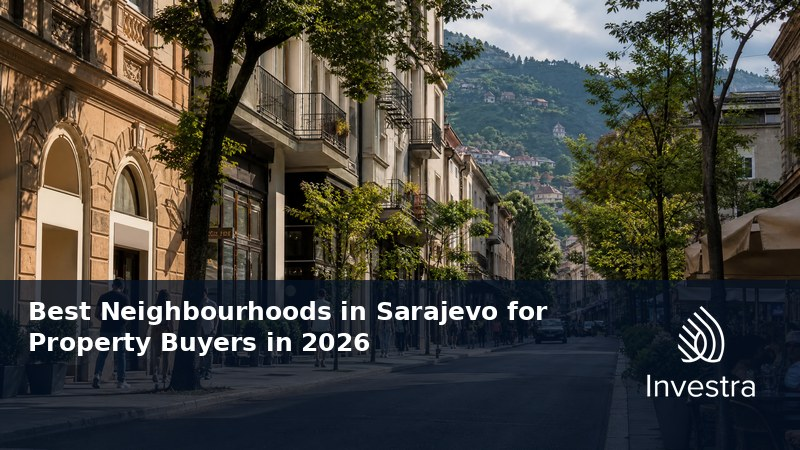
Best Neighbourhoods in Sarajevo for Property Buyers in 2026
Best Neighbourhoods in Sarajevo for Property Buyers in 2026
Why Sarajevo Is Capturing Global Investor Attention in 2026
Quick Answer: Sarajevo combines some of Europe's lowest property prices (€800–€2,500/m²) with growing tourism, EU accession momentum, and strong rental demand — making it one of the Balkans' most compelling real estate markets for 2026. Investra market research tracks emerging markets like Sarajevo to help global investors identify high-value opportunities before the mainstream catches on.
There's a particular energy to Sarajevo that's hard to explain to someone who hasn't walked its streets. It's a city where Ottoman bazaars transition into Austro-Hungarian boulevards within a single block, where the call to prayer mingles with church bells, and where a generation of young professionals is quietly reshaping the urban fabric.
Bosnia and Herzegovina officially submitted its EU membership application in 2016, and the European Commission granted candidate status in December 2022 — a milestone that has meaningfully shifted investor sentiment. EU accession timelines remain uncertain, but the direction of travel is clear enough that developers, foreign funds, and individual buyers are all recalibrating their exposure to Sarajevo real estate.
Average prices in the most desirable Sarajevo neighbourhoods sit between €1,400 and €2,500 per square metre — fractions of what you'd pay in Lisbon, Warsaw, or Prague for equivalent quality and lifestyle. The gross rental yield picture is equally compelling, with well-positioned short-term rental apartments in the city centre generating 7–10% annually, and long-term furnished rentals in Ilidža and Stari Grad averaging 5–7%. For investors working with advisors like Siniša Dagary investment insight, who specialises in Balkan market entry strategies, Sarajevo in 2026 represents a window that won't stay open indefinitely.
This guide breaks down Sarajevo neighbourhood by neighbourhood, with concrete price data, investment rationale, and the practical details that property buyers — whether purchasing a holiday apartment, a buy-to-let, or a longer-term capital appreciation play — actually need.
Understanding the Sarajevo Property Market in 2026: Key Fundamentals
Quick Answer: The Sarajevo property market in 2026 is characterised by steadily rising prices (averaging 6–9% annual appreciation), low vacancy rates in the city centre, and an undersupply of quality new-build stock — creating favourable conditions for both capital growth and rental income investors.
Before picking a neighbourhood, it's worth understanding the structural dynamics driving Sarajevo real estate. The city has a population of roughly 340,000 in the urban core, expanding to approximately 600,000 in the broader metropolitan area.
What we've seen over the past three years is a meaningful acceleration in both local and foreign buyer activity. Domestic demand is driven by urbanisation from smaller Bosnian cities, return migration from the diaspora (particularly from Western Europe and North America), and a young professional class seeking quality apartments in central locations.
The numbers tell a clear story. Average transaction prices in Sarajevo Canton rose approximately 7.2% year-on-year in 2024, with premium neighbourhoods like Stari Grad and Centar outperforming at 9–11%. New construction in the western suburbs is adding some supply, but building permit data suggests the pipeline remains insufficient to close the gap.
For investors comparing regional opportunities, it's useful to benchmark Sarajevo against markets covered in resources like the Zajecar Real Estate Market 2026 Eastern Serbia Property Guide or the Loznica Real Estate Market 2026 Macva Region Property Guide — both of which illustrate how smaller Balkan cities at different development stages price and yield compared to capital cities. Sarajevo occupies a distinctive middle ground: it has the cultural density, infrastructure, and tourism appeal of a capital, but much of the pricing still reflects its emerging-market status.
Transaction costs for buyers are moderate. The real estate transfer tax in the Federation of Bosnia and Herzegovina (which covers most of Sarajevo) is 5% of the transaction value for resale properties. Notary fees, registration costs, and agency commissions typically add another 2–4%. New-build purchases are subject to VAT of 17% rather than transfer tax.
Stari Grad (Old Town): The Prestige Buy for Culture and Airbnb
Quick Answer: Stari Grad is Sarajevo's most iconic neighbourhood and its strongest short-term rental market, with property prices ranging from €1,800 to €2,800/m² and Airbnb gross yields consistently hitting 8–11% for well-presented apartments near Baščaršija.
Stari Grad — the Old Town — is where Sarajevo's identity lives. Baščaršija, the 15th-century Ottoman bazaar at its heart, draws over a million visitors annually. The narrow cobblestone streets, the craft workshops, the coffee houses serving Bosnian-style coffee in hammered copper džezvas — this is the Sarajevo that appears on every travel list and every social media feed.
A well-furnished 40–55m² apartment within walking distance of Baščaršija can realistically generate €18,000–€28,000 gross annually through platforms like Airbnb and Booking.com during a full operating year. At purchase prices of €90,000–€150,000 for that size range, the gross yield math is compelling by any European standard.
The reality of buying in Stari Grad is that genuinely good stock is scarce. The neighbourhood is dense with historic buildings, many of which have undergone various degrees of renovation over the decades — some excellent, some cosmetic. Buyers should budget for professional surveys and be prepared to invest in proper renovation if purchasing an older unit.
The buyer profile here tends to be the experienced investor who understands hospitality-adjacent real estate. The management intensity of short-term rentals is higher than long-term lets, and the regulatory environment around tourist apartments in Sarajevo is evolving — the Canton has been discussing registration requirements and potential zoning restrictions on short-term rentals, so buyers should monitor this closely.
Centar Municipality: The Safe, Liquid Core of the Sarajevo Market
Quick Answer: Centar is Sarajevo's central business district and most liquid property market, with prices ranging from €1,500 to €2,500/m² and steady long-term rental yields of 5–7% driven by corporate tenants, embassy staff, and professionals.
If Stari Grad is the romantic choice, Centar is the rational one. It's the neighbourhood of wide boulevards, government ministries, international organisations, embassies, and the city's main commercial spine along Ferhadija and Titova streets.
Prices in Centar have been among the fastest-rising in the city. New-build apartments in the better developments — and there are several quality projects that have come to market since 2021 — are achieving €2,200–€2,500/m² at launch, with resale properties for quality renovated stock in the €1,600–€2,000 range.
For the long-term rental investor, Centar is arguably the most straightforward market in the city. A 70m² two-bedroom apartment in good condition in a central building will rent for €600–€850/month to a professional tenant or international organisation employee. At a purchase price of €120,000–€150,000, that generates a gross yield of 5.5–7%, with low vacancy risk and tenants who typically stay 12–36 months.
It's also worth mentioning that Centar is where most of the quality new-build pipeline is concentrated. Developers understand that central Sarajevo buyers, both domestic high-end purchasers and international investors, are most concentrated here. For guidance on financial structuring and cross-border investment vehicles for Centar purchases, resources from Findes Group & Partners provide useful context on regional banking and mortgage options for non-resident buyers in Southeast European markets.
Novo Sarajevo: The Value Play with Long-Term Upside
Quick Answer: Novo Sarajevo offers Sarajevo's best value-for-money proposition for investors, with apartment prices of €900–€1,600/m², solid rental demand from students and young professionals, and considerable upside from ongoing regeneration and infrastructure investment.
Novo Sarajevo doesn't have the postcards, but it has the numbers. This municipality — which covers a substantial east-west stretch of the Miljacka River valley, from Skenderija south and east toward Dobrinja — is home to a large portion of the city's middle-class residential stock, built predominantly during the Yugoslav socialist period and increasingly supplemented by new-build developments.
Prices here are meaningfully lower than in Centar or Stari Grad. Older socialist-era apartments in need of renovation can be acquired for €800–€1,100/m², while renovated or new-build stock in better positions achieves €1,300–€1,600/m².
The tenant base in Novo Sarajevo is varied. University of Sarajevo facilities, several large hospitals, and major employers are all accessible, generating consistent demand from students, healthcare workers, and professionals who prioritise affordability and transport access over prestige address.
The regeneration story is real. Several significant mixed-use development projects are underway or in planning along the Miljacka corridor in Novo Sarajevo. The completion of the Sarajevo bypass road system has improved accessibility, and tram and bus connections to both Centar and the eastern business district are reliable.
Ilidža: Sarajevo's Western Suburb and the Smart Family Buy
Quick Answer: Ilidža is Sarajevo's most developed suburban municipality, offering modern apartments and houses at €900–€1,500/m², strong long-term rental demand from families and expats, and proximity to the airport and Vrelo Bosne nature park.
Twenty minutes west of the city centre by tram, Ilidža occupies a special place in Sarajevo's residential geography. It's greener, quieter, and more spaciously laid out than the central municipalities. The centrepiece is Vrelo Bosne — the source of the Bosna River — a genuinely beautiful park that draws weekend visitors from across the city and makes Ilidža one of Sarajevo's most liveable addresses for families and outdoor enthusiasts.
The expat and diplomatic community has historically favoured Ilidža for family accommodation — proximity to international schools, the airport (approximately 8 km), and the more spacious residential environment make it a natural choice. This creates a reliable premium tenant pool for larger 3–4 bedroom apartments and houses.
For investors comparing suburban residential plays across the Western Balkans, it's instructive to look at how similar dynamics have played out in cities like Sremska Mitrovica — the Sremska Mitrovica Real Estate 2026 Srem Region Property Guide provides useful context on suburban residential investment logic in comparable post-transition markets. Ilidža's fundamentals — population growth, infrastructure investment, airport proximity — check many of the same boxes.
Grbavica and Kovačići: The Young Professional Hotspot
Quick Answer: Grbavica and Kovačići are Sarajevo's most dynamic residential neighbourhoods for young professionals, with prices of €1,200–€1,900/m² and strong medium-term rental demand from a growing tech, media, and creative sector workforce.
Ask any Sarajevan under 35 where they want to live, and a significant number will name Grbavica. Situated between the Miljacka river and the Trebević mountain foothills, just southeast of Centar, this neighbourhood has evolved from a post-war reconstruction area into arguably Sarajevo's most vibrant urban district.
Kovačići, nestled between Grbavica and the hillsides leading up to Trebević, is the slightly elevated, quieter sibling — literally and figuratively. Apartments here often enjoy panoramic city views, and the neighbourhood has attracted a particular wave of renovation activity as buyers have recognised the quality of the housing stock and the views on offer.
For the buy-to-let investor targeting young professional tenants, Grbavica and Kovačići offer a sweet spot. A well-furnished one-bedroom (45–55m²) in a renovated building here rents for €450–€650/month on a long-term basis, generating gross yields of 5.5–7.5% on typical purchase prices of €70,000–€100,000.
Trebević cable car, reopened in 2018 after being destroyed during the siege, has become a significant attraction and has genuinely enhanced the desirability of hillside properties with mountain views. The cable car station is within walking distance of upper Kovačići, and that connectivity — mountain access in 10 minutes, city centre in 15 — is a genuine differentiator for this micro-market.
Baščaršija Adjacent and Bjelave: The Emerging Premium Micro-Market
Quick Answer: The hillside neighbourhoods of Bjelave and the streets immediately above Baščaršija are Sarajevo's fastest-appreciating micro-markets, with prices rising 10–14% annually and growing international buyer interest in restored Ottoman and Austro-Hungarian period properties.
The numbers here are beginning to reflect the attention. While it's possible to find properties needing full renovation at €700–€900/m², finished period properties in this zone — particularly those with garden space, multiple levels, and city views — are now transacting at €1,800–€2,500/m² and sometimes above.
International buyers — particularly from Germany, Austria, the Netherlands, and increasingly from Gulf states — are among the most active in this micro-market. The appeal is partly lifestyle (living in a genuine historic city at affordable cost) and partly investment (the conviction that these properties will re-rate significantly as Sarajevo's international profile grows).
The business strategy and market timing perspective offered by experts like those at Siniša Dagary investment insight is directly applicable here: this is the kind of micro-market where local knowledge and early positioning create disproportionate returns, and where the gap between current and intrinsic value is widest for buyers who do their homework.
Dobrinja and Mojmilo: The Practical Investment Zones for Yield-Focused Buyers
Quick Answer: Dobrinja and Mojmilo offer Sarajevo's most affordable entry points for residential investment at €700–€1,100/m², with consistent rental yields of 6.5–9% driven by student and workforce housing demand near the airport and new commercial development.
Not every investor needs a premium address. For yield-maximising buyers who are comfortable with the aesthetics of large-scale socialist-era residential developments, Dobrinja and Mojmilo — in the western part of the metropolitan area, adjacent to the airport — offer some of the strongest pure yield numbers in Sarajevo.
These were purpose-built residential districts developed for the 1984 Winter Olympics (Sarajevo's enduring moment of global cultural soft power), housing athletes and officials before transitioning to residential use. The apartment blocks are large, serviceable, and increasingly well-maintained as the local ownership base has invested in building upgrades over the past decade.
Purchase prices range from €700 to €1,100/m² depending on floor, condition, and proximity to transport routes. Monthly rents for a renovated 55–65m² two-bedroom apartment run €400–€550, generating gross yields of 7–9% on acquisition costs of €50,000–€80,000 — among the highest in the city. For investors deploying smaller amounts of capital but seeking income rather than prestige, this zone makes a compelling mathematical case.
The airport proximity also generates a specific tenant cohort: airline staff, logistics professionals, construction workers on larger regional projects, and shorter-term corporate lets for people rotating through Sarajevo on business assignments. This tenant diversity provides a degree of vacancy protection that pure tourism or student-dependent markets don't always offer.
Legal Framework for Foreign Property Buyers in Bosnia and Herzegovina
Quick Answer: Foreign nationals from EU and most other countries can legally purchase property in Bosnia and Herzegovina's Federation entity (which covers Sarajevo) on the basis of reciprocity, with a relatively straightforward process involving a purchase contract, notarisation, and land registry registration typically completed in 4–8 weeks.
Bosnia and Herzegovina's property law framework is more accessible to foreign buyers than many people expect — though it's also more complex than a single-sentence summary can capture, because the country operates with two entities (Federation of BiH and Republika Srpska), each with somewhat different legal frameworks. Sarajevo falls almost entirely within the Federation of BiH jurisdiction, which is where this overview focuses.
Under Federation law, foreign nationals can acquire real estate on the basis of reciprocity. This means citizens of countries that allow Bosnian nationals to purchase property can also buy in Bosnia — which covers virtually all EU citizens, US, Canadian, Australian, and most other Western passport holders.
The purchase process involves several key stages. First, a preliminary agreement with the seller and engagement of a licensed real estate agent or direct negotiation. Second, formal preparation of a purchase contract (kupoprodajni ugovor) by a licensed notary public (javni bilježnik). Third, completion of any necessary surveys, environmental checks, or due diligence.
The purchase contract must specify the exact property identification (cadastral designation and property number), parties to the transaction, purchase price, payment terms, and any conditions (such as those relating to renovation or title clearance). Registration typically occurs within 5–15 working days following notarisation, and the land registry will issue a certificate of ownership confirming the buyer's legal status.
Title due diligence is critical. The post-war property situation in Bosnia and Herzegovina created complexities around displaced persons, claims, and historical ownership that required resolution through the law. Most modern transactions are now clear, but older properties — particularly those that changed hands during the war or shortly after — warrant professional title insurance and legal review.
For non-resident foreign buyers, the process is identical to that for Bosnian nationals and residents. Some buyers choose to establish a Bosnia-registered company to hold the property, which offers certain tax and liability advantages, though this is not required. Consulting with specialist real estate attorneys experienced in cross-border transactions is recommended, particularly for larger acquisitions or investment portfolios.
Taxation, Costs, and Financial Structuring for Sarajevo Property Investment
Quick Answer: Total acquisition costs for Sarajevo property range from 7–10% of purchase price (transfer tax at 5%, notary and registration at 2–4%), and annual holding costs consist primarily of property tax (0.3–0.8% of cadastral value) plus building maintenance (€80–€200/year), with rental income taxed at 15–20% depending on entity structure.
Understanding the true cost of property ownership in Sarajevo requires looking beyond the headline purchase price. The Federation of Bosnia and Herzegovina imposes a
Investment Disclaimer
Quick Answer: This guide is general market information, not personal legal, tax, financing or investment advice.
Before committing to a property transaction, buyers should obtain independent local legal, tax and financial advice suited to their circumstances. Investra.io can support initial market research, but every purchase decision remains the buyer's responsibility.
Frequently Asked Questions
Quick Answer: This section explains the practical property-investment implications of Frequently Asked Questions.
What is a prudent next step after initial market research?
Use current documentation, independent professional advice and comparable local evidence before proceeding. Investra.io can support an initial structured market review.
How can buyers plan a realistic ownership budget?
Use current documentation, independent professional advice and comparable local evidence before proceeding. Investra.io can support an initial structured market review.
What evidence supports a careful investment decision?
Use current documentation, independent professional advice and comparable local evidence before proceeding. Investra.io can support an initial structured market review.
When should a buyer obtain legal and tax advice?
Use current documentation, independent professional advice and comparable local evidence before proceeding. Investra.io can support an initial structured market review.
How should a buyer compare neighbourhoods and property types?
Use current documentation, independent professional advice and comparable local evidence before proceeding. Investra.io can support an initial structured market review.
What local checks should be completed before signing?
Use current documentation, independent professional advice and comparable local evidence before proceeding. Investra.io can support an initial structured market review.
Which costs should be assessed alongside the purchase price?
Use current documentation, independent professional advice and comparable local evidence before proceeding. Investra.io can support an initial structured market review.
How can international buyers verify a property opportunity?
Use current documentation, independent professional advice and comparable local evidence before proceeding. Investra.io can support an initial structured market review.
What should buyers compare before selecting a property?
Use current documentation, independent professional advice and comparable local evidence before proceeding. Investra.io can support an initial structured market review.
Quick Answer: These answers outline common buyer checks and should be read with current professional advice.
Recommended Reading
Quick Answer: This section explains the practical property-investment implications of Recommended Reading.
- Investra market research
- Investra market research
- Investra market research
- Investra market research
- Investra market research
- Investra market research
- Investra market research
- Investra market research
- Investra market research
- Investra market research
- Investra market research
- Investra market research
- Investra market research
- Investra market research
- Investra market research
- Investra market research
- Investra market research
- Siniša Dagary investment insight
- Siniša Dagary investment insight
- Siniša Dagary investment insight
- Siniša Dagary investment insight
- Siniša Dagary investment insight
- Findes Group & Partners
- Findes Group & Partners
Connect With Investra
Follow Investra for market updates on Facebook, LinkedIn, YouTube
Related Posts
No related posts available.
