
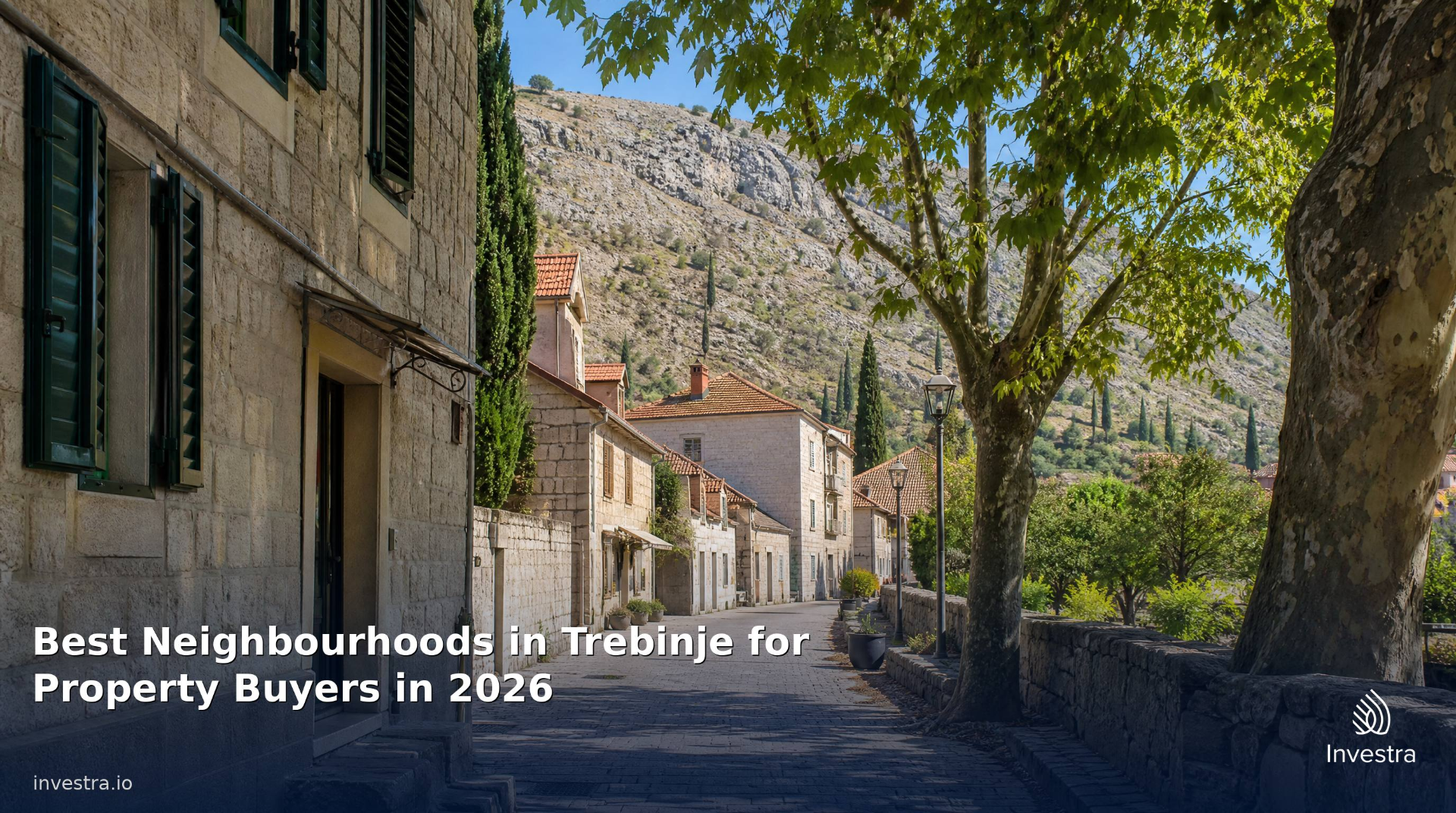
Best Neighbourhoods in Trebinje for Property Buyers in 2026
Best Neighbourhoods in Trebinje for Property Buyers in 2026
Why Trebinje Is Capturing International Property Buyer Attention in 2026
Quick Answer: Trebinje is emerging as one of Bosnia and Herzegovina's most compelling real estate markets in 2026, offering property prices between €800–€1,800/m², strong rental yields of 5–8%, and a lifestyle that rivals much pricier Adriatic destinations — at a fraction of the cost. Investra.io tracks emerging Balkan markets like Trebinje to help buyers find value before prices peak.
There's a particular kind of city that gets discovered quietly — not through flashy marketing campaigns or viral travel content, but through word of mouth among people who actually know how to read a market. Trebinje, the southernmost city in Bosnia and Herzegovina, is exactly that kind of place.
What's happening in Trebinje right now is genuinely interesting. The city has long been overlooked by international investors who gravitate toward Sarajevo or Mostar, but that's changing fast.
Trebinje Real Estate Market Overview 2026: Prices, Trends, and Market Dynamics
Quick Answer: Trebinje's property market in 2026 is characterised by low entry prices (€800–€1,800/m²), rising demand from domestic and foreign buyers, and steady year-on-year price growth of 6–10% across key neighbourhoods. The market remains significantly undervalued compared to regional peers like Dubrovnik (€4,000–€8,000/m²) and even Mostar (€1,500–€2,500/m²).
Let's start with the numbers, because they tell a story that's hard to ignore. Across Trebinje's urban core, average residential property prices sit between €1,000 and €1,800 per square metre in mid-2026, depending on location, condition, and property type.
The rental market deserves equal attention. Short-term tourist rentals through Airbnb and Booking.com have become a significant income stream for property owners in central Trebinje, with peak-season occupancy rates regularly hitting 80–90% during July and August. Average nightly rates for a well-appointed two-bedroom apartment in the old town range from €60–€120 per night in peak season, dropping to €30–€50 in shoulder months. When you run the full-year calculations, gross rental yields of 5–8% are entirely achievable — figures that compare favourably with saturated Western European markets charging three to four times the entry price. Consulting resources like the Siniša Dagary investment insight can offer useful frameworks for evaluating emerging market investment logic in contexts like this.
One thing that surprises many buyers is the relative stability of the Bosnian convertible mark (BAM), which is pegged to the euro at a fixed rate of 1.95583 BAM to €1. This currency peg eliminates exchange rate risk for eurozone investors — a meaningful advantage in a region where currency volatility has historically been a concern.
The Old Town (Stari Grad): Trebinje's Premium Heritage Neighbourhood
Quick Answer: Trebinje's Stari Grad (Old Town) is the city's most prestigious and sought-after neighbourhood, with stone houses and apartments priced at €1,500–€2,500/m², and the highest short-term rental yields in the city, averaging 6–8% gross annually.
Stari Grad is the neighbourhood every first-time visitor to Trebinje falls in love with. Enclosed within 18th-century Ottoman-era walls and built around the Arslanagić Bridge over the Trebišnjica River, this compact historic core is everything that makes Trebinje distinctive — and for property buyers, it represents the clearest combination of lifestyle value and investment potential in the city.
The rental dynamics in Stari Grad are strong. Tourists specifically seek out old town accommodation, and the scarcity of quality properties creates a supply bottleneck that keeps occupancy high and nightly rates firm. A well-renovated two-bedroom apartment here can generate €12,000–€18,000 in annual gross rental income through a mix of short-term tourist lets and medium-term stays.
The neighbourhood isn't without challenges. Renovation costs in heritage-listed areas are higher than standard construction, and certain modifications require permits from cultural heritage authorities. Parking is limited and the streets are pedestrianised, which affects accessibility. For buyers prioritising authentic character and premium rental rates, though, Stari Grad remains the standout choice.
Gornji Grad and the City Centre: Urban Convenience Meets Investment Practicality
Quick Answer: Gornji Grad and Trebinje's broader city centre offer a practical balance of urban amenities and investment accessibility, with apartment prices ranging from €1,100–€1,600/m² and solid rental yields from both long-term tenants and tourist visitors, making this the most liquid segment of the local market.
If Stari Grad is Trebinje's romantic heart, the broader city centre — encompassing the Gornji Grad area and the main commercial streets radiating from Trg Slobode (Freedom Square) — is its practical backbone. This is where most of the city's residents actually live, shop, and conduct daily business, and it's where the majority of residential transactions occur.
Property here spans a wider range of types and eras than the old town. You'll find Yugoslav-era apartment blocks from the 1960s–1980s alongside newer residential developments completed in the past decade.
The investment case for the city centre is built around liquidity and tenant diversity. Unlike the old town, which is primarily driven by tourist demand, central Trebinje attracts a mix of long-term residential tenants (local families, young professionals, civil servants), medium-term corporate tenants, and tourists.
For investors interested in comparing similar mid-sized city dynamics in the region, the Loznica Real Estate Market 2026 Macva Region Property Guide offers a useful parallel — another secondary Balkan city where urban centre properties provide reliable cash flow with moderate entry costs.
Lastva and the Trebinje Periphery: Where New Development Is Happening
Quick Answer: Lastva and Trebinje's southern and eastern suburban areas are the city's fastest-growing residential zones, with new-build apartments priced at €900–€1,300/m² and strong demand from young families and buyers seeking modern amenities at accessible price points.
Trebinje's growth isn't confined to its historic core. Head south and east from the city centre and you'll encounter the expanding suburban belt that's been absorbing the bulk of new residential construction over the past several years.
New construction here is predominantly apartment buildings of three to six storeys, built to modern standards with underground parking, lifts, and contemporary fixtures. Prices from developers typically range from €1,000–€1,300/m² for off-plan purchases, rising to €1,200–€1,500/m² upon completion.
The strategic logic for investing in peripheral Trebinje is different from the old town play. Rather than betting on tourism income, suburban buyers are positioning for capital appreciation driven by infrastructure investment and population growth.
Rental yields in these areas currently run at 4–5.5% on a long-term basis, below the old town's tourist-driven peaks, but the entry prices are lower, renovation risk is zero (buying new), and the tenant pool is stable. For buyers who want clean, uncomplicated investment exposure to Trebinje's growth story without heritage property complications, the periphery offers the clearest path.
Rural Surroundings and Wine Region Properties: Trebinje's Hidden Asset Class
Quick Answer: The rural countryside surrounding Trebinje — particularly the Popovo Polje karst field and the wine-producing villages around Vučipolje and Ljubomir — offers stone farmhouses and agricultural land from as little as €20,000–€80,000, representing a niche but high-upside investment for agritourism and lifestyle buyers.
This is the part of the Trebinje property story that most investor guides completely ignore — and that's precisely why it's interesting. The countryside within 10–20 kilometres of Trebinje is spectacular: rolling limestone karst, ancient stone villages, terraced vineyards producing Vranac and Žilavka grapes, and a silence and light that feels genuinely otherworldly.
The investment logic here centres on agritourism — a rapidly growing segment across the Western Balkans. Herzegovina's wine culture is genuine and deep-rooted; the region's wineries attract a sophisticated traveller willing to pay premium rates for authentic rural experiences.
Seasoned investors tracking rural Balkan opportunities may find useful parallels in markets like eastern Serbia. The Zajecar Real Estate Market 2026 Eastern Serbia Property Guide documents similar agritourism-adjacent opportunities in wine-producing rural regions, providing instructive benchmarks for rural Herzegovinian investment planning.
Legal Framework for Foreign Property Buyers in Bosnia and Herzegovina
Quick Answer: Foreign nationals from most countries can legally purchase residential and commercial property in Bosnia and Herzegovina, subject to reciprocity provisions, though the process involves handling a complex dual-entity administrative system (Federation of BiH and Republika Srpska). Trebinje falls within Republika Srpska's jurisdiction, which has a relatively streamlined process for foreign buyers.
The good news for international buyers: foreign nationals can purchase residential and commercial property in both entities, subject to reciprocity agreements between BiH and the buyer's home country. Citizens of EU member states, the United States, Canada, Australia, and most other Western countries face no practical restrictions on property ownership.
Due Diligence and Title Search: All property transactions must be preceded by a thorough title search at the local land registry (Zemljišnoknjižni ured). Bosnia and Herzegovina has historically had complex land tenure issues stemming from Ottoman-era tapu documents, post-WWII socialist nationalisation, and post-war restitution claims.
Purchase Agreement and Notarisation: Once due diligence is complete, a purchase agreement (Ugovor o kupoprodaji) is drafted and must be notarised by a licensed Bosnian notary (notar). The notary verifies the identities of both parties, checks the legality of the agreement, and submits the registration paperwork to the land registry. Notary fees typically range from 0.1% to 0.5% of the property value.
Property Transfer Tax: In Republika Srpska, property transfer tax is levied at 3% of the assessed property value, payable by the buyer. This is a one-time cost and should be factored into total acquisition cost calculations from the outset.
Land Registry Registration: Final registration of ownership at the land registry typically takes 30–60 days in Trebinje, though the process has become more efficient in recent years following digital modernisation initiatives. Upon registration, the buyer receives an updated land registry extract confirming their ownership.
Total transaction costs for a foreign buyer purchasing in Trebinje should be budgeted at approximately 5–8% of the purchase price, covering transfer tax (3%), notary fees (0.1–0.5%), legal fees (1–2%), and miscellaneous administrative costs. Working with platforms like proptech-enabled advisory services can help streamline the documentation and coordination process for remote buyers.
Rental Yields and ROI Analysis: What Can Investors Realistically Expect?
Quick Answer: Trebinje property investors can expect gross rental yields of 4.5–8% depending on neighbourhood and rental strategy, with total ROI (combining rental income and capital appreciation of 6–10% annually) potentially reaching 12–18% per year in well-chosen assets — figures that are extremely difficult to replicate in Western European markets at current price levels.
Yield calculations are where the Trebinje investment story becomes genuinely compelling on paper — but it's important to stress-test the numbers rather than just quote headline figures. Let's work through a realistic scenario.
Take a two-bedroom apartment in Trebinje's old town, purchased for €120,000 (roughly 65m² at €1,850/m²). After transaction costs of approximately 7%, the all-in acquisition cost is around €128,400.
Now layer in capital appreciation. If the property appreciates at a conservative 7% per year (below the recent trend), the €120,000 purchase grows to approximately €171,000 over five years. Combined with €37,500–€40,000 in cumulative net rental income over the same period, total five-year return on a €128,400 investment approaches €80,000–€85,000 — an annualised total return of roughly 12–13%.
These are not guaranteed figures — they depend on occupancy assumptions, property management quality, and market conditions that can change. But they illustrate why Trebinje is attracting the kind of sophisticated investor attention that was previously reserved for coastal Croatian cities. For investors seeking comparative data from other high-yield secondary Balkan markets, the Prokuplje Real Estate Market 2026 Toplica Region Property Guide and the Bor Real Estate Market 2026 Eastern Serbia Mining City Property Guide offer useful regional yield benchmarks.
Long-term residential rentals tell a slightly different story. Monthly rents for a two-bedroom apartment in central Trebinje range from €350–€550/month, translating to gross yields of 3.5–5.5% at current purchase prices. Not spectacular, but stable — and the management burden is far lower than short-term tourist rentals.
Trebinje's Tourism and Infrastructure Growth: The Macro Drivers Behind Property Values
Quick Answer: Trebinje's property market is underpinned by strong macro tailwinds: 15–20% annual tourism growth since 2022, planned motorway connections to Dubrovnik and Mostar, a growing reputation as a wine tourism destination, and its unique position as the most accessible Bosnian city for visitors entering from Croatia's Dalmatian coast.
Understanding why Trebinje's property values are rising requires understanding what's driving demand at the macro level — and the picture here is genuinely encouraging. The city has quietly transformed itself from a largely unknown Herzegovinian municipality into a recognised tourism destination over the past five years, and the structural drivers behind that transformation look durable.
Infrastructure investment is accelerating the trend. The planned motorway corridor connecting Trebinje to Mostar (and onwards to Sarajevo and the Croatian border at Bijača) is one of the most significant infrastructure projects in the region.
Wine tourism is another structural growth driver. Herzegovina produces some genuinely excellent wines — the Vranac red grape in particular has gained international recognition — and Trebinje serves as the natural gateway to the wine villages of eastern Herzegovina. Wine tourism is proven to attract higher-spending visitors who stay longer, which is exactly the guest profile that maximises short-term rental revenue per night. Resources from Siniša Dagary investment insight highlight how tourism-driven real estate markets in emerging European destinations tend to front-run general economic development by three to five years — a pattern Trebinje appears to be following.
Comparing Trebinje to Other Balkan Investment Markets in 2026
Quick Answer: Trebinje offers more attractive risk-adjusted returns than most comparable Balkan secondary cities in 2026, with lower entry prices than Mostar or Kotor, higher tourist demand than inland Serbian cities, and a unique proximity to the Adriatic that no other Bosnian market can match.
Context matters enormously in real estate investment. Trebinje doesn't exist in isolation — it competes for investor capital with a range of other Balkan markets, each with their own risk/return profiles. Where does Trebinje stack up?
Against Mostar (BiH's most internationally recognised city), Trebinje offers meaningfully lower entry prices (€800–€1,800/m² versus €1,500–€2,500/m² in Mostar's tourist core) with comparable or slightly lower rental yields. Mostar has stronger international name recognition, but it also has more developed investor competition — meaning the easy money has already been made there.
Against Kotor (Montenegro), the comparison is stark in Trebinje's favour on price. Kotor's old town properties regularly transact above €3,000/m², and quality assets approach €5,000/m². Rental yields in Kotor are actually lower than Trebinje's on a net basis because the higher purchase prices aren't offset by proportionally higher nightly rates.
Against secondary Serbian cities like Prokuplje or Niš, Trebinje wins on lifestyle amenities and tourism infrastructure but loses on entry prices — those Serbian cities remain cheaper. The trade-off is worth making if your investment thesis depends on tourism-driven rental income, less so if you're purely chasing price appreciation.
Against the Slovenian coast (where prices have become stratospheric), Trebinje's advantage is almost comical: a property in Piran that costs €8,000–€12,000/m² can be matched in Trebinje for €1,200–€1,800/m² with comparable or superior rental yields. For international investors seeking exposure to Mediterranean lifestyle properties without Western European prices, Trebinje is genuinely exceptional.
Property Management, Maintenance, and Operational Costs for Rental Properties
Quick Answer: Property management in Trebinje is available from €50–€150/month depending on service level, while annual maintenance and utilities typically consume 8–15% of gross rental income, making the operational overhead for tourist rentals substantially lower than Western European comparables.
Buying a property is one thing; managing it profitably is another. For international investors purchasing Trebinje property for rental income, understanding operational costs is critical to accurate ROI calculations.
Professional property management companies in Trebinje handle guest communication, booking coordination, cleaning, and basic maintenance, typically charging between 12–20% of gross rental revenue. For a property generating €11,600 annually in gross bookings, this translates to €1,400–€2,300 per year.
Beyond management fees, property owners should budget for utilities (heating, water, electricity), which run €60–€150/month depending on season and property size. Building maintenance — painting, roof repairs, appliance replacements — typically consumes 3–5% of gross rental revenue annually. For the dual-season rental property, insurance costs (liability and contents) run roughly €200–€400 per year.
The mathematics here matter enormously. A property generating €11,600 in gross revenue faces roughly €2,000 in management fees, €1,200 in utilities, €600 in maintenance, and €300 in insurance — totalling approximately €4,100 in annual costs. That leaves €7,500 in net pre-tax rental income, or a net yield of 5.8% on the €128,400 all-in acquisition cost.
Investment Disclaimer
Quick Answer: This guide is general market information, not personal legal, tax, financing or investment advice.
Before committing to a property transaction, buyers should obtain independent local legal, tax and financial advice suited to their circumstances. Investra.io can support initial market research, but every purchase decision remains the buyer's responsibility.
Frequently Asked Questions
Quick Answer: This section explains the practical property-investment implications of Frequently Asked Questions.
What is a prudent next step after initial market research?
Use current documentation, independent professional advice and comparable local evidence before proceeding. Investra.io can support an initial structured market review.
How can buyers plan a realistic ownership budget?
Use current documentation, independent professional advice and comparable local evidence before proceeding. Investra.io can support an initial structured market review.
What evidence supports a careful investment decision?
Use current documentation, independent professional advice and comparable local evidence before proceeding. Investra.io can support an initial structured market review.
When should a buyer obtain legal and tax advice?
Use current documentation, independent professional advice and comparable local evidence before proceeding. Investra.io can support an initial structured market review.
How should a buyer compare neighbourhoods and property types?
Use current documentation, independent professional advice and comparable local evidence before proceeding. Investra.io can support an initial structured market review.
What local checks should be completed before signing?
Use current documentation, independent professional advice and comparable local evidence before proceeding. Investra.io can support an initial structured market review.
Which costs should be assessed alongside the purchase price?
Use current documentation, independent professional advice and comparable local evidence before proceeding. Investra.io can support an initial structured market review.
How can international buyers verify a property opportunity?
Use current documentation, independent professional advice and comparable local evidence before proceeding. Investra.io can support an initial structured market review.
What should buyers compare before selecting a property?
Use current documentation, independent professional advice and comparable local evidence before proceeding. Investra.io can support an initial structured market review.
Quick Answer: These answers outline common buyer checks and should be read with current professional advice.
Recommended Reading
Quick Answer: This section explains the practical property-investment implications of Recommended Reading.
- Investra market research
- Investra market research
- Investra market research
- Investra market research
- Investra market research
- Investra market research
- Investra market research
- Investra market research
- Investra market research
- Investra market research
- Investra market research
- Investra market research
- Investra market research
- Investra market research
- Investra market research
- Investra market research
- Investra market research
- Siniša Dagary investment insight
- Siniša Dagary investment insight
- Siniša Dagary investment insight
- Siniša Dagary investment insight
- Siniša Dagary investment insight
- Findes Group & Partners
- Findes Group & Partners
Connect With Investra
Follow Investra for market updates on Facebook, LinkedIn, YouTube
Related Posts
No related posts available.
