
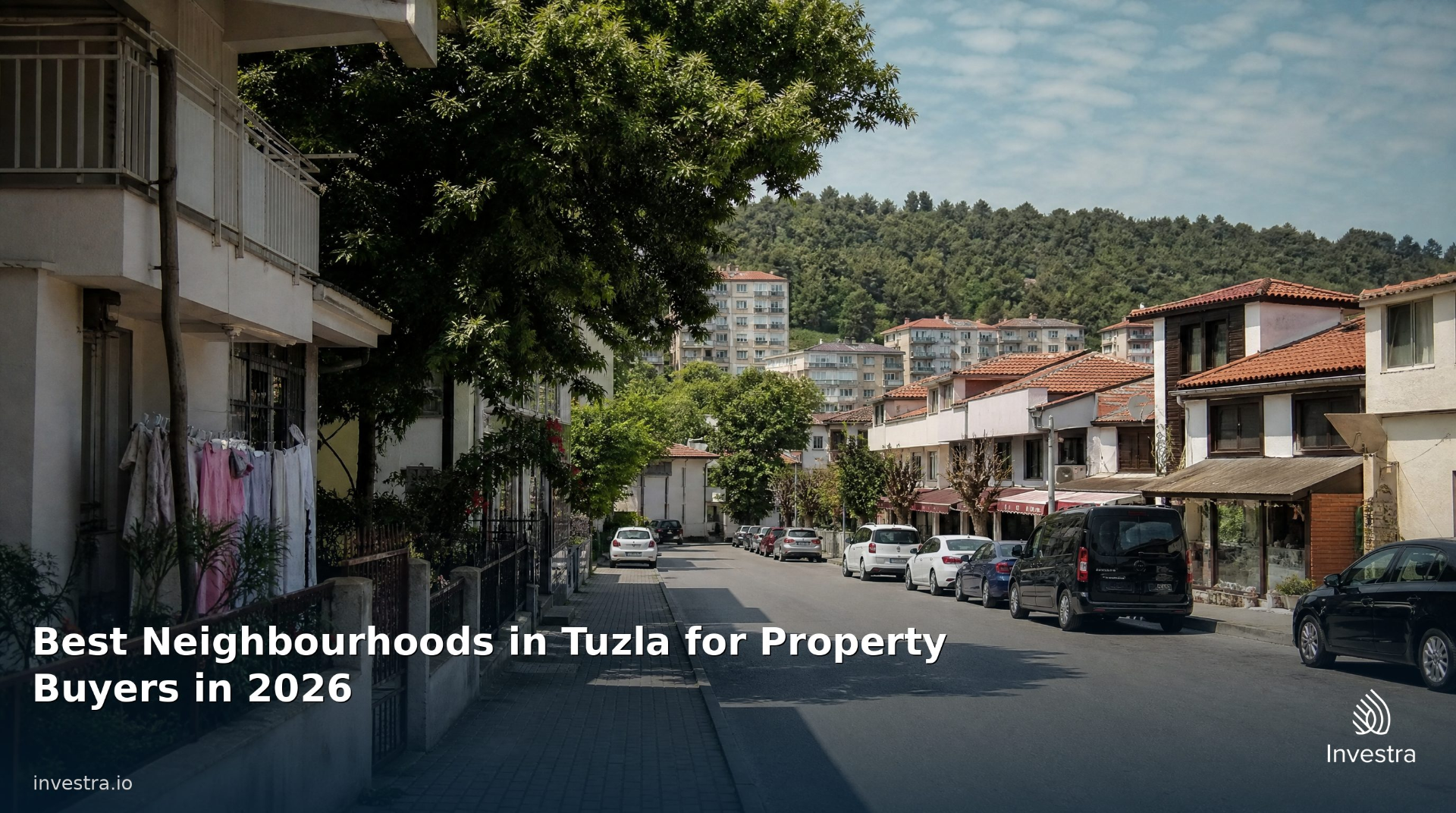
Best Neighbourhoods in Tuzla for Property Buyers in 2026
Best Neighbourhoods in Tuzla for Property Buyers in 2026
Why Tuzla Is Attracting Property Buyers in 2026
Quick Answer: Tuzla is attracting property buyers in 2026 because of its affordable entry prices (€600–€1,400/m²), growing student rental demand, improving infrastructure, and position as Bosnia and Herzegovina's industrial and cultural heartland — making it one of the Balkans' most compelling emerging investment destinations.
Tuzla is Bosnia and Herzegovina's third-largest city by population, home to roughly 110,000 people in the urban core and close to 200,000 in the wider canton. It sits in the northeastern part of the country, close to the Serbian and Croatian borders, and serves as the economic engine of the Tuzla Canton.
What has been observed across the Balkans in recent years is a pattern where second-tier cities quietly outperform capital city markets on rental yield, simply because purchase prices remain low while rental demand from students and young professionals stays robust. Tuzla fits this pattern almost perfectly.
The infrastructure picture is improving too. Tuzla International Airport handles regular routes to Western Europe, which matters enormously for the diaspora community — tens of thousands of Bosnians living in Austria, Germany, and Sweden who regularly send remittances home or consider returning to purchase property.
For investors tracking emerging Balkan markets, comparing Tuzla to other regional opportunities is instructive. Platforms covering Loznica Real Estate Market 2026 Macva Region Property Guide illustrate how similar secondary cities across the border in Serbia are attracting capital — and Tuzla's fundamentals are broadly comparable, with some additional advantages around lower competition and higher yield potential.
Understanding Tuzla's Urban Geography and Neighbourhood Structure
Quick Answer: Tuzla's residential areas are organized around a compact city centre, several historic working-class districts, and newer peripheral developments — each offering distinct price points and investment profiles that buyers should understand before committing capital.
The city centre — locally referred to as the Centar or Stari Grad area — is where the highest concentration of pre-war and early post-war buildings are located, the main pedestrian zone (Korzo) exists, and the highest property prices are commanded. Moving outward, districts like Sjenjak, Slatina, and Stupine represent the city's main mid-20th century residential belt.
Further from the centre, neighbourhoods like Solina, Husino, and Grabovica offer more affordable options — typically standalone houses, older apartment blocks, and some newer private construction. These areas attract first-time Bosnian buyers and returning diaspora more than international investors, though price appreciation potential exists here as the city continues to grow outward.
One geographic peculiarity worth understanding: Tuzla is famous for its salt lake (Panonska jezera), an artificial recreational lake complex built over former underground salt mines. Properties near this area benefit from an unusual amenity premium — it is essentially a lakeside promenade in the middle of a landlocked industrial city, and it is increasingly popular for short-term leisure visitors.
Centar and Stari Grad: The Premium Urban Core
Quick Answer: Tuzla's Centar and Stari Grad districts command the city's highest prices — typically €1,100–€1,400/m² for renovated apartments — but offer the strongest short-term rental potential and the most liquid resale market for international investors.
The city centre is, predictably, where Tuzla's property market is most developed and most visible. Walking the Korzo pedestrian zone, there is a sense of a city that genuinely functions well at street level: café culture, retail, services, and a steady flow of foot traffic at most hours of the day.
The rental market here is the strongest in Tuzla. A renovated two-bedroom apartment (55–65m²) in the Centar commands monthly rents of €350–€450, occasionally higher for fully furnished units targeting young professionals or expats.
What surprises many buyers is the quality of some of the older building stock in this area. Austro-Hungarian-era buildings near the old town have thick walls, high ceilings, and architectural character that simply cannot be replicated in modern construction. Several have been partially renovated by local developers, with individual apartments sold as completed units. These properties tend to sell quickly and often off-market, which is why having a local network or working with platforms covering Serbia Proptech 2026 How Technology Is Changing Real Estate — which covers regional proptech trends highly relevant to neighbouring markets — is increasingly important for accessing deals before they reach public listings.
The primary risk in the Centar is the building condition. Many structures here are aging, with shared systems (elevators, roofs, pipes) that may require significant investment. Buyers should always commission a technical survey before purchase and factor potential maintenance costs into yield calculations. This is not a reason to avoid the area — it is just due diligence that cannot be skipped.
Sjenjak: Tuzla's Most Sought-After Residential District
Quick Answer: Sjenjak is widely regarded as Tuzla's most desirable residential neighbourhood, offering modern apartment stock, excellent city connectivity, and strong demand from both owner-occupiers and tenants — with prices ranging from €900–€1,200/m² depending on building age and condition.
Ask any established Tuzla real estate agent where the city's "nice" residential area is, and they will almost universally point toward Sjenjak. Perched on slightly elevated ground to the south of the city centre, this neighbourhood developed primarily from the 1970s through the 1990s and has continued to see new private construction in the years since.
The price range in Sjenjak reflects this diversity. Apartments in the older Yugoslav-era blocks, particularly unrenovated units, start at around €750–€850/m².
What distinguishes Sjenjak from other Tuzla neighbourhoods is not just quality — it is stability of demand. The tenant pool here is broad: university students who want a nicer environment than student dormitories, young professional couples, mid-level management from Tuzla's industrial companies, and returning diaspora who want to rent before committing to purchase.
New developments in Sjenjak are worth watching particularly closely. Several local developers are constructing small residential buildings of 12–20 units, targeting the growing middle-class buyer. Off-plan prices for these projects are sometimes 10–15% below completed market value, creating a specific arbitrage opportunity for buyers comfortable with construction risk. Consulting with specialists like Siniša Dagary investment insight — who has deep regional expertise in Balkan investment strategy — can help buyers assess whether specific off-plan projects carry acceptable risk profiles.
Stupine and Slatina: Value Plays in Established Residential Zones
Quick Answer: Stupine and Slatina are Tuzla's established mid-tier residential districts offering apartment prices of €600–€900/m², strong student rental demand, and excellent value-add potential through renovation — making them natural targets for yield-focused investors with lower acquisition budgets.
Not every investor needs or wants the premium of Sjenjak or the bustle of the Centar. Stupine and Slatina represent Tuzla's most practical buy-to-let sweet spot: enough demand to keep vacancy low, low enough prices to generate yields that justify the investment, and building stock that ranges from cosmetically tired (opportunity) to reasonably maintained (lower-risk entry).
Stupine sits northeast of the centre, close to the University of Tuzla's main campus. This proximity is the neighbourhood's defining investment characteristic. Student demand here is structural and predictable — tens of thousands of students need accommodation, university dormitories can only house a fraction of them, and private rentals fill the gap.
The mathematics on student rentals in Stupine is compelling at the entry level. A compact one-bedroom apartment (35m²) in reasonable condition can be purchased for €22,000–€32,000. At a rental of €220/month, gross yield approaches 8–9%, which is among the highest in the Tuzla market.
Slatina offers a slightly different profile — less student-oriented, more balanced between working families and young professionals. Properties here are similar in age to Stupine (predominantly Yugoslav-era concrete construction) but with a somewhat wider range of unit sizes.
The renovation opportunity in these districts is real and frequently underestimated. What has been observed in comparable Balkan markets — for instance, in the analysis covered in the Aleksinac Real Estate Market 2026 Southern Serbia Property Guide — is that value-add strategies in second-tier cities often outperform passive buy-and-hold approaches when renovation costs are controlled and the local contractor market is well-managed.
Panonska Jezera Area: The Emerging Short-Term Rental Hotspot
Quick Answer: The area surrounding Tuzla's Panonska Jezera (Pannonian Lakes) is emerging as the city's primary short-term rental zone, with furnished apartments commanding Airbnb nightly rates of €35–€70, offering investors gross annual yields of 8–11% when occupancy is well-managed.
The numbers, when occupancy is managed well, are attractive. An apartment generating an average €45/night at 55% annual occupancy produces approximately €9,000 in gross annual revenue. If that apartment was acquired for €75,000–€90,000 (the premium for lakeside proximity is real), gross yields of 10–12% are achievable.
The caveat here is management complexity. Short-term rental income in Bosnia and Herzegovina requires proper registration, tax declaration, and increasingly, compliance with local municipality rules around tourist accommodation. This is not a barrier — it is just a process that requires local legal and accounting support from day one. Working with specialists in Balkan property structuring, such as those connected through Siniša Dagary investment insight, can help investors set up the right structures before rather than after problems emerge.
One more practical note: the Panonska Jezera area is still developing. New hospitality and commercial projects are planned, and the promenade infrastructure continues to improve. Early-mover investors buying in this zone in 2026 are likely buying ahead of a tourism infrastructure curve that will only accelerate demand over the next five to seven years.
Legal Framework for Foreign Property Buyers in Bosnia and Herzegovina
Quick Answer: Foreign nationals from EU countries and most others can legally purchase residential property in Bosnia and Herzegovina under the principle of reciprocity, though the process involves handling both entity-level laws (Federation of BiH or Republika Srpska) and municipal registries — making professional legal representation non-negotiable.
Bosnia and Herzegovina's constitutional structure is unlike any other country in Europe, and this complexity extends directly into property law. The country is divided into two entities — the Federation of BiH and Republika Srpska — plus the Brčko District, each with its own legal framework governing property transactions.
Foreign nationals are permitted to purchase real estate in BiH under the principle of reciprocity — meaning citizens of countries that allow Bosnian nationals to purchase property are generally permitted to do so in return. For most EU citizens, Americans, Australians, and Canadians, this is a non-issue. Citizens of some non-EU countries should verify their specific status before proceeding.
The transaction process itself follows a relatively straightforward structure: preliminary agreement (ugovor o kupoprodaji), land registry verification, payment through a notary-supervised escrow or direct transfer, and final registration with the relevant land registry (Zemljišna knjiga). The critical step — and where many foreign buyers encounter problems — is the land registry verification.
This is not a market where DIY transactions make sense. Hiring a local attorney (advokat) who specializes in property transactions is essential, and their fees are reasonable — typically 0.5–1% of the transaction value. Notary fees add another 0.3–0.5%, and property transfer tax (porez na promet nekretnina) in the Federation of BiH is set at 5% of the assessed value.
For context on how these legal and tax frameworks compare across the broader Balkans, reviewing how similar markets handle foreign buyer registration is instructive — as explored in the Prokuplje Real Estate Market 2026 Toplica Region Property Guide, which covers the Serbian side of the border and offers useful comparison points.
Taxes, Costs, and the True Price of Buying Property in Tuzla
Quick Answer: The total acquisition cost for property in Tuzla typically runs 7–10% above the purchase price when all taxes, notary fees, legal costs, and registration charges are included — and annual holding costs (property tax, maintenance, management) add approximately 1.5–3% of asset value per year.
Understanding the real cost of a property purchase goes beyond the price tag on the listing. In Bosnia and Herzegovina, and specifically within the Federation of BiH where Tuzla is located, buyers face a specific set of transaction taxes and fees that need to be budgeted for from the outset.
Annual holding costs are comparatively light, which is one of Tuzla's genuine advantages as a buy-to-let market. Property tax (porez na imovinu) in the Federation of BiH is very low — typically 0.05–0.5% of assessed value annually, often resulting in bills of €50–€200/year for standard residential units. There is no annual wealth tax or second-home surcharge for most residential properties.
The net cost picture, when modelled properly, is still highly favourable compared to Western European or even some Central European jurisdictions. A Tuzla investor buying a €60,000 apartment, renting it for €350/month (€4,200/year gross), and carrying annual costs of €1,200 (tax, maintenance, management) pays roughly €420 in income tax on the net income — leaving a net annual return of approximately €2,580, or 4.3% on capital invested. That is before any capital appreciation, which in Tuzla's current trajectory has been running at 3–6% per year in better locations. Services like Findes Group & Partners can help international buyers structure their investment vehicles and tax reporting obligations in a way that maximizes after-tax returns across multiple jurisdictions.
Rental Yields and ROI Across Tuzla Neighbourhoods: A Comparative View
Quick Answer: Gross rental yields in Tuzla range from 5.5% in premium Centar locations to 9%+ in student-heavy areas like Stupine, with the Panonska Jezera short-term rental zone capable of 8–11% gross yields — placing Tuzla comfortably among the higher-yielding residential markets in the Western Balkans.
Data on rental yields in Bosnian cities is not as systematically published as in Western European markets, which means investors need to build their own bottom-up analysis. What follows is a best-estimate synthesis based on current market listings, transaction reports, and comparable regional data from 2025–2026.
Starting with the Centar: renovated apartments trading at €1,100–€1,400/m² can achieve monthly rents of €10–€12/m², suggesting gross yields of approximately 8.5–10.5% at first glance. But Centar properties tend to be larger (many units are 65–90m²), and larger units in BiH do not rent at the same per-square-meter rate as compact units. Realistic gross yields here are 5.5–7% on a whole-unit basis.
In Sjenjak, the combination of solid mid-range rents (€300–€420/month for 2-bedroom units) and moderate purchase prices (€58,000–€75,000) produces gross yields of 6–7.5%. Net yields of 5–5.5% are typical after costs. This is a strong, steady return with lower management intensity than student rentals.
The student rental zones — Stupine primarily, parts of Slatina — offer the highest potential gross yields: 8–10% on compact units, 7–8.5% on slightly larger ones. The trade-off is year-round management attention and higher wear on fixtures. For investors who either live locally or use professional management services, this segment consistently outperforms on raw return metrics.
The Panonska Jezera short-term rental opportunity has already been discussed, but it bears repeating in a comparative context: well-managed short-term rental properties near the lake can generate gross yields of 8–11%. The risk-adjusted return is slightly lower than the headline suggests (higher management costs, seasonal volatility), but for experienced short-term rental operators, this is a genuinely compelling market entry point. For investors tracking similar yield profiles across the region, regional market guides like the Sremska Mitrovica Real Estate 2026 Srem Region Property Guide offer useful comparative context on neighbouring Balkans opportunities.
Infrastructure, Connectivity, and Long-Term City Growth Drivers
Quick Answer: Tuzla's strategic location, airport connectivity, university anchor, and diversified industrial base create structural long-term growth drivers that support property price appreciation and rental demand — with infrastructure improvements already underway and more planned through 2030.
Understanding a city's long-term investment thesis requires looking beyond current prices and rental yields to the structural factors that will drive growth five to ten years ahead. Tuzla's case is compelling in this regard.
The city's position in the Pannonian Plain, close to Serbia and Croatia, makes it a natural logistics and distribution hub. Several major industrial facilities operate in and around Tuzla — food processing, pharmaceuticals, and manufacturing — providing stable employment and underpinning the local economy in ways that tourism-dependent cities simply cannot match.
Tuzla International Airport currently operates regional routes to Western Europe, but the airport authority has been working on expanding both destinations and flight frequencies. Better air connectivity will progressively improve the diaspora buyer experience and support short-term tourism at places like Panonska Jezera. This is infrastructure that benefits property values in a very direct way.
The University of Tuzla continues to grow, with enrollments now stable at over 13,000 students. The university has been investing in campus facilities and modernizing its academic programs, which tends to attract higher-quality students and faculty — in turn supporting demand for better-quality rental accommodation. This virtuous cycle is already visible in the Sj
Investment Disclaimer
Quick Answer: This guide is general market information, not personal legal, tax, financing or investment advice.
Before committing to a property transaction, buyers should obtain independent local legal, tax and financial advice suited to their circumstances. Investra.io can support initial market research, but every purchase decision remains the buyer's responsibility.
Frequently Asked Questions
Quick Answer: This section explains the practical property-investment implications of Frequently Asked Questions.
What is a prudent next step after initial market research?
Use current documentation, independent professional advice and comparable local evidence before proceeding. Investra.io can support an initial structured market review.
How can buyers plan a realistic ownership budget?
Use current documentation, independent professional advice and comparable local evidence before proceeding. Investra.io can support an initial structured market review.
What evidence supports a careful investment decision?
Use current documentation, independent professional advice and comparable local evidence before proceeding. Investra.io can support an initial structured market review.
When should a buyer obtain legal and tax advice?
Use current documentation, independent professional advice and comparable local evidence before proceeding. Investra.io can support an initial structured market review.
How should a buyer compare neighbourhoods and property types?
Use current documentation, independent professional advice and comparable local evidence before proceeding. Investra.io can support an initial structured market review.
What local checks should be completed before signing?
Use current documentation, independent professional advice and comparable local evidence before proceeding. Investra.io can support an initial structured market review.
Which costs should be assessed alongside the purchase price?
Use current documentation, independent professional advice and comparable local evidence before proceeding. Investra.io can support an initial structured market review.
How can international buyers verify a property opportunity?
Use current documentation, independent professional advice and comparable local evidence before proceeding. Investra.io can support an initial structured market review.
What should buyers compare before selecting a property?
Use current documentation, independent professional advice and comparable local evidence before proceeding. Investra.io can support an initial structured market review.
Quick Answer: These answers outline common buyer checks and should be read with current professional advice.
Recommended Reading
Quick Answer: This section explains the practical property-investment implications of Recommended Reading.
- Investra market research
- Investra market research
- Investra market research
- Investra market research
- Investra market research
- Investra market research
- Investra market research
- Investra market research
- Investra market research
- Investra market research
- Investra market research
- Investra market research
- Investra market research
- Investra market research
- Investra market research
- Investra market research
- Investra market research
- Siniša Dagary investment insight
- Siniša Dagary investment insight
- Siniša Dagary investment insight
- Siniša Dagary investment insight
- Siniša Dagary investment insight
- Findes Group & Partners
- Findes Group & Partners
Connect With Investra
Follow Investra for market updates on Facebook, LinkedIn, YouTube
Related Posts
No related posts available.
