
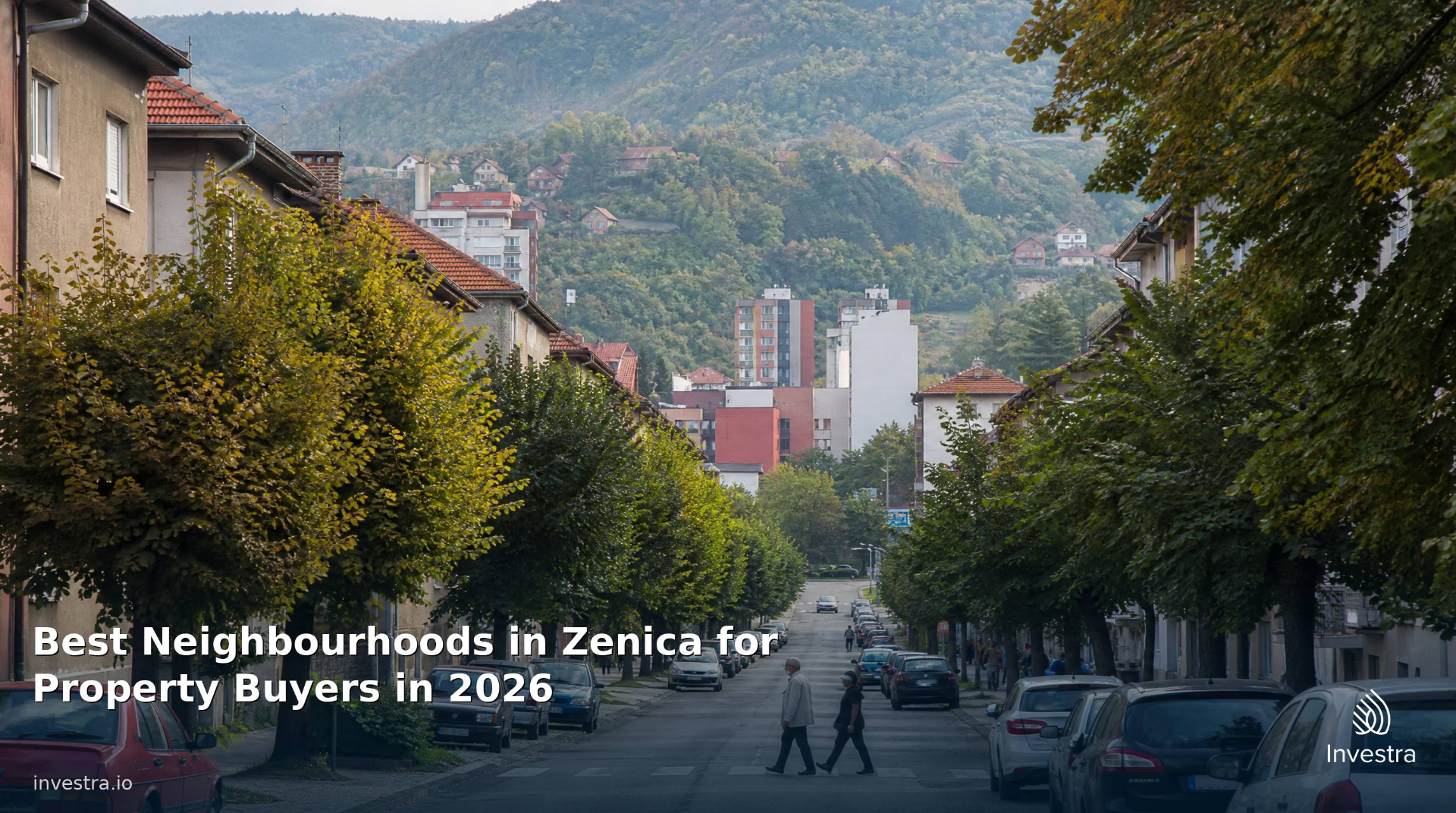
Best Neighbourhoods in Zenica for Property Buyers in 2026
Best Neighbourhoods in Zenica for Property Buyers in 2026
Why Zenica Is Attracting Property Buyers in 2026
Quick Answer: Zenica is emerging as one of Bosnia and Herzegovina's most compelling property markets in 2026, offering affordable entry prices from €500–€1,200/m², growing rental demand, and significant urban regeneration momentum that's catching the attention of both regional and international investors.
Zenica doesn't make the headlines the way Sarajevo or Mostar do. It's not a UNESCO-listed medieval town or a postcard-perfect lakeside retreat. But that's precisely why property buyers with a sharper eye for value are paying close attention to it right now.
Bosnia and Herzegovina's fourth-largest city — with a population of roughly 110,000 — sits in the Bosna River valley in central Bosnia, and it's in the middle of a slow but unmistakable transformation. The city was once synonymous with heavy industry, its skyline dominated by the ArcelorMittal steel plant that employed tens of thousands during the Yugoslav era.
What's changed? Quite a lot, actually. Urban renewal programmes funded partly by EU pre-accession instruments have started modernising the city centre. The University of Zenica brings over 7,000 students annually, creating a stable tenant base.
The reality is that Zenica remains one of the most undervalued urban property markets in Southeast Europe. Average apartment prices in the city centre sit between €900 and €1,200 per square metre, while residential zones on the outskirts can still be purchased for €500–€750/m². Compare that to Sarajevo's city-centre rates of €2,000–€3,500/m² and the value proposition becomes hard to ignore. Seasoned regional investors who've already explored markets covered in guides like the Zajecar Real Estate Market 2026 Eastern Serbia Property Guide will recognise this pattern immediately — mid-sized industrial cities in transition tend to offer the best risk-adjusted entry points.
This guide breaks down Zenica's best neighbourhoods for property buyers in 2026, with hard data on pricing, rental yields, legal considerations, and the practical realities that every serious buyer needs to understand before signing anything.
Understanding Zenica's Property Market Structure in 2026
Quick Answer: Zenica's property market is divided into a densely built city centre, transitional mid-ring residential zones, and more affordable suburban and semi-rural areas — each offering distinct price points and investment profiles ranging from €500 to €1,400/m².
Before discussing specific neighbourhoods, it helps to understand how Zenica's urban geography actually works — because the city's layout shapes its property dynamics in ways that aren't immediately obvious to outsiders.
The city essentially operates in three concentric rings. The innermost ring — what locals call the centar or city centre — contains the bulk of commercial activity, government institutions, the main university campus, and older socialist-era apartment blocks built in the 1960s through 1980s.
The middle ring consists of established residential neighbourhoods like Jalija, Bilino Polje, Radakovo, and the areas around the Zenica stadium. These are genuinely liveable zones — quieter than the centre, with better green space, decent infrastructure, and a strong mix of owner-occupiers and long-term renters.
The outer ring includes settlements like Crkvice, Pehare, Arnauti, and the broader peri-urban fringe. Land and detached house prices drop sharply here, often below €400/m² for construction land or older houses needing renovation. This is territory for developers, self-builders, and patient long-term investors rather than those seeking immediate rental income.
What's driving the 2026 market? Several overlapping factors. Bosnia and Herzegovina's EU candidacy status (formally granted in December 2022) has injected optimism into the real estate sector, with foreign buyer inquiries rising noticeably.
Centar (City Centre): Premium Location, Reliable Returns
Quick Answer: Zenica's city centre is the highest-priced neighbourhood, with apartments ranging from €900–€1,400/m², offering gross rental yields of 5–7% annually and the strongest demand from students, young professionals, and short-term visitors.
The centar is where most buyers look first — and for good reason. It's where the city's pulse is strongest: the main pedestrian zone along Maršala Tita street, the Bosna River promenade, the indoor market, cafes, restaurants, and the central bus and rail station all sit within easy walking distance of each other.
Pricing reflects that demand. A renovated two-bedroom apartment (60–75m²) in a solid building near the centre will typically list at €55,000–€90,000, which works out to roughly €950–€1,200/m². Genuinely premium units — recently renovated, high floor, good views, modern fittings — can touch €1,300–€1,400/m², though these are the exception rather than the rule.
What surprised many buyers is just how much variation exists within even a small radius. An apartment in a well-maintained building on Kamberovića Čikma (one of the more desirable central streets) might command 20–30% more than a similar-sized unit two blocks away in a building with deferred maintenance. Condition and building management quality matter enormously here.
Rental yields in the centre are running at 5–7% gross annually in 2026, based on monthly rents of €300–€500 for a one-to-two bedroom apartment. Student demand from the University of Zenica provides a reliable baseline, supplemented by young professionals working in the growing service and healthcare sectors.
The main risk in the centar? Building age and maintenance. Many central apartment blocks are 40–60 years old. Some have had minimal maintenance since the 1990s war, and buyers need to factor renovation costs — typically €200–€400/m² for a full refresh — into their total acquisition budget.
Jalija and Bilino Polje: The Best Value in Zenica Right Now
Quick Answer: Jalija and Bilino Polje offer the sweet spot of Zenica's market — established infrastructure, 10–20% lower prices than the centre at €750–€1,050/m², and growing demand from families and mid-career professionals seeking more space without sacrificing urban amenities.
If forced to pick a single area representing the best risk-adjusted opportunity in Zenica's 2026 market, most experienced local agents and consultants would point to Jalija and the adjacent Bilino Polje district. This isn't contrarianism — it's a straightforward read of where supply, demand, and price growth are aligning most favourably.
Jalija sits immediately south of the city centre, separated from it by the Bosna River. It's well-connected via bridges and public transport, and it offers something the centre simply can't: room. Apartment buildings here are newer on average (predominantly 1980s–2000s construction), with better parking, larger floor plates, and more green space between buildings.
Bilino Polje, named after the famous meadow where medieval Bosnian history unfolded, is home to the Zenica stadium and a well-developed residential fabric. It's genuinely pleasant to walk around, with tree-lined streets and a community feel that the centre lacks.
Price-wise, expect €750–€1,050/m² for apartments depending on condition and precise location. A 70m² two-bedroom in good condition might sell for €55,000–€75,000 — meaningfully cheaper than equivalent space in the centre.
New build supply in these areas is limited, which is actually a positive signal for existing stock. When demand grows faster than new supply, price appreciation tends to be more durable. Investors tracking similar dynamics in emerging European markets — including those watching the Prokuplje Real Estate Market 2026 Toplica Region Property Guide — will recognise this supply-demand imbalance as a classic value driver.
Radakovo and the Northern Residential Belt: Family Living at Affordable Prices
Quick Answer: Radakovo and the northern residential belt offer Zenica's most affordable established housing at €600–€900/m², making them ideal for buyers prioritising space, quiet living, and long-term capital appreciation over immediate rental yield maximisation.
Prices reflect this demographic profile. Apartments here trade at €600–€900/m², while detached houses on decent plots can be acquired for €80,000–€150,000 depending on size, condition, and land area.
The northern belt also contains some of Zenica's newer private housing developments, with local developers building townhouse complexes and small villa-style properties in the €120,000–€200,000 range. These attract buyers who want modern standards without Sarajevo's premium, and they represent a growing segment of the market as Bosnian middle-class aspirations evolve.
Infrastructure in these areas is functional but less polished than the centre — roads can be rougher, public transport connections less frequent. That said, car ownership rates in Bosnia are high, and the northern belt's road access to the A1 motorway (connecting Zenica to Sarajevo in under an hour) is actually one of its hidden advantages.
For long-term capital growth plays, the northern belt offers compelling land banking opportunities. Serviced building plots can be found for €50–€120/m² — dramatically below equivalent land in comparable cities. Consultants like Siniša Dagary — Investment Consultant have consistently pointed out that land banking in pre-EU-accession Western Balkans cities tends to generate exceptional returns over 7–10 year horizons, particularly where urban expansion is constrained by topography (as it is in the Bosna valley).
Novo Zenica and New Development Zones: The Growth Story
Quick Answer: Novo Zenica and the city's designated development zones represent the highest-risk, highest-potential segment of the market, with new-build apartments selling at €1,000–€1,300/m² and significant upside tied to ongoing urban masterplan implementation and EU-funded infrastructure investment.
Every city in transition has its "new quarter" — the area where planners and developers are trying to write the next chapter of the urban story. In Zenica, that role is increasingly being played by the newer development zones along the eastern and western flanks of the city, where a mix of public investment and private development is reshaping the landscape.
Developer activity has accelerated since 2022. The Zenica-Doboj Canton administration has approved several large mixed-use projects that include residential apartments, commercial ground floors, and public spaces. Some of these have already reached completion; others are in the pre-sale phase.
The growth story here is tied to a broader thesis: as Bosnia and Herzegovina progresses through EU accession chapters, foreign direct investment will increase, professional employment will grow, and demand for modern housing will outstrip the city's existing stock. That's the bull case. The bear case is that accession timelines slip (they always do), that Zenica's specific economic base doesn't diversify quickly enough, and that new development overshoots actual demand. Both scenarios are plausible, which is why diversification across multiple neighbourhoods — or multiple markets, as explored in the Loznica Real Estate Market 2026 Macva Region Property Guide — tends to produce better risk-adjusted outcomes.
Legal Framework for Property Buyers in Bosnia and Herzegovina
Quick Answer: Foreign nationals can generally purchase property in Bosnia and Herzegovina, but the legal framework is fragmented across two entities (Federation of BiH and Republika Srpska) and one district (Brčko), requiring entity-specific due diligence — in Zenica's case, applying the Federation of BiH legal framework.
Bosnia and Herzegovina's legal system is, to put it diplomatically, distinctive. The country operates under a complex constitutional arrangement established by the 1995 Dayton Peace Agreement, which created two entities — the Federation of Bosnia and Herzegovina (FBiH) and Republika Srpska (RS) — plus the self-governing Brčko District.
Foreign nationals from countries that have reciprocal property rights agreements with Bosnia and Herzegovina can purchase real estate directly. Most EU citizens, citizens of the Western Balkans, and nationals of the US, Canada, and Australia generally face no prohibition on purchasing.
The property purchase process in Zenica typically follows these stages. First, a preliminary contract ( predugovor ) is signed with a deposit of 10% — legally binding and subject to double-deposit return if the seller withdraws.
Due diligence cannot be overstated. Bosnia's land registry system has historical gaps stemming from the war period, socialist-era collective ownership structures, and incomplete digitalisation. Properties with unclear title histories — particularly older apartment buildings and rural land — require specialist legal review. Engaging a qualified local attorney costs roughly €500–€1,500 depending on complexity, which is genuinely excellent value relative to the risks it mitigates. The About Siniša Dagary profile provides useful context on how experienced Western Balkans investment advisors approach this kind of cross-jurisdictional due diligence.
Buyers should also be aware of the condominium ownership system (etažna svojina) that governs apartment buildings. Under this system, each apartment is individually titled, with common areas owned proportionally. Building maintenance funds (zajednička rezerva) are legally required, though enforcement varies significantly by building and municipality.
Taxes, Costs, and Transaction Fees in Zenica
Quick Answer: Total transaction costs for purchasing property in Zenica typically run 6–9% above the purchase price, including 5% property transfer tax, notary fees, land registry fees, and legal costs — making accurate budgeting from the outset essential for international buyers.
Understanding the full cost of acquisition is non-negotiable. Too many buyers focus exclusively on the listed price and find themselves scrambling to cover transaction costs that weren't factored into their budget. Here's what the complete picture looks like for a property purchase in Zenica in 2026.
Notary fees are regulated by the FBiH Notary Chamber and are calculated on a sliding scale based on transaction value. For a €70,000 transaction, expect approximately €300–€600 in notary fees. Land registry fees for recording the title transfer add another €100–€300. Legal fees for an attorney handling the full process run €500–€1,500.
On the ownership cost side, annual property taxes (porez na imovinu) in the Federation of BiH are relatively modest — typically 0.1–0.5% of assessed value annually, which on a €70,000 property might amount to €70–€350 per year. Utility costs (water, heating, garbage collection, building maintenance fund) for a standard city-centre apartment run approximately €100–€200 per month.
For rental income, landlords in Bosnia are required to register rental contracts and declare rental income. The personal income tax rate on rental income in FBiH is 10%, with deductions permitted for maintenance costs (up to 20% of gross rent as a standardised deduction). This gives an effective rate on declared net rental income of around 8%, which is competitive by regional standards. Platforms like Findes Financial Services can provide detailed cross-border tax structuring advice for investors managing rental income across multiple jurisdictions.
Rental Yields and ROI: What the Numbers Actually Show
Quick Answer: Gross rental yields in Zenica range from 5% to 8% depending on location and property type, with net yields (after taxes, management, and maintenance) typically 4–6.5% — comfortably above the Western European average and competitive with other emerging Balkan markets.
Let's get into the numbers that actually matter for investment decision-making. Rental yield analysis in Zenica reveals a market that's quietly delivering solid returns — nothing spectacular, but reliable and growing.
In the city centre, a well-located one-bedroom apartment (45–55m²) purchased for €45,000–€55,000 can generate monthly rent of €250–€350. That implies gross yields of 6.5–8.5% — genuinely strong for a European market. Two-bedroom units (65–80m²) at €60,000–€85,000 generate €350–€500/month, giving yields of 5.8–8%.
In Jalija and Bilino Polje, the numbers are slightly lower due to marginally reduced demand intensity, but still compelling: two-bedroom apartments at €60,000–€75,000 renting for €300–€420/month produce gross yields of 5.5–7.5%.
Deducting realistic costs — 10% property management fee, 10% vacancy allowance, annual maintenance reserves of 1% of property value, and 8% tax on net rental income — brings net yields to approximately 4–6.5%. That's in line with what we've seen in comparable emerging European cities, including those profiled in the Sremska Mitrovica Real Estate 2026 Srem Region Property Guide and the Negotin Real Estate Market 2026 Zajecar District Property Guide.
Capital appreciation adds another dimension. Zenica property prices have increased at an estimated 5–8% annually over the 2020–2025 period, driven by general Western Balkans property market appreciation, BAM/euro stability, and improving local economic conditions.
Short-term rentals via Airbnb and Booking.com are viable in the city centre but represent a smaller opportunity than in Sarajevo or Mostar. Average daily rates for centrally located one-bedroom apartments run €40–€60 during high season (summer and winter holidays), with lower occupancy rates during shoulder seasons.
Key Market Trends and Future Outlook for Zenica Property
Quick Answer: Zenica's property market is entering a consolidation phase with moderate annual price growth of 5–7%, improving affordability relative to regional peers, and strengthening fundamentals driven by EU-related policy improvements and infrastructure investment through 2026–2028.
Understanding where Zenica's property market is headed requires looking beyond current prices to the structural drivers reshaping the city. Several trends are worth tracking closely.
Urban regeneration momentum has genuinely shifted from planning documents to bricks and mortar. The Zenica City Centre Masterplan, supported by European Commission technical assistance funds, has reached implementation phase. Pedestrian zones are being widened, facades renovated, and public spaces redesigned.
Rental demand cycles are also shifting. University enrolment has stabilised at 7,000–8,000 students annually (after years of declining enrolment), while the city's professional services sector (accounting, healthcare, legal services) is growing at an estimated 8–10% annually.
New-build supply is measured — and that's intentional. The city administration has carefully managed development permissions to prevent speculative overbuilding. This supply discipline, while constraining overall housing stock, protects existing property owners from rapid value dilution. Investors in European markets like those covered in the
Investment Disclaimer
Quick Answer: This guide is general market information, not personal legal, tax, financing or investment advice.
Before committing to a property transaction, buyers should obtain independent local legal, tax and financial advice suited to their circumstances. Investra.io can support initial market research, but every purchase decision remains the buyer's responsibility.
Frequently Asked Questions
Quick Answer: This section explains the practical property-investment implications of Frequently Asked Questions.
What is a prudent next step after initial market research?
Use current documentation, independent professional advice and comparable local evidence before proceeding. Investra.io can support an initial structured market review.
How can buyers plan a realistic ownership budget?
Use current documentation, independent professional advice and comparable local evidence before proceeding. Investra.io can support an initial structured market review.
What evidence supports a careful investment decision?
Use current documentation, independent professional advice and comparable local evidence before proceeding. Investra.io can support an initial structured market review.
When should a buyer obtain legal and tax advice?
Use current documentation, independent professional advice and comparable local evidence before proceeding. Investra.io can support an initial structured market review.
How should a buyer compare neighbourhoods and property types?
Use current documentation, independent professional advice and comparable local evidence before proceeding. Investra.io can support an initial structured market review.
What local checks should be completed before signing?
Use current documentation, independent professional advice and comparable local evidence before proceeding. Investra.io can support an initial structured market review.
Which costs should be assessed alongside the purchase price?
Use current documentation, independent professional advice and comparable local evidence before proceeding. Investra.io can support an initial structured market review.
How can international buyers verify a property opportunity?
Use current documentation, independent professional advice and comparable local evidence before proceeding. Investra.io can support an initial structured market review.
What should buyers compare before selecting a property?
Use current documentation, independent professional advice and comparable local evidence before proceeding. Investra.io can support an initial structured market review.
Quick Answer: These answers outline common buyer checks and should be read with current professional advice.
Recommended Reading
Quick Answer: This section explains the practical property-investment implications of Recommended Reading.
- Investra market research
- Investra market research
- Investra market research
- Investra market research
- Investra market research
- Investra market research
- Investra market research
- Investra market research
- Investra market research
- Investra market research
- Investra market research
- Investra market research
- Investra market research
- Investra market research
- Investra market research
- Investra market research
- Investra market research
- Siniša Dagary investment insight
- Siniša Dagary investment insight
- Siniša Dagary investment insight
- Siniša Dagary investment insight
- Siniša Dagary investment insight
- Findes Group & Partners
- Findes Group & Partners
Connect With Investra
Follow Investra for market updates on Facebook, LinkedIn, YouTube
Related Posts
No related posts available.
