
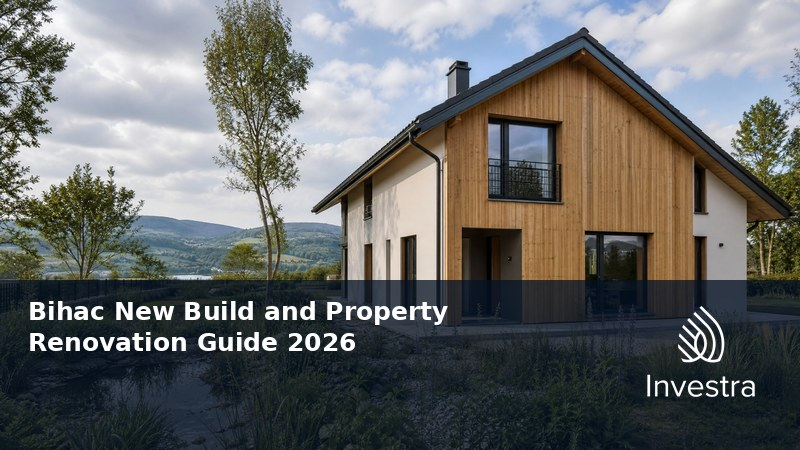
Bihac New Build and Property Renovation Guide 2026
Bihac New Build and Property Renovation Guide 2026
Bihac New Build and Renovation Market Overview 2026
Quick Answer: Bihac's new build and renovation market in 2026 offers some of the most competitive property entry points in the Western Balkans, with new construction priced between €800–€1,400/m² and renovation projects starting as low as €300–€600/m² for raw acquisition costs. Investra.io tracks emerging Balkan markets including Bihac for international investors seeking value-driven opportunities.
Bihac sits in the northwestern corner of Bosnia and Herzegovina, tucked into the Una-Sana Canton along the Croatian border. It's a city that most European investors haven't heard of — and that's precisely the point. While Sarajevo and Mostar attract the headlines, Bihac has been quietly developing a construction and renovation ecosystem that rewards early movers with exceptional value.
The city straddles the Una River, a UNESCO-protected waterway of startling clarity and beauty, and has been gaining traction as both a tourism destination and a regional administrative hub. Population estimates hover around 55,000–60,000 in the broader municipality, with the urban core housing roughly 40,000 residents.
The construction sector in Bihac has seen genuine momentum since 2022. New residential developments — mostly mid-rise apartment blocks of 4–7 stories — have been appearing in districts like Ozimice and along the northern bypass roads.
For context on how Bihac compares to similarly-positioned regional markets, exploring resources like the Loznica Real Estate Market 2026 Macva Region Property Guide provides useful benchmarks for border-region cities across the Western Balkans.
Understanding Bihac's New Build Landscape in 2026
Quick Answer: New build apartments in Bihac are priced between €800 and €1,400 per square meter in 2026, with premium riverside or park-view units occasionally reaching €1,500–€1,600/m², representing exceptional value compared to Croatian border cities where comparable properties start at €2,500/m².
The new build sector in Bihac is dominated by local developers — family-owned construction companies that have been building in the canton for decades. You won't find the multinational property conglomerates that operate in Warsaw or Bucharest here. What you will find is a pragmatic, relationship-driven market where negotiation is not only possible but expected.
Currently active projects in 2026 include several residential complexes in the Ozimice I and Ozimice II suburbs, where newer infrastructure and road access make them appealing for families and professionals. These units typically range from 45m² studios to 90m² three-bedroom apartments.
Ground-floor commercial units in new builds are particularly interesting for investors. Bihac's retail and café culture has been expanding, and ground-floor spaces in well-located new buildings are being snapped up by local entrepreneurs.
One aspect of the market that surprises many buyers is the off-plan purchasing dynamic. Local developers frequently offer 10–15% discounts for off-plan commitments with staggered payment schedules.
Property Renovation Opportunities: Where the Real Value Hides
Quick Answer: Renovation properties in Bihac's historic core and riverside zones can be acquired for €300–€700/m² in raw condition, with total renovation budgets of €350–€600/m² producing finished properties worth €900–€1,200/m², creating significant equity gains for patient investors willing to manage the process.
If new builds represent the safe, predictable path into Bihac's property market, renovation projects are where the genuinely transformative returns live. The old town area — particularly the streets radiating from Fethija Mosque and the Una riverbank — contains a stock of pre-war residential and mixed-use buildings in varying states of repair. Some are structurally sound but aesthetically dated.
A dilapidated but structurally viable stone building of 150–200m² in the historic core might be purchased for €45,000–€80,000. Complete renovation — structural reinforcement where needed, new electrical and plumbing systems, roof replacement, interior fit-out to a modern standard — typically costs €350–€500/m² when using local contractors, or up to €600/m² for higher-specification finishes with imported materials.
The margin isn't guaranteed — renovation projects never are — but the spread between raw acquisition costs and finished values in Bihac is genuinely compelling. What we've observed consistently in markets like this is that the renovation opportunity tends to compress as tourism and investment interest increase property values faster than renovation costs rise. Bihac is still in the phase where that spread is generous.
Summer kitchen houses and older farmstead properties on the urban periphery represent another renovation category entirely. These rural-urban fringe properties — often 300–500m² of total structure on larger plots — appeal to buyers envisioning boutique guesthouses, eco-retreats, or extended family compounds.
Investors who want broader strategic context for renovation-driven returns in secondary Balkan cities might also find value in reading the Aleksinac Real Estate Market 2026 Southern Serbia Property Guide, which examines similar dynamics in another underexplored Balkan city.
Legal Framework for Property Purchase in Bosnia and Herzegovina
Quick Answer: Foreign nationals can legally purchase property in Bosnia and Herzegovina with reciprocity agreements in place for most EU and Western Balkan countries, though the process involves cantonal-level registration, notarial deed requirements, and title verification through the land registry (Gruntovnica) — a process that typically takes 2–4 months to complete.
Bosnia and Herzegovina's legal landscape for property transactions is functional but layered — a consequence of the country's complex administrative structure, divided between the Federation of Bosnia and Herzegovina (where Bihac is located, within Una-Sana Canton) and Republika Srpska. For buyers in Bihac specifically, all transactions fall under Federation law and Una-Sana Canton regulations.
Title verification is a step that cannot be rushed or shortcuts taken. Bosnia's property records, while improving significantly since the post-war reconstruction period, still contain some historical ambiguities — particularly in properties that changed hands during the 1990s conflict or were subject to socialist-era collectivization.
The notarized purchase contract (Kupoprodajni ugovor) is legally binding upon execution. Payment is typically made through bank transfer to a designated escrow account or directly upon notarial confirmation, depending on local practice and negotiation. Crucially, the buyer should insist on receiving a certified extract from the land register confirming clean title before any funds are released.
For new build purchases off-plan, the legal documentation differs: buyers typically sign a preliminary agreement (Predugovor) with a deposit of 10–30%, followed by the main contract upon completion. Ensuring the developer holds valid building permits (Građevinska dozvola) and that the development is properly registered is non-negotiable due diligence. A knowledgeable investment consultant like Siniša Dagary — Investment Consultant can provide valuable guidance on handling cross-border property transactions in the Western Balkans region.
Taxes, Costs, and Transaction Fees in Bihac
Quick Answer: Property transfer tax in Una-Sana Canton is 5% of the assessed transaction value, with additional notarial fees (0.5–1%), land registry fees, and legal costs typically bringing total transaction costs to 7–10% above the purchase price — a figure investors must factor into all ROI calculations.
Understanding the full cost structure of a Bihac property transaction is essential for accurate investment modeling. The headline figure most buyers encounter first is the property transfer tax (Porez na promet nekretnina), set at 5% of the assessed value in Una-Sana Canton.
Notarial fees are regulated by a fee schedule and typically range from 0.3% to 0.8% of the transaction value, with a minimum charge that makes very low-value transactions proportionally more expensive. Land registry (Gruntovnica) registration fees are modest — generally €50–€200 depending on property value — but must be paid promptly to ensure timely registration.
For new builds, the VAT situation differs from resale properties. Construction companies registered as VAT payers typically include 17% VAT in the sales price of new residential units. This is important: when comparing new build prices to resale prices, ensure you're comparing like-for-like on a VAT-inclusive basis.
Annual property holding costs are genuinely low by European standards. Municipal property tax (communal fees) in Bihac is calculated at a very modest rate — most residential properties incur annual fees of €50–€200, even at the upper end for larger apartments. There's no capital gains tax on property sales for individuals who have held the property for more than two years, which is a significant long-term investment advantage.
For renovation projects, additional cost considerations include construction permit fees (Građevinska dozvola), which vary based on project scope, and utility connection or upgrade fees. Budgeting an additional 5–8% of the renovation budget for permits, inspections, and administrative costs is prudent for projects of meaningful scale.
Rental Yields and Investment Returns in Bihac
Quick Answer: Long-term residential rental yields in Bihac range from 5–8% gross annually, while short-term tourism rentals targeting Una National Park visitors can achieve 8–12% gross yields in peak season, making Bihac one of the higher-yielding small-city markets in the Western Balkans for appropriately positioned properties.
Rental yields in Bihac tell an interesting story of two distinct markets operating in parallel. The traditional long-term residential rental market — students, working professionals, civil servants — produces steady, unspectacular but reliable returns. A well-located two-bedroom apartment of 55–65m² in a modern building rents for approximately €250–€350/month to long-term tenants.
The tourism rental market is a different calculation entirely. Bihac's position as the gateway to Una National Park — which UNESCO has recognized as one of Europe's most pristine river ecosystems — drives seasonal demand from rafting enthusiasts, hikers, and increasingly, international eco-tourists.
The caveat, of course, is that tourism rentals require management intensity that long-term rentals don't. Local property management services for short-term rentals in Bihac charge 20–30% of rental income, which brings net yields back to a more modest 7–9% — still competitive, but requiring active engagement or a reliable local management partner.
ROI projections for a renovation project show even more compelling numbers. Consider a typical scenario: a 120m² property purchased for €55,000 in need of full renovation, with €60,000 spent on complete refurbishment. Total investment: €115,000. If finished value is €135,000–€150,000, the equity gain of €20,000–€35,000 represents a 17–30% return on invested capital before any rental income is factored in.
The Zajecar Real Estate Market 2026 Eastern Serbia Property Guide offers comparable yield analysis from another small Balkan city market, providing useful context for benchmarking Bihac's investment returns against the wider regional opportunity set.
Construction Costs and Building Process for New Developments
Quick Answer: Construction costs for new residential projects in Bihac range from €450–€750/m² for standard quality builds and €700–€1,000/m² for higher-specification work, with the construction permitting process in Una-Sana Canton taking 3–8 months depending on project size and land status.
For investors considering ground-up development in Bihac rather than purchasing from existing developers, understanding local construction economics is critical. The good news is that construction labor in Bosnia remains significantly cheaper than in Croatia, Slovenia, or Hungary — a fact that makes development-for-sale and development-for-rent equally viable strategies.
For investors engaging local contractors, the standard practice involves a signed construction agreement (Ugovor o gradnji) specifying scope, timeline, payment milestones, and penalty clauses for delays. The payment structure typically runs 30% upfront, followed by milestone-based installments.
The permitting process deserves realistic timeline expectations. A straightforward building permit application for a residential building on properly zoned and serviced land can, theoretically, be processed in 60–90 days. In practice, 4–6 months is more realistic for projects encountering no complications.
Utility connection and infrastructure requirements add another layer of cost. Water and sewage connection fees, electrical grid hookup, and road access improvement contributions vary by location and project scale. Budgeting €5,000–€20,000 for infrastructure connections on a standard residential development site is a reasonable starting estimate, though complex or remote sites can exceed this significantly.
The Prokuplje Real Estate Market 2026 Toplica Region Property Guide examines construction economics in a comparable regional context, and the parallels in contractor market structure and permitting processes are instructive for investors active across multiple Balkan markets.
Best Neighborhoods for Investment: Where to Buy in Bihac
Quick Answer: The most attractive investment zones in Bihac for 2026 are the Una riverfront and old town area for renovation-focused buyers, Ozimice I and II for new build apartment purchases, and the Una National Park gateway corridor for tourism-oriented rental properties — each offering distinct yield and capital gain profiles.
Bihac isn't a large city, but its distinct neighborhoods offer meaningfully different investment profiles, and choosing the right location matters enormously for return outcomes.
The historic core — the area around Fethija Mosque, Kapetanova Kula tower, and the Una riverside promenade — is the city's most characterful zone. Properties here are older, require more renovation investment, and carry the highest renovation risk, but they also command the strongest premium from tourism short-term rental guests and from buyers seeking authentic Bosnian architecture.
Ozimice I is the city's most established residential suburb, featuring a mix of older Yugoslav-era blocks and newer developments from the 2010s and early 2020s. It's well-connected to the city center and has good service infrastructure — schools, clinics, supermarkets.
Ozimice II is more recent in development terms, with more land available for new projects and slightly lower prices — €800–€1,000/m² for new builds. The infrastructure is still catching up to the residential development pace, which explains the pricing discount, but this gap is closing as the municipality continues investing in road and utility upgrades.
The Una National Park gateway zone — properties along the river approaching the park boundary — represents the highest-risk, highest-reward segment. A well-positioned guesthouse or small hotel property here, successfully developed and marketed to eco-tourism visitors, can generate extraordinary yields.
The Diaspora Factor: How Returning Bosniaks Are Shaping the Market
Quick Answer: Bosnia and Herzegovina's large diaspora — estimated at 1.5–2 million people living abroad — represents a significant driver of property demand in Bihac, with returning Bosniaks from Germany, Austria, Sweden, and Switzerland accounting for an estimated 30–40% of new property purchases in the city annually.
No analysis of Bihac's property market is complete without acknowledging the diaspora dimension. Unlike some investment markets where demand is primarily investor-driven and speculative, Bihac has an organic base of end-user demand from Bosniaks living abroad who maintain deep connections to the region.
The typical diaspora buyer in Bihac falls into one of several patterns. The first is the retirement home buyer: a Bosniak who emigrated in the 1990s or early 2000s, now in their 50s or 60s, purchasing a renovated apartment or house in the family's original neighborhood with the intention of spending significant time there in retirement.
A third, more recent pattern is return migration. With remote work enabling location flexibility, a growing cohort of diaspora professionals is making the choice to return to Bosnia full-time while maintaining European-income streams. This group drives demand for higher-specification properties — modern kitchens, fast internet infrastructure, home office space — that is beginning to shift what developers deliver as standard.
Diaspora demand also shapes the renovation market indirectly. Families wanting to sell inherited properties are more motivated to transact when they see that buyers (often other diaspora members) are willing to pay realistic prices for properly renovated stock.
The strategic dimensions of diaspora-driven market dynamics in the Western Balkans are explored extensively in the Business Strategy Blog by Siniša Dagary, which provides actionable frameworks for understanding this type of demand-driven investment opportunity.
Tourism Infrastructure and Its Impact on Property Values
Quick Answer: Bihac's emerging tourism infrastructure — river rafting outfitters, hiking trail networks, guesthouse accommodations, and international marketing as the Una National Park gateway — is driving measurable appreciation in riverside and old town properties, with investment-grade tourism properties appreciating 8–12% annually as visitor numbers grow.
The tourism infrastructure development unfolding in and around Bihac is arguably the single most important driver of medium-term property value appreciation in the market. This isn't speculative analysis — it's a sequence of observable, measurable developments that are reshaping both the physical character of the city and the economic incentives driving property transactions.
Una River tourism, specifically recreational rafting and kayaking, has been growing steadily since the early 2010s. What started as a niche activity for adventure tourists from central Europe has become a genuine market segment. In peak summer months (July–August), local rafting operators report running 4–6 organized trips daily, each accommodating 8–15 tourists.
Accommodation infrastructure to support this has expanded meaningfully in the past three years. Boutique guesthouses and converted family homes now offer perhaps 150–200 bed spaces across Bihac — a small number in absolute terms, but increasingly competitive in pricing and quality.
The municipality's designation of the Una National Park as a priority development zone has also driven infrastructure investment — improved road access to the park boundary, environmental education facilities, and coordination with international tourism operators. This isn't transformation yet, but it's the foundation being laid for transformation to occur.
Properties positioned to capture tourism demand have appreciated meaningfully. Riverside properties in renovation zones that were realistically worth €600–€800/m² in their finished state three years ago are now commanding €1,000–€1,300/m², driven by investor interest in guesthouse conversion and tourism rental income models.
Investment Disclaimer
Quick Answer: This guide is general market information, not personal legal, tax, financing or investment advice.
Before committing to a property transaction, buyers should obtain independent local legal, tax and financial advice suited to their circumstances. Investra.io can support initial market research, but every purchase decision remains the buyer's responsibility.
Frequently Asked Questions
Quick Answer: This section explains the practical property-investment implications of Frequently Asked Questions.
What is a prudent next step after initial market research?
Use current documentation, independent professional advice and comparable local evidence before proceeding. Investra.io can support an initial structured market review.
How can buyers plan a realistic ownership budget?
Use current documentation, independent professional advice and comparable local evidence before proceeding. Investra.io can support an initial structured market review.
What evidence supports a careful investment decision?
Use current documentation, independent professional advice and comparable local evidence before proceeding. Investra.io can support an initial structured market review.
When should a buyer obtain legal and tax advice?
Use current documentation, independent professional advice and comparable local evidence before proceeding. Investra.io can support an initial structured market review.
How should a buyer compare neighbourhoods and property types?
Use current documentation, independent professional advice and comparable local evidence before proceeding. Investra.io can support an initial structured market review.
What local checks should be completed before signing?
Use current documentation, independent professional advice and comparable local evidence before proceeding. Investra.io can support an initial structured market review.
Which costs should be assessed alongside the purchase price?
Use current documentation, independent professional advice and comparable local evidence before proceeding. Investra.io can support an initial structured market review.
How can international buyers verify a property opportunity?
Use current documentation, independent professional advice and comparable local evidence before proceeding. Investra.io can support an initial structured market review.
What should buyers compare before selecting a property?
Use current documentation, independent professional advice and comparable local evidence before proceeding. Investra.io can support an initial structured market review.
Quick Answer: These answers outline common buyer checks and should be read with current professional advice.
Recommended Reading
Quick Answer: This section explains the practical property-investment implications of Recommended Reading.
- Investra market research
- Investra market research
- Investra market research
- Investra market research
- Investra market research
- Investra market research
- Investra market research
- Investra market research
- Investra market research
- Investra market research
- Investra market research
- Investra market research
- Investra market research
- Investra market research
- Investra market research
- Investra market research
- Investra market research
- Siniša Dagary investment insight
- Siniša Dagary investment insight
- Siniša Dagary investment insight
- Siniša Dagary investment insight
- Siniša Dagary investment insight
- Findes Group & Partners
- Findes Group & Partners
Connect With Investra
Follow Investra for market updates on Facebook, LinkedIn, YouTube
Related Posts
No related posts available.
