
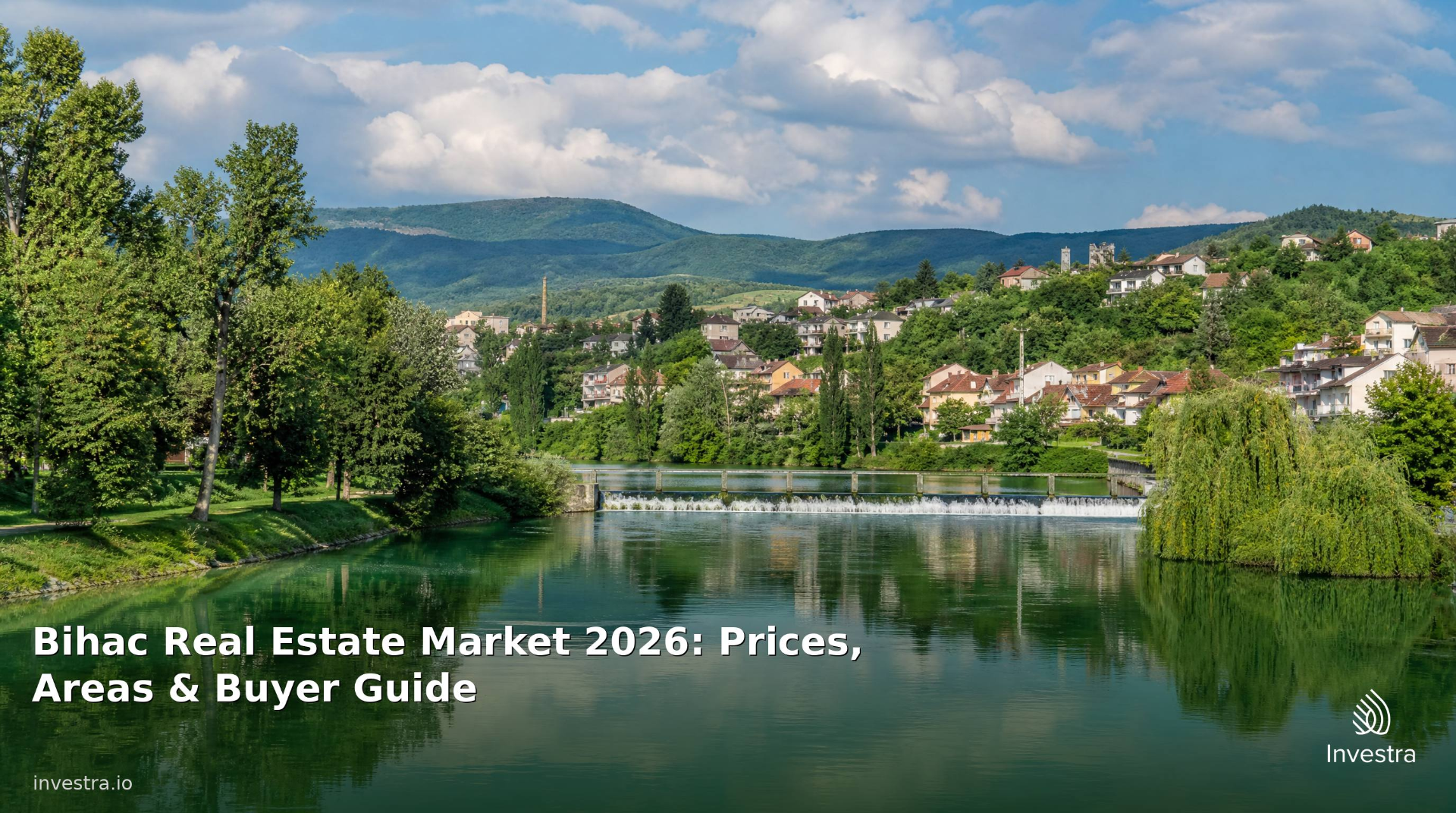
Bihac Real Estate Market 2026: Prices, Areas & Buyer Guide
Bihac Real Estate Market 2026: Prices, Areas & Buyer Guide
Bihac Real Estate Market Overview 2026: What's Actually Happening
Quick Answer: Bihac's real estate market in 2026 is one of Bosnia and Herzegovina's most promising emerging markets, with residential property prices ranging from €700 to €1,800 per m², driven by tourism growth, EU candidate-country momentum, and sustained demand from the diaspora. Investra.io tracks emerging Balkan markets to help investors identify opportunities before they peak.
The city itself has a population of around 56,000, making it the administrative center of the Una-Sana Canton. What's changed in recent years is the pace of development. The Una National Park, which draws over 200,000 visitors annually, has become a genuine tourism anchor. The Štrbački Buk and Martin Brod waterfalls are UNESCO-nominated natural sites that have placed Bihac firmly on international travel maps.
Bosnia and Herzegovina's EU candidate status, formally granted in December 2022 and progressing through 2025–2026, has injected optimism into the country's entire property sector. Investors who've watched similar transitions in Serbia, North Macedonia, and Montenegro are now paying close attention to BiH.
What we've seen across the Western Balkans property landscape is a consistent pattern: cities near national parks or UNESCO-heritage areas experience price appreciation that outpaces urban centers over 5–10 year horizons. Bihac is following that playbook.
Bihac Property Prices Per Square Meter in 2026
Quick Answer: Residential property in Bihac ranges from €700/m² for older socialist-era apartments to €1,800/m² for newly built or renovated properties in prime locations, with the market average sitting around €1,000–€1,200/m² in 2026. Compare with similar emerging Balkan city markets to understand the regional pricing context.
Let's get into the actual numbers, because that's what matters. The Bihac property market in 2026 spans a fairly wide price band depending on property type, age, location, and condition—not unlike what we observe in comparable Balkan secondary cities.
Residential Apartments (City Center & New Builds): New construction apartments in Bihac's central districts typically list between €1,200 and €1,800 per m². These are properties built post-2015, often with parking, elevators, and modern finishes. There's been a modest but notable uptick in development activity since 2022, with several residential complexes in the Ozimice and Harmani neighborhoods.
Older Apartments (Socialist-Era Stock): The majority of Bihac's housing stock was built between 1960 and 1990. These units—ranging from studio flats to large three-bedroom apartments—trade between €700 and €1,100 per m² depending on floor, condition, and proximity to the city center. Many of these represent excellent value-add opportunities for buyers willing to renovate.
Houses and Villas: Standalone houses on the outskirts of Bihac, particularly in areas like Pritoka, Ripa, and the villages along the Una River, range from €60,000 to €200,000 for the full property. Waterfront or river-view properties command a significant premium—sometimes 30–40% above comparable non-waterfront homes.
Rural and Tourism Properties: Agro-tourism properties, small guesthouses, and rural plots near the Una National Park have seen the most dramatic price movement. Plots designated for tourism use can reach €15–€35 per m² depending on proximity to the park boundary and access roads.
Year-on-year, what we've tracked shows approximately 6–9% price appreciation across the market from 2023 to 2026, outperforming Bosnia's national average of around 4–5%. That differential reflects Bihac's tourism premium and diaspora demand more than any macro-economic shift.
Best Neighborhoods and Areas to Buy in Bihac
Quick Answer: The most sought-after areas in Bihac for property investment include the historic city center (Stari Grad), the Ozimice residential zone, and Una River-adjacent villages like Pritoka—each offering different risk-reward profiles for investors. Understanding neighborhood dynamics is as important in Bihac as it is in any Balkan city.
Bihac isn't a large city by European standards, but its neighborhoods have distinct characters—and distinct investment implications. Choosing the right micro-location can be the difference between a 5% and an 8% annual yield, so understanding the local geography matters.
Ozimice and Harmani: These are Bihac's primary modern residential neighborhoods, and they're where most new construction activity is concentrated. The infrastructure is solid, schools are nearby, and the commute to the center is easy. These are reliable buy-to-let areas, with strong demand from local families, young professionals, and university students. Prices range from €1,100 to €1,500/m² for new builds.
Pritoka and Una Riverside Villages: For the tourism-play investor, this is the most compelling zone. Small villages stretching south along the Una—Pritoka, Ripač, Orašac—are within 5–15 minutes of central Bihac but feel entirely different. Guesthouses, rural cottages, and eco-tourism properties here attract visitors year-round, particularly in summer.
Bosanska Krupa (satellite town, 30km SE): Not Bihac proper, but worth mentioning for investors seeking even deeper value. Similar river landscapes, significantly lower prices (€600–€900/m²), and growing weekend tourism. Increasingly appearing on the radar of investors pricing themselves out of Bihac.
Rental Yields and Return on Investment in Bihac
Quick Answer: Long-term rental yields in Bihac average 5–7% gross, while short-term tourist rentals near the Una National Park can push yields to 8–11% during peak season, making it one of the higher-yield secondary markets in the Western Balkans. Consult Siniša Dagary—Investment Consultant for personalized yield analysis on specific Bihac properties.
The rental yield picture in Bihac is one of the most compelling aspects of the market—and one that surprises many first-time visitors to this data. When you combine relatively low entry prices with meaningful rental demand, the math starts looking attractive.
Long-Term Rentals: A standard two-bedroom apartment in Bihac (60–70m²) in a decent neighborhood rents for approximately €350–€550 per month. At a purchase price of €75,000–€90,000 for such a unit, that translates to gross yields of 5–7%. Running costs—utility charges, minor maintenance, property management if applicable—typically consume 1.5–2.5% of property value annually, leaving net yields of roughly 3–5%.
Short-Term / Tourist Rentals: This is where Bihac distinguishes itself from comparable-size cities in the region. Well-positioned properties near the Una River or old town, marketed on Booking.com or Airbnb (both active in BiH), can achieve average nightly rates of €40–€80 per night. Occupancy during the peak summer season (June–September) runs at 70–85% for quality listings.
The Siniša Dagary investment insight blog covers Western Balkans yield analysis in considerable depth, and several recent analyses have highlighted Una-Sana Canton as an undervalued tourism investment corridor.
Legal Framework for Foreign Buyers in Bosnia and Herzegovina
Quick Answer: Foreign nationals can legally purchase real estate in Bosnia and Herzegovina, though the process involves handling a dual-entity administrative structure (Federation of BiH and Republika Srpska), with Bihac located in the Federation—generally considered the more streamlined jurisdiction for foreign buyers. Working with Findes Group & Partners can help structure cross-border property transactions efficiently.
Bosnia and Herzegovina's constitutional structure—a country divided into two entities, the Federation of BiH (FBiH) and Republika Srpska, plus the Brčko District—creates a legal landscape that's more complex than most of its neighbors. Bihac is in the Federation of BiH, specifically Una-Sana Canton, which has its own canton-level regulations layered on top of entity and state-level laws.
Can Foreigners Buy Property in BiH? Yes. Under the Law on Property Relations of the Federation of BiH, foreign nationals are entitled to purchase real estate on a reciprocity basis. Citizens of EU countries, the US, and most Western nations face no practical restrictions.
Land Registry Issues: This deserves honest discussion. Bosnia's land registry is historically fragmented and not fully digitized in all cantons. There can be discrepancies between cadastre records and actual physical boundaries, or unresolved inheritance claims on older properties. A qualified local attorney conducting thorough due diligence is not optional—it's essential.
Notary Requirements: All property purchase agreements must be certified by a licensed notary (notar). The notary fee is regulated and typically ranges from 0.1–0.5% of the transaction value, with minimum fees applying for smaller transactions.
Property Taxes, Transaction Costs, and Ongoing Fees in Bihac
Quick Answer: The total acquisition cost in Bihac typically adds 3–6% above the purchase price, with the primary tax being a 5% property transfer tax—considerably lower than many EU markets—and annual property taxes remaining modest at €0.01–€0.05 per m². Compare tax structures across the Western Balkans to see how BiH stacks up.
Transaction costs in Bosnia are relatively investor-friendly when compared to Western European markets—a meaningful advantage for ROI calculations. Here's the full breakdown of what to expect when buying in Bihac.
Property Transfer Tax (Porez na Promet Nekretnina): The primary transaction tax in the Federation of BiH is 5% of the assessed or contracted purchase price (whichever is higher). This is paid by the buyer and is non-negotiable. On a €100,000 property, that's €5,000—factored into your acquisition cost from day one.
Notary Fees: Roughly 0.1–0.3% of purchase price, typically €200–€800 for most transactions.
Legal Fees: A reputable property lawyer in BiH charges €500–€1,500 for standard residential conveyancing. Complex transactions (tourism businesses, agricultural land, multiple parcels) can run higher.
Agent Commission: Real estate agents in Bihac and wider BiH typically charge 2–3% commission, usually split between buyer and seller or borne entirely by the seller depending on arrangement. Always clarify this upfront.
Land Registry Registration Fee: Minimal administrative fees of €50–€200 depending on property value and transaction complexity.
Annual Property Tax: This is where BiH genuinely shines for investors. Annual property taxes are assessed at the municipal level and remain very low—typically €0.01 to €0.05 per m² of floor area, resulting in annual tax bills of €5–€50 for a standard apartment. There's no wealth tax, no capital gains tax on primary residence sales after a holding period, and no inheritance tax for immediate family members.
Capital Gains Tax: Individuals who sell property within two years of purchase pay income tax (10% in FBiH) on the profit. Properties held for more than two years are generally exempt from capital gains tax, making buy-and-hold strategies particularly tax-efficient.
The Una National Park Tourism Economy and Its Property Implications
Quick Answer: The Una National Park directly underpins Bihac's short-term rental economy, driving a 40–60% premium on properties within the tourism corridor and supporting year-round occupancy rates that most comparable Bosnian cities simply can't match. Similar nature-adjacent property markets in the region confirm this pattern.
Understanding the Una National Park isn't just background color for a property article—it's fundamental to understanding Bihac's investment thesis. The park, established in 2008 and covering approximately 198 km² along the Una and Unac rivers, is a genuinely world-class natural environment.
What surprised many property observers is how this tourism growth has translated into accommodation demand. Bihac proper has limited hotel stock—a handful of three-star properties and some boutique options. The gap is filled by private accommodation: apartments, rural guesthouses, eco-camps, and agro-tourism estates.
Investors considering tourism-focused properties around Bihac should look at the Siniša Dagary investment insight page for context on the investment consultant's experience with nature-tourism real estate in the Western Balkans specifically.
Bihac Infrastructure, Connectivity, and Development Outlook
Quick Answer: Bihac's infrastructure is improving steadily, with the A1 motorway connecting it to Sarajevo and the Croatian border, though the city lacks a commercial airport—a genuine constraint that differentiates it from competing tourism markets. Infrastructure analysis in Balkan secondary cities consistently shows its outsized impact on property values.
Infrastructure is the unsexy part of any real estate market analysis, but it's frequently the variable that determines whether a market's price appreciation story becomes real or remains theoretical. For Bihac, the picture is mixed—genuinely improving, but with some honest limitations that investors need to factor in.
Road Infrastructure: The biggest development has been the gradual completion of the A1 motorway corridor through BiH. The section connecting Sarajevo to Zenica has long been in place, and extensions toward the northwest (toward Bihac and the Croatian border) have been progressing, though at the typically slow pace of infrastructure construction in BiH.
Airport Access: Bihac has no functioning commercial airport—this is the most significant connectivity gap in the market. The nearest airports are Banja Luka (approx. 130km), Sarajevo (approx. 260km), Zagreb (approx. 230km), and Split (approx. 290km). For domestic travel, this is manageable; for international short-break tourists arriving by air, it's a genuine friction point.
Digital and Business Infrastructure: Una-Sana Canton has made meaningful strides in digital infrastructure. Fiber internet is available throughout central Bihac, and the city has an active tech-freelancer community partly connected to the regional development of the Bihac Technopolis zone. This has quietly created demand for modern apartments with home office capacity—a niche but growing rental segment.
Urban Development Projects: Several mixed-use development projects have been announced or initiated in the 2023–2026 period, including riverfront promenade upgrades and new commercial-residential buildings in the Ozimice district. The Una-Sana Canton Development Strategy to 2030, which earmarks EU pre-accession funds for tourism and infrastructure, provides a medium-term policy tailwind.
Bosnia and Herzegovina EU Candidacy Impact on Bihac Real Estate
Quick Answer: Bosnia and Herzegovina's EU candidate status, granted in December 2022, has measurably improved investor confidence in the Bihac property market, with foreign buyer inquiries rising an estimated 25–35% since the announcement and institutional interest in the country's real estate sector growing steadily. The EU accession trajectory is a proven property price catalyst across the Western Balkans.
The EU candidacy question is one that serious investors ask about every Western Balkans market right now. Bosnia's path to full EU membership is longer and more complicated than, say, Serbia's or Montenegro's—the country's political structure and occasional governance crises ensure that. But the candidate status itself matters, and here's why.
EU candidacy does several concrete things for a real estate market. It signals institutional stability improvements, attracts EU pre-accession funding for infrastructure and regulatory alignment, increases the country's visibility for international investors, and—perhaps most tangibly—tends to drive property price convergence toward EU-adjacent levels over time.
For Bihac specifically, the most immediate benefits from EU pre-accession funds are likely to flow into infrastructure (roads, the Una National Park visitor infrastructure, border crossing improvements), institutional capacity building (land registry digitization, business registration), and tourism development. All of these directly support the property investment case.
The timeline to full membership remains uncertain—realistically, the 2030s at the earliest, and that's contingent on significant political reforms. But for a 7–10 year investment horizon, the direction of travel matters more than the exact arrival date. Property markets tend to price in EU membership expectations well before formal accession occurs.
Consulting resources like the Serbia Proptech 2026 report provides useful context on how digital transformation and EU-alignment are reshaping real estate markets across the entire region simultaneously.
Diaspora Investment and Its Role in Bihac's Market Dynamics
Quick Answer: The Bosnian diaspora—particularly communities in Austria, Germany, Switzerland, and the United States—represent approximately 30–40% of foreign property investment in Bihac, driven by emotional attachments to heritage, family consolidation, and tax-efficient retirement planning. Aleksinac Real Estate Market 2026 Southern Serbia Propert... demonstrates similar diaspora dynamics across the wider Balkans region.
One variable that's often underestimated in Balkan property analysis is the diaspora factor. Bosnia and Herzegovina has one of the largest diaspora populations in Europe—estimates suggest 1.5–2 million Bosnians living abroad, compared to a current domestic population of 3.5 million. For Bihac specifically, the diaspora connection is profound.
Waves of emigration from Bosnia occurred during the 1990s war and in subsequent economic contractions. Significant Bosnian communities established themselves in Austria, Germany, Switzerland, Belgium, and North America. These communities have retained strong ties to their hometowns, and as they've accumulated wealth over the past 15–20 years, a meaningful portion has returned to Bosnia as property investors.
The diaspora purchase profile differs from speculative investors or vacation home buyers. Diaspora buyers often purchase with multigenerational thinking—acquiring a property where elderly parents might spend summers, where children can visit heritage sites, or where the buyer plans eventual retirement.
Bihac specifically benefits from this dynamic. The city's size and character appeal to diaspora buyers seeking authenticity without the complexity of managing large commercial properties. A modest apartment or house is often precisely what returning diaspora want: manageable, connected to family memory, and appreciating gently over time.
Comparison with Other Bosnian Investment Markets
Quick Answer: Compared to Sarajevo (which trades at 25–35% premium pricing due to capital status) and Mostar (which offers cheaper entry but slower appreciation), Bihac represents the optimal middle ground—lower prices than capital markets but superior growth drivers (tourism, EU momentum, diaspora demand) than most regional alternatives. Investra market research confirms Bihac's relative positioning in the BiH property landscape.
Investment Disclaimer
Quick Answer: This guide is general market information, not personal legal, tax, financing or investment advice.
Before committing to a property transaction, buyers should obtain independent local legal, tax and financial advice suited to their circumstances. Investra.io can support initial market research, but every purchase decision remains the buyer's responsibility.
Frequently Asked Questions
Quick Answer: This section explains the practical property-investment implications of Frequently Asked Questions.
What is a prudent next step after initial market research?
Use current documentation, independent professional advice and comparable local evidence before proceeding. Investra.io can support an initial structured market review.
How can buyers plan a realistic ownership budget?
Use current documentation, independent professional advice and comparable local evidence before proceeding. Investra.io can support an initial structured market review.
What evidence supports a careful investment decision?
Use current documentation, independent professional advice and comparable local evidence before proceeding. Investra.io can support an initial structured market review.
When should a buyer obtain legal and tax advice?
Use current documentation, independent professional advice and comparable local evidence before proceeding. Investra.io can support an initial structured market review.
How should a buyer compare neighbourhoods and property types?
Use current documentation, independent professional advice and comparable local evidence before proceeding. Investra.io can support an initial structured market review.
What local checks should be completed before signing?
Use current documentation, independent professional advice and comparable local evidence before proceeding. Investra.io can support an initial structured market review.
Which costs should be assessed alongside the purchase price?
Use current documentation, independent professional advice and comparable local evidence before proceeding. Investra.io can support an initial structured market review.
How can international buyers verify a property opportunity?
Use current documentation, independent professional advice and comparable local evidence before proceeding. Investra.io can support an initial structured market review.
What should buyers compare before selecting a property?
Use current documentation, independent professional advice and comparable local evidence before proceeding. Investra.io can support an initial structured market review.
Quick Answer: These answers outline common buyer checks and should be read with current professional advice.
Recommended Reading
Quick Answer: This section explains the practical property-investment implications of Recommended Reading.
- Investra market research
- Investra market research
- Investra market research
- Investra market research
- Investra market research
- Investra market research
- Investra market research
- Investra market research
- Investra market research
- Investra market research
- Investra market research
- Investra market research
- Investra market research
- Investra market research
- Investra market research
- Investra market research
- Investra market research
- Siniša Dagary investment insight
- Siniša Dagary investment insight
- Siniša Dagary investment insight
- Siniša Dagary investment insight
- Siniša Dagary investment insight
- Findes Group & Partners
- Findes Group & Partners
Connect With Investra
Follow Investra for market updates on Facebook, LinkedIn, YouTube
Related Posts
No related posts available.
