
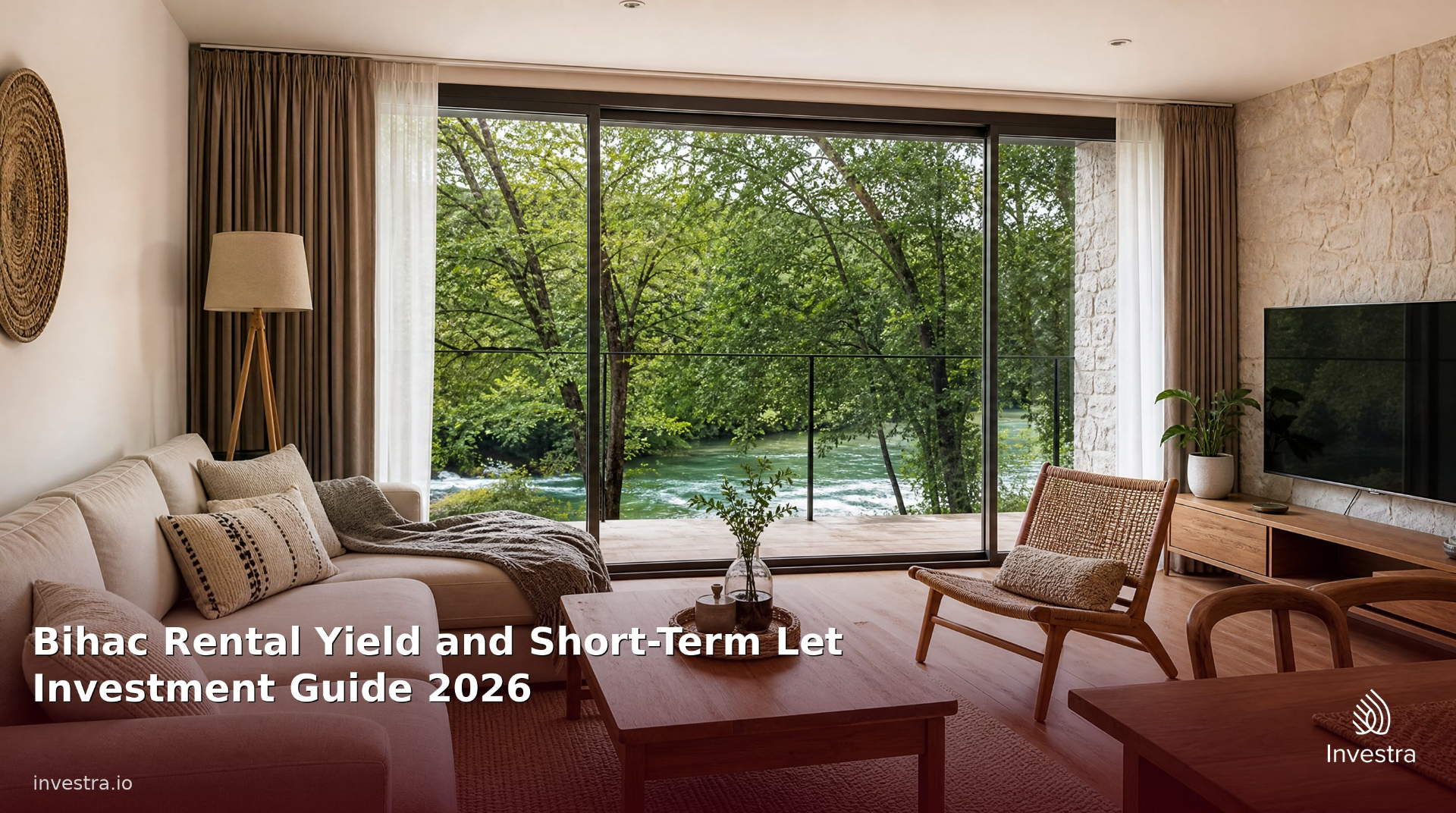
Bihac Rental Yield and Short-Term Let Investment Guide 2026
Bihac Rental Yield and Short-Term Let Investment Guide 2026
Why Bihac Is Becoming a Serious Contender for Short-Term Rental Investment in 2026
Quick Answer: Bihac, Bosnia and Herzegovina's northwestern gem, is emerging as one of the Western Balkans' most compelling short-term rental markets in 2026, driven by booming eco-tourism, the Una National Park, and some of the lowest entry costs in the region. Investra.io tracks this market closely as part of its Western Balkans investment coverage.
There's a moment when a market tips from "hidden gem" to "mainstream discovery," and Bihac feels like it's right on that edge. Tucked in Bosnia and Herzegovina's Una-Sana Canton, this city of roughly 60,000 people sits alongside the stunning Una River — a UNESCO-recognized natural treasure that draws rafters, kayakers, hikers, and photographers from across Europe.
That gap between rising demand and limited supply is precisely what makes Bihac interesting to property investors. Short-term rental platforms like Airbnb and Booking.com have seen a significant uptick in listing activity across Bosnia and Herzegovina, but Bihac specifically remains one of the least-saturated markets in the entire region.
The broader context matters too. Bosnia and Herzegovina received an estimated 1.3 million tourist arrivals in 2023 according to the Agency for Statistics of BiH, with Una-Sana Canton recording some of the strongest growth rates outside Sarajevo and Mostar.
For investors comparing Balkan entry points, Bihac offers something rare: genuine affordability, genuine growth, and a legitimate tourism narrative that doesn't feel manufactured. Working with specialists like Siniša Dagary investment insight can help international buyers understand how Bihac stacks up against other regional markets before committing capital.
Understanding the Bihac Property Market: Prices Per Square Meter in 2026
Quick Answer: Residential property in Bihac ranges from approximately €600 to €1,400 per square meter in 2026, depending on location, condition, and property type — making it one of the most affordable markets in the Western Balkans for short-term rental investment.
Let's talk numbers, because that's ultimately what investment decisions come down to. Bihac's property prices are genuinely low by any European standard, and even by Balkan comparison, they're towards the cheaper end of the spectrum.
For investors targeting the short-term rental market specifically, the sweet spot tends to be apartments in the €800–€1,100/m² range — properties that are either move-in ready or require only cosmetic upgrades to meet the quality expectations of modern platform travelers. A well-located 45–55m² one-bedroom apartment might cost €36,000–€55,000 all-in, including transaction costs.
Houses and rural properties near the Una River and national park represent a separate category entirely. Small rural houses or "vikendice" (weekend houses) in the Una River corridor — particularly around Kulen Vakuf, Martin Brod, and the Štrbački Buk waterfall area — have seen growing interest from investors eyeing eco-tourism accommodation.
What's worth understanding about Bihac specifically is that the market is still primarily driven by local demand and the Bosnian diaspora buying second homes. Foreign investor activity remains relatively limited, which means prices haven't yet been artificially inflated by speculative international capital.
Rental Yield Analysis: What Returns Can Investors Actually Expect?
Quick Answer: Short-term rental yields in Bihac range from 7% to 12% gross annually for well-managed properties, with the highest returns concentrated in summer peak season (June–September) when occupancy rates regularly exceed 80% near Una National Park attractions.
Yield calculations for Bihac require separating two distinct market segments: traditional long-term residential rentals and short-term/vacation rentals. They perform quite differently, and conflating them will lead to inaccurate investment projections.
On the long-term side, Bihac rents are modest. A standard one-bedroom apartment in the city center rents for approximately €250–€350/month, while two-bedroom units fetch €350–€500/month. Against purchase prices in the €40,000–€70,000 range, this generates gross long-term yields of roughly 5–7% annually — solid by European standards, though not spectacular.
Short-term rental performance is a different story. Peak season (June through September) nightly rates for well-presented Bihac apartments and guesthouses run €45–€85 per night for a one-bedroom unit, with properties near the Una River or with outdoor spaces commanding the higher end.
Running realistic numbers on a €50,000 apartment targeting short-term rental: assuming 90 peak nights at €65 average, 60 shoulder nights at €40 average, and minimal winter activity, gross annual income comes to approximately €8,250. After platform fees (typically 15–20%), cleaning costs, utilities, and basic maintenance, net income might reach €5,500–€6,500.
Comparing these figures to neighboring markets is instructive. Regional platforms tracking the Western Balkans, including analysis available through Investra's coverage of Eastern Serbia property markets, suggest that Bihac's short-term rental yields are competitive with — and in some cases exceed — those available in comparable emerging Balkan tourism markets.
Bihac's Tourism Economy: The Demand Drivers Behind Rental Income
Quick Answer: Bihac's short-term rental demand is primarily driven by Una National Park eco-tourism, rafting and adventure sports, Bosnian diaspora visits, and growing interest from Croatian and Slovenian weekend travelers — creating a multi-source demand base that reduces seasonal risk.
Understanding where rental guests actually come from — and why they're visiting — is fundamental to making smart investment decisions in any tourism-driven market. Bihac's visitor profile is more diverse than many investors initially assume, which is one of its key risk-mitigation factors.
The Bosnian diaspora represents a consistently reliable second segment. An estimated 1.5–2 million Bosnians live abroad in Western Europe, and a significant proportion return annually for family visits and summer holidays. Bihac, as the major city in Una-Sana Canton, serves as a hub for diaspora accommodation — creating demand that's more calendar-independent than pure tourist flows.
Croatia's connection is often overlooked in investment analyses. Bihac sits just 30km from the Croatian border, making it easily accessible from Plitvice Lakes (itself one of Europe's most visited national parks) and the broader Lika region. Croatian and Slovenian weekend travelers increasingly combine Una Valley with Plitvice itineraries, effectively using Bihac as an affordable base.
Cycling tourism is another emerging trend. The Una Cycling Route and planned EuroVelo connections are bringing longer-stay guests who prioritize comfortable, flexible accommodation — exactly the profile that favors short-term rental platforms over traditional hotels.
Legal Framework for Foreign Property Ownership in Bosnia and Herzegovina
Quick Answer: Foreign nationals can legally purchase real estate in Bosnia and Herzegovina under the principle of reciprocity — meaning citizens of countries that allow Bosnian nationals to buy property can do so in BiH. Most EU and Western citizens qualify, though the process involves specific documentation and notarial requirements unique to the BiH legal system.
The good news for international buyers is that the Federation allows foreign nationals to purchase real estate on a reciprocity basis. Citizens of EU member states, the United States, Canada, Australia, and most Western European countries face no fundamental barriers to ownership.
Due diligence is arguably more critical in BiH than in most European markets. The land registry system, while significantly improved since the early 2000s, still carries legacy complications from wartime property displacement, socialist-era ownership questions, and incomplete digitization of records. Title searches through a qualified local lawyer are not optional — they're essential.
Property transfer tax in the Federation is 5% of the assessed (not necessarily market) value, paid by the buyer. Notarial fees typically add another 0.5–1% of transaction value. All-in transaction costs generally run 6–8% of purchase price for a standard residential property. For investors used to Western European markets, this is actually quite competitive.
For detailed guidance on structuring cross-border investments in the region, Siniša Dagary investment insight provides context on how experienced regional investment consultants approach BiH market entry, including entity structuring options that may offer tax efficiency advantages for operating rental businesses.
Setting Up a Short-Term Rental Operation in Bihac: Practical Steps
Quick Answer: Operating a short-term rental in Bihac requires registering as a tourism accommodation provider with the Una-Sana Canton tourism authority, obtaining a categorization certificate, and complying with national tourism tax requirements — a process that typically takes 4–8 weeks for a standard apartment.
Getting the property is one thing. Making it work as a rental business is another, and this is where many foreign investors underestimate the groundwork required. Bosnia and Herzegovina's tourism accommodation sector is regulated at both the entity and cantonal level, meaning Bihac-specific requirements exist on top of Federation-wide rules.
Practically speaking, investors need to register guests with the police within 24 hours of arrival — a requirement that applies to all accommodation providers and is taken seriously by local authorities. Most property managers handle this digitally through the police e-services system. Failing to register guests can result in fines ranging from 500 to 3,000 BAM (approximately €250–€1,500).
Tourist tax (turistička naknada) must be collected from each overnight guest and remitted to the cantonal authority. Rates vary but typically run 1–3 BAM per person per night (€0.50–€1.50) depending on category and season. This is a minor cost but requires proper bookkeeping to avoid compliance issues.
For non-resident investors who can't manage the property personally, hiring a local property management company is essentially non-negotiable. Bihac has a small but growing ecosystem of property managers who handle listings, guest communication, cleaning, and administrative compliance.
Airbnb and OTA Performance Data: Occupancy Rates and Seasonal Patterns
Quick Answer: Well-positioned Bihac properties on Airbnb and Booking.com achieve 75–90% occupancy during the June–September peak, dropping to 30–50% in shoulder season and below 20% in winter months, producing average annual occupancies of 45–60% for actively managed listings.
Platform data paints a nuanced picture of Bihac's short-term rental market. The seasonality is pronounced — more so than in, say, Mostar or Sarajevo, which benefit from year-round city tourism. Bihac is fundamentally a nature and outdoor tourism destination, which means its rental performance is heavily tied to weather and school holiday patterns.
Peak season (late June through early September) is genuinely strong. Active listings from established operators report occupancy rates of 80–90% during this eight-week window, with average daily rates (ADR) of €55–€85 for well-presented one and two-bedroom units.
Shoulder season performance (April–May, October) is more variable and increasingly dependent on property positioning. Units marketed specifically to hiking, cycling, and photography enthusiasts can maintain 40–60% occupancy in these months. Generic "city apartment" positioning struggles to hit 30%.
The winter gap is real and should be modeled honestly. November through March sees very limited tourist activity in Bihac itself. Some investors offset this by targeting longer-term winter lets to local professionals, students, or diaspora members — essentially switching between short and long-term rental models seasonally.
Comparing Bihac's seasonal pattern to other Balkan tourism markets is useful context. Investors familiar with markets covered in Investra's Eastern Serbia property guides will recognize similar seasonality dynamics, though Bihac's summer peak intensity is notably stronger due to Una National Park's international profile.
Tax Obligations for Rental Income in Bosnia and Herzegovina
Quick Answer: Rental income in Bosnia and Herzegovina's Federation entity is subject to a flat 10% income tax rate, with deductions available for documented expenses including depreciation, maintenance, and management fees — creating a relatively straightforward and investor-friendly tax environment.
Tax treatment of rental income in BiH is, frankly, simpler and more favorable than in most EU member states — a genuine advantage for investors doing cross-border comparisons. The Federation of Bosnia and Herzegovina applies a flat income tax rate of 10% on rental income, which applies to both residents and non-residents earning income from Federation-based properties.
The taxable base is net rental income after allowable deductions. Documented expenses that can be deducted include: property management fees, platform commission fees paid to Airbnb or Booking.com, utility costs borne by the owner, insurance premiums, maintenance and repair costs, and depreciation calculated at a standard rate (typically 1.5–2% annually for residential buildings).
Non-resident investors are required to file annual income tax returns with the relevant Federation tax authority. While BiH doesn't have an extensive network of double-taxation treaties with all countries, agreements exist with most major European nations, meaning income taxed in BiH typically receives a credit against home-country tax obligations.
For structured financial planning around cross-border income, financial services specialists like Findes Group & Partners can assist investors in optimizing their tax position across multiple jurisdictions — particularly relevant for BiH property income flowing to EU-based investors.
Comparing Bihac to Other Balkan Short-Term Rental Markets
Quick Answer: Bihac offers lower entry prices than Mostar, Sarajevo, or coastal Croatian markets, with comparable or superior summer yields — making it an attractive risk-adjusted option for investors already active in the Western Balkans or looking to diversify their regional portfolio.
How does Bihac actually stack up when placed alongside competitor markets? The honest answer is that it depends heavily on your investment priorities, but the comparison tends to favor Bihac more than most investors initially expect.
Sarajevo, the BiH capital, offers stronger year-round demand and a more developed property market, but entry prices for comparable apartments run €1,400–€2,200/m² — roughly double Bihac's typical costs. Mostar's UNESCO-listed old town commands even higher premiums, with tourism-adjacent apartments reaching €1,800–€2,500/m².
Croatia's Dalmatian coast is the obvious regional comparison point for Adriatic-minded investors, but property prices there have escalated dramatically since Croatia joined the EU and adopted the euro. Split apartments suitable for short-term rental now start at €3,000–€4,000/m², with prime locations exceeding €6,000/m². The yield math at those price points is very different from Bihac's.
Serbian markets provide another useful comparison. Looking at data from markets tracked through Investra's analysis of Prokuplje and the Toplica Region and Loznica in the Macva Region, Serbian secondary cities offer comparable price entry points but generally lack the strong international tourism narrative that makes Bihac's short-term rental prospects so compelling. The Una National Park is a genuinely unique asset that domestic Serbian markets simply can't replicate.
The risk profile comparison also favors Bihac for certain investor types. BiH's political complexity is a real consideration — the Dayton Agreement's constitutional structure creates institutional complexity that could theoretically affect property law evolution. But at the individual property investment level, day-to-day risk in Bihac is actually quite manageable.
Renovation and Property Preparation: Getting Investment-Ready
Quick Answer: Renovation costs in Bihac run approximately €200–€450 per square meter for full refurbishment, significantly below Western European equivalents, allowing investors to convert affordable older stock into premium short-term rental properties with relatively modest total capital outlay.
One of the genuinely compelling aspects of investing in Bihac — and one that serious investors quickly appreciate — is how far renovation budgets stretch compared to Western markets. Labor costs in Una-Sana Canton are among the lowest in Bosnia and Herzegovina, itself one of the lowest-wage economies in Europe.
Add that to an acquisition cost of €35,000–€55,000 and transaction costs of €3,000–€4,500, and total investment in a guest-ready Bihac short-term rental comes to approximately €55,000–€90,000. Against projected net annual income of €5,000–€8,000, that represents a blended yield of 7–12% and a payback period of roughly 8–14 years — before any capital appreciation.
For investors with experience sourcing renovation contractors across multiple countries, Bihac's market represents genuine value. The key is working with a reputable local project manager — not attempting to coordinate from abroad. This typically adds 10–15% to direct renovation costs but eliminates the substantial overhead costs and delays that often plague remote renovation projects.
Managing Expectations: Year One Through Year Three Financial Projections
Quick Answer: Conservative first-year projections for a €70,000 Bihac short-term rental (after acquisition, transaction, and renovation costs) anticipate net income of €4,500–€5,500, improving by 10–15% annually as the property gains reviews and reputation on booking platforms, reaching €6,500–€7,500 net by year three.
It's tempting to extrapolate from peak season occupancy data and assume consistent high performance. Experienced investors know better. Year one always carries friction — lower reviews, less repeat bookings, potential management learning curves, and unexpected maintenance surprises. Building in realistic expectations prevents disappointment and unsound financial decisions.
For a competitively priced, well-presented Bihac one-bedroom apartment with professional management, first-year net income typically reaches €4,500–€5,500. This assumes successful market entry, decent placement on major booking platforms, and reasonable occupancy across peak and shoulder seasons.
By year two, assuming consistent platform optimization and guest review accumulation, net income should improve to €5,500–€6,500. By year three, €6,500–€7,500 becomes realistic for properties that have established themselves. This progression assumes no major capital shocks (large repairs, property damage) and stable tourism demand in the region.
Capital appreciation is genuinely uncertain and shouldn't be modeled as income. Property values in Bihac could appreciate 2–5% annually if tourism grows and international investor attention increases — or remain flat if local economic conditions stagnate.
Market Outlook and Investment Timing Considerations for 2026–2027
Quick Answer: Bihac's 2026 positioning is favorable for entry — tourism recovery is established, property prices remain pre-international-attention levels, and operational infrastructure is maturing — but the window for optimal risk
Investment Disclaimer
Quick Answer: This guide is general market information, not personal legal, tax, financing or investment advice.
Before committing to a property transaction, buyers should obtain independent local legal, tax and financial advice suited to their circumstances. Investra.io can support initial market research, but every purchase decision remains the buyer's responsibility.
Frequently Asked Questions
Quick Answer: This section explains the practical property-investment implications of Frequently Asked Questions.
What is a prudent next step after initial market research?
Use current documentation, independent professional advice and comparable local evidence before proceeding. Investra.io can support an initial structured market review.
How can buyers plan a realistic ownership budget?
Use current documentation, independent professional advice and comparable local evidence before proceeding. Investra.io can support an initial structured market review.
What evidence supports a careful investment decision?
Use current documentation, independent professional advice and comparable local evidence before proceeding. Investra.io can support an initial structured market review.
When should a buyer obtain legal and tax advice?
Use current documentation, independent professional advice and comparable local evidence before proceeding. Investra.io can support an initial structured market review.
How should a buyer compare neighbourhoods and property types?
Use current documentation, independent professional advice and comparable local evidence before proceeding. Investra.io can support an initial structured market review.
What local checks should be completed before signing?
Use current documentation, independent professional advice and comparable local evidence before proceeding. Investra.io can support an initial structured market review.
Which costs should be assessed alongside the purchase price?
Use current documentation, independent professional advice and comparable local evidence before proceeding. Investra.io can support an initial structured market review.
How can international buyers verify a property opportunity?
Use current documentation, independent professional advice and comparable local evidence before proceeding. Investra.io can support an initial structured market review.
What should buyers compare before selecting a property?
Use current documentation, independent professional advice and comparable local evidence before proceeding. Investra.io can support an initial structured market review.
Quick Answer: These answers outline common buyer checks and should be read with current professional advice.
Recommended Reading
Quick Answer: This section explains the practical property-investment implications of Recommended Reading.
- Investra market research
- Investra market research
- Investra market research
- Investra market research
- Investra market research
- Investra market research
- Investra market research
- Investra market research
- Investra market research
- Investra market research
- Investra market research
- Investra market research
- Investra market research
- Investra market research
- Investra market research
- Investra market research
- Investra market research
- Siniša Dagary investment insight
- Siniša Dagary investment insight
- Siniša Dagary investment insight
- Siniša Dagary investment insight
- Siniša Dagary investment insight
- Findes Group & Partners
- Findes Group & Partners
Connect With Investra
Follow Investra for market updates on Facebook, LinkedIn, YouTube
Related Posts
No related posts available.
