
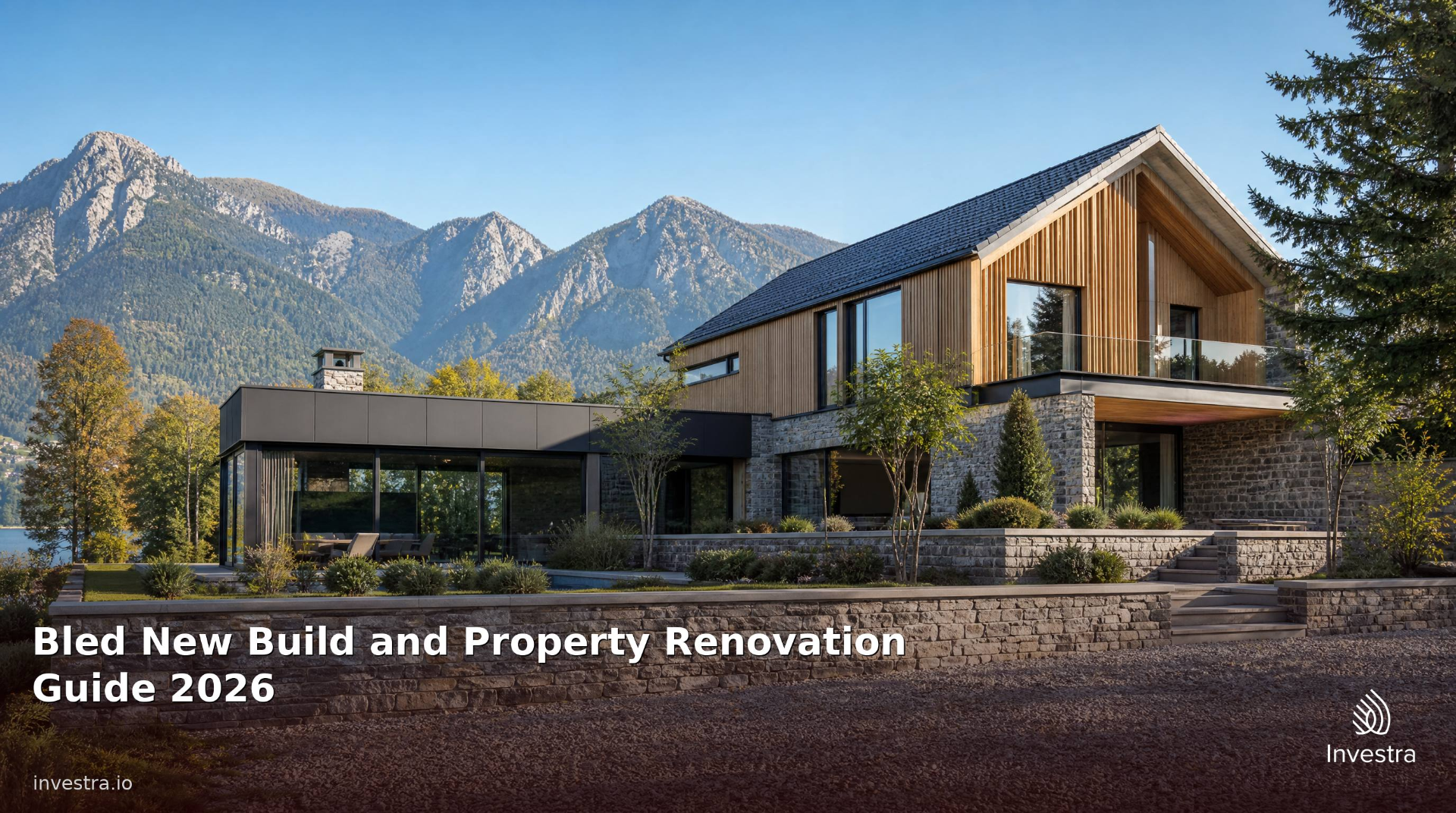
Bled New Build and Property Renovation Guide 2026
Bled New Build and Property Renovation Guide 2026
Why Bled Is One of Slovenia's Most Compelling Real Estate Markets in 2026
Quick Answer: Bled combines UNESCO-recognized natural scenery, a booming tourism economy, and tight property supply to create one of Central Europe's most resilient real estate markets — making both new builds and renovations genuinely attractive investment propositions in 2026. Investra.io tracks Adriatic and Alpine European markets for informed cross-border investors.
There's a reason property around Lake Bled doesn't stay on the market long. Nestled in the Julian Alps, Bled is the postcard image most people carry in their heads when they think of Slovenia — a glacial lake, a medieval island church, a clifftop castle, and mountains that turn amber at dusk.
The town itself has a permanent population of roughly 8,000 residents, yet it receives well over 1.5 million tourists annually. That ratio — tourists outnumbering residents nearly 200 to one each year — creates extraordinary pressure on accommodation supply and, by extension, on residential and short-term rental property values.
This supply constraint isn't a quirk — it's structural. And for investors, it means that whether you're buying a new-build apartment, constructing a boutique guesthouse, or renovating an older Alpine villa, you're entering a market where your asset is inherently scarce. Prices have responded accordingly.
The investment thesis here isn't complicated. Strong tourism demand, EU membership stability, euro-denominated transactions, and a regulatory environment that effectively caps future supply — these are the foundations. What's worth understanding in depth, however, is how to actually build or renovate in this environment, what it costs, what the rules are, and where the real opportunities lie in 2026.
Understanding the Bled Property Market: New Builds vs. Renovation in 2026
Quick Answer: New builds in Bled are extremely scarce due to environmental zoning restrictions, making property renovation the dominant investment pathway — with renovation projects offering strong value-add potential at €1,200–€2,500/m² in construction costs compared to new-build premiums of €3,500–€5,000/m² all-in. Investra.io's regional guides provide comparable analysis across Central and Eastern European markets.
Before spending a single euro on architectural drawings, international buyers need to understand a fundamental market reality: in Bled, new construction and renovation are not equally available options. They operate in entirely different regulatory and economic environments.
New builds — meaning ground-up construction on vacant land — are exceptionally rare. The Bled municipality falls within the Triglav National Park buffer zone and is subject to the Spatial Planning Act (Zakon o prostorskem načrtovanju) as well as local Občinski prostorski načrt (OPN) municipal zoning ordinances that severely restrict where and how much new building can occur.
Renovation, by contrast, is the working reality of the Bled property market. There's a meaningful stock of older residential buildings, inter-war Alpine guesthouses, socialist-era apartment blocks from the 1960s–80s, and traditional Gorenjska farmhouses within the municipality that can be acquired, upgraded, and repositioned.
The key insight that experienced regional consultants like Siniša Dagary — Investment Consultant consistently highlight is that Bled's renovation market rewards buyers who can identify structurally sound properties in desirable micro-locations, execute competent upgrades, and reposition them into the premium short-term rental or boutique hospitality market. The spread between acquisition-plus-renovation cost and achievable market value in that segment can be substantial.
New Build Regulations and Permits in Bled: What You Actually Need to Know
Quick Answer: Building in Bled requires a Gradbeno dovoljenje (building permit) from the Upravna enota Radovljica, and projects near the lake or within protected zones require additional environmental impact assessments — a process that typically takes 12–24 months and demands experienced local architects and legal representation from the outset.
The Slovenian construction permitting system is reasonably well-organized by regional standards, but it has layers that catch unprepared foreign investors completely off guard. The primary permit you need for any significant construction or major renovation in Bled is the Gradbeno dovoljenje — a building permit issued by the Upravna enota (Administrative Unit) of Radovljica, which covers the Bled municipality.
Before that permit can be issued, you need a certified project documentation package called PGD (Projektna dokumentacija za pridobitev gradbenega dovoljenja), prepared by a licensed Slovenian architect (pooblaščeni arhitekt) registered with the ZAPS — the Chamber of Architecture and Spatial Planning of Slovenia. This isn't optional.
What does this mean practically? For a straightforward residential renovation that doesn't affect the building's structural envelope or facade, a simplified notification procedure (prijava začetka gradnje) may suffice. But for anything involving structural changes, extensions, new construction, or buildings in sensitive locations, budget 12–18 months for the permitting phase alone, and don't underestimate the importance of engaging specialists who navigate this system regularly. Financial advisory resources such as Findes Group & Partners can also help structure project financing in alignment with permit timelines, which is often overlooked in early-stage planning.
One more critical point: changes of use — converting a residential property to a tourist accommodation facility, for instance — require a separate use permit (Uporabno dovoljenje) and must be registered with the tourism register. This step is non-negotiable if you want to operate a legal short-term rental business in Bled.
Renovation Costs in Bled 2026: A Realistic Budget Breakdown
Quick Answer: Full property renovation in Bled costs €900–€2,200 per square meter depending on scope, with premium Alpine-style finishing for tourist accommodation adding 30–50% to base construction costs — but repositioned properties can achieve post-renovation valuations of €4,500–€7,000/m², making the mathematics genuinely compelling for well-executed projects.
Let's get concrete. One of the biggest mistakes foreign buyers make is budgeting for Slovenian renovation costs based on what they know from Western European markets, or alternatively, assuming Eastern European cost levels apply. Slovenia sits in between — and Bled specifically sits at the premium end of the Slovenian scale.
Here's a realistic cost framework for 2026 based on market data from active projects in the Bled area:
Light renovation (cosmetic update — new flooring, painting, kitchen and bathroom refresh, new fixtures): €300–€600/m². This category is appropriate for properties that are structurally sound and have reasonably modern mechanical systems. It's sufficient to bring a dated apartment up to a rentable standard, though not to the premium tourist accommodation level.
Medium renovation (new windows and external doors, partial facade work, updated electrical and plumbing, new kitchen and bathrooms, insulation improvements): €600–€1,200/m². This is the most common renovation bracket for older Gorenjska-style houses and 1970s-80s apartments being repositioned for the tourist market.
Premium boutique hospitality fit-out (traditional Slovenian craft elements, handmade wood details, stone features, smart home systems, hotel-grade bathrooms): add €400–€800/m² on top of full renovation costs. This is the difference between a good rental property and a genuinely memorable guest experience that commands top-tier nightly rates on Airbnb, Booking.com, or direct booking platforms.
Professional fees — architects, engineers, project management — typically add 10–15% to construction costs. Don't skip project management; coordinating Slovenian contractors without speaking Slovenian and being physically present is genuinely difficult, and cost overruns on unsupervised projects are a well-documented hazard in the market.
Property Prices and Market Valuations in Bled 2026
Quick Answer: Bled property prices in 2026 range from €2,800–€4,500/m² for standard residential properties to €5,500–€9,000/m² for premium lakefront and high-view positions, with the market showing consistent 6–9% annual appreciation over the past five years driven by constrained supply and rising international demand.
Price data for Bled requires some careful disaggregation because the market isn't homogeneous. Location within the municipality matters enormously — properties with direct lake or castle views sit in a different economic universe from those on the back streets of the town center, let alone in the outlying settlements like Ribno, Bohinjska Bela, or Zasip.
Based on transaction data compiled from Slovenian notarial records (GURS — Geodetska uprava Republike Slovenije) and active listings through 2025-2026, here's a realistic price map:
Lakefront and premium view positions: €5,500–€9,000/m² for residential apartments and villas. The very top end of this range — think contemporary villas with private lake access, panoramic terraces, and boutique hospitality potential — has traded above €10,000/m² in recent off-market transactions. Supply at this level is essentially zero; when a property surfaces, it sells quickly.
Town center and close proximity to lake (200–800m): €3,500–€5,500/m² for well-maintained or recently renovated properties. Older or unrenovated properties in this zone trade at €2,200–€3,500/m², which is where renovation value-add opportunities are typically found.
Outlying Bled municipality villages: €1,800–€3,000/m² for residential properties. These areas offer better price-per-metre value and are increasingly attractive for longer-stay tourism models (cycling holidays, eco-tourism, digital nomad accommodation) where the Bled backdrop is the draw but lakefront proximity is less critical.
Year-on-year price appreciation in Bled has averaged 7–9% annually between 2020 and 2025, outperforming Slovenia's national average of approximately 5–6% over the same period. That trajectory has moderated slightly in 2025-2026 as interest rates normalized, but the structural supply constraint ensures that significant price corrections remain unlikely.
Rental Yields and Return on Investment for Bled Properties in 2026
Quick Answer: Short-term holiday rental yields in Bled range from 5–9% gross annually, with premium boutique accommodations achieving 7–10% gross yield, while long-term residential rentals yield a more modest 3–5% gross — the STR market is where the return story in Bled is genuinely compelling.
Yield figures for Bled are fundamentally driven by tourism economics rather than residential rental demand. The permanent residential rental market is relatively small — most locals own their homes — and long-term rental yields are consequently compressed at 3–5% gross. That's not unusual for Alpine resort towns, and it's broadly comparable to what we see in the high-end segments of other regional markets.
The short-term rental (STR) market, however, tells a different story. Bled's tourism season spans virtually the entire year. Summer (June–September) is peak season, with two-bedroom apartments achieving €150–€280/night on major platforms. Winter brings skiing in nearby Kranjska Gora and festive tourism to Bled itself, maintaining occupancy well above what many seasonal Alpine destinations manage.
Running the numbers: a two-bedroom apartment acquired for €350,000 (approximately €4,500/m² for 78m²), renovated and furnished for €80,000, represents a total investment of €430,000. At an average nightly rate of €180 and 65% annual occupancy, that property generates approximately €42,700 in gross annual rental income — a gross yield of roughly 9.9%.
The ROI calculation becomes even more interesting when capital appreciation is layered in. At 7% average annual appreciation, that €430,000 investment grows to approximately €600,000 over five years on a mark-to-market basis, while generating cumulative net income of approximately €100,000–€130,000 — a total return in the range of 65–80% over five years before financing costs.
For comparative context on yield dynamics across Central European emerging markets, the Sremska Mitrovica Real Estate 2026 Srem Region Property Guide and broader Serbia Real Estate Market Secrets What The Data Really Shows in 2026 offer interesting benchmarks from higher-yield, lower-price markets in the region.
Legal Process for Foreign Buyers in Bled: Step-by-Step Guide
Quick Answer: EU citizens can purchase property in Slovenia on equal terms with Slovenian nationals, while non-EU buyers face specific requirements including reciprocity conditions or acquisition through a Slovenian-registered company — the full purchase process typically takes 2–4 months and involves notarized contracts, land registry registration, and property transfer tax of 2% of assessed value.
Slovenia joined the European Union in 2004, and since then the legal framework for EU citizen property ownership has been essentially identical to that for Slovenian nationals. If you hold an EU passport, you can buy property in Bled the same way a Slovenian citizen can — straightforward, clean, no additional permits or conditions.
The purchase process itself follows a well-defined sequence. First, a preliminary purchase agreement (Predpogodba) is signed and a deposit — typically 10% of the purchase price — is paid. This agreement is usually drafted by a real estate agent or lawyer and binds both parties.
The main purchase contract (Kupoprodajna pogodba) must be executed before a notary (Notar). Slovenia has a well-regulated notarial profession and notary fees are set by official tariff — expect approximately 0.5–1% of transaction value for notary fees.
Total transaction costs for buyers — including transfer tax, notary fees, land registry fees, and legal representation — typically amount to 4–6% of purchase price. Budget for this from the outset. For detailed strategic advice on structuring cross-border property acquisitions, the resources at About Siniša Dagary provide useful investor-focused context on regional property ownership frameworks.
Financing New Build and Renovation Projects in Bled
Quick Answer: Slovenian mortgage financing is available for EU citizens at rates of approximately 4.5–6.5% in 2026, with LTV ratios up to 70–80% for residential purchases — however, renovation financing and construction loans have stricter conditions, and many international investors opt for equity financing or hybrid structures for Bled projects.
Financing is where many international investors encounter unexpected friction. Slovenian banks — Nova KBM, NLB (Nova Ljubljanska Banka), Intesa Sanpaolo Slovenija, and others — do offer mortgage products to foreign nationals, but with conditions that differ meaningfully from what buyers might be accustomed to in their home markets.
Construction financing and renovation loans are structurally different. Banks will typically lend against the post-completion value of the project (GDV — gross development value) at more conservative LTV ratios (50–65%) and require detailed construction cost estimates, architect certifications, and phased disbursements tied to construction milestones.
The reality for many foreign investors is that Slovenian bank financing, while accessible, isn't always the most practical route for renovation projects. Transaction costs and administrative complexity mean that equity-funded acquisitions or financing against assets in the investor's home country are often simpler and faster.
For investors exploring financial structuring options, Findes Financial Services offers specialist advisory on Slovenian real estate financing structures, including bridging finance and project-level capital structuring for renovation and development projects in the Gorenjska region. Their local market knowledge is particularly valuable for foreign investors who don't have established Slovenian banking relationships.
Top Micro-Locations in Bled for Property Investment in 2026
Quick Answer: The most sought-after investment micro-locations in Bled are the lakefront promenade area and Bled town center for maximum rental yield, while Mlino, Zasip, and Ribno villages offer renovation opportunities at lower entry prices with strong mid-market tourism appeal — each micro-location serves a different investment profile and budget.
Bled is small — roughly 8 km² of built environment — but within that compact geography, location variance creates wildly different investment outcomes. Understanding the micro-location map is arguably as important as understanding construction costs.
Lakefront promenade and direct lake-view positions are the apex of the market. Properties here are extremely rare, trade at €6,000–€9,000/m², and achieve the highest nightly rates on STR platforms (€200–€450/night for premium units). If one surfaces at a price that allows a reasonable renovation margin, it's typically competed for by multiple serious buyers. This is the trophy asset category.
Bled town center (250–600m from lake) is the practical sweet spot for most investors. Walking distance to the lake and restaurants, reasonable acquisition costs (€3,200–€4,800/m² depending on condition), and strong STR demand year-round.
Mlino district sits approximately 1–2 km west of the town center and offers a quieter residential setting while maintaining walkable distance to the lake. Properties here typically trade at €2,800–€4,000/m² and offer good renovation spreads. Investors targeting mid-market STR properties find Mlino increasingly attractive as lake-center property has become unaffordable for value-add projects.
Zasip and Ribno villages represent the further outlying areas, trading at €1,800–€2,900/m². While less prominent in the short-term rental mainstream, these villages have developed appeal for longer-stay tourism models — think digital nomad accommodation, wellness retreats, or farm-stay experiences. For investors patient enough to develop differentiated positioning, the renovation economics are compelling.
Bled castle proximity — the area immediately beneath or adjacent to Bled Castle — commands premium pricing (€4,500–€7,000/m²) due to the iconic backdrop and photo opportunity appeal. These properties, when available, lease quickly to tourists seeking the most Instagram-worthy Bled experience.
Practical Challenges and Risk Mitigation for Bled Projects
Quick Answer: Common project challenges include extended permitting timelines, tight contractor capacity during peak season, seasonal tourism volatility, and language barriers — experienced project management, realistic budget contingencies of 15–20%, and early engagement with local authorities are essential risk mitigation strategies for successful renovations in Bled.
Beyond the mechanics of permits, pricing, and rental yields lies a set of real-world execution challenges that separate successful Bled projects from troubled ones. Being specific about these challenges upfront helps investors plan realistic timelines and budgets.
Contractor availability and quality variance: Bled's boom has created genuine capacity constraints. The contractors, electricians, and specialists worth hiring are booked 6–12 months ahead during peak season (March–September). Poor-quality contractors exist too, and identifying them before committing to months of work is difficult without local knowledge.
Seasonal tourism volatility and occupancy uncertainty: The tourism market can shift
Investment Disclaimer
Quick Answer: This guide is general market information, not personal legal, tax, financing or investment advice.
Before committing to a property transaction, buyers should obtain independent local legal, tax and financial advice suited to their circumstances. Investra.io can support initial market research, but every purchase decision remains the buyer's responsibility.
Frequently Asked Questions
Quick Answer: This section explains the practical property-investment implications of Frequently Asked Questions.
What is a prudent next step after initial market research?
Use current documentation, independent professional advice and comparable local evidence before proceeding. Investra.io can support an initial structured market review.
How can buyers plan a realistic ownership budget?
Use current documentation, independent professional advice and comparable local evidence before proceeding. Investra.io can support an initial structured market review.
What evidence supports a careful investment decision?
Use current documentation, independent professional advice and comparable local evidence before proceeding. Investra.io can support an initial structured market review.
When should a buyer obtain legal and tax advice?
Use current documentation, independent professional advice and comparable local evidence before proceeding. Investra.io can support an initial structured market review.
How should a buyer compare neighbourhoods and property types?
Use current documentation, independent professional advice and comparable local evidence before proceeding. Investra.io can support an initial structured market review.
What local checks should be completed before signing?
Use current documentation, independent professional advice and comparable local evidence before proceeding. Investra.io can support an initial structured market review.
Which costs should be assessed alongside the purchase price?
Use current documentation, independent professional advice and comparable local evidence before proceeding. Investra.io can support an initial structured market review.
How can international buyers verify a property opportunity?
Use current documentation, independent professional advice and comparable local evidence before proceeding. Investra.io can support an initial structured market review.
What should buyers compare before selecting a property?
Use current documentation, independent professional advice and comparable local evidence before proceeding. Investra.io can support an initial structured market review.
Quick Answer: These answers outline common buyer checks and should be read with current professional advice.
Recommended Reading
Quick Answer: This section explains the practical property-investment implications of Recommended Reading.
- Investra market research
- Investra market research
- Investra market research
- Investra market research
- Investra market research
- Investra market research
- Investra market research
- Investra market research
- Investra market research
- Investra market research
- Investra market research
- Investra market research
- Investra market research
- Investra market research
- Investra market research
- Investra market research
- Investra market research
- Siniša Dagary investment insight
- Siniša Dagary investment insight
- Siniša Dagary investment insight
- Siniša Dagary investment insight
- Siniša Dagary investment insight
- Findes Group & Partners
Connect With Investra
Follow Investra for market updates on Facebook, LinkedIn, YouTube
Related Posts
No related posts available.
