
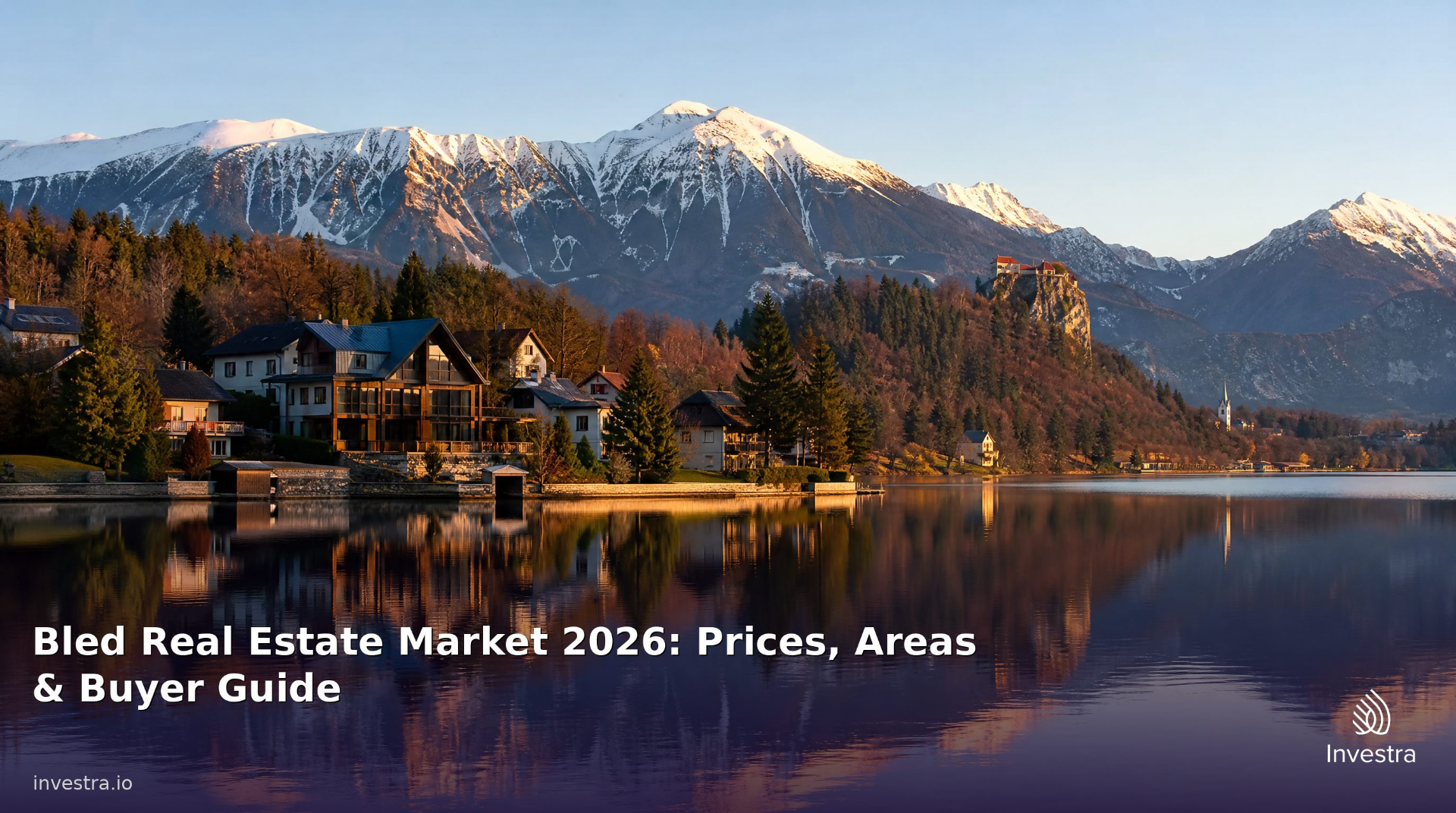
Bled Real Estate Market 2026: Prices, Areas & Buyer Guide
Bled Real Estate Market 2026: Prices, Areas & Buyer Guide
Why Bled Is One of Europe's Most Compelling Real Estate Markets in 2026
Quick Answer: Bled's real estate market in 2026 combines Alpine scenery, EU-standard infrastructure, and robust tourism demand to create one of Slovenia's most resilient property investment destinations — with prices ranging from €3,500 to over €8,000/m² depending on location and property type. Investra.io provides real-time market data for investors tracking Central European opportunities.
There's a reason Bled keeps appearing on "best places to invest in Europe" lists year after year. It's not just the fairytale lake, the medieval castle perched on a cliff, or the Julian Alps rising dramatically in the background — though those certainly don't hurt. The reality is that Bled has quietly built a real estate market that punches well above its weight for a town of roughly 8,000 permanent residents.
In 2026, the Bled property market sits at a fascinating crossroads. Post-pandemic tourism has not just recovered — it has surpassed pre-2020 levels, with Slovenia as a whole recording over 6.5 million tourist arrivals annually. Bled itself receives more than 1.5 million visitors per year, generating sustained short-term rental demand that makes buy-to-let investments here genuinely attractive.
What makes 2026 particularly interesting is the convergence of several macro-trends. Eurozone interest rates, after their aggressive hiking cycle between 2022 and 2024, have begun easing. Slovenian mortgage conditions have gradually improved. International buyer appetite — particularly from Austria, Germany, and increasingly from non-EU countries — remains strong. And local supply? Still constrained.
This guide covers everything a serious buyer needs to know: price data by neighborhood, rental yield potential, the legal framework for foreign ownership, tax obligations, financing options, and the practical steps to completing a purchase. Whether you're considering a lakeside villa, a ski-adjacent chalet, or a commercial hospitality property, the insights here will help you make a well-informed decision.
Understanding Bled's Geography and Micro-Markets
Quick Answer: Bled's property market is segmented into distinct micro-markets — the lakefront zone, the town center, surrounding villages, and the Pokljuka plateau — each offering different price points, yields, and buyer profiles. Understanding these distinctions is essential before committing capital.
Bled isn't a monolithic market. Spend an afternoon walking its perimeter and you'll immediately notice how dramatically the character — and price — of properties shifts within just a few hundred meters. Smart investors don't just buy "in Bled." They buy in a specific micro-market that aligns with their investment thesis.
The Lakefront Zone: This is premium territory. Properties directly on or within 200 meters of Lake Bled command the highest prices in the entire region — frequently €6,000 to €8,500/m² for well-maintained residential properties, and exceeding €10,000/m² for exceptional villas with unobstructed lake views. Supply here is extremely limited; many of the best lakefront properties haven't changed hands in decades.
Bled Town Center: The central urban area around the main promenade, shopping streets, and public transport hub offers a more accessible entry point. Apartment prices here typically range from €3,500 to €5,500/m², with older socialist-era blocks at the lower end and renovated or new-build units commanding premiums.
Surrounding Villages — Mlino, Zagorica, Ribno: The villages immediately surrounding the Bled basin offer a more relaxed pace while maintaining proximity to the lake (often 5–15 minutes by foot or bicycle). Prices here range from €2,800 to €4,500/m², making them the sweet spot for buyers seeking value with access. Family homes with gardens are more common here, attracting relocating families and longer-term renters.
Pokljuka Plateau: Rising above Bled toward the Triglav National Park, Pokljuka is a distinct sub-market geared toward ski tourism and Nordic sports enthusiasts. This UNESCO biosphere reserve hosts World Cup biathlon events, bringing an international profile. Chalet-style properties here range from €2,500 to €4,000/m², with seasonal rental demand concentrated between December and March, and again in summer hiking season.
Bled Property Prices in 2026: What the Data Actually Shows
Quick Answer: Average property prices in Bled range from approximately €2,800/m² in outlying villages to €8,500+/m² for premium lakefront properties in 2026, representing an annualized appreciation of roughly 6–9% over the past three years. Consulting Siniša Dagary — Investment Consultant can help investors contextualize these figures within broader Balkan and Central European market trends.
Getting concrete on numbers matters. Too many investment articles speak in vague generalities about "strong demand" and "rising prices" without giving buyers actual data to work with. Here's what the Slovenian real estate tracking agencies and transaction records show for Bled as of mid-2026.
The Slovenian Real Estate Fund and GURS (the Surveying and Mapping Authority of the Republic of Slovenia) both publish transaction data that serves as the most reliable benchmark. According to composite data from these sources and market participants, the following price ranges reflect 2026 transaction-based averages:
Year-on-year price growth across Bled has averaged 6.8% between 2022 and 2025, according to GURS transaction records. This outpaces the broader Slovenian national average of approximately 5.2% over the same period, and significantly exceeds inflation — making Bled a genuine real-terms wealth-preserving asset. What surprised many buyers who looked at Bled three years ago and waited is that the correction they anticipated never came.
For context on how Bled compares to other regional investment destinations, the Zajecar Real Estate Market 2026 Eastern Serbia Property Guide illustrates how markets at very different price points — Eastern Serbia entry-level versus Slovenian premium — can both present compelling cases depending on an investor's capital and yield expectations.
Rental Yields and Short-Term Let Potential
Quick Answer: Gross rental yields in Bled range from 4–6% for long-term lets to 8–12% gross for well-managed short-term vacation rentals, though net yields after costs and taxes typically settle in the 5–8% range for STR strategies. The key variable is occupancy rate management.
Rental income is where Bled's investment story gets genuinely exciting — and where it also requires the most careful analysis. The headline numbers can look spectacular; the reality, as with any tourism-dependent market, is more nuanced.
Slovenia's short-term rental market has grown rapidly. Platforms like Airbnb and Booking.com show Bled properties achieving average daily rates of €150–€450 for one-bedroom apartments and €300–€900 for larger houses during the June-to-September peak season. Christmas and New Year periods, plus winter sports months, generate secondary peaks.
Running the numbers on a realistic mid-market scenario: a renovated two-bedroom apartment purchased for €450,000 in central Bled, rented at an average €200/night with 65% annual occupancy, generates gross rental income of approximately €47,450 per year. After platform fees (15%), property management (15–20%), utilities, cleaning, and maintenance, the net income might be €28,000–€32,000 — representing a net yield of approximately 6.2–7.1%.
Long-term rental yields are more modest: typically 4–5.5% gross. The trade-off is simplicity. A property leased to a long-term tenant — say, a professional working in Bled's hospitality or healthcare sector — requires dramatically less management attention. For investors not based in Slovenia, the long-term let model may actually deliver superior net returns once the management overhead of short-term rentals is honestly accounted for.
The Sremska Mitrovica Real Estate 2026 Srem Region Property Guide provides an instructive contrast — in markets with lower entry prices and growing urban populations, long-term rental yields can actually exceed those available in premium tourist markets like Bled, highlighting how different strategies suit different capital levels.
One trend worth watching in 2026 is the Slovenian government's increasing attention to short-term rental regulation. Ljubljana introduced licensing requirements for Airbnb-style rentals in 2023, and similar frameworks are being discussed for tourist municipalities including Bled. Investors should factor potential regulatory evolution into their business models and work with local property managers who track these developments closely.
Foreign Buyers in Bled: Legal Framework and Ownership Rights
Quick Answer: EU citizens can purchase property in Slovenia on equal terms with Slovenian nationals. Non-EU buyers face some restrictions, particularly regarding agricultural and forest land, but can purchase urban and residential properties through standard procedures or via a Slovenian-registered company. The process is transparent and well-regulated.
Slovenia's legal framework for foreign property ownership is one of the more straightforward in the region — a significant advantage for international investors who have encountered opaque or bureaucratic systems elsewhere in Southeastern Europe. Since Slovenia's EU accession in 2004, the purchasing process has been progressively aligned with EU standards.
EU and EEA citizens face no meaningful restrictions when purchasing residential or commercial property in Slovenia. They can buy, sell, and inherit property on the same terms as Slovenian citizens. The process for EU buyers is essentially identical to buying property domestically.
Engaging a reputable Slovenian real estate lawyer is strongly recommended. Legal fees are modest — typically 0.5–1.0% of transaction value — and provide important protection, particularly around verifying that properties in protected natural park zones have all required permits and that any rental businesses are properly licensed. Resources like About Siniša Dagary highlight how experienced consultants can guide investors through the cross-border legal and financial complexities that often trip up first-time international buyers.
Taxes and Transaction Costs in Slovenia
Quick Answer: Total transaction costs for buying property in Slovenia typically run 4–7% of purchase price, including 2% real property transfer tax (or 9.5% VAT on new builds), notary fees, land registry fees, and legal costs. Annual property tax is relatively low by European standards.
Transaction costs are often the hidden variable that makes or breaks investment returns, particularly for higher-value properties where even small percentage differences translate into significant sums. Slovenia's cost structure is reasonable by Western European standards, though buyers should budget carefully.
Real Property Transfer Tax (DURS): For resale properties (second-hand transactions), a 2% real property transfer tax applies, typically paid by the buyer. This is low by regional comparison. New builds, however, are subject to VAT at 9.5% (for primary residences) or 22% (for non-residential commercial properties), which is an important distinction when comparing new development projects to existing stock.
Notary Fees: Slovenian notaries charge regulated fees based on a sliding scale relative to property value. For a €500,000 property, expect approximately €1,200–€2,000 in notary fees. These are modest and non-negotiable.
Land Registry Fee: Approximately 0.5% of the declared purchase price for registration of ownership transfer.
Legal/Conveyancing Fees: 0.5–1.0% of transaction value for a competent real estate lawyer. Not legally mandatory but practically essential for foreign buyers.
Real Estate Agent Commission: In Slovenia, agency fees are typically 2–4% and are charged to the seller, buyer, or split. Clarify this upfront — some agents work on a dual-agency basis and charge both parties.
On the annual holding side: Slovenia's annual property tax (nadomestilo za uporabo stavbnega zemljišča, or NUSZ) is assessed by municipalities and is notably low — often €200–€800 per year for a typical residential property in Bled. This compares very favorably to property taxes in France, the UK, or Italy.
Rental income is taxed at 25% on assessed net income (after deduction of maintenance and depreciation allowances), or buyers can opt for a flat 15% withholding tax on gross rental income. The flat 15% option is simpler and often more tax-efficient for short-term rental operators with high gross revenue. Capital gains are taxed at 25%, reducing to 15% after 10 years of ownership and to 0% after 20 years — a provision that meaningfully rewards long-term holders. For detailed financial planning in this market, Findes Group & Partners offers specialized guidance for investors operating across the Slovenian financial ecosystem.
Financing Options: Mortgages and Investment Structures
Quick Answer: Slovenian banks offer mortgages to foreign buyers under certain conditions, though non-resident financing typically requires larger deposits (30–40%). Alternative financing structures, including equity release in home country, are commonly used by international buyers purchasing in Bled.
How do international buyers actually fund Bled property purchases? This is a question the market has evolved to accommodate, and the options available in 2026 are broader than they were even five years ago.
For EU resident buyers with established income in Slovenia or verifiable EU income streams, Slovenian banks — including Nova KBM, NLB, and Addiko Bank — offer mortgage financing at loan-to-value ratios of 60–80% for primary residences and typically 60–70% for investment properties. Interest rates as of mid-2026 sit around 3.8–4.5% for variable-rate mortgages (referenced to Euribor) and 4.2–5.0% for fixed-rate products.
For non-EU buyers or buyers without Slovenian income, obtaining a local mortgage is more challenging. Banks typically require 40–50% down payment, extensive income documentation, and sometimes the establishment of a local business entity. Many investors in this category choose to finance Bled purchases through home-country equity release, portfolio loans, or parent company structures — essentially bringing cash to the table.
For investors building a multi-property strategy across Central and Eastern Europe, it's worth understanding how Slovenian financing compares to the landscape in emerging Balkan markets. The Loznica Real Estate Market 2026 Macva Region Property Guide and the broader Central European scene illustrate how different financing environments across the region affect total return calculations for portfolio investors.
One structure increasingly used by sophisticated investors is the Slovenian d.o.o. (limited liability company). Purchasing through a company can offer tax advantages — particularly for investors who reinvest profits rather than extracting income — and simplifies the ownership structure for non-EU nationals. It also provides cleaner estate planning for multi-generational strategies.
The Tourism Economy That Drives Bled's Real Estate Demand
Quick Answer: Bled receives 1.5–2 million visitors annually and benefits from year-round tourism — Alpine skiing in winter, hiking and cycling in summer, and MICE (meetings, incentives, conferences, events) business throughout the year — creating diversified, resilient rental demand that supports strong occupancy rates.
Understanding Bled's rental demand means understanding its tourism economy — and that economy is more sophisticated than many outsiders initially realize. Yes, the lake and the postcard scenery attract leisure tourists. But the demand drivers go considerably deeper.
The cycling and outdoor sports market has also exploded. Bled sits at the heart of some of the best road and mountain biking routes in the Alps-Adria region. The Triglav National Park, accessible within minutes from town, is a designated UNESCO biosphere and attracts hikers, climbers, and nature tourists with serious disposable income — the demographic that rents apartments rather than staying in budget hostels.
Perhaps most interestingly for 2026, Bled is increasingly positioned as a wellness and medical tourism destination. Slovenia's spa culture (think Terme resorts throughout the country) has roots here, and several boutique wellness retreats have opened in the area in recent years. This segment attracts a different buyer — longer stays, higher per-night rates, less seasonality.
The seasonal risk that plagues some tourist-dependent property markets is real but manageable in Bled. The genuine year-round demand — combined with proximity to Ljubljana (55km by road) and the Italian border (roughly 60km to Tarvisio) — means that savvy property managers achieve annual occupancy rates of 65–80% on well-presented properties.
Neighborhoods Worth Buying in Bled Right Now
Quick Answer: The highest-value opportunity in 2026 lies in central Bled apartments for renovation, village properties in Mlino and Ribno for family rental, and Pokljuka chalets for ski/outdoor tourism let. Lakefront properties remain the most prestigious but offer the most limited supply and require the deepest pockets.
Let's get specific. Here's a candid assessment of where the smart money is going in Bled's micro-markets right now — and where caution is warranted.
Best value play: Mlino village. Sitting on the southwestern shore of the lake, Mlino is the village where locals who actually grew up in Bled have historically bought. It's quieter than the main town, has a community feel, and sits within easy cycling distance of everything.
Highest appreciation potential: New-build town center apartments. There's a small pipeline of new residential developments in Bled's central zone, and they're selling fast. New builds offer modern insulation, contemporary interiors that appeal to higher-paying short-term rental guests, and lower maintenance costs in early years.
Highest yield potential: Pokljuka plateau. For investors focused purely on rental yield rather than capital appreciation, Pokljuka offers interesting numbers. A chalet purchased at €350,000–€500,000 in this area can generate €35,000–€55,000 gross rental income when marketed effectively across ski season (winter) and outdoor season (summer). Net yields of 6–8% are achievable here with disciplined management.
Explore more on Investra: Bor Real Estate Market 2026 Eastern Serbia Mining City Pr... | Prokuplje Real Estate Market 2026 Toplica Region Property... | Aleksinac Real Estate Market 2026 Southern Serbia Propert... | Serbia Proptech 2026 How Technology Is Changing Real Estate | Serbia Co Living Investment 2026 New Trend In Belgrade Re... | Serbia Green Real Estate 2026 Eco Friendly Properties Sus... | Serbia Property Renovation Guide 2026 Costs Permits Best ... | Serbia Building Permits 2026 How To Get Construction Perm... | Serbia Real Estate Market Secrets What The Data Really Sh... | Kopaonik Real Estate Faq 2026 30 Questions About Ski Reso... |
Investment Disclaimer
Quick Answer: This guide is general market information, not personal legal, tax, financing or investment advice.
Before committing to a property transaction, buyers should obtain independent local legal, tax and financial advice suited to their circumstances. Investra.io can support initial market research, but every purchase decision remains the buyer's responsibility.
Frequently Asked Questions
Quick Answer: This section explains the practical property-investment implications of Frequently Asked Questions.
What is a prudent next step after initial market research?
Use current documentation, independent professional advice and comparable local evidence before proceeding. Investra.io can support an initial structured market review.
How can buyers plan a realistic ownership budget?
Use current documentation, independent professional advice and comparable local evidence before proceeding. Investra.io can support an initial structured market review.
What evidence supports a careful investment decision?
Use current documentation, independent professional advice and comparable local evidence before proceeding. Investra.io can support an initial structured market review.
When should a buyer obtain legal and tax advice?
Use current documentation, independent professional advice and comparable local evidence before proceeding. Investra.io can support an initial structured market review.
How should a buyer compare neighbourhoods and property types?
Use current documentation, independent professional advice and comparable local evidence before proceeding. Investra.io can support an initial structured market review.
What local checks should be completed before signing?
Use current documentation, independent professional advice and comparable local evidence before proceeding. Investra.io can support an initial structured market review.
Which costs should be assessed alongside the purchase price?
Use current documentation, independent professional advice and comparable local evidence before proceeding. Investra.io can support an initial structured market review.
How can international buyers verify a property opportunity?
Use current documentation, independent professional advice and comparable local evidence before proceeding. Investra.io can support an initial structured market review.
What should buyers compare before selecting a property?
Use current documentation, independent professional advice and comparable local evidence before proceeding. Investra.io can support an initial structured market review.
Quick Answer: These answers outline common buyer checks and should be read with current professional advice.
Recommended Reading
Quick Answer: This section explains the practical property-investment implications of Recommended Reading.
- Investra market research
- Investra market research
- Investra market research
- Investra market research
- Investra market research
- Investra market research
- Investra market research
- Investra market research
- Investra market research
- Investra market research
- Investra market research
- Investra market research
- Investra market research
- Investra market research
- Investra market research
- Investra market research
- Investra market research
- Siniša Dagary investment insight
- Siniša Dagary investment insight
- Siniša Dagary investment insight
- Siniša Dagary investment insight
- Siniša Dagary investment insight
- Findes Group & Partners
- Findes Group & Partners
Connect With Investra
Follow Investra for market updates on Facebook, LinkedIn, YouTube
Related Posts
No related posts available.
