
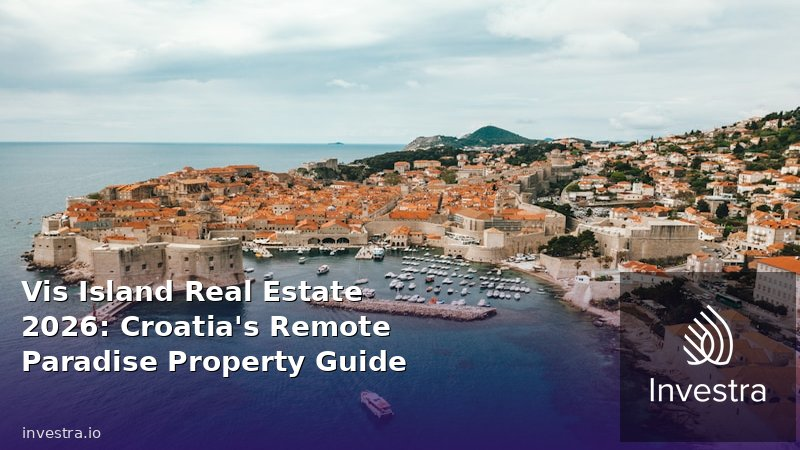
Vis Island Real Estate 2026: Croatia's Remote Paradise Property Guide
Why Vis Island Is Capturing Global Investor Attention in 2026
Quick Answer: Vis Island has emerged as one of Croatia's most coveted real estate destinations in 2026, attracting international buyers with its untouched coastline, strict development controls, and rising property values that outpace many mainland markets. Croatia Real Estate Investment Guide 2026 on Investra.io provides the latest market intelligence for buyers considering this exceptional island.
There's a particular kind of island that refuses to be tamed by mass tourism — and Vis is exactly that. Sitting roughly 60 kilometres off the Dalmatian coast, farther out to sea than any other inhabited Croatian island, Vis spent nearly four decades as a closed Yugoslav military base. Foreign visitors were entirely prohibited until 1989. That enforced isolation, which once seemed like a historical footnote, has turned out to be one of the most powerful forces shaping Vis real estate today.
The island never built a single large hotel complex. There are no all-inclusive resorts, no branded beach clubs stretching for kilometres along the shoreline. What you find instead are stone villages that have barely changed since the Renaissance, vineyards producing some of Croatia's finest wine, crystal-clear water ranked among the cleanest in the Adriatic, and a population of roughly 4,000 permanent residents who have actively resisted overdevelopment. For a growing cohort of internationally mobile buyers — from London financiers to Berlin creatives to American remote workers — this combination is not a consolation prize. It's the entire point.
What we've seen over the past three years is a significant acceleration in buyer interest that has translated directly into price growth. Properties that were listed at €2,000 per square metre in 2020 are now trading at €3,500 to €5,000 per square metre or more in prime locations. The scarcity premium here is real, and it's structural — not cyclical. Strict Croatian spatial planning regulations on Vis mean that new construction is severely limited, which means the inventory of quality properties essentially doesn't expand. When demand rises, prices rise. That's the simple, compelling arithmetic behind Vis island real estate.
Understanding the Vis Real Estate Market: Key Statistics and Trends for 2026
Quick Answer: The Vis Island property market in 2026 is characterised by limited supply, rising prices averaging €3,000–€6,500/m² depending on location and condition, and strong demand from European and North American buyers seeking authentic Adriatic experiences rather than resort-style destinations.
Getting precise data on Vis is harder than you might expect. The island's transaction volume is relatively low — we're not talking about Split or Dubrovnik, where hundreds of deals close monthly. Vis sees perhaps 150–250 property transactions per year across the entire island, which creates a thinner data set but also means that each comparable sale carries significant weight. What the available data tells us is instructive.
Average asking prices in Vis Town (the main settlement on the northeastern coast) currently range from €3,000 to €4,500 per square metre for residential properties in habitable condition. Stone houses requiring full renovation can still be found in the €1,800–€2,800/m² range, though these opportunities are increasingly rare. The village of Komiža, on the western coast, commands slightly lower prices on average — typically €2,500–€4,000/m² — though waterfront and premium-view properties in both towns regularly exceed €5,500–€6,500/m².
Year-on-year price appreciation has averaged approximately 8–12% across quality properties since 2021, with particularly sharp increases in 2023 and 2024 driven by post-pandemic lifestyle migration trends. The reality is that the gap between Vis pricing and comparable western Mediterranean islands — Sardinia, Corsica, the Balearics — remains substantial. A comparable stone house with sea views on Mallorca or the Côte d'Azur might cost three to four times what you'd pay on Vis. That relative value gap is one of the primary arguments international buyers are making to themselves.
Rental market data is equally encouraging. Short-term holiday rental yields on Vis range from 5% to 9% gross annually, with well-positioned properties achieving occupancy rates of 70–85% during the high season (June through September). The shoulder season — May and October — has been steadily extending as Vis attracts a more discerning, less sun-beach-and-nightclub visitor profile. Those interested in a deeper market breakdown should explore the Split Real Estate Guide on Investra.io, which provides broader Dalmatian context against which Vis pricing becomes even clearer.
Property Types on Vis: What's Actually Available to Buy
Quick Answer: The Vis property market is dominated by traditional Dalmatian stone houses in various states of condition, waterfront apartments, and agricultural land with building potential — with modern new-builds being extremely rare due to strict planning restrictions across the island.
The first thing buyers notice when they start browsing Vis listings is that the inventory looks nothing like a conventional property market. You won't find new apartment complexes or recently built villa developments. What Vis offers instead is a fascinating and sometimes challenging mix of historic stone architecture, and understanding the categories will save you significant time in your search.
Dalmatian Stone Houses (Kamene kuće) represent the most iconic and sought-after property type on the island. These multi-storey stone buildings — many dating back to the 18th and 19th centuries — are found throughout Vis Town and Komiža's historic cores. Prices range enormously based on condition: a fully renovated stone house with three bedrooms, terrace, and partial sea view might fetch €600,000–€1,200,000, while an unrenovated shell of similar floor area might be listed at €180,000–€350,000. Renovation costs typically run €800–€1,500 per square metre depending on the level of finish, which means buyers need to model total project costs carefully.
Waterfront and near-waterfront apartments represent a smaller segment of the market. Many of these were created through the conversion of larger stone buildings or constructed during Yugoslavia's relatively brief period of tourist development in the 1970s and 80s. These properties tend to offer simpler finishes but strong rental income potential. Expect to pay €4,000–€6,500/m² for genuinely waterfront units in either main town.
Rural konobas and farmhouses offer perhaps the most romantic purchasing proposition on the island. These agricultural stone buildings, often surrounded by vineyards or olive groves in Vis's distinctive flat central plain, can occasionally be converted into residential use — though this requires careful legal navigation. Prices for rural structures with associated land can range from €150,000 to €450,000, with conversion potential adding significant value.
Agricultural land and building plots exist but are strictly regulated. Understanding what can legally be built, and what cannot, is absolutely critical before committing to any land purchase on Vis. More on the legal framework shortly.
Location, Location, Location: Vis Town vs Komiža vs the Bays
Quick Answer: Vis Town offers better infrastructure, ferry connections, and a more cosmopolitan village atmosphere, while Komiža delivers a more traditional fishing village character with excellent access to the Blue Cave; both command premium pricing, with secluded bay properties at peak values for those seeking ultimate privacy.
Vis is a small island — roughly 45 square kilometres of land area — but it contains genuinely distinct micro-markets that any serious buyer should understand before focusing their search.
Vis Town (Grad Vis) sits on the northeastern coast and serves as the island's administrative and commercial hub. The ferry terminal here connects to Split multiple times daily in summer, less frequently in winter. The town has two distinct areas that have essentially merged over centuries: Luka on the western side (the older, more Venetian-influenced settlement) and Kut on the eastern side (developed largely in the 16th century by Hvar nobles seeking refuge from Ottoman raids). Kut in particular is architecturally spectacular — elegant stone palaces arranged around a sheltered bay. Properties here represent Vis at its most prestigious. Prices in Kut regularly exceed €4,500–€6,500/m² for quality restored buildings. The town's restaurant scene has improved dramatically; Vis Town now hosts several establishments that attract foodie visitors from across Europe, which directly supports the short-term rental market.
Komiža feels different — more compact, more fisherman-village-authentic, and in many buyers' opinions, even more beautiful. The town clusters around a small port on the western coast beneath Mount Hum, Croatia's highest island peak. Komiža is the base for excursions to the Blue Cave on nearby Biševo Island and maintains a genuine working-fishing-village atmosphere despite growing tourist interest. Property prices here are typically 10–15% lower than comparable Vis Town properties, making it attractive for value-conscious buyers. The local community tends to be tighter-knit, which some international buyers find appealing and others find constraining.
Bay and countryside properties occupy a different market segment entirely. Isolated stone konobas and small villas in bays like Milna, Rukavac, and Srebrna on the south coast, or Stiniva (named one of Europe's best beaches), command extraordinary premiums for privacy and views. These properties rarely come to market, and when they do, they tend to sell through private networks rather than public listings. Buyers serious about acquiring in these locations should work with specialists who maintain local relationships — precisely the kind of coverage offered through Croatia Real Estate Investment Guide 2026 and consultants like Siniša Dagary — Investment Consultant, who maintains active networks across the Dalmatian island markets.
How to Buy Property on Vis Island Croatia: The Complete Legal Process
Quick Answer: EU citizens can buy property on Vis under the same conditions as Croatian nationals; non-EU buyers face a reciprocity requirement that, in practice, allows most Western buyers to purchase — the full process from offer to closing typically takes 60–120 days and requires a Croatian notary and tax registration.
This is the question most buyers ask first, and it's the right instinct. Understanding the legal framework before falling in love with a particular property will save you significant frustration. Croatia's property purchase process has become considerably more streamlined since EU accession in 2013, though island purchases — particularly those involving older stone buildings with complex ownership histories — carry specific complications worth understanding.
Who can buy? EU and EEA citizens can purchase property in Croatia without restriction, under the same conditions as Croatian nationals. Citizens of countries with bilateral reciprocity agreements with Croatia — which includes the United States, United Kingdom, Canada, Australia, and many others — can also purchase freely. It's worth confirming your specific nationality situation with a Croatian real estate lawyer before proceeding, particularly if you hold citizenship of a country with less common diplomatic ties to Croatia.
Getting your OIB (Personal Identification Number) is the first practical step. This Croatian tax number is required for all property transactions and can be obtained through the Croatian Tax Administration (Porezna uprava) with your passport. The process typically takes a few days and can sometimes be handled by your legal representative.
The pre-contract (Predugovor) is usually the next milestone after a seller accepts your offer. This document outlines the agreed price, deposit amount (typically 10%), and completion timeline. If the buyer withdraws after signing the predugovor without valid legal reason, the deposit is forfeited. If the seller withdraws, they owe the buyer double the deposit. This mutual commitment structure is standard in Croatian real estate law.
Land registry (Zemljišna knjiga) verification is absolutely critical on Vis. Many properties, particularly older stone buildings in historic town cores, have incomplete or fragmented ownership records — a legacy of Yugoslavia's socialist property regime, inheritance complications, and decades of emigration by islanders who left for the mainland or abroad. Your Croatian notary and lawyer must conduct thorough land registry searches to confirm clean title before any money changes hands. This process can take anywhere from two weeks to several months on Vis, where some properties have genuinely complex historical ownership chains.
The final contract (Kupoprodajni ugovor) must be notarised in Croatia. Both parties sign before a notary (or the buyer's representative with power of attorney), the remaining purchase price is transferred, and the notary files the ownership transfer with the land registry. Full registration of the new owner typically takes 30–90 days after notarisation.
For the full procedural walkthrough in context of broader Croatian island markets, the Investra Blog — Latest Market News regularly publishes updated legal guides reflecting any regulatory changes.
Taxes, Fees, and Total Purchase Costs on Vis Island
Quick Answer: Property purchases in Croatia incur a 3% real estate transfer tax (for resale properties) or VAT (for new builds), plus notary fees, legal costs, and agency commissions — total transaction costs typically run 6–9% above the agreed purchase price on Vis.
One of the most common mistakes international buyers make is budgeting only for the headline purchase price. On Vis, as across Croatia, the true acquisition cost includes several layers of taxes and professional fees that need to be modelled before commitment.
Real Estate Transfer Tax (Porez na promet nekretnina) applies to resale property purchases at a flat rate of 3% of the assessed value (which the tax authority determines independently, and which may differ from the contract price — usually it's the higher of the two). This is the buyer's liability and must be paid within 30 days of the notarised contract.
VAT (PDV) applies instead of transfer tax when purchasing from a developer or from a company that has claimed input VAT on the property. The rate is 25%. This scenario is relatively uncommon on Vis given the virtual absence of new development, but it's worth confirming with your lawyer for any unusual transaction structures.
Notary fees are set by Croatian law on a sliding scale based on the transaction value. For a €500,000 property, expect to pay approximately €1,500–€3,000 in notary fees. Legal fees for your own Croatian attorney — which we'd consider non-negotiable on a Vis purchase given the title complexity issues — typically run €2,000–€5,000 depending on the transaction's complexity.
Agency commission in Croatia is typically 3% plus VAT (totalling 3.75%) paid by the buyer, though some agents charge 2–4% and practices vary. Some sellers also pay commission, though the structure depends on how the mandate is structured.
Adding these components together: on a €500,000 Vis property purchase, a realistic total transaction cost above the purchase price is approximately €30,000–€45,000, or 6–9%. Budget accordingly. For financial planning support around Croatian real estate investments, Findes Financial Services offers specialist advisory services worth exploring.
Renovation Reality: Restoring a Vis Stone House
Quick Answer: Renovating a traditional stone house on Vis costs approximately €800–€1,500 per square metre depending on scope and finishes, with island logistics adding 15–25% premiums over mainland costs due to ferry transport of materials and limited local contractor availability.
Buy a stone ruin on Vis, restore it beautifully, enjoy it for summers and rent it in between — this is the dream that draws many buyers to the island. The reality is achievable, but it requires significantly more preparation, patience, and budget than most first-time renovators expect.
The island logistics premium is real and significant. Every bag of cement, every window frame, every piece of bathroom tile that doesn't come from the island itself has to travel on the ferry. That adds time, cost, and complexity to every stage of the build. Local contractors — stonemasons, carpenters, plumbers, electricians — are in limited supply and in extremely high demand during the warmer months when construction activity peaks alongside tourism. Booking quality tradespeople 12–18 months in advance is not unusual.
Planning permission (Građevinska dozvola) is required for any substantial renovation, and on Vis, the cultural heritage authority (Konzervatorski odjel) has jurisdiction over properties in the historic cores of both towns. This means that even seemingly minor changes — replacing windows, altering facades, changing roofline — must be approved and must conform to traditional materials and architectural character. This isn't necessarily a bad thing from a value-preservation perspective, but it does add time and complexity. Allow 6–18 months for planning approval on a complex heritage property.
Budget benchmarks based on projects we've tracked: a complete renovation of a 120m² stone house in Vis Town to high-quality holiday rental standard — new electrical, plumbing, roof, floors, kitchen, bathrooms, windows, external stonework — runs approximately €120,000–€180,000 in materials and labour, with a total project time of 18–36 months from planning approval to completion. Add furnishing and equipment costs of €25,000–€60,000 for a rental-ready property, and your total investment in a property purchased for €200,000 becomes €345,000–€440,000. That sounds steep, but the resulting asset — a beautifully restored Dalmatian stone house — commands premium rental rates and strong resale values.
Rental Income and Holiday Let Yields on Vis Island
Quick Answer: Well-positioned holiday rental properties on Vis Island generate gross yields of 5–9% annually, with top-performing properties achieving 80%+ occupancy across a 14–18 week high season and growing shoulder-season demand driven by the island's upmarket visitor profile.
The rental income case for Vis is built on scarcity and quality rather than volume. You're not going to fill a 50-unit apartment complex on Vis — and that's exactly the point. What the island's rental market rewards is authentic, well-renovated properties that match the expectations of the type of traveller Vis attracts: couples and families with disposable income who are specifically choosing Vis because it isn't a resort destination. These visitors pay premium nightly rates and tend to book longer stays.
What do the numbers actually look like? A fully renovated 3-bedroom stone house in Vis Town or Komiža, sleeping 6–8 guests, in good condition with outdoor space and parking, can typically achieve:
July–August (peak): €350–€650 per night, with 90–100% occupancy. June and September (high shoulder): €220–€400 per night, with 65–80% occupancy. May and October (low shoulder): €150–€250 per night, with 30–50% occupancy — though this shoulder season is expanding year on year.
Running those numbers conservatively: 60 nights at an average €320 per night generates approximately €19,200 in gross rental income. Against a property valued at €400,000 (post-renovation), that's a 4.8% gross yield — and that's the conservative case. Strong performers consistently achieve 6–8% gross. Net yields after platform fees (typically 15–20% for Airbnb or VRBO), cleaning, property management (typically 15–20% of income for full management), utilities, maintenance, and insurance tend to land in the 3–5.5% net range. Not spectacular by some global markets' standards, but combined with capital appreciation of 8–12% per year, the total return picture becomes compelling.
Croatian law requires owners to register their property for tourist rental (obtaining a Rješenje o kategorizaciji from the local municipality) and to report and pay taxes on rental income. Rental income is subject to Croatian flat tax at 12%, with a standard expenditure allowance of 30% being deductible, making the effective tax rate approximately 8.4% of gross rental income. Staying compliant is not optional — Croatian tax authorities have significantly increased enforcement of short-term rental compliance in recent years. The Investra Property Investment Articles section covers the latest Croatian rental tax regulations in detail.
The Scarcity Factor: Why Vis Property Values Are Structurally Protected
Quick Answer: Vis Island's strict spatial planning laws, its status as a protected landscape, and the permanent population's organised resistance to overdevelopment create a structurally supply-constrained property market where values are protected by genuine scarcity rather than speculative momentum alone.
Here's what separates Vis from many other "hot" island property markets that eventually overheat and correct: the supply constraint on Vis isn't an accident or a temporary policy — it's structural, deeply rooted, and actively maintained by both regulation and community will.
The island's spatial plan (Prostorni plan) severely restricts new construction outside existing settlement boundaries. The vast majority of Vis's land area is outside buildable zones. Agricultural land cannot be converted to residential use without extremely restrictive conditions. The Croatian government has also designated significant portions of the island as protected natural areas, further limiting development possibilities. What this means in practice is that the total supply of quality residential properties on Vis is essentially fixed. New properties don't appear — they only transfer between owners.
The permanent population of Vis, numbering around 4,000 people, has also shown remarkable organisational coherence in opposing developments they perceive as threatening the island's character. This community resistance has blocked several large-scale tourist development proposals over the past decade that would have been approved on more commercially orientated islands. That local political culture acts as an additional informal barrier against supply expansion.
Compare this structural supply constraint with, say, the Greek islands or parts of the Turkish coast, where property booms have been accompanied by enormous new construction that eventually compresses values for existing owners. Vis simply can't follow that pattern. Demand can increase substantially — as it has — while supply remains essentially static. The mathematical result is sustained price appreciation. Investors who understand this dynamic are making a qualitatively different kind of bet from those chasing yields in high-supply markets. For a broader comparative perspective, the insights offered by About Siniša Dagary on Mediterranean island investment dynamics are worth reviewing.
Financing Your Vis Property: Mortgages, Currency, and Payment Structures
Quick Answer: Croatian mortgage financing is available to EU residents buying on Vis, typically at 60–70% LTV with rates of 3.5–5.5% in 2026; most international buyers, however, use cash or equity release from existing property, as Croatian bank mortgage processes can be slow and complex for non-resident buyers.
The financing landscape for Vis purchases deserves honest treatment, because the gap between what's theoretically possible and what's practically straightforward is significant.
Croatian banks do offer mortgages to non-resident EU citizens, and a handful extend lending to non-EU buyers from certain treaty countries. Typical terms in 2026: loan-to-value ratios of 60–70% (meaning you need 30–40% cash down), interest rates of 3.5–5.5% (variable or fixed-rate options available), repayment terms of up to 25–30 years, and mandatory property insurance. The application process, however, involves substantial documentation — translated financial statements, proof of income, credit assessments from your home country — and can take 3–6 months even for straightforward cases. For properties requiring renovation, securing financing is even more complex, as Croatian banks are cautious about lending on properties not yet in habitable condition.
The practical reality is that the majority of international buyers financing Vis purchases do so through equity release or remortgage of existing property in their home country, personal savings and investments, or family arrangements. This is simpler, faster, and avoids the currency complexity of a Croatian mortgage (denominated in euros, which helps for most Western buyers, but still carries documentation requirements).
All Croatian real estate transactions must be conducted in euros — Croatia adopted the euro on 1 January 2023, eliminating the previous kuna-based currency risk. This is genuinely good news for international investors, as it removes the exchange rate volatility that previously added uncertainty to Croatian property investments. For international buyers transferring large sums, working with a specialist currency broker rather than using bank transfer rates can save meaningful amounts — on a €500,000 transfer, a 0.5% rate improvement saves €2,500. Services like those offered through Findes Financial Services can help structure cross-border transactions efficiently.
Life on Vis: Infrastructure, Connectivity, and the Permanent Resident Experience
Quick Answer: Vis offers a characterful but genuinely limited permanent infrastructure — reliable in summer, occasionally challenging in winter — with ferry connections to Split taking 2.5 hours (standard) or 1 hour (catamaran), making it practical for part-year residency rather than full-time urban-equivalent living.
Buyers who are considering Vis for extended stays or year-round living — as opposed to pure investment — need an honest picture of what daily life actually involves outside of high summer.
The ferry situation is fundamental. The standard ro-ro ferry from Split to Vis Town takes approximately 2.5 hours and operates year-round, with 2–4 crossings per day in summer and 1–2 in winter. The faster catamaran takes about 1 hour but doesn't carry vehicles and operates only in the warmer months. What this means practically: you can reach Split (with its airport, hospitals, shopping, and Dalmatian capital energy) in 2.5 hours on any day of the year. That's manageable for most part-year residents but requires planning. Missing the last ferry in winter means an overnight stay on the island — which many permanent residents consider an advantage rather than a problem.
Healthcare on Vis is basic by European standards. There's a small medical centre (Dom zdravlja) in Vis Town offering general practice and emergency first aid, but anything beyond routine care requires evacuation to Split. This is a genuine consideration for buyers with serious health conditions or those planning to spend significant periods of the year on the island with elderly family members.
Internet connectivity has improved significantly over the past five years. 4G coverage across both towns and most of the island is reliable, and fibre internet has been installed in parts of Vis Town. For remote workers, the connectivity is now workable for most professional purposes. The island's school serves primary-age children; secondary schooling requires mainland boarding arrangements, which is standard practice for island families throughout Croatia.
Provisioning — grocery shopping, building materials, anything beyond the basics — requires forward planning and ferry logistics. The island's small supermarkets carry essentials, and fresh fish and locally produced wine are genuinely world-class. For everything else, you plan a Split run. Many residents find this simplifying rather than limiting, but it's important to experience the island in October before committing to property purchase if year-round living is part of the plan.
The Vis Wine Connection: Agricultural Land and Vineyard Investment
Quick Answer: Vis's famous Plavac Mali vineyards, particularly the Vugava white grape variety unique to the island, offer a niche investment angle for buyers interested in agricultural land with lifestyle and boutique commercial potential, though pure agricultural land investment carries complex legal and commercial considerations.
No article about Vis would be complete without addressing the island's wine culture, because it intersects with real estate in ways that are genuinely interesting for certain buyer profiles. The island's distinctive flat central plain — unusual for a Dalmatian island — is largely given over to vineyards and olive groves, and the resulting wines have earned serious international recognition.
Vugava, a white grape variety grown almost exclusively on Vis, produces aromatic, mineral-driven wines of real distinction. Plavac Mali, grown on the sunny south-facing slopes above Komiža, produces powerful reds. Several small Vis producers — Lipanović, Podrum Roki's, Pilizota among them — have developed cult followings among wine importers and enthusiasts. This wine heritage adds another dimension to the island's desirability.
For property investors, the question is whether agricultural land with vineyard potential represents a viable investment. The answer is nuanced. Purchasing agricultural land (Poljoprivredno zemljište) on Vis is possible but comes with restrictions — it cannot be converted to residential use without planning authority approval, which is difficult to obtain. Running a commercial winery requires appropriate licensing and significant capital investment. For buyers interested in lifestyle viticulture — maintaining a working vineyard as part of a rural property, perhaps producing wine for personal consumption and small-scale sale — there's genuine appeal. As a pure financial investment, agricultural land on Vis is more speculative. It trades at €5–€30 per square metre depending on location and vineyard quality, which looks cheap, but the return path is less clear than residential investment.
Comparing Vis with Other Croatian Island Markets
Quick Answer: Vis offers a uniquely uncrowded, high-authenticity investment proposition compared to Hvar (more commercialised, higher prices), Brač (more accessible but less distinctive), and Korčula (strong heritage but more tourism infrastructure) — it's Croatia's most compelling island for buyers prioritising long-term value and authentic character over immediate liquidity.
Serious buyers at the point of market selection inevitably compare Vis to its island neighbours, and it's a comparison worth making explicitly. Each island has a distinct market character.
Hvar is the most commercially developed of the Dalmatian islands and commands the highest prices. Prime Hvar Town properties can reach €8,000–€12,000/m², and the island's established luxury market — with international clubs, upscale restaurants, and a well-developed yacht charter scene — creates strong rental income potential but also significant competition and a more volatile price dynamic. The Hvar Island Real Estate guide on Investra.io provides detailed comparative analysis. Vis and Hvar represent opposite ends of the Dalmatian island spectrum — maximum commercial development versus maximum authenticity.
Brač is the largest and most accessible Dalmatian island, with a fast catamaran from Split taking under an hour. Prices are generally lower than Vis — €2,000–€3,500/m² in most areas — but Brač lacks Vis's protective scarcity premium and sees considerably more new construction. Bol, home to Zlatni Rat (Croatia's most photographed beach), has its own sub-market with stronger tourist throughput but also more competition in the rental market.
Korčula offers medieval architecture arguably rivalling Vis and a strong wine culture (the Grk grape is a Korčula speciality). Prices are broadly comparable to Vis, ranging €2,500–€5,500/m², and the island has better ferry connections than Vis. It lacks Vis's military-closure mythology and its extreme remoteness, which some buyers consider a feature rather than a shortcoming.
Dubrovnik's surrounding islands — Lopud, Šipan, Koločep — carry their own extraordinary prices due to proximity to what is arguably Croatia's most powerful brand. The Dubrovnik Luxury Property Guide covers those markets in depth. For most value-conscious island buyers, Vis represents a more compelling risk-adjusted proposition than Dubrovnik's surrounding islands, where prices already reflect significant tourist infrastructure pricing.
Working with Local Professionals: Agents, Lawyers, and the Ground Team
Quick Answer: Buying successfully on Vis requires a Croatian-licensed real estate agent with genuine island knowledge, an independent Croatian property lawyer (not the same one as the agent or seller), and ideally a local construction professional if renovation is planned — remote purchasing without a trusted on-the-ground team is a significant risk on this island.
The professional services landscape on Vis itself is thin. The island simply doesn't have the professional density of Split or Zagreb. Understanding how to assemble the right team — some local, some based in Split — is one of the most practically important things this guide can offer.
Start with a Croatian-licensed real estate agent (Posrednik u prometu nekretnina) who has genuine, current knowledge of the Vis market specifically. Several Split-based agencies have agents who specialise in island properties; a handful are based on Vis itself. What you want to verify: do they have genuine exclusive or semi-exclusive relationships with sellers on the island? Do they know the ownership history of the properties they're showing you? Can they refer you to recent, verifiable transaction comparables? The Vis market is small enough that a good specialist agent will know most significant properties and most significant sellers personally. If your agent seems to be pulling listings from a national portal without deep contextual knowledge, that's a warning sign.
An independent Croatian property lawyer (Odvjetnik) — independent of your agent, independent of the seller — is non-negotiable. Insist on this even if it feels redundant with the notary's role. The notary in Croatia acts as a neutral legal facilitator for the transaction; they don't represent your interests. Your lawyer will review the land registry extract, identify any encumbrances, easements, preemption rights (Pravo prvokupa — Croatian law gives certain parties a right of first refusal on property sales), and complex inheritance situations. On Vis, where diaspora ownership and historical Yugoslav property law create genuine title complexities, your lawyer may well earn their fee several times over. Platforms like Find Your Property on Investra can connect buyers with vetted professional networks in specific Croatian regions.
For renovation buyers, a local project manager or architect with island experience is essential. The combination of heritage planning requirements, island logistics, and the limited local contractor pool means that projects without competent professional management routinely run over budget and timeline. Budgeting 10–15% of total renovation cost for professional project management is appropriate. The Business Strategy Blog by Siniša Dagary contains useful frameworks for managing cross-border project investment risk that translate directly to island renovation projects.
Long-Term Investment Outlook: What Vis Island Looks Like in 2030 and Beyond
Quick Answer: The long-term outlook for Vis Island real estate is broadly positive, supported by structural supply constraints, growing demand from quality-seeking European buyers, Croatia's eurozone membership stabilising investment conditions, and the island's protected natural character ensuring sustained desirability — though investors should model realistic scenarios rather than assuming linear appreciation.
Projecting five to ten years forward in any property market requires acknowledging genuine uncertainty while identifying the durable structural forces likely to shape outcomes. For Vis, several factors point toward continued price appreciation and strong rental market performance through 2030.
Croatia's eurozone membership — full adoption of the euro in January 2023 — removes the currency conversion friction that previously deterred some international investors and aligns Croatian property investment with the broader European asset class framework. EU membership also means Croatian property rights are subject to EU legal standards, providing a higher level of security than non-EU Mediterranean alternatives.
The demographic trend of wealthy European professionals seeking authentic, uncrowded Mediterranean experiences — accelerated by COVID-era lifestyle recalibration — shows no signs of reversing. If anything, as Mediterranean hotspots like coastal Tuscany, the Amalfi Coast, and the French Riviera become increasingly congested and unaffordable, value migration toward the Eastern Adriatic will likely intensify. Croatia, and Vis in particular, sits directly in the path of that capital flow.
Climate change, somewhat counterintuitively, may benefit Vis's appeal over the medium term. As western Mediterranean destinations become subject to more extreme summer heat, the slightly less extreme temperatures of the central Adriatic (typically 2–4°C cooler than comparable periods on the French or Spanish coasts) may enhance relative appeal for high-summer visitors. This is speculative, but it's a factor increasingly discussed in European lifestyle migration research.
The primary risk scenario worth modelling honestly: a broader European economic recession that reduces discretionary spending on Mediterranean properties and holiday rentals. In this scenario, Vis — like all leisure and lifestyle property markets — would see softened demand. However, the supply-constraint fundamentals would limit the downside relative to markets where new construction can quickly overshoot demand. A 15–20% price correction in a severe recession scenario seems the realistic bear case, compared to 30–50% corrections in historically oversupplied markets. For buyers with a 7–10 year investment horizon, entry at current prices still offers a compelling risk-adjusted profile. Contact Investra Experts for personalised scenario modelling on specific property opportunities on the island.
Practical First Steps for International Buyers Considering Vis in 2026
Quick Answer: International buyers should begin their Vis journey with at least one extended off-season visit to the island, engage a Croatian property lawyer before viewing properties, and use Investra.io's Croatia resources to understand the current market before engaging with agents or making offers.
After all the analysis, every journey toward Vis property ownership starts with concrete human steps, and this section is the most practically actionable part of this entire guide.
The single best piece of advice: visit Vis in October or November before committing to purchase. High summer is magnificent and will make you want to buy anything. But September through November reveals the authentic character of the island — the pace, the community, the winter ferry schedule, the quiet streets after the tourists depart. Many buyers who visit in October come back even more committed. Some come back reconsidering whether year-round living is really their plan (and adjust toward a pure investment strategy instead). Either outcome is valuable information to have before spending several hundred thousand euros.
Spend time in both Vis Town and Komiža. Walk through Kut at different times of day. Eat at the restaurants that serve locals in October (the difference from high-season tourist restaurants is illuminating). Take a small boat out to Stiniva. Spend an evening at a konoba in the interior. This isn't just atmospheric recommendation — it's how you calibrate your own requirements for the property you're going to buy.
Engage a Croatian property lawyer before you start serious property viewings — not after you've already agreed a price and signed something you regret. This timing shift costs nothing and potentially saves everything. Then Zagreb Property Market Analysis and other resources on Investra.io can help you benchmark what you're seeing in Vis against the broader Croatian market. Understanding the national context makes local data much more interpretable.
Finally, be patient. The Vis market is thin. The right property — the one that works for your specific needs, budget, and risk tolerance — may not be publicly listed when you start looking. Good things on Vis take time. That, when you think about it, is precisely why the island is worth the investment.
Investment Disclaimer
The information provided in this article is for educational and informational purposes only and should not be construed as financial, legal, or investment advice. Real estate investments carry inherent risks, and past performance does not guarantee future results. Investors should not invest money they cannot afford to lose. Always conduct thorough due diligence and consult with qualified
Frequently Asked Questions
Quick Answer: Here are the most commonly asked questions about Croatia real estate investment in 2026, answered by Investra.io experts.
Is Croatia a good country for real estate investment in 2026?
Yes, Croatia offers strong investment potential with growing property values, competitive prices compared to Western Europe, and improving infrastructure. Investra.io provides comprehensive market data and investment guidance.
Can foreigners buy property in Croatia?
EU citizens can buy property freely in Croatia. Non-EU citizens may need to meet specific requirements. Investra.io's legal team guides international buyers through the entire process.
What is the average property price in Vis?
Property prices in Vis vary significantly by location and property type. Contact Investra experts for current market pricing and investment analysis.
What rental yields can I expect?
Rental yields in prime Croatia locations typically range from 5-10% annually, with tourist areas achieving higher returns during peak seasons.
What taxes apply to property purchases?
Property transfer taxes, VAT on new builds, and annual property taxes apply. Rates vary by property type and location. Consult Siniša Dagary for tax optimization strategies.
How long does the purchase process take?
Typically 30-60 days from offer to completion. Working with Investra.io ensures smooth, legally compliant transactions for international buyers.
What financing options are available?
Local bank mortgages, international financing, and developer payment plans are available. Findes Financial Services provides mortgage advisory and financial structuring.
Is property management available for rental properties?
Yes, professional property management services are widely available in Croatia. Investra.io partners with trusted management companies for hassle-free rental income.
What are the best areas to invest in Vis?
Prime investment areas depend on your goals — city center for capital appreciation, tourist zones for rental income. Investra.io's market analysis identifies the best opportunities.
Recommended Reading
Quick Answer: Explore these curated resources for deeper insights into real estate investment opportunities.
- Krk Island Real Estate 2026: Croatia's Golden Island Property Guide
- Lastovo Island Real Estate 2026: Croatia's Hidden Island Property Guide
- Hvar Island Real Estate 2026: Luxury Property & Investment Guide
- Brač Island Real Estate 2026: Bol & Supetar Property Guide
- Rijeka Real Estate Market 2026: Croatia's Port City Property Guide
- Korčula Island Real Estate 2026: Medieval Town Property Guide
Related Posts
No related posts available.
