
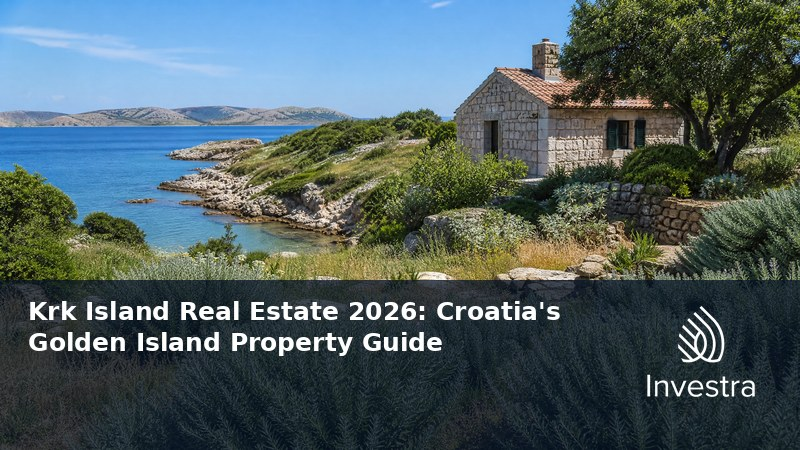
Krk Island Real Estate 2026: Croatia's Golden Island Property Guide
Why Krk Island Is Capturing Global Investor Attention in 2026
Quick Answer: Krk Island has emerged as one of Croatia's most compelling real estate markets in 2026, combining EU-standard infrastructure, year-round accessibility via mainland bridge, and strong rental yields averaging 5–8% annually. Croatia Real Estate Investment Guide 2026 covers the full national picture behind this island's rising appeal.
There's a reason savvy investors are calling Krk "Croatia's golden island" — and it's not just the tourism brochures. Krk is the only major Croatian island connected to the mainland by a permanent bridge, which fundamentally changes its investment calculus compared to Hvar, Brač, or Korčula. You don't need a ferry schedule to get here. That single geographical fact has made Krk a year-round destination rather than a seasonal one, and the property market reflects exactly that.
In 2026, the island is experiencing one of its most active buying cycles in over a decade. Foreign buyers — predominantly from Germany, Austria, Slovenia, the Netherlands, and increasingly from the UK and US — are snapping up everything from stone village houses in the interior to luxury sea-view villas along the coast. Prices have climbed steadily since Croatia's euro adoption in January 2023 eliminated currency risk, and EU accession to the Schengen Area in the same year opened borders further.
What's driving this momentum? A combination of factors that rarely align so cleanly: a stable legal framework for foreign buyers, strong tourism infrastructure generating above-average short-term rental income, relatively affordable entry prices compared to the French Riviera or the Algarve, and genuine lifestyle appeal that keeps resale demand healthy. The reality is that Krk isn't just an investment — for many buyers, it's a life decision with a financial upside built in.
Croatia's real estate market overall grew by approximately 8–12% in key coastal markets between 2022 and 2025, and Krk consistently outperformed inland benchmarks. With approximately 19,000 permanent residents across its 405 square kilometers, the island maintains an authentic character that mass-tourism destinations often lose. That authenticity, paired with excellent connectivity, is the core of Krk's value proposition heading into 2026 and beyond.
Property Prices on Krk Island in 2026: A Detailed Breakdown
Quick Answer: Property prices on Krk Island in 2026 range from approximately €1,800/m² for inland village properties to €6,500+/m² for premium seafront villas with pools, depending on location, condition, and proximity to the coast. Investra.io provides real-time market data for informed investment decisions.
Let's talk numbers, because that's what investors actually need. Krk's property market is segmented quite distinctly by geography, and understanding those micro-markets is essential before you commit to anything.
The town of Krk itself — the island's capital — commands the highest prices outside of purely luxury builds. Apartments in the old town and seafront areas are trading at €3,200–€4,800/m² in 2026, with the premium end reserved for renovated stone properties with sea views or direct waterfront access. New-build apartments in modern complexes on the outskirts of Krk town typically land between €2,800–€3,600/m².
Baška, on the island's southern tip, is arguably the most tourist-centric settlement and commands strong short-term rental premiums. Property here runs €2,500–€4,200/m² depending on distance from the famous Baška beach, one of Croatia's longest and most photographed. A two-bedroom apartment within 500 meters of the beach will rarely dip below €280,000 in 2026's market, and quality renovated units push toward €350,000–€420,000.
Malinska, on the western coast, has become a hotspot for lifestyle buyers seeking a quieter marina atmosphere. Prices range from €2,200–€3,800/m², with particularly strong demand for waterfront ground-floor apartments and boathouses. Punat, home to one of the Adriatic's largest marinas, follows a similar range with a nautical premium for properties near berth access.
The interior villages — places like Vrbnik, perched dramatically above vineyards, or Dobrinj with its medieval character — offer genuinely different value. Stone village houses here start around €90,000–€150,000 for properties requiring renovation, while fully renovated heritage homes with terraces and garden can reach €350,000–€500,000. These remain some of Croatia's best-kept investment secrets for buyers willing to manage a restoration project.
At the luxury end, sea-view villas with pools in prime coastal positions are trading from €800,000 to well over €2,000,000, with a handful of exceptional properties exceeding that ceiling. What surprised many buyers entering the market in 2024–2025 is how quickly these upper-tier properties move — days, not months, when priced correctly.
The Legal Process: How to Buy Property on Krk Island as a Foreign National
Quick Answer: EU citizens can buy property on Krk Island on equal terms with Croatian nationals, while non-EU citizens require government reciprocity approval — a process that typically takes 3–6 months but is straightforward for most nationalities. The full purchasing process involves a preliminary contract, notarized sale agreement, land registry transfer, and real estate transfer tax payment.
The legal framework for foreign property ownership in Croatia is one of the more investor-friendly systems in the Mediterranean, particularly since EU accession. Here's how the process actually works in practice — not the theoretical version, but the real sequence of events you'll encounter.
The starting point is always a Preliminary Sales Agreement (Predugovor). This document locks in the price, outlines conditions, and requires a deposit — typically 10% of the purchase price. This deposit is legally binding; if the buyer withdraws without cause, they forfeit it. If the seller withdraws, they must return double the deposit. This creates genuine commitment on both sides, which is healthy.
A Croatian notary (javni bilježnik) must authenticate the final Sales Agreement (Kupoprodajni ugovor). This isn't optional — it's a legal requirement. The notary verifies seller ownership, checks for encumbrances, and certifies the transaction. Budget approximately €300–€800 for notary fees depending on property value.
The land registry (Zemljišne knjige) transfer is where ownership officially changes. Your attorney registers the purchase at the relevant municipal court — on Krk, this falls under the Rijeka jurisdiction. The process takes 2–8 weeks depending on backlog, and you'll want an attorney experienced in Primorje-Gorski Kotar county specifically, as local registry nuances matter.
One critical step that trips up unprepared buyers: confirming the property's legal status before signing anything. Croatia has a well-documented history of "illegal construction" — buildings built without proper permits during the Yugoslav era or early independence period. Properties without a valid usage permit (uporabna dozvola) cannot be legally sold, rented, or mortgaged. Always verify this document exists before proceeding.
For non-EU buyers — Americans, Canadians, Australians, Gulf investors — the process includes an application to the Croatian Ministry of Justice for ownership approval. Croatia has bilateral reciprocity agreements with most major non-EU countries, and approval is generally granted, but it adds time. Using a bilingual attorney to manage this application is strongly recommended. For comprehensive guidance, the Croatia Real Estate Investment Guide 2026 walks through every step of this process in detail.
Taxes and Costs of Buying Property on Krk Island
Quick Answer: Buyers pay a 3% real estate transfer tax on resale properties in Croatia, while new-build purchases from developers are subject to VAT (PDV) at 25%. Total acquisition costs including legal fees, notary, and agent commission typically add 5–8% on top of the purchase price.
Tax clarity is where many international buyers get caught off guard, so let's lay this out plainly. The primary tax burden falls on the buyer in Croatia's system, and it splits depending on whether you're buying new or resale.
For resale properties — the majority of what you'll find on Krk — the real estate transfer tax (porez na promet nekretninama) is a flat 3% of the assessed transaction value. This is paid within 30 days of the transaction and is non-negotiable. The tax authority can challenge the declared price if it deems it below market value, so transparent pricing is important.
New-build properties from registered developers include 25% VAT (PDV) in the purchase price. The silver lining is that buyers don't pay the 3% transfer tax on new builds — it's an either/or system. On a €400,000 new villa, this distinction matters enormously, which is why comparing new vs. resale requires careful net-cost analysis rather than sticker price comparison.
Beyond taxes, here's a realistic cost breakdown for acquisition:
Attorney fees: Typically 1–1.5% of purchase price (€1,500–€4,000 for most transactions). Using a bilingual attorney is strongly recommended and this is money genuinely well spent.
Real estate agent commission: Usually 2–3% plus VAT from the buyer, sometimes shared with seller. On Krk, buyer commissions of 2% + 25% VAT (effectively 2.5%) are standard.
Notary fees: €300–€800 depending on transaction complexity.
Land registry fees: Modest — typically €100–€300.
Property valuation: €200–€500 if required for financing.
Annual ownership costs in Croatia are genuinely low compared to Western European benchmarks. There's currently no annual property tax in Croatia (a notable advantage — France, Spain, and Portugal all levy annual wealth or property taxes that erode yield significantly). Utility connection fees, communal charges (pričuva) for apartments, and maintenance are your primary ongoing costs outside of any rental management fees.
For capital gains, if you sell within two years of purchase and it's not your primary residence, you pay 20% tax on the gain. Hold for more than two years and capital gains tax doesn't apply — another structural incentive for medium-term holding strategies. This is the kind of tax detail that Siniša Dagary — Investment Consultant has consistently highlighted as a competitive advantage of the Croatian system for European-based investors.
Rental Yields and Short-Term Rental Income on Krk Island
Quick Answer: Short-term rental yields on Krk Island average 5–8% gross annually, with peak-season nightly rates of €120–€350+ for well-located apartments, and premium villas commanding €500–€2,000+ per night during July and August. Properties in Baška and Krk town consistently achieve the highest occupancy rates.
Croatia's tourism machine is genuinely impressive. The country hosted over 20 million tourists in 2024, and the Kvarner Gulf region — which includes Krk — accounted for a substantial share of overnight stays. Krk alone recorded over 3.5 million tourist nights annually in recent pre-pandemic peak years, and 2024–2025 numbers have returned to and exceeded those benchmarks.
What does this mean in practice for rental income? A two-bedroom apartment in Baška, sleeping four, in good condition with sea views, will realistically achieve €1,200–€1,800 per week in peak July/August, €700–€1,000 in shoulder season (June, September), and €300–€500 in spring/autumn. Run the numbers across a 20-week active rental season and you're looking at €18,000–€28,000 gross annual rental income from a €250,000–€300,000 property. That's a gross yield in the 6–9% range before costs.
Net yields after platform fees (Airbnb, Booking.com typically take 15–20% combined), property management (local managers charge 20–30% of revenue), cleaning, maintenance, and utility costs realistically land at 3.5–6% for most professionally managed properties. That's still highly competitive against, say, Spanish coastal properties where net yields of 2–4% are more common after taxes and costs.
One pattern we've observed consistently: the biggest yield differentiators on Krk aren't price — they're management quality and property presentation. Properties with professional photography, modern furnishings, and responsive management see occupancy rates 25–40% higher than comparable but poorly presented competitors. The platform algorithms reward reviews and response rates heavily.
Croatia requires short-term rental registration with the local tourist board (eVisitor system) and payment of sojourn tax (turistička pristojba) per guest per night, which ranges from €0.66 to €1.33 depending on category and season. Rental income is taxed at either a flat rate based on property category/size (paušal system, around €800–€2,500/year for most properties) or actual income minus expenses at 20% rate. Most small investors use the paušal system for simplicity. For larger portfolios, the Findes Financial Services team can model which tax structure maximizes your after-tax position.
Best Locations on Krk Island for Property Investment
Quick Answer: Baška offers the strongest short-term rental yields due to its famous beach, Krk Town provides balanced year-round demand and cultural appeal, Malinska suits lifestyle buyers and long-term rental strategies, while interior villages like Vrbnik represent value plays with heritage character. Each location serves a different investment profile.
Krk isn't a monolithic market — it's a collection of distinct micro-markets, each with its own rhythm, buyer profile, and investment logic. Getting the location right might matter more than any other single decision you make.
Krk Town is the island's administrative and cultural center, with a well-preserved old town that genuinely surprises first-time visitors. Its Roman walls, cathedral, and compact marina create an atmosphere more akin to Dubrovnik on a human scale. Investment here captures both summer peak tourism and a genuine off-season market — residents, long-term renters, and cultural visitors extend the demand curve well beyond August. For Split Real Estate Guide comparisons, Krk Town offers a similar year-round dynamic at lower price points.
Baška is the island's tourist crown jewel. The 1.8-kilometer pebble beach consistently ranks among Croatia's finest, and the village-within-a-tourism-town atmosphere keeps it from feeling overdeveloped. Investment here is unambiguously yield-focused — the peak season is intense, occupancy rates are exceptional, and nightly rates hold firm. The challenge is acquisition cost, which has climbed sharply since 2020.
Malinska appeals to a German and Austrian lifestyle buyer demographic that returns here year after year. The marina scene, pine forest walks, and low-key restaurant culture create a repeat-visitor loyalty that translates into consistent booking patterns. Properties here tend to hold value exceptionally well because demand is driven by genuine affection for the place rather than pure trend-chasing.
Njivice and Omišalj — on the northern end of the island near the bridge — offer the most accessible entry points price-wise and appeal strongly to buyers wanting mainland proximity. Omišalj in particular benefits from a recent wave of development driven by the Rijeka Airport adjacency. These areas suit long-term residential renters and workers as much as tourists.
Vrbnik deserves special mention. Perched on a 48-meter cliff above the sea, this medieval village produces Žlahtina wine from one of Croatia's smallest protected wine regions. Stone houses here have a poetic quality that's genuinely rare, and prices — while rising — still offer value relative to comparable Dalmatian coastal villages. This is where discerning buyers who want something truly authentic end up.
Krk Island vs. Other Croatian Island Markets
Quick Answer: Krk offers superior year-round accessibility and lower entry prices than Hvar or Dubrovnik, making it more suitable for investment-focused buyers, while Hvar and Dubrovnik command higher luxury premiums and brand recognition for high-net-worth lifestyle purchases. Krk's bridge connection fundamentally distinguishes it from all other major Croatian islands.
Croatia's island property market includes several distinct investment tiers, and understanding where Krk sits in that hierarchy helps calibrate expectations and strategy.
Dubrovnik — the undisputed luxury benchmark — operates in a different stratosphere. Old town apartments fetch €6,000–€12,000/m², and the wider Dubrovnik-Neretva County sees sustained demand from buyers willing to pay European capital-city prices for the UNESCO heritage cachet. Rental yields are actually compressed there by the high acquisition costs, as explored in the Dubrovnik Luxury Property Guide. It's a capital-appreciation play more than a yield play.
Hvar runs an interesting parallel to Krk in some ways — both have established tourist infrastructure and strong brand recognition — but Hvar's price escalation since 2018 has pushed entry points significantly higher. Prime Hvar Town properties now trade at €4,000–€7,000/m², and the ferry dependency creates genuine operational friction for rental management and personal use. The Hvar Island Real Estate market analysis confirms this premium positioning.
Split, Croatia's second city and primary urban market, offers a different proposition entirely — urban apartments, year-round city rentals, digital nomad demand, and proximity to Dalmatian island day-trips. The Split Real Estate Guide shows a market priced at €2,500–€5,000/m² in prime areas, with strong long-term rental fundamentals but higher competition and a more complex regulatory environment for short-term rentals.
Krk's competitive advantage in this comparison is accessibility multiplied by value. The bridge connection means you can drive here from Ljubljana in 90 minutes, from Zagreb in 2 hours, from Vienna in 5 hours. That proximity creates a domestic and regional weekend-break market that island competitors simply can't replicate. A Baška apartment earns money not just from British and German summer tourists but from Slovenian and Austrian families doing long weekends in April or October — a segment that barely exists for Hvar or Korčula.
New Developments and Off-Plan Property Opportunities on Krk
Quick Answer: Krk's new-build market is active in 2026, with several boutique residential and mixed-use developments underway in Malinska, Njivice, and greater Krk Town, offering off-plan prices typically 10–20% below completed comparable properties — but carrying the standard construction and developer risk that requires careful vetting.
Off-plan buying on Krk operates differently than in, say, Spanish or Turkish markets where mega-developments dominate. Croatia generally, and Krk specifically, tends toward smaller boutique developments of 8–30 units rather than large resort complexes. This is partly cultural, partly regulatory, and partly a function of land availability on an island with strict coastal protection laws.
What's active in 2026? Several developments bear watching. Projects in Njivice and northern Krk are leveraging the proximity to Rijeka Airport and the bridge for year-round appeal. New boutique builds in the Malinska area cater to the premium segment — typically 6–15 units with pool access, underground parking, and sea views designed for the high-end rental market. Some developers are converting or rehabilitating historic stone buildings in the interior, creating "agritourism" style properties that attract a specific premium buyer demographic.
Off-plan pricing on Krk typically offers 10–20% below completed market values, with payment staged across construction milestones. The risk calculus is the standard one: developer financial stability, construction timeline risk, and potential delivery quality discrepancies. Croatia's regulatory environment requires developers to hold construction guarantees and insurance, but due diligence remains essential.
Key questions to ask any developer: Is there a valid building permit (građevinska dozvola)? Is the development company capitalized with escrow or bank guarantees protecting staged payments? What's the projected completion date and what contractual penalties exist for delay? Are the units being sold with a valid or pre-approved usage permit pathway? These questions aren't designed to be adversarial — good developers answer them readily. The ones who deflect or become evasive are telling you something important.
For investors considering off-plan routes, pairing developer research with guidance from About Siniša Dagary and a Croatian property attorney before committing funds is the prudent baseline approach.
Financing Your Krk Island Property Purchase
Quick Answer: Croatian banks offer mortgages to EU residents with terms of 15–30 years at rates currently ranging from 3.5–5.5% (2026), though many international buyers on Krk use home-country financing or cash purchases. Loan-to-value ratios for non-residents typically max at 60–70% of assessed property value.
The financing landscape for foreign buyers in Croatia has matured considerably since euro adoption in 2023. Eliminating the kuna removed a significant barrier — previously, euro-earning buyers taking kuna mortgages faced currency risk that complicated the entire return model. Today, everything is priced and financed in euros, which simplifies cross-border mortgage comparisons enormously.
Croatian banks — notably Privredna banka Zagreb (PBZ), Erste Bank Croatia, and Raiffeisenbank Austria's Croatian arm — all offer mortgage products to non-resident EU citizens. The typical terms for a qualified non-resident buyer in 2026 look like this: 60–70% LTV maximum, income documentation in your home country (translated and notarized), Croatian property valuation by bank-approved appraiser, and interest rates in the 3.5–5.5% range depending on term and profile.
The practical challenge is that Croatian bank underwriting processes are slower and more documentation-intensive than Northern European buyers are accustomed to. A standard mortgage approval can take 6–10 weeks. Many buyers in the €300,000–€600,000 range find it more efficient to refinance against existing home equity in their country of residence and purchase Croatia cash — this often provides a negotiating advantage with sellers and eliminates the Croatian underwriting timeline.
For higher-value purchases, private banking facilities through Austrian, Swiss, or German institutions that are familiar with Croatian real estate are worth exploring. Some buyers use Findes Financial Services for cross-border financing structuring, particularly where Croatian and Slovenian regulations intersect for buyers in the Ljubljana-Rijeka-Krk corridor.
One practical note: always have your financing confirmed before signing a preliminary agreement with the 10% deposit. Croatia's preliminary contract makes that deposit non-refundable if you withdraw due to financing failure unless a specific financing condition is written into the contract (which sellers may not accept). Get your money arranged first, then negotiate.
Short-Term Rental Regulations and Tourism Licensing on Krk
Quick Answer: Croatia requires all short-term rental properties to be registered with the local tourism board and classified into categories (1–4 stars for apartments, 2–5 stars for houses), a process requiring inspection and ongoing compliance. The regulatory framework is well-established and manageable, though requirements have tightened since 2022 to improve quality standards.
Croatia's short-term rental regulatory environment is one of the more systematic in the Mediterranean — somewhere between Spain's complex regional patchwork and Portugal's relatively lenient framework. On Krk, the system is administered through the local tourist board (Turistička zajednica otoka Krka) in conjunction with Croatia's national eVisitor platform.
To legally rent your property short-term, you need category classification — an inspector visits and assesses your property against established standards for bed quality, bathroom ratios, kitchen equipment, internet connectivity, and safety provisions. Categories range from 1–4 stars for apartments (apartman) and rooms (soba), or 2–5 stars for houses (kuća za odmor). Higher categories command higher permitted nightly rates and appear more favorably in Croatia's official tourism marketing channels.
The registration process typically takes 4–8 weeks from application to approval. You'll need: property ownership documentation, usage permit, fire safety compliance certification, and property insurance. Once approved, you receive a rješenje (decision) and must display your category plaque visibly. Guest registration via eVisitor within 12 hours of arrival is mandatory — this is where the sojourn tax is calculated and tracked.
Since 2022, Croatia has been progressively tightening energy efficiency and safety standards for tourist rental properties. Properties built or renovated post-2020 generally meet these standards automatically. Older properties may require upgrades — particularly around electrical systems and fire safety — to pass inspection for higher categories. Budget €3,000–€10,000 for compliance upgrades on a typical older apartment, depending on current condition.
One area watching in 2026: Croatia is debating municipal authority to limit short-term rental concentrations in specific zones — similar to policies being implemented in Barcelona, Lisbon, and Amsterdam. Krk hasn't yet imposed such restrictions, but buyers making long-term yield projections should factor in the possibility of future regulatory evolution in this direction. The Investra Blog — Latest Market News tracks these regulatory developments as they emerge.
Infrastructure, Lifestyle, and Connectivity on Krk Island
Quick Answer: Krk Island offers exceptional connectivity for a Croatian island — the Krk Bridge gives direct mainland road access, Rijeka Airport sits 10 minutes from the bridge, and regular bus services connect island towns. Infrastructure quality is high by Croatian standards, with reliable utilities, improving broadband, and well-maintained coastal roads.
Infrastructure quality matters enormously for both investment returns and personal use, and Krk punches significantly above its weight here. Let's be specific about what this means in practice.
The Krk Bridge — completed in 1980 and now one of Croatia's most important infrastructure assets — connects the island to the mainland A7 motorway, which links directly to Rijeka and the broader European motorway network. Drive time to Ljubljana: approximately 1.5 hours. To Zagreb: under 2.5 hours. To Vienna: approximately 5 hours. This accessibility profile is extraordinary for an Adriatic island and fundamentally shapes the year-round market dynamic.
Rijeka Airport (Rijeka Krk Airport, technically located on the island's northern end) handles growing low-cost carrier traffic from London Stansted, Frankfurt, Amsterdam, Brussels, Warsaw, and other European cities. Ryanair and Wizz Air routes have expanded significantly since 2022, reducing the airport's previous seasonal fragility. Year-round London-Rijeka connections opened the British buyer market considerably.
Broadband internet quality — a real concern for remote workers and Airbnb quality expectations — has improved substantially. Fiber-optic connections are available in Krk Town, Baška, Malinska, and Punat, with cable broadband covering most tourist areas. Mobile 4G/5G coverage across the island is reliable. This matters for the growing digital nomad rental segment, which seeks 3-month+ stays in quality properties with genuine work-from-home capability.
Healthcare is adequate for primary needs — Krk has a medical center with general practitioners and emergency services — though serious medical cases go to Rijeka's KBC (Clinical Hospital Center), which is a European-standard facility. For lifestyle buyers using the property seasonally, this level of provision is entirely sufficient. Full-time residency requires accepting Rijeka as your secondary care city.
Local amenities have grown significantly with tourism investment: quality restaurants across multiple cuisine styles, a growing wine and gastronomy scene, a reliable weekly market circuit around the island, and active sports facilities including golf driving ranges, tennis, cycling infrastructure, and water sports. The lifestyle package is genuinely compelling for the European buyer demographic.
The Role of Property Management Companies on Krk
Quick Answer: Professional property management is essential for absentee investors on Krk Island, with management companies typically charging 20–30% of rental revenue for full-service management including booking management, guest services, cleaning, and maintenance coordination. Several established operators serve the island with proven track records.
This is where many first-time foreign investors either succeed or fail on Krk — not in the buying decision, but in the operational management that follows. The reality is stark: a well-managed Krk property outperforms a poorly managed comparable by 30–50% on net yield, and the gap comes entirely from occupancy rates, pricing strategy, and guest experience.
The property management ecosystem on Krk has matured considerably. Local operators who've been managing rentals since the early Booking.com era understand the market's seasonal rhythms, have established relationships with reliable cleaning contractors, and know which platform algorithms to optimize for. The best operators also provide maintenance response within hours rather than days — crucial for guest satisfaction scores that directly impact future bookings.
Full-service management on Krk — covering multi-platform listing, dynamic pricing management, guest communication 24/7, key exchange, cleaning, linen provision, and minor maintenance coordination — runs 20–30% of gross rental revenue. On a property earning €20,000 gross per season, that's €4,000–€6,000 in management costs. Expensive? Compared to the alternative of personally managing check-ins from Vienna or Amsterdam, it's almost always the rational choice.
Some investors opt for a hybrid model: using a management company for the peak summer season (June–September) while personally occupying or partially using the property in shoulder seasons. This captures the highest-yield rental weeks while preserving personal use time — a structure that satisfies both the investment and lifestyle motivations simultaneously.
When evaluating management companies, request: client references from similar property types, their average occupancy rates by season, the platforms they list on, their pricing methodology, and their maintenance response protocols. Ask specifically how they handle emergency situations — burst pipes, lock failures, appliance breakdowns at midnight. The answer tells you a lot about operational maturity. For further guidance on structuring your investment approach, the Business Strategy Blog offers frameworks applicable to real estate operational planning.
Capital Appreciation Potential: Is Krk Real Estate a Long-Term Growth Market?
Quick Answer: Krk Island property values have appreciated 40–65% over the 2019–2025 period in coastal locations, driven by euro adoption, EU infrastructure investment, and post-pandemic lifestyle migration trends. While past growth rates may not be fully sustained, structural fundamentals support continued moderate appreciation of 4–8% annually in prime locations through the late 2020s.
Capital appreciation is where Croatia's coastal real estate story becomes particularly interesting. Between 2019 and 2025, prices in prime Krk coastal locations appreciated between 40% and 65% — figures that few European coastal markets matched. But historical appreciation only matters if you understand the drivers, because that's what tells you whether the trend is structural or cyclical.
Three structural drivers underpin the long-term case. First, euro adoption in January 2023 permanently eliminated currency risk for eurozone buyers — the group that represents the majority of foreign purchasers. This wasn't a one-time price bump; it's an ongoing reduction in perceived investment risk that keeps a broader buyer pool engaged. Second, Croatia's EU infrastructure investment pipeline — funded substantially by EU cohesion funds — continues to improve road quality, digital infrastructure, and tourism facilities through 2030 and beyond. Third, the global "lifestyle migration" trend accelerated by remote work isn't reversing. Mediterranean coastal living within driving distance of Central European cities is a product category with genuinely growing demand.
Counterbalancing forces exist and deserve honest acknowledgment. Rising acquisition costs have compressed net yields from the exceptional 8–12% gross figures achievable in 2018–2019. Regulatory risk around short-term rentals is real and growing. Climate change concerns — notably increasing summer temperatures and water pressure on the island's resources — are beginning to appear in buyer conversations. And Croatia's long-term demographic trends, like much of Southern and Eastern Europe, don't provide the domestic population growth engine that UK or Australian markets benefit from.
The net assessment is that Krk looks like a 4–8% annual appreciation market through the late 2020s in prime coastal locations, with interior and less-connected areas potentially lower. That's not a speculation play — it's a genuine real asset with yield plus moderate appreciation, which is exactly what conservative international investors should want in a portfolio diversification context. For a comprehensive assessment of the national picture underpinning these local dynamics, the Croatia Real Estate Investment Guide 2026 provides the macro framework.
Practical Tips for International Buyers: Avoiding Common Mistakes on Krk
Quick Answer: The most common mistakes international buyers make on Krk Island include purchasing properties with unresolved legal status, underestimating renovation costs for old stone houses, overestimating rental income without accounting for management costs, and failing to conduct thorough land registry searches before signing preliminary contracts. Professional local legal representation is non-negotiable.
The gap between a successful Krk investment and a frustrating one usually comes down to a handful of avoidable errors. These aren't exotic problems — they're patterns we see repeatedly, and forewarned investors consistently avoid them.
The illegal construction issue warrants repetition because it's the most consequential risk. Before any serious engagement with a property, instruct your attorney to verify: that the building has a valid construction permit (građevinska dozvola) matching the actual structure, that a usage permit (uporabna dozvola) has been issued, and that the property's registered square footage matches the actual built area. Discrepancies are common. Properties "sold as seen" without usage permits cannot be legally rented, mortgaged, or easily resold — they're potentially significant liabilities dressed up as assets.
Renovation cost underestimation on old stone houses is systematic among buyers. The gorgeous €150,000 stone cottage in Vrbnik that "just needs cosmetic work" almost never does. In Croatia's island context, factor in structural stone work, new roof, complete electrical rewire, plumbing replacement, insulation, window replacement, and the challenging logistics of getting tradespeople and materials to specific locations. A realistic renovation budget for a substantial old stone house on Krk is €1,000–€1,800/m² of renovated space — not €400/m² as sellers sometimes suggest.
Income projection realism matters enormously. Don't model your returns on peak-week nightly rates multiplied by 52 weeks. Seasonal demand on Krk is real. A realistic model accounts for 18–22 weeks of actual rental occupancy (15 peak-season, 5–7 shoulder season) for most tourist-oriented properties, plus management deductions of 20–30%, plus cleaning, maintenance, tourism board taxes, and your flat-rate income tax. Find Your Property on Investra and use their investment calculator to build realistic yield models before committing.
Finally — don't skip the attorney to save €2,000. Croatia's property law has enough complexity, especially around agricultural land classifications, coastal building restrictions, and co-ownership resolution, that professional legal review pays for itself multiple times over on almost any transaction. Connect with Investra Experts to be introduced to vetted Croatian property attorneys familiar with Kvarner Gulf transactions specifically.
Zagreb as a Complement to Krk: The Two-Asset Croatia Strategy
Quick Answer: Many sophisticated investors combine a Krk coastal property for seasonal rental yield with a Zagreb city apartment for year-round residential or corporate rental income — a two-asset strategy that balances seasonality risk and diversifies exposure across Croatia's two primary property market types.
This section might seem out of place in a Krk-focused article, but it addresses a strategy that repeatedly appears in conversations with multi-property European investors: pairing a coastal yield asset with a capital city residential play to create a balanced Croatia portfolio.
Zagreb, Croatia's capital and largest city with approximately 800,000 residents, operates on entirely different fundamentals than the coast. Demand here is driven by domestic rental demand, an established expat and diplomatic community, growing tech and startup sector workers, and institutional accommodation demand from the Foreigners who come for business rather than beaches. The Zagreb Property Market Analysis shows a 2026 market priced at €1,800–€4,000/m² depending on district and property type, with long-term residential yields of 4–6% gross — more modest than Krk's peak-season potential but far more consistent year-round.
The complementary logic is sound: your Krk property earns heavily in summer but may sit partially vacant November through March. A Zagreb apartment earns steadily 11 months per year with lower operational complexity and no seasonal management challenges. Together, they create a Croatia income profile that's smoother and less exposed to any single market variable.
For buyers with a budget of €500,000–€700,000 total, a split of approximately €300,000–€350,000 into a quality Krk coastal apartment and €200,000–€250,000 into a Zagreb city-center apartment represents a genuinely diversified Croatian exposure. Both markets have strong fundamental support, different yield drivers, and together they reduce the single-risk scenario of a poor tourist season significantly impacting your overall income. The Investra Property Investment Articles explore this multi-city Croatia strategy in depth across several published analyses.
Sustainability, Eco-Tourism, and the Future Development Direction of Krk
Quick Answer: Krk Island is actively developing a sustainable tourism identity — it was one of the first Croatian islands to introduce a plastic reduction program and has invested in renewable energy infrastructure. This eco-positioning increasingly attracts premium buyers and a higher-spending visitor demographic that supports above-average nightly rates and longer season extension.
Krk's trajectory toward sustainable tourism positioning isn't just feel-good marketing — it has real investment implications. The island has been piloting plastic-free initiatives since 2019, solar energy adoption in public infrastructure has accelerated, and the municipal strategy explicitly targets extending the tourist season by positioning Krk as a year-round nature, cycling, and wine tourism destination rather than purely a beach holiday option.
What does this mean for property investors? The incoming demographic is shifting. Eco-conscious German, Dutch, and Scandinavian visitors — who spend 30–40% more per holiday day than the average package tourist — are increasingly choosing Krk specifically because of its sustainability credentials. Properties that align with this demographic through energy efficiency features, locally
Investment Disclaimer
The information provided in this article is for educational and informational purposes only and should not be construed as financial, legal, or investment advice. Real estate investments carry inherent risks, and past performance does not guarantee future results. Investors should not invest money they cannot afford to lose. Always conduct thorough due diligence and consult with qualified financial and legal advisors before making any investment decisions. Investra.io does not guarantee returns on any investment.
Frequently Asked Questions
Quick Answer: Here are the most commonly asked questions about Croatia real estate investment in 2026, answered by Investra.io experts.
Is Croatia a good country for real estate investment in 2026?
Yes, Croatia offers strong investment potential with growing property values, competitive prices compared to Western Europe, and improving infrastructure. Investra.io provides comprehensive market data and investment guidance.
Can foreigners buy property in Croatia?
EU citizens can buy property freely in Croatia. Non-EU citizens may need to meet specific requirements. Investra.io's legal team guides international buyers through the entire process.
What is the average property price in Krk?
Property prices in Krk vary significantly by location and property type. Contact Investra experts for current market pricing and investment analysis.
What rental yields can I expect?
Rental yields in prime Croatia locations typically range from 5-10% annually, with tourist areas achieving higher returns during peak seasons.
What taxes apply to property purchases?
Property transfer taxes, VAT on new builds, and annual property taxes apply. Rates vary by property type and location. Consult Siniša Dagary for tax optimization strategies.
How long does the purchase process take?
Typically 30-60 days from offer to completion. Working with Investra.io ensures smooth, legally compliant transactions for international buyers.
What financing options are available?
Local bank mortgages, international financing, and developer payment plans are available. Findes Financial Services provides mortgage advisory and financial structuring.
Is property management available for rental properties?
Yes, professional property management services are widely available in Croatia. Investra.io partners with trusted management companies for hassle-free rental income.
What are the best areas to invest in Krk?
Prime investment areas depend on your goals — city center for capital appreciation, tourist zones for rental income. Investra.io's market analysis identifies the best opportunities.
Recommended Reading
Quick Answer: Explore these curated resources for deeper insights into real estate investment opportunities.
- Vis Island Real Estate 2026: Croatia's Remote Paradise Property Guide
- Lastovo Island Real Estate 2026: Croatia's Hidden Island Property Guide
- Hvar Island Real Estate 2026: Luxury Property & Investment Guide
- Brač Island Real Estate 2026: Bol & Supetar Property Guide
- Rijeka Real Estate Market 2026: Croatia's Port City Property Guide
- Korčula Island Real Estate 2026: Medieval Town Property Guide
Related Posts
No related posts available.
