
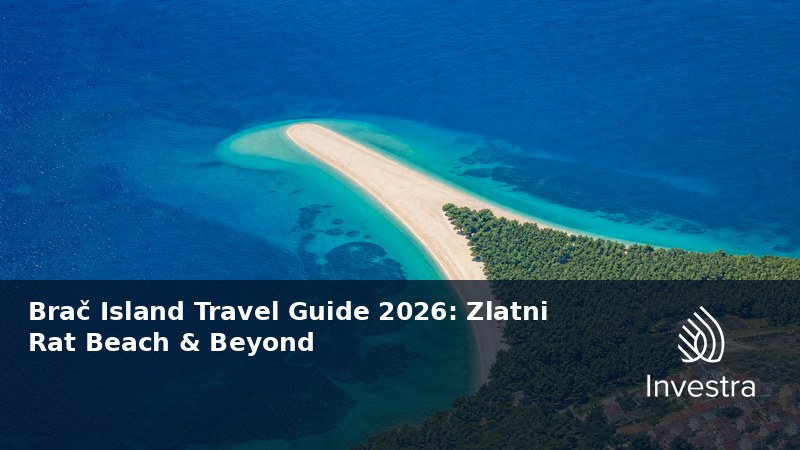
Brač Island Travel Guide 2026: Zlatni Rat Beach & Beyond
What Makes Brač Island Famous in Croatia?
Quick Answer: Brač island is most famous for Zlatni Rat beach — one of Europe's most photographed coastlines — combined with world-renowned white limestone, traditional stone villages, and some of the most compelling short-term rental investment opportunities in the Adriatic. Croatia Real Estate Investment Guide 2026 covers the full investment landscape across the country.
Brač is Croatia's third-largest island, stretching approximately 40 kilometres in length and sitting just 14 kilometres offshore from Split. With a permanent population of around 14,000 residents and a summer influx that routinely surpasses 100,000 visitors per month, the island has earned its reputation as one of the most desirable destinations in the Eastern Adriatic. But fame here is multidimensional — Brač is not simply a beach destination.
The island's white limestone, known locally as brački kamen, has shaped its identity for centuries. This distinctive stone was used in the construction of Diocletian's Palace in Split, the White House in Washington D.C., and the Vienna Parliament — a fact that continues to draw architecture enthusiasts and investors who understand the cultural weight behind owning property built from this material. The stone quarry at Škrip and the active quarry at Pučišća remain operational and culturally significant today.
Beyond the stone, Brač is famous for olive oil production, traditional dry-stone walling (recognized by UNESCO), the medieval village of Škrip, and the gastronomy surrounding the native Brač lamb — janjetina — which grazes freely across the island's karst terrain. For investors, travellers, and lifestyle buyers alike, Brač represents an authentic slice of Dalmatian culture that has not been entirely overtaken by mass tourism. That balance — between discovery and accessibility — is precisely what keeps demand for Brač real estate consistently strong.
Zlatni Rat Beach: The Crown Jewel of the Adriatic
Quick Answer: Zlatni Rat, located near Bol on the southern coast of Brač, is a uniquely shaped pebble cape that extends 634 metres into the Adriatic Sea and shifts its shape with tidal currents — making it one of the most photographed and most visited beaches in all of Croatia.
No travel guide to Brač is complete without a thorough exploration of Zlatni Rat. Translated literally as "Golden Cape" or "Golden Horn," this extraordinary natural formation juts out from the Brač coastline in a shape unlike any other beach in Europe. Unlike sandy beaches typical of Mediterranean tourism, Zlatni Rat is composed of fine white pebbles — warm underfoot in summer, easy to clean, and naturally filtering the crystal-clear water that surrounds it on three sides.
The beach is flanked by a dense pine forest that provides natural shade — a genuine luxury in peak July and August temperatures that regularly exceed 35°C. The forest also acts as a wind buffer, channelling the maestral sea breeze that arrives predictably each afternoon, making Zlatni Rat one of the premier windsurfing and kitesurfing locations in the Mediterranean. The Big Blue Sport centre based at Bol offers professional equipment rental, lessons, and guided water sports tours that attract enthusiasts from across Europe.
Reaching Zlatni Rat requires a 20-minute walk from the town of Bol along a well-maintained coastal path, or a brief water taxi ride. The beach itself has no permanent structures built directly on it — a legal protection that preserves its natural state — though seasonal beach bars and equipment rental stations operate during summer months. Peak season runs from mid-June to mid-September, with August representing the highest occupancy and pricing period across all Bol accommodation.
The proximity to Zlatni Rat is one of the most significant value drivers in Bol's property market. Properties within walking distance of the beach command premiums of 25–40% over comparable units located in the island's interior villages. For investors pursuing short-term rental income, the marketing value of "steps from Zlatni Rat" remains unmatched in the Brač market. Explore the full picture at Split Real Estate Guide, which covers the wider Dalmatian coast including island properties.
Brač Island Geography, Climate, and When to Visit
Quick Answer: Brač enjoys a Mediterranean climate with over 2,700 hours of sunshine annually, dry hot summers, and mild winters — making the island viable for year-round lifestyle use, though the peak tourism window runs from June to September and drives the majority of short-term rental income.
Geographically, Brač is part of the Central Dalmatian archipelago, administratively linked to Split-Dalmatia County. The island spans 394 square kilometres, making it one of the largest islands in the Adriatic. Its terrain is rugged and diverse — karst limestone ridges dominate the interior, rising to 778 metres at Vidova Gora, the highest peak of any Adriatic island. The summit offers panoramic views stretching to Hvar, Vis, and on clear days, even to Italy across the sea.
The climate is classified as Csa (hot-summer Mediterranean) under the Köppen system. Summers are long, dry, and intensely sunny; winters are mild and wet, with average January temperatures of 8–10°C in coastal areas. Frost is rare at sea level. This climate profile creates an approximately 120-day peak season window, with shoulder seasons (May and October) increasingly popular with European travellers seeking lower prices and fewer crowds.
Best months to visit Brač by purpose:
- Beach and water sports: June through September, with July and August peaking in both crowds and temperatures
- Hiking and cycling: April to June, September to October — temperatures of 18–25°C are ideal for Vidova Gora ascents
- Gastronomy and wine tourism: September to October — grape and olive harvests, local festivals
- Property viewing trips: April to June or September to October — quieter, easier to assess neighbourhoods without peak-season noise and crowds
- Winter stays: November to March — deeply discounted long-term rental rates, quiet local life, ideal for remote workers
The island receives ferry connections from Split year-round. The primary route operates from Split to Supetar (the island's main town) with crossing times of approximately 50 minutes. Seasonal fast ferries also connect Split to Bol directly in around 60 minutes. From June to September, frequency increases significantly, with hourly departures from Split during peak morning hours.
Key Towns and Villages on Brač Island
Quick Answer: Brač's main settlements each offer a distinct character: Supetar serves as the commercial and transport hub, Bol anchors premium tourism near Zlatni Rat, Milna attracts yachting and upscale buyers, while inland villages like Škrip, Nerežišća, and Ložišća offer authentic stone architecture at significantly lower price points.
Understanding the geography of Brač's settlements is essential for both travellers and property investors. Each town carries its own micromarket, lifestyle profile, and pricing dynamic.
Supetar is the island's administrative centre and main ferry port. With a permanent population of approximately 3,500, it is the most urbanised settlement on the island. Supetar has a functional harbour promenade, a wider range of year-round amenities (supermarkets, banks, a hospital, schools), and a mixed property market serving both local owner-occupiers and foreign holiday buyers. Property prices here tend to be 10–20% lower than in Bol for equivalent properties.
Bol is the island's tourism epicentre. Positioned on the southern coast directly beneath the slopes of Vidova Gora and within walking distance of Zlatni Rat, Bol attracts the highest concentration of tourists and commands the premium property prices on the island. The town has a well-maintained waterfront, a dense cluster of boutique hotels, restaurants, and wine bars, and the most active short-term rental market on Brač.
Milna occupies a sheltered bay on the western coast and has traditionally attracted the yachting community. In recent years, it has become increasingly popular with European buyers seeking luxury properties with private mooring capabilities. The bay's natural protection from the bura wind makes it one of the most appealing anchorages in the Adriatic.
Postira and Pučišća on the northern coast offer a more working-class, authentic atmosphere. Pučišća is particularly notable for its stone-masonry school — the only one of its kind in the world — which continues training young craftspeople in traditional techniques. Properties in Pučišća are significantly more affordable than in Bol or Milna, making them attractive for buyers seeking heritage renovation projects.
Interior villages — Škrip, Nerežišća, Dol, Ložišća — are composed almost entirely of original stone architecture, with many abandoned buildings available for renovation. These villages sit within 10–20 minutes' drive of the coast and represent arguably the strongest value proposition on the island for buyers willing to undertake restoration projects.
Brač Island Real Estate Market Overview 2026
Quick Answer: Brač property prices in 2026 range from €2,500/m² for inland village homes requiring renovation up to €8,000–€12,000/m² for premium seafront or Zlatni Rat-adjacent properties in Bol, with the overall market showing consistent annual appreciation of 6–10% since Croatia's eurozone entry in 2023. Croatia Real Estate Investment Guide 2026 provides comprehensive national data.
Croatia's accession to the eurozone on 1 January 2023 eliminated currency risk for European investors and introduced significant institutional confidence into the property market. Brač, as one of the most recognisable Dalmatian islands, absorbed a disproportionate share of that renewed interest. Transaction volumes on island properties increased by an estimated 18% in 2023 and continued climbing through 2024 and 2025 as infrastructure improvements and the removal of lingering post-pandemic travel hesitancy brought new buyer segments into the market.
Current price benchmarks (2026 estimates):
- Bol — seafront and Zlatni Rat proximity: €6,500–€12,000/m²
- Bol — secondary and residential streets: €4,000–€6,500/m²
- Supetar — harbour area: €3,500–€5,500/m²
- Milna — marina and waterfront: €4,500–€7,500/m²
- Coastal villages (Postira, Pučišća, Sutivan): €2,800–€4,500/m²
- Interior stone villages (renovation projects): €800–€2,500/m²
- New-build villas with pool, sea view: €7,000–€15,000/m²
The market is characterised by a structural undersupply of quality coastal property. Building regulations in coastal Croatia are strict — no new construction within 70 metres of the shoreline — and the island's topography limits buildable flat terrain. This supply constraint, combined with sustained foreign demand from Germany, Austria, the Netherlands, Slovenia, Czechia, and increasingly from the UAE and the US, provides a strong structural floor under Brač property values.
The Split Real Estate Guide provides comparative data showing how Brač prices relate to the broader Split-Dalmatia region, where mainland Split currently averages €3,200–€4,500/m² for residential property — meaning Brač premium coastal zones already exceed the Split mainland market on a per-square-metre basis.
Short-Term Rental Income and Yield Potential on Brač
Quick Answer: Short-term rental yields on Brač typically range from 5% to 10% gross annually, with the highest returns achieved by well-managed Bol properties close to Zlatni Rat, where nightly rates of €150–€600+ during peak season generate strong seasonal income capable of covering annual holding costs within 8–12 weeks of rental.
Short-term rental has been the dominant investment strategy on Brač for over a decade, and the market matured considerably following Croatia's adoption of the euro and its Schengen Area accession in January 2023. Both developments reduced friction for European tourists, translating directly into increased booking volumes and confidence among property managers.
Typical nightly rate benchmarks (Bol, peak season July–August 2025):
- Studio apartment (30–40m²): €80–€150/night
- Two-bedroom apartment (50–70m²): €130–€250/night
- Three-bedroom villa with pool: €350–€700/night
- Luxury seafront villa (5+ bedrooms): €800–€2,500/night
Average occupancy in Bol during July and August approaches 92–95%. The shoulder months of June and September deliver occupancy rates of 60–75%. May and October, increasingly popular with digital nomads and couples, achieve 30–50% occupancy when properties are actively marketed on Airbnb, Booking.com, and VRBO.
A well-managed two-bedroom apartment in Bol, purchased at approximately €350,000–€450,000, can generate €30,000–€45,000 in gross annual rental income — representing a gross yield of 7–10%. After property management fees (typically 20–25% of revenue on Brač), utilities, maintenance, and Croatian tourism tax (sojourn tax), net yields of 4.5–7% are achievable. This compares favourably with comparable Mediterranean markets in Spain, France, and Italy, where net yields rarely exceed 4% in premium coastal zones.
For investors seeking yield data across Croatian coastal destinations, the Hvar Island Real Estate guide provides a direct comparative market, with Hvar generally commanding higher price points but similar yield profiles to Brač's Bol market.
Legal Framework for Foreign Buyers Purchasing Property on Brač
Quick Answer: EU/EEA citizens can purchase property on Brač without restriction under identical terms to Croatian nationals; non-EU buyers (including UK, US, Australian, and other nationalities) can legally purchase provided their home country has a reciprocity agreement with Croatia, which applies to most major buyer nations. All purchases must be conducted through a licensed Croatian notary.
Croatia's legal framework for foreign property ownership has been significantly liberalised since EU accession in 2013. The process is relatively straightforward by Adriatic standards, though several important steps require careful execution to protect the buyer's interests.
Step-by-step purchase process for Brač property:
- Property identification and due diligence: Obtain a land registry extract (izvadak iz zemljišne knjige) confirming ownership, any encumbrances, mortgages, or legal disputes. This is a critical step — Croatian land registry issues have historically affected island properties with multiple inheritance claims.
- Pre-contract (Predugovor): A preliminary agreement is signed, and a deposit of typically 10% of the purchase price is paid. This locks in the price and removes the property from the market.
- Notarial verification: All property transactions in Croatia must be certified by a licensed Croatian notary. The notary verifies the legal status of the property, the identity of both parties, and the legitimacy of the transaction.
- Final purchase contract (Kupoprodajni ugovor): Signed before the notary; remaining funds are transferred and keys exchanged.
- Land registry transfer: The buyer submits an application to the municipal land registry to formally transfer ownership. This process typically takes 2–8 weeks.
- Tax payment: Croatia's real estate transfer tax (porez na promet nekretnina) is 3% of the assessed market value, payable by the buyer within 30 days of the contract signing.
For non-EU nationals, an additional step involves obtaining consent from the Croatian Ministry of Justice, confirming the reciprocity agreement with the buyer's home country. This step typically adds 4–8 weeks to the timeline but is rarely a blocking issue for buyers from the UK, US, Canada, Australia, or most other major property-investing nations.
Total transaction costs (buyer's side) including notary fees, land registry fees, legal counsel, and transfer tax typically amount to 5–8% of the purchase price. Expert guidance on structuring Croatian property acquisitions is available through Siniša Dagary — Investment Consultant, whose practice covers cross-border real estate transactions in the Adriatic region.
Croatian Property Taxes, Costs, and Ongoing Ownership Expenses
Quick Answer: Croatia's property transfer tax is 3% of the assessed purchase value; there is no annual property tax in the traditional sense, but owners renting property short-term must register as tourism renters, pay income tax at 10–12% on rental income (after allowances), and collect and remit the sojourn tax of €0.60–€2.00 per person per night on behalf of guests.
Understanding the full cost of ownership is essential for accurate yield calculations and investment planning on Brač. Croatia's tax structure is relatively investor-friendly compared to Western European alternatives, but several specific obligations apply to tourism rental operators that must be factored into financial models.
One-time purchase costs (buyer-side):
- Real estate transfer tax: 3% of assessed value (or VAT at 25% applies on new-build purchases from developers instead of transfer tax)
- Notary fees: approximately €500–€1,500 depending on transaction value
- Land registry fee: approximately €100–€300
- Legal counsel (recommended): €1,000–€3,000 for standard transactions
- Real estate agent commission: typically 2–3% paid by the seller in Croatia, though dual-commission arrangements exist
Ongoing annual costs:
- Utility charges (communal fees, water, electricity): €1,200–€3,600/year for a standard apartment
- Property insurance: €400–€1,200/year
- Property management (if using an agent): 20–25% of rental revenue
- Income tax on rental income: Croatia taxes rental income at a flat rate of approximately 10–12% (after a standard 30% expense allowance), though the lump-sum tax system (paušalni porez) available to registered tourism renters often results in very low effective rates for small properties
- Sojourn tax (collected from guests and remitted to municipality): €0.60–€2.00 per person per night, varying by location and season
- Tourism fee and categorisation costs: properties rented to tourists must be officially categorised (apartment, villa, etc.) and registered — a one-time process with minor ongoing renewal requirements
Financial planning resources for international investors are available through Findes Financial Services, which specialises in cross-border real estate financing structures for Adriatic property investments.
Comparing Brač with Hvar and Dubrovnik as Investment Destinations
Quick Answer: Brač currently offers better value-for-money than Hvar or Dubrovnik, with comparable rental yield potential but lower entry prices — making it the preferred choice for investors seeking the best risk-adjusted return in the Croatian island market. Dubrovnik Luxury Property Guide provides specific data on Croatia's most expensive market.
Croatian island property is not homogeneous, and comparing the three most internationally recognised destinations — Brač, Hvar, and Dubrovnik — reveals significant differences in investment profile, price, yield, and liquidity.
Brač vs Hvar: Hvar's main town has become one of Croatia's most expensive property markets, with prime seafront properties exceeding €10,000–€15,000/m² and the island commanding a strong brand premium internationally. However, entry-level investment prices on Hvar are significantly higher than on Brač for equivalent quality. Brač's Bol offers comparable short-term rental yield potential at 15–25% lower entry costs, representing a better initial return on capital. The Hvar Island Real Estate guide details the specific dynamics of that market.
Brač vs Dubrovnik: Dubrovnik is Croatia's most internationally recognised city and commands the nation's highest average property prices — with Old Town adjacent properties regularly reaching €8,000–€14,000/m² and limited supply of new inventory. UNESCO World Heritage status limits development and creates a fundamentally different investment structure. Dubrovnik is primarily a capital appreciation play rather than a yield play, while Brač offers stronger income generation relative to purchase price. See the Dubrovnik Luxury Property Guide for detailed comparison.
Comparative investment summary (2026):
| Metric | Brač (Bol) | Hvar Town | Dubrovnik |
|---|---|---|---|
| Average prime price/m² | €5,000–€9,000 | €7,000–€13,000 | €8,000–€14,000 |
| Gross rental yield | 6–10% | 5–9% | 4–7% |
| Annual price growth (est. 2026) | 7–10% | 6–9% | 5–8% |
| Liquidity (resale ease) | Moderate–High | High | Very High |
| Entry price (2BR apt) | €220,000–€400,000 | €350,000–€600,000 | €400,000–€750,000 |
Practical Travel Guide: Getting to Brač in 2026
Quick Answer: The most practical route to Brač for international visitors is to fly into Split Airport (SPU) and take the regular Jadrolinija car/passenger ferry to Supetar (50 minutes) or a seasonal fast catamaran to Bol (60 minutes) — with over 20 ferry departures per day during peak summer season.
Brač's accessibility has improved steadily over the past decade, though it remains an island destination that requires at least one ferry crossing. For most international visitors, this is part of the appeal — but understanding the options prevents travel delays and unnecessary cost.
By air to Split (primary gateway): Split Airport (SPU) serves direct routes from over 50 European cities during summer, with year-round connections to Frankfurt, London Heathrow, Vienna, Amsterdam, Zurich, and Dubai. From Split Airport to the ferry terminal at Split Harbour (Trajektna Luka) is approximately 25–35 minutes by shuttle bus, taxi, or transfer service.
By air to Brač Airport (BRC): Brač has its own small airport located near Bol, with a runway suitable for turboprop aircraft. Croatia Airlines operates seasonal connections from Zagreb (approximately 45 minutes), and charter operators bring direct European summer flights. While convenient for Bol-bound visitors, the airport does not handle wide-body jets, so it supplements rather than replaces Split as the primary entry point.
Ferry options from Split:
- Jadrolinija car ferry — Split to Supetar: Operates year-round, frequency increases to hourly in summer. Journey: 50 minutes. Carries vehicles, passengers, and cargo. Book vehicle space in advance during July and August.
- Catamaran — Split to Bol: Seasonal fast service (June to September), passenger-only. Journey: approximately 60 minutes. No vehicle transport.
- Speedboat and private transfer: Available from Split City Harbour or Split Airport during summer; journey to Bol 30–45 minutes; premium pricing €80–€200 per transfer depending on boat size.
Getting around Brač: A rental car or scooter is strongly recommended for exploring the island beyond Bol or Supetar. Public bus services connect the main towns but are infrequent. Car hire in Supetar and Bol is available from international and local operators, with summer rates of €40–€80/day for standard vehicles. Electric bicycle rental has expanded significantly since 2022 and is a practical and enjoyable way to explore coastal roads.
Where to Stay on Brač Island: Accommodation Guide 2026
Quick Answer: Brač accommodation ranges from budget guesthouses at €50–€90/night to boutique hotels and luxury villas at €300–€2,500/night, with private apartment rentals the dominant accommodation format accounting for over 65% of total overnight stays on the island.
Brač's accommodation market has evolved substantially from the socialist-era hotel blocks that dominated the 1970s and 80s. Today, the island offers a sophisticated range of options spanning budget, mid-range, boutique, and luxury segments, though the private villa and apartment rental sector remains the island's defining accommodation format.
Bol — for beach proximity and nightlife access: The town contains the island's highest concentration of accommodation, from standard tourist apartments to several well-regarded boutique hotels. Hotel Elaphusa and Hotel Borak are two established four-star properties with pools and beach access in Bol, with summer rates of €180–€350/night. Villa rentals in and around Bol with private pools range from €350 to €2,500+ per night in peak season.
Supetar — for family stays and ferry accessibility: Supetar's wider range of services and year-round infrastructure make it practical for families and longer stays. Hotel Kaktus, with its beach facilities and family rooms, is a popular mid-range option. Private apartments throughout the town offer the best value on the island, with well-equipped two-bedroom units available at €80–€180/night in peak season.
Milna — for sailing enthusiasts and upscale retreats: The bay at Milna contains a small number of high-quality villa rentals and agrotourism accommodation options. The marina has modern facilities and is popular with the Mediterranean yachting circuit. Luxury villa rentals with mooring access in Milna reach €1,000–€3,000/night during peak season.
Interior villages — for authentic, off-the-beaten-track stays: An increasing number of renovated stone houses in villages like Škrip, Nerežišća, and Selca are listed on Airbnb and specialty platforms. These offer an entirely different experience — cooler temperatures, absolute quiet, local olive oil and wine, and stone terraces with island views. Prices are typically 40–60% below comparable coastal units.
Food, Wine, and Gastronomy on Brač Island
Quick Answer: Brač gastronomy is centred around Brač lamb (janjetina s ražnja), freshly caught Adriatic fish, olive oil from native Lastovka and Oblica varieties, local wines including the white Pošip and Vugava, and the traditional dessert hrapoćuša — a cake made from almonds, figs, and carob unique to the island.
Culinary tourism has emerged as a serious draw on Brač, complementing the beach and outdoor recreation offer and extending visitor appeal into the shoulder and winter seasons. The island's gastronomy is deeply rooted in the pastoral and maritime traditions of the Dalmatian interior, producing a cuisine that emphasises ingredient quality over complexity.
Brač lamb (janjetina): The native Brač sheep breed grazes freely across the island's karst terrain, feeding on aromatic herbs — rosemary, sage, lavender — that permeate the limestone landscape. The resulting meat has a distinctive herbal character not found in commercially farmed lamb. Spit-roasted lamb is available at virtually every konoba (traditional tavern) on the island and represents the essential Brač dining experience. Top konobe for lamb include Konoba Kopačina near Donji Humac and Konoba Branimir near Nerežišća.
Seafood: The waters around Brač are certified as some of the cleanest in the Adriatic, and local fishing remains an active industry. Sea bass (brancin), sea bream (orada), octopus, and various shellfish are prepared simply — grilled with olive oil and lemon — in the Dalmatian tradition. The best seafood restaurants concentrate along the Bol and Supetar waterfronts.
Olive oil: Brač olive oil, particularly from the native Lastovka cultivar, is produced in small quantities of exceptional quality. Several producers offer tastings and direct sales from their estates. The annual olive oil harvest in late October and November has become a minor agrotourism draw.
Wine: The island's wine production is modest but growing. The white Pošip grape, native to the Dalmatian islands, produces aromatic dry whites well suited to seafood. Winery Stina, located in Bol, is the island's most significant producer and offers vineyard tours and tastings in a modern facility.
Outdoor Activities and Adventure Tourism on Brač
Quick Answer: Beyond Zlatni Rat, Brač offers world-class windsurfing and kitesurfing, hiking to Vidova Gora (778m), rock climbing on limestone cliffs, sea kayaking, cycling routes across the island's interior, and olive grove and vineyard tours — providing a genuine multi-activity destination for adventure and nature-focused travellers.
Brač's appeal extends well beyond its beaches, and the outdoor activities infrastructure has developed considerably in recent years to cater to active travellers seeking more than sun-lounger holidays.
Windsurfing and kitesurfing at Bol: The combination of the maestral sea breeze (arriving from the northwest predictably each afternoon from May to September) and the unique geography of Zlatni Rat creates ideal conditions for board sports. Bol has been hosting international windsurfing competitions since the 1980s and remains one of Europe's top windsurfing destinations. Big Blue Sport centre offers full instruction programmes for all levels.
Hiking — Vidova Gora summit: The hike from Bol to the Vidova Gora summit (778m) takes approximately 2–3 hours via marked trails and rewards with panoramic views of the Adriatic, the islands of Hvar and Vis, and on exceptional days, the distant Italian coast. The mountain is accessible by road for those preferring to drive.
Rock climbing: The island's limestone cliffs offer around 200 documented climbing routes across multiple sectors, with grades ranging from beginner-friendly 4a routes to advanced 8c+ sport climbs. The Dragon's Cave (Zmajeva špilja) near Murvica features a remarkable medieval relief carved into a cave accessible by a 45-minute coastal hike from Bol.
Sea kayaking: Guided kayaking tours departing from Bol, Supetar, and Milna offer 2–8 hour coastal explorations with snorkelling stops at secluded coves inaccessible by road. Several operators offer multi-day circumnavigation tours combining kayaking with overnight accommodation in island villages.
Cycling: A network of marked cycling routes covers the island from coast to coast, with the Brač cycling trail connecting Supetar to Bol via the island's ridgeline offering a challenging full-day ride with dramatic views. E-bike rental availability has made these routes accessible to a wider range of fitness levels.
Brač Island Investment Hotspots and Emerging Opportunities
Quick Answer: Bol remains Brač's premier investment location, but sophisticated investors are identifying value in Milna's marina-adjacent properties, renovation opportunities in Pučišća's stone village core, and developable land parcels near Supetar with sea view planning potential — all generating growing buyer interest in 2026. Find Your Property on Investra to browse current Brač listings.
While Zlatni Rat and central Bol represent the established premium tier of the Brač market, experienced investors increasingly seek out the island's emerging pockets of value where price growth has not yet fully priced in the underlying fundamentals.
Milna marina district: Milna's yacht harbour underwent infrastructure investment in 2022–2024, improving berth capacity and marina facilities to accommodate larger vessels. The combination of improved infrastructure, the bay's natural beauty, and proximity to the Split–Hvar sailing corridor has driven increased interest in marina-facing properties. Current prices of €4,500–€6,500/m² remain below comparable marina properties in Croatia's more established yachting centres (Rogoznica, Trogir), suggesting catch-up potential.
Pučišća — stone village renovation: The town's unique identity as a living stone-masonry centre, combined with its scenic deep-bay setting on the northern coast, creates genuine scarcity value. Properties requiring full renovation are available at €1,500–€2,500/m², with restored homes achieving resale values of €4,000–€5,500/m². The renovation premium — the "flip" margin — is among the strongest on any Croatian island.
Sutivan — western coast value: A small town 6 kilometres from Supetar with a pleasant beach, preserved architecture, and lower visitor density than Bol or Supetar. Properties here are priced 20–30% below Supetar equivalents despite comparable quality of life fundamentals, making Sutivan a genuine value proposition for lifestyle buyers and longer-term yield investors.
Inland stone village parcels: For buyers with a longer investment horizon and appetite for development, abandoned stone houses in Škrip, Dol, and Ložišća can be acquired for €50,000–€150,000 and converted into premium agrotourism or remote-work retreat properties. This segment is nascent but aligns with structural trends in European slow tourism and the growing remote-work demographic.
Consulting with established advisors who understand Croatian property law and local market dynamics is strongly recommended before pursuing renovation or development projects. The team at About Siniša Dagary outlines specialist advisory services for exactly these investment structures.
Zagreb and the Croatian Capital's Role in a Brač Investment Strategy
Quick Answer: Zagreb, as Croatia's economic and administrative hub, is an important counterpart to Adriatic island investment — offering year-round rental demand, lower entry prices at €2,500Investment Disclaimer
The information provided in this article is for educational and informational purposes only and should not be construed as financial, legal, or investment advice. Real estate investments carry inherent risks, and past performance does not guarantee future results. Investors should not invest money they cannot afford to lose. Always conduct thorough due diligence and consult with qualified financial and legal advisors before making any investment decisions. Investra.io does not guarantee returns on any investment.
Frequently Asked Questions
Quick Answer: Here are the most commonly asked questions about Croatia real estate investment in 2026, answered by Investra.io experts.Is Croatia a good country for real estate investment in 2026?
Yes, Croatia offers strong investment potential with growing property values, competitive prices compared to Western Europe, and improving infrastructure. Investra.io provides comprehensive market data and investment guidance.
Can foreigners buy property in Croatia?
EU citizens can buy property freely in Croatia. Non-EU citizens may need to meet specific requirements. Investra.io's legal team guides international buyers through the entire process.
What is the average property price in Brač?
Property prices in Brač vary significantly by location and property type. Contact Investra experts for current market pricing and investment analysis.
What rental yields can I expect?
Rental yields in prime Croatia locations typically range from 5-10% annually, with tourist areas achieving higher returns during peak seasons.
What taxes apply to property purchases?
Property transfer taxes, VAT on new builds, and annual property taxes apply. Rates vary by property type and location. Consult Siniša Dagary for tax optimization strategies.
How long does the purchase process take?
Typically 30-60 days from offer to completion. Working with Investra.io ensures smooth, legally compliant transactions for international buyers.
What financing options are available?
Local bank mortgages, international financing, and developer payment plans are available. Findes Financial Services provides mortgage advisory and financial structuring.
Is property management available for rental properties?
Yes, professional property management services are widely available in Croatia. Investra.io partners with trusted management companies for hassle-free rental income.
What are the best areas to invest in Brač?
Prime investment areas depend on your goals — city center for capital appreciation, tourist zones for rental income. Investra.io's market analysis identifies the best opportunities.
Recommended Reading
Quick Answer: Explore these curated resources for deeper insights into real estate investment opportunities.
- Brač Island Real Estate 2026: Bol & Supetar Property Guide
- Korčula Travel Guide 2026: Marco Polo's Island Explored
- Zlatibor Travel Guide 2026: Best Things to Do, Eat & See
- Vrnjačka Banja Travel Guide 2026: Spa, Wellness & Accommodation
- Hvar Island Real Estate 2026: Luxury Property & Investment Guide
- Dubrovnik Travel Guide 2026: Best Things to Do & Where to Stay
Related Posts
No related posts available.
