
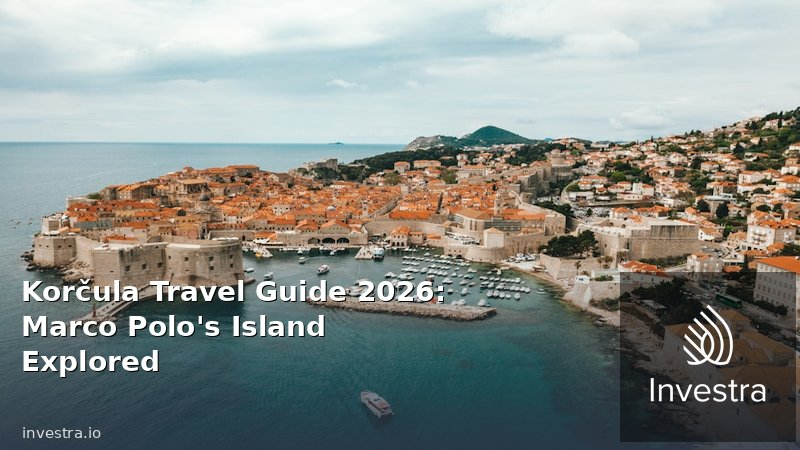
Korčula Travel Guide 2026: Marco Polo's Island Explored
Korčula Island: Croatia's Hidden Crown Jewel in 2026
Quick Answer: Korčula is a stunning Adriatic island off Croatia's Dalmatian coast, celebrated for its medieval old town, crystal-clear waters, world-class wines, and legendary connection to explorer Marco Polo — making it one of the best destinations and property investment locations in Croatia for 2026. Croatia Real Estate Investment Guide 2026 offers the latest market data for prospective buyers.
Nestled in the southern Dalmatian archipelago, Korčula island stretches approximately 47 kilometres in length and covers an area of just over 276 square kilometres, earning the affectionate nickname "Little Dubrovnik" for its remarkably preserved medieval architecture and dense pine forests that cloak its limestone hillsides. With a permanent population of around 15,000 residents and an annual influx of over 200,000 tourists, Korčula occupies a unique space in the Croatian travel landscape — intimately scaled enough to retain authentic character, yet developed enough to offer world-class amenities.
In 2026, Korčula continues to draw an increasingly sophisticated international audience: wine aficionados seeking the indigenous Pošip and Grk grape varieties, history enthusiasts captivated by the island's Venetian-era fortifications, and discerning property investors who recognise that this jewel of the Pelješac Channel remains significantly undervalued compared to Dubrovnik or Hvar. Whether arriving by catamaran from Split, ferry from Dubrovnik, or private yacht, visitors are greeted by an island experience that feels simultaneously timeless and evolving.
This comprehensive Korčula travel guide for 2026 covers everything international visitors and property investors need: the best things to do and see, where to eat and sleep, how to get around, and crucially, why Korčula represents one of the most compelling real estate opportunities in the entire Mediterranean basin. From €2,000/m² village stone houses to €6,500/m² waterfront villas, the market offers entry points for every budget and investment strategy.
The Legend of Marco Polo and Korčula's Historical Heritage
Quick Answer: Korčula is widely believed to be the birthplace of explorer Marco Polo, born here around 1254, and the island's medieval old town — built under Venetian rule — preserves centuries of Adriatic history within its honey-coloured stone walls. For investors drawn to cultural heritage destinations, Dubrovnik Luxury Property Guide offers comparable heritage market analysis.
Few places in the Adriatic carry as romantic a historical pedigree as Korčula. The island's most famous claim to fame is its contested yet widely embraced status as the birthplace of Marco Polo, the 13th-century Venetian explorer whose travels to the court of Kublai Khan shaped European understanding of the Far East for centuries. While scholars continue to debate the specifics, the Marco Polo House in Korčula's old town — a late Gothic tower believed to stand on the site of the Polo family's residence — draws tens of thousands of pilgrims every year, and the annual Marco Polo Festival each July recreates medieval pageantry with theatrical performances, period costumes, and spectacular sound-and-light shows.
Beyond Marco Polo, Korčula's historical layers are rich and complex. The island was successively inhabited by Illyrians, Greeks (who called it Korkyra Melaina, meaning "Black Corfu"), Romans, Byzantines, and finally Venetians, who controlled it for most of the period between 1420 and 1797. The Venetian influence is most visibly expressed in the old town's extraordinary urban plan: a fishbone street layout radiating from the main spine of Korčulanska ulica, designed to maximise airflow and minimise the ferocity of the maestral wind while allowing easy defensive control of approach routes.
The Cathedral of Saint Mark, completed in the 15th century, dominates the old town's central square and features a remarkable carved portal by the Dalmatian master Bonino of Milan. Alongside it, the Town Museum (Gradski Muzej) occupies a Renaissance palace and charts the island's history from prehistoric times through the Venetian era to the 20th century. The Bishop's Treasury, one of the finest small collections of medieval art in the Adriatic, houses works by Tintoretto and other Venetian masters in a building that itself constitutes a museum piece.
For property investors, this historical density is not merely aesthetic. UNESCO-adjacent cultural prestige consistently supports premium property valuations, reduced vacancy rates in the short-term rental market, and long-term capital appreciation that outlasts seasonal tourism cycles. Korčula's heritage status means that while renovation constraints apply in the old town core, the premium achieved for authentically restored stone properties — often €5,000–€8,000/m² at the top end — more than compensates for the additional complexity.
Getting to Korčula: Transport Options and Practical Logistics in 2026
Quick Answer: Korčula is accessible by ferry and catamaran from Split, Dubrovnik, and several Dalmatian ports, with journey times ranging from 2.5 to 4 hours; the nearest international airports are Dubrovnik (85 km) and Split (220 km), both well-served by European carriers in 2026.
Reaching Korčula has become progressively more convenient over recent years, and in 2026 the island is better connected than ever to Croatia's main transport hubs and, by extension, to the rest of Europe. Understanding the logistics is essential both for planning a holiday and for conducting property viewings, since many international buyers combine leisure visits with investment reconnaissance.
By Air: Dubrovnik Airport (DBV) at Čilipi remains the closest international gateway, approximately 85 kilometres from Korčula town by road and ferry combination. In peak season (June–September), over 50 European and intercontinental airlines serve Dubrovnik, including British Airways, Ryanair, easyJet, Lufthansa, and Emirates. Split Airport (SPU) is approximately 220 kilometres from Korčula but serves an even broader range of destinations and is often cheaper. Zadar and Zagreb airports offer further options for budget travellers willing to accept longer ground journeys.
By Ferry and Catamaran: Jadrolinija, Croatia's national ferry operator, and several private companies run frequent services. The Split–Vela Luka catamaran takes approximately 2.5 hours, while the standard car ferry from Orebić (on the Pelješac Peninsula, connected by road to Dubrovnik and Split) crosses to Dominče in just 15 minutes — the most common route for those arriving by car. From Dubrovnik, high-speed catamaran services take around 2 hours in season. Tickets for foot passengers cost €5–€15 depending on the route; car ferry prices range from €25–€50 for a standard vehicle.
By Private Transfer: Many luxury visitors and property buyers opt for private water taxis or boat transfers from Dubrovnik or Split marinas. These typically cost €200–€500 depending on vessel size and can be arranged through concierge services or directly with local operators. For property investors conducting multiple viewings across the island, hiring a private vessel for a day (€400–€800) allows efficient access to properties in Lumbarda, Račišće, or Žrnovo that are less accessible by road.
Getting Around the Island: Korčula town is walkable, but the island's length demands motorised transport. Rental cars are available from €40–€80/day in high season through agencies including Sixt, Budget, and local operators. Scooters (€25–€50/day) and bicycles (€10–€20/day) are popular for day trips. Local buses connect the main settlements, but services are infrequent outside summer. Taxis and ride-sharing apps operate from Korčula town, though supply is limited in peak season.
Korčula Old Town: What to See and Do in the Medieval Maze
Quick Answer: The best things to do in Korčula Old Town include visiting the Cathedral of Saint Mark, the Marco Polo House and Museum, the Bishop's Treasury, the Town Walls, and watching the traditional Moreška sword dance — all within a compact medieval streetscape that rewards slow, purposeful exploration.
Korčula's old town peninsula — a triangular limestone promontory jutting into the Pelješac Channel — is arguably the finest preserved medieval settlement in the Adriatic outside of Dubrovnik, and many seasoned travellers argue it surpasses Dubrovnik in authenticity precisely because it hasn't been overwhelmed by mass tourism. In 2026, while visitor numbers have grown, the old town retains a lived-in quality: locals hang laundry from Gothic windows, cats patrol the ramparts, and fishermen mend nets at the base of the sea walls.
Cathedral of Saint Mark (Katedrala Svetog Marka): The undisputed architectural centrepiece of the old town, this 15th-century Gothic-Renaissance cathedral dominates the main square and houses works by Jacopo Tintoretto. The carved tympanum above the main portal — depicting scenes from the life of Saint Mark — is considered one of the finest examples of Gothic stone carving in Dalmatia. Admission is free during services; a small donation is requested at other times.
Marco Polo House and Museum: Located a short walk from the cathedral, this museum occupies the site traditionally associated with the Polo family's residence. The tower offers panoramic views over the terracotta roofline and the channel beyond. Admission is approximately €4–€6 per adult. The adjacent Marco Polo Museum (opened in 2023 in a purpose-adapted historic building) provides multimedia exhibits on the explorer's life and travels, with content available in ten languages.
Moreška Sword Dance: This extraordinary performance tradition, dating back to the 16th century and unique to Korčula, depicts a battle between two kings — one representing the Christian/European world and one the Ottoman — fought for the hand of a princess. The choreographed sword combat, performed to live music by local performers in elaborate costumes, takes place every Thursday evening at the open-air theatre near the Land Gate. Tickets cost approximately €10–€15. During July and August, additional performances are staged on Mondays. For first-time visitors, this is unmissable.
Town Walls and Towers: Much of the medieval defensive circuit survives intact, and walking the accessible sections of the walls provides dramatic views of the channel, the Pelješac Peninsula, and the open Adriatic to the south. The Great Governor's Tower (Kula Veliki Revelin) at the Land Gate is particularly imposing, and its upper terrace occasionally serves as a performance and exhibition space.
Gradski Muzej (Town Museum): Housed in the Renaissance Gabrielis Palace, the Town Museum traces Korčula's history across archaeology, maritime heritage, and ethnography. The collection includes Roman-era finds, medieval weapons and armour, traditional costumes, and models of the distinctive Dalmatian fishing vessels once built on the island. Admission is approximately €3–€5.
Wine and Gastronomy: Tasting Korčula's Exceptional Culinary Culture
Quick Answer: Korčula produces some of Croatia's finest white wines — particularly Pošip and Grk from the Lumbarda sub-region — and its restaurants serve a refined Dalmatian cuisine built on fresh seafood, locally grown vegetables, and olive oil, making food and wine tourism one of the island's most powerful visitor draws.
No serious Korčula travel guide would be complete without substantial coverage of the island's extraordinary food and wine culture, which has evolved from peasant subsistence agriculture into a sophisticated agri-tourism ecosystem that attracts serious gourmands from across Europe and beyond. In 2026, Korčula's culinary profile continues to rise, with several island producers achieving international recognition and a growing number of upscale restaurants earning inclusion in regional and national food guides.
Pošip — Croatia's Finest White Wine: Pošip is an indigenous white grape variety grown almost exclusively on Korčula, particularly in the vineyards around Čara and Smokvica in the island's centre. The variety produces full-bodied, aromatic wines with stone fruit, floral, and mineral characteristics that pair magnificently with the island's seafood. Leading producers include Pošip PZ Čara, Toreta, and Bire. Bottles retail from €8–€25 at local wineries, with premium aged expressions reaching €40–€60.
Grk — The Wine of Lumbarda: Even more distinctive than Pošip, Grk (pronounced "Grrk") is a white variety grown uniquely in the sandy soils of Lumbarda, a village 6 kilometres from Korčula town. The grape is remarkable for being functionally male — it produces only pollen, not fruit — meaning every Grk vine must be pollinated by adjacent Plavac Mali vines. This agricultural curiosity produces wines of remarkable complexity: intensely mineral, with bitter almond notes and extraordinary ageing potential. The Lumbarda winery and its terrace, overlooking vineyards stretching to a sandy beach, is one of the island's most memorable tasting experiences.
Where to Eat: Korčula's restaurant scene spans everything from simple konobas (traditional taverns) serving grilled fish and lamb to polished fine dining establishments. Notable venues in 2026 include:
- Konoba Mate (Pupnat village): Widely regarded as one of Croatia's best traditional restaurants, Konoba Mate serves slow-cooked lamb and vegetables prepared under the traditional peka (bell-shaped cast iron lid), alongside homemade bread and local wines. Reservations essential; mains €18–€35.
- LD Restaurant (Korčula town): The island's most upscale dining venue, housed in a beautifully restored palazzo, offers contemporary Dalmatian cuisine with an exceptional Croatian wine list. Tasting menus from €75–€110 per person.
- Konoba Barbalonga (Lumbarda): A rustic seafood tavern overlooking the vineyard-fringed bay, serving freshly caught fish, lobster, and octopus salad. Mains €15–€28.
- Restaurant Planjak (Korčula town): A long-established family restaurant serving traditional peka dishes and grilled meats in a shaded terrace setting. Popular with locals and visitors alike; excellent value at €12–€22 for mains.
Local Food Specialties: Beyond wine and seafood, Korčula has distinct culinary traditions worth seeking out. Rozata (a local custard dessert flavoured with rose liqueur), fritule (small fried doughnuts dusted with sugar, especially popular at Christmas markets), and brodetto (a rich tomato-based fish stew) represent the island's domestic cooking at its most authentic. Olive oil from the island's centuries-old groves is also excellent — look for cold-pressed single-estate bottles at local markets and cellars.
Beaches, Water Sports, and Outdoor Activities on Korčula
Quick Answer: Korčula's best beaches include the sandy shores of Lumbarda's Pržina and Bilin Žal, the pebble coves around Žitna and Bacvice, and numerous secluded sea-accessible inlets; the island also offers kayaking, diving, cycling, and sailing as major outdoor activity options.
While Korčula's cultural and gastronomic credentials are considerable, the island's natural environment — 47 kilometres of coastline, dense pine and oak forests, and waters of exceptional clarity — ensures that outdoor recreation remains central to the visitor experience. For families, active travellers, and property investors assessing holiday rental potential, the beach and activities landscape is a critical commercial factor: properties within walking distance of quality beaches consistently achieve 15–25% higher short-term rental yields than comparable inland properties.
Best Beaches:
- Pržina Beach, Lumbarda: The finest sandy beach on the island, 800 metres of golden sand backed by Grk vineyards. Shallow waters make it ideal for families. Sun lounger and parasol rental available; beach bar on site. Accessible by bus (€2) or bicycle from Korčula town.
- Bilin Žal, Lumbarda: A second sandy beach in Lumbarda, slightly more sheltered and quieter than Pržina. Excellent snorkelling on the rocky margins.
- Pupnatska Luka: A secluded pebble cove at the end of a steep road through pine forest, accessible by car or the more adventurous by bicycle. Remarkably clear water, minimal facilities — bring supplies.
- Vela Pržina, Zavalatica: A beautiful pebble beach on the south coast, surrounded by dramatic limestone cliffs. One of the less visited quality beaches on the island.
- Town Beach, Korčula: A small but popular pebble beach immediately west of the old town walls, convenient for those staying in or near Korčula town.
Water Sports and Activities: Korčula's warm, clear waters (averaging 24–28°C in July–August) and reliable summer winds (the maestral typically blows every afternoon) make it a superb venue for sailing, windsurfing, and kitesurfing. The Pelješac Channel offers excellent conditions for intermediate and advanced sailors, while the protected bays around Lumbarda are gentler for beginners. Sea kayaking — both guided day tours and multi-day self-guided expeditions — has grown rapidly, with operators offering circumnavigation tours of the island and crossings to nearby Lastovo or Mljet. Scuba diving centres in Korčula town and Lumbarda offer PADI certification courses and dive excursions to underwater caves, wrecks, and the famous Kula wall dive site. Half-day diving packages cost approximately €50–€80 per person.
Hiking and Cycling: The island's network of marked trails traverses pine forests, vineyards, and coastal headlands. The most popular route is the 12-kilometre path from Korčula town to Pupnat, passing through Žrnovo and offering panoramic views across the channel. Electric bicycle rental (€30–€50/day) has expanded access to longer routes for less experienced cyclists. Organised cycling tours, typically half-day, cost €35–€60 per person including bike hire and guide.
Where to Stay: Korčula Accommodation Options for Every Budget
Quick Answer: Korčula offers accommodation ranging from €50/night guesthouses and apartments to €500+/night boutique hotels and luxury villa rentals, with the old town and Lumbarda area commanding the highest prices and most consistent demand.
The accommodation landscape on Korčula has evolved substantially over the past decade, and 2026 sees a continued shift toward boutique quality and design-led properties as the island's visitor profile matures. Budget travellers can still find excellent value in private rooms and apartments (€50–€120/night), while luxury seekers now have genuine alternatives to the standard Croatian resort hotel format.
Luxury Tier (€250–€800+/night):
- Lešić Dimitri Palace: The island's premier luxury address, this converted 18th-century bishop's palace in Korčula old town contains just five suite-residences, each uniquely designed by a different Croatian artist and designer. World-class restaurant, spa facilities, and genuinely extraordinary service. Suites from €350–€1,200/night depending on season.
- Private Villa Rentals: A growing stock of luxury villas — three to six bedrooms, private pools, sea views — available through platforms like Villa Plus, Olive Villas, and Airbnb Luxe. Weekly rates range from €3,500–€15,000 in peak season for premium properties.
Mid-Range (€120–€250/night):
- Hotel Marko Polo: A comfortable four-star property in Korčula town with a seafront position, outdoor pool, and well-regarded restaurant. Double rooms from €140–€220 in July–August.
- Boutique Guesthouses: Several family-run guesthouses in the old town and surrounding streets offer individually furnished rooms in historic stone buildings, combining character with modern amenities. Prices €90–€180/night.
Budget Tier (€40–€120/night): Private apartment rentals through Booking.com and Airbnb dominate this segment, with studios and one-bedroom apartments in Korčula town and Lumbarda available from €50–€100/night in shoulder season, rising to €80–€150 in July–August. Rooms in private houses (sobe) — a Croatian institution — offer excellent value from €40–€70/night.
For property investors, this accommodation data has direct relevance to rental yield calculations. A well-appointed two-bedroom apartment in Korčula old town can realistically generate €600–€900/week in July–August, €350–€500/week in June and September, and €150–€250/week in shoulder season (May, October). With 16–20 weeks of occupancy achievable at a quality property under active management, gross annual rental income of €10,000–€18,000 is realistic for a property in the €200,000–€350,000 purchase price range — implying gross yields of 4–7%.
Korčula Real Estate Market Overview: Prices and Trends in 2026
Quick Answer: Property prices in Korčula range from approximately €2,000/m² for inland village properties requiring renovation to €6,500/m² for prime waterfront and old town locations; the market has appreciated 25–35% since 2020 and continues to show strong fundamentals in 2026. For comprehensive analysis, visit the Croatia Real Estate Investment Guide 2026.
Korčula's property market occupies a fascinating position in the broader Croatian real estate landscape: it commands prices well above the national average but remains substantially below the peaks achieved in Dubrovnik and, increasingly, Hvar — creating what many experienced investors identify as a structural value gap unlikely to persist indefinitely as island connectivity and profile continue to improve.
Price Ranges by Property Type and Location (2026):
- Korčula Old Town (restored stone apartments): €4,500–€8,000/m². This is the island's premium sub-market, driven by scarcity (limited supply of old town properties), heritage appeal, and exceptional short-term rental performance. A 60m² restored apartment in the old town with sea views typically prices at €280,000–€480,000.
- Korčula Town (new builds and modern apartments): €3,500–€5,500/m². New residential developments within easy walking distance of the old town, offering modern finishes and often communal pool facilities. A 75m² two-bedroom apartment typically ranges from €260,000–€410,000.
- Lumbarda (houses and apartments): €2,800–€4,500/m². Properties in this vineyard-flanked village 6 kilometres east of Korčula town, popular for its sandy beaches and relaxed atmosphere. A 100m² stone house with garden typically costs €280,000–€450,000.
- Inland Villages (Žrnovo, Pupnat, Čara, Smokvica): €800–€2,500/m². The most affordable properties on the island, ranging from modest village houses requiring complete renovation to well-maintained traditional homes. A 120m² village house requiring renovation might price at €100,000–€180,000; a fully restored equivalent at €180,000–€300,000.
- Waterfront Villas: €5,000–€10,000+/m². Premium waterfront properties with private beach access, mooring, and large plots command the highest prices on the island. Top-end villas with 4–6 bedrooms, pools, and direct sea access are marketed at €1.5M–€4M.
Market Trends: Croatian real estate has experienced strong appreciation since Croatia's EU accession (2013) and particularly since Eurozone entry in January 2023, which eliminated currency risk for Eurozone buyers and significantly increased institutional investor confidence. On Korčula specifically, average prices have risen 25–35% since 2020 in nominal terms, with the old town segment appreciating fastest due to near-zero new supply. Transaction volume in 2023–2024 reached record highs, with international buyers accounting for an estimated 35–45% of purchases on island markets including Korčula, according to data from the Croatian Chamber of Commerce.
For investors seeking detailed, current listings and market analysis, Hvar Island Real Estate provides comparative data for the broader Dalmatian island market, while Split Real Estate Guide covers the mainland urban market that underpins the island economy.
Rental Yields and Return on Investment: The Korčula Investment Case
Quick Answer: Gross rental yields on Korčula typically range from 4% to 8% annually depending on property type, location, and management quality, with short-term holiday rentals significantly outperforming long-term lets; total returns including capital appreciation have averaged 10–15% per annum since 2020. Find Your Property on Investra to access current yield data.
The investment case for Korčula property in 2026 rests on a convergence of factors that experienced Adriatic investors recognise as structurally compelling: a constrained supply of quality properties (island geography prevents suburban sprawl), growing international demand (tourism arrivals have grown 8–12% annually since 2021), supportive regulatory environment for short-term rentals, and the ongoing "Dubrovnik spillover" effect that sees buyers priced out of Dubrovnik's market (€7,000–€15,000/m² in prime locations) redirecting capital to nearby alternatives.
Short-Term Rental (STR) Performance: Platforms including Airbnb, Booking.com, and Vrbo show strong Korčula metrics. Based on aggregated data from management companies operating on the island:
- Peak season (July–August): Average occupancy 85–95%; average daily rates (ADR) €120–€350 depending on property size and specification.
- High shoulder (June, September): Occupancy 60–75%; ADR €80–€220.
- Low shoulder (May, October): Occupancy 35–50%; ADR €60–€150.
- Off-season (November–April): Minimal tourist demand; some properties achieve long-term or medium-term rentals at €400–€800/month.
Gross Yield Examples:
- A €280,000 two-bedroom old town apartment generating €22,000 gross annual rental income = 7.9% gross yield.
- A €420,000 waterfront house in Lumbarda generating €28,000 gross annual income = 6.7% gross yield.
- A €180,000 renovated inland village house generating €12,000 gross annual income = 6.7% gross yield.
Net Yields: After deducting platform fees (15–20%), property management (10–15%), utilities, maintenance, and Croatian tourism tax (€1–€2 per guest per night), net yields typically land at 3.5–5.5% for professionally managed properties. While not exceptional by global standards, these yields are supported by strong capital appreciation (estimated 6–10% per annum in current conditions) for total annual returns in the 10–15% range — well above comparable returns available on Eurozone government bonds or savings accounts.
For strategic investment guidance tailored to Croatian island markets, consulting experts such as Siniša Dagary — Investment Consultant provides invaluable perspective on structuring acquisitions for maximum tax efficiency and yield optimisation. Further analysis of comparable island markets is available through Investra Property Investment Articles.
Legal Framework for Foreign Property Buyers in Croatia
Quick Answer: EU citizens can purchase property in Croatia on exactly the same terms as Croatian nationals; non-EU citizens can generally buy with prior approval from the Ministry of Justice, with the process taking 2–6 months; Croatia's Torrens-style land registry system provides strong legal protection for buyers. Zagreb Property Market Analysis provides detailed legal framework information applicable across Croatia.
Croatia's property purchase legal framework is among the more transparent and investor-friendly in Central and Eastern Europe, a status reinforced by EU membership since 2013 and the associated adoption of European property rights directives. International buyers, however, must navigate several procedural requirements, and understanding the legal landscape is essential before committing capital.
EU/EEA Citizens: Nationals of EU or EEA member states enjoy full property purchase rights in Croatia without restriction. The process is essentially identical to purchasing as a Croatian citizen: identify property, agree price, instruct a public notary (javni bilježnik), conduct title search at the Land Registry (Zemljišna knjiga), sign a preliminary contract (predugovor) with 10% deposit, and complete the transaction with a certified sale agreement (kupoprodajni ugovor), followed by Land Registry registration.
Non-EU Citizens: Citizens of countries with bilateral reciprocity agreements with Croatia (including the USA, UK post-Brexit under existing bilateral treaties, Canada, Australia, and many others) may purchase property subject to prior approval from the Croatian Ministry of Justice. The approval process typically takes 2–6 months and requires documentation including proof of funds, clean criminal record, and purpose of purchase. Approval is generally granted as a matter of course for residential purchases in non-restricted areas. Restricted areas include certain border zones and some protected natural areas where additional constraints apply.
Purchase Process Timeline:
- Property identification and price negotiation (1–4 weeks).
- Preliminary contract signed, 10% deposit paid into escrow or notary account (1–2 weeks after agreement).
- Title search and due diligence — confirming ownership, absence of encumbrances, building permits, occupancy permits (2–6 weeks).
- For non-EU buyers: Ministry of Justice application filed (2–6 months).
- Final sale contract signed before notary, balance paid (1–2 weeks after approvals).
- Land Registry registration completed (2–8 weeks post-signing; Croatia has been improving this timeline significantly).
Essential Due Diligence Checks: The most common issues encountered on Korčula and other Dalmatian islands include: properties with unregistered construction (common in properties built before stricter building codes), complex inheritance ownership structures (multiple heirs with fractional ownership shares), and agricultural land classifications that restrict residential development. Engaging a qualified local attorney (odvjetnik) with specific experience in Dalmatian island real estate is strongly recommended; fees typically run to 1–2% of purchase price for comprehensive legal representation.
For financial structuring considerations, Findes Financial Services provides specialist international property finance guidance, while detailed strategic investment commentary is available from About Siniša Dagary.
Taxes, Fees, and Transaction Costs for Korčula Property
Quick Answer: Property purchase costs in Croatia total approximately 5–8% of purchase price, comprising 3% real estate transfer tax, notary fees, legal fees, and agent commission; ongoing costs include communal fees, utility charges, and a modest annual property tax introduced in 2024. For complete tax guidance, see the Croatia Real Estate Investment Guide 2026.
Understanding the full cost of property acquisition and ownership in Croatia is essential for accurate investment modelling. Unlike some countries where headline prices mask substantial additional costs, Croatia's transaction cost structure is relatively predictable and, by European standards, moderate.
Purchase Transaction Costs:
- Real Estate Transfer Tax (RETT): 3% of market value for resale properties. This is levied on the buyer and must be paid within 30 days of contract registration. New-build properties purchased directly from a developer are subject to VAT (25%) instead of RETT, but this is typically included in the developer's advertised price.
- Notary Fees: Approximately €300–€800 for standard residential transactions, calculated on a regulated scale based on contract value.
- Land Registry Registration Fee: Approximately €100–€250.
- Legal Fees: 1–2% of purchase price for comprehensive legal representation, or €1,000–€3,000 for a fixed-fee engagement.
- Real Estate Agent Commission: Typically 3–6% (often split between buyer and seller at 2–3% each, but market practices vary). Always confirm who pays the commission and at what rate before signing any agency agreement.
- Translation and Apostille Costs: For foreign buyers, sworn translation of documents and apostille certification typically costs €300–€800 in total.
Total Acquisition Costs: Budget 5–8% of purchase price over and above the agreed property price to cover all of the above.
Ongoing Ownership Costs:
- Property Tax: Croatia introduced a new annual property tax framework effective from 2024, replacing the previous communal contribution system. For residential properties used as holiday homes, the annual tax is determined by local municipalities and typically ranges from €0.50–€8.00/m² per year. For a 70m² apartment, this implies an annual tax of €35–€560 — relatively modest by European standards.
- Communal Fees (Naknada za komunalni doprinos): Monthly fees for building maintenance and shared services in apartment buildings, typically €50–€200/month depending on building specification.
- Utilities: Electricity, water, and internet for a 70m² apartment typically cost €100–€200/month in summer (air conditioning demand) and €80–€150/month in winter.
- Tourism Category Registration: For short-term rental properties, registration with the local tourism board and annual categorisation fees apply, typically €50–€300/year depending on property size and category rating achieved.
Rental Income Taxation: Rental income earned by non-resident property owners in Croatia is subject to Croatian income tax. The flat withholding tax on rental income is 20% (reduced from the previous 30% following 2024 tax reforms), applied to gross income after a standard 30% cost deduction — effectively a 14% net tax rate on gross rental income. Double taxation treaties between Croatia and most EU member states, the UK, USA, Canada, and Australia prevent this income from being taxed twice.
Best Areas to Buy Property on Korčula: A Location-by-Location Guide
Quick Answer: The best areas to buy property on Korčula in 2026 are Korčula Old Town (maximum heritage prestige and STR yields), Lumbarda (sandy beaches and vineyard setting), and renovated inland villages (highest value appreciation potential and lowest entry prices). Dubrovnik Luxury Property Guide provides context on adjacent premium market dynamics.
Korčula is not a monolithic market. The island's different areas each have distinct character, price points, buyer profiles, and investment characteristics. Understanding these micro-markets is essential for making a well-targeted acquisition.
Korčula Old Town: The island's most prestigious and liquid sub-market. Buyers here are typically purchasing for a combination of personal enjoyment, heritage prestige, and short-term rental income. The extremely limited supply of authentic stone properties — perhaps 80–120 apartments and houses total within the old town walls — ensures that quality properties rarely require extended marketing periods. Prices €4,500–€8,000/m²; minimum realistic budget approximately €200,000 for a studio, €300,000+ for a one-bedroom apartment. Due diligence complexity is highest here due to irregular building histories and multiple ownership structures.
Korčula Town Surrounds (Sveti Nikola, Borak): The residential areas immediately surrounding the old town offer more affordable prices (€3,000–€5,000/m²) with easy walking access to the old town's amenities. New apartment developments in this zone offer modern construction standards with communal pools and parking — attractive to buyers who want Korčula's cultural appeal with contemporary living standards. Good short-term rental performance due to proximity to the old town.
Lumbarda: Six kilometres east of Korčula town, Lumbarda is a gentler, more pastoral setting surrounded by Grk vineyards and flanked by the island's best sandy beaches. Popular with families and those seeking a quieter holiday base, Lumbarda has a growing property market driven by northern European buyers. Stone houses and new-build villas at €2,800–€4,500/m² offer excellent value relative to old town prices. Short-term rental yields are solid, particularly for properties with beach proximity.
Račišće: A small fishing village on the north coast, Račišće offers some of the most authentic and affordable property on the island (€1,500–€3,000/m²). The village has minimal tourist infrastructure but spectacular bay views and a genuine community character. Long-term appreciation play for patient investors comfortable with illiqu
Investment Disclaimer
The information provided in this article is for educational and informational purposes only and should not be construed as financial, legal, or investment advice. Real estate investments carry inherent risks, and past performance does not guarantee future results. Investors should not invest money they cannot afford to lose. Always conduct thorough due diligence and consult with qualified financial and legal advisors before making any investment decisions. Investra.io does not guarantee returns on any investment.
Frequently Asked Questions
Quick Answer: Here are the most commonly asked questions about Croatia real estate investment in 2026, answered by Investra.io experts.
Is Croatia a good country for real estate investment in 2026?
Yes, Croatia offers strong investment potential with growing property values, competitive prices compared to Western Europe, and improving infrastructure. Investra.io provides comprehensive market data and investment guidance.
Can foreigners buy property in Croatia?
EU citizens can buy property freely in Croatia. Non-EU citizens may need to meet specific requirements. Investra.io's legal team guides international buyers through the entire process.
What is the average property price in Korčula?
Property prices in Korčula vary significantly by location and property type. Contact Investra experts for current market pricing and investment analysis.
What rental yields can I expect?
Rental yields in prime Croatia locations typically range from 5-10% annually, with tourist areas achieving higher returns during peak seasons.
What taxes apply to property purchases?
Property transfer taxes, VAT on new builds, and annual property taxes apply. Rates vary by property type and location. Consult Siniša Dagary for tax optimization strategies.
How long does the purchase process take?
Typically 30-60 days from offer to completion. Working with Investra.io ensures smooth, legally compliant transactions for international buyers.
What financing options are available?
Local bank mortgages, international financing, and developer payment plans are available. Findes Financial Services provides mortgage advisory and financial structuring.
Is property management available for rental properties?
Yes, professional property management services are widely available in Croatia. Investra.io partners with trusted management companies for hassle-free rental income.
What are the best areas to invest in Korčula?
Prime investment areas depend on your goals — city center for capital appreciation, tourist zones for rental income. Investra.io's market analysis identifies the best opportunities.
Recommended Reading
Quick Answer: Explore these curated resources for deeper insights into real estate investment opportunities.
- Korčula Island Real Estate 2026: Medieval Town Property Guide
- Brač Island Travel Guide 2026: Zlatni Rat Beach & Beyond
- Opatija Travel Guide 2026: Croatia's Riviera Explored
- Zlatibor Travel Guide 2026: Best Things to Do, Eat & See
- Vrnjačka Banja Travel Guide 2026: Spa, Wellness & Accommodation
- Hvar Island Real Estate 2026: Luxury Property & Investment Guide
Related Posts
No related posts available.
