
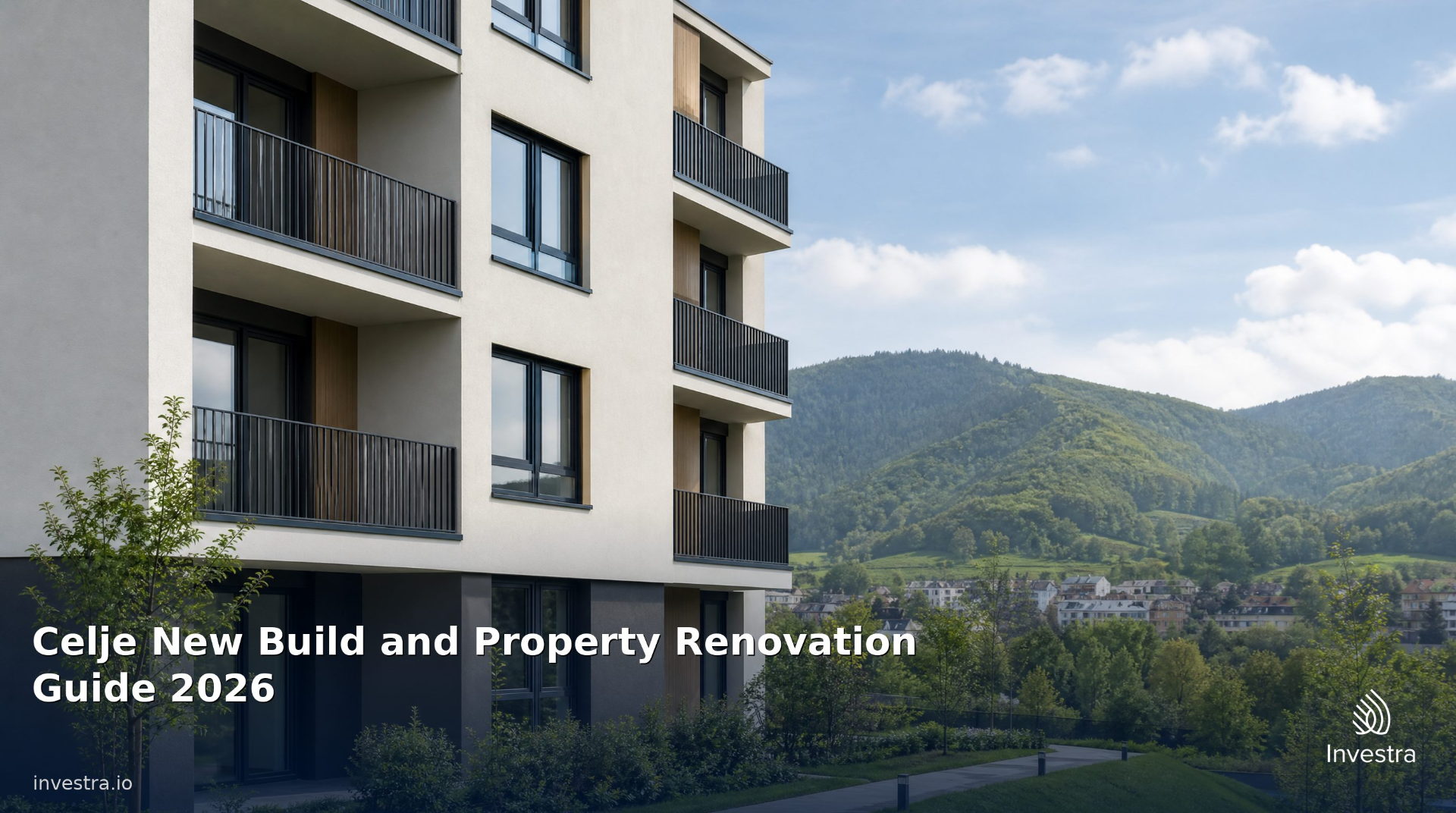
Celje New Build and Property Renovation Guide 2026
Celje New Build and Property Renovation Guide 2026
Celje New Build and Property Renovation Market Overview 2026
Quick Answer: Celje's new build and renovation market in 2026 offers competitive entry prices between €1,800–€3,200/m² for new developments and significant value-add opportunities in older stock, making it one of Slovenia's most accessible yet underappreciated property markets for international investors. Investra.io provides real-time market data for informed investment decisions.
Celje doesn't get nearly enough attention. Slovenia's third-largest city, sitting at the crossroads of the Savinja Valley with a rich medieval history and a quietly modernising economy, has spent years in the shadow of Ljubljana and Maribor. But what we've seen shift over the past 18 months is genuinely interesting — a market that was undervalued is starting to wake up, and smart money is noticing.
The city's real estate landscape in 2026 is defined by two parallel storylines. On one side, there's a wave of new residential developments catering to young professionals and families priced out of Ljubljana.
According to the Slovenian Real Estate Fund (SSRS) and data compiled by the Surveying and Mapping Authority (GURS), average residential property prices across Celje municipality reached approximately €1,950–€2,400/m² in 2025, representing a year-on-year increase of roughly 7–9%. New builds consistently command a premium of 20–35% over comparable older properties.
What makes 2026 particularly interesting is the confluence of EU cohesion funding, Slovenia's national energy renovation programme, and a demographic shift toward secondary cities. These aren't abstract macro trends — they're translating into actual crane activity, permit approvals, and transaction volumes in Celje's Gaberje, Lava, and Novo Celje districts.
Understanding Celje's Property Market Segments: New Build vs. Renovation
Quick Answer: New builds in Celje typically cost €2,200–€3,200/m² and offer modern energy ratings, while renovation projects in older districts can be acquired for €800–€1,500/m² with refurbishment costs of €400–€900/m², creating potential for substantial equity uplift. Consulting specialists like Siniša Dagary — Investment Consultant can help identify which segment aligns with your capital and risk profile.
The distinction matters enormously here, and it's one that too many first-time international buyers blur together. New build and renovation aren't just different price points — they're fundamentally different investment strategies with different timelines, risk exposures, and return profiles.
New Build Market: Celje's new residential development activity is concentrated in several distinct zones. The Novo Celje district has attracted multi-phase apartment complexes aimed at owner-occupiers and buy-to-let investors simultaneously.
Prices for new builds vary considerably by specification and developer. Entry-level new apartments in less central locations start around €2,000–€2,200/m². Mid-range developments with solid finish standards run €2,400–€2,800/m². Premium or architecturally distinctive projects — smaller in supply — can reach €3,000–€3,200/m².
Renovation Market: This is where Celje's real story lives, at least for value-oriented investors. The city has an extensive stock of properties built between 1950 and 1990, many sitting in neighbourhoods with good infrastructure but poor energy performance. These properties trade at €800–€1,500/m² depending on condition and location.
That spread — buy low, add value, sell or rent at a significantly higher rate — is the core renovation investment thesis. It works. But it requires local contractor relationships, realistic budgeting (always add a 15–20% contingency), and patience.
New Build Development Zones and Key Projects in Celje 2026
Quick Answer: The most active new build development zones in Celje in 2026 include Novo Celje, Gaberje, and the revitalised area adjacent to the Savinja River, with projects ranging from compact studios targeting the rental market to larger family apartments aimed at owner-occupiers.
If you're going to understand where Celje's new build market is heading, you need to understand the geography. Celje is a compact city — around 50,000 residents in the municipality — and new residential development isn't sprawling randomly. It's concentrating in specific corridors that make sense from both infrastructure and demand perspectives.
Novo Celje sits northeast of the historic centre and has become the de facto new residential district for the city. Several multi-phase projects from established Slovenian developers have broken ground or completed in this zone since 2022. Apartment sizes trend toward 50–75m² two-bedroom units, which are the sweet spot for both young professional buyers and the rental market.
Gaberje, the western district, is seeing more mixed development — residential projects alongside commercial and light industrial use. This creates a particular profile: slightly lower prestige, but strong functional appeal for working households. New apartments here price at €2,000–€2,400/m² and generate solid rental demand from workers in nearby logistics and manufacturing facilities.
Savinja Riverside Corridor: This is the more aspirational play. Celje's relationship with the Savinja River has historically been complicated (flooding concerns have constrained development), but improved flood management infrastructure has opened up certain riverside parcels.
For investors exploring broader Central and Eastern European new build markets, the Serbia Proptech 2026 How Technology Is Changing Real Estate article explores tools and platforms increasingly relevant for Central European investors.
Renovation Opportunities: Where to Find Undervalued Property in Celje
Quick Answer: The highest concentration of renovation-ready properties in Celje is found in the Staro Celje (Old Celje) district, along Mariborska cesta, and in several inner-ring neighbourhoods where socialist-era apartment blocks and interwar townhouses offer compelling value-add potential at €800–€1,400/m².
The renovation opportunity in Celje is real, but it's not uniform. Location selection matters as much as purchase price — perhaps more. A cheap property in a neighbourhood with declining demographics or poor transport links is a trap, not an opportunity.
Staro Celje — the historic core — has a particular character that makes it both desirable and complicated for renovation investors. The architecture here is genuinely attractive: interwar Austro-Hungarian townhouses, narrow lanes, proximity to the pedestrianised centre.
The inner ring neighbourhoods around Mariborska cesta and Ulica XIV. Divizije offer a different profile — less heritage complication, more straightforward renovation plays. Panel buildings (bloki) from the 1960s–1980s here sell for €800–€1,100/m² unrenovated.
Townhouses in the transitional zones between the centre and outer suburbs present a third profile. These larger properties — typically 120–250m² across multiple floors — often sat in single-family ownership for decades and are now coming to market as older owners downsize or pass assets to heirs who lack the inclination to maintain them.
For investors considering parallel value-add opportunities in nearby Balkan markets, the Loznica Real Estate Market 2026 Macva Region Property Guide and the Sremska Mitrovica Real Estate 2026 Srem Region Property Guide illustrate how renovation strategies translate across different regulatory environments.
Construction Costs, Renovation Budgets, and Material Pricing in Slovenia 2026
Quick Answer: Full renovation costs in Slovenia for 2026 range from €400–€900/m² depending on specification level, with labour accounting for approximately 40–50% of total project costs and material inflation having stabilised after the 2022–2023 peak, making current conditions more predictable for project budgeting.
Numbers matter here, and vague estimates are worse than useless for investment planning. What we know from current market conditions is that construction costs in Slovenia stabilised through 2024–2025 after the acute inflation experienced in 2022–2023, when material prices spiked 20–35% across categories. That normalisation has made project feasibility analysis more reliable again.
Here's a practical breakdown of renovation cost categories for a standard apartment renovation in Celje in 2026:
Basic cosmetic renovation (new floors, paint, kitchen and bathroom refresh without structural changes): €200–€350/m². This is the minimum-intervention strategy — it improves the aesthetic appeal and livability enough to justify higher rents but doesn't address energy performance. Suitable for properties already in reasonable structural condition.
Mid-range full renovation (new windows, updated electrical and plumbing, new bathroom and kitchen, insulation of exterior walls if detached, flooring throughout): €450–€650/m². This is the most common scope for the renovation-yield play — transforms the energy rating, significantly improves comfort, and achieves meaningful rental premium.
High-specification renovation (everything above plus premium fixtures, underfloor heating, smart home systems, architectural details): €700–€950/m². Appropriate for premium rental markets or properties targeting sale to owner-occupiers at the top end of the local market.
Labour costs in Slovenia are notably higher than in neighbouring Balkan markets — Slovenian construction workers earn substantially more than counterparts in Serbia or North Macedonia — but the trade-off is generally better quality execution and easier management of compliance with Slovenian building regulations. Expect to pay €25–€45/hour for skilled tradespeople.
Energy renovation deserves special mention. Slovenia's commitment to EU energy efficiency directives means that energy renovation grants and subsidised loans are available through Eko sklad (the Slovenian Environmental Public Fund).
For additional perspective on how technology is reshaping property investment analysis in the region, the Serbia Proptech 2026 How Technology Is Changing Real Estate article explores tools and platforms increasingly relevant for Central European investors.
Rental Yields and Return on Investment in Celje 2026
Quick Answer: Gross rental yields in Celje range from 4.5–7.5% depending on property type and strategy, with renovation-optimised properties targeting the mid-market rental segment and short-term tourism lets generating the upper end of that range. Net yields after taxes and costs typically land at 3.5–5.5%.
Let's talk returns, because this is what ultimately determines whether a Celje investment makes sense relative to alternatives. The yield story here is genuinely competitive for a euro-denominated market — and that euro denomination matters.
For standard long-term residential lets in Celje, the numbers currently look like this. A well-located 50m² two-bedroom apartment purchased new at €2,400/m² (total acquisition cost ~€120,000 plus costs) rents for €600–€750/month to a professional tenant. That's a gross yield of approximately 6–7.5%.
Renovation scenarios can generate stronger returns precisely because the acquisition cost is lower. A 60m² apartment acquired at €1,000/m² (€60,000), renovated for €500/m² (€30,000 total), arrives at an all-in cost of €90,000. If that same renovated apartment achieves €680/month rent, the gross yield on invested capital is approximately 9.1% — considerably more attractive.
Short-term rental (Airbnb/Booking.com style) adds a further dimension. Celje's tourism appeal — the medieval old castle (Celjski stari grad), the cultural calendar, proximity to thermal spas at Laško and Rimske Terme — supports meaningful short-term rental demand.
For comparative yield benchmarks across different Central European micro-markets, the Aleksinac Real Estate Market 2026 Southern Serbia Property Guide provides useful context on how Celje's yield profile compares to similar-sized cities in the broader region.
Legal Process for Foreign Buyers: Purchasing New Build and Renovation Properties in Slovenia
Quick Answer: EU citizens can purchase property in Slovenia on equal terms with Slovenian nationals, while non-EU buyers face restrictions primarily on agricultural land but can freely purchase residential and commercial property; the standard purchase process takes 4–8 weeks and requires a Slovenian tax number (davčna številka), notary-certified contracts, and land registry registration.
Slovenia's legal framework for foreign property ownership is, by regional standards, refreshingly straightforward — particularly for EU citizens. Slovenia's EU membership since 2004 means that European buyers face essentially no ownership restrictions on residential property.
The purchase process follows a clear sequence. First, you obtain a Slovenian tax identification number (davčna številka) — this is a bureaucratic necessity and takes 1–2 weeks, requiring a visit to the local Financial Administration office or processing through a legal representative. You cannot legally complete a property purchase without this number.
The purchase agreement (prodajna pogodba) must be notarised by a Slovenian notary. This isn't optional — it's a legal requirement for valid real estate transfer. The notary verifies the identities of parties, confirms the property is free of encumbrances (by checking the land registry, or zemljiška knjiga), and certifies the document.
Transfer tax (davek na promet nepremičnin) applies at 2% of the transaction value for existing properties. New builds are subject to VAT at 9.5% (for first-time residential sales), which is typically already included in the developer's quoted price — confirm this explicitly. Land registry registration completes the transfer, typically within 2–4 weeks of notarised agreement submission.
For renovation projects specifically, building permits (gradbeno dovoljenje) are required for structural works, extensions, or changes of use. Cosmetic renovation generally doesn't require permits, but if you're modifying load-bearing elements, changing floor plans, or adding extensions, engage a certified architect (pooblaščeni arhitekt) to prepare the permit application.
The Findes Group & Partners team provides Slovenia-specific financial and legal guidance for international buyers handling the purchase process, including mortgage access and tax structuring for investment properties.
Financing New Builds and Renovation Projects: Mortgages and Grants in Slovenia
Quick Answer: Slovenian banks offer mortgages to foreign buyers at interest rates currently ranging from 3.8–5.2% (variable to fixed), with LTVs of 60–80% for non-residents; EU energy renovation grants through Eko sklad can cover up to 50% of qualifying renovation costs, dramatically improving project returns for sustainability-focused refurbishments.
Financing is where international buyers sometimes get tripped up, not because Slovenia is difficult, but because expectations formed in other markets don't always transfer cleanly. Let's work through the realistic picture.
Slovenian banks — NLB, Nova KBM, SKB, Addiko, and others — do lend to foreign buyers, but terms are generally less favourable than for Slovenian residents. Non-resident foreign buyers can typically access mortgages at 60–70% LTV (loan-to-value), meaning you need 30–40% equity plus transaction costs. Slovenian residents can access up to 80% LTV.
For new builds purchased off-plan, developer payment structures often involve stage payments that reduce the need for a mortgage during construction — 10% on reservation, 20–30% on contract signing, staged payments through construction milestones, balance on completion. This can actually work in favour of buyers who prefer to build equity before taking on long-term debt.
Renovation financing in Slovenia has an interesting twist: Eko sklad, the state environmental fund, offers both grants and subsidised loans specifically for energy renovation works. For 2026, the grant scheme covers 25–50% of eligible costs for improvements including insulation, windows, roof, heat pumps, solar panels, and mechanical ventilation.
Eko sklad also provides subsidised renovation loans at rates below commercial bank products — typically 1.5–2.5% — for qualifying renovation works. These can be combined with commercial mortgages, allowing investors to structure renovation projects with optimised blended cost of capital.
Currency considerations are essentially moot for eurozone investors. For British, American, or other non-euro buyers, Slovenia's euro denomination actually reduces complexity versus buying in Central European markets with their own currencies — there's no currency hedging required, no exchange rate exposure to manage on an ongoing basis.
Tax Implications for New Build and Renovation Investors in Slovenia
Quick Answer: Key taxes for property investors in Slovenia include 2% transfer tax (existing properties), 9.5% VAT on new builds, 25% income tax on net rental income, and capital gains tax of 25% (reducing to 15% after 5 years, 0% after 20 years of ownership), making longer hold strategies particularly tax-efficient.
Slovenia's tax framework for property investment is transparent and relatively investor-friendly once you understand the structure. The complexity isn't in the rates — they're straightforward — it's in making sure you're correctly applying deductions and timing strategies to minimise overall tax burden.
Transfer and Purchase Taxes: When acquiring property in Slovenia, you'll encounter transfer tax (davek na promet nepremičnin) on existing properties at 2% of the transaction value. This applies to both domestic and foreign buyers equally. New builds are subject to VAT at 9.5% (for first-time residential property sales); this is typically already included in the developer's price but verify explicitly.
Annual Property Taxes: Slovenia maintains a property tax system, but it's minimal by European standards. The annual property tax (davek na nepremičnine) is calculated based on property value and the applicable municipal rate, typically resulting in €100–€400 annually for residential properties. This is negligible in return calculations but worth noting for annual cost projections.
Rental Income Taxation: Rental income is taxed at the standard personal income tax rate of 25% on net income (gross rent minus allowable deductions). Allowable deductions include maintenance costs, property management fees, insurance, utilities you pay, and depreciation on building structures.
Capital Gains Tax: When you sell a property for profit, capital gains tax applies at 25%. However, Slovenia provides meaningful tax incentives for longer holding periods. Properties held for 5+ years see the rate reduce to 15%. Properties held for 20+ years are entirely exempt from capital gains tax. This structure heavily incentivises buy-and-hold strategies.
For international investors particularly, Slovenia's tax treaty network (Slovenia has comprehensive double taxation agreements with most major economies) is important to understand. You should consult with a tax advisor familiar with your home country's rules to understand how Slovenian-source rental income and capital gains are treated in your jurisdiction, as this varies significantly by country.
Deductible Costs and Record-Keeping: Maintaining detailed records of all property-related costs is essential. Deductible expenses include property management fees, maintenance and repairs, insurance, property taxes, utilities (
Investment Disclaimer
Quick Answer: This guide is general market information, not personal legal, tax, financing or investment advice.
Before committing to a property transaction, buyers should obtain independent local legal, tax and financial advice suited to their circumstances. Investra.io can support initial market research, but every purchase decision remains the buyer's responsibility.
Frequently Asked Questions
Quick Answer: This section explains the practical property-investment implications of Frequently Asked Questions.
What is a prudent next step after initial market research?
Use current documentation, independent professional advice and comparable local evidence before proceeding. Investra.io can support an initial structured market review.
How can buyers plan a realistic ownership budget?
Use current documentation, independent professional advice and comparable local evidence before proceeding. Investra.io can support an initial structured market review.
What evidence supports a careful investment decision?
Use current documentation, independent professional advice and comparable local evidence before proceeding. Investra.io can support an initial structured market review.
When should a buyer obtain legal and tax advice?
Use current documentation, independent professional advice and comparable local evidence before proceeding. Investra.io can support an initial structured market review.
How should a buyer compare neighbourhoods and property types?
Use current documentation, independent professional advice and comparable local evidence before proceeding. Investra.io can support an initial structured market review.
What local checks should be completed before signing?
Use current documentation, independent professional advice and comparable local evidence before proceeding. Investra.io can support an initial structured market review.
Which costs should be assessed alongside the purchase price?
Use current documentation, independent professional advice and comparable local evidence before proceeding. Investra.io can support an initial structured market review.
How can international buyers verify a property opportunity?
Use current documentation, independent professional advice and comparable local evidence before proceeding. Investra.io can support an initial structured market review.
What should buyers compare before selecting a property?
Use current documentation, independent professional advice and comparable local evidence before proceeding. Investra.io can support an initial structured market review.
Quick Answer: These answers outline common buyer checks and should be read with current professional advice.
Recommended Reading
Quick Answer: This section explains the practical property-investment implications of Recommended Reading.
- Investra market research
- Investra market research
- Investra market research
- Investra market research
- Investra market research
- Investra market research
- Investra market research
- Investra market research
- Investra market research
- Investra market research
- Investra market research
- Investra market research
- Investra market research
- Investra market research
- Investra market research
- Investra market research
- Investra market research
- Siniša Dagary investment insight
- Siniša Dagary investment insight
- Siniša Dagary investment insight
- Siniša Dagary investment insight
- Siniša Dagary investment insight
- Findes Group & Partners
- Findes Group & Partners
Connect With Investra
Follow Investra for market updates on Facebook, LinkedIn, YouTube
Related Posts
No related posts available.
