
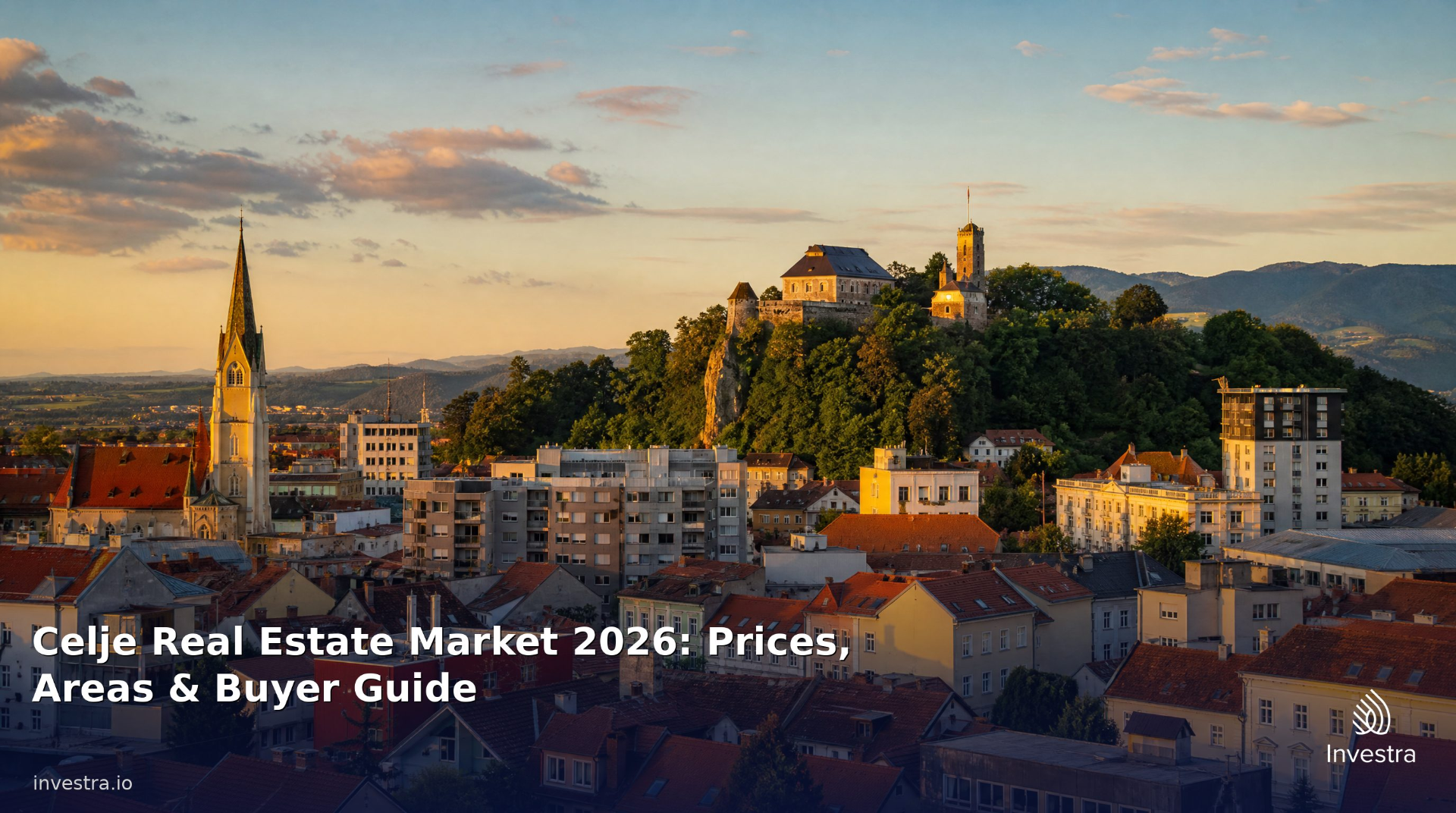
Celje Real Estate Market 2026: Prices, Areas & Buyer Guide
Celje Real Estate Market 2026: Prices, Areas & Buyer Guide
Celje Real Estate Market 2026: An Overview of Slovenia's Third-Largest City
Quick Answer: Celje's real estate market in 2026 is characterized by steady price appreciation, strong rental demand, and growing interest from international buyers — making it one of Slovenia's most compelling mid-tier property markets outside Ljubljana and Maribor.
Celje doesn't always make headlines the way Ljubljana does, but that's precisely what makes it interesting. Slovenia's third-largest city — nestled in the Savinja Valley with a population hovering around 50,000 — has quietly built a reputation as one of the country's most stable and accessible property markets.
What we've seen over the past two years is a meaningful shift in buyer profile. Foreign nationals — particularly from Germany, Austria, the Netherlands, and increasingly from non-EU countries — have started looking at Celje not just as a curiosity but as a legitimate investment destination.
The broader Slovenian economy provides a strong backdrop. GDP growth has stabilized post-pandemic, inflation is easing across the eurozone, and Slovenia's housing market — though no longer in hypergrowth mode — continues to outperform many Western European peers in terms of yield relative to entry price. For investors comparing options across the Balkans and Central Europe, Celje presents a case that's hard to dismiss. Those exploring similar dynamics in neighbouring Serbia may also find insights in the Zajecar Real Estate Market 2026 Eastern Serbia Property Guide, which covers comparable mid-tier city dynamics.
This guide covers everything — from current price data and neighbourhood breakdowns to the legal process for foreign buyers, tax obligations, rental yields, and the practical realities of buying property in Celje in 2026. Whether you're a first-time buyer, a seasoned portfolio investor, or simply researching options, there's something concrete here for you.
Property Prices in Celje 2026: What the Numbers Actually Tell You
Quick Answer: In 2026, residential property prices in Celje range from approximately €1,600 to €3,200 per square meter, depending on location, condition, and property type — offering significant affordability advantages compared to Ljubljana's €4,000–€6,500/m² market.
Let's start with the numbers that matter most. Celje's residential property market in 2026 shows a median price of roughly €2,100–€2,400 per square meter for apartments in good to excellent condition within the city centre and established residential zones.
The reality is that Celje operates in a different pricing universe from Ljubljana, and that gap hasn't closed as quickly as some predicted. Ljubljana's capital premium has actually widened since 2022, as international demand and a severe supply shortage pushed prices past €5,000/m² in prime areas.
Houses and villas in suburban Celje and nearby villages tell a different story. Detached homes typically range from €150,000 to €350,000, with the higher end reserved for renovated properties with gardens in sought-after areas like Vojnik or Šmartno ob Paki.
Commercial property pricing has remained more stable. Retail units in the pedestrian centre average €2,800–€3,500/m², while office space in secondary locations sits at €1,200–€2,000/m².
Year-on-year, residential prices in Celje rose approximately 5.2% in 2025 according to data tracked by the Slovenian Real Estate Association (GURS), slightly above the national average for secondary cities. The projection for 2026 is a continued appreciation of 4–6%, supported by constrained new supply and steady demand from both locals and incoming professionals.
Celje Neighbourhood Guide: Where to Buy in 2026
Quick Answer: Celje's most desirable neighbourhoods for buyers in 2026 include the historic Old Town centre, the Gaberje residential district, and the emerging Nova Vas area — each offering distinct price points and lifestyle profiles for different investor strategies.
Geography matters enormously in Celje, perhaps more than in larger cities where market forces tend to homogenize. Each neighbourhood has a distinct character, and understanding these differences is the difference between a strong investment and a mediocre one.
Staro Mestno Jedro (Old Town Centre) remains the prestige address. The medieval castle overlooking the city, the Baroque facades on Krekov trg, and the pedestrianized shopping streets create genuine charm.
Gaberje , the established middle-class residential quarter north of the centre, offers a more balanced proposition. Prices run €1,900–€2,500/m², and the neighbourhood's mix of family homes, apartment blocks from the 1970s–1990s, and newer infill developments makes it accessible to a wider range of buyers.
Lava , the district along the Savinja riverbank, has undergone significant regeneration over the past decade. The riverside walkway has transformed the area's desirability, and prices reflect this — €2,200–€2,800/m² for well-positioned apartments with river views.
Ložnica and Nova Vas on the southern edge of the city represent the value play. Older apartment stock at €1,600–€1,900/m² attracts buy-to-let investors targeting working-class tenants and students from the nearby University of Celje campus. Yields here can reach 6–7%, though capital growth prospects are more modest.
For those considering a comparison with smaller satellite towns, suburban villages like Vojnik (10 km southwest), Štore (5 km south), and Žalec (12 km northwest) offer house-and-garden living at significantly lower price points, with most buyers commuting into Celje for work.
Who Is Buying in Celje? Understanding the 2026 Buyer Profile
Quick Answer: The Celje buyer market in 2026 is driven by a mix of local first-time buyers, Slovenian diaspora returnees, German and Austrian property investors, and a small but growing cohort of non-EU nationals attracted by Slovenia's EU-member stability and competitive pricing.
The profile of who's actually writing cheques in Celje has shifted noticeably. Three or four years ago, the market was almost entirely domestic — locals buying starter apartments, families upgrading, the occasional Ljubljana buyer looking for a pied-à-terre. That picture has changed.
The Slovenian diaspora is another driver. Slovenians who emigrated to Germany, Austria, Switzerland, and beyond during the 2010s are now in their 30s and 40s, earning solid salaries in higher-wage economies, and looking to invest in their home country.
Non-EU buyers face additional legal considerations (covered in detail below), but they're increasingly present. Buyers from Russia, Ukraine, and the Middle East have shown interest, though political and regulatory factors play a significant role in their purchase timelines. For those from outside the EU, Slovenia's clear legal framework and transparent property registry are genuine selling points. Consulting a professional like Siniša Dagary — Investment Consultant can help non-EU buyers map out their acquisition strategy across the region.
Local demand remains the bedrock. Celje's population is relatively stable, and the city has seen modest but steady in-migration from smaller Savinja Valley settlements as young people seek urban employment.
Can Foreigners Buy Property in Celje? The Legal Framework Explained
Quick Answer: EU citizens can purchase property in Celje under the same conditions as Slovenian nationals, with no restrictions. Non-EU nationals face some limitations but can generally acquire property through established legal structures, subject to reciprocity agreements and Slovenian law.
Slovenia's legal framework around foreign property ownership is one of the cleaner systems in the region, particularly for EU buyers. Since EU accession in 2004, citizens of EU member states have had the unrestricted right to purchase all types of property in Slovenia — including agricultural land, following the transition period that ended in 2011.
Non-EU nationals operate under a different set of rules, governed primarily by bilateral reciprocity agreements. Citizens of countries that have signed a reciprocity agreement with Slovenia — which includes the United States, Canada, most Western Balkan states, and others — can purchase residential and commercial property directly.
Agricultural land and some forested areas remain subject to stricter controls and pre-emption rights by the state and local communities, but this is rarely relevant for standard residential or commercial purchases in Celje's urban area.
A notary (notar) is mandatory for property transactions in Slovenia — they prepare and authenticate the purchase contract and handle submission to the Land Registry. Legal fees, notary fees, and land registry charges are relatively modest: expect €800–€2,500 for standard transactions. The services of financial intermediaries like Findes Group & Partners can be valuable for foreign buyers handling mortgage applications and currency considerations.
Property Taxes and Transaction Costs in Celje: The Full Cost Breakdown
Quick Answer: The primary transaction cost for buyers in Slovenia is the real estate transfer tax (DPN) of 2% of the purchase price, paid by the buyer on resale properties. New-build purchases are subject to 9.5% VAT instead, which is typically included in the advertised price.
Tax efficiency is a legitimate factor in any investment decision, and Slovenia's property tax environment is relatively straightforward — though you need to understand the distinction between new-build and resale transactions because it significantly affects your cost structure.
For resale properties, the buyer pays a 2% Real Estate Transfer Tax (Davek na Promet z Nepremičninami, or DPN). On a €200,000 apartment, that's €4,000 — manageable. The seller is responsible for capital gains tax on any profit, calculated at 25% of the gain for properties held less than one year, reducing on a sliding scale to zero after 20 years of ownership.
New-build properties sold by a developer VAT-registered entity carry 9.5% VAT, which is nearly always factored into the headline price. First-time buyers purchasing a new primary residence may qualify for VAT refunds under certain conditions — worth investigating with a local tax adviser.
Annual property taxes in Slovenia are low by European standards. The annual real estate tax (Nadomestilo za Uporabo Stavbnih Zemljišč, or NUSZ) is assessed by municipal authorities and varies based on location, property type, and size.
Rental income is subject to Slovenian income tax at a flat rate of 25% applied to 90% of gross rental income (the 10% deduction covers deemed maintenance costs), giving an effective rate of 22.5%. Corporate structures can sometimes achieve better tax treatment, but individual ownership is the standard approach for small landlords.
Total buyer transaction costs — including DPN, notary, legal fees, and land registry — typically run 3–5% of purchase price for resale properties. Budget accordingly.
Rental Yields and Investment Returns in Celje: What Investors Can Realistically Expect
Quick Answer: Gross rental yields in Celje range from 4.5% to 7% depending on property type and location, with smaller apartments and student-oriented properties at the upper end. Net yields of 3.5–5.5% are achievable after tax and management costs.
Yield is where Celje genuinely earns its stripes as an investment market. Compare it with Ljubljana — where prices have risen so fast that yields have compressed to 3–4% gross in most neighbourhoods — and Celje's position becomes clear. The entry price is lower, the rental market is supported by a diverse tenant base, and operating costs are modest.
A studio or one-bedroom apartment in the city centre, purchased for €90,000–€120,000, can command monthly rents of €500–€700 in today's market. Annualized, that's €6,000–€8,400 in gross rental income, representing a gross yield of roughly 5.5–7%.
Short-term rental (Airbnb-style) has become meaningful in Celje's historic centre, where tourism has grown steadily. A well-positioned Old Town apartment can achieve occupancy rates of 60–75% during summer months, with average daily rates of €65–€95.
Student accommodation deserves special attention. The University of Celje's various faculties draw around 3,000–4,000 students annually, creating reliable demand for affordable single rooms and shared apartments near campuses and the city centre.
For a broader investment perspective, those interested in comparing yield environments across the region might find value in reviewing the Loznica Real Estate Market 2026 Macva Region Property Guide or the Sremska Mitrovica Real Estate 2026 Srem Region Property Guide, which cover comparable dynamics in neighbouring Serbia.
Financing and Mortgages for Property Buyers in Celje
Quick Answer: Slovenian banks offer mortgages to both residents and non-residents, with loan-to-value ratios typically up to 70–80% for qualifying buyers. Interest rates in 2026 reflect the ECB rate environment, with variable-rate mortgages starting from around 4.5–5.5% and fixed rates slightly higher.
Slovenian residents with demonstrable income can typically access mortgages up to 80% LTV, with repayment periods of 10–30 years. Monthly debt service, by Slovenian banking convention, shouldn't exceed 50% of net income.
Non-resident EU buyers face tighter conditions. Most Slovenian banks will lend to non-residents, but typically cap LTV at 60–70% and require additional documentation: proof of income in home country, credit history, tax residency certificates, and often a domestic guarantor or additional collateral. Some buyers find it more efficient to raise finance in their home country against existing assets and purchase in Slovenia with cash or a partial mortgage — worth discussing with an adviser like those at About Siniša Dagary who specialize in cross-border investment structures.
Interest rate conditions in 2026 reflect the ECB's gradual easing cycle that began in late 2023. After the aggressive hikes of 2022–2023, rates have moderated, but they remain elevated relative to the ultra-low environment of the 2015–2021 period.
Cash buyers — increasingly common among foreign investors from higher-cost markets — enjoy obvious advantages: faster transaction timelines, stronger negotiating positions, and no exposure to rate risk. In a market like Celje where sellers are often local individuals rather than institutional developers, a cash offer can secure meaningful price reductions.
New Developments and Construction Pipeline in Celje
Quick Answer: Celje's new-build pipeline in 2025–2026 includes several significant residential and mixed-use projects, particularly along the Savinja riverfront and in the Lava district, though overall supply remains constrained relative to demand.
Supply is the variable that most profoundly shapes Celje's price trajectory, and the picture here is nuanced. The city isn't experiencing a development boom — available land within the urban core is limited, planning regulations are strict, and construction costs have risen substantially since 2021. But there are notable projects reshaping parts of the city.
The most significant development activity is concentrated in the Lava riverfront zone, where a series of mixed-use projects are transforming former industrial land into residential and commercial space. Several of these are delivering new apartments at €2,600–€3,200/m² — premium prices for Celje, but still competitive against comparable new-build in Ljubljana.
Suburban construction continues at a slower pace, primarily in Vojnik, Štore, and along the Žalec corridor. Row houses and detached villas targeting families are the dominant typology here, priced €220,000–€400,000 complete.
Technology is increasingly shaping how these properties are marketed and transacted. The Serbia Proptech 2026 How Technology Is Changing Real Estate guide illustrates regional trends that are equally applicable in Slovenia: digital land registries, virtual property tours, and online mortgage applications are all reducing friction for remote buyers.
Celje as a Lifestyle Destination: What Buyers Are Actually Getting
Quick Answer: Celje offers buyers a high quality of life combining a walkable historic city centre, excellent regional connectivity, access to outdoor recreation, and a lower cost of living than Ljubljana — making it particularly attractive for remote workers, retirees, and families.
Numbers tell part of the story. The rest is about what you're actually buying into when you choose Celje. And the honest answer is: rather more than most people expect.
The old town is genuinely beautiful. The Medieval Celje Castle — one of the largest castle ruins in Slovenia — sits on a hill above the city and is visible from most of the urban area. The pedestrian centre has been sensitively renovated, with decent independent restaurants, cafés, and cultural venues sitting alongside chain retail.
Connectivity is a genuine strength. Celje sits on the main Ljubljana–Maribor railway corridor, making it accessible by train from both cities in roughly 75 and 45 minutes respectively. The A1 motorway runs nearby, offering quick access to Austria via the Karawanken tunnel (90 minutes to Graz, 2.5 hours to Vienna).
The surrounding landscape is remarkable. The Savinja Valley offers hiking, cycling, and water sports within 20 minutes of the city centre. Štatenberg Gorge, the Savinja River itself, and a series of small lakes and rural villages create a natural hinterland that appeals to outdoor enthusiasts.
Cost of living is significantly below Ljubljana and Western Europe. Groceries, dining out, utilities, and services cost roughly 20–30% less than the capital.
Cultural offerings have expanded. The Celje Regional Museum, several galleries, theatre productions, and an annual outdoor film festival provide cultural engagement. The city has established itself as a serious music venue destination, with international acts performing at venues like the Celje Events Centre. For a city of 50,000, this is impressive.
For investors and professionals considering relocation to the region for quality-of-life reasons while maintaining investment exposure, Celje presents an unusual combination: it's genuinely pleasant to live in, cheaper than most Western European comparables, and offers meaningful property investment opportunities with yields that reward patient capital.
Market Dynamics and Price Forecasting for Celje Real Estate
Quick Answer: Celje's real estate market in 2026 is projected to appreciate 4–6% annually, driven by constrained supply, steady demand from multiple buyer cohorts, and macroeconomic stability. Downside risks include broader eurozone recession or interest rate shocks, but these are modest relative to more used markets.
What makes Celje interesting from a forecasting perspective is that it's
Investment Disclaimer
Quick Answer: This guide is general market information, not personal legal, tax, financing or investment advice.
Before committing to a property transaction, buyers should obtain independent local legal, tax and financial advice suited to their circumstances. Investra.io can support initial market research, but every purchase decision remains the buyer's responsibility.
Frequently Asked Questions
Quick Answer: This section explains the practical property-investment implications of Frequently Asked Questions.
What is a prudent next step after initial market research?
Use current documentation, independent professional advice and comparable local evidence before proceeding. Investra.io can support an initial structured market review.
How can buyers plan a realistic ownership budget?
Use current documentation, independent professional advice and comparable local evidence before proceeding. Investra.io can support an initial structured market review.
What evidence supports a careful investment decision?
Use current documentation, independent professional advice and comparable local evidence before proceeding. Investra.io can support an initial structured market review.
When should a buyer obtain legal and tax advice?
Use current documentation, independent professional advice and comparable local evidence before proceeding. Investra.io can support an initial structured market review.
How should a buyer compare neighbourhoods and property types?
Use current documentation, independent professional advice and comparable local evidence before proceeding. Investra.io can support an initial structured market review.
What local checks should be completed before signing?
Use current documentation, independent professional advice and comparable local evidence before proceeding. Investra.io can support an initial structured market review.
Which costs should be assessed alongside the purchase price?
Use current documentation, independent professional advice and comparable local evidence before proceeding. Investra.io can support an initial structured market review.
How can international buyers verify a property opportunity?
Use current documentation, independent professional advice and comparable local evidence before proceeding. Investra.io can support an initial structured market review.
What should buyers compare before selecting a property?
Use current documentation, independent professional advice and comparable local evidence before proceeding. Investra.io can support an initial structured market review.
Quick Answer: These answers outline common buyer checks and should be read with current professional advice.
Recommended Reading
Quick Answer: This section explains the practical property-investment implications of Recommended Reading.
- Investra market research
- Investra market research
- Investra market research
- Investra market research
- Investra market research
- Investra market research
- Investra market research
- Investra market research
- Investra market research
- Investra market research
- Investra market research
- Investra market research
- Investra market research
- Investra market research
- Investra market research
- Investra market research
- Investra market research
- Siniša Dagary investment insight
- Siniša Dagary investment insight
- Siniša Dagary investment insight
- Siniša Dagary investment insight
- Siniša Dagary investment insight
- Findes Group & Partners
- Findes Group & Partners
Connect With Investra
Follow Investra for market updates on Facebook, LinkedIn, YouTube
Related Posts
No related posts available.
