
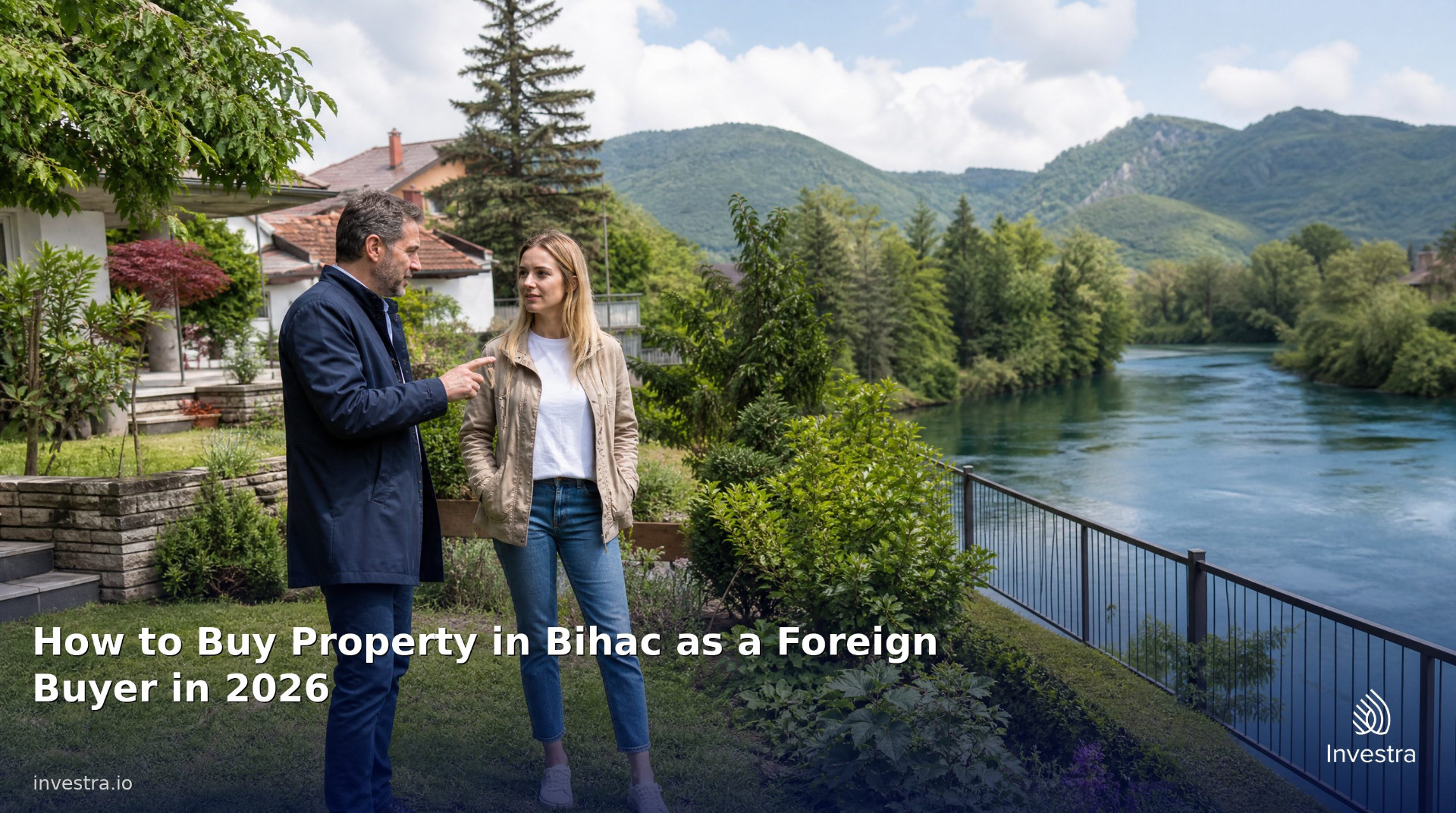
How to Buy Property in Bihac as a Foreign Buyer in 2026
How to Buy Property in Bihac as a Foreign Buyer in 2026
Why Bihac Is Attracting Foreign Property Buyers in 2026
Quick Answer: Bihac is attracting foreign buyers in 2026 due to its affordability, growing tourism infrastructure, EU-adjacent location, and property prices that remain 60–70% below Western European averages — making it one of the Balkans' most compelling emerging markets. Investra.io tracks emerging Balkan markets where early-entry advantages are still very much available.
Bihac doesn't always make the shortlist when investors think about Balkan real estate. Sarajevo, Mostar, Neum — those names come up first. But in 2026, something is quietly shifting.
The reasons aren't complicated. Property here is genuinely cheap — not "cheap for the Balkans" cheap, but cheap in any meaningful European context. A well-located apartment in the city center can be acquired for €600–€900 per square meter. A house with a garden on the outskirts might cost you €50,000–€80,000 total.
Tourism is a real factor here too. The Una River — crystal clear, fed by mountain springs — draws kayakers, rafters, and hikers in growing numbers. The annual Una Regatta has become one of Bosnia's most iconic outdoor events.
Bosnia and Herzegovina's EU candidate status, granted in December 2022 and progressing through accession requirements, adds a longer-term dimension to the investment case. Markets that successfully navigate EU accession — think Slovenia, Croatia, Bulgaria — have historically seen property values appreciate substantially in the years surrounding membership. That trajectory, while not guaranteed, is part of what Siniša Dagary — Investment Consultant and other regional analysts are watching closely.
The reality is that Bihac is at an inflection point. It's discovered enough to have genuine rental demand, but underpriced enough that first-movers still have meaningful advantages. That's a rare combination in European real estate in 2026.
Understanding Bosnia and Herzegovina's Legal Framework for Foreign Buyers
Quick Answer: Foreign nationals can legally purchase property in Bosnia and Herzegovina, subject to reciprocity agreements and specific procedural requirements — with the process varying slightly between the Federation of Bosnia and Herzegovina entity (where Bihac is located) and Republika Srpska. Most EU, UK, and US citizens face no significant legal barriers.
The legal landscape for foreign property buyers in Bosnia and Herzegovina is more accessible than many people expect, but it does require careful attention. Bosnia operates under a complex constitutional structure — a legacy of the 1995 Dayton Agreement — comprising two entities: the Federation of Bosnia and Herzegovina (FBiH) and Republika Srpska (RS), plus the Brčko District.
What does "reciprocity" mean in practice? It means that if a Bosnian citizen can buy property in your country, you can buy property in Bosnia. For nationals of most Western countries, this creates no effective barrier.
One distinction worth understanding: foreigners cannot own agricultural land outright in most cases, though they can own buildings and construction land. This matters if you're looking at rural properties with large land parcels.
The Findes Group & Partners team and other cross-border financial specialists who work with Bosnian real estate consistently emphasize that legal due diligence in Bosnia requires a qualified local lawyer — not just a notary. Title chains can be murky, especially for older properties, and the land registry (gruntovnica) system, while improving, still has gaps from the war period of the 1990s. Budget for proper legal support: €500–€1,500 is a reasonable range for attorney fees depending on the complexity of the transaction.
Step-by-Step Process: How to Buy Property in Bihac
Quick Answer: The property purchase process in Bihac involves finding a property, conducting due diligence, signing a preliminary agreement, paying a deposit, finalizing a notarized sales contract, paying property transfer tax, and registering ownership at the land registry — typically taking 2–4 months from initial agreement to completed registration.
Let's walk through this practically, because the process is manageable once you understand each stage. Many foreign buyers are surprised to find that buying in Bihac isn't dramatically more complex than buying in established European markets — it's just different in the details.
Step 1: Property Search and Initial Assessment. Most foreign buyers start online through local portals like Nekretnine.ba or Oglasi.ba, or through international aggregators. Engaging a local real estate agent familiar with Bihac's market is strongly recommended.
Step 2: Legal Due Diligence. Before any money changes hands, your lawyer needs to verify the property's title at the Bihac Municipal Court land registry. This process confirms ownership, checks for encumbrances (mortgages, liens, rights of way), and verifies that the property's actual state matches its registered description.
Step 3: Preliminary Agreement (Predugovor). Once due diligence is satisfactory, a preliminary contract is signed outlining the agreed price, payment terms, and timeline. A deposit of 10% is standard. This agreement is legally binding — if the buyer withdraws without cause, the deposit is forfeited; if the seller withdraws, they typically owe the buyer double the deposit.
Step 4: Notarized Sales Contract (Kupoprodajni Ugovor). The final contract must be certified by a notary (notar). Both parties must be present, or represented by a power of attorney.
Step 5: Transfer Tax Payment. Property transfer tax in the FBiH is levied at the cantonal level. In Una-Sana Canton (where Bihac is located), the rate is typically 5% of the assessed market value. This must be paid before registration can proceed.
Step 6: Land Registry Registration. The final step is registering the new ownership at the gruntovnica. This is handled by your lawyer and typically takes 2–8 weeks depending on the registry's backlog. Until registration is complete, you are not officially the legal owner — don't consider the process finished until you receive the registered title document.
Property Prices in Bihac 2026: What Does the Market Actually Look Like?
Quick Answer: In 2026, property prices in Bihac range from approximately €500–€900 per square meter for apartments and €400–€700 per square meter for houses, with significant variation by location, condition, and proximity to the Una River or city center. Comparable Balkan markets show similar value dynamics in mid-sized emerging cities.
Price data on Bihac is harder to come by than on more prominent Bosnian cities, which is itself a clue about the market's maturity level. What we know from aggregated listing data, local agent interviews, and transaction records from Una-Sana Canton suggests the following picture for 2026.
In the city center and areas close to the Una River — particularly the Centar and Ozimice neighborhoods — newly renovated or new-build apartments trade between €700–€950 per square meter. These command premium rates because of proximity to restaurants, the main pedestrian zone, and the river promenade. A 60m² apartment in this zone would typically cost €42,000–€57,000.
Older-stock apartments in residential areas like Prekounje or Luka, built during the Yugoslav era and in varying states of repair, can be found for €450–€650 per square meter. Many of these represent genuine value-add opportunities — buy at €500/m², invest €100–€150/m² in renovation, and emerge with a €700–€800/m² asset. The math works if you have appetite for a light project.
Houses and villas outside the immediate urban core present a different calculus. In villages within 10–20 km of Bihac — areas like Ripač, Privilica, and Kralje — traditional stone houses with land can be acquired for as little as €20,000–€50,000. Properties closer to Una National Park command a modest premium due to eco-tourism potential.
What's the trajectory? Annual price appreciation in Bihac has been modest but consistent — market watchers estimate 4–7% annually over the past three years. That's not spectacular, but combined with rental income potential, total returns become more attractive.
It's also worth understanding that the market here is relatively illiquid. Transaction volumes are low compared to larger cities, which means individual deals can move prices more than in deep markets. For buyers, this creates negotiating room — 10–15% below asking price is not unusual in Bihac, particularly for properties that have been listed for several months.
Rental Yields and Income Potential for Foreign Investors
Quick Answer: Short-term rental yields in Bihac can reach 7–12% gross annually for well-located properties targeting tourism demand, while long-term residential rentals typically yield 5–7% gross — both significantly above Western European averages. Similar yield dynamics are observed across emerging Balkan cities with developing tourism infrastructure.
The rental income story in Bihac has two distinct chapters, and understanding both is essential for building a realistic investment case.
The short-term rental market, primarily through Airbnb and Booking.com, is the more exciting story. Bihac receives an estimated 80,000–100,000 tourists annually, a number that's been growing at roughly 12–15% per year as the Una National Park gains international recognition and Bosnia's overall tourism sector expands.
Long-term residential rentals tell a steadier story. Monthly rents for a 50–70m² apartment in central Bihac typically range from €250–€450/month, depending on condition and location. On a property acquired for €40,000–€55,000, this produces gross yields of 5.5–8% annually.
The Business Strategy Blog published by Siniša Dagary has noted that hybrid rental strategies — short-term during summer, long-term during winter — are becoming increasingly common among sophisticated investors in Bosnian tourist markets, and Bihac fits this model well.
Taxes, Costs, and What Foreign Buyers Often Miss
Quick Answer: Total acquisition costs for foreign buyers in Bihac typically add 8–12% on top of the purchase price, including a 5% transfer tax, notary fees, attorney costs, and agent commissions — while ongoing holding costs are low, with annual property taxes running below €200 for most residential properties.
Budgeting accurately for a Bosnian property purchase means going beyond the asking price. The transaction costs are real, and underestimating them is one of the most common mistakes first-time buyers in this market make.
Here's a realistic cost breakdown for a €60,000 apartment purchase in Bihac:
Property Transfer Tax (Porez na promet nekretnina): 5% of the assessed value, paid to Una-Sana Canton. On a €60,000 property, this is €3,000. Note that the tax is assessed on the "official" value, which can sometimes differ from the actual transaction price — your attorney will navigate this.
Notary Fees: Notarial services for certifying the sales contract are regulated by a fee schedule and typically amount to €200–€500 for residential transactions in this price range.
Attorney Fees: Budget €500–€1,200 for comprehensive legal services including due diligence, contract review, tax registration, and title registration. Don't cut corners here — this is the single most important professional service in the transaction.
Real Estate Agent Commission: Typically 2–3% of the purchase price if applicable. On a €60,000 deal, this could be €1,200–€1,800. In some cases, this is entirely seller-paid; in others, it's split.
Land Registry Fee: Modest, typically €50–€150.
Total additional costs on a €60,000 purchase: approximately €5,000–€7,000, or roughly 8–12%. That's your realistic all-in budget number.
Ongoing costs are very manageable. Annual property tax in Bosnia is extremely low by European standards — typically €50–€200 per year for a standard apartment. There's no wealth tax or annual capital value tax. If you rent the property, rental income is subject to personal income tax at a rate of 10% in the FBiH — one of the lowest in Europe.
What foreign buyers often miss are the practical costs of managing a property from abroad. Property management fees for short-term rentals typically run 20–30% of gross rental income when using a local management company. For long-term rentals, management costs are lower (8–12% of rent) but still meaningful. Factor these into your yield calculations from day one.
Financing Options: Can Foreign Buyers Get a Mortgage in Bosnia?
Quick Answer: Getting a mortgage from a Bosnian bank as a non-resident foreign buyer is possible but difficult — most foreign investors in Bihac purchase with cash or finance through home-country lenders, equity release products, or developer payment plans. Cross-border financing strategies are worth exploring for larger investment portfolios.
The financing landscape for foreign buyers in Bosnia is one of the market's genuine friction points, and it's important to go into this with realistic expectations.
The practical reality is that most foreign buyers in the Bihac market — and in Bosnian real estate generally — complete purchases in cash. Given that a well-located apartment costs €40,000–€80,000, the cash requirement is meaningful but not prohibitive for buyers from higher-income countries.
For investors considering multiple Bosnian properties or a broader Balkan portfolio strategy, corporate structures can unlock more sophisticated financing options. Consulting with specialists like those at About Siniša Dagary — who have experience structuring cross-border investment vehicles — can be valuable at this level of complexity.
Best Neighborhoods in Bihac for Foreign Investors
Quick Answer: The best areas for foreign investment in Bihac in 2026 are the Centar district for tourism-oriented rentals, the Una River corridor for premium short-term lets, and the Ozimice area for long-term residential tenants — each offering distinct risk-return profiles. Neighborhood selection is as critical in Bihac as in any Balkan city with variable micro-market dynamics.
Bihac is compact enough that neighborhood differences are measured in minutes, not hours — but those differences matter significantly for investment performance.
Centar (City Center): The commercial and cultural heart of Bihac, centered around the Captain's Tower and the main pedestrian zone. Properties here command the highest prices — €700–€950/m² — but also generate the strongest short-term rental income. Proximity to restaurants, cafes, the market, and transport connections makes this the most liquid submarket.
Una River Corridor: Properties with views of or direct access to the Una River represent Bihac's premium segment. The river is genuinely spectacular — emerald-green water, waterfalls, protected national park landscapes — and tourists are willing to pay significantly more for riverside accommodation. New developments along this corridor have been trading at €800–€1,100/m².
Ozimice: A more residential neighborhood popular with local families and long-term tenants. Prices are 20–30% below Centar, and the rental market here is dominated by working professionals, students, and families rather than tourists.
Prekounje and Luka: Older residential zones with significant renovation potential. These areas have the lowest prices in the city but require the most active management — both in terms of renovation work and tenant oversight. Appropriate for experienced investors comfortable with value-add strategies, less suitable for passive investors from abroad.
Rural surroundings — Ripač, Sokolac, Kulen Vakuf: For buyers seeking eco-tourism or agritourism plays, the villages and hamlets within 15–30 minutes of Bihac offer extraordinary value. Traditional stone houses in these areas can be acquired for €15,000–€60,000 and converted into rural guesthouses or boutique retreats.
Practical Challenges for Foreign Buyers — And How to Solve Them
Quick Answer: The main practical challenges for foreign buyers in Bihac include language barriers, incomplete land registry records, managing a property remotely, and currency considerations — all of which are solvable with proper local professional support and advance planning.
Honesty matters here. Buying property in Bihac as a foreigner isn't without friction, and glossing over the practical challenges would be a disservice to anyone seriously considering this market.
The language barrier is real. Bosnian (closely related to Serbian and Croatian) is the working language of all legal documents, contracts, official communications, and the land registry. Almost none of this is available in English. This means you're entirely dependent on your legal advisor and any bilingual agent you engage — which is why professional selection is so critical.
Land registry issues are the single most common source of transaction delays and complications. Many properties in Bosnia have imperfect title chains because the 1990s war period created gaps in registration records.
Managing a property from abroad requires establishing local infrastructure. You need a bank account in Bosnia for rental income and expense management, ideally a trusted local property manager if you're pursuing rental income, and a contact person who can handle emergencies.
Currency exposure is real too. If you purchase in euros but your home currency is pounds sterling, Danish krone, or Norwegian krone, you're taking on currency risk. The Bosnian convertible mark (KM) is fixed 1:1 to the euro, so euro-based purchases eliminate one layer of currency risk, but euro appreciation against your home currency could affect returns.
The good news is that all of these challenges have known solutions. Engaging qualified local professionals, budgeting realistic timelines, establishing clear management structures, and being thoughtful about currency positioning turn these challenges from deal-breakers into manageable complications.
Tourism Growth and Future Investment Potential in Bihac
Quick Answer: Tourism in Bihac is projected to grow 10–15% annually through 2030, driven by international recognition of the Una National Park, improved transport infrastructure, and rising adventure tourism demand — creating strong momentum for rental property valuations and investor returns.
Part of what makes Bihac compelling as an investment market today is what it's positioned to become tomorrow. The tourism narrative isn't speculative — it's grounded in hard data about visitor flows, seasonal patterns, and infrastructure investment.
The Una River became officially designated as a national park in 2008, but international recognition has accelerated markedly only in the past 5–7 years. Travel blogs, YouTube guides, and outdoor adventure platforms have discovered it.
Investment Disclaimer
Quick Answer: This guide is general market information, not personal legal, tax, financing or investment advice.
Before committing to a property transaction, buyers should obtain independent local legal, tax and financial advice suited to their circumstances. Investra.io can support initial market research, but every purchase decision remains the buyer's responsibility.
Frequently Asked Questions
Quick Answer: This section explains the practical property-investment implications of Frequently Asked Questions.
What is a prudent next step after initial market research?
Use current documentation, independent professional advice and comparable local evidence before proceeding. Investra.io can support an initial structured market review.
How can buyers plan a realistic ownership budget?
Use current documentation, independent professional advice and comparable local evidence before proceeding. Investra.io can support an initial structured market review.
What evidence supports a careful investment decision?
Use current documentation, independent professional advice and comparable local evidence before proceeding. Investra.io can support an initial structured market review.
When should a buyer obtain legal and tax advice?
Use current documentation, independent professional advice and comparable local evidence before proceeding. Investra.io can support an initial structured market review.
How should a buyer compare neighbourhoods and property types?
Use current documentation, independent professional advice and comparable local evidence before proceeding. Investra.io can support an initial structured market review.
What local checks should be completed before signing?
Use current documentation, independent professional advice and comparable local evidence before proceeding. Investra.io can support an initial structured market review.
Which costs should be assessed alongside the purchase price?
Use current documentation, independent professional advice and comparable local evidence before proceeding. Investra.io can support an initial structured market review.
How can international buyers verify a property opportunity?
Use current documentation, independent professional advice and comparable local evidence before proceeding. Investra.io can support an initial structured market review.
What should buyers compare before selecting a property?
Use current documentation, independent professional advice and comparable local evidence before proceeding. Investra.io can support an initial structured market review.
Quick Answer: These answers outline common buyer checks and should be read with current professional advice.
Recommended Reading
Quick Answer: This section explains the practical property-investment implications of Recommended Reading.
- Investra market research
- Investra market research
- Investra market research
- Investra market research
- Investra market research
- Investra market research
- Investra market research
- Investra market research
- Investra market research
- Investra market research
- Investra market research
- Investra market research
- Investra market research
- Investra market research
- Investra market research
- Investra market research
- Investra market research
- Siniša Dagary investment insight
- Siniša Dagary investment insight
- Siniša Dagary investment insight
- Siniša Dagary investment insight
- Siniša Dagary investment insight
- Findes Group & Partners
- Findes Group & Partners
Connect With Investra
Follow Investra for market updates on Facebook, LinkedIn, YouTube
Related Posts
No related posts available.
